Monday, March 16, 2015

The stock market has gone up this far, this fast only twice since 1900
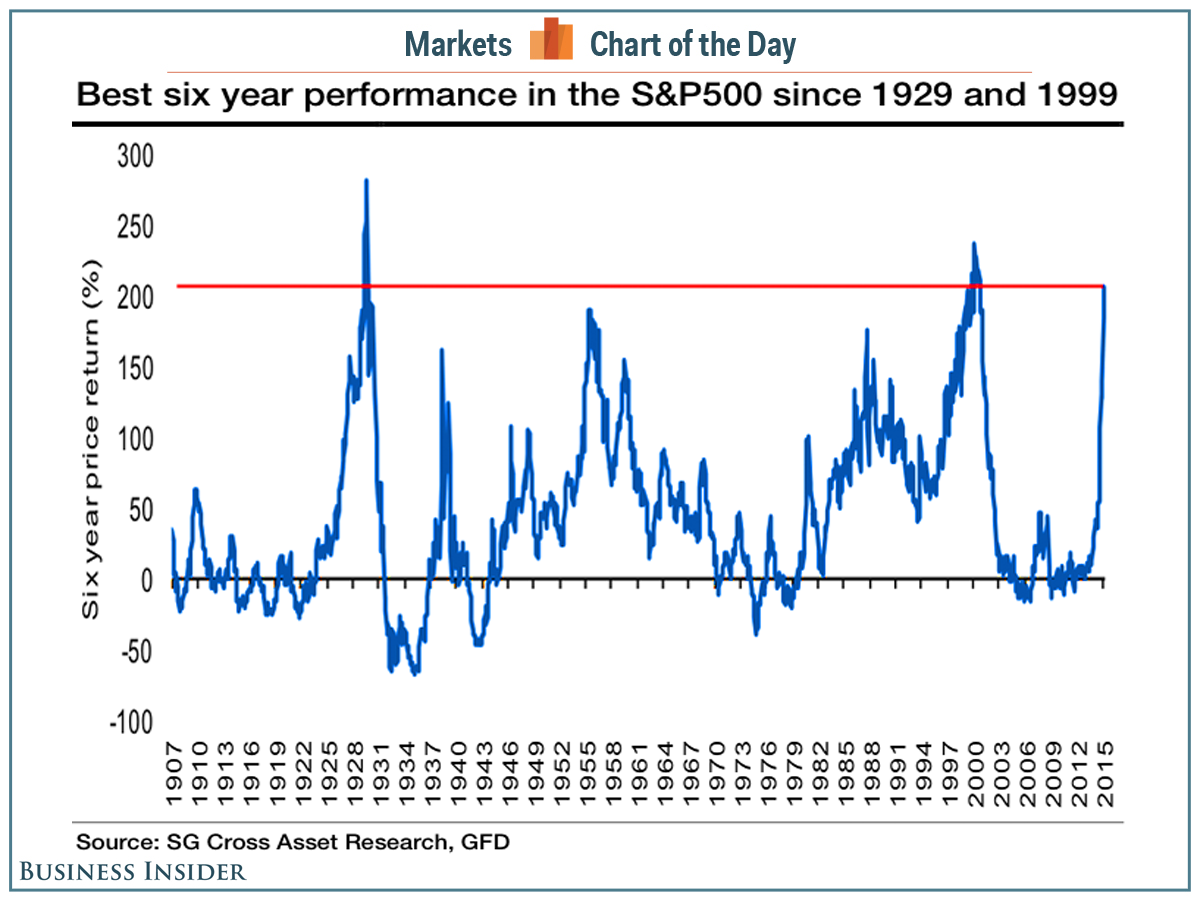

The stock market has gone up this far, this fast only twice since 1900 http://read.bi/1FM2AwQ
“Margin Call from Hell”: Why a Stronger Dollar will Lead to Deflation, Recession and Crisis
“Margin Call from Hell”
Why a Stronger Dollar will Lead to Deflation, Recession and Crisis
By Mike Whitney
“There are no nations…. no peoples…. no Russians.. no Arabs…no third worlds…no West. There is only one holistic system of systems, one vast and immane, interwoven, interacting, multi-variate, multi-national dominion of dollars. Petro-dollars, electro-dollars, multi-dollars, reichmarks, rins, rubles, pounds, and shekels. It is the international system of currency which determines the totality of life on this planet. That is the natural order of things today.”
“There is the risk for a sell-off in emerging market bonds, leading to conditions like in 1997. The multitrillion dollar carry trade may be on the verge of unwinding, meaning capital fleeing the periphery and rushing back to the US. Vast amounts of capital are already leaving some of these countries, and the secondary market for emerging bonds is beginning to dry up. A rise in US interest rates would only put oil on the fire.
http://smirkingchimp.com/thread/mike-whitney/61381/margin-call-from-hell-why-a-stronger-dollar-will-lead-to-deflation-recession-and-crisis
A strong dollar is NOT good for the economy, job creation, raising incomes, and — most importantly — America’s debt.
October always seems to be a bad month. And this go-round has been particularly troublesome because of all the uproar globally.
The market as a whole is wildly uncertain as to what that means and what impact it will have on global bond and equity markets when the Fed is out of the bond-manipulation business. Investors are trying to front-run a future that they expect will not be good for stocks, commodities, gold or currencies other than the dollar.
As emotion takes the reins, market volatility races higher …
Wall Street has grown fearful and anxious in regards to Yellen and her Fed these days. Investors haven’t a clue what the Fed is really up to … because the Fed itself seems a bit clueless in its directions and commentary. And the Street reflexively understands that the Fed has itself in a nasty pickle:
Why a Stronger Dollar will Lead to Deflation, Recession and Crisis
By Mike Whitney
“There are no nations…. no peoples…. no Russians.. no Arabs…no third worlds…no West. There is only one holistic system of systems, one vast and immane, interwoven, interacting, multi-variate, multi-national dominion of dollars. Petro-dollars, electro-dollars, multi-dollars, reichmarks, rins, rubles, pounds, and shekels. It is the international system of currency which determines the totality of life on this planet. That is the natural order of things today.”
– Arthur Jensen’s speech from Network, a 1976 American satirical film written by Paddy Chayefsky and directed by Sidney Lumet
March 14, 2015 “ICH” – “Counterpunch” – The crisis that began seven
years ago with easy lending and subprime mortgages, has entered its
final phase, a currency war between the world’s leading economies each
employing the same accommodative monetary policies that have intensified
market volatility, increased deflationary pressures, and set the stage
for another tumultuous crack-up. The rising dollar, which has soared to a
twelve year high against the euro, has sent US stock indices plunging
as investors expect leaner corporate earnings, tighter credit, and
weaker exports in the year ahead. The stronger buck is also wreaking
havoc on emerging markets that are on the hook for $5.7 trillion in
dollar-backed liabilities. While most of this debt is held by the
private sector in the form of corporate bonds, the stronger dollar means
that debt servicing will increase, defaults will spike, and capital
flight will accelerate. Author’s Michele Brand and Remy Herrera summed
it up in a recent article on Counterpunch titled “Dollar Imperialism,
2015 edition”. Here’s an excerpt from the article:“There is the risk for a sell-off in emerging market bonds, leading to conditions like in 1997. The multitrillion dollar carry trade may be on the verge of unwinding, meaning capital fleeing the periphery and rushing back to the US. Vast amounts of capital are already leaving some of these countries, and the secondary market for emerging bonds is beginning to dry up. A rise in US interest rates would only put oil on the fire.
http://smirkingchimp.com/thread/mike-whitney/61381/margin-call-from-hell-why-a-stronger-dollar-will-lead-to-deflation-recession-and-crisis
A strong dollar is NOT good for the economy, job creation, raising incomes, and — most importantly — America’s debt.
October always seems to be a bad month. And this go-round has been particularly troublesome because of all the uproar globally.
We have Ebola in America freaking out the natives (not to mention investors).
We have the sanctions in Europe and Russia undermining the European
economies. And we have double trouble in the oil markets: the Saudis are
manipulating the price to run high-cost American and Canadian producers
out of the market, while at the same time a robust dollar is reducing
oil demand globally.
And at the pinnacle of this pyramid of problems sits our Federal Reserve.
This month, it has promised, it will end its Quantitative Easing (QE)
campaign and begin moving toward normalized interest rates.The market as a whole is wildly uncertain as to what that means and what impact it will have on global bond and equity markets when the Fed is out of the bond-manipulation business. Investors are trying to front-run a future that they expect will not be good for stocks, commodities, gold or currencies other than the dollar.
As emotion takes the reins, market volatility races higher …
Wall Street has grown fearful and anxious in regards to Yellen and her Fed these days. Investors haven’t a clue what the Fed is really up to … because the Fed itself seems a bit clueless in its directions and commentary. And the Street reflexively understands that the Fed has itself in a nasty pickle:
- The Fed has said it will begin raising interest rates, possibly within six months of ending the QE program, which would imply spring … yet the euro zone is pushing rates down in Europe. That means interest rates on the dollar and the euro will be moving in opposite directions … which means money coming out of the euro and into the dollar, resulting in a stronger dollar. That’s not good, because …
- The Fed needs a stronger economy to create jobs and, the Fed hopes, inflation that then flows through to higher personal incomes that have been on the decline for the better part of a decade. Yet a stronger dollar works to undermine that need, since a strong dollar curtails export activity, thereby slowing the U.S. economy. Meanwhile …
- The Fed has to balance higher rates with America’s horrific levels of debt. As rates rise, so do interest payments on our debt … which either impacts Congress’ ability to fund the various programs it needs to fund, or it requires America to borrow even more money to cover the higher interest payments, throwing us into the early stages of a deadly debt vortex.
Fed governors, thus, are walking a tightrope as
thin as floss, and investors are expressing their panic by fleeing all
assets but the dollar.
http://thesovereigninvestor.com/economic-collapse-2/global-economy-anticipates-fed-next-move/?utm_content=buffer54da1&utm_medium=social&utm_source=twitter.com&utm_campaign=bufferNomi Prins – People Don’t Have Any Money, When Artificial Debt Buying Stops Things Will Apart
So, is anything in
the financial sector actually fixed? Former top Wall Street banker Nomi
Prins contends, “We have many trillions of dollars and government policy
trying to basically cover up the holes in the entire financial system
that could create another Lehman or multiple Lehmans. So, we have a
white wash or a hole in the wall that’s been plastered over many, many,
many times. The hole is still there. The danger is still there. The
co-dependency is still there. The leverage is still there. . . .It all
look like there has been this cosmetic shift supporting these banking
institutions rather than supporting, from the bottom up, the economies
of these countries. That has the effect of creating deterioration in any
of the assets that these banks are still financing. . . . “Buying
securities does not help people get jobs. It does not help industries to
continue to innovate. It does absolutely nothing for spreading a
foundation of solid economics throughout the population. All it does is
make banks look better and cover these holes. Even with all that, holes
continue to pop up and be visible, and that indicates a much larger
problem. . . . People don’t have money. Even if the headline
unemployment looks good, the reality is the jobs being created do not
pay well. So, people don’t have any money.”
In closing, Prins paints a grim picture by saying, “When there is no
artificial external buyer for debt, that’s when things will fall apart.”Join Greg Hunter as he goes One-on-One with Nomi Prins, best-selling author of “All the Presidents’ Bankers.”
http://usawatchdog.com/when-artificia…
The World’s Largest Derivative Holder…Just Failed the Stress Test
The US Federal Reserve has slammed the
breaks on the German bank’s plans to raise dividends and buy back
shares. The central bank says its US operations are too weak to survive
another major economic crisis.
Fed tells Deutsche Bank US to reduce risk
The US divisions of Germany’s biggest bank failed a crucial stress test on Wednesday after the Federal Reserve in Washington deemed its financial foundation too weak to withstand a crisis like the one that threatened to crash the global economy in 2008.
The Fed faulted the capital plans of some 12 to 14 percent of Deutsche Bank’s US operations, saying they showed “numerous and significant deficiencies.”
For the second year in a row, the central bank also vetoed the US plans of Spain’s largest bank, Santander, pointing to “widespread and critical deficiencies” with regard to governance, planning for risks and other areas.
Santander and Deutsche Bank have $118 billion (111.1 billion euros) and $55 billion in assets in the US respectively.
Deutsche Bank offensive
For Deutsche Bank, it was the first US stress test since the Fed launched its review in 2009.
Reacting to the Fed’s objections, a Deutsche Bank spokeswoman in New York said the company had already recruited 500 employees and launched an investment offensive to the tune of 1 billion euros ($1.06 billion) meant to improve the shortcomings.
The Elephant In The Room: Deutsche Bank’s $75 Trillion In Derivatives Is 20 Times Greater Than German GDP
It is perhaps supremely ironic that the last time we did an in depth analysis of Deutsche Bank’s financial situation was precisely a year ago, when the largest bank in Europe (and according to some, the world), stunned its investors with a 10% equity dilution. Why the capital raise if everything was as peachy as the ECB promised it had been? It turned out, nothing was peachy, and in fact DB would proceed to undergo a massive balance sheet deleveraging campaign over the next year, in which it would quietly dispose of all the ugly stuff on its balance sheet during the relentless Fed and BOJ-inspired “dash for trash” rally in a way not to spook investors about everything else that may be beneath the Deutsche covers.
We note this because moments ago, Deutsche Bank did the same again when it announced that it would issue yet another €1.5 billion in Tier 1 capital.
http://www.zerohedge.com/news/2014-04-28/elephant-room-deutsche-banks-75-trillion-derivatives-20-times-greater-german-gdp
Jim Willie: Swiss De-peg Triggers Massive Derivative Crisis, Potential END OF THE EURO!
Big Banks and Derivatives: Why Another Financial Crisis Is Inevitable
http://www.forbes.com/sites/stevedenning/2013/01/08/five-years-after-the-financial-meltdown-the-water-is-still-full-of-big-sharks/Derivatives contributed to the Economic Crisis
http://www.wapublicbankproject.org/index.php?option=com_content&view=article&id=50&Itemid=60
uncle
Most currencies are taking a drubbing against the almighty Fed-might-tighten U.S. dollar
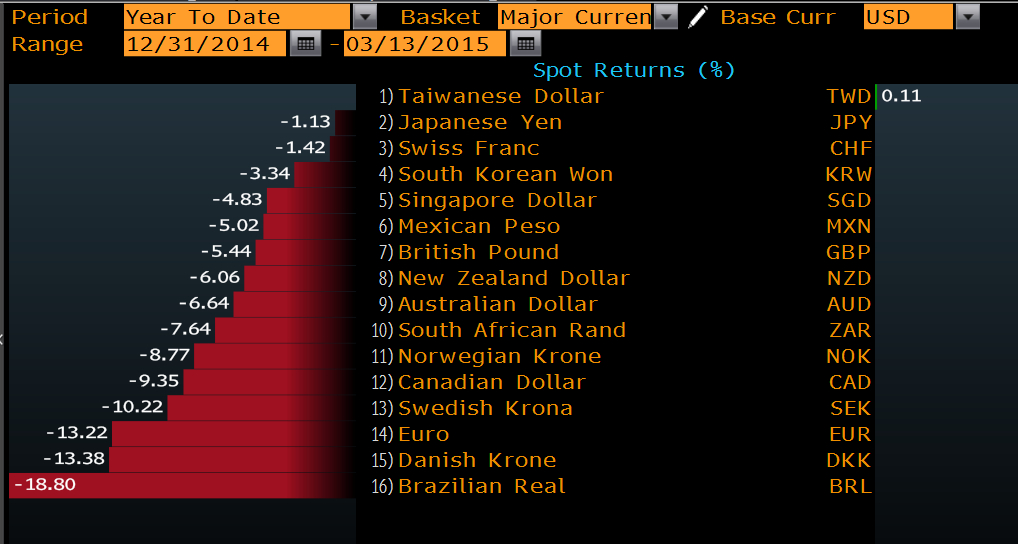

Most currencies are taking a drubbing against the almighty Fed-might-tighten U.S. dollar http://bloom.bg/1Be5Yw1
What do the Malawian kwacha, the Somali shilling, the Seychelles rupee, and the Costa Rican colon have in common?
They are the only currencies in the world that are more than 1 percent higher against the U.S. dollar so far this year.
http://www.bloomberg.com/news/articles/2015-03-13/how-a-bunch-of-different-currencies-are-doing-against-the-dollar-this-year
Subscribe to:
Posts (Atom)