Sunday, May 18, 2014

World Economy : Fastfood Chains shift from Low Wage Workers to Robot Workers (May 16, 2014)

News Articles:Panera Bread Will Replace Cashiers With Robots By 2016
http://dailycaller.com/2014/05/14/pan… 
Fight for $15 an hour is winning in Seattle
http://www.cnn.com/2014/05/13/opinion… 
Coming To A Fast Food Restaurant Near You: Machines That Won’t Be Paying SEIU Dues
http://www.redstate.com/2013/12/08/co… 
Meet “Smart Restaurant”: The Minimum-Wage-Crushing, Burger-Flipping Robot
http://www.zerohedge.com/news/2014-01… 
The Shift From Low-Wage Worker to Robot Worker
http://fivethirtyeight.com/features/y…

Study Confirms US Is Ruled by Rich, Corporate News Ignores It

Steve Rendall  
American democracy is no longer very democratic, according to a new university study (4/9/14; Perspectives on Politics, Fall/14). Instead, it’s dominated by moneyed elites in a process where public opinion has little to no impact on policy. Released a month ago by Princeton’s Martin Gilens and Northwestern’s Benjamin I. Page, the study concludes:
Economic elites and organized groups representing business interests have substantial independent impacts on US government policy, while average citizens and mass-based interest groups have little or no independent influence.
The political scientists looked at more than 1,700 policies over 20 years to find out how public opinion translates into policy, and concluded that where economic elite views diverged from those of the public, the public had “zero estimated impact upon policy change, while economic elites are still estimated to have a very large, positive, independent impact.”
Bracing news? The study went viral in social media, but has hardly shown up in the US corporate press. A month after its release there have been no network news mentions, nor has it appeared in the most influential newspapers–the New York TimesWashington Post and Los Angeles Times. (The New York Times4/21/14 and the Washington Post, 4/8/14 published blog posts on the study.)
The Baltimore Sun (5/12/14) was a rare exception with an op-ed calling for public financing of campaigns to counter the influence of wealth. “Rather than curl up in a fetal position and cede the fate of our democracy to those with the fattest bank accounts,” Kate Planco Waybright and Jennifer Bevan-Dangel wrote in a response to the study, “our organizations are taking action. We believe public financing of elections has enormous potential to transform our democracy and to help ordinary Americans regain our voices in the political sphere.”
There are likely several reasons why corporate media have ignored the study, chief among them that its findings hit too close to home: The same well-heeled elites and their representatives who dominate US politics and policy are also the owners of US corporate media.
In one study after another, FAIR has shown how corporate media discount popular views and the opinions of the less powerful in favor of elite viewpoints. Pro-business think tanks are favored over those viewed as less than business friendly; and corporate sources in news stories are far more numerous than those who might be seen as their counterweights– representatives of labor unions, consumer and environmental groups. FAIR studies have repeatedly shown how the subject of poverty is slighted in news coverage, including a study to be published next month (Extra!, 6/14) that finds coverage of the poor nearly nonexistent, and news sources who are affected by poverty even scarcer. Indeed, according to the study, America‘s 482 billionaires received many times as much coverage as America‘s 50 million poor.
Not that you need a study to demonstrate the media’s corporate deference–not when major media figures will come right out and tell you. As when NBC’s Meet the Press anchor David Gregory (11/11/12) faulted Barack Obama for not cozying up more to CEOs, telling an approving Jim Cramer of CNBC:
Jim, I always thought that one of the big mistakes of the first Obama term is that he never had a moment in the Rose Garden where he was flanked by the biggest business leaders in America and said, “Look, we’re going to work together in common cause to deal with this economy, to deal with our fiscal position, and ultimately affect America‘s influence in the rest of the world.” Can he have that moment now?
In fact, Obama did have a moment precisely like that, appearing with several CEOs at a press conference on January 28, 2009, shortly after his inauguration. It’s hard to imagine a Democratic president who has tried harder to make corporate interests his own.
Similarly, when former CNBC host Maria Bartiromo was launching her new Fox News show, she told the media industry website MediaBistro (3/18/14) how her new business would be different–corporations would finally get a chance to tell their side of the story:
Maria BartiromoThere’s a void in the market. We never hear business people as part of the conversation on a Sunday. I only hear politicos doing their talking points. I want to get the guy on the front line, the gal on the front line, telling us why they’re not taking money from overseas and putting it here, what should tax reform look like, what should immigration reform look like. So I’m going to bring business people into the conversation on a Sunday morning.
The only mention of the study on cable news channels came on MSNBC’s All In With Chris Hayes (4/16/14), where the host cited gun legislation requiring a background check before one could purchase a firearm, that had as high as 90 percent public backing, but was voted down in a congress swimming in gun lobby money. Hayes concluded, “In fact, it sounds like the textbook definition of oligarchy, of government by the few.” The wealthy few.
Steve Rendall writes for FAIR.

Du Pont heir convicted of raping daughter spared prison


(CNN) -- Though Robert H. Richards IV was convicted of rape, the wealthy heir to the du Pont family fortune was spared prison by a Delaware court in 2009 because he would "not fare well" behind bars, according to court documents CNN obtained Tuesday.
Richards is a great-grandson of the chemical magnate Irenee du Pont.
He received an eight-year prison sentence in 2009 for raping his toddler daughter, but the sentencing order signed by a Delaware judge said "defendant will not fare well" in prison and the eight years were suspended.
Richards was placed on eight years' probation and ordered to get treatment and register as a sex offender, the documents show. He was also prohibited from having contact with children under 16, including his own children.
The documents were never sealed, yet the ruling managed to go unnoticed until March, when Richards' former wife, Tracy Richards, filed a lawsuit in Delaware Superior Court on behalf of their children alleging "personal injuries arising from the childhood sexual abuse." The 11-page suit alleges that not only was their daughter abused, but Richards abused their son, too. The suit seeks unspecified monetary damages.
While he was convicted of raping his daughter, Richards has never been charged with sexually molesting his son, according to Jason Miller, a spokesman for the Delaware attorney general's office.
CNN tried repeatedly to reach Richards and Eugene Maurer, the attorney who represented him in 2009. Maurer is no longer representing Richards, his assistant told CNN on Wednesday. CNN asked if he had a comment; he has not offered one.
Attorney John C. Balaguer is representing Richards in the civil case, his assistant told CNN. Balaguer has not returned e-mails or voice mail messages CNN has left for him.
This week, after news of Richards' 2009 case came to light, many took to Twitter to criticize the judge in the case, saying that it echoed a recent Texas case in which a wealthy teenager driving drunk killed four people but received no jail time. Ethan Couch was sentenced last year to 10 years' probation.
A witness in Couch's case claimed the teenager was a victim of "affluenza" -- the product of wealthy, privileged parents who never set limits for the boy.
Delaware's Judicial Code of Conduct prohibits Judge Jan R. Jurden from discussing the 2009 ruling with reporters, court spokeswoman Amy Quinlan told CNN.
But at least one member of the Delaware legal community came to Jurden's defense Tuesday.
"It's wrong to attribute (the 'defendant would not fare well' comment) to Judge Jurden," said Richard Kirk, a lawyer who is chairman of a Delaware State Bar Association committee that he says steps up to respond "when judges are criticized and unable to speak for themselves."
Kirk says the argument that Richards would not do well in prison could have been the recommendation of probation or parole officers. However, he said, "common sense suggests that it came from defense counsel."
As for the prosecutor's side, the attorney general's spokesman gave CNN a written statement.
"Cases of child sexual abuse are extremely complicated and difficult," it read. The objective is to "secure justice in every case to the best of its ability given the unique facts and circumstances presented in each case -- sometimes that results in a resolution that is less than what prosecutors would want," the statement read.
"In this particular case, the facts and circumstances made it unlikely that a conviction could be secured at trial. ...This resolution protected the victim and imposed conditions that would make it less likely the defendant could harm others."

Bilderberg's silent takeover of Britain’s $60bn defense budget


A British Lynx 2 helicopter.(AFP Photo)


Democracy had another near-fatal stroke, and the military industrial complex further tightened UK defense spending with the appointment of ex-army officer and Tory hothead Rory Stewart MP as the new chairman of Westminster’s Defence Select Committee.
Last week the Home Affairs Select Committee delivered a damning verdict on Britain's defense and secret service oversight, on taxpayer accountability. It said the refusal of the director general of MI5, Andrew Parker, to appear before them and lack of any effective supervision was "undermining the credibility of the intelligence agencies and parliament itself."
Surely nothing could surpass the ‘Dodgy Dossier', the criminal conspiracy that led to the US and Britain, as the Arab League put it in 2003, to 'Opening the Gates of Hell in Iraq'? But with Stuart's appointment to oversee public scrutiny of UK military spending just two weeks before NATO's political cabal of which he's a member, the Bilderberg conference, meets in Copenhagen later this month, it is clear to those who still have eyes to see that those bloody lessons have not been learned and the worse could be yet to come.

The most powerful private club in the world

In their Christmas 1987 edition, The Economist described Bilderberg as ‘Ne Plus Ultra’ the most powerful private club in the world. Its power has certainly not diminished as the decades have rolled by and neither has its secrecy. Although it began with trades unionists and powerful people it wanted to persuade, in its final days Bilderberg has boiled down to a rotten core of bankers, royalty, arms industry, oil and media barons and Rory Stuart MP, in the tradition of Kissinger, Blair, Cameron, Osborne and Balls, has thrown his lot in with them.
In 1943, half way through the war, the US power elite saw that, barring any big surprises, Hitler was going to lose World War Two, so their ‘War And Peace Studies Group’ of the Council On Foreign Relations (CFR) quietly began to prepare the Marshall Plan for the post-war world. Alongside the Office of Strategic Services (OSS), a sizable budget was set aside to fund a range of activities which would ensure Europeans didn't vote communist and were welded economically, culturally and politically to the US for the foreseeable future.
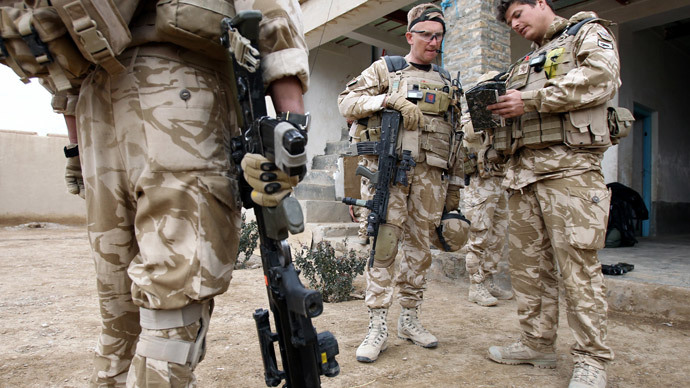
British soldier Lieutenant-Colonel Nick Lock (C) checks his equipment before conducting a patrol with soldiers of the 1st Batallion of the Royal Welsh in streets of Showal in Nad-e-Ali district, Southern Afghanistan, in Helmand Province.(AFP Photo / Thomas Coex )

Born in a Nazi ‘witches cauldron’ of British blood

Bilderberg's first chairman, Prince Bernhard of the Netherlands, was born into the German aristocracy. He joined the Nazi party at university, then the SS but he married into the Dutch royal family, dropping the silver deaths-head and black SS uniform before the war. His newly adopted Holland was invaded by his old Nazi friends in 1941, so he fled to Britain with Dutch Queen Wilhelmina and his wife, Princess Juliana.
As a former SS officer he was scrutinized by the Admiralty's wartime spymaster, Ian Fleming who, after a year of watching Bernhard, signed him to the British army as a trusted Dutch liaison officer.
With 1944 came one of Bernhard’s most important jobs: to supervise the Dutch underground in the run-up to September's liberation of large parts of Holland. Field Marshall Montgomery’s audacious airborne operation, the biggest in history, depicted in Cornelius Ryan’s 1977 film A Bridge Too Far, was codenamed 'Market Garden' and intended to end the war by Christmas.
As liaison officer for the coming Arnhem deliverance, Bernhard sent in Dutch spy, Christiaan Lindemans, codename 'King Kong', ten days beforehand to prepare resistance fighters for the allies lunge through Eindhoven, Nijmegen and over the Rhein into Arnhem.
But instead of making contact with the Dutch underground, Bernhard’s 'King Kong' found some German soldiers and demanded to be taken straight to the Abwehr, German military intelligence. The allies’ plans for the airborne assault were in enemy hands because Bernhard’s precious Lindemans was a double agent. He had wrecked the allies’ all-important element of surprise.
‘King Kong’ was arrested and quizzed after the war by the British but never got a chance to tell his story because, under Dutch orders, he was whisked off to Germany and died in suspicious circumstances.
Operation Market Garden went ahead on Sunday September 17, 1944, but the British paratroopers at Arnhem were quickly split and surrounded by forces containing self-propelled guns, tanks and crack SS troops, who happened to be resting nearby. Frost's 2nd battalion held on to the bridge leaving the rest of the 1st Airborne Division surrounded in what the Nazis called the Hexenkessel or 'witches cauldron', pinned down in the suburb of Oosterbeek.
On Wednesday 20 September, 1944, as British airborne Colonel John Frost’s remaining paratroopers were being mauled by SS Panzers at Arnhem Bridge, the tanks of the Grenadier Guards, along with US paratroopers, were tantalizingly close, destroying the last German defenses down the road in Nijmegen. Ironically, it was a young captain, who was also to chair the Bilderberg meetings in later life, Lord Peter Carrington, who was leading the Grenadier battle group of Sherman tanks as they took the penultimate bridge. At 8 o'clock that evening, he was just a 20-minute drive from reinforcing Frost at the Arnhem Bridge, and victory.
But although they still had eight hours or so before Arnhem Bridge would finally fall into German hands, Carrington’s force, along with the Irish guards, of a hundred or so tanks inexplicably stopped, just over the Nijmegen Bridge in the village of Lent, for an eighteen hour rest. After the war, 10 SS Panzer Division General Heinz Harmel mocked Carrington saying, “The British tanks made a mistake when they stayed in Lent. If they had carried on it would have been all over for us.”
'Colonel Frost later put the blame,' as Stuart Hills reports in 'By Tank To Normandy', 'firmly on the lack of drive by Guards Armoured,' of which Carrington's Grenadiers were the spearhead. 'Comparing their relatively light casualties with those suffered by the British 1st Airborne and US 82nd. Forty years later,' in 1984, 'he stood on the bridge at a reunion, shook his fist and roared a question into the air for the guards. 'Do you call that fighting!'
So Bilderberg’s first 1954 venue in Oosterbeek, Holland, was highly significant, being the same spot where a decade before the British army had suffered nearly 10,000 casualties in of one of the last Nazi bloodbaths of World War II. Bernhard had given the game away and when it looked like, despite his treachery, the brave allied soldiers might pull it off, Carrington and his corps of tanks ground to a halt for an eighteen hour tea break.

AFP Photo / Dan Chung

Psychos always return to the scene of the crime

Like the psychopath, who feels compelled to return to the scene of the crime, Prince Bernhard returned to Oosterbeek to chair the inaugural Bilderberg meeting in 1954. The conferences led to the signing of the Treaty of Rome, which started the European Economic Community (EEC) three years later.
Surrounded by the great and good of the post war world, the prince hoped nobody would examine his reasons for choosing Oosterbeek. At the best it was an in-joke – at the worst the battle was thrown. Whatever way you look at it sixty years on, the coded message from that first Bilderberg meeting should be clear to us now. Ten years after the war, the Nazis were back.

The seventy year Bilderberg project is almost complete

So seventy years since the Arnhem slaughter and sixty years since the first Bilderberg conference, the EEC has become the EU. NATO's new feudal oligarchy of Western banksters and multinationals own and control all the big political parties as well as almost everything that moves both sides of the Atlantic.
Some saw it coming: former SS general Paul Hausser, who became chief of HIAG, the German SS veterans group after the war, claimed that "the foreign units of the SS were really the precursors of the NATO army." Others detailed the Nazis' transformation from military to financial empire including former CBS News correspondent Paul Manning in his 1981 book 'Martin Bormann Nazi in Exile'.
Bilderberg’s latest wheeze is the Transatlantic Trade and Investment Partnership (TTIP). This treaty makes voting pointless by letting multinationals sue governments and will leave only the thinnest veneer of democracy for the mainstream media to chew on both in Europe and America. The ‘nation states’ will become mere prefectures and the European Commission will be the unelected government of the United States of Europe.
As ordinary people across Europe and America cry out for decent basic standards such as fresh water, food, shelter, healthcare, heating and full employment, the mainstream media barely hear them because this is not the Bilderberg way. Instead, these pinstriped fascists bury us in debt, steal our leisure time, erode quality time with children, friends and family, and then blame us for demanding a fair share of the rewards of human progress.
The statements, views and opinions expressed in this column are solely those of the author and do not necessarily represent those of RT.

Deutsche Bank leaves Vegas & Yves Smith on PE Real Estate Tricks

Our lead story: Deutsche Bank is finally able to leave Las Vegas! That’s because before their fear became loathing, and they found a buyer for their always-in-the-red Cosmopolitan Hotel in Las Vegas, Nevada. Erin takes a look.Then, Erin sits down with financial blogger powerhouse Yves Smith of Naked Capitalism to talk about private equity and their rental shenanigans. They talk about why PE firms have gotten into the real estate market and the problems created by their actions. What are these PE firms trying to do and do they create jobs? Smith breaks it down.Then to round out the week Edward Harrison and Erin check in on their Accrued Interest. Keep the comments coming!

'Never Trust the Govt!' - Vivienne Westwood on Fracking, Banks, Austerity

Afshin Rattansi talks fracking, debt-based money and austerity with punk pioneer and activist Vivienne Westwood.


Corporate lawyer jumps to his death from 22nd-floor Central Park West apartment: cops

tephen Hertz, 55, jumped the apartment Friday around 9:20 p.m. and landed in a nearby tree.

NEW YORK DAILY NEWS

Stephen Hertz jumped to his death from his Central Park West apartment, cops said Saturday.
Google  
Stephen Hertz jumped to his death from his Central Park West apartment, cops said Saturday.

A high-powered corporate lawyer jumped to his death from his luxury Manhattan apartment overlooking Central Park, police said Saturday.
Stephen Hertz jumped from his home on the 22nd floor of the highrise on Central Park West near 105th St. about 9:20 p.m. Friday, cops said, landing in a tree.
Emergency responders had to cut down branches to get to his mangled body, a police source said.
Hertz, 55, was a partner in Midtown lawfirm Debevoise & Plimpton, where he specialized in venture capitalism and mergers and acquisitions.