Did
you know that the U.S. state that produces the most vegetables is
going through the worst drought it has ever experienced and that the
size of the total U.S. cattle herd is now the smallest that it has
been since 1951? Just the other day, a CBS News article boldly
declared that “food
prices soar as incomes stand still“, but the truth is that this
is only just the beginning. If the drought that has been
devastating farmers and ranchers out west continues, we are going to
see prices for meat, fruits and vegetables soar into the
stratosphere. Already, the federal government has
declared portions
of 11 states to be “disaster areas”, and California
farmers are going to leave half a million acres sitting idle this
year because of the extremely dry conditions. Sadly, experts
are telling us that things are probably going to get worse before
they get better (if they ever do). As you will read about
below, one expert recently told National Geographic that throughout
history it has been quite common for that region of North America to
experience severe droughts that last for
decades.
In fact, one drought actually lasted for about 200 years. So
there is thepossibility that
the drought that has begun in the state of California may not
end during
your entire lifetime.
This drought has gotten so bad that it is
starting to get national attention. Barack Obama visited the
Fresno region on Friday, and he declared that “this is going to be
a very challenging situation this year, and frankly, the trend lines
are such where it’s going to be a challenging situation for some
time to come.”
According
to NBC
News, businesses across the region are shutting down, large
numbers of workers are leaving to search for other work, and things
are already so bad that it “calls
to mind the Dust Bowl of the 1930s“…
In the state’s Central Valley — where
nearly 40 percent of all jobs are tied to agriculture production and
related processing — the pain has already trickled down. Businesses
across a wide swath of the region have shuttered, casting countless
workers adrift in a downturn that calls to mind the Dust Bowl of the
1930s.
If
you will recall, there
have been warnings that Dust Bowl conditions were going to
return to the western half of the country for quite some time.
Now the mainstream media is finally starting to
catch up.
And of course these extremely dry conditions
are going to severely affect food prices. The following are 15
reasons why your food bill is going to start soaring…
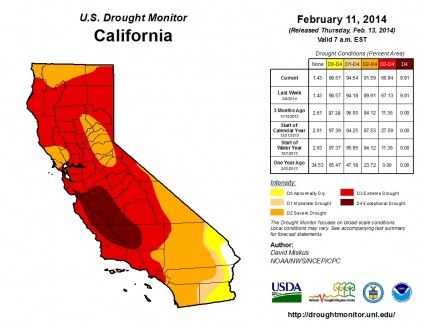
#2 According
to the U.S. Drought Monitor, 91.6 percent of the entire state of
California is experiencing “severe
to exceptional drought” even as you read this article.
#3 According
to CNBC,
it is being projected that California farmers are going to let half
a million acres of farmland sit idle this
year because of the crippling drought.
Given that California is one of the largest
agricultural regions in the world, the effects of any drought, never
mind one that could last for centuries, are huge. About 80 percent of
California’s freshwater supply is used for agriculture. The cost of
fruits and vegetables could soar, says Cantu. “There will be
cataclysmic impacts.”
#5 Mike
Wade, the executive director of the California Farm Water
Coalition, recently
explained which crops he believes will be hit the hardest…
Hardest hit would be such annual row crops as
tomatoes, broccoli, lettuce, cantaloupes, garlic, peppers and corn.
Wade said consumers can also expect higher prices and reduced
selection at grocery stores, particularly for products such as
almonds, raisins, walnuts and olives.
#6 As
I discussed in a previous
article, the rest of the nation is extremely dependent on the
fruits and vegetables grown in California. Just consider the
following statistics regarding what percentage of our
produce is grown in the state…
-99
percent of
the artichokes
-44
percent of
asparagus
-two-thirds of
carrots
-half of
bell peppers
-89
percent of
cauliflower
-94
percent of
broccoli
-95
percent of
celery
-90
percent of
the leaf lettuce
-83
percent of
Romaine lettuce
-83
percent of
fresh spinach
-a
third of
the fresh tomatoes
-86
percent of
lemons
-90
percent of
avocados
-84
percent of
peaches
-88
percent of
fresh strawberries
-97
percent of
fresh plums
#7 Of
course it isn’t just agriculture which will be affected by this
drought. Just consider this chilling
statement by Tim Quinn, the executive director of the
Association of California Water Agencies…
“There
are places in California that if we don’t do something about it,
tens of thousands of people could turn on their water faucets
and nothing
would come out.”
#8 The
Sierra Nevada snowpack is only about 15 percent of what it normally
is. As the
New York Times recently explained, this is going to be
absolutely devastating for Californians when the warmer months
arrive…
Experts
offer dire warnings. The current drought has already eclipsed
previous water crises, like the one in 1977, which a meteorologist
friend, translating into language we understand as historians,
likened to the “Great Depression” of droughts. Most Californians
depend on the Sierra Nevada for their water supply, but
the snowpack there
was just 15 percent of normal in early February.
#9 The
underground aquifers that so many California farmers depend upon are
being drained at
a staggering rate…
Pumping from aquifers is so intense that the
ground in parts of the valley is sinking about a foot a year. Once
aquifers compress, they can never fill with water again. It’s no
surprise Tom Willey wakes every morning with a lump in his throat.
When we ask which farmers will survive the summer, he responds quite
simply: those who dig the deepest and pump the hardest.
#10 According
to an expert interviewed by National Geographic, the current drought
in the state of California could potentially last for
200 years or more as
some mega-droughts in the region have done in the past…
California
is experiencing its worst drought since record-keeping began in the
mid 19th century, and scientists say this may be just the
beginning. B.
Lynn Ingram, a paleoclimatologist at the University of California
at Berkeley, thinks that California needs to brace itself for a
megadrought—one
that could last for 200 years or more.
#11 Much
of the western U.S. has been exceedingly dry for an extended period
of time, and this is hurting huge
numbers of farmers and ranchers all the way from Texas to
the west coast…
The western United States has been in a drought
that has been building for more than a decade, according to
climatologist Bill Patzert of NASA’s Jet Propulsion Laboratory.
“Ranchers in the West are selling off their
livestock,” Patzert said. “Farmers all over the Southwest, from
Texas to Oregon, are fallowing in their fields because of a lack of
water. For farmers and ranchers, this is a painful drought.”
#12 The
size of the U.S. cattle herd has been shrinking for seven years in a
row, and it is now the smallest that it has been since
1951. But our population has more than doubled since then.
#13 Extremely
unusual weather patterns are playing havoc with crops all over the
planet right now. The following is an excerpt from a recent
articleby
Lizzie Bennett…
Peru,
Venezuela, and Bolivia have experienced rainfall heavy
enough to flood fields and rot crops where they stand. Volcanic
eruptions in Ecuador are
also creating problems due to cattle ingesting ash with their feed
leading to a slow and painful death.
Parts
of Australia have been in drought for years affecting cattle
and agricultural production.
Large parts
of the UK are underwater, and much of that water is sea water which
is poisoning the soil. So wet is the UK that groundwater is so high
it is actually coming out of the ground and adding to the water from
rivers and the sea. With the official assessment being that
groundwater flooding will
continue until MAY, and that’s if it doesn’t rain again
between now and then. The River Thames is 65
feet higher than
normal in some areas, flooding town after town as it heads to the
sea.
While the government says prices are up 6.4
percent since 2011, chicken is up 18.4 percent, ground beef is up
16.8 percent and bacon has skyrocketed up 22.8 percent, making it a
holiday when it’s on sale.
#15 As
I have written about previously, median household income has
fallen for five years in a row. So average Americans are
going to have to make their food budgets stretch more than they ever
have before as this drought drags on.
If the drought does continue to get worse,
small agricultural towns all over California are going to die off.
The farms in and around Mendota are dying of
thirst. The signs are everywhere. Orchards with trees lying on their
sides, as if shot. Former farm fields given over to tumbleweeds. Land
and cattle for sale, cheap.
Large
numbers of agricultural workers continue to hang on, hoping that
somehow there will be enough work for them. But as Evelyn
Nievesrecently
observed, panic is starting to set in…
Off-season, by mid-February, idled workers are
clearly anxious. Farmworkers and everyone else who waits out the
winter for work (truckers, diesel providers, packing suppliers and
the like) are nearing the end of the savings they squirrel away
during the season. The season starts again in March, April at the
latest, but no one knows who will get work when the season begins, or
how much.
People are scared, panicked even.
I did not write this article so that you would
panic.
Yes, incredibly hard times are coming. If
you will recall, the 1930s were also a time when the United States
experienced extraordinarily dry weather conditions and a tremendous
amount of financial turmoil. We could very well be entering a
similar time period.
Worrying about this drought is not going to
change anything. Instead of worrying, we should all be doing
what we can to store some things up while food is still relatively
cheap. Our grandparents and our great-grandparents that lived
during the days of the Great Depression knew the wisdom of having a
well-stocked food pantry, and it would be wise to follow their
examples.
Please
share this article with as many people as you can. The United
States has never faced anything like this during most of our
lifetimes. We need to shake people out of their “normalcy
bias” and get them to understand that big changes are coming.