Saturday, June 22, 2013

How Wall Street Fraudsters Plunder Public Finances, And 5 Ways to Fight Back

Editor’s note: This article is part of an ongoing AlterNet series, “The Age of Fraud,edited by Lynn Stuart Parramore.
Say your town needs a new bridge. It might turn to Wall Street to come up with strategies to finance the project. This is supposed to be a win-win arrangement, but in the lucrative municipal finance business, one side has turned out to be the big loser. Guess which?
Nearly five years after Wall Street’s shady activities triggered massive funding crises for cities, states, and municipalities, the $3.7 trillion municipal finance cesspool has yet to be dredged.  Banks continue to profit from their bad — or even fraudulent — advice that cost billions of dollars of taxpayer money. Meanwhile, the rest of us must tighten our belts, or pay higher taxes, or see services slide.
Let’s take a look at how bankers cooked up scams to drain the public coffers and why they continue to get away with it.
How your community became Wall Street prey
Many municipalities invested in flawed “structured finance” deals on the advice of bankers who said these complex transactions would give them a better deal than simpler, traditional products. So trusting public finance officials lined up to follow their advice — only to be told later that advice was not to be relied upon.
Tellingly, few (if any) corporations used similar structures to meet their funding needs. Nor did the banks themselves. Unfortunately, these products didn’t work as advertised, and public funding costs exploded as a result.
The financial structures bankers inflicted on the public are not easy to understand, but please try and stick with us: Banks rely on this complexity to obscure just how badly cities and states that followed their advice were hosed.
One common structure combined three key pieces: variable rate demand bonds (VRDBs), letters of credit and interest rate swaps. Municipal treasurers were looking to achieve the equivalent of a fixed rate financing— think of a 30-year mortgage—at lower than the market rate. And they signed on the dotted line in record numbers for these deals, with issuances of these complex bonds peaking in 2008.
Bankers realized that many professional investors — such as money market fund managers — cannot hold long-term debt, and instead prefer investments that can be dumped quickly when market conditions change. So bankers created VRDBs, which were “putable”— allowing buyers to get their money back, in most cases, every week, if they chose. Bankers thought these bonds, which in effect came with a money-back guarantee, would appeal to money market fund investors. At first, they did.
Alas, there’s no such thing as a free lunch. A bond that can be returned, with no penalty charges, every week doesn’t sound at all like the long-term infrastructure financing the city or state wanted. So banks promised municipal clients that if investors wanted to return bonds, the bank would find another buyer. Sounds like it might work out okay, right?
But what would happen if no one wanted to buy these returned bonds? To avoid leaving its municipal client and investors in a lurch, the bank created a guarantee, a letter of credit, that would provide alternative financing. Think of this letter of credit as insurance that would allow the city or state to continue to pay its bills if the market for its bonds dried up, while providing assurance to bond investors that the bond could be redeemed on demand.
The final piece of the structured contraption was a complex derivative, an interest rate swap. It was supposed to convert the weekly variable interest rate on the bonds to a fixed interest rate. This was another form of insurance that was meant to protect the public authority if interest rates went up.
This article originally appeared on: AlterNet

Detroit officials find $286 million to subsidize new sports arena

Detroit’s Downtown Development Authority (DDA) has approved a $650 million plan that will allow Mike Ilitch to build a new sports and entertainment district just north of downtown Detroit. Nearly half of the cost will be covered by public funds.
The announcement comes just two days after Emergency Manager Kevyn Orr said the public coffers are empty when it comes paying the pensions and healthcare benefits owed to city workers. Orr has threatened to pay as little as 10 cents on every dollar owed to pension funds and force retired workers to get health care through the federal Medicare program or President Obama’s cut-rate medical exchanges.
A more callous slap in the face could not be imagined for pensioners and other city residents facing the gutting of essential services and the selling off of city parks, zoos and art museums. There is supposedly no money for the needs of the city’s working class population, but several hundred million can easily be found to subsidize a new arena for a billionaire sports franchise owner. The project has been sanctioned by Orr, who has final say over how the city’s finances are managed.
The area north of downtown Detroit slated to become the "entertainment district"
The new arena—for Ilitch’s Red Wings hockey team—will be 650,000 square feet and house 18,000 spectators—few enough, comments the Free Press, to make the tickets more expensive than average. Other nearby development will include a hotel and 265,000 square feet of new or renovated office, retail and residential space.
The city will contribute 44 percent of the funds for the new stadium, or around $286 million. The rest will be financed by private sources, including Mike Ilitch.
The stadium will be built in a 45-block “entertainment district” a few streets away from the Henry Street apartments, where hundreds of low-income residents are facing eviction by the end of the month. Although the new owner of the apartment complex has been kept secret, residents all along speculated that Ilitch was behind their evictions. Many of those being thrown out have lived in the apartments for decades.
Simultaneously, residents at the Griswold, a nearby apartment tower housing mostly retirees, also face eviction come next March. This is in keeping with the stated goal of the city planners: the entire area is to be gentrified, with low income tenants being pushed out to make way for rarified lofts and office spaces.
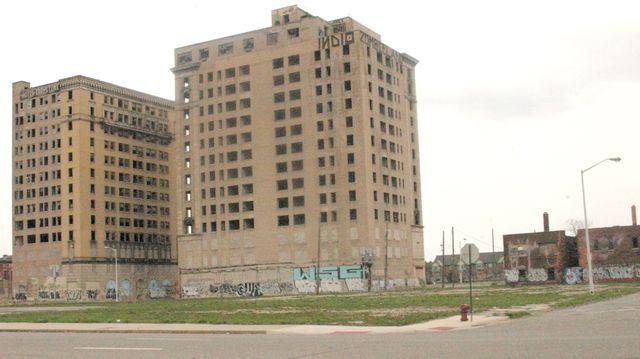
The stadium district is intended to be the centerpiece of the new upscale “Arena District,” which spans the gap between midtown and downtown. Currently, the impoverished area is a stark reminder of the devastation wrought on Detroit by big business. The new development will encompass “office, retail and residential” space.
In addition to Ilitch, the founder of mortgage lender Quicken Loans, billionaire Dan Gilbert, has been a primary advocate of the plans to remake Detroit’s downtown. Gilbert has bought up more than 30 buildings around the city at low prices. He stands to make a fortune on rising property values in the downtown. Ilitch has also begun buying properties in downtown Detroit and is rumored to have been the buyer of the Griswold building.
The construction of the stadium is a part of a policy by the city government to “revitalize” Detroit. This means, in practice, clearing downtown and midtown of poorer residents by raising the land value—and thus the rents—and making an enclave of wealth at the center of America’s poorest big city. The office workers who labor in the new downtown, of course, will have to pay the inflated rents. To this end, the Detroit Free Press cites the “successful redevelopment” of the David Broderick Tower, which rents penthouse suites for $5,100 a month.
Current rents in the downtown area are around $1.25 per square foot, and the developers’ goal is to raise this number to at least $2.00.
The gentrification of Detroit is not intended to improve the city as a whole, nor will it. It is a part of the broader attack on the living conditions of working people. As “undesirables” are shooed away from the city center, Orr and other city officials are shutting down whole areas of the city deemed too poor to invest in and forcing residents to abandon neighborhoods by cutting off street lights, closing schools and ending fire protection.
As usual, the arena is being justified to the people of Detroit with the claim that it will create thousands of jobs. Taking the city’s generous figure of 8,300 new jobs at face value, this is cold comfort to Detroit’s residents. The same was said for the city casinos built more than a decade ago. Low wage service jobs are poor replacement for the dismembered auto industry, and the incoming white-collar workers at Quicken Loans and other downtown companies will be highly exploited and gouged by the city’s new billionaire landlords.

Student Loan Proposal Would Avert Deadline, But Raise Borrowing Costs, Boosting Government Profit


WASHINGTON -- Student borrowers and their families would pay more to finance college under a proposal pushed by a bipartisan group of senators, increasing the federal government’s profits despite warnings over record student debt levels.
The proposal comes as the federal government has been recording mounting profit off the backs of students and their families, raising questions about the lawmakers’ claims to help students afford higher education. The Department of Education has booked nearly $120 billion in profit over the last five fiscal years thanks to record spreads between what it costs the government to borrow and what the government charges students and their families.
The proposal by Sens. Angus King (I-Maine), Joe Manchin (D-W.Va.), Tom Coburn (R-Okla.) and Richard Burr (R-N.C.) would tie student loan interest rates to the government’s cost to borrow for 10 years -- the 10-year Treasury notes. Beginning sometime in 2016 or 2017, according to projections by the nonpartisan Congressional Budget Office, the proposal as currently drafted would raise the cost to borrow for most households, compared with loans under existing law.
Lawmakers and the White House have been trying to forge an agreement resetting student loan interest rates in part because they anticipate a political backlash on July 1, when the rate on a small subset of new loans available to some undergraduates is set to double to 6.8 percent. The deadline is largely artificial, as the vast majority of students begin taking out loans in August and September.
The bipartisan Senate plan, according to a draft obtained by the Huffington Post, would put the annual rate for undergraduate Stafford loans at 2 percentage points above the yield on the 10-year Treasury note. Stafford loans for graduate students would be set at 3.5 percentage points above the 10-year Treasury. PLUS loans -- used by graduate students who exhaust Stafford limits and by parents of undergraduates who need additional funds to finance ever-expensive college tuition -- would be set at 4.5 percentage points above 10-year notes.
The yield on the 10-year note closed Thursday at 2.41 percent. Most Stafford loans now carry interest rates of 6.8 percent. PLUS loans are set at 7.9 percent.
The draft legislation would make loans cheaper for student loan borrowers for roughly three years, according to the Congressional Budget Office forecast. It would be more expensive for students and their families thereafter as the economy improves and interest rates rise. The yield on the 10-year Treasury is forecast to average 4.1 percent in the 2016 fiscal year before rising to 4.9 percent in the 2017 fiscal year. Yields will then increase to 5.2 percent, according to CBO forecasts.

The CBO estimated in a June 10 report that the government would generate $184 billion in profit for loans made from this fiscal year to 2023, not including $15 billion in profit the government booked this year from loans made in previous years.
If the Senate compromise proposal becomes law, it would increase the federal government’s profit over the next decade by an additional $8 billion, congressional aides said the CBO has projected.
Crystal Canney, a spokeswoman for King, said: “Nothing has been finalized. There is still a great deal of negotiating underway. Our goal is to get the best deal for students as possible and avoid the doubling of rates now scheduled for July 1st.”
Representatives for Manchin and Coburn did not respond to requests for comment.
The scheduled July 1 interest rate hike would affect about one-quarter of new federal student loan dollars. The doubled rates would cost affected borrowers, who come from middle- and lower-income households, about $1,000 more over the average 12-year life of each loan.
Representatives of top Democratic lawmakers said the proposal had little chance of becoming law. Senior White House officials met with lawmakers on Thursday in hopes of striking a deal.
Reaction from student advocates was swift and unsparing. Groups have been mobilizing to prevent rates for some borrowers from doubling, and at the same time have been trying to reform the government’s student loan program and reduce overall borrowing costs.
“Congress must preserve its historical commitment to protecting students from outrageous interest rates now and in the future,” Sen. Tom Harkin, chairman of the chamber’s education committee, said through a spokeswoman.
“This plan serves up nothing but leftovers,” said Christine Lindstrom, higher education program director for U.S. Public Interest Research Group student chapters. “It increases costs to students above and beyond what they would pay on July 1 if the rate doubles.”
Lindstrom added: “We can't accept any deal as serious unless it delivers lower costs to borrowers than what they would pay if nothing happens and the rate doubles on July 1. And this plan fails to deliver."
The proposal comes as the Obama administration is forecast to generate a record $51 billion profit this year from student loan borrowers, a sum greater than the earnings of the nation's most profitable companies and roughly equal to the combined net income of the four largest U.S. banks by assets.
The CBO estimate places the government’s profit above that of Exxon Mobil Corp., the nation's most profitable company, which reported about $45 billion in net income last year. JPMorgan Chase, Bank of America, Citigroup and Wells Fargo reported a combined $52 billion in profit last year.
Congress sets interest rates on federal student loans. But the rates have not kept pace with the significant decline in borrowing costs that have occurred since the onset of the financial crisis.
Compared with a benchmark interest rate -- the yield on the 10-year Treasury note -- student borrowers have never paid more for loans, increasing the burden of their student debt as wage increases and yields on investments and bank accounts fail to keep up with the relative increase in student loan interest payments.
At $1.1 trillion, student debt eclipses all other forms of household debt, except for home mortgages, according to federal regulators. It's the only kind of consumer debt that has increased since the onset of the financial crisis, according to the Federal Reserve Bank of New York.
Washington policymakers increasingly have focused on soaring student debt levels and the record relative interest rates that borrowers pay as a potential impediment to economic growth. Regulators and officials at agencies that include the Federal Reserve, Treasury Department, Consumer Financial Protection Bureau and New York Fed have warned that student borrowing may dampen consumption, depress the economy, limit credit creation or pose a threat to financial stability.
Officials have said they are worried that overly indebted student borrowers are unable to save enough to purchase a home, take out loans for new cars, start a business or save for retirement.
Last month, President Barack Obama noted that the average new college graduate carries more than $26,000 in student debt.
“That doesn’t just hold back our young graduates. It holds back our entire middle class,” Obama said. Student loan payments “can last for years, even decades, which means young people are putting off buying their first car or their first house -- the things that grow our economy and create new jobs.”
The outline of the bipartisan deal comes after weeks of partisan fist-waving over the scheduled doubling of rates.
The standoff escalated Thursday, when House Speaker John Boehner (R-Ohio) sent a letter to Obama chastising Senate Democrats for putting student loan rates at risk. The House passed a Republican measure that also is forecast to increase students’ borrowing costs in a few years.
"Frankly, there is no evidence that Democrats are making a sincere effort to get a bill passed in the Senate," Boehner wrote. "With Republicans and you in general agreement on the policy, it is difficult to identify any motivation other than politics to explain why a solution has not already been signed into law."
The White House also proposes to tie student loan interest rates to the yield on the 10-year Treasury note. But under Obama’s plan, the difference between student loan rates and the yield on the 10-year Treasury is far less than in the bipartisan Senate proposal or in the House Republicans' bill.
House Minority Leader Nancy Pelosi (D-Calif.), flanked by college students, said Thursday that House Democrats would place blame squarely on Republicans for allowing rates on some student loans to rise.
Critics said House leaders' political grandstanding showed they have little appetite for resolution.

Greek leftists quit coalition government after public media shutdown

Dimar (Democratic Left) party leader Fotis Kouvelis leaves the Greek prime minister's office late June 20, 2013 (AFP)
 
  • 4


Greece’s moderate Democratic Left party will withdraw from the coalition government, one of the party’s ministers confirmed on Friday after a week-long crisis sparked by the shock closure of the country’s state broadcaster.
“Following the party’s decision to withdraw from the government and withdraw its ministers I will table my resignation to the prime minister,” outgoing administrative reform minister Antonis Manitakis told reporters.

Time To Pay For Messing With The Markets?

Can you smell that?  It is the smell of panic in the air.  As I have noted before, when financial markets catch up to economic reality they tend to do so very rapidly.  Normally we don’t see virtually all asset classes get slammed at the same time, but the bucket of cold water that Federal Reserve Chairman Ben Bernanke threw on global financial markets on Wednesday has set off an epic temper tantrum.  On Thursday, U.S. stocks (NYSEARCA:SPY), European stocks (NYSEARCA:VGK), Asian stocks, gold (NYSEARCA:IAU), silver (NYSEARCA:SLV) and government bonds all over the planet all got absolutely shredded.  This is not normal market activity.  Unfortunately, there is nothing “normal” about our financial markets anymore.  Over the past several years they have been grossly twisted and distorted by the Federal Reserve and by the other major central banks around the globe.  Did the central bankers really believe that there wouldn’t be a great price to pay for messing with the markets?  The behavior that we have been watching this week is the kind of behavior that one would expect at the beginning of a financial panic.  Dick Bove, the vice president of equity research at Rafferty Capital Markets, told CNBC that what we are witnessing right now “is not normal. It is not normal for all markets to move in the same direction at the same point in time due to the same development.”  The overriding emotion in the financial world right now is fear.  And fear can cause investors to do some crazy things.  So will global financial markets continue to drop, or will things stabilize for now?  That is a very good question.  But even if there is a respite for a while, it will only be temporary.  More carnage is coming at some point.
What we have witnessed this week very much has the feeling of a turning point.  The euphoria that drove the Dow Jones Industrial Average (INDEXDJX:.DJI) well over the 15,000 mark is now gone, and investors all over the planet are going into crisis mode.  The following is a summary of the damage that was done on Thursday…
-U.S. stocks had their worst day of the year by a good margin.  The Dow fell 354 points, and that was the biggest one day drop that we have seen since November 2011.  Overall, the Dow has lost more than 550 points over the past two days.

-Thursday was the eighth trading day in a row that we have seen a triple digit move in the Dow either up or down.  That is the longest such streak since October 2011.
-The yield on 10 year U.S. Treasuries went as high as 2.47% before settling back to 2.42%.  That was a level that we have not seen since August 2011, and the 10 year yield is now a full point above the all-time low of 1.4% that we saw back in July 2012.
- The yield on 30 year U.S. Treasuries hit 3.53 percent on Thursday.  That was the first time it had been that high since September 2011.
-The CBOE Volatility Index (NYSEARCA:VXX) jumped 28 percent on Thursday.  It hit 20.49, and this was the first time in 2013 that it has risen above 20.  When volatility rises, that means that the markets are getting stressed.
-European stocks got slammed too.  The Bloomberg Europe 500 index fell more than 3 percent on Thursday.  It was the worst day for European stocks (NYSEARCA:VGK)  in 20 months.
-In London, the FTSE fell about 3 percent.  In Germany(NYSEARCA:EWG), the DAX fell 3.3 percent.  In France, the CAC-40 fell 3.7 percent.
-Things continue to get even worse in Japan (NYSEARCA:EWJ).  The Nikkei has fallen close to 17 percent over the past month.
-Brazilian stocks (NYSEARCA:EWZ) have fallen by about 15 percent over the past month.
-On Thursday the price of gold (NYSEARCA:GLD) got absolutely hammered.  Gold was down nearly $100 an ounce.  As I am writing this, it is trading at $1273.60.
-Silver (NYSEARCA:SLV) got slammed even more than gold did.  It fell more than 8 percent.  At the moment it is trading at $19.57.  That is ridiculously low.  I have a feeling that anyone that gets into silver now is going to be extremely happy in the long-term if they are able to handle the wild fluctuations in the short-term.
-Manufacturing activity in China (NYSEARCA:FXI) is contracting at a rate that we haven’t seen since the middle of the last recession.
-For the week ending June 15th, initial claims for unemployment benefits in the United States rose by about 18,000 from the previous week to 354,000.  This is a number that investors are going to be watching closely in the months ahead.
Needless to say, Thursday was the type of day that investors don’t see too often.  The following is what one stock trader told CNBC
“It’s freaking, crazy now,” said one stock trader during the 3 p.m. ET hour as the Dow sunk more than 350 points. “Even defensive sectors are getting smoked. The super broad-based sell off between commodities, bonds, equities – I wouldn’t say it’s panic, but we’ve seen aggressive selling on the lows.”
Unfortunately, this may just be the beginning.
In fact, Mark J. Grant has suggested that we may see even more panic in the short-term…
Yesterday was the first day of the reversal. There will be more days to come.
What you are seeing, in the first instance, is leverage coming off the table. With short term interest rates right off of Kelvin’s absolute Zero there was been massive leverage utilized in both the bond and equity markets. While it cannot be quantified I can tell you, dealing with so many institutional investors, that the amount of leverage on the books is giant and is now going to get covered. It will not be pretty and it will be a rush through the exit doors as the fire alarm has been pulled by the Fed and the alarms are ringing. There is also an additional problem here.
The Street is not what it was. There is not enough liquidity in the major Wall Street banks, any longer, to deal with the amount of securities that will be thrown at them and I expect the down cycle to get exacerbated by this very real issue. Bernanke is no longer at the gate and the Barbarians are going to be out in force.
If we see global interest rates start to shift in a major way, that is going to be huge.
Why?
Well, it is because there are literally hundreds of trillions of dollars worth of interest rate derivatives contracts sitting out there…
The interest rate derivatives market is the largest derivatives market in the world. The Bank for International Settlements estimates that the notional amount outstanding in June 2009 were US$437 trillion for OTC interest rate contracts, and US$342 trillion for OTC interest rate swaps. According to the International Swaps and Derivatives Association, 80% of the world’s top 500 companies as of April 2003 used interest rate derivatives to control their cashflows. This compares with 75% for foreign exchange options, 25% for commodity options and 10% for stock options.
If interest rates begin to swing wildly, that could burst the derivatives bubble that I keep talking about.
And when that house of cards starts falling, we are going to see panic that is going to absolutely dwarf anything that we have seen this week.
So keep watching interest rates, and keep listening for any mention of a problem with “derivatives” in the mainstream media.
When the next great financial crash comes, global credit markets are going to freeze up just like they did in 2008.  That will cause economic activity to grind to a standstill and a period of deflation will be upon us.  Yes, the way that the Federal Reserve and the federal government respond to such a crisis will ultimately cause tremendous inflation, but as I have written about before, deflation will come first.
It would be wise to build up your emergency fund while you still can.  When the next great financial crisis fully erupts a lot of people are going to lose their jobs and for a while it will seem like hardly anyone has any extra money.  If you have stashed some cash away, you will be in better shape than most people.
This article is brought to you courtesy of Michael Snyder from The Economic Collapse Blog.

The Terror Con: How Keeping Americans Terrified Is Making Corporations Big Bucks

The name of the game is threat inflation.
 

For defense contractors, the government officials who write them mega checks, and the hawks in the media who cheer them on, the name of the game is threat inflation. And no one has been better at it than the folks at Booz Allen Hamilton, the inventors of the new boondoggle called cyber warfare.
That’s the company, under contract with the National Security Agency, that employed whistle-blower Edward Snowden, the information security engineer whose revelation of Booz Allen’s enormously profitable and pervasive spying on Americans now threatens the firm’s profitability and that of its parent hedge fund, the Carlyle Group.
Booz Allen, whose top personnel served in key positions at the NSA and vice versa after the inconvenient collapse of the Cold War, has been attempting to substitute terrorist for communist as the enemy of choice. A difficult switch indeed for the military-industrial complex about which Dwight Eisenhower, the general-turned-president, had so eloquently warned us. 
But just when the good times for war profiteers seemed to be forever in the past, there came 9/11 and the terrorist enemy, the gift that keeps on giving, for acts of terror always will occur in a less than perfect world, serving as an ideal excuse for squandering resources, as well as our freedoms.
Just ask New York Times columnists Thomas Friedman and Bill Keller. Rising to the defense of NSA snooping on a scale never before imagined in human history, they warn us that if there was a second 9/11-type attack, we would lose all of our civil liberties, so we should be grateful for this trade-off.
“I believe that if there is one more 9/11—or worse, an attack involving nuclear material—it could lead to the end of the open society as we know it,” Friedman wrote in his June 11 column. 
No nation in history has ever possessed such an imbalance of military superiority and the ability to ward off foreign threats without sacrificing its core values. Never has this country been as vulnerable to foreign attacks as when the founders approved our Constitution with its Fourth Amendment and other protections of individual sovereignty against an intrusive government. They did so out of the conviction that individual freedom makes us stronger rather than weaker as a nation. In short, they trusted in the essential wisdom of the people as opposed to the pundits who deride it.
Defending Friedman’s column, Keller wrote  Sunday:
“Tom’s important point was that the gravest threat to our civil liberties is not the NSA but another 9/11-scale catastrophe that could leave a panicky public willing to ratchet up the security state, even beyond the war-on-terror excesses that followed the last big attack.”
So it’s the panicky public’s fault and not the ill-informed work of establishment journalists like Friedman, who led the charge to war with Iraq based on phony claims about terrorism.
Once again, Friedman has a misplaced faith in the work of the intelligence community. The NSA snooping was quite extensive before 9/11 and certainly in full force prior to the Boston Marathon attack, but did not prevent either event. Indeed, our much-vaunted spy agencies still have not come up with an explanation of how 19 hijackers, 15 from our ally Saudi Arabia, managed to legally enter this country and learn flying skills while under our government’s watch.
Nor have those intelligence agencies explained why the only three countries that recognized the Taliban government sponsors of al-Qaida were that same Saudi Arabia as well as our other friends in Pakistan and the United Arab Emirates. For information on the UAE connection, the NSA might check with its buddies at Booz Allen Hamilton. 

Pages

Every Asset That Depends On Cheap, Abundant Credit (Housing, Bonds, Stocks) Is Doomed

by Charles Hugh-Smith of OfTwoMinds blog,
Four words: financialization, debtocracy, diminishing returns.
About a month ago I asked What If Stocks, Bonds and Housing All Go Down Together? (May 24, 2013). Why would such an outrageous thought even occur to me?
Four words: financialization, debtocracy, diminishing returns. The entire global economy, developed and developing nations alike, is now dependent on cheap, abundant credit for everything: for “growth,” for asset inflation, and ultimately for central state deficit spending, which props up all the cartels, rentier arrangements, fiefdoms and armies of toadies, lackeys, apparatchiks and embezzlers that suck off the Status Quo.
I have long endeavored to explain the harsh reality of neofeudal, neocolonial financialization: Neofeudalism and the Neocolonial-Financialization Model (May 24, 2012) and the neofeudal debtocracy that depends on low yields (interest rates) to enable enormous deficit spending: Why Krugman and the Keynesians Are Lackeys for the Neofeudal Debtocracy (April 24, 2013).
The wheels fall off the entire financialized debtocracy wagon once yields rise.There’s nothing mysterious about this:
1. As interest rates/yields rise, all the existing bonds paying next to nothing plummet in market value
2. As mortgage rates rise, there’s nobody left who can afford Housing Bubble 2.0 prices, so home prices fall off a cliff
3. Once you can get 5+% yield on cash again, few people are willing to risk capital in the equities markets in the hopes that they can earn more than 5% yield before the next crash wipes out 40% of their equity
4. As asset classes decline, lenders are wary of loaning money against these assets; if the collateral for the loan (real estate, bonds, stocks, etc.) are in a waterfall decline, no sane lender will risk capital on a bet that the collateral will be sufficient to cover losses should the borrower default.
Let’s take a look at four charts about housing and household net worth. For the middle class, the home remains the key asset, so housing and household net worth are correlated.
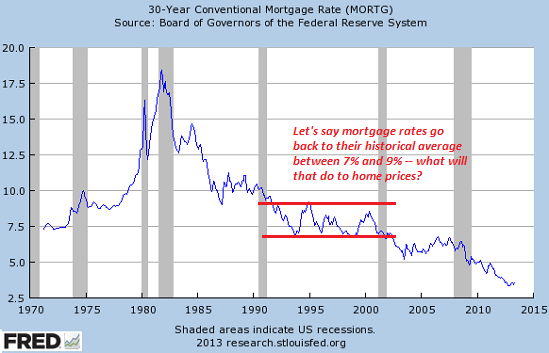
Here is a chart of mortgage rates since 1970. Rates were pushed to 17+% to snuff inflation in the early 1980s, and they’ve dropped over the past 30 years to historic lows: the rate for a fixed-rate 30-year conventional mortgage was about 3.5% a few weeks ago. It has now risen above 4%.

In the golden age of growth from 1991 to 2002, mortgages rates bounced between about 7% and 9%. The band from 1970 to 1979 was about 7.5% to 10%.
In other words, in eras of strong growth and low inflation, mortgage rates have been around 7% to 9%. So what happens to the monthly payments when the mortgage rate doubles from 4% to 8%? The payments double, too. And what happens to the price of houses when rates double? They fall to the point that households borrowing money at 7.5% – 8% can afford to buy a house, i.e. a price much lower than today’s Housing Bubble 2.0 prices.
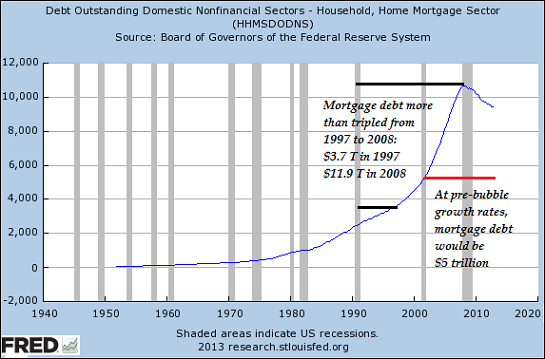
Here’s mortgage debt. If mortgage debt had expanded at the previous rate, total debt would be closer to $5 trillion instead of $10 trillion.
You see what happens when debt becomes cheap and abundant: debt rises faster than wages or assets.
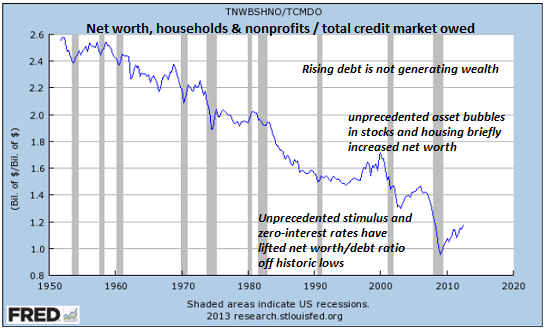
But hasn’t household wealth increased mightily in the past decades? Here is a chart that plots the relationship of household net worth and total credit owed, i.e. debt:
Household wealth may be rising, but what this chart reveals is debt is rising even faster–that’s why the line is declining. Put another way, every dollar of new debt is generating less and less wealth.
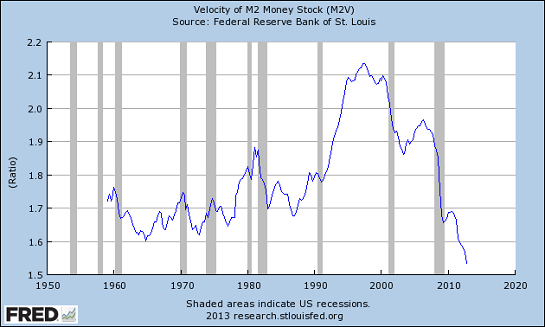
You might think that The Federal Reserve’s policy of making credit cheap and abundant would goose people to consume and invest more money. Alas, the velocity of money is hitting historic lows: the Fed may be creating credit but people and enterprises aren’t putting that money into circulation.
It’s called diminishing returns: every dollar of debt creates interest payments, but it’s no longer doing households or enterprises any good. The Fatal Disease of the Status Quo: Diminishing Returns (May 1, 2013).
That’s why all asset classes that depend on cheap, abundant credit are doomed: once yields/rates rise, the valuations of those assets implode. And once valuations implode, there’s not enough collateral left to support the loans used buy all those cheap-credit-inflated assets. So the financial system also implodes.