Thursday, May 30, 2013

Senate Republicans Want to Destroy the Consumer Financial Protection Bureau (CFPB) Elizabeth Warren Created

MARK KARLIN, EDITOR OF BUZZFLASH AT TRUTHOUT
cordrayThe Senate Republcans are trying to defang Elizabeth Warren's Consumer Financial Protecton Bureau by not officially appointing Richard Cordray as head of the agency.Count the ways that the GOP in Congress is still trying to destroy the Consumer Financial Protection Bureau (CFPB). There are so many that you would need a calculator.
Start with the holding up through a -- you got it – yet another "threatened" filibuster of the appointment of Richard Cordray as official head of the agency.  Currently, he is only in the position as a recess appointment.  This limits his power, term and implementation of the full consumer protection law that was enacted as part of the Dodd-Frank legislation, which the Republicans loathe, as weak as it is.
According to the Washington Post's Mike Konczl, the GOP is using its never-ending intimidation aimed at Harry Reid that they will hold up the Senate's business to block Cordray's official appointment unless, in essence, the agency s gutted through amendatory legislation.  Reid, in what now is a tired toothless threat, says that he may end the non-filibuster/filibuster by reducing a closure vote to merely needing a majority and not 60 votes.
But Reid has threatened this for years.  His dithering on dropping the "nuclear bomb" of actually making a filibuster a filibuster is either due to his agreement with the corporate status quo or he's just a naïve get along to go along wimp.  Some Democrats say changing the filibuster regulation (it is a Senate rule, not a law or constitutional provision) would force the Democrats to lose a leveraging tool if they become the minority in the Senate in 2014 or thereafter. That might make a good argument except the Democrats generally roll over and support Republican bills and federal judicial and executive branch nominees without threatening a filibuster when they are in the minority.
The Republicans play politics like street thugs and the Democrats like jellyfish.
Meanwhile, the consumers are already benefiting from the CFPB, even if in its weakened stake, and from regulation of financial legislation in the Dodd-Frank law, according to the Post:
The CFPB is structured to look like all the other banking regulators. Indeed, it is consciously modeled as a consumer-focused version of the Office of the Comptroller of the Currency (OCC). And as we’ll see, the powers that Republicans are arguing are unprecedented are actually the same powers and structures the other banking regulators have.This isn’t to say the CFPB isn’t a serious banking regulator. It is not a committee set up to go study something and make recommendations or an advisory panel that will disband before doing anything. Already it’s bringing accountability to the financial sector on behalf of consumers: It’s gone after illegal or deceptive practices at American Express, Discover, and Capital One and is bringing extensive new regulations to the housing market. It is, as they say, a big deal, and it is now the law of the land.
However, the law of the land also requires it to have an executive to be fully operational. As the Congressional Research Service summarized, “Until a CFPB Director is appointed, [Dodd-Frank] provides the Secretary the authority to exercise some, but not all of the Bureau’s authorities.“With the Senate stonewalling, President Obama recess-appointed Cordray. The constitutionality of this action was brought into question when the U.S. Court of Appeals in Washington, D.C. rejected a recess appointment to the National Labor Relations Board made at the same time.
So until Cordray (who is a ringer for the fictional NBC page -- Kenneth Parcell -- on "30 Rock," by the way) is confirmed by the Senate, the right of consumers to be protected from predatory financial institutions and banks hangs by a thread. All because 43 GOP Senators -- who represent roughly only about a third of the US population because they are mostly from states with relatively small numbers of voters -- have signed a letter opposing not just Cordray (remember Obama dumped Elizabeth Warren who designed the agency due to GOP opposition), but any Obama nominee to head the agency, according to the Post:
The senators state, “We will continue to oppose the consideration of any nominee, regardless of party affiliation, to be the CFPB director until key structural changes [are made.]”
Is it time to protect consumers by majority rule.  A "take no prisoners" Republican caucus is defying two-thirds of the US population, a majority by anyone's standards, by merely scaring Harry Reid for the umpteenth time with a filibuster that never occurs because Reid won't call their bluff.
Consumer protection is an All-American issue.  What consumer wants to be screwed over financially?  Why the Democrats don't take the ball and ram it to the goal post may be more a testament to the power of corporate and financial institutions over Congress than to Reid's craven capitulation.
(Photo: Wikipedia)

Basel III: How The Bank For International Settlements Is Going To Help Bring Down The Global Economy

Michael Snyder
Economic Collapse

A new set of regulations that most people have never even heard of that was developed by an immensely powerful central banking organization that most people do not even know exists is going to have a dramatic effect on the global financial system over the next several years.  The new set of regulations is known as “Basel III”, and it was developed by the Bank for International Settlements.  The Bank for International Settlements has been called “the central bank for central banks”, and it is headquartered in Basel, Switzerland.  58 major central banks (including the Federal Reserve) belong to the Bank for International Settlements, and the decisions made in Basel often have more of an impact on the direction of the global economy than anything the president of the United States or the U.S. Congress are doing.  All you have to do is to look back at the last financial crisis to see an example of this.  Basel II and Basel 2.5 played a major role in precipitating the subprime mortgage meltdown.  Now a new set of regulations known as “Basel III” are being rolled out.  The implementation of these new regulations is beginning this year, and they will be completely phased in by 2019.  These new regulations dramatically increase capital requirements and significantly restrict the use of leverage.  Those certainly sound like good goals, the problem is that the entire global financial system is based on credit at this point, and these new regulations are going to substantially reduce the flow of credit.  The only way that the giant debt bubble that we are all living in can continue to persist is if it continues to expand.  By restricting the flow of credit, these new regulations threaten to burst the debt bubble and bring down the entire global economy.
Not that the current global financial system is sustainable by any means.  Anyone with half a brain can see that the global financial system is a pyramid scheme that is destined to collapse.  But Basel III may cause it to collapse faster than it might otherwise have.
So precisely what is Basel III?  The following is a definition from the official website of the Bank for International Settlements…
“Basel III” is a comprehensive set of reform measures, developed by the Basel Committee on Banking Supervision, to strengthen the regulation, supervision and risk management of the banking sector. These measures aim to:
  • improve the banking sector’s ability to absorb shocks arising from financial and economic stress, whatever the source
  • improve risk management and governance
  • strengthen banks’ transparency and disclosures.
All of that looks good at first glance.  But when you start looking into the details you start realizing what it is going to mean for the global financial system.  Banks are going to be required to have higher reserve ratios and use less leverage.  Banks are going to have to be more careful with their money, which is a good thing, but it is also going to mean that credit will not flow as freely.  Unfortunately, the only way for a debt bubble to survive is if it keeps expanding.  Anything that restricts the flow of easy money threatens to bring a debt bubble to an end.
These new regulations are going to be phased in between 2013 and 2019.  You can see a chart which shows the implementation schedule for the Basel III regulations right here.
So why is bringing the debt bubble to an end a bad thing?
Well, because it will cause the false prosperity that we have been enjoying to disappear, and that will be an exceedingly painful adjustment.
Sadly, most people have no idea what is happening.  Most people have never even heard of “Basel III” or “the Bank for International Settlements”.  Most people just assume that the people they voted into office know what they are doing and have everything under control.
Unfortunately, that is not the case at all.  The truth is that an unelected, unaccountable body of central bankers is making decisions which deeply affect us all, and there is not much that we can do about it.
This unelected, unaccountable body of central bankers played a major role in bringing about the last financial crisis.  The following is a brief excerpt from a recent article posted on Before It’s News
If you have any questions about the power of these Basel Banking Regulations you can also see the effects that Basel II and 2.5, mark to market accounting, had on the Housing Markets in the United States of America in 2008. There were many causes for that housing bubble, then housing crisis, but Basel II and 2.5 was most assuredly the pin that popped the housing bubble that led to the financial crisis of 2008-09.
But do most people know about this?
Of course not.  Most people want to blame the Republicans or the Democrats or Bush or Obama, and they have no idea about the financial strings that are being pulled at the highest levels.
It is so important that we get people educated about how the global financial system actually works.  The following is a summary of how the Bank for International Settlements works from one of my previous articles entitled “Who Controls The Money? An Unelected, Unaccountable Central Bank Of The World Secretly Does“…
An immensely powerful international organization that most people have never even heard of secretly controls the money supply of the entire globe.  It is called the Bank for International Settlements, and it is the central bank of central banks.  It is located in Basel, Switzerland, but it also has branches in Hong Kong and Mexico City.  It is essentially an unelected, unaccountable central bank of the world that has complete immunity from taxation and from national laws.  Even Wikipedia admits that “it is not accountable to any single national government.“  The Bank for International Settlements was used to launder money for the Nazis during World War II, but these days the main purpose of the BIS is to guide and direct the centrally-planned global financial system.  Today, 58 global central banks belong to the BIS, and it has far more power over how the U.S. economy (or any other economy for that matter) will perform over the course of the next year than any politician does.  Every two months, the central bankers of the world gather in Basel for another “Global Economy Meeting”.  During those meetings, decisions are made which affect every man, woman and child on the planet, and yet none of us have any say in what goes on.  The Bank for International Settlements is an organization that was founded by the global elite and it operates for the benefit of the global elite, and it is intended to be one of the key cornerstones of the emerging one world economic system.
Even though most people have never even heard of the BIS, the truth is that the global elite have had big plans for it for a very long time.  Inanother article I included a quote from a book that Georgetown University history professor Carroll Quigley wrote many years ago entitled “Tragedy & Hope”…

[T]he powers of financial capitalism had another far-reaching aim, nothing less than to create a world system of financial control in private hands able to dominate the political system of each country and the economy of the world as a whole. This system was to be controlled in a feudalist fashion by the central banks of the world acting in concert, by secret agreements arrived at in frequent private meetings and conferences. The apex of the system was to be the Bank for International Settlements in Basle, Switzerland, a private bank owned and controlled by the world’s central banks which were themselves private corporations.
Today we have such a system, and most of the public does not even know that it exists.
And when the next great financial crisis strikes, there will probably be very little ever said about the Bank for International Settlements in the mainstream media.
But right now the BIS is helping set the stage for the great credit crunch that is coming.
Get prepared while you still can, because time is running out.

Why The Next War With China Could Go Very Badly For The United States

Michael Snyder
American Dream
Most Americans assume that the U.S. military is so vastly superior to everyone else that no other nation would ever dream of fighting a full-scale war against us.  Unfortunately, that assumption is dead wrong.  In recent years, the once mammoth technological gap between the U.S. military and the Chinese military has been closing at a frightening pace.  China has been accomplishing this by brazenly stealing our technology and hacking into our computer systems.  The Pentagon and the Obama administration know all about this, but they don’t do anything about it.  Perhaps the fact that China owns about a trillion dollars of our national debt has something to do with that.  In any event, today China has the largest military in the world and the second largest military budget in the world.  They have stolen plans for our most advanced jets, helicopters, ships and missile systems.  It is estimated that stealing our technology has saved China about 25 years of research and development.  In addition, China is rapidly developing a new generation of strategic weapons that could potentially enable it to actually win a future war against the United States.  At one time such a notion would have been unthinkable, but as you will see below, the next war with China could go very badly for the United States.
The Washington Post is reporting on a confidential report that was prepared for the Pentagon, and what this report says about the extent of Chinese cyber espionage is absolutely startling.  Will China know ALL of our secrets at some point?  The following is a brief excerpt from the Washington Post articleabout the theft of our military technology by China.  It turns out that Chinese hackers have gotten their hands on plans for almost all of the new cutting edge weapons systems that we have been developing…
Some of the weapons form the backbone of the Pentagon’s regional missile defense for Asia, Europe and the Persian Gulf. The designs included those for the advanced Patriot missile system, known as PAC-3; an Army system for shooting down ballistic missiles, known as the Terminal High Altitude Area Defense, or THAAD; and the Navy’s Aegis ballistic-missile defense system.
Also identified in the report are vital combat aircraft and ships, including the F/A-18 fighter jet, the V-22 Osprey, the Black Hawk helicopter and the Navy’s new Littoral Combat Ship, which is designed to patrol waters close to shore.
Also on the list is the most expensive weapons system ever built — the F-35 Joint Strike Fighter, which is on track to cost about $1.4 trillion.
One military expert that the Washington Post showed the report to was absolutely stunned…
“That’s staggering,” said Mark Stokes, executive director of the Project 2049 Institute, a think tank that focuses on Asia security issues. “These are all very critical weapons systems, critical to our national security. When I hear this in totality, it’s breathtaking.”
The experts said the cybertheft creates three major problems. First, access to advanced U.S. designs gives China an immediate operational edge that could be exploited in a conflict. Second, it accelerates China’s acquisition of advanced military technology and saves billions in development costs. And third, the U.S. designs can be used to benefit China’s own defense industry. There are long-standing suspicions that China’s theft of designs for the F-35 fighter allowed Beijing to develop its version much faster.
But it isn’t just hackers that the U.S. military needs to be concerned about.
The truth is that the Chinese are stealing secrets from us any way that they can.
For example, the Chinese use attractive young women to seduce our defense contractors.  In fact, as the Washington Times recently reported, one 59-year-old American man was recently charged with passing very sensitive secrets to a 27-year-old Chinese “honeypot” that he was seeing…
A U.S. defense contractor who works in intelligence at the military’s Pacific Command in Hawaii has been charged with passing classified national security information to a 27-year-old Chinese woman he was dating.
Benjamin Pierce Bishop, 59, is accused of sending the woman an email in May with information on Pacom’s war plans, nuclear weapons and U.S. relations with international partners, according to the complaint filed in U.S. District Court in Honolulu and unsealed Monday.
The complaint goes on to allege that Mr. Bishop told the woman over the telephone in September about the deployment of U.S. nuclear weapons and about the ability of the U.S. to detect other nations’ short- and medium-range ballistic missiles.
Another way that China is gaining a strategic advantage over the U.S. is by getting the U.S. military to become increasingly dependent upon them.  According to Forbes, now the U.S. military is even leasing a Chinese satellite for communications purposes…
American dependence on China grows by the day. The latestnews is that the United States has been reduced to leasing a Chinese satellite to handle communications with U.S. military bases in Africa. Surprising, isn’t it? The nation that launched the world’s first communications satellite (I remember it well – it was called Telstar) has so lost its manufacturing mojo that it has to rely on its most formidable military adversary to provide the hardware for some of its most sensitive communications. This at a time when underlying unemployment rates among U.S. manufacturing workers remain at near-depression levels.
Isn’t that crazy?
And a recent Senate report discovered that many of our most advanced weapons systems are absolutely riddled with counterfeit Chinese parts…
A recent Senate report, titled Inquiry Into Counterfeit Electronic Parts In The Department Of Defense Supply Chain, “uncovered overwhelming evidence of large numbers of counterfeit parts making their way into critical defense systems.”
The investigation found 1,800 cases of counterfeit electronic parts involving over one million suspect parts in 2009-10 alone, thereby exposing “a defense supply chain that relies on hundreds of unveiled independent distributors to supply electronic parts for some of our most sensitive systems.”
The report concluded, among other things, that China is the “dominant source” of counterfeit products that enter the DoD supply chain, that the Chinese government does little to stop it and that the DoD doesn’t know the “scope and impact” of these parts on critical defense systems.
Who in the world would be stupid enough to allow one of their greatest strategic enemies to supply large numbers of parts for key weapons systems?
Apparently we are that stupid.
Things are particularly bad when it comes to semiconductors
Senator John McCain commented: “We can’t tolerate the risk of a ballistic missile interceptor failing to hit its target, a helicopter pilot unable to fire his missiles, or any other mission failure because of a counterfeit part.” Calling the issue “a ticking time bomb,” Brian Toohey, president of the Semiconductor Industry Association, commented: “The catastrophic failure risk inherently found in counterfeit semiconductors places our citizens and military personnel in unreasonable peril.”
It would be bad enough if we just had to worry about counterfeit parts failing.  But what if China has a way to shut some of those parts down in the event of a conflict?  What if some of those parts contain “Trojan Horse” computer chips or malware?
That may sound crazy, but unfortunately Trojan Horse chips can be extremely difficult to detect.  The following is from a recent Forbes article
As the Defense Science Board pointed out, Trojan Horse circuitry is almost impossible to detect even with the most rigorous analysis. This is particularly so if a saboteur can accomplish matching subversions in both software and relevant hardware.
And as I mentioned above, China is rapidly developing a vast array of new strategic weapons which may enable it to actually win the next war with the United States.
For example, China has been developing a new generation of inter-continental and submarine-launched nuclear missiles.
The submarine-launched missiles are of particular concern…
The Ju Lang-2 intercontinental missile is the second generation of Chinese submarine-launched ballistic missiles.
It’s a closely held secret, and details are sketchy. If it lives up to what public military intelligence says it is, it’s a huge get for China, especially with their new sub fleet.
The missile is believed to have a range of 8,000 km, and can carry conventional or nuclear warheads.
Do you remember a few years ago when a Chinese sub fired a missile from just off the west coast of the United States?
We didn’t know that the sub was there.  If that missile had been fired at Los Angeles it would have been destroyed long before we could have ever responded.
And don’t think that a first strike by either China or Russia is inconceivable.  As I have written about previously, the U.S. strategic nuclear arsenal has already been reduced by about 95 percent, and Obama seems absolutely determined to whittle it down even more.  In fact, there has been talk that the Obama administration ultimately wants to reduce our arsenal down to just 300 warheads.  If Russia or China knows exactly where those warheads are, it would be very easy to take them out in less than 10 minutes with a submarine-based first strike.
And China has also reportedly been developing very sophisticated EMP weapons.  The following is from a WND report…
In 2011, it was first revealed that China was developing EMP weapons to be used against U.S. aircraft carriers in any future conflict, especially over Taiwan, according to a 2005 National Ground Intelligence Center study.
That center study said the Chinese were developing a family, or “assassin’s mace” of EMP and high-powered microwave, or HPM, weapons to be used by a technologically inferior force such as China’s, against U.S. military forces.
The once secret but now declassified study pointed out that the Chinese could detonate an EMP weapon some 30 to 40 kilometers over Taiwan or – by inference – a U.S. carrier strike group – and destroy the electronics capability on which U.S. network-centric strategy depends.
But an EMP weapon does not have to be a high-altitude weapon that affects a large area.  Smaller scale EMP weapons could take out a wave of fighter jets or a carrier fleet.
In a future conflict with China, we could see U.S. planes falling out of the sky or great naval vessels sitting dead in the water after being hit with EMP blasts.
  • A d v e r t i s e m e n t
But isn’t China our friend?
That is what most Americans and most American politicians seem to believe.  They seem to think that China is our “buddy” and “trading partner” and that we will never have a military conflict with China.
But that is NOT how the Chinese see things.
The Chinese regard the United States as their greatest strategic threat and as an enemy that needs to be vanquished.
That is why they are constantly spying on us, hacking into our computers and stealing our technology.
That is why they are feverishly building up their military and preparing for a future war with America.
So what do you think?
Do you believe that war with China is in our future?
If so, do you think that we will win?
Please feel free to post a comment with your thoughts below…

American Bridges Falling Down


On May 23rd, sections of the I-5 bridge that crosses over the Skagit river collapsed, sending two cars plummeting into the frigid waters below. It is just the latest failure of American infrastructure at a time when annual spending on construction is at the lowest rate since 1993. What’s more, the American Society for Civil Engineers has given the U.S. a D+ in overall infrastructure. They estimate it will take an investment of $3.6 trillion by 2020 to bring American roads, bridges and waterways up to safety standards. RT Correspondent Meghan Lopez takes a look at the long road ahead.

Why is Gold not rising?

gold price
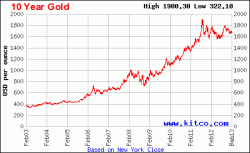
As we have discussed time and again, the main driver for Gold’s rise in the last decade has not been fear of inflation (mainly because there isn’t any) but uneasiness with the prospects of the Dollar and the Empire and ‘speculation’ Gold would be money again. But if this is the correct analysis, why has Gold stopped rising for 18 months now?
While this question is impossible to answer, there are a number of issues worth discussing to get a better picture.

The reports pointing in the direction of a Gold Standard have been mounting massively over the last months. Here’s yet another from last September by Business Insider on a paper by Deutsche Bank, that made some waves in the Gold community. It contains some interesting points, most notably Deutsche Bank addresses the most important Mainstream argument against a Gold Standard: that the economy grows quicker than the World’s Gold supply. Meaning that there is a structural decline in the amount of Gold compared to total economic activity, which is deflation. Deutsche Bank says the problem is real, but smaller than thought: part of the economic growth of the last decades was due to unmerited credit expansion and that would not happen under a Gold Standard.
According to Deutsche, Gold supplies grow at 1.6% per annum, while the economy, corrected for artificial credit induced growth, grows at about 2,2%. Deutsche considers this manageable.
However: this is true of the US economy, the World economy at large grew much quicker over the last decades and since the move to Gold is clearly global, Deutsche seems to be doing what vampires usually do: spin reality into oblivion.
Another interesting point in the paper is that Deutsche Bank says the market is wrong to handle Gold as a normal commodity. Gold is already money, says Deutsche, because it is held by Central Banks as part of their reserves.
Obviously, Interest-Free Economics has another definition of money: that which is agreed upon to be a means of exchange.
Gold is not money. Until we agree it is, of course.
But it is quite typical, the way wealth and store of wealth is automatically mistaken for money.
Gold is wealth. Like every other commodity. It represents value, because people want it. The amazing thing about Gold is, it is good at only two things: looking pretty and being expensive. This fact is even used as a rationale why it should be money. But in this regard it is quite similar to diamonds. And we don’t consider diamonds money, do we?
Very few people consider Gold money. But clearly we are being ‘educated’.
Gold is being sold as a solution to debt. The narrative goes: we’re all crack whores wanting ever more easy credit. But alas, reality is reality and that’s why it’s good to have Gold, because it cannot be printed and thus there can be no more debt than money.
Forget all that. The problem is not debt, it’s interest. Should we stop paying interest on the debts and use that ‘debt-service’ to pay off the principal instead there would be no debt left in 20 years.
But let’s not get into that now. Because the whole idea of ‘steady volume’ (of money) when on a Gold Standard is so…
Volume
There are a few issues to keep in mind, when considering the volume of Gold and thus the volume of the money supply when under a Gold Standard.
In the first place, the official numbers about volume. You hear these numbers: 150 thousand Tonnes. Wiki mentions 171 thousand.
Forget about that too.
Nobody knows how much Gold there is, but I’ll tell you this: there is much, much more than that. In fact: this is one other way Gold resembles diamonds. It is well known that De Beers and the Russians share only a small fraction of what they’ve got. For obvious reasons.
Remember Peak Oil? They do everything they can to create ‘artificial scarcity’. That’s what monopoly does.
As a reminder, here’s how the Protocols put it:
22. YOU ARE AWARE THAT THE GOLD STANDARD HAS BEEN THE RUIN OF THE STATES WHICH ADOPTED IT, FOR IT HAS NOT BEEN ABLE TO SATISFY THE DEMANDS FOR MONEY, THE MORE SO THAT WE HAVE REMOVED GOLD FROM CIRCULATION AS FAR AS POSSIBLE.
Mining
Recently National Geographic reported on 150 Trillion in Gold in deposits in the sea. Imagine the inflation that 150 trillion worth of Gold would bring!
These will not be mined, or reach the market. Not in time to stop the long term deflation that we face with resurgence of Gold as currency, anyway.
The role of mining is not very important. Sure, some Gold enters the market. But the world’s acknowledged Gold supplies grow only a little each year and the price is based on the inventory that we have.
Perhaps this is one reason why Gold mining shares have not been doing quite as well as many expected. Losses of 30% have been reported. Many have been burnt while buying Gold mining stocks, automatically assuming high Gold prices would be good for them. But other dynamics in Gold mining might be much more important than its impact on Gold prices, or vice versa. Nonetheless: the Rothschilds are getting back in mining again, so perhaps a new dawn arises for Gold mining after all. Or is it yet another of their diversions, suckering even more investors? That’s the problem with market gazing: they will fool you all of the time.
Paper ‘Gold’
The other thing about volume is, that because of paper Gold, which is the standard at the current Gold market, there is much more ‘Gold’ in circulation than these 171,000 Tonnes wiki mentions. So we have a double bind: real Gold is artificially scarce, but paper Gold is artificially plentiful.
How much more paper than Gold is there outstanding?
I don’t know, but it’ll be much more.
As we know, paper Gold is manipulated to the core. One of the early Internet heroes was Bill Murphy, still going strong today with http://www.gata.org, exposing how the big banks rule the paper metal market and keep bullion down. To prevent exposure of their fiat empire through Gold appreciation. Or so the story goes. Conveniently.
For the time being, everybody is still holding their breath and playing along in the paper Gold scheme. Meaning paper Gold is still priced the same as physical Gold. But at some point the landlord always comes and the rent is due. So it is with all that paper. People at some point are going to want to know who’s who. And this is a moment of truth that the Gold community has been waiting for for quite some time now.
Notwithstanding its suppression, Gold rose, from $250, to $1800. And now it has been stuck at that level for about 18 months. What drove its rise to begin with? Mainly speculation it would be money again.
We’ve seen how the money supply is tanking and that we are in deflation. Many say prices are rising, especially for the basics, but we’ve pointed at Money Power managed speculation in the primary sector (commodities, mining, agriculture), forcing prices up, which is not the same thing as an increasing money supply, which is inflation. We have stagflation, not inflation. Clear proof of that are not only the money supply statistics, but also tanking housing- and paper assets. The Dow should be at 5,000, this 14,000 nonsense is entirely a Fed fabrication. The Fed has only been fighting deflation in the financial economy, not in the real one. Just look at the pressure on wages and the massive unemployment because wages are not going down quickly enough to match supply and demand. Should the rising prices for basics that we see be a result of monetary inflation, wages would be rising too.
So it’s not inflation that is driving Gold and deflation normally speaking leads to automatic Gold suppression too. No, the growing monetary role of Gold is what is driving it. It seems Gold needs to be at $40,000 per ounce to mop up all fiat currency. That is the promised land of Austrian Economics and Gold buggery.
But the Powers that Be managed to suppress Gold for so long, was it just ‘investors’ making it go up? I guess not. The involvement of ‘small investors’ is just a whitewash. The rise of Gold has been a carefully orchestrated affair. And its current stagnation is undoubtedly also a part of that. Perhaps it was going too fast. Or there are tactical reason. There are all sorts of dynamics behind the scene that we simply cannot know of.
But all the believers have their eyes on the ball and it’s coming. No doubt.
The paper Gold empire is built on the dollar. It’s built on the credibility of the US Empire and it is a cornerstone of the US Empire. The fall of Comex, the paper Gold bourse ‘par excellence’, will coincide with the rest.
‘Fiat’ has nothing to do with it
It has little to do with ‘fiat’ money as such. The Euro, for instance, will live. Here’s a cute stat courtesy of FOFOA.
Eurosystem_ReservesBlue represents Euro Gold reserves, red paper assets. As you can see,they more or less balance each other. Everything the reserves lose to paper ‘inflation’, is compensated by the rise in their Gold assets.
Meaning Frankfurt is ready to back the Euro by Gold at any time. The Euro will not have many problems in the coming transition. This is no coincidence of course: the Euro cannot fail. If the Euro fails, there can be no World Currency. FOFOA rightly maintains Gold backing was always the plan for the Euro.
There is no such graph for the Dollar. There are two reasons for this. Officially, it is because all Gold the Fed holds is still priced at $45, because the Fed’s accountancy rules ‘force’ it to book it at the price it was bought. The Euro reserves are ‘marked to market’: they are booked at current market prices.
The real reason, as we know, is that there is no Gold at Fort Knox. It is not for nothing that Nixon ended convertibility. And what was left then, has been pledged a thousand times since.
This does remind of another glaringly obvious fact of life. Most of the known Gold reserves are held by Central Banks. Maybe not the Fed, but the others do hold much gold. This is reported every day by the ‘Alternative Media’. So why would these banks hate Gold?
This is just one of those many cognitive dissonances that we are continuously bombarded with. Of course the (Central) Banks don’t hate Gold. The reason they own it all (that we know of) is because they love it so much.
Conclusion
I’m not worried about the prospects of Gold. I don’t have any, but those that do needn’t lose sleep over their investments. Gold is becoming money and the whole rise of it has been painstakingly planned and executed over decades. The wealth transfer from the have nots to the haves will be legendary. It will further the deflation the Money Power wants. It is easily combined with supranational units like the Euro and what is being developed elsewhere. In fact, Gold IS World Currency. If everybody uses Gold to back their units, what difference does it make whether they call it a Yuan or a Yen?
If you are looking to ‘preserve wealth’ and strike it rich in the process, get as much Gold as you humanly can.

Spain’s Bankia Decimates Savers As Stock Plummets; Police Officer Stabs Banker Who Sold Him Shares

Source: Forbes
While investors across the globe applaud Bernanke and other central bankers for pushing stock markets to record highs, retail investors and savers in Spain are facing massive losses.  Markets appear to have forgotten Europe’s sovereign debt crisis and the woes in Spain: on Tuesday, new shares in nationalized financial institution Bankia Bankia began trading, closing the day at €0.57 ($0.74), marking a more than 80% drop from their floating price in 2011 when the banking group was formed.  The average Spaniard is suffering, and the situation has gotten to the point where on Sunday, a police officer stabbed a former Bankia employee four times after a heated discussion related to the sale of preferred shares in the failed banking group.
It’s not pretty in Spain these days.  A contracting economy and a spiraling unemployment rate are taking its toll on the population.  And few things can illustrate that as well as Bankia, the nationalized financial group that is currently the fourth largest bank in Spain by market capitalization.
After having received more than €15 billion ($19 billion) in capital from the federal government, Bankia executed a recapitalization plan that culminated in floating 11.5 billion shares which began trading on Tuesday.  Conditioned by the Troika (IMF, European Central Bank, and the EU Commission), Bankia forced its shareholders to take losses to finance a bailout, and after engineering an exchange of preferred shares and convertible bonds, priced the new stock at €1.35 last month ($1.75).
All along, the exchange was a trap for retail investors.  Last week, the stock fell more than 50% when institutional investors were allowed to sell out of their already losing positions.  Savers and retail investors had to wait until Tuesday, when the stock fell as low as €0.475 ($0.61) at one point.  Spanish daily El Mundo reports that institutional investors held positions worth about €1.85 billion ($2.4 billion) in Bankia, compared to nearly €5 billion ($6.5 billion) for the 190,000 people that bought up the preferred stock and hybrid instruments, convinced they were making a good investment with their savings.
Bankia’s story is a tragic one.  Begot from the merger of seven regional banks or cajas, Spain’s fourth largest bank unveiled the largest ever corporate loss in the country’s history in March, at €19.2 billion ($25 billion) for the full year.  Shares in Bankia had originally been floated at €3.75 ($4.85) in 2011, with investment banks targeting domestic buyers after seeing limited interest from large institutional investors.  With a construction and property-related portfolio that hit €37 billion ($48 billion), and having become the third-largest holder of Spanish debt, Bankia collapsed under the weight of its books as the European sovereign debt crisis, and Spain’s own real estate implosion, intensified.
While tourists flock to the beautiful city of Barcelona, or the sandy beaches of Mallorca to enjoy the European summer, the average Spaniard is hurting.  I have previously reported of suicides due to bank foreclosures.  Over the weekend, a police officer directly attacked a former Bankia employee who reportedly sold him €300,000 worth of preferred shares.  El Mundo reported the cop, nearly 40, stabbed the 55-year old former bank employee four times after a heated discussion in Valencia, Spain’s third largest city; Bankia issued a statement repudiating the aggression.
The Spanish financial industry is in tatters, but it’s also recovering.  Having gone through one of the most intense restructuring of any nation across the Eurozone, the largest institutions are beginning to stake their ground and take advantage of a decimated opposition.  Banco Santander Banco Santander, BBVA, and CaixaBank have emerged as the three largest players.  Yet they have dramatically underperformed markets, major European peers like Deutsche Bank and UBS, and their American counterparts like Citigroup and JPMorgan Chase.
Bankia is in a league of its own.  It has survived because of a European bailout in the heat of last year’s intensification of the sovereign debt crisis plaguing the Old Continent.  Regulators, fearing a new Lehman Brothers-like situation could throw off the entire Eurozone, moved to secure financing and keep the bank alive.  They changed management and injected capital.  Beyond facing massive losses, Bankia has taken with it hundreds of thousands of Spanish savers.  Regulators are hoping the institution can be turned around and eventually made profitable.  Spanish retail investors better keep their fingers crossed, if they can hold on to their shares for long enough.

The Real Reason Governments Are Killing Financial Privacy

image source
Nick Giambruno
Casey Research

At the latest G-20 meeting, central bankers, finance ministers, and an assortment of other central planners touted what they hoped would be a new "global standard" of the automatic sharing of financial information.

The US has taken the lead with the odious FATCA law, and the EU has followed suit with its own version. Through FATCA and other measures, both governments are aggressively seeking new ways to undermine financial privacy.

Financial privacy should not be viewed in a negative light, as it is often portrayed. The Swiss view it as a fundamental human right to preserve dignity, akin to medical privacy. How would you feel if the government snooped into your medical records and automatically shared those records with foreign governments?

While it would appear that the primary objective of this new "global standard" is to rake in more money for bankrupt governments, it seems another motive is at play here.

The optimistic estimate for FATCA is that it will bring in around $9 billion over 10 years or $900 million on average per year.

With the deficit in 2012 for the US federal government at $1.1 trillion, the expected $900 million from FATCA is not even a drop in the bucket (actually around one-tenth of one percent). Even in the unlikely event that the US will moderately reduce its deficit in the future, the revenue from FATCA will remain a pittance in comparison.

So, it begs the question: Why would the US government go through all the enormous trouble of implementing FATCA if it's going to bring in such a meager amount of money?

If it's not money, it appears the primary motivation here is control. The new "global standard" is a path that will put governments around the world one step closer to being able to track and control every penny you earn and every penny you spend. It dovetails nicely with the global war on cash.
The time is short, but there is still an opportunity for you to legally avoid getting boxed in by desperate and out-of-control governments by internationalizing your savings, your income, yourself, and your digital presence out of their immediate reach.

While governments around the world – particularly in the US – are making it increasingly difficult to internationally diversify your assets, there are still many legal strategies available to you. You'll find the latest information on the best of these in the brand-new special report Going Global 2013, a comprehensive, 114-page guide packed with actionable advice from renowned experts in international gold storage… opening foreign bank accounts and IRAs… second passports and living abroad… the best foreign currencies to invest in…. and much, much more.

Simply put, there's no better resource available on international diversification than Going Global 2013. Learn more here.