Saturday, April 13, 2013

Bitcoin price craters as panic selloff claims 75% loss from bubble high

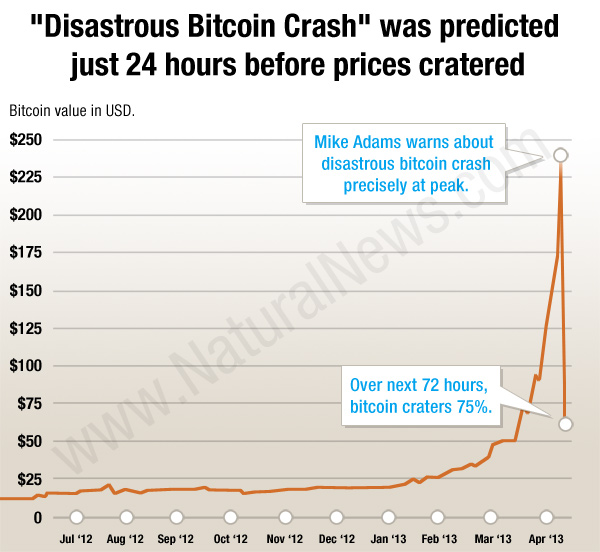
(NaturalNews) The bitcoin selloff that began less than 24 hours after I predicted a "disastrous bitcoin crash" has now plummeted nearly 75% from Wednesday's bitcoin high of $266, wiping out over $1.5 billion in valuation for the crypto currency.

As bitcoin skyrocketed in value, I saw unmistakable signs of "irrational exhuberance" kicking in, with bitcoin hypsters starting to talk more like charlatans and cult members than rational investors. So I published an urgent warning and repeated the same warning live on national radio.

The very next day, bitcoin cratered from $266 to $105. Self-deluded bitcoin cultists called this "50% off Wednesdays" and urged everyone to "buy and hold." (Because that's how the con works.)

But the selloff had already picked up steam, and while Thursday saw some support around the $110 - $120 level, by Friday morning the bitcoin bubble accelerated its downfall, plummeting to $61.11, a loss of over 75% from its high.

Bitcoin investors are delusional fools

Even at $61, bitcoin is wildly over-valued. The crypto currency now has almost no practical use whatsoever in the world of e-commerce because its extreme volatility means no large merchant will ever accept it.

Any currency that can drop 60% (or more) in a few hours is not a reliable currency for exchange, period. You can't argue with mathematics, although bitcoin cult members are certainly trying.


Here's a video of the bold bitcoin crash prediction I made on the Alex Jones Show a full day before the crash began, where I said:

Eventually it's going to crash hard. I bet my reputation on that, Alex. I am 100% sure we are going to see a massive bitcoin crash at some point with an ultra-accelerated velocity. It will be the fastest crash of any currency in the history of human civilization. It will be a high-velocity crash. People are buying bitcoins who don't know what bitcoins are and who have no use for them. These are speculators.

Here's the video:


Bitcoin cultists prove they are a band of fools

Immediately after this prediction, I was branded a "conspiracy theorist" and a "doom and gloomer" by the now-crazed bitcoin community which was becoming more delusional and insane by the hour.

Every drop in price was called nothing more than a "buying opportunity" or a "discount," and it was repeatedly stated that bitcoins would keep going sky-high because "20,000 new people are buying bitcoins every day."

In truth, bitcoins became a runaway pyramid scheme. The only purpose for buying bitcoins was to sell bitcoins. The entire market became purely speculative, resembling the tulip bulb mania of 1637. And it was headed for certain disaster.

This is why I wrote, two days before the bitcoin crash:

"Bitcoin has become a speculative bubble now driven primarily by greed and risk rather than utilitarian value... Today, bitcoin looks and feels a lot like the dot-com bubble of 2000... When the bitcoin crash comes, it will be wildly accelerated. The entire thing may unravel in mere hours... Be warned that if you buy bitcoins today, you are essentially playing the lottery because you're joining other greed-driven speculators who are all unwittingly playing out a repeat of the dot-com bubble. A crash seems inevitable."

And then, one day before the bitcoin crash, I wrote:

"Mark my words: Bitcoin is headed for a disastrous crash. All the signs are there. It's undeniable. When speculative investors, driven by greed, flood a particular investment vehicle creating a fast-expanding bubble, a crash is inevitable... Bitcoin has now become a casino. If you are buying bitcoin right now, you are gambling with your money. There's a sucker born every minute... try not to be one of them... If you are buying bitcoins right now and thinking to yourself, "I'm gonna buy today, hold them, and sell at the top!" then look in the mirror and mouth the word "SUCKER" to yourself ten times until it sinks in.

Like everyone else, you will fail to sell at the top. You will ride the losses down to nothing, and you will lose almost everything you put into the system. Why? Because you're only human, and when it comes to the fear and greed of markets, human psychology is pathetically predictable."

Never argue with mathematics

Bitcoin fanboys (i.e. cult members) are learning the hard way that you should never argue with mathematics. If you try to, you will lose.

I wrote previously that I could see a bitcoin crash coming because I knew that 2+2=4. Yes, it was that obvious. But just like all the suckers who lost their shirts in the dot-com bubble and the housing bubble, the bitcoin bubble players thought the laws of economics did not apply to them. They thought they could all become wealthy without expending effort. They were fools.

They were, technically, the "greater fools" always described in market dynamics textbooks. They got suckered by greed while abandoning mathematical reality.

The only way bitcoin could have continues to climb was if more and more people were suckered into the pyramid scheme. But now, with bitcoin's reputation in ruins, no intelligent person is going to buy until the bitcoin price crashes another 75% or so if they do their research, meaning the bitcoin mania has been shattered.

And the bitcoin cult has been exposed as pure delusion.

We should all be happy that bitcoin crashed before it spiraled too far out of control in terms of valuation, otherwise the impact of the crash could have been much, much worse.

Introducing Sh!tcoin

By the way, I'm going to be announcing a brand new virtual currently called "sh!tcoin," where every coin equals exactly one piece of sh!t.

Very strong passwords will be required so that people don't "steal your sh!t" and the people who hold the greatest number of sh!tcoins will be called the "sh!theads."

Millions fear losing job would mean losing home

What would happen if you lose your job? Would you be able to afford your mortgage payments or rent?
Millions wouldn't, according to research by the housing charity Shelter, which shows that one in three workers could not pay for their home for more than a month if they lost their job.
Some 4.4 million people – 18 per cent – said that if they lost their jobs in April and couldn't get a new one right away, they wouldn't be able to pay their rent or mortgage at all.
The squeeze on people's budgets will mean a surge in demand from people at risk of becoming homeless, Shelter predicts.
Campbell Robb, the charity's chief executive, said: "The buffer between having a home and potentially becoming homeless is a single pay cheque.
"The depth of the financial pressure and insecurity felt by people across the country means that millions are living on the edge of a crisis, only secure in their homes for a matter of weeks.
"At the same time, support for people who have lost their homes is being stripped away – it's easy to see why every 15 minutes, another family in England finds themselves homeless."

Yuan reaches record high against the US dollar

Further appreciation predicted, which would fuel inflation on the mainland and in Hong Kong
The yuan reached a record high yesterday as the central bank fixed its midpoint against the US dollar at the strongest level ever.
That sparked anticipation of further appreciation this year and stoked inflationary pressure on the mainland and Hong Kong.
The People's Bank of China set the midpoint at 6.2506 yuan per US dollar - up from the fixing of 6.2578 on Thursday - ahead of a visit by US Secretary of State John Kerry to Asia. The yuan jumped to 79.775 Hong Kong dollars per 100 yuan, just near the record of 79.729 on Wednesday.
China often allows the yuan to appreciate faster before visits by officials from Western countries, who usually push for exchange rate liberalisation.
However, the yuan is set to strengthen this year. Inflows of capital are expected to generate higher demand for the yuan than last year as the mainland economy recovers, economists said.
"In 2013 we'll see greater risks of capital inflows to China, rather than two-way movements in the yuan exchange rate or capital outflows as last year," said Chang Jian, an economist at Barclays Capital. Barclays expects the yuan to strengthen 2 per cent against the greenback this year, after considering China's intention to protect exporters in the still shaky economic recovery.
The yuan rate in the spot market touched 6.1903 per dollar yesterday, the highest since 1994. The yuan spot rate has risen 0.6 per cent so far this year, after hitting highs in the past couple of weeks.
Economists at Standard Chartered forecast the spot rate for yuan would reach 6.18 by the end of June and 6.10 by the end of this year. They said China was unlikely to follow Japan in depreciating its currency, as Japanese exporters are not its major competitors.
Nathan Chow, a DBS Bank economist, expects the strengthening of the yuan to continue to put pressure on inflation in Hong Kong because the city's currency is pegged to the US dollar.
"The inflationary pressure caused by the yuan appreciation is inevitable, as Hong Kong imports a variety of goods, such as food and medical supplies, from the mainland," Chow said.
A 1 per cent rise in the yuan would result in a 0.05 percentage point increase in Hong Kong's consumer inflation, the Monetary Authority says.

the great global tax grab is already underway

ZeroHedge
http://www.zerohedge.com/contributed/2013-04-12/great-global-tax-grab-already-underway

The world will soon be facing a tsunami of defaults on bad debts. This will include municipal or local government defaults such as the one now occurring in Stockton California, governments “defaulting” on promises they’ve made to the people (Social Security, Medicaid), a default on the social contract between society and politicians such as the one in Cyprus (a default on the notions of private property and Democracy), stealth defaults on debts in the form of inflation and finally, of course, outright sovereign defaults.

However, the last option will be sovereign defaults; all other options will be tried first. The reason for this is that sovereign bonds are the senior most collateral posted by the banks for their hundreds of trillions of Dollars worth of derivatives bets.

The minute an actual sovereign default occurs in Europe, Asia or the US, then the large global banks will all be vaporized. End of story.  As is now clear, the Central banks do not care about ordinary citizens. They only care about propping up the big banks.

This is why Cyprus decided to default on the social contract with its people and steal their funds rather than simply instigating a formal default. And it’s why in general we’re going to see Governments implementing more and more theft in the form of “taxes” (Cyprus called its theft a tax) in the future.

This will be sold to the public as either an attempt to tax those with a lot of money because it’s only fair that they put in more to bailout the nation OR as a form of financial terrorism e.g. “either you take a 7% cut on your deposits and the bank stays afloat or the bank crashes and you lose everything.”

This will be spreading throughout the world, GUARANTEED.

Spain, Canada (which allegedly has the safest banks in the world), and New Zealand have already begun discussing confiscation schemes for depositors in the event of a banking crisis.

As Cyprus has shown us, when push comes to shove, rule of law goes out the window. I fully expect that when things get really bad in the financial system the money grabs will come fast and furious. Foreign accounts, including possibly even Gold held aboard, will come under attack. Heck, the US got Switzerland to throw its 300-year-old banking secrecy out the window…


The Swiss bank Wegelin is to close, after admitting that it helped about 100 US clients evade paying taxes.
The news that Switzerland's oldest private bank will cease to operate has potentially huge implications for Switzerland's entire banking sector, and for the long tradition of Swiss banking secrecy.
Thirteen other Swiss banks are under investigation by US authorities, among them Credit Suisse, a bank now termed "too big to fail" by the Swiss government.
When Wegelin's managers pleaded guilty in a New York court, the case was watched with mounting horror by the financial communities in Zurich and Geneva.
Many had expected Wegelin to continue to try to fight the case. For months, the bank had failed to turn up in court, saying the summons had not been delivered correctly.
Instead, Wegelin's guilty plea included the admission that it intentionally opened accounts for US citizens to help them avoid tax.


If you’re an individual investor worried about what Europe’s Crisis really means for your portfolio, we’ve published a FREE Special Report outlining exactly that. It’s titled, What Europe Means For You and Your Savings.

In this report, we outline the risks Europe’s banking crisis holds not only for those in Europe, but for savers around the world. We also explain how this crisis will most likely unfold, including which areas are most at risk in the financial system. And we cap it off by listing multiple backdoor plays on Europe that investors can use to profit from Europe’s Crisis.

You can pick up a FREE copy here:

http://gainspainscapital.com/what-europes-collapse-means-for-your-savings/

Thank you for reading!

Graham Summers

The Entire Economy Is a Ponzi Scheme

Ponzinomics

Bill Gross, Nouriel Roubini, Laurence Kotlikoff, Steve Keen, Michel Chossudovsky, the Wall Street Journal and many others say that our entire economy is a Ponzi scheme.
Former Reagan budget director David Stockton just agreed:
So did a top Russian con artist and mathematician.
Even the New York Times’ business page asked, “Was [the] whole economy a Ponzi scheme?
In fact – as we’ve noted for 4 years (and here and here) – the banking system is entirely insolvent. And so are most countries. The whole notion of one country bailing out another country is a farce at this point. The whole system is insolvent.
As we noted last year:
Nobel economist Joe Stiglitz pointed out the Ponzi scheme nature of the whole bailout discussion:
Europe’s plan to lend money to Spain to heal some of its banks may not work because the government and the country’s lenders will in effect be propping each other up, Nobel Prize-winning economist Joseph Stiglitz said.
“The system … is the Spanish government bails out Spanish banks, and Spanish banks bail out the Spanish government,” Stiglitz said in an interview.
***
It’s voodoo economics,” Stiglitz said in an interview on Friday, before the weekend deal to help Spain and its banks was sealed. “It is not going to work and it’s not working.”
[The same is true of every other nation.]
Credit Suisse’s William Porter writes:
“Portugal cannot rescue Greece, Spain cannot rescue Portugal, Italy cannot rescue Spain (as is surely about to become all too abundantly clear), France cannot rescue Italy, but Germany can rescue France.” Or, the credit of the EFSF/ESM, if called upon to provide funds in large size, either calls upon the credit of Germany, or fails; i.e, it seems to us that it probably cannot fund to the extent needed to save the credit of one (and probably imminently two) countries that had hitherto been considered “too big so save” without joint and several guarantees.***
As Nouriel Roubini wrote in February:
[For] problems of that magnitude, there simply are not enough resources—governmental or super-sovereign—to go around.
As Roubini wrote in February:
“We have decided to socialize the private losses of the banking system.
***
Roubini believes that further attempts at intervention have only increased the magnitude of the problems with sovereign debt. He says, “Now you have a bunch of super sovereigns— the IMF, the EU, the eurozone—bailing out these sovereigns.”
Essentially, the super-sovereigns underwrite sovereign debt—increasing the scale and concentrating the problems.
Roubini characterizes super-sovereign intervention as merely kicking the can down the road.
He says wryly: “There’s not going to be anyone coming from Mars or the moon to bail out the IMF or the Eurozone.” [Others have made the same point.]
But, despite the paper shuffling of debt at the national level—and at the level of supranational entities—reality ultimately intervenes: “So at some point you need restructuring. At some point you need the creditors of the banks to take a hit —otherwise you put all this debt on the balance sheet of government. And then you break the back of government—and then government is insolvent.”

Peak Demographics?

Indeed, population may be the biggest ponzi scheme of all. Specifically – as we’ve pointed out for years – rapidly-aging populations in the developed world will exert a big drag on the economy.
The Global Mail notes:
Half the world, including almost all the developed world, now is reproducing at below replacement level. A generation from now, according to United Nations Population Division projections, less than a quarter of the world’s women – most of them in Africa and south Asia – will be reproducing at above replacement rate. And those UN forecasts are probably on the high side, for reasons we’ll come to later.
And as the birth rate has plunged in developed nations, and the native-born population has begun to shrink and rapidly age, governments and business have sought to make up the numbers by importing people to prop up their economies. It’s all they know how to do, for our economic system is, at its base, a giant Ponzi scheme, dependent on ever more people producing and consuming ever more stuff.
But what happens if that all stops? What happens when you get an ageing, shrinking population that consumes less?
“The answer to that question is that we don’t know because it’s never happened before,” says Peter McDonald, professor of demography and director of the Australian Demographic and Social Research Institute at the Australian National University.
***
“We’re certainly operating a Ponzi scheme in Australia,” says Dr Bob Birrell, an economist and migration expert from Monash University.
“Our growth is predicated on extra numbers… [and] more of our activity is going into city building and people servicing, which do not directly produce many goods that can be traded in overseas markets.
***
Half the world is facing the problem of low fertility, and Australia, with its massive program of importing people, is providing an extreme example of one approach to the conundrum.
In a nutshell, the problem is this: lower fertility rates mean older, less innovative and productive workforces. More importantly to the Ponzi economic order, older, stable or declining populations consume less. So growth requires either importing people, or exporting stuff, or a combination of the two. Orthodox economics simply can’t cope otherwise.
Europe as a whole has been reproducing at well below replacement rate for close to 40 years. The last period for which UN data showed Europe’s total fertility rate above the replacement rate was 1970-75.
Europe’s contemporary demographics give new meaning to the descriptor ‘the old world’. The continent’s average person is over 40 now. By 2050, if things continue on trend, the average European will be 45.7. If one takes the UN’s “low variant” projection, he/she will be over 50 years of age.
And the low variant now looks closer to the mark. Fertility rates had actually rebounded a little over recent years, the result of a bit of “catch-up” after a shift over several previous decades in which women delayed child-bearing. But the European recession has set fertility rates plunging again.
<p>Jamie Ferguson/The Global Mail</p>
Jamie Ferguson/The Global Mail
The recession’s effects will likely linger for decades, in lower rates of earnings and savings, and also in reduced fertility.
***
Last year, Forbes magazine, that most reliable voice of the economic orthodoxy, laid the blame for Europe’s economic decline squarely on its citizens’ failure to reproduce in adequate numbers, in an article headlined What’s Really Behind Europe’s Decline? It’s The Birth Rates, Stupid.
The Forbes piece was unequivocal: the biggest threat to the European Union was its low fertility rate.
***
The piece ended with a dire warning that unless Club Med managed to induce people to have more babies, catastrophic economic consequences would flow for all of Europe and maybe the world.
***
As Thomas Sobotka, one of the authors of a 2011 study on population trends by the Vienna Institute of Demography, told the Guardian newspaper, massive cuts in social spending would only exacerbate the problem.
“This may prolong the fertility impact of the recent recession well beyond its end. It could lead to a double-dip fertility decline,” he said.
But when it comes to fertility declines, Asia takes the cake.
Japan, Singapore, South Korea, Taiwan, Macau, Hong Kong, and most importantly China currently all have fertility rates lower than those of Europe.
***
China’s and Korea’s are about to start falling, if they haven’t already.
“I’m pretty pessimistic about the east-Asian situation,” says McDonald. “I think those countries find it very difficult move in the right direction of supporting work and family, in particular, reducing work hours.
“We are now talking about some 30 per cent of Japanese women not getting married.”
“I saw a couple of people from the Japanese government give a paper recently, essentially accepting this as an inevitability – a low birth rate forever,” he says.
It’s the same all over Asia.
***
Hong Kong has a birth rate of 1.09, which is on track to see its population almost halve in a generation. Taiwan is at 1.10; China, 1.55; Thailand, 1.66; Vietnam, 1.89. Even Indonesia’s fertility is just above replacement rate, at 2.23, and is falling fast. Malaysia and the Philippines are still growing pretty quickly, as are the south-Asian countries, which may give them a competitive edge for a few decades – and a growing export industry of people. But it is not projected to last more than a few decades.
Let’s return to America. The United States also is reproducing at below replacement rate, and its birthrate has declined sharply in recent years.
***
The US birth rate not only fell to its lowest level ever in 2011, but the greatest decline was among immigrant women.
***
In the longer term, the world will have to adjust its economic system to cope with the novel concept of less. Fewer people, less consumption, lowered need for resources, energy, housing, roads, you name it.
Indeed, smart curmudgeons like Jeremy Granthan and Chris Martensen think that we have not only “peak” demographics, but also peak resources.

There’s HOPE

The above is admittedly depressing. But the reality is that there’s hope.
We can have a very bright future, indeed … if we switch from the status quo to something smarter. For example, see this and this.
For example, we can cut out the middlemen in the banking and political realms … and prosper.
And as we’ve previously noted about energy:
The current paradigm is that energy is produced expensively by governments or large corporations through gigantic projects using enormous amounts of money, materials and manpower. Because energy can only be produced by the big boys, we the people must bow our heads to the powers-that-be. We must pay a lot of our hard-earned money to buy electricity from them, and we can’t question the methods or results of their energy production.
Our life will become much better when we begin to understand that energy is all around us – as an ocean of electromagnetic forces and as a byproduct of other processes in the form of heat, pressure, etc. – and all we need do is learn how to harvest it.

SENATOR: "Banks Still Owe Us For The Bailouts!"


"Hank Paulson is the world's greatest salesman.  We gave $700 billion to Wall Street and nobody cares."
New interview.  Inhofe beats on Paulson.
Luke Rudkowski of We Are Change interviews Senator James Inhofe about his opposition to TARP and martial law threats he received from Henry Paulson.
Not stopping TARP was my biggest failure.
"Think about how big it was -- $700 billion given to an unelected bureaucrat, with no accountability, to do anything he wanted with it.  Can this happen?  It did."
More quotes:
  • The banks still owe us about $250 billion.
  • I'm still mad at all the Republicans for voting for TARP.
  • You're the first person in 5 years that's even mentioned it.
  • That thing was $700 billion, and nobody cares.


AMBUSH: Paulson Confronted On The Streets Of NYC

Kyle Bass: "I'd Much Rather Own Gold Than Paper"

We've moved to an ideology of unlimited printing.
"I'm perplexed as to why gold is as low as it is.  The largest central banks in the world have all moved to an unlimited printed ideology.  If monetary policy is the only game in town, then we're all in for a world of trouble."
--
From Bloomberg:
Trust in Gold Not Bernanke as U.S. States Promote Bullion
Distrust of the Federal Reserve and concern that U.S. dollars may become worthless are fueling a push in more than a dozen states to recognize gold and silver coins as legal tender.  Arizona is poised to follow Utah, which authorized bullion for currency in 2011.  Similar bills are advancing in Kansas, South Carolina and other states.
Read more here...


Kyle Bass: The Best Way To Get Paid Back By Fannie