Monday, December 20, 2010

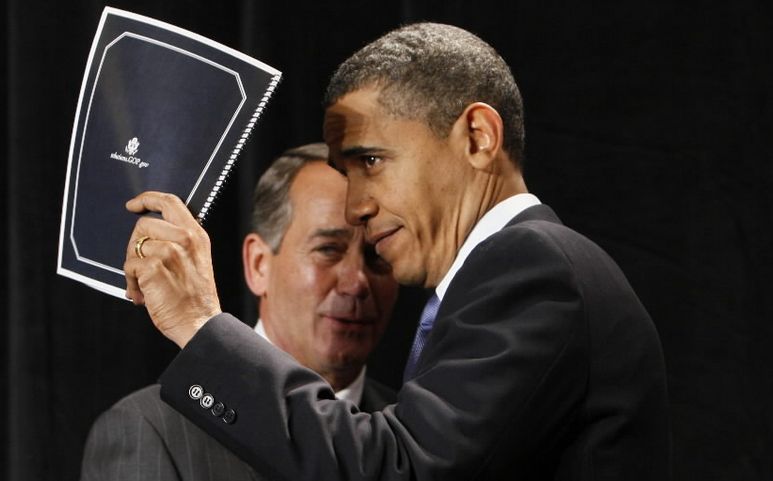
« Deficit Be Damned: House Passes Obama Tax Bill »

Before I get to the story, here's a reminder on where things stand. And this figure is before the extension of the Bush tax cuts and everything else thrown into this irresponsible bill, so you'll need to add another trillion to the total.

A $20.6 trillion national debt by 2015.

#

The U.S. debt will top $13.6 trillion this year and climb to an estimated $19.6 trillion by 2015, according to a Treasury Department report to Congress.

http://www.reuters.com/article/idUSN088462520100608

---

WASHINGTON (AP) -- Acting with uncommon speed, Congress sent President Barack Obama sweeping, bipartisan legislation late Thursday night to avoid a Jan. 1 spike in income taxes for millions and renew jobless benefits for victims of the worst recession in 80 years.

The measure also will cut Social Security taxes for nearly every wage-earner and pump billions of dollars into the still-sluggish economy.

The 277-148 vote came the day after the Senate cleared the bill, 81-19.

Passage was backed by 139 Democrats and 138 Republicans. Opposed were 112 Democrats and 36 Republicans, many of whom wanted to include spending cuts to offset the $56 billion cost of the unemployment benefits.

After struggling with rank and file discontent, the Democratic leadership splintered at the end. Speaker Nancy Pelosi of California did not vote, while Majority Leader Steny Hoyer of Maryland supported the measure. Rep. Chris Van Hollen of Maryland, outgoing chairman of the Democratic campaign committee, opposed it after assuming a prominent role in pushing for the estate tax increase.

The bill provides a two-year extension of tax cuts enacted when George W. Bush was president, avoiding an increase at all income levels that would otherwise occur on New Year's Day.

It would also renew an expiring program of benefits for the long-term jobless, and enact a reduction in Social Security taxes for 2011 that would amount to $1,000 for an individual earning $50,000 a year. The bill's cost, $858 billion over two years, would be tacked on to the federal deficit, a sore spot with deficit hawks in both parties.

Continue reading - AP

###

David Stockman on the national debt and tax cuts...

The Colbert Report Mon - Thurs 11:30pm / 10:30c
David Stockman
www.colbertnation.com

Colbert Report Full Episodes 2010 Election March to Keep Fear Alive

Video - David Stockman on the Colbert Report - Dec. 2, 2010

Stockman says the deficit solution is to let the Bush tax cuts expire and cut the budget for the pentagon killing machine. Sound familiar..?..

---

How to Survive the Collapse of America

Activist Post reviews National Bestseller, How to Survive the End of the World as We Know It, by author James Wesley, Rawles (makes an important Christmas gift)


Activist Post

It's a sure sign of the times that a book titled, How to Survive the End of the World as We Know It: Tactics, Techniques and Technologies for Uncertain Times becomes a National Bestseller. First printed a year after the October financial crash of 2008 when the world awoke to the fragility of the "system," author James Wesley, Rawles offers a pragmatic and thorough guide to survive other potentially more severe future crashes.

The book does not go into extended detail about what may trigger the breakdown of civilization, but uses its precious 316 pages to inform readers of how to prepare for nearly any disaster. Many survival books are great references to have in your library should a disaster take place, but this book is essential to read and implement well before disaster occurs.

Author, Jim Rawles, a former U.S. Army Intelligence Officer and founder of the very popular website SurvivalBlog.com, not only talks the talk, but also walks the walk. He lives on a fully self-sufficient and well-stocked retreat "somewhere west of the Rockies." Upon reading the book, one thing is apparent: Rawles has written this book not as a "what if" guide, but rather a "when it happens" guide. The tone of urgent pragmatism enhances the assumption that disaster is not only inevitable, but perhaps imminent.

Rawles suggests that the collapse of America will likely be triggered by economic circumstances, notably the death of the dollar, which will then cause a domino effect where civilization as we know it will breakdown into chaos. The book describes the collapse of American society in brief detail, explaining that supply lines for food and fuel will likely grind to a halt, forcing a mass exodus of people out of cities into the suburbs and countryside. He also outlines how the government will be completely crippled by this ensuing anarchy due to the rapid increase in desperation and decrease in essential services. Despite this "most likely" scenario, Rawles also prepares readers to survive events like nuclear attacks on American soil.

This book becomes an invaluable resource in the incredibly detailed chapters about preparing for any collapse scenario; from your location and shelter, to food storage and production, water purification, tools and barter goods, medical supplies, bug-out bags, security measures, communication and much more. Rawles covers each of these categories, providing organized and thoughtful plans to implement self-sufficiency preparation.

It's worth listing the chapter titles to help better explain how very thorough this book is:
  1. The Survival Mind-Set for Living in Uncertain Times
  2. Priorities: Your List of Lists
  3. The Survival Retreat
  4. Water: A Key Resource
  5. The Deep Larder: Your Family's Food Storage
  6. Fuel and Home Power
  7. Gardens and Livestock
  8. Medical Supplies and Training
  9. Communications and Monitoring
  10. Home Security and Self-Defense
  11. Firearms for Self-Sufficiency and Self-Defense
  12. G.O.O.D. Vehicles and the Dreaded Trip Outta Dodge
  13. Investing, Barter, and Home-Based Business
  14. It Comes Down to You
Consequently, because the book is so detailed, it can be somewhat intimidating. The second chapter labeled Priorities is immensely comprehensive and can seem impossible for readers to implement -- particularly those who feel the collapse is presently upon us. However, Rawles' priority lists are indeed necessary for anyone who wishes to survive with relative comfort in the worst of times. Readers should get to work on as much of the priority list as can be reasonably achievable.

Rawles is the consummate survival expert and consultant, yet he still says it is impossible to prepare on all the necessary levels without help. And although he says he understands the instinct to go "lone wolf," he declares it is utterly foolish to believe you will be better off alone than with a group. He states that this is especially true when it comes to security. So, as we have pointed out in past articles, collapse survival will be tribal -- begin recruiting like-minded people now.

One especially important tip in the book that can be easily achievable for most people, and will help cover gaps in your preparation plan, is to stock up on pre-1965 dimes for bartering. They are 1/10th of an ounce and contain roughly 90% troy silver. In other words, if the dollar collapses and silver goes to $100 per ounce, then each dime will carry about $9 of trade value in today's marketplace. Therefore, if you stock up on this "junk silver" while making other preparations, then you may be able to trade them for any shortcomings.

America's decline by all measures will likely snowball, gaining size and speed with each tumble, and ultimately result in an avalanche that covers her in a long winter of suffering. In the end, this is a must-read book for anyone who feels that the fragile economic, environmental, and social system in America has tripped into decline. Preparation is no longer just for the fringe of society, but for the whole of aware citizens.

Wikileaks: Play the Ball, not the Man – and Check Who’s Kicking it

When people write political commentary on blogs or other social media, it is my experience that it is not — with some exceptions — their goal to expose the truth. Rather, it is their goal to position themselves among their peers on whatever the issue of the day is. The most effective, the most economical way to do that is simply to take the story that's going around — it has already created a marketable audience for itself — and say whether they're in favor of that interpretation or not.’[1]

So said Julian Assange in an interview with Time magazine on 30 November, presumably to justify why he chose to release Cablegate through the very mainstream media whose ineptitude, bias, and lack of courage purportedly necessitated the formation of Wikileaks in the first place.

But even that description does not quite do him justice. Assange has gone further than providing the story –or selected excerpts at least – he has also created the market, through deals with major media players and hidden financial backers,[2] and intends it to be played out for some time through protracted releases.

With few exceptions the majority of the public, but more worryingly, many supposed investigative and/or independent journalists, have dismally failed to exercise even the most minimum capacity for critical assessment, either talking-up the revelations (many of which were already common knowledge, or should have been to journalists doing their job properly) and/or participating in the indecent stampede to lionise Assange as some great champion of freedom of information and open government - or both.

This, like the cables themselves, conveniently deflects attention from the real issues - the right to information, the desirability of open government, the protection of whistle-blowing, and the protection for individuals from state abuses of the judiciary for political purposes. Moreover it achieves this deflection not by presenting all of the information in its original form, which might conceivably pass as a search for truth, but by presenting selected and redacted information, ie spin, which does not pass as a search for truth. The protracted nature of the releases suggests an eye on income, as well as keeping the world’s attention distracted from any and everything else, like, perhaps, the next Operation Cast Lead.

It has, however, nicely positioned Assange amongst his peers.

On 30 November I sent an email to a friend in Mexico, with several concerns I had about the cables, relating to three ‘who’s – who they were being released through, who was not mentioned (Israel) and who would suffer most through the releases. My friend responded that there was no point in further communicating with me. It seemed the mere suggestion that Julian Assange might not be the Che Guevara of information liberation was reason enough for my immediate exile!

But even before Cablegate, people were questioning who was behind Wikileaks.[3] Many experienced Wikileaks people themselves were becoming increasingly disturbed with its manner of operation,[4] and have since bailed out.[5]

So what's Assange’s game?

According to him, keeping governments open by disseminating ‘public interest’ information through selected media outlets. Since beginning this piece, SCOOP has published an article by Michel Chossudovsky that makes many of the points I did about the media selected to edit the material, so I won’t repeat them – you can read them for yourself here.[6] However, I do make a couple of additional points:

  1. In releasing the information to these ‘architects of media disinformation’ as Chossudovsky describes them, Assange is implicitly saying that we the public are too stupid, moronic, or ignorant to be able to assess and analyse the contents for ourselves, and/or
  2. these ‘architects of media disinformation’ must be given the opportunity to put their spin on it because God forbid we might come to our own, possibly different, conclusions, and
  3. this spin includes presenting the cables as if everything they contain is the truth, i.e. that what some US staffer said that a particular person in Iran or Turkey or Australia thinks/said/did is actually what that person thinks/said/did. (How many journalists have bothered to go to the supposed source, let alone subject, of any of these cables to verify the accuracy of the contents?)

One thing that tends to annoy people as much as being lied to by their governments, is being patronised. (Now that’s a thought for the lionisers – make Assange the patron saint of disinformation.... you can spin that either way)

As for the claim that Assange/Wikileaks has revolutionised information-sharing, yes, we do now have available a plethora of information, some of which is very important, but most of which is nothing new, or even particularly interesting. Worse, we also have yet another player in the spoon-feeding frenzy that passes for mainstream journalism – that is, instead of vested interests and States spooning it to a lap-dog media who then spoon it to us, we now have Assange/Wikileaks forking it to the media, who are forking us – business as usual. And for some inexplicable reason we are expected to hail Assange as the objective, independent champion of freedom of information and the truth. Why? Because he says he is.

Assange’s record on these fronts is not too great. Compare his operational procedures to those of Openleaks and note the difference between ‘limitless sharing’ and selective release. Look also at objectivity and independence. Chossudovsky quotes Assange as stating that Wikileaks’ primary focus is on ‘oppressive regimes in Asia, the former Soviet bloc, Sub-Saharan Africa and the Middle East.’ Which country out of all in these areas has the most United Nations Resolutions against it for breaches of international law and human rights abuses? Israel. Which country is not only almost completely absent from Cablegate, but whose Prime Minister also comes in for some flattery from Assange in the 30 November Time interview? Israel. Whose Prime Minister said the leaks were good for Israel? Israel’s! Netanyahu went so far as to say that ‘Israel had worked in advance to limit any damage from leaks’ [7] Reports of deals struck with Israel in Geneva [8] don’t sound so far-fetched after all. So much for independence.

As a champion of freedom of information and open government he might have been expected to fare somewhat better. But hasn’t he just succeeded in doing the very opposite? Assange said in the Time interview that ‘If their behavior is revealed to the public, they have one of two choices: one is to reform in such a way that they can be proud of their endeavors, and proud to display them to the public. Or the other is to lock down internally and to balkanize, and as a result, of course, cease to be as efficient as they were.’[9]

What does he mean by ‘less efficient’... internal lockdown and balkanization is probably the most efficient method of keeping information from the public – and is exactly what we are seeing in the aftermath of the latest releases. As a strategy to increase openness, it is achieving the opposite.

And why is he so selective in which governments he keeps ‘open’? According to his ex-deputy, Assange is the only one to have the key, or password, to the Tel Aviv embassy cables relating to the 2006 Lebanon assault and the 2008-9 Gaza invasion. In fact, of some 4000 cables from the Tel Aviv embassy only 22 have seen the light of day.[10] As Chossudovsky also noticed, Assange’s target countries could well pass for a summary of US foreign policy interests. The best indication of who or what is behind this selectivity is the omissions – they are far more telling than anything in the cables. Which is the only country to come out of Wikileaks smelling like roses? Yes, Israel.

Which leaves only the truth, and I fear we are yet to hear it.

Whether all the activists and supporters demonstrating outside courtrooms and various other localities around the world are victims of ‘sophisticated counterintelligence tactics designed to manipulate the unwitting’[11] is in some senses irrelevant. If they are demonstrating against the suppression of information, against governments lying to their citizens, against the persecution of whistleblowers, and against the abuse of judicial processes for political purposes they are making valid and justified demands, all laudable goals for Wikileaks.

If they are claiming that Julian Assange is an uncorrupted example of them that is quite another - possibly very erroneous - matter.

We would all do well to keep this distinction centre-table.

It would be far easier to fully support Julian Assange if he weren’t suppressing information himself, and was demanding openness from every government, not just those he doesn’t like. It would be not only easier, but essential, to give him our total support if it were clear that he was a genuine whistleblower, and not Israel’s stooge – or even a bit of both.

Unless and until the Tel Aviv cables are released, we will not know. Unless and until Wikileak’s funding sources are as open and transparent as we demand Governments to be, we will not know.

About the only thing the evidence suggests Assange deserves unequivocal support for is as a victim of a rendition attempt by the United States, aided and abetted by Sweden.

But you don’t need me to tell you - read the footnotes below and their footnotes, and anything else you can get your hands on - and take a stab at coming to your own conclusions – it beats being spoon-fed, or forked over.
Record low temperature at Crosby coast

Sea smoke at Crosby The historic low temperature caused a huge amount of sea smoke, or fog

Part of the Merseyside coast has been experiencing its lowest temperature since records began.

A Met Office weather observing station on the coast at Crosby, north of Liverpool, recorded a temperature of -17C on Saturday night.

It was the lowest since operations began at the site in 1983

The low temperature caused a huge amount of sea smoke - or fog - to form on the surface of the water, reducing visibility, the coastguard said.

Sea smoke is a type of fog which commonly forms when very cold air drifts across relatively warm water.

A spokesman for the Maritime and Coastguard Agency (MCA) said the thermometer at its Liverpool Maritime Rescue Co-Ordination Centre (MRCC) read -17.5C.

'Exceptional' low

The Met Office spokesman described the record low as a "truly exceptional figure given its maritime location".

"Temperatures below -10C may occur again tonight although the possibility of freezing fog patches may prevent values falling as low as what we have just witnessed," he added.

People sledging in Woolton, Liverpool

The Met Office said the region would experience a relatively sunny but cold day, with temperatures unlikely to rise above -1C.

It warned that widespread ice would form on untreated surfaces producing dangerous driving conditions and advised the public to take extra care on the roads.

A severe weather warning has been issued about potential widespread icy roads in Cheshire, Halton, Merseyside and Warrington.

Merseytravel, which oversees trains, buses and the Mersey Ferries, was not expecting any major weather-related disruption on Sunday.

Liverpool John Lennon Airport warned that some disruption to flight was possible because of adverse weather and cancellations at other UK and European airports.

Passengers are advised to check with their airline before travelling.

Sweden in 'coldest December in 100 years'

Power outages, traffic accidents as well as train and flight delays have left Swedes reeling from Thursday’s snowstorm, which forecasters say isn’t over yet.

“Slippery conditions will continue across the country. There is already a lot of snow on the roads,” SMHI’s Elin Torstensson told the TT news agency.

She explained that Sweden has experienced more cold days and more snow than is normal for December.

“There were a number of days in a row with below-freezing temperatures, so called ice days. And that we have that before Lucia (December 13th) hasn’t happened in more than 100 years,” she said.

In Örnsköldsvik in eastern Sweden, 2,300 customers of the Vattenfall power company were without electricity for several hours overnight. As of 7am Friday morning, about 1,000 households remained in the dark.

And an additional 1,000 homes lost power in Västerbotten in northern Sweden in the wake of the storm, which dumped a blanket of thick snow on much of the country.

However, according to Vattenfall spokesperson Magnus Örvell, the outages were likely caused by the storm’s heavy winds.

The fierce winds and continued snow also caused problems at many of Sweden’s airports, according to airport operator Swedavia.

Passengers are encouraged to contact their airlines for the latest information about possible delays.

Rail service was also affected by the storm. In Skåne in southern Sweden, trains traveling between Malmö and Lund were replaced with buses, and other trains were redirected via the Lommabanan route, according to the website of the Swedish Transit Authority (Trafikverket).

Trains traveling between Ängelholm and Båstad in western Sweden are experiencing 25 minute delays because of switching problems, while track problems have resulted in buses replacing trains between Karlskrona and Emmaboda in southern Sweden.

Swedish motorists also had trouble dealing with the wild winter weather. A long-haul truck slid off of route 56 north of Heby in central Sweden. While no one was injured, the road was blocked as crews struggled to clear away the trucks spilled load of gas canisters.

Outside of Luleå in northern Sweden, a school bus collided with a logging truck on Thursday, sending eight children to hospital for observation.

In Skåne, around 35 accidents were reported on Thursday, five of which resulted in injuries.

Meteorology agency SMHI has issued a class 1 warning covering all of northern Sweden due to the large amounts of new snow, combined with the strong winds.

The agency also forecasts that the snow will continue throughout much of the country on Friday.

Snow showers are expected to continue throughout the weekend over parts of Götaland and southern Svealand in central Sweden, with light flurries forecast for the north of the country.

“We’re expecting about five centimetres of new snow,” said SMHI's Torstensson.

Temperatures on Saturday are expected to range from a few degrees below freezing in Götaland to -25 Celsius in the far north, before cooling somewhat on Sunday when temperatures in the northern Sweden may dip down to 35 degrees below zero.

TT/The Local/dl (news@thelocal.se)

Snow blower snatchers take Stockholm by storm

Sweden’s exceptionally snowy winter has police chasing a new class of thieves who may simply be looking for a way to give their weary backs a rest.

Thefts of snow blowers have spiked in the Stockholm region in the wake of a string of heavy snowfalls, the Svenska Dagbladet (SvD) newspaper reports.

In the southern Stockholm suburb of Tyresö alone, 18 snow blowers have been reported stolen in recent weeks.

“Having so many thefts is something new for me,” Börje Holmberg of the police in the southern suburb of Nacka, told the newspaper.

According to SvD, stores throughout Sweden are suffering from a shortage of snow removal equipment, including shovels and snow blowers.

Police are advising residents to be more careful about how they store the machines, which cost around 10,000 kronor ($1,450) and up.

“They should be locked up when they’re stored,” said Holmberg.

The wave of snow blower thefts comes as eastern Sweden prepares for another round of snow showers expected to sweep north across the region on Sunday.

According to meteorology agency SMHI, some areas along Sweden's east coast may receive up to 20 centimetres of snow by Sunday evening, with coastal winds 50 to 65 kilometres per hour expected to cause problems with blowing and drifting snow.

TT/The Local/dl (news@thelocal.se)

What do you think? Leave your comment below.

The Real Deal-Assnage Arrested, Charles Attacked-12-12-2010-(Part1)