Saudi Arabia burnt through its reserves faster than anyone thought.
In signs of a huge liquidity crunch, at best, the country has delayed
paying contractors and now considers paying them in IOUs and tradable
bonds.
In retrospect, the Saudi threat to dump US assets looks more ridiculous than ever.
Saudi Arabia has told banks in the country that it is
considering giving contractors IOUs to settle some outstanding bills,
according to people with knowledge of the discussions.
A projected budget deficit this year is prompting the government to
weigh alternatives to limit spending. Contractors would receive
bond-like instruments to cover the amount they are owed by the state
which they could hold until maturity or sell on to banks, the people
said, asking not to be identified because the information is private.
Contractors have received some payments from the government in cash
and the rest could come in “I-owe-you” notes, the people said. The government started delaying payments last year to prevent the budget deficit from exceeding $100 billion after the oil slump.
Beyond a Liquidity Crisis
Deficits don’t shrink if you delay paying the bills. Deficits arose because more money was spent than collected.
On May 17, the Senate Passed a Bill Allowing 911 Victims to Sue Saudi Arabia.
Obama threatens a veto. Meanwhile, Saudi threatens to dump $750
billion in U.S. securities and other American assets if the bill becomes
law.
Does Saudi Arabia even have $750 billion. Color me skeptical.
Saudi Arabia’s bluff that it would sell US assets if the Obama signed the bill seems more ridiculous than ever.
For discussion of Saudi involvement in 911 and the alleged dumping threat please see Understanding the Saudi, Chinese “Economic Nuclear War” Threat; Saudi 911 Round-Up.
For discussion of Saudi Treasury holdings, please see Treasury Department Finally Discloses Saudi Treasury Holdings – Incorrectly?
There is no “nuclear” economic threat by Saudi Arabia or China as some have proclaimed.
Mike “Mish” Shedlock
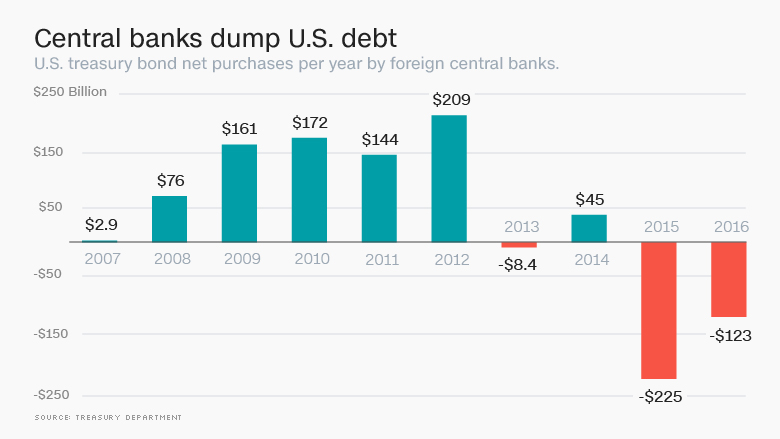
Central banks are dumping America's debt at a record pace.
China, Russia and Brazil sold off U.S. Treasury bonds as they tried to
soften the blow of the global economic slowdown. They each sold off at
least $1 billion in U.S. Treasury bonds in March.
In all, central banks sold a net $17 billion. Sales had hit a record $57 billion in January.
So far this year, the global bank debt dump has reached $123 billion.
It's the fastest pace for a U.S. debt selloff by global central banks
since at least 1978, according to Treasury Department data published
Monday afternoon. Related: Saudi Arabia owns $117 billion in U.S. debt
Treasuries are considered one of the safest assets in the world, but some experts say a sense of panic about the global economy drove the selloff.
"It's more of global fear than anything," says Ihab Salib, head of
international fixed income at Federated Investors. "There's still this
fear of 'everything is going to fall apart.'"
Judging by the
selloff, policymakers across the globe were hitting the panic button
often and early in the year as oil prices fell, concerns about China's
economy rose and stock markets were very volatile.
In response,
countries may be selling Treasuries to prop up their currencies, some
of which lost lots of value against the dollar last year. By selling
U.S. debt, central banks can get hard cash to buy up their local
currency and prevent it from losing too much value.
Also, as investors have pulled money out of developing countries,
central bankers seek to replenish those lost funds by selling their
foreign reserves. Related: China posts worst economic growth in 7 years
The leader in the selloff: China.
"We've seen Chinese central bank foreign reserves fall dramatically,"
says Gus Faucher, senior economist at PNC Financial. "Their currency is
under pressure."
Between December and February, China's central bank sold off
an alarming $236 billion to help support its currency, which China is
slowly letting become more controlled by markets and less by the
government. In March, China sold $3.5 billion in U.S. Treasury bonds,
Treasury data shows.
Experts say the sell off may be slowing down now that global concerns have eased.
If anything, demand is still high for U.S. Treasury bonds -- it's just
coming from private investors. The yield on a typical 10-year bond is
just 1.76%, which is very low.
"While central banks may be
selling Treasuries to support their currencies, investors seek the
safety of Treasuries at the same time," says Jeff Kleintop, chief global
investment strategist at Charles Schwab. --Sophia Yan contributed to this article
ROCKLIN, Calif. (AP) — Perry Lutz says his struggle to survive as a
small businessman became a lot harder after California voters reduced
theft penalties 1½bd} years ago.
About a half-dozen times this year, shoplifters have stolen expensive
drones or another of the remote-controlled toys he sells in HobbyTown
USA, a small shop in Rocklin, northeast of Sacramento. "It's just pretty
much open season," Lutz said. "They'll pick the $800 unit and just grab
it and run out the door."
Anything below $950 keeps the crime a misdemeanor — and likely means the
thieves face no pursuit and no punishment, say retailers and law
enforcement officials. Large retailers including Safeway, Target, Rite
Aid and CVS pharmacies say shoplifting increased at least 15 percent,
and in some cases, doubled since voters approved Proposition 47 and
ended the possibility of charging shoplifting as a felony with the
potential for a prison sentence.
Shoplifting reports to the Los Angeles Police Department jumped by a
quarter in the first year, according to statistics the department
compiled for The Associated Press. The ballot measure also lowered
penalties for forgery, fraud, petty theft and drug possession.
Public Policy Institute of California researcher Magnus Lofstrom noted a
troubling increase in property crime in California's largest cities in
the first half-year after Proposition 47 took effect. Preliminary FBI
crime reports show a 12 percent jump in larceny-theft, which includes
shoplifting, but he said it is too early to determine what, if any,
increase is due to the ballot measure.
The increase in shoplifting reports set up a debate over how much
criminals pay attention to penalties, and whether law enforcement is
doing enough to adapt to the legal change.
Prosecutors, police and retailers, including California Retailers
Association President Bill Dombrowski and CVS Health spokesman Mike
DeAngelis, say the problem is organized retail theft rings whose members
are well aware of the reduced penalties.
"The law didn't account for that," said Capt. John Romero, commander of
the LAPD's commercial crimes division. "It did not give an exception for
organized retail theft, so we're seeing these offenders benefiting and
the retailers are paying the price."
Lenore Anderson, executive director of Californians for Safety and
Justice, who led the drive to pass Proposition 47, said law enforcement
still has plenty of tools, including using the state's general
conspiracy law and proving that the same thief is responsible for
multiple thefts that together top $950.
Shoplifting rings generally recruit society's most vulnerable — the
homeless, low-end drug users, those living in the country illegally — to
steal merchandise that can be sold for a discount on the streets or
over the Internet, said Joseph LaRocca, a Los Angeles-based
theft-prevention consultant and formerly the National Retail
Federation's vice president of loss prevention.
While misdemeanors, in theory, can bring up to a year in county jail,
Fresno Police Sgt. Mark Hudson said it's not worth it to issue a
citation or arrest a suspect who would likely be immediately released
because of overcrowding.
"We've heard of cases where they're going into stores with a calculator
so they can make sure that what they steal is worth less than $950,"
said Robin Shakely, Sacramento County assistant chief deputy district
attorney.
Adam Gelb, director of the public safety performance project at The Pew Charitable Trusts, disputes those sorts of anecdotes.
"The vast majority of offenders just aren't fine-tuning their behavior that way," Gelb said.
His organization recently reported finding no effect on property crimes
and larceny rates in 23 states that increased the threshold to charge
thefts as felonies instead of misdemeanors between 2001 and 2011.
California raised its threshold from $400 in 2010.
"It's hard to see how raising the level to $950 in California would
touch off a property crime wave when raising it to $2,000 in South
Carolina six years ago hasn't registered any impact at all," Gelb said.
The study did not include the effects of Proposition 47, but Gelb and
other Pew researchers said there is no reason to believe adding
shoplifting to the list would spark an increase in thefts.
California is among 17 states without an organized retail crime law that
specifically targets shoplifting rings with tougher penalties,
according to the Organized Retail Crime Resource Center. Results vary:
Of the top five states for shoplifting last year, three — Florida,
Pennsylvania and Texas — had such laws, while California and New York
did not.
For his part, Lutz, the hobby shop owner, has provided police with
surveillance videos, and even the license plate, make and model of the
getaway vehicles.
"They go, 'Perry, our hands are tied because it's a misdemeanor,'" Lutz
said. "It's not worth pursuing, it's just a waste of manpower."
At last year’s WEC, we warned that the collapse of the euro was
underway. We achieved the Yearly Bearish Reversal on the close of 2015,
but we did so far below the number. We had been waiting for the rally to
retest the 11600 level, which we finally achieved. The ECB monetary
policy has been typical banker nonsense and has brought Europe closer to
a major financial crash. Draghi has applied the unsupported quantity of money theory
and assumes he will simply buy in the debt and the cash will
miraculously be spent wildly by consumers. Trading volumes and the
velocity of money have been falling in general since 1996-1998. The low
to negative interest rate policy of the ECB has endangered pensions and
ailing banks, and this is just now beginning to push pensions and banks
over the edge. Draghai will not admit he is wrong, so he will blame
everyone other than himself.
We are looking at a complete
global financial meltdown of the world financial system, which we will
focus on at this year’s WEC. The construct of the common European
currency is no longer sustainable. A completely new monetary system will
be introduced as early as 2018. The fiscal mismanagement of government
perpetually borrowing money they have no intention to pay back threatens
a complete collapse of the world financial system.
The survivability of the euro has now crossed the point of no return.
A daily closing in the cash euro back below 11215 will warn that the
high of May could stand as the end of the reaction from the March 2015
low. A monthly closing back below 10520 level would signal that the
collapse is underway.
At this year’s WEC, we will be focusing on the pension crisis,
sovereign debt crisis, rising pressures for separatist movements, civil
wars, and financial chaos. When will it end? We will explain how to
recognize it from the signs of the past.
The remarkable number of Massachusetts Institute of Technology connected
economists heading central banks appears set to expand once again.
Haifa, Israel-born Ilan Goldfajn, formerly director of economic policy
for the Central Bank of Brazil, is said to be the front-runner to
replace outgoing bank chief Alexandre Tombini, reports Israel Hayom. Brazil's interim President Michel Temer is likely to make a decision by June 8.
Goldfajn earned his undergraduate and graduate degrees in economics from
the Pontifical Catholic University of Rio de Janeiro, and his doctorate
from MIT .
Ben Bernanke, former chairman of the Federal Reserve Bank is an MIT grad.
Current European Central Bank president Mario Drgahi is an MIT grad.
Stanley Fischer, who was the head of the central bank of Israel and who
is the current vice-chairman of the Federal Reserve, studied at the
London School of Economics and obtained his B.Sc. and M.Sc. in economics
from 1962–1966. Fischer then moved to the United States to study at
MIT and earned a Ph.D. in economics in 1969.
He was a professor at the MIT Department of Economics from 1977 to 1988.
While at MIT, he was also Ben Bernanke's and Mario Draghi's Ph.D. thesis advisor.
Rob Kirby arranges gold sales between buyers and sellers by the ton.
Kirby says the biggest concern for his customers is the U.S. dollar.
Kirby says, “The dollar is going to be kicked off its perch. That is a
guarantee. It’s only a matter of time . . . The universal message is
people are trying to get, for the most part, as much of their assets
into physical precious metals as they can. Precious metal is getting
increasingly hard to buy.”
Has Kirby seen demand for precious metals higher than right now?
Kirby says, “No, I haven’t. I also have never seen this much interest to
procure or own physical precious metal. Up until 2010, central banks
were net sellers of gold, and since 2010, they have been net buyers of
physical precious metal, and they never bought more than last year,
except this year will be bigger than last year.
Join Greg Hunter as he goes One-on-One with macroeconomic analyst Rob Kirby of KirbyAnalytics.com.