
Wednesday, January 13, 2016

The US in 2016: No Money for Social Programs, Cash to Burn for the Military

us-army-jared-rodriguez
The US Navy’s “goals and objectives” outline for 2016, released last week, does not mince words: the first goal listed in the second subhead reads: “Buy more ships.”
And that is exactly what the world’s most powerful navy is doing. On Wednesday, the Defense Department announced it was moving forward with plans to replace its Ohio-class ballistic missile submarines, the most lethal killing machines in the history of mankind, with a completely new design beginning in 2021.
Each Ohio-class ballistic submarine is, by itself, the fifth most powerful military in the world. The Navy operates 14 of them. Each submarine carries 24 Trident II missiles, with each missile carrying eight warheads with a yield six times greater than the “little boy” bomb that killed over a hundred thousand people in the US bombing of Nagasaki, Japan, in 1945.
Image: The Navy’s Goals and Objectives outline for 2016
With an effective range of more than 7,456 miles, a single Ohio-class submarine in the waters outside of San Diego could obliterate 192 cities in western China, with a combined population of 400 million people, if the commander-in-chief were so inclined.
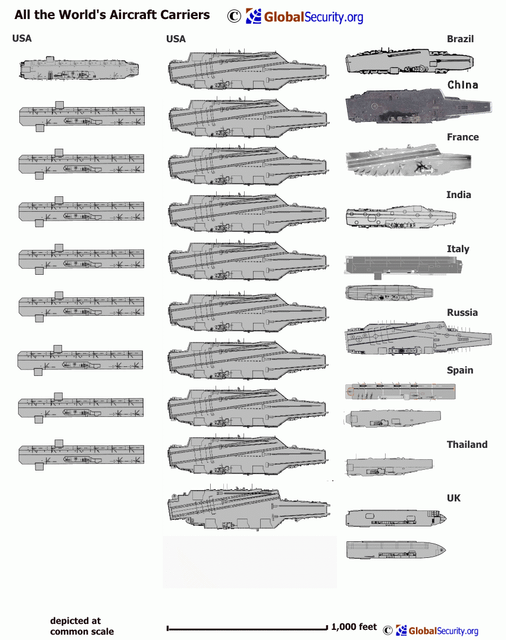
Image: A comparison of the world’s aircraft and helicopter carriers
But the Ohio class is apparently in need of an upgrade, and the White House gave the Pentagon the go-ahead last Monday to send a “Request for Proposal” to the ship’s contractor, General Dynamics Electric Boat, approving funds for the building of a prototype. Each submarine, of which there will be 12, will cost an estimated $6-8 billion—not including research and development costs, the price of each submarine’s nearly 200 nuclear warheads, and associated operating costs—up from $2 billion for the Ohio class.
The day after the White House gave the go-ahead for replacing the Ohio-class submarines, the Center on Budget and Policy Priorities (CBPP) reported Monday that up to a million people will lose food stamp benefits in 2016.
Twenty-three states are expected this year to lift a moratorium on one of the harshest austerity measures imposed by the Clinton administration’s “welfare reform” program, which caps the amount of time many people are eligible for food stamps at three months. The time limits were halted during the recession, but under the pretense that there is “no money,” to pay for food stamps, states all over the country are re-imposing the time limits.
“The loss of this food assistance, which averages approximately $150 to $170 per person per month for this group, will cause serious hardship among many,” reported the organization. The CBPP notes, “USDA data show that the individuals likely to be cut off by the three-month limit have average monthly income of approximately 17 percent of the poverty line, and they typically qualify for no other income support.”
In announcing the food stamp cuts, Clinton pledged to “spend the taxpayers’ money wisely and with discipline, that we can spend more money on the future.” If he had been telling the truth, he would have declared that he was proposing the cuts so that the Navy could “Buy more ships.”
After all, the money has to come from somewhere. And it’s easiest to take from those who are the least capable of defending themselves. In addition to the poor people who depend on food stamps to survive, working class children have been targeted.
The same day that the White House gave the go-ahead for the design of the new submarines, the CBPP released a report showing that funding for schools has been slashed in most states since 2008, and in 15 states by more than 10 percent. Arizona has cut education spending by 23.3 percent, Alabama by 21.4 percent, Idaho by 16.9 percent, and Georgia by 16.5 percent.
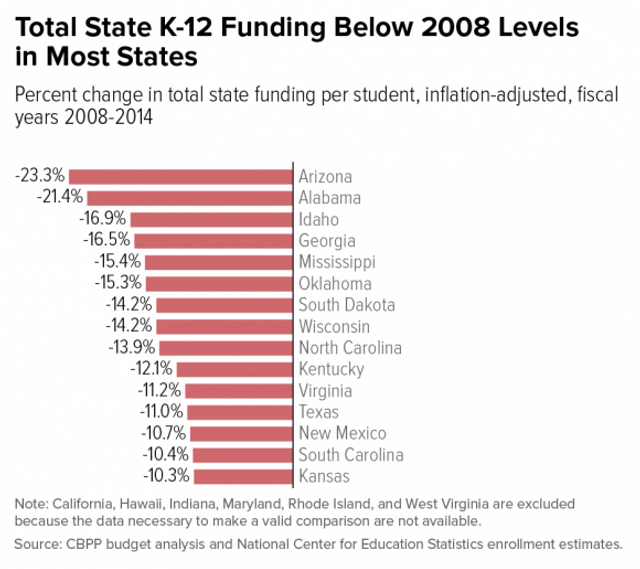
Image: States have slashed education spending since 2008
While there is, of course, no money for children and the poor, defense contractors are licking their chops over the expected uptick in global military spending resulting from the wars flaring out of control in the Middle East and the growing standoff in Eastern Europe and the Pacific.
Defense industry analyst Deloitte gleefully declared earlier this month that military spending is “poised for a rebound” as a result of “heightened tensions” around the world.
It notes,
“2015 was a pivotal year that saw heightened tensions between China, its neighbors and the US over ‘island building’ in the South and East China Seas, and the related claims of sovereign ocean territory rights by China. In addition, Russia and the Ukraine are at odds related to Russia’s takeover of Crimea and their military actions in Eastern Ukraine,”
while “The recent tragic bombings in Paris, Beirut, Mali, the Sinai Peninsula, and other places have emboldened nations to join in the fight against terrorism.”
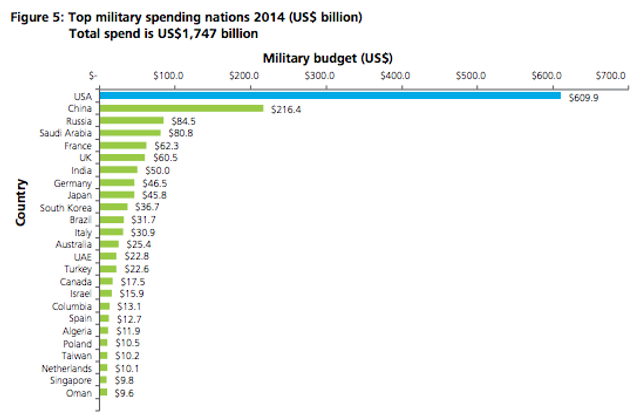
Image: The US spends more on its military than the next seven countries combined
The report notes that “improved profitability” will result from “renewed interest from buyers” in acquiring “armored ground vehicles, ground attack munitions, light air support aircraft” and “maritime patrol ships and aircraft,” as “the military operations tempo is likely to increase and more missions are executed.”
The global uptick in military spending coincides with a major new shopping spree by the United States, which spends as much money on its military as the next seven countries—China, Russia, Saudi Arabia, France, the UK, India and Germany—combined. The US expends $609.9 billion out of the $1.7 trillion spent worldwide by all countries each year on war.
But this figure is slated to surge as “Many large, mainly US [Department of Defense] programs representing billions of US dollars, are likely to start soon, enter the engineering manufacturing design phase, and reach low-rate or full-scale production over the next few years. These programs include Ohio Class Submarine replacement, F-35 fighter jet, KC-46A aerial refueling tanker, and Long Range Strike Bomber.”
Just one of these programs, the F-35 “Lightning II,” plagued with delays and cost-overruns, will cost $1.45 trillion over its lifecycle, more than twice the amount that state, federal, and local governments spend educating 50 million children each year.

Nigerian Currency Collapses After Central Bank Halts Dollar Sales To Stall "Hyperinflation Monster"

Having told banks and investors "don't panic" in September, amid spiking interbank lending rates and surging default/devaluation risks, it appears the massive shortage of dollars that we warned about in December has washed tsunami-like ashore in oil-producing Nigeria. Following the Central bank's decision this week to halt dollar sales to non-bank FX market operators, black market exchange rates spiked to 282/USD (vs 199 official) and CDS spiked to record highs implying drastic devaluations loom.
As Reuters reports, Nigeria's central bank is halting dollar sales to non-bank foreign exchange operators and letting commercial banks accept dollar deposits with immediate effect, its governor said on Monday, in an effort to shore up dwindling foreign reserves.
Africa's biggest economy, an OPEC member state that depends on oil sales for about 95 percent of its foreign reserves, has been hammered by a collapse in global oil prices, which has triggered a slide in its naira currency.

Godwin Emefiele said the sale of foreign exchange to bureaux de change would be discontinued because they were using up the country's foreign reserves for illegal transactions and selling the dollar at 250 naira compared to the official central bank rate of 197 naira.

The currency hit a record low of 282 per dollar on the unofficial market on Monday after the central bank's announcement.

Emefiele said foreign reserves stood at around $28 billion compared with $37 billion in June 2014, and that the bureaux were depleting them at a rate of $28.4 million per week.

"This is a huge haemorrhage on our scarce foreign exchange reserves, and cannot continue," Emefiele told a news conference in the capital Abuja.
To avoid devaluing the currency, a stance so far supported by President Muhammadu Buhari, the central bank adopted increasingly stringent foreign exchange rules last year and effectively banned dollar access for the purchase of 41 items, which has also been criticised at the World Trade Organisation by the United States and the European Union.
The CDS market gives the clearest picture of what traded levels for the Naira may be like...


Implying at least a 20-25% devaluation of the Naira is already priced in to capital markets and any efforts to stall the outflows will inevitably leak (just as they do in China).
As we concluded previously, of course, defending one's currency is a losing game as not only Argentina most recently, but the Swiss National Bank most infamously, will admit.
"As African central banks place restrictions on access to their dollars, while burning through these reserves to support their currencies, they are also storing up longer-term troubles.
“Few investors will want to put money into a country at an official exchange rate that is not set by the market and which is not seen as sustainable in the long run,“ said Charles Robertson, global chief economist at investment bank Renaissance Capital."
For now Africa has avoided the "hyperinflation monster", the result of an all too predictable scarcity of dollars, however the countdown is on and with every passing day that oil prices do not rebound, the inevitability of a full-on continental currency collapse, with hyperinflation and social unrest to follow, becomes increasingly more likely.
Worse, Africa is just the start: while the manifestations will differ, the mechanics of the dollar shortage, which we recently quantified in the trillions of dollars, are universal, and should the Fed's rate divergence path with the rest of the world continue pushing the USD ever higher, soon this USD-shortage will escape the confines of the world's poorest continent and make landfall somewhere where it will be far more difficult to ignore the adverse consequences of the global commodity collapse and the Fed's monetary policy.
*  *  *
Finally, Nigeria has resorted to desperation, apparently lying about upcomgh emergency OPEC meetings (the same M.O. Venezuela used multiple times last year)...
OPEC will soon make efforts to convene before the next scheduled meeting in June as the slump in oil prices is hurting producers, including the world’s biggest exporter, Saudi Arabia, said Emmanuel Kachikwu, Nigeria’s minister of state for petroleum resources.

Even so, there’s been no formal request for an OPEC meeting, according to three delegates who asked not to be identified. And the U.A.E.’s energy minister said OPEC can’t change its policy because of low prices.
“I certainly hope that it doesn’t go below $30 for the sake and survival of everybody” Kachikwu said. “My perception is that we will see it get worse before it gets better.” Oil is seen ending the year at $40 to $50 a barrel, he said.
And then there is this...
  • *NIGERIA'S STATE OIL CO. PLANS FIRST IPO IN 2 YEARS: MINISTER
Well if Aramco can do it!!??

Forget $20 Oil: StanChart Says "Prices Could Fall As Low As $10 A Barrel"

A little over a year ago, Paul Hodges was roundly mocked when in December 2014 he made a drastic call that "Oil May Drop To $25 On Chinese Demand Plunge, Supply Glut, Ageing Boomers." After oil got as close as 40 cents away from the dreaded 2-handle, Paul had the last laugh.
But the bigger point is that not only is $20 oil not a shocker any more, it is largely expected and could be indeed welcomed, as first Goldman, then practically everyone else has now admitted it is just a matter of time before oil trades to levels not seen since the 20th century.
So, perhaps to make a name for himself, the head of commodity research at Standard Chartered, Paul Horsnell decided to lower the bar into even more dramatic territory, and overnight suggested that oil prices could drop as low as $10 a barrel.
"Given that no fundamental relationship is currently driving the oil market towards any equilibrium, prices are being moved almost entirely by financial flows caused by fluctuations in other asset prices, including the USD and equity markets,” Horsnell said. "We think prices could fall as low as $10/bbl before most of the money managers in the market conceded that matters had gone too far."
When does he see oil bottoming? "in extreme case, price floor may be set when entire market believes oil has undershot."
So with a new, and even lower bogey, that means that an upper, or even lower $20-print in oil will be the shocker so many bottom hunters are looking for, but instead after this expectations reset, oil may have to indeed drop another $10 before the BTFD algos can finally make some money.
So with a $10 oil bogey now in the books, here is what others are predicting, courtesy of Bloomberg. Spoiler alert: everyone is bearish.
Energy Aspects
  • Even oil in $20s won’t speed market rebalancing
  • Cost of halting and then restarting production makes output curbs unlikely, even at prices below $30/bbl
  • Risk of further price declines “still on the cards”
ADIA head of research Christof Ruhl
  • Conventional oil producers “can’t win” in battle to drive U.S. shale producers out of market
  • U.S. oil shale showing relentless efficiency gains
Natixis
  • Natixis cuts 2016 Brent forecast by $8.30 to $39.50/bbl
  • “We expect a very slow recovery in oil prices, thanks to the continued resilience of U.S. oil output”
Barclays
  • Strong demand may lead to gasoline shortage in summer
  • Cites new refinery additions less tailored toward light products, increasing demand for petrol in Asia
  • Cut Brent, WTI 2016 fcasts to $37/bbl on “marked deterioration” of mkt fundamentals
  • Represents $23 cut to Brent fcast, $19 reduction on WTI
In short, peak pessimism is here. The only missing link is one major high-cost oil producer (like Venezuela for example) blowing up. It shouldn't be too long.

Record Numbers Of Retired Americans Are Working Part-Time Jobs

Every other aspect of the US economy may be going to hell in a handbasket, with an acute manufacturing recession starting to spill over into the services sector, but at least the US jobs number is "stellar", right?
Wrong.
We showed one way how the BLS fudges the number higher, when we reported on Friday that of the surge in December jobholders, a whopping 324,000 of these new "jobs" were by multiple jobholders, as in 1 person = 2 (or more) jobs, effectively cutting the job gain in half (or worse). Worse, the total number of jobholders surged to 7.738 million, just shy of an all time high, and the highest since August 2008.


And then there is this.
According to a Bloomberg report, a record number Americans who are retired (or are collecting Social Security) worked part-time last month.
In December, a record 2.6 million workers had either reached full retirement or restricted themselves to work-weeks of 34 hours or less due to Social Security income limitations. Individuals can collect Social Security and work with no limit on earnings once they reach full retirement age. However, if they receive Social Security before full retirement age they will lose some of their benefit if they exceed the annual earnings limit. For 2016, this cap is $15,720. The penalty is a $1 deduction in Social Security for every $2 earned above the limit.


What is most disturbing, is that this is the "data" the Fed uses to justify to the world that its decision to hike rates was the right one. Meanwhile, anyone who is not an economist will take on look at the above charts and realize why 7 years ino the "recovery" there has been no wage growth, and why the Fed is shooting itself both in the leg and in the head by hiking at this point.

U.K. Industrial Output Plunges Most in Almost Three Years

U.K. industrial production fell the most in almost three years in November as warmer-than-usual weather reduced energy demand.
Output dropped 0.7 percent from the previous month, with electricity, gas and steam dropping 2.1 percent, the Office for National Statistics said in London on Tuesday. Economists had forecast no growth on the month.
The data highlight the uncertain nature of U.K. growth, which remains dependent on domestic demand and services. After stagnating in October and falling in November, industrial production will have to rise 0.5 percent to avoid a contraction in the fourth quarter. Hindering that by curtailing export sales is the level of sterling, which, despite falling since mid-November on a trade-weighted basis, is still about 15 percent higher than March 2013.
“It seems likely that manufacturing output will do little better than flatline in the final quarter as a whole,” said Ruth Miller, an economist at Capital Economics Ltd. in London. “Given the strong pound and the continued weakness of demand in the neighboring euro zone, we doubt that the recovery in the export-orientated manufacturing sector will get back on track soon.”
The British currency fell as low as $1.4441 after the data, its weakest level since June 2010. It was trading at $1.4445 as of 10:55 a.m. London time, down 0.7 percent from Monday.

Factory Woes

Manufacturing also delivered a worse-than-forecast performance in November, with output dropping 0.4 percent on the month and by 1.2 percent from a year earlier, the biggest annual decline since July. Factories reduced output in each of the past two quarters.
The data follow other reports of weakness in the manufacturing sector. A survey published by Markit this month showed growth cooled in December, suggesting it made little contribution to the economy in the fourth quarter.
According to manufacturers’ organization EEF, companies are feeling increasingly pressured by issues such as the strength of the pound. It said on Monday that only 56 percent of manufacturers say the U.K. is a competitive location, compared with 70 percent a year ago.
Bank of England officials will probably keep their key interest rate at a record-low 0.5 percent this week. Minutes of the meeting released Thursday may reveal their thinking on the fall in oil prices and worries about China’s economy.

Silver, Silliness, Gold, and Risk

The movie “The Big Short” features Michael Burry.  His statement from Zerohedge:
“It seems the world is headed toward negative real interest rates on a global scale.  This is toxic.  Interest rates are used to price risk, and so in the current environment, the risk pricing mechanism is broken.” 
Repeat:  “THE RISK PRICING MECHANISM IS BROKEN.”
What risks could be mispriced?  A few come to mind.
  • The world is saturated in debt – over $200 Trillion. Does anyone expect that debt to be repaid?  What are the risks when over $200 Trillion in debt can be counted as an asset ONLY if that massive and increasing debt can be rolled over and replaced with say $300 Trillion in debt?  What are the risks this exponentially increasing debt nonsense will be acknowledged for what it is – a train wreck in progress?
  • The US stock market looks like it is rolling over, just as it did 7+ years ago in 2008, and 15 years ago in 2000, and 1994, and 1987. What are the risks that the S&P 500 is overvalued, that the P/E and a dozen other measures are overvalued, and the stock market will correct/crash?  Think back to 2008, 2000, 1994, and 1987.  Read:  Tread Lightly – 2016 Technical Outlook.
  • People and countries in the Middle East are not playing nice with each other. Regardless of whether the problems are religious, a 2,000 year feud, outside interference, control over gas and oil pipelines, or foreign policy stupidity, the region appears ripe for turmoil and more violence.  Have risks been properly assessed?  What happens if WWIII is born out of the fires of Middle East hatred, energy markets, and political posturing?  Has that risk been properly priced into bond markets with negative yields, or stock markets with historically high P/E ratios, or crude oil prices at multi-year lows?
  • Silver (paper) prices have been crushed by nearly five years of paper selling, derivatives, central bank manipulations, support for stock and bond markets, and more. Have the risks of financial turmoil, economic catastrophe, and escalating war been properly priced into paper COMEX silver prices?
  • Actual physical gold has left the vaults in the western world and moved east into private and public vaults in Russia, India, and China. Have the risks of paper gold defaults (cash settlement) been priced into the COMEX paper price of gold?  What if much of the gold supposedly vaulted in London, New York, and Fort Knox has mysteriously been replaced by “IOU gold” paper promises?  Have the risks of missing gold and increasing demand for real physical gold been properly priced into the paper gold market?
  • What is the risk of nuclear confrontation between Russia and the US? If we believe the bond markets, the risk is exceptionally low, since the prices of money (interest rates), are at multi-decade or perhaps multi-century lows.  Have the risks of major war, or nuclear war, been mispriced in the bond market?
But looking on the silly side of a broken risk pricing mechanism …  (SARCASM ALERT)
  1. Wall Street financial firms are doing “God’s Work” here on earth and will take care of the rest of us.
  2. Social Security recipients will receive no cost of living increase in 2016 because, per the Social Security Administration, “The law does not permit an increase in benefits when there is no increase in the cost of living.” Good to know there has been no increase in the cost of living during 2015!  Apparently the Obamacare price INCREASES in premiums and deductibles compensated for other price increases…. (reminder – sarcasm alert).
  3. The Presidential race is heating up, but good things might happen in a single party political system masquerading as a two party process. Vote for the least offensive candidate and tell yourself there is a difference, not in the candidates, but in the policies that will be implemented.
  4. But don’t worry, be happy, trust debt based fiat currencies with no intrinsic value, and spend, spend, spend, because “deficits don’t matter.” Frankly, what could go wrong?  Remember – sarcasm alert!
Silver thrives, paper dies!  That mantra will serve us well in 2016 and 2017 since paper silver prices are currently very low compared to ratios to the US national debt, the S&P 500 Index, total global debt, fiscal and monetary silliness, and political stupidity (graphs not shown).  If risk has been mispriced because the “risk pricing mechanism is broken” as Michael Burry says, then we should expect a volatile and traumatic year in 2016 as risk pricing adjusts. 
Rig for stormy weather, expect surprises, markets regressing to the mean, pricing mechanisms failing, political systems collapsing, and Middle-East politics exploding.  There will be blood and trauma.  Do not trust the supposed value of paper assets and find security in real assets such as silver and gold bars and coins stored outside the financial system.

Silver thrives, paper dies!

Gary Christenson
The Deviant Investor

CRASH2: Lalalalalah on the business channels, but one bank says “Sell everything”

BY JOHN WARD

“Sell everything except high quality bonds. This is about return of capital, not return on capital.”RBS yesterday

Tom Orlik of Bloomberg has a piece up this morning pointing out that the Shanghai sieve doesn’t say anything about the Chinese economy, so what’s all the fuss about?
It’s insouciant pieces like this one that make me despair as to where Page One has gone. Surely, if the Shanghai has nothing to do with ‘real’ business, then the whole bourse form of capitalism is shot full of holes?
The TV version of Big B had a British asset manager – obviously a bloke with an illustrious past, so he ought to have something worth listening to – opining at the same level as Orlik….that is, ‘business as usual’. The euro, he said, was 20% undervalued against the Dollar. He didn’t interrogate why the Dollar is so ridiculously high. Nor did he venture a view as to whether the euro is worth anything – let aone 80% of the buck. But he was happy about today’s UK retail results, because the word was that the companies involved had beaten analysts’ expectations. I almost never rate such expectations, because most of the idiots involved don’t know what they’re talking about. In turn, I rarely trust ‘results’ because they are always full of massage and obfuscation. But he didn’t venture anything about why Sterling has weakened against the euro – so I will: Osborne’s scooter has lost a wheel, and has a puncture in the other one.
Finally, the Brit asset expert said eurozone equities – especially the banks – looked like “a good entry point for investors”. I’m so glad. Mainly, I’m glad he isn’t my wealth manager.
As well as chucking Yuan at the Shanghai, the PBOC, it now emerges, is upping spend on the currency to balance the onshore and offshore rates. It also intervened several times during last night’s session. But not to worry, because Tom Orlik says it’s nothing to do with business. And capital flight is nothing to do with business, and the price of the Yuan has nothing to do with exports, and the collapsing price of a Top Ten Company has nothing to do with investment in business and sexual intercourse is totally unrelated to population growth.
One of the UK retailers reporting today is Morrisons. Lots of people are jumping for joy because its like-for-like sales are positive. Put out more flags: people should look more closely at its ROI per square foot in general, and its margins in particular. You can’t have the cheapo sector storming ahead without the middle fatties suffering somewhere along the line. Only Sainsbury has given out the right message – watch the pennies but don’t compromise on quality – and it’s paid off. Tesco and M&S, by contrast, are all over the place.
££££££££££££££££££$$$$$$$$$€€€€€€€€€€€€€€€€€€
The overall point I’m making here is that no major television 24/7 channel is paying any heed to the underlying causes of what’s going on: the growing dominance by, and dysfunction of, bourse globalism, the atrocious lending history of banks, the runaway nature of the UK national debt, the inexperience of the Beijing politburo, the global slump being disguised with QE, the inability of Britain’s poorest 50% to drive a consumption recovery, the overdependence of the London City on commodity trading, the planetary dependence on debt for growth, and the hare-brained geopolitics of oil overladen on an already plunging commodities sector.
The price of oil is now $30.35, and RBS thinks it could drop to $18. Rubbish Bank of Shakey is, without question, one of the most doubtful investments in Europe; but on the other hand, when it comes to being in the mire, there is the old adage that it takes one to know one. On a landscape full of people looking the other way as a mushroom cloud sprouts on the horizon, at the moment RBS is a notable exception.
“Sell everything except high quality bonds. This is about return of capital, not return on capital. In a crowded hall, exit doors are small,” said its latest client note. The investment arm expects stock market corrections of around 20%, while having the nous to note that both investment lending and world trade are way, way down. What, indeed, is the point of rising liquidity if nobody has the confidence to borrow it?
RBS has been ultra-bearish for six weeks now, and it’s hard to argue that they’ve been wrong: the markets are down roughly 6%, and as far as I’m concerned the argument that China doesn’t matter is codswallop: the economy bone is connected to the Shanghai bone, and the China bone is connected to the global bone. Any other view is just idiocy or PR.