Friday, June 19, 2015

When you look back on this time in history, a decade from now, you will wonder how could they have been so foolish.

by James Quinn 
I’ve done it again. For those who don’t like to read a detailed analytical assessment of the stock market valuation, I’ve picked out the key bits from Hussman’s weekly letter. When you look back on this time in history, a decade from now, you will wonder how could they have been so foolish. History books will call this the the Era of Delusion & Idiocy. Ignore the words below at your own peril.
image: http://www.hussmanfunds.com/wmc/wmc150615a.png
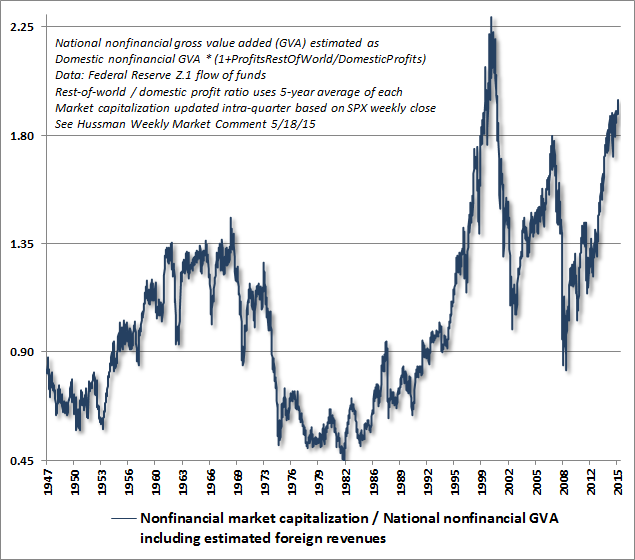
When you look back on this moment in history, remember that spectacular extremes in reliable valuation measures already told you how the story would end.
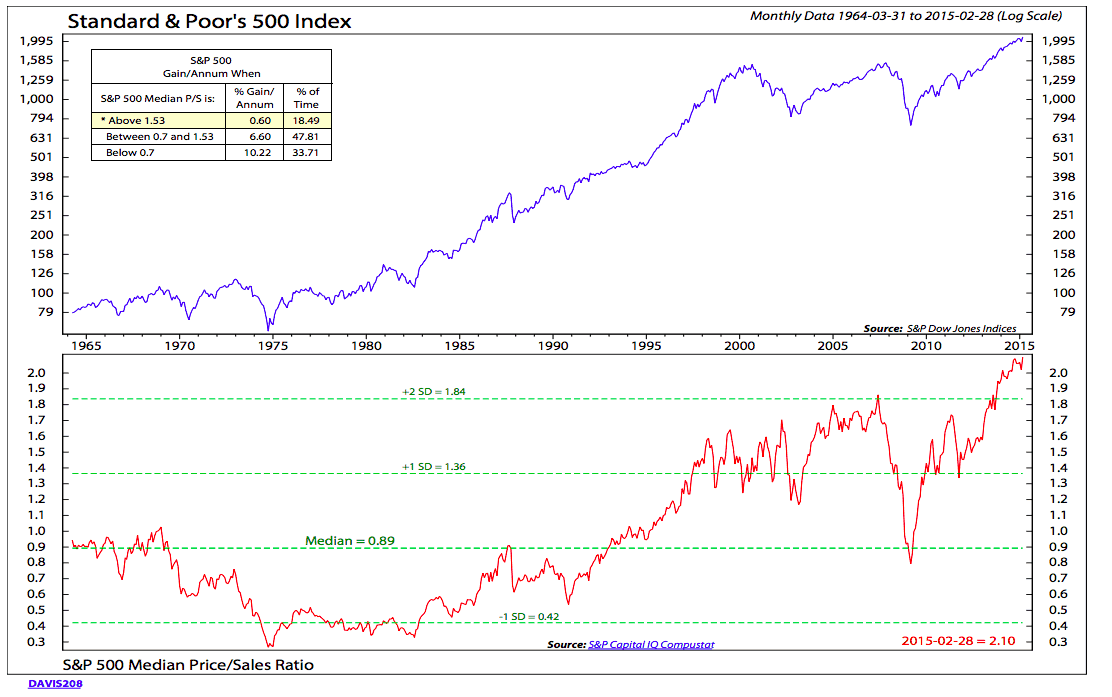
When you look back on this moment in history, remember that the valuation of the median stock was never higher. Ever. Even at the 2000 peak.
When you look back on this moment in history, remember that S&P 500 returns had never materially exceeded zero over the decade following similar valuations.
When you look back on this moment in history, remember that rich valuations had not only been associated with low subsequent market returns, but also with magnified risk of deep interim price losses over shorter horizons.
When you look back on this moment in history, remember that dismal return/risk prospects were grounded in objective historical evidence, not simply opinion.
When you look back on this moment in history, remember that extreme valuations had already been joined by deterioration in market internals and credit spreads.
When you look back on this moment in history, remember that the strongest historical prerequisites for a market crash were already in place.
When you look back on this moment in history, remember that many investors ruled out the possibility of major losses over the completion of the current market cycle because they presumed relationships that could not be established in the data, and assumed the absence of any material economic or financial shock in the coming years.
When you look back on this moment in history, remember that the popular “Fed Model” was a statistical artifact, not a “fair value” relationship.
When you look back on this moment in history, remember that many investors implicitly believed that depressed interest rates and high valuations were good for future stock market returns.
When you look back on this moment in history, understand that all of this evidence was freely available.
Read Hussman’s entire Weekly Letter

Is there a Shortage of Gold in Europe? Will it Be Confiscated?

Some people have misread my posting on an observation in Spain. The retail sales of gold coins in Spain was virtually nonexistent. This is not a shortage of gold. In Italy there were bullion coins being sold in stores. It is France that is after gold coins demanding no cash sales and reporting on buyers and sellers. Even the rare coin shows have left Paris for the dealers refused to comply with such reporting. The French were driving to Belgium to deal in gold and the French government was complaining about that.
Even the banks are requiring explanation of every deposit in an account to get mortgages in the USA. Gold refiners are now required to report even to the US government every shipment of gold reporting where it comes from and where it went.
They seem to be keen on watching gold bullion. The question is why? That seems to be clear from the stand point of eliminating any alternative if they seek to move toward a cashless society.  Look at the former speaker of the House Dennis Hastert who has been charged with lying to federal agents and evading financial reporting requirements called STRUCTURING, reportedly while attempting to conceal past sexual misconduct. This is money you have paid taxes on, but you are withdrawing it in cash to pay off someone else. So you withdraw cash in amounts under $10,000 to avoid reporting. So this is NOT tax evasion, this is failing to tell the government you have paid someone else in cash and they didn’t pay their taxes.
So can they make gold illegal? Only a fool would say no. If it is illegal to pay someone in cash, they will make it illegal to pay someone in gold. This is the direction we are headed in. This is not a personal attack on gold and sure the gold promoters will say I am wrong for they are afraid it might reduce the whole idea of buying gold as an alternative to dollars. But this is the world we face. They are closing in the net from every possible angle. This is not just gold. This is hunting spare change in any form.
[…]
Will they confiscate? History repeats because the passion of man never change. We have to understand this is a economic meltdown. They will not go quietly into the light. They will scream and rage all the way.
http://armstrongeconomics.com/archives/33601

The Monsanto Protection Act is Back, and Worse Than Ever

Comment by truth yesterday
Latest changes to the Pompeo “DARK” Act create an anti-democracy, anti-consumer, anti-environment mega-bill June 15, 2015 (Washington, D.C.) - Center for Food Safety (CFS) today expressed strong opposition to Representative Pompeo’s newly revised genetically engineered (GE) food labeling preemption bill (H.R. 1599), which now has been greatly expanded to not only prohibit all labeling of GE foods, but also to make it unlawful for states or local governments to restrict GE crops in any way. These new provisions would not only prohibit any future state and local laws, but also undemocratically nullify GE crop regulations that have existed in numerous counties across the country for over a decade. The bill would also further weaken already weak federal regulation of GE crops, while at the same time forbidding local communities from opting to protect their citizens, their farmers, and their environments. The bill draft will be discussed at a House hearing on Thursday.
“The Monsanto Protection Act is back, and it’s even worse than before. This bill would strip away a state or local government’s basic rights of local control, and hands the biotech industry everything it wants on a silver platter. No Member of Congress that cares about the rights and concerns of his or her constituents should support this bill,” said Andrew Kimbrell, executive director at Center for Food Safety.
http://www.centerforfoodsafety.org/press-releases/3961/the-monsanto...

With 46 million on foodstamps and 93 million out of the workforce a “defense” budget this big is unjustifiable.

With 46 million on foodstamps and 93 million out of the workforce a "defense" budget this big is unjustifiable.
(CNSNews.com) – The number of beneficiaries on the Supplemental Nutrition Assistance Program (SNAP)—AKA food stamps–has topped 46,000,000 for 38th straight months, according to data released by the Department of Agriculture (USDA).
In October 2014, the latest month reported, there were 46,674,364 Americans on food stamps. Food stamp recipients have exceeded 46 million since September 2011.
image: http://cns7prod.s3.amazonaws.com/styles/ap_image/s3/images/FOOD%20STAMPS-OCTOBER-2014.jpg
ype=”node” title=”Food Stamps Exceed 46,000,000 for 38 Straight Months
The 46,674,364 on food stamps in October was an increase of 214,434 from the 46,459,930 on food stamps in September.
As of July, the national population was 318,857,056, the Census Bureau estimates. Thus, the 46,674,364 on food stamps equaled 14.6 percent of the population.
The number of households on food stamps increased from 22,749,951 in September to 22,867,248 in October, an increase of 117,297.
http://www.cnsnews.com/news/article/ali-meyer/food-stamp-beneficiaries-exceed-46000000-38-straight-months
(CNSNews.com) – The number of Americans 16 years and older who did not participate in the labor force–meaning they neither had a job nor actively sought one in the last four weeks–rose from 92,898,000 in February to 93,175,000 in March, according to data released today by the Bureau of Labor Statistics.
That is the first time the number of Americans out of the labor force has exceeded 93 million.
Also from February to March, the labor force participation rate dropped from 62.8 percent to 62.7 percent, matching a 37-year low.
Five times in the last twelve months, the participation rate has been as low as 62.8 percent; but March’s 62.7 percent, which matches the participation rate seen in September and December of 2014, is the lowest since February of 1978.
image: http://cns7prod.s3.amazonaws.com/styles/ap_image/s3/images/march-labor.jpg
ype=”node” title=”labor chart
BLS employment statistics are based on the civilian noninstitutional population, which consists of all people 16 or older who were not in the military or an institution such as a prison, mental hospital or nursing home.
In March, the civilian noninstitutional population was 250,080,000 according to BLS. Of that 250,080,000, 156,906,000 — or 62.7 percent — participated in the labor force, meaning they either had or job or had actively sought one in the last four weeks.
http://cnsnews.com/news/article/ali-meyer/americans-not-labor-force-exceed-93-million-first-time-627-labor-force
US Defense Spending
http://www.usgovernmentspending.com/us_defense_spending_30.html
https://en.wikipedia.org/wiki/Military_budget_of_the_United_States

Read more at http://investmentwatchblog.com/with-46-million-on-foodstamps-and-93-million-out-of-the-workforce-a-defense-budget-this-big-is-unjustifiable/#XlwHRI3O6VD1hcig.99

Chip maker Intel laying off, but the economy is GREAT!

No worries…they will probably replace the laid off people with H1-B visa holders…….
Intel is quietly making plans to lay off employees across the company later this month in response to disappointing sales.
A confidential, internal memo obtained by The Oregonian/OregonLive indicates that Intel wants to keep expenses flat to match the company’s reduced revenue outlook for 2015, citing plans it announced in April to cut its research and administrative budget by $300 million this year.
http://www.oregonlive.com/silicon-forest/index.ssf/2015/06/intel_facing_disappointing_sal.html#incart_river
Intel’s pending round of job cuts start Monday, part of a broad effort to reduce spending in response to a disappointing start to the year.
A letter that will go to laid-off employees, obtained by The Oregonian/OregonLive, spells out the rationale for the cuts and explains what benefits are available to employees losing their jobs.
“Intel Corporation… has decided to reduce spending in the second half of 2015. As part of that effort, we have made the difficult decision to terminate your employment,” begins the standard notification cover letter, dated June 15. It says laid-off employees will be paid through July 15.
http://www.oregonlive.com/silicon-forest/index.ssf/2015/06/intels_layoff_letter_we_have_m.html

JK

Ron Paul’s “Financial Collapse” Is FINALLY Going To Happen Worldwide


Ron Paul was right about many things, but just ahead of his time. Now there is so much going on at the macroeconomic level that coincides with what Ron Paul has been saying for DECADES that it would take a very dull person or research to not see signs of what may be coming. Not in years or decades, but this year.
Financial collapse is coming. But luckily, we have real alternatives this time, and we’ll be just fine when the banking class eats itself alive and then eventually implodes due to unsustainable debt the rest of us simply have not consented to.
http://www.nytimes.com/2015/05/23/opi…

LICENSE TO WORK – 30% of U.S. Workers Require a License to Perform Their Job


LICENSE TO WORK – 30% of U.S. Workers Require a License to Perform Their Job
1. Occupational licensing drives up costs to consumers. Licensed workers earn 15% more on average than their unlicensed counterparts in other states. Across the U.S. economy, occupational licensing adds at least $116 billion a year to the cost of services.
2. For several occupations that are regulated in some states but not others (e.g. librarians, nutritionists and respiratory therapists), employment growth for those professions was about 20% greater in the unregulated states between 1990 and 2000 than the regulated states.
3. In the 1970s, only about 10% of workers needed an occupational license, but by 2008, almost 30% of the work force needed them.
4. Occupational licensing does nothing to close the inequality gap in the US, and in fact probably makes it worse because it raises wages for some licensed professions but “does little to help the bargaining power of the most vulnerable workers.” In Minnesota, more classroom time is required to become a cosmetologist than to become a lawyer. Becoming a manicurist takes double the number of hours of instruction as a paramedic. In Louisiana, the only state in the country that requires licenses for florists, monks were until recently forbidden to sell coffins because they were not licensed funeral directors. Professor Kleiner goes on to explain that the growth of occupational regulation has prompted opposition from both the right (concerns about economic liberty and reduced competition) and the left (concerns about the poor, who are forced to pay higher prices and face barriers to getting jobs), and then offers some public choice reasons for the ongoing expansion of occupational licensing:
work employment license “job agency” agency u.s. usa america “united states” stats lawyer doctor job “skilled work” electrician Labourer safety inspection research student apprentice apprenticeships expert university certificate “college course” college trust 2015 2016 plumber standard course regulation professional “work visa” profession hairdresser beautician builder “elite nwo agenda” unemployed education “study abroad” “law school” graduate degree “student loan” debt un payed work experience salary training corporate slave real estate alex jones infowars rant max keiser coast to coast am jim rogers end game collapse russia china forex dollar mcdonalds walmart american dream positive thinking daboo77 daboo777 lindsey williams louis farrakhan
MP: In other words, it’s a classic case of well-organized, well-funded, concentrated special interest groups using the political process to take advantage of disorganized, dispersed consumers. The well-organized special interest groups can offer politicians benefits and payoffs in the form of political support, donations and votes, while the disorganized consumers offer the politician nothing. Elected officials won’t generally lose any votes or donations from rationally ignorant consumers by supporting more or stricter occupational regulations, but will be handsomely rewarded with votes and donations from the special interest occupations. As Mencken observed, the political process is often like two foxes (special interest groups and politicians) and a chicken (consumers) taking a vote on what to eat for lunch. MP: In other words, it’s a classic case of well-organized, well-funded, concentrated special interest groups using the political process to take advantage of disorganized, dispersed consumers. The well-organized special interest groups can offer politicians benefits and payoffs in the form of political support, donations and votes, while the disorganized consumers offer the politician nothing. Elected officials won’t generally lose any votes or donations from rationally ignorant consumers by supporting more or stricter occupational regulations, but will be handsomely rewarded with votes and donations from the special interest occupations. As Mencken observed, the political process is often like two foxes (special interest groups and politicians) and a chicken (consumers) taking a vote on what to eat for lunch. The best slave is a slave that doesn’t know he’s a slave. #2 The percentage of working age Americans that have a job right now is still about the same as it was during the depths of the last recession. Posted below is a chart that shows how the employment-population ratio has changed since the beginning of the decade. Does this look like a full-blown “employment recovery” to you?…