Friday, March 6, 2015

The Global Problem: Monetary Policy Can’t Fix An Economy’s Structural Problems

by Charles Hugh-Smith
When we look back from 2025, it will be painfully obvious that central bank policies exacerbated the systemic crises that brought down the global financialization machine.
What with all the praise being heaped on central banks for “saving” the world from economic doomsday in 2008, it’s only natural to ask which structural problems their unprecedented policies solved in the past 6 years. After all, “saving” the world from financial collapse was relatively quick work; so what problems beyond imminent implosion did the central banks policies solve in the past 6 years?
Answer: none. zip, zero, nada. The truth is central bank policies of zero-interest rates and free money for financiers have made many structural problems worse.
Did central bank policies resolve the structural problem of unfunded pension and retiree healthcare liabilities? No, they made it worse, as zero-interest rates have reduced the yields on pension funds, 401Ks and IRAs to mere pittances. This destruction of safe yields has driven pension funds into risky investments in junk bonds and stocks, leaving them vulnerable to devastating losses when the current credit bubble bursts.
Did central bank policies resolve the structural problem of corporate wealth buying political influence? No, they made it worse, by encouraging corporations to borrow vast sums to use on whatever they fancied–for example, lobbying and share buybacks.
Did central bank policies resolve the structural problem of rising dependence on credit for weak “growth”? No, they made it worse, as cheap money enabled the re-emergence of subprime loans to marginal borrowers. The deterioration of credit quality guarantees a credit crisis and bubble pop as marginal borrowers default.
Did central bank policies resolve the structural problem of low investment in new assets that boost productivity, enabling widespread advances in wealth? No, they made it worse, as near-zero interest rates for financiers and corporations and limitless liquidity have incentivized debt-based speculation and highly leveraged bets on completely unproductive projects such as share buybacks, which boost the value of corporate insiders’ stock options while producing no new goods or services.
Did central bank policies resolve the structural problem of rising wealth/income inequality? No, they made it worse, by boosting the value of assets owned by the super-wealthy .01% and to a lesser degree, the top 5%.
Did central bank policies resolve the structural problem of moral hazard, the separation of financial risk from consequence? No, they made it worse, as monetary policies were designed not to help Main Street but to recapitalize Wall Street banks by diverting tens of billions of dollars that were once paid in interest to depositors straight into the banks’ coffers.
Nothing has changed: private banks are free to make risky bets, knowing that if the bets go sour the state or central bank will make good their losses.
image: http://www.oftwominds.com/photos2015/usfed-sum3-15a.png
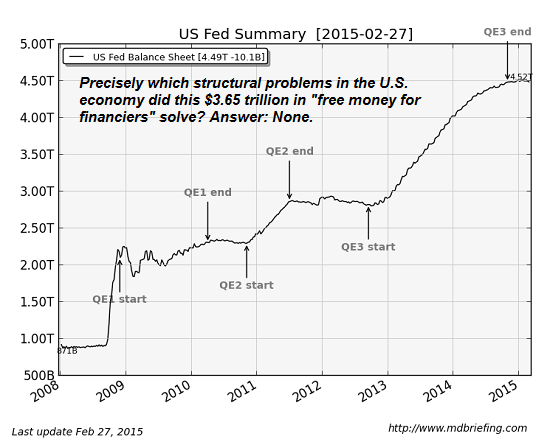
Did central bank policies resolve the structural problem of sovereign debt, i.e. central states overborrowing and saddling future generations with crushing debt loads? No, they made it worse, as zero-interest rate policies have enabled central states to borrow gargantuan sums without the interest due on the debt squeezing out other spending.
image: http://www.oftwominds.com/photos2015/us-debt3-15.png
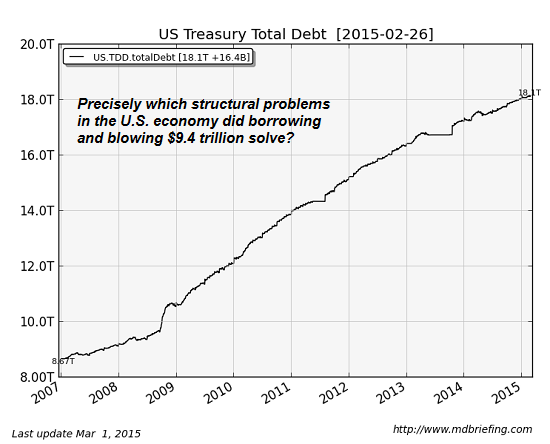
When credit is nearly free, there’s no need to make hard choices or face the costs of systemic corruption, waste, fraud, cronyism and inefficiency; just borrow another trillion dollars, yen, euros or yuan to prop up parasitic elites and vested interests.
When we look back from 2025, it will be painfully obvious that central bank policies exacerbated the systemic crises that brought down the global financialization machine. Extend and pretend only increases the power and amplitude of the crises that will eventually burst forth from the monetary dysfunctions and distortions that are currently praised as financial genius.

Water Wars are Coming


one day the water will run out …
Website: zerohedge.com
Posting credit: Tyler Durden, zerohedge.com
Submission credit: James E Miller via Mises Canada blog,
Link: http://www.zerohedge.com/news/2015-03…

A customer walked into his pizza shop and changed Philadelphia with $1 and a single Post-it note.


Philadelphia is the poorest large city in the United States.

And it's the city with the worst deep poverty rate in the country, with roughly 185,000 people (including 60,000 kids) living on incomes below half of the federal poverty line. With that, homelessness is on the rise, and the city doesn't have enough resources to be there for everyone.

Heavy, right?

Well, I don't mean to bum you out. Actually, I want to shine a big, bright light on some people who are giving Philadelphia's homeless a daily taste of hope and kindness.

At one Philly pizza parlor, customers can "pay it forward" by pre-purchasing $1 slices of pizza for people in need.

Owner Mason Wartman, who left his Wall Street desk job to open Rosa's Fresh Pizza, says pay-it-forward pizza started with one customer, one dollar, and one Post-it note.

Mason Wartman stands at the helm of Rosa's Fresh Pizza.
The customer was inspired by an Italian coffee house practice called caffè sospeso (suspended coffee), by which customers can pre-purchase cups of coffee for less fortunate customers. Wartman wrote the purchase on a Post-it and slapped it on the wall behind the register to be redeemed by the next homeless patron to enter the store.

As word spread, more and more customers participated.

And Rosa's wall blossomed with colorful notes signifying acts of kindness — and a guaranteed slice for everyone who walked in, regardless of their ability to pay.

Since that first pay-it-forward slice, Rosa's has provided nearly 10,000 pizza slices to needy Philadelphians.

Pre-purchased slices now represent a whopping 10% of Rosa's business. And it's having a remarkable impact on the community, showing not only that acts of kindness can be contagious, but also how a small gesture of support can have a ripple effect of positivity.
In the video, Wartman tells the story of a homeless regular who disappeared for a while only to return having found a new job and wanting to pay it forward as others had done for him. And in an interview with the Pittsburgh Post-Gazette, Wartman notes that some have even said the program has helped to keep them out of trouble with the law:
"[Wartman] said people who receive the slices have told him the generosity helps them avoid committing petty crime to get money for food. 'I knew it saved people money,' Mr. Wartman said. 'I hadn't considered that it stopped people from committing crime.'"

If one small business acting as a hub of kindness can have this kind of effect, imagine the potential impact of an entire community of businesses and their customers doing the same thing.

If you'd like to see more of this sort of thing in your neighborhood, share this story with folks at your favorite local businesses and ask your friends to do the same. I know I will.

Next bit of Upworthiness:

ThisKid'sScaryPersonificationOfDepressionGivesMeChills

Walmart Workers to Earn $10 an Hour; Walmart Heirs “Earn” $445,776 an Hour


walmartsuper_590


Thanks to three years of organizing, 500,000 Walmart workers will soon get a raise.
Scott Klinger
Over the last three years, strikes and pickets by Walmart’s low-wage employees have steadily expanded. Last Black Friday, protests were staged at more than 1,000 Walmart stores across the U.S. Dozens of employees were arrested.
Late last month, the nation’s largest private employer finally responded by agreeing to raise its workers’ pay to $9 an hour by April and $10 an hour by next February. The announcement means half a million Walmart employees – almost 40 percent of the company’s U.S. workforce – will be getting a raise, including 6,000 who currently make the federal minimum wage of $7.25 an hour.
After the raise, the lowest paid full-time Walmart worker will be making $20,080 a year; the typical 28-hour per week part-time employee, $14,560. The poverty line for a family of three is $20,090.
Walmart’s exceedingly low-wage structure has forced many of its employees onto public assistance programs to supplement their earnings. Public nutrition, health care, and housing assistance provided to Walmart workers cost U.S. taxpayers $6.2 billion a year, according to a 2014 study by Americans for Tax Fairness. Walmart’s recent announcement will lower, but not eliminate, the subsidies the American people pay to Walmart.
unnamed_3
Walmart’s retired CEO makes $1,070 an hour, even while he sleeps.
By contrast, Walmart’s former CEO, Mike Duke, earned $44 million in his last three years at the company’s helm – $4,751 an hour assuming a 60-hour workweek – and left with a retirement package valued at $140 million. If Mr. Duke converted his golden nest egg to an annuity, he would receive a monthly check for $770,000 – $1,070 per hour around the clock, even while he is sleeping.
But wait, it gets even more unfair: the Walton heirs “earned” $445,776 an hour on the increase in the value of the stocks they inherited – in just the last five years.
Together, Walton’s daughter-in-law, Christy, and children Alice, Jim, and Rob Walton own half the company’s stock and had a combined net worth of $157.5 billion last year, an amount equal to the combined net worth of 42 percent of America’s families. They occupy slots six through nine on the Forbes 400 list of richest Americans.
While low-income Americans struggled through the Great Recession, the Waltons have seen their combined wealth more than double since 2009 (when it was just $79.4 billion). If their wealth gain over the last five years was converted to an hourly wage, each of the four would have “earned,” on average, $445,776 each and every hour for the last five years.
The good news: the race to raise the wage floor in the retail sector is on.
Walmart was not the first retailer to significantly increase pay for workers at the bottom of the pay ladder. Furniture retailer IKEA announced it would increase the average minimum wage of its U.S. workforce to $10.76 an hour – with workers in low cost-of-living areas getting a boost to $8.69 an hour, and workers in highest cost-of-living regions seeing their paychecks bump to at least $13.22 an hour.
GAP also joined the wage-raising party last year, raising their workers’ pay to $9 an hour in 2014, and $10 this year. Last month, health insurer Aetna raised the minimum pay for its lowest-wage workers to $16 an hour, which boosted pay for 12 percent of the company’s workforce.
Costco, a direct competitor of Walmart’s Sam’s Club wholesale stores, uses a business model that stresses paying hourly workers well in order to keep turnover low. Costco pays its hourly workers an average of $20 an hour, far higher than the $11.39 an hour average for retail workers. Fewer than five percent of its workers leave each year.
Wal-Mart could do a lot more.
While Walmart’s announcement is a step in the right direction, the company can and should do far more.
Today, Walmart generates pre-tax profits of $13,866 per employee in its U.S. operations. (Pre-tax profits are what remains after all of the expenses of the business – salaries, costs of merchandise, utilities, except taxes, are paid). Walmart’s profits per employee are near the top of the retail industry. Moreover, Walmart’s profits per employee have been trending higher over the last five years, having grown more than 10 percent since 2010.
graph_2_0.jpgSource: Walmart 10-K annual reports filed with the U.S. Securities and Exchange Commission
Walmart also generates more profits from each employee’s labor than most of its retail competitors.
graph_1_0.jpgSource: Company 10-K annual reports filed with the U.S. Securities and Exchange Commission. Significant Walmart competitors including Costco and Target were excluded because they have significant non-US stores, but only disclose data for their global workforce, making it impossible to determine sales per U.S. employee.
Let’s cheer for Walmart’s wage announcement and then get back to pressuring the company to share more of its profits with the workers who have helped create such astounding wealth.
Scott Klinger is Director of Revenue and Spending Policies at the Center for Effective Government. Prior to joining Center for Effective Government, Scott was the Tax Policy Director at the American Sustainable Business Council and an Associate Fellow at theInstitute for Policy Studies, where he wrote about issues of tax and economic inequality.
This piece was reprinted by RINF Alternative News with permission or license.

U.S. foreign aid to Israel: 2014 congressional report

Last updated: March 2, 2015
The 2015 visit of Israeli prime minister Benjamin Netanyahu to address a joint session of Congress has opened up a rare split in the relations between the United States and Israel, its strongest ally in the Middle East. On its surface, the issue appears to be purely political: Netanyahu was invited by House Speaker John Boehner without consultation of the White House, an apparent violation of protocol. While Netanyahu intends to address what he says is the growing threat from Iran, President Obama expressed concerns that the visit could be an attempt to influence the upcoming election in Israel, and will not meet with the prime minister.
Still, if the past is any judge, U.S.-Israel relations will recover. Since it was founded in 1948, Israel has become the largest single recipient of U.S foreign assistance — a total of $121 billion, almost all of which has been in the form of military assistance. A 2014 report by the Congressional Research Service, “U.S. Foreign Aid to Israel,” highlights this historical support for Israel, as well as the current appropriations of defense funding and the key areas of military collaboration. (The report is an update of the 2012 edition, available here.)
The 2014 report’s findings include:
  • In 2007 the Bush Administration established a 10-year, $30 billion Israeli military aid package for fiscal years 2009 through 2018. The Obama Administration budgets have held true to this commitment, with $3.1 billion allocated for FY2014 and the same amount requested for FY2015.
  • This FY2015 foreign military financing (FMF) level would constitute roughly 55% of the United States’ total FMF funding worldwide and would finance 23% to 25% of the overall Israeli defense budget — percentages that clearly demonstrate the U.S. commitment to Israeli security and Israel’s dependence on U.S. support.
  • Since 2008 Congress has required the executive branch to submit biennial reports on “maintaining Israel’s Qualitative Military Edge (QME) over neighboring militaries.” The report states that “the rationale for QME is that Israel must rely on better equipment and training to compensate for being much smaller geographically and in terms of population than its potential adversaries.”
  • In addition to the $3.1 billion in FY2015 funding, the Obama Administration also requested $96.8 million for joint US-Israeli programs and $175.9 million for Iron Dome, Israel’s short-range anti-rocket system. This funding is provided in regular U.S. defense authorization and appropriations bills and does not formally constitute direct bilateral aid.
  • The Iron Dome system has cumulatively received more than $704 million in U.S. financial support, with an additional $235.3 million appropriated in the FY2014 appropriations act and the $175.9 requested for FY2015. The U.S. has also assisted with the development of Israel’s David’s Sling long-range missile defense system, and since 1990, has contributed $2.365 billion to the Arrow Anti-Missile System, just under half of the program’s total cost.
  • Up to 26.3% ($815.3 million in FY2014) of U.S. FMF to Israel may be used for procurement from Israeli defense companies, enabling Israel to build a domestic defense industry that ranks in the top 10 of arms suppliers worldwide. No other recipient of U.S. military assistance is granted this benefit.
  • U.S. support isn’t limited to monetary gestures either. In 2008, the U.S. began the deployment of the X-Band Radar system on Israeli soil; an operation that remains U.S. owned and is staffed by U.S. troops. Not only is the X-Band system “far more capable of detecting incoming missiles than Israel’s natively produced radar system, but the United States has linked the X-Band to its global network of satellites in the U.S. Defense Support System.”
  • The U.S. Defense Department also stores military supplies on Israeli bases in preparation for combat, and if needed, Israeli forces can request use of these supplies from the U.S. government in times of emergency, as happened in the 2006 conflict with Hezbollah. The value of the U.S. materiel stored in Israel increased to $800 million in 2010, with Congressional approval for up to $1.2 billion.
  • The United States and Israel announced in 2010 that Israel will use $2.75 billion in FMF grants to purchase 19 F-35 Joint Strike Fighters. Originally expected to be delivered in 2015, the aircraft are now projected for a 2016-2017 delivery date. An advanced but extremely expensive aircraft, the F-35 has experienced technical and budgetary troublesfor more than a decade.
The United States also provides Israel with financial assistance not related to defense. This includes:
  • Since 1973 Israel has received annual grants from the State Department’s Migration and Refugee Assistance program to assist with the resettlement of migrants in Israel. Funding levels, which were at $60 million annually as recently as 2003, have decreased in recent years, with FY2014 at $15 million and the Obama Administration requesting $10 million for FY2015.
  • In 2003 Israel received $9 billion in loan guarantees over three years for economic recovery. The law authorizing the guarantees stated that they could only be used within Israel’s borders prior to June 5, 1967. The U.S. Department of State later reduced the FY2003 loans by nearly $290 million because Israel continued the construction of settlements in the occupied territories and other actions. In FY2005 the available funds were cut by nearly $800 million, and Israel has not borrowed any funds since that year.
  • In 2012 Congress passed and the president signed a bill extending the loan-guarantee program until September 2015. “As of 2014, Israel is still authorized to issue up to $3.8 billion in U.S.-backed bonds. In general, Israel may view U.S. loan guarantees as a ‘last resort’ option, which its treasury could use if unguaranteed local and international bond issuances become too expensive.”

GOLD STILL TESTING $1200 AS NEW YORK TRADERS START LOSING FAITH IN ‘GLITCHES’, AND FRENCH UNEMPLOYMENT HITS 10.4%

BY JOHN WARD
image: http://hat4uk.files.wordpress.com/2015/03/hollandecheek.png?w=812
hollandecheekFrancois Hollande: viewing news with tongue in cheek

Glitches, Gold and Gaul: the truth will out

“I’ve been monitoring this for some time,” a NYSE contact told me last Monday, “and just about the only time these electronic glitches occur is when the market looks ready to choke.”
Now today a Greek contact sends me a guest piece at Paul Craig Roberts: note the uncanny resemblance:
‘Every time the S&P 500/Dow are in a free-fall, one of the big HFT electronic commications networks (ECNs) mysteriously “breaks”…today the S&P 500 was down 16 points and falling quickly. Then the BATS ECN announced that it had to suspend trading in all of its trade routing systems to the NYSE. It just so happens that BATS is one of the largest, if not the largest, electronic communication networks in the world. This happens every time the stock market goes into cliff-dive mode. How come it NEVER happens when the S&P 500 is going parabolic to the upside?’
A few years back, this would’ve been dismissed as conspiracy NVE drivel, but not today: being prepared to report these things in 2015 is no longer the ‘pilots won’t report UFOs’ thing: after Libor, the RBS repossession scam – and some pretty crude gold manipulation – even the fans of bourse monopolism accept that the unmentionable solids come in all the sizes, all the shapes, and profusion down there in the deep liquidity pools of light-speed trading.
Talking of gold, I posted recently about gold continuing its steady value destruction process. Yesterday afternoon it challenged $1200 a couple of times. This morning at 8.00am and 11.35am CET it tested the same level again. In the context of current events, this is so ludicrously counterintuitive, it would be funny if lots of not that wealthy retired folks weren’t getting so monumentally screwed.
But some fundamentals simply can’t be ignored forever. Today, the French government released statistics showing that the country has a quite astonishing level of unemployment: 10.4%. At this rate, France will soon be applying for official membership of ClubMed. The French press have used the term “highest for 17 years”, but even this is putting a brave face on it: it’s 17 years since new and incomparable records began to measure ‘real’ French unemployment. The chances are this is the hexagon’s worst set of figures since the late 1940s.

Mainstream Financial Experts Recommend: Take Out A Loan And Invest In Stock Markets

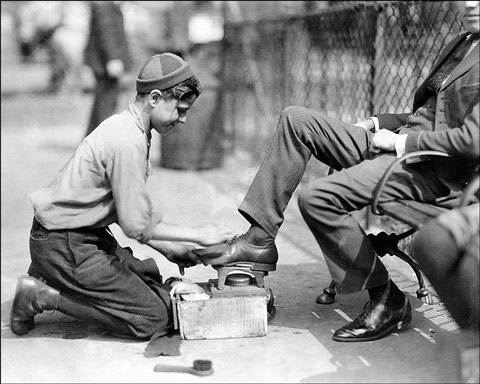
shoeshineboy(Pictured: Shoeshine Boy In New York City Circa 1924)
The anecdote goes that avid investor Joe Kennedy was on his way to work in the winter of 1928 and stopped to have his shoes shined. When the shoeshine boy finished he offered up a tip to Kennedy.
“Buy Hindenburg,” he told the millionaire.
Kennedy soon unloaded most of his holdings. When pressed by friends and associates about his reason for selling, Kennedy quipped:
“You know it’s time to sell when shoeshine boys give you stock tips. This bull market is over.”
Less than a year later stock markets around the world collapsed, leaving tens of millions of people impoverished for decades to come.
Kennedy knew something was wrong when everyone, including a shoeshine boy, was talking about the stock market as some sort of magical money making tree.
While the circumstances today may not be exactly like those of the 1920′s, one can’t help but see the similarities.
And though we don’t know of any shoeshine boys giving stock tips today, the following CNBC segment offers a similar warning of market exuberance and irrationality.  In it, several well known financial pundits discuss a new strategy that can help you generate serious gains.
As we all know it takes money to make money. But where do you get your investment capital?
Take out a loan, of course, because stock market prices, like real estate values, can only go up from here.
Watch below as Bill Griffeth and Kelly Evans host WSJ’s Jonathan Clements and Premier Financial Advisors’ Mark Martiak for a discussion on what we’re calling the car-stock arbitrage wherein you are (literally) encouraged to take out a 7 year loan with a rapidly amortizing asset as collateral in order to buy stocks. (Zero Hedge)

Wall Street Journal financial columnist Jonathan Clements explains how you, too, can make money in a stock market that has reached all-time highs:
I think it’s a reasonable trade-off. You know, borrow at three or four percent and then go up and invest in the stock market. I wouldn’t actually really be that concerned about whether the car is going to depreciate or not. Yeah, we know the car is going to lose half of its value in the first four years…
The question is ‘what is the better financial transaction to do?’
And if you take a holistic view of your finances, yeah you probably want to take out that loan and invest in equities.
There you have it.
Oh, and when you do get that low interest loan, don’t forget to “Buy Hindenburg.”