Tuesday, May 6, 2014

Banca d’Italia Comes Clean: Half of Italy’s Gold is Held in New York Fed Vault

Italy’s central bank, the Banca d’Italia, has recently published an important document detailing the storage locations and composition of the country’s gold reserves. The document confirms that Italy’s gold is held across four vault locations, three of which are outside Italy.
This is a significant announcement given that the Banca d’Italia is the world’s third largest official holder of gold after the U.S. and Germany. Italy officially holds 2,451.8 tonnes of gold, worth more than €72 billion (US$ 100 billion) at current market prices [1].
In the detailed three page report focusing exclusively on its gold reserves (and only published in Italian), the Banca d’Italia reveals that 1,199.4 tonnes, or nearly half the total, is held in the Bank’s own vaults under its Palazzo Koch headquarters on Via Nazionale in Rome, while most of the other half is stored in the Federal Reserve Bank gold vault in New York.


From Goldcore:
Today’s AM fix was USD 1,285.00, EUR 927.26 and GBP 761.03 per ounce.
Yesterday’s AM fix was USD 1,283.00, EUR 924.15 and GBP 759.04 per ounce.
Gold fell $5.50 or 0.43% yesterday to $1,284.90/oz. Silver slipped $0.13 or 0.68% yesterday to $19.06/oz.
Gold remained in range bound trading yesterday and into this morning, fluctuating between $1,280 and $1,285/oz. Likewise, silver traded in a narrow band between $18.90 and $19.10/oz. The precious metals appear to be treading water while awaiting the open of New York morning trading, and the release of the latest U.S. non-farm payroll figures today.
Consensus payroll data estimates from surveyed economists indicate improving expectations for April and a possible drop in the unemployment rate. Any surprises in the U.S. payroll data today could be the catalyst to move the gold price out of its very narrow trading pattern, although given that it’s the end of the trading week, the short term direction for gold may not become apparent until next week.
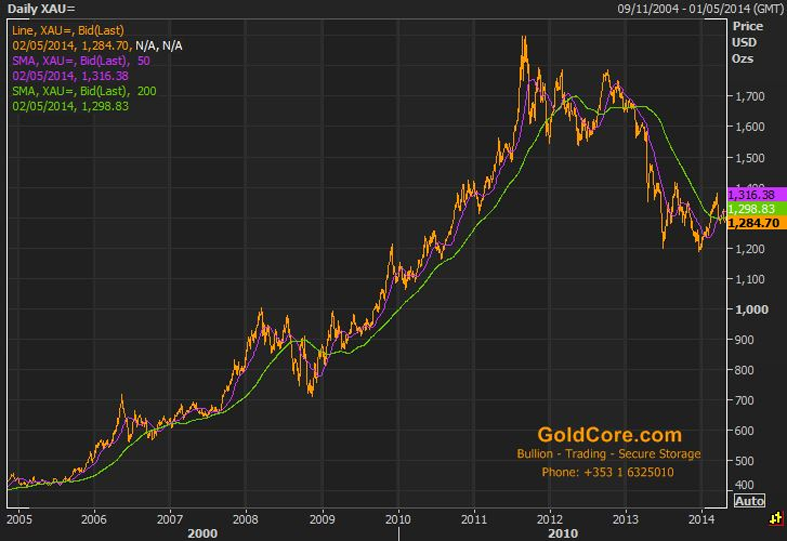
Gold in USD Simple Moving Averages, 9 Years – (Thomson Reuters)

Italy May Have Over 1,000 Tonnes Of Gold At The New York Fed
Written by Ronan Manly

Italy’s central bank, the Banca d’Italia, has recently published an important document detailing the storage locations and composition of the country’s gold reserves. The document confirms that Italy’s gold is held across four vault locations, three of which are outside Italy.
This is a significant announcement given that the Banca d’Italia is the world’s third largest official holder of gold after the U.S. and Germany. Italy officially holds 2,451.8 tonnes of gold, worth more than €72 billion (US$ 100 billion) at current market prices [1].
In the detailed three page report focusing exclusively on its gold reserves (and only published in Italian), the Banca d’Italia reveals that 1,199.4 tonnes, or nearly half the total, is held in the Bank’s own vaults under its Palazzo Koch headquarters on Via Nazionale in Rome, while most of the other half is stored in the Federal Reserve Bank gold vault in New York. The report also states that smaller amounts are stored at the Bank of England in London, and at the vaults of the Swiss National Bank in Bern, Switzerland.
The Gold in Rome
Of the 1,199.4 tonnes held in Rome, 1,195.3 tonnes are in the form of gold bars, with 4.1 tonnes held as gold coins (871,713 coins). There are 95,493 bars in the Rome vault, most of which are the standard trapezoidal shaped bars, however the holdings also include brick shaped U.S. Assay Office bars produced by the U.S. Assay Office, and another bar type which the Bank d’Italia refers to as ‘panetto’ (or loaf) shaped ‘English’ bars.
Like other major European central banks, the Banca d’Italia’s gold reserves were mainly accumulated during the late 1950s and early 1960s. Although Italy was already an important official gold holder during the first half of the 20th century, it still only held 402 tonnes of gold as of 1957. However, from 1958 until the late 1960s, the country’s gold reserves increased nearly 600% to exceed 2,560 tonnes by 1970[2].
Since 1970, Italy’s gold holdings have remained fairly constant, although at times some of the gold has been used in various financial transactions such as gold collateral against a German loan during the 1970s, and as contributions to the European Monetary Cooperation Fund (EMCF) and more recently to the European Central Bank (ECB).


The RAI Broadcast, the BIS and Bern
While the report from the Banca d’Italia appears to be the first official written confirmation that documents the exact storage sites of its gold reserves, the four storage locations were previously confirmed to Italian TV station RAI in 2010 when an RAI presenter and crew were allowed to film a report from inside the Bank’s gold vaults in Rome.
In the RAI broadcast for an episode of ‘Passaggio a Nord Ovest’, the presenter Alberto Angela states that in addition to Rome, the Italian gold is stored at the Federal Reserve Bank in New York, the Bank of England in London, and at the Bank for International Settlements (BIS) in Switzerland. The reporter uses the exact words “Banca dei Regolamenti Internazionali”.
The BIS connection was also confirmed in August 2009, when Italian newspaper “La Repubblica” published an article about Italy’s gold, stating that it was held in Rome, at the Federal Reserve in New York, in the vaults of the the Bank of England, and in the ‘vaults’ of the BIS in Basel.
This apparent contradiction between, on the one hand, the RAI and La Repubblica, who both state that some of the Italian gold is stored with the BIS in Switzerland, and on the other hand, the Banca d’Italia’s own document which states that its gold in Switzerland is stored at the Swiss National Bank (SNB) in Bern, is not really a contradiction since the BIS does not have its own gold storage facilities in Switzerland. The BIS simply uses the SNB’s gold vaults in Bern.
The BIS confirms this fact on its web site, under foreign exchange and gold services, where it states that it offers its clients “safekeeping and settlements facilities available loco London, Bern or New York”.[3] The term loco refers to settlement location for precious metals transactions.
By confirming that it stores gold at the Swiss National Bank in Bern, the Banca d’Italia has also inadvertently confirmed that the Swiss National Bank’s gold vaults are located in Bern. While this was generally known, the SNB currently will not confirm this fact publically and does not go beyond saying that it stores its own gold “domestically and internationally” in “decentralised” locations.[4]
However, Bern based Swiss newspaper “Der Bund” published an article in 2008 stating that the SNB’s gold vaults are in Bern, specifically underneath the Bundesplatz square which is adjacent to the SNB’s headquarters at No. 1 Bundsplatz. The SNB has two headquarters, one in Bern, the other in Zurich.
So it appears that the Italian gold in Switzerland is on deposit with the BIS (either earmarked or as a sight deposit) and is, at the same time, stored in Bern at the SNB vaults. Therefore the RAI and La Repubblica reports and the Banca d’Italia report are most likely both all in agreement, since they are merely saying the same thing, just in different ways. Another possibility is that the BIS sight deposit was converted back to earmarked gold in the SNB vault sometime since the 2010 RAI broadcast.
The reason for the confusion is because the Banca d’Italia will not confirm any of these details about how their gold in Bern is held, and they stated last week that they cannot comment beyond what is published in their April document.
Some of the details in the Bank’s gold reserve document were also confirmed a week prior to its publication when three Italian senators from Beppe Grillo’s political party Movimento 5 Stelle (Five Star Movement), namely, the party treasurer Giuseppe Vacciano, Andrea Cioffi and Francesco Molinari, visited the Rome vault on 31st March 2014.
The senators’ report states that as well as the 1,199.4 tonnes of gold held in Rome, “the remainder is mostly deposited at the Federal Reserve”, but also at the Bank of England and at “la Banca Centrale Svizzera” (which is the Swiss National Bank). The senators also reported that “For confidentiality reasons we were not notified of the exact extent of the deposits in different countries”.
Italian Gold in New York
As per the senators’ experience, the Banca d’Italia document does not specify how much of the Italian gold is held in New York, London and Bern, beyond stating that most of the gold that is not stored in Rome is stored in New York. However, the document does state that “the bulk” of foreign stored gold is in New York with “contingents of smaller size” located in London and Bern, so essentially it implies that the London and Bern holdings are not very large.
Of the 1,252.4 tonnes not in Rome, technically, a majority of this figure is anything greater than 626.2 tonnes. So with a simple calculation, there is at least 626.2 tonnes of Italian gold in New York.  But given that the “bulk” of 1,252.4 tonnes is in New York as the Bank’s document implies, and that “most of the remainder” not in Rome is in New York as the senator’s comments imply, then there could be anywhere up to between 1,000 tonnes and 1,200 tonnes of Italian gold in the FRB in New York.
In fact, 522 tonnes of this Italian gold that was earmarked at the Federal Reserve in New York in September 1974 was used as gold collateral for the Bundesbank loan to Italy during the first gold loan to Italy between 1974 and 1976. This collateral rose to 543 tonnes between 1976 and 1978.
London – The Bank of England
It is possible using historical data and records of Italian gold movements to estimate how much, or how little, Italian gold may be in London.
It would appear that the Banca d’Italia does not hold very large amounts of gold in London. During the late 1960s, mainly between 1966 and 1968, the Banca d’Italia moved most of their gold that was stored at the Bank of England back to Italy. Regular shipments were exported and delivered to the Bank’s vaults in both Rome and Milan. By the end of 1969, the Banca d’Italia held less than 1,000 gold bars in London, or just under 400,000 ounces (approx. 12 tons).
Therefore, since Italian gold reserves have not in total changed very much since 1969, it would be realistic to assume that the Banca d’Italia’s London gold holdings have not changed very much since 1969, unless gold was moved back to London (or swapped back to London) after 1969. This would only make sense if it had been moved back to London for a specific reason such as to allow Italian gold lending through the London market. Gold lending only really began in London in the mid-1980s, and there is no public record that the Italians have engaged in gold lending through London.
Bern, Switzerland
Historical records from the BIS show that there wasn’t any Italian gold left in Bern after WWII, so whatever Italian balance is in Bern has been built up since 1946. It’s interesting to note that Sweden and Finland both recently published the international locations of their gold reserves, and revealed that only very small percentages of their gold is kept in the SNB vaults in Switzerland. Of Sweden’s 125.7 tonnes of gold reserves, only 2.8 tonnes or 2.2% is stored with the SNB vaults[5]. For Finland, only 7%, or 3.4 tonnes of its 49 tonnes of gold reserves are stored with the SNB in Switzerland[6].
If this Swedish-Finnish 2-7% range of allocations at the SNB was applied to the Italian gold that is reported to be outside Italy, it would work out at between 25 tonnes and 87.6 tonnes of Italian gold held at the SNB vaults in Bern. Assuming that there is very little Italian gold in London (400,000ozs or about 12 tonnes), and only a small allocation in Bern, then there could be nearly 1,200 tonnes of Italian gold at the Federal Reserve in New York.
Gold Audits and Repatriation
The Banca d’Italia state in their gold document that external auditors verify the gold held in Rome each year in conjunction with the Bank’s own internal auditors. The external auditors also verify the gold held abroad using annual certificates issued by the central banks that act as the depositories i.e.
This sound very similar to the way the German gold reserves stored abroad was audited. i.e. the gold stored abroad is not physically audited at all (although the Bundesbank did describe recently in quite a vague way that their gold in New York was recently audited by some of their own appointed representatives).
Given the widespread recent media coverage of the German Bundesbank’s plans to repatriate 300 tonnes of its gold reserves from the Federal Reserve in New York to the Bundesbank’s headquarters in Frankfurt, it will be interesting to see whether, in time, a critical mass is reached in Italian public opinion or even in Italian political opinion that would lead to the Banca d’Italia raising a similar request to the Federal Reserve.
The fact that the initial gold repatriated from New York by the Bundesbank needed to be melted down and recast (suggesting that it was low grade coin bars), does not inspire confidence that the Banca d’Italia might not face a similar problem if it attempts any gold repatriation from New York.


Source Links (all in Italian):
Banca d’Italia gold document, April 2014
http://www.bancaditalia.it/media/chiarimenti/riserve-auree.pdf
RAI gold vault video http://www.youtube.com/watch?v=4u4iSEQOxyk&sns=em
La Repubblica gold article:http://www.repubblica.it/2009/07/sezioni/economia/scudo-fiscale-1/lingotti-italiani/lingotti-italiani.html
Movimento 5 Stelle article:http://www.latina5stelle.it/vacciano_riserveauree_bankitalia/
Movimento 5 Stelle video of visit to Bank: https://www.youtube.com/watch?v=RNbGc2P677s
[1] Excluding the IMF, Italy is the world’s third largest official gold holder; including the IMF, Italy is the world’s fourth largest gold holder.
[2] Central Bank Gold Reserves, An Historical perspective since 1845, Timothy Green, Research Study No. 23, November 1999, WGC
[3] http://www.bis.org/banking/finserv.htm
[4] http://www.goldcore.com/goldcore_blog/swiss-gold-stored-“decentralised-locations”-–-snb-does-not-disclose-where
[5] http://www.thelocal.se/20131029/51064
[6]http://www.suomenpankki.fi/en/suomen_pankki/ajankohtaista/tiedotteet/pages/tiedote26

France Approves Largest Austerity Package In Years


Luis R. Miranda 
RINF Alternative News
Citing the legitimacy of the French government and that of the European Union as well as the credibility of France abroad, the French Prime Minister, Manuel Valls, defended Tuesday the biggest cuts in public spending in modern French history.
Mr. Valls made his appeal after the vote that approved the cuts was led by a broken alliance between the National Assembly and the Socialist Party (PS ) of France. Valls pushed through a vote of 265 yeas against 232 nays and 41 abstentions in the ranks of PS.
Although his administration was heavily influenced by Brussels, Valls presented his Stability Triennial Program as an example of “France’s sovereignty” and as an effort to reduce the country’s deficit that was born in Paris.
Valls said that the new package would help to improve business competitiveness, growth, reduce the deficit and ensure “social justice and the purchasing power of the poor.”
“We cannot live longer beyond our means,” proclaimed Valls, who asked vehemently for the symbolic support of the representatives of the Socialist government, who were overwhelmed by internal dissent. Valls asked government and assembly members to be “consistent, to show courage and take their share of responsibility.”
Regarding the recent losses in municipal elections, the prime minister said “It’s not just a vote, but a decisive vote that will profoundly mark the evolution of this country. The result determines both the legitimacy of the government, its ability to govern and, above all, the credibility of France.”
Valls was cheered by the bench at the end of most of his speech. He denied that the snip of 50,000 million in the period between 2014-2017 will be an “austerity plan” and stated that the priority remains investing in education and creating youth employment.
Valls added that the drop in 30,000 million of tax and labor burdens on companies “should serve” to create jobs, but he did not specify how much, when and how. He said that it would not “increase dividends and salaries of managers” – and encouraged unions and the “people’s representatives” to monitor the employers meet their commitments.
The prime minister sought to give a coat of positivism to the neoliberal policies embraced by François Hollande in January when he announced massive spending cuts while offering employers unions a covenant of responsibility.
“The wealth is created by businesses and jobs, too,” Valls said, recalling that France has lost tens of thousands of jobs in recent years. Today 3.6 billion people do not engage in any activity – and it is necessary to “reduce the competitive disadvantage between France and Germany.”
“The drop in labor costs will intensify. Zero charges for workers earning the minimum wage from January 1, 2015 is an important incentive for entrepreneurs ,”said Valls , who acknowledged that the pact has generated “doubts” among political groups, including the socialist, but he said that the fiscal adjustment “is just, well distributed , and it is not hard nor soft, but calibrated to ensure economic recovery.”
Valls then promised that Hollande will require that Brussels provides new monetary and investment policies to stimulate employment and “reduce the high price of the euro” and justified the measures with some real issues: “40 years ago we spent over what we produced. Debt costs us 45,000 million per year. We have changed to take the measures that were needed.”
“France is a great country,” said Valls, resorting to the infallible words of grandeur. “But it must ensure its financial independence and sovereignty, ie, not neing dependent on financial markets and not put the burden of the debt on future generations.” France now pays about 2 % for financing its sovereign debt, the lowest number in decades, but drags public debt equivalent to 96 % of GDP.
“In these years we are collectively depleted, and the French can no take more tax increases, “also said the former Minister of the Interior, who avoided reminding the audience that the measures adopted require a tax increase worth 10,000 million euros for taxpayers who pay income tax.
The stability program undertaken by the Government will reduce France’s spending by 18.000 million and by 11.000 million in other expenses. In addition, it will cut 10,000 million and 11,000 million in health and other benefits.
The cuts will play their role in the next two and a half years for 6.6 million public employees and nearly 15 million pensioners. Salaries aid by the State will be frozen for a year. Salaries of officials – frozen since 2010 -, pensions and family allowances and housing will only be raised on October 1, 2015, which will save 2,000 million euros, or 4.000 million if the social dialogue can also freeze supplementary pensions.
Valls said that the government will create 30,000 additional jobs in education, as planned, and others whose figure is not clear in the police and justice, while the number of employees in all other ministries will continue to decline.


Luis R. Miranda is the Founder and Editor of The Real Agenda. His 16 years of experience in Journalism include television, radio, print and Internet news. Luis obtained his Journalism degree from Universidad Latina de Costa Rica, where he graduated in Mass Media Communication in 1998. He also holds a Bachelor’s Degree in Broadcasting from Montclair State University in New Jersey. Among his most distinguished interviews are: Costa Rican President Jose Maria Figueres and James Hansen from NASA Space Goddard Institute. Read more about Luis.

The World Has Nothing to Fear From the US Losing Power

As China looks set to overtake the US as the world’s largest economy, a multipolar world can only be good for democracy
Mark Weisbrot
The news that China will displace the US as the world’s largest economy this year is big news. For economists who follow these measurements, the tectonic shift likely occurred a few years ago. But now the World Bank is making it official, so journalists and others who opine on world affairs will have to take this into account. And if they do so, they will find that this is a very big deal indeed.
What does it mean? First, the technicalities: the comparison is made on a purchasing power parity (PPP) basis, which means that it takes into account the differing prices in the two countries. So, if a dollar is worth 6.3 renminbi today on the foreign exchange market, it may be that 6.3 renminbi can buy a lot more in China than one dollar can buy in the US. The PPP comparison adjusts for that; that is why China’s economy is much bigger than the measure that you have most commonly seen in the media, which simply converts China’s GDP to dollars at the official exchange rate.
The PPP measure is a better comparison for many purposes. For example, take military spending: the money that China needs to build a fighter jet or pay military personnel is a lot less than the equivalent in dollars that the US has to pay for the same goods and services. This means that China has a bigger economy than that of the US, for purposes of military spending. And in a decade, the Chinese economy will most likely be about 60 percent bigger than the US economy.
President Obama has just returned from a trip to Asia where he was criticised for not being tougher with China. However, Americans may want to consider whether “containing” China with a “pivot” to Asia is an affordable proposition.
When the US had an arms race with the Soviet Union, the Soviet economy was maybe one-quarter the size of ours. We have not experienced an arms race with a country whose economy is bigger than ours, and whose economic size advantage is growing rapidly. Are Americans prepared to give up social security or Medicare in order to maintain US military supremacy in Asia? To ask this question is to answer it.
Read more

Florida beer wholesalers move to crush microbrews with the help of politicians


Dr. Marc Faber: The Market is Long Overdue for a Significant Correction


REALIST NEWS – CME Group To Enact Precious Metals Price Controls


U.S. Corruption: A Summary of Recent Reports

By (about the author)
corruption threat to liberty
(image by DonkeyHotey)
www.flickr.com/photos/47422005@N04/11001289643/: corruption threat to liberty" alt="From www.flickr.com/photos/47422005@N04/11001289643/: corruption threat to liberty" width="300">
On 24 April 2014, Jake Bernstein at ProPublica headlined, "Judge Tosses Retaliation Lawsuit by Fired N.Y. Fed Examiner," and reported that when Carmen Segarra, "a lawyer, was hired [on 31 October 2011] along with other examiners for her expertise in compliance," as part of the N.Y. Fed's new initiative to "ramp up its supervision of nine so-called 'Too-Big-To-Fail' financial institutions" and she found that "Goldman Sachs lacked a firm-wide conflict-of-interest policy," her three bosses ordered her to eliminate her finding, she refused to do so, and she was fired on 23 May 2012. She then filed charges against them and the N.Y. Fed; she "argued that numerous laws and regulations underpinned" her findings in the case; and the judge, whose husband was an attorney "representing Goldman Sachs in an advisory capacity" in the case, wrote in her ruling, that "Plaintiff [Segarra] has failed to state a cause of action." This judge "had also previously worked at a law firm with the Fed's lead counsel in the case." In other words: Don't whistle-blow if you're hired as a regulator and you find that a firm you're regulating isn't doing what the laws and regulations say they should. The judge ordered "to terminate the motions ... and to close the case." This was "regulation," in today's United States: Don't do your job -- or else! (Or else you'll be fired for doing it.)
Also on 24 April 2014, the Center for Public Integrity headlined "Meet the Banking Caucus, Wall Street's secret weapon in Washington: Lawmakers help industry donors beat back tougher rules," and a team reported that: "Members of this Banking Caucus receive massive financial support from the industry and collaborate with industry lobbyists to block or roll back efforts to tighten oversight of financial firms. Lobbyists help draft legislation and write questions for lawmakers to ask at hearings. Lawmakers help drum up support for lobbyists' pet issues."
The next day, yet another team at the Center for Public Integrity bannered, "What Happens When a Dark Money Group Blows Off IRS Rules? Nothing. The Government Integrity Fund spent most of its money on election ads, despite IRS rules prohibiting a social welfare nonprofit from doing so." The Government Integrity Fund was an Ohio nonprofit set up by aristocrats to oust the most progressive U.S. Senator, Ohio's Senator Sherrod Brown, and to install in his place a very conservative Republican, Josh Mandel. You can see the top 20 known contributors to each of these two contenders at opensecrets.org where the biggest two for Brown were Ohio State University ($113,980), and JStreet PAC ($110,990), and the biggest two for Mandel were Senate Conservatives Fund (former Republican U.S. Senator Jim DeMint's bundling operation) ($360,319), and Club For Growth (a Wall Street front) ($301,553). However, the Government Integrity Fund reported too late to make that list, and when they finally did report at opensecrets.org, they reported spending $1.3 million for Mandel, who nonetheless ended up with only 45% of the vote. Somehow, the most progressive U.S. Senator, Sherrod Brown, just kept on winning, even in his middle-of-the-road state of Ohio, despite everything that conservative aristocrats have been able to throw at him. Barack Obama's IRS refused to enforce the law against the clear legal violation by Mandel's largest donor-group: Government Integrity Fund.
On 26 April 2014, William K. Black at New Economic Perspectives bannered "Corporate CEOs Demand that They Be Tipped Off When a Whistleblower Reports Their Crimes," and he noted that, "The degree of hostility against regulators and whistleblowers, and intense sympathy for the CEOs leading the control frauds [i.e., heading the frauds against investors and consumers], is palpable among large numbers of Reagan and Bush judicial appointees," as a consequence of which there was now a raging war against whistleblowers. A reader-comment observed: "Enlisting the government to help whack rats is brazen even for the money industry." President Obama stood aside silently, while the "rats" who wanted clean and honest corporate governance, got "whacked" by judges, with his Administration's quiet complicity.
On 28 April 2014, yet a different team at the Center for Public Integrity bannered "Law-Breaking Judges Took Cases That Could Make Them Even Richer: Federal judges aren't supposed to hear cases in which they have a financial stake" but some "do it anyway," because "Judges face no formal punishment for breaking these rules." Consequently, for example: "When Linda Wolicki-Gables and her husband appealed a lawsuit all the way to the second-highest court in the nation against Johnson & Johnson over a malfunctioning medication pump that had been implanted in her body, the couple had no idea that one of the judges who decided their case had a financial stake in the giant multinational company. Eleventh U.S. Circuit Court of Appeals Judge James Hill owned as much as $100,000 in Johnson & Johnson stock when he and two other judges ruled against the Gables' appeal in the precedent-setting case."
Also on April 28th, the American Constitution Society headlined, "Federal Judge Says Big Donors' Money Drowning Out 'We the People'," and Jeremy Leaming reported an April 24th decision by U.S. District Court Judge Paul A. Crotty: "'In effect' Crotty wrote, 'it is only direct bribery -- not influence -- that the [U.S. Supreme] Court views as crossing the line into quid pro quo corruption'"; and, so, Crotty was compelled to rule in a case that there was no corruption, even though he thought that there actually was.
These are 6 news reports during 24-28 April 2014, about federal corruption, that did not appear at the New York Times, Washington Post, CNN, Fox "News," NBC, etc., but that seem to indicate the U.S. is a very corrupt country, perhaps including in its corruption major news-media themselves (if, that is, you and others find this to be a type of news-reporting that's more interesting than much of what those major news-media actually are reporting on -- because they virtually ignore it). If you would want to see more coverage of this type of news, you may indicate that in a reader-comment here, and I shall be happy to pass it along to major news-media, as a suggestion to them, that they should be covering this.
----------