Friday, September 13, 2013

GOLD AND SILVER ARE SELLING OFF! Vicious Gold Slamdown Breaks Gold Market For 20 Seconds. Gold Futures Halted at 2:54am

Gold continues to move further and further away from the peak it made August 28 following the latest rally in the shiny yellow metal.
This morning, it’s down 2.1%, trading right around $1335 an ounce. Earlier, it fell as low as $1331.90 (around 8:30 AM ET).
On Tuesday, Société Générale commodities strategists, who have been bearish on gold all year, declared that the “gold bounce is over,” and advised clients to “sell gold with a $1200 target.”
The strategists outlined a few bearish arguments against the metal:
A US military strike now looks much less likely with Syria having accepted Russia’s proposal for Syria’s chemical weapons to be given up for UN control.
Read more: http://www.businessinsider.com/gold-is-getting-slammed-2013-9#ixzz2egdeMxH8
Its a practice known as taking out the bid stack. Done here at 3 am when the volume is low.
There was a time when, if selling a sizable amount of a security, one tried to get the best execution price and not alert the buyers comprising the bid stack that there is (substantial) volume for sale. Of course, there was and always has been a time when one tried to manipulate prices by slamming the bid until it was fully taken out, usually just before close of trading, an illegal practice known as “banging the close.” It appears that when it comes to gold, the former is long gone history, and the latter is perfectly legal. As the two charts below from Nanex demonstrate, overnight just before 3 am Eastern, a block of just 2000 GC gold futures contracts slammed the price of gold, on no news as usual, sending it lower by $10/oz. However, that is not new: such slamdowns happen every day in the gold market, and the CFTC constantly turns a blind eye. What was different about last night’s slam however, is that this time whoever was doing the forced, manipulation selling, just happened to also break the market. Indeed:following the hitthe entire gold market was NASDARKed for 20 seconds after a circuit breaker halted trading!
To summarize: a humble block of 2000 gold futs (GC) taking out the bid stack, and slamming the price of gold, managed to halt the gold market: one of the largest “asset” markets in the world in terms of total notional, for 20 seconds.
Here is Exhibit A of either market manipulation or yet another broken market from Nanex:
December 2013 Gold (GC) Futures Depth of Book 


http://www.zerohedge.com/news/2013-09-12/vicious-gold-slamdown-breaks-gold-market-20-seconds
http://www.nanex.net/aqck2/4420.html

U.S. jobless claims drop below 300,000 but computer delays cited

WASHINGTON (MarketWatch) — The number of applications for U.S. jobless benefits fell below 300,000 for the first time since 2006, but the government attributed the surprising plunge to computer-related glitches instead of a sudden improvement in the labor market.
Initial claims sank by 31,000 to a seasonally adjusted 292,000 in the week ended Sept. 7, the Labor Department said Thursday. Yet a government official said two states, one heavily populated and the other small, made changes to their computer systems that resulted in some claims not being processed in time.
The Labor Day holiday may have also skewed the level of claims.
“I don’t necessarily think this is a change in labor market conditions,” the Labor official said. He said it’s department policy not to name the two states involved. Read: Why jobless claims are screwed up.
Before the report came out, economists polled by MarketWatch had expected claims to rise to 330,000 from an unrevised 323,000 in the last week of August.
U.S. stocks rose slightly in early Thursday trades.

Bloomberg Enlarge Image
Job seekers wait to interview with company representatives in El Segundo, California.
Some or all of the drop in claims is likely to be reversed in the following week as states catch up in processing applications for unemployment benefits.
“It is unclear what the result would have been without this distortion, and it is likely that the coming week will see a considerable rebound as the “missing” claims are reported by the two states,” said Joshua Shapiro, chief U.S. economist at MFR Inc. in New York.
The average of new claims over the past month, a more reliable gauge than the volatile weekly number, fell by 7,500 to 321,250. That’s the lowest level since October 2007.
Jobless claims have been edging lower since late spring, mainly because layoffs have declined to a post-recession low. The claims report is mainly a proxy for how many people are losing their jobs.
The pace of hiring, on the other hand, tapered off a bit toward the end of summer despite the gradual decline in claims. Companies are still cautious about taking on new workers given the slow pace of growth at home and abroad as well as questions about whether Washington is headed toward another budget showdown in the fall.
Meanwhile, the government said continuing claims in the week ended Aug. 31 decreased by 73,000 to a seasonally adjusted 2.87 million. Continuing claims reflect the number of people already receiving benefits.

GLD ETF Investors Unable To Get Physical Gold

Today’s AM fix was USD 1,340.25, EUR 1,008.54 and GBP 847.46 per ounce.
Yesterday’s AM fix was USD 11,365.25, EUR 1,028.98 and GBP 865.73 per ounce.
Gold fell $.20 or .02% yesterday, closing at $1,364.60/oz. Silver rose $0.18 or .78%, closing at $23.14. At 0.11 GMT, Platinum climbed $1.89 or .1% to $1,469.49/oz, while palladium fell $3.04 or .4% to $688.47/oz.
Gold prices fell sharply again just prior to European markets opening, in aggressive selling which saw gold quickly fall from $1,355/oz to $1,343/oz at 0754 GMT. Support at $1,360/oz was breached overnight and gold should now test support at $1,320/oz.

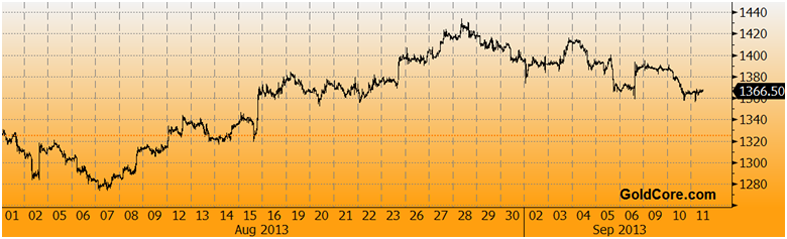
Gold In US Dollars, 60 Days - (Bloomberg)

Gold prices are now at the lowest in almost three weeks
more @

Gold drops over 2% for lowest close in a month

Prices set for lowest close in a month on Fed taper expectations

By Myra P. Saefong and Victor Reklaitis, MarketWatch
SAN FRANCISCO (MarketWatch) — Gold futures dropped more than 2% on Thursday as expectations that the U.S. Federal Reserve will announce a decision to taper its stimulus measures at a meeting next week helped push prices to their lowest level in a month.
Analysts said the metal’s drop below key chart levels accelerated selling and gold was also under pressure from reduced expectations for a U.S. strike on Syria, which dulled haven demand for the metal. 


Meanwhile, GFMS forecasts that gold prices will edge higher for the rest of the year and head toward $1,500 in early 2014 before slipping lower again.
On Thursday, gold for December delivery GCZ3 -1.47%  tumbled $33.20, or 2.4%, to settle at $1,330.60 an ounce. Prices, based on most-active contracts, settled at their lowest level since Aug. 13, according to FactSet data.
December silver SIZ3 -1.49%  dropped $1.02, or 4.4%, to $22.15 an ounce. Prices also closed at the lowest since mid-August.
Gold is “under punishing selling pressure after the support zone of $1,360 was broken this morning with massive selling orders,” said Naeem Aslam, chief market analyst at Ava Trade, in emailed comments. He said the next immediate support areas for the precious metal come at $1,280 followed by the $1,220.
Ross Norman, CEO of Sharps Pixley, said key technical support levels of $1,357 and $1,350 an ounce have given way and opened up the market to more selling. “With things quieter on the Syria front and really not much to add on taper, the market is behaving quite technically just now and traders very much studying the charts.”
In related news Thursday, Nanex Research said a large sell order among gold-futures contracts caused a circuit breaker to trip and shut down electronic trading on Globex for 20 seconds early Thursday.
The CME Group CME +0.03%  referred to the 20-second episode as a “Stop Logic Event.”
“A 20-second pause is the standard Stop Logic period for overnight, electronic trading in our metals complex,” a CME spokesman told MarketWatch.
“Stop logic introduces a momentary pause in trading, lasting between 5-20 seconds, to prevent excessive price movements from cascading stop price orders,” according to the CME. 

Economic data released Thursday fueled expectations that the U.S. central bank will start reducing its $85 billion-a-month bond purchase program at the Federal Open Market Committee meeting on Sept. 17 and Sept. 18.
Data showed lower-than-expected initial weekly jobless claims, but the government attributed the surprise drop to processing delays rather than a sudden improvement in the labor market.

Criminal Cartel’s Vicious Gold Slamdown Breaks Gold Market For 20 Seconds

There was a time when, if selling a sizable amount of a security, one tried to get the best execution price and not alert the buyers comprising the bid stack that there is (substantial) volume for sale. Of course, there was and always has been a time when one tried to manipulate prices by slamming the bid until it was fully taken out, usually just before close of trading, an illegal practice known as “banging the close.” It appears that when it comes to gold, the former is long gone history, and the latter is perfectly legal. As the two charts below from Nanex demonstrate, overnight just before 3 am Eastern, a block of just 2000 GC gold futures contracts slammed the price of gold, on no news as usual, sending it lower by $10/oz. However, that is not new: such slamdowns happen every day in the gold market, and the CFTC constantly turns a blind eye. What was different about last night’s slam however, is that this time whoever was doing the forced, manipulation selling, just happened to also break the market. Indeed: following the hit, the entire gold market was NASDARKed for 20 seconds after a circuit breaker halted trading!

GOLD ETF Investors Unable To Get Physical Gold

by GoldCore
Today’s AM fix was USD 1,340.25, EUR 1,008.54 and GBP 847.46 per ounce.
Yesterday’s AM fix was USD 11,365.25, EUR 1,028.98 and GBP 865.73 per ounce.
Gold fell $.20 or .02% yesterday, closing at $1,364.60/oz. Silver rose $0.18 or .78%, closing at $23.14. At 0.11 GMT, Platinum climbed $1.89 or .1% to $1,469.49/oz, while palladium fell $3.04 or .4% to $688.47/oz.
Gold prices fell sharply again just prior to European markets opening, in aggressive selling which saw gold quickly fall from $1,355/oz to $1,343/oz at 0754 GMT. Support at $1,360/oz was breached overnight and gold should now test support at $1,320/oz.

Gold In US Dollars, 60 Days – (Bloomberg)

Gold prices are now at the lowest in almost three weeks after Obama asked Congress to delay a vote on U.S. military action against Syria and hope grew that a U.S. strike on Syria could be avoided diminishing demand for safe haven gold in the short term.
Obama said yesterday he would prefer a peaceful solution to the Syrian conflict and that he saw “encouraging signs” of diplomacy ending the confrontation. In a New York Times opinion piece, Russia’s Putin called on the U.S. to avoid the use of force and “return to the path of civilised diplomatic and political settlement.”
Putin’s claim that the Syrian rebels, and not the Assad government, were behind a recent alleged chemical attack is likely to further badly damage relations between the U.S. and Russia and heighten geopolitical tensions in the coming months which will support gold.
Gold jumped 6.3% last month partly due to concerns that political tension in the Middle East could lead to surging oil prices, hurting fragile global economies and stoking inflation.
Continued speculation that the U.S. Federal Reserve will commit to reducing stimulus next week is also leading to weakness. However, the possible slight reduction in the massive $85 billion a month bond buying programme will only be short term negative for gold. Ultra loose monetary policies with interest rates close to zero are set to continue for the foreseeable future.
Respected investment managers, Grant Williams and John Hathaway, told King World News overnight that customers of the GLD ETF are being told that they cannot have their gold.
The GLD ETF or ‘SPDR Gold Shares’ is the largest gold ETF in the world.
Grant Williams, one of the most highly respected fund managers in Singapore and a perceptive analyst of the gold market said that custodians of the GLD ETF have refused to give people physical gold in exchange for the shares as investors are entitled too.

John Hathaway confirmed that “people have tried to get their gold out of that ETF and you just can’t get it.”

Williams warned that the massive and escalating paper claims on physical gold at COMEX warehouses will create an explosion in the price of gold. Paper claims on gold are now at 55 to 1 meaning that there are contracts worth 55 ounces for every one ounce of actual physical gold in the COMEX warehouses.
“We’ve seen the gold being drained out of the COMEX almost non-stop this year, certainly since the Bundesbank repatriation request. It hasn’t had any noticeable effect just yet, but it really is a spring that is continually being coiled, and at some point it is going to snap back.  And when it does, with all of these disparate claims on each ounce of gold, there is going to be some fireworks, no doubt about it,”Williams said.
“There are a lot of people that aren’t going to get their gold” said Williams.
Since the creation of the gold ETFs we have continually warned in our market updates and in our gold guides  about the unappreciated counterparty risk in these new financial instruments.
There has been significant skepticism regarding whether many gold and silver ETFs are backing their ETF holdings ounce for ounce. Much of that skepticism has abated, however there is a potentially equally important issue which should be considered.
Gold ETFs are riskier than most forms of allocated gold ownership. This is due to the very high level of indemnifications in the prospectus and in the terms and conditions of many ETFs.
There is also the important fact that you are an unsecured creditor of a large number of banks who are custodians and sub custodians of your bullion holdings.

In the event of one of these banks engaging in dodgy accounting, malpractice or becoming insolvent, one would be an unsecured creditor of one or all of the many custodians and sub custodians who are primarily banks.
In the event of a Lehman Brothers style systemic crisis, there is the risk that your bullion would be subject to a “bail-in” or could be nationalised by an insolvent sovereign nation.

Prepare For Tough Times If Your Job Has Anything To Do With Real Estate Or Mortgages

If you have a job that involves building homes, buying homes, selling homes or that is in any way related to the mortgage industry, you might want to start searching for alternate employment. Seriously.
Interest rates are starting to rise dramatically, and mortgage lenders such as Bank of America, Wells Fargo and JPMorgan Chase are all cutting thousands of mortgage-related jobs. Last week, mortgage refinance activity plunged to the lowest level that we have seen since June 2009 and total mortgage activity dropped to the lowest level since October 2008. Unfortunately, this is only the beginning. Mortgage rates closely mirror the yield on 10 year U.S. Treasuries, the the yield on 10 year U.S. Treasuries has nearly doubled since early May. But it is still only sitting at about 3 percent right now. As I have written about previously, it has a ton of room to go up before it hits “normal” historical levels, and so do mortgage rates.
As I noted the other day, some analysts believe that the yield on 10 year U.S. Treasuries is going to hit 7 percent eventually. If that happens, mortgage rates will be more than double what they are today. And we have already seen the average rate on a 30 year fixed rate mortgage go from 3.35 percent in May to 4.57 percent last week. If interest rates continue to rise we could be heading for a “housing Armageddon” that will make the last housing crash look like a Sunday picnic.
The mini-housing bubble that we have been enjoying for the last couple of years is coming to an abrupt end. It doesn’t matter what the mainstream media is telling you about a “sustainable” housing recovery. Just look at how the big mortgage lenders are behaving. They know the gig is up. According to Bloomberg, Bank of America has just announced that they will be eliminating 2,100 mortgage-related jobs…
Bank of America Corp., the second-largest U.S. lender, will eliminate about 2,100 jobs and shutter 16 mortgage offices as rising interest rates weaken loan demand, said two people with direct knowledge of the plans.
Would they be doing that if we were really heading into a “sustainable housing recovery”?
And Wells Fargo and JPMorgan Chase are also both eliminatingthousands of mortgage-related jobs
Mortgage lenders are paring staff as higher interest rates discourage refinancing and cast doubt on how long the housing market rebound will last. Wells Fargo & Co., the biggest U.S. home lender, plans more than 2,300 job cuts, and JPMorgan Chase & Co. may dismiss 15,000.
Would they be doing this if they thought that brighter days were ahead?
Of course not.
In fact, Well Fargo just announced that it expects to make 30 percent fewer home loans this quarter because of rapidly rising interest rates.
It’s over folks.
The mini-housing bubble that the mainstream media has been hyping so much is over.
If your job has anything to do with real estate or mortgages, it is time to start thinking about a career change.
This is especially true if your job is related to refinancing mortgages. All of the smart people have already refinanced. As rates continue to rise rapidly, the only ones that will be refinancing are really stupid people. According to Zero Hedge, mortgage refinance activity has already dropped by a whopping 70 percent since early May…
For the 16th of the last 18 weeks, mortgage refinance activity plunged (dropping 20% this week alone).Since early May, when the dreaded word “Taper” was first uttered, refis have collapsed over 70%. With mortgage servicers and providers large and small laying people off, it seems hard for even the most egregiously biased bull to still suggest that the housing recovery is sustainable.
And this rise in interest rates is just getting started. The Federal Reserve has not even begun to “taper” yet. Once that starts happening, the consequences could be quite dramatic
“In early 1994, when the U.S. recovery gained strength, the Fed started a tightening cycle and bond markets crashed not only in the U.S. but also around the world,” European Central Bank Executive Board member Joerg Asmussen said on Tuesday.
“If spillovers were large in 1994, we can expect them to be even larger today in an even more deeply interconnected world,” he added in the text of a speech for delivery in Brussels.
Of course when the Federal Reserve “tapers” their quantitative easing it won’t really be “tightening” as much as it will be slowing down the pace at which they are recklessly creating tens of billions of dollars out of thin air. But the effect will be similar to what we saw back in 1994.
As interest rates rise, it will become much more expensive to buy a home and much more difficult to sell a home. To give you an idea of how dramatically interest rates can affect housing affordability, I wanted to share some numbers from one of my previous articles
A year ago, the 30 year rate was sitting at 3.66 percent. The monthly payment on a 30 year, $300,000 mortgage at that rate would be $1374.07.
If the 30 year rate rises to 8 percent, the monthly payment on a 30 year, $300,000 mortgage at that rate would be $2201.29.
Does 8 percent sound crazy to you?
It shouldn’t. 8 percent was considered to be normal back in the year 2000.
Are you starting to get the picture?
As interest rates go up, home prices will have to fall. Otherwise, nobody will be able to afford them.
In the end, we could end up with tens of millions more homeowners that are substantially “underwater” on their mortgages.
So who is to blame?
The Federal Reserve of course.
They created this bubble by forcing interest rates down to record low levels.
At some point it was inevitable that interest rates would start reverting back to more “normal” levels, and that “adjustment” is going to be immensely painful for the U.S. economy.
As we saw back in 2008 and 2009, when the housing industry suffers the entire economy suffers.
And the higher that interest rates go, the more suffering there will be.
So let us hope and pray that interest rates do not go any higher, but let us also start preparing for the very worst.