Thursday, August 22, 2013

Are We On The Brink of Another Economic Disaster?

Stocks are in a ‘dead zone’
Stocks are drifting lower with few catalysts to move the market. Chuck Carlson, CEO of Horizon Investment Services, says we’ll get a “fresher idea of where investors’ and traders’ heads are” after Labor Day.
http://www.marketwatch.com/story/stocks-are-in-a-dead-zone-2013-08-21
Home-refinancing applications plunge 62% since May, mortgage bankers say
http://blogs.marketwatch.com/capitolreport/2013/08/21/home-refinancing-applications-plunge-62-since-may-mortgage-bankers-say/?mod=MW_home_latest_news
2.89%
http://www.marketwatch.com/investing/bond/TMUBMUSD10Y?countrycode=BX
http://finance.yahoo.com/q?s=^tnx
GALLUP: Unemployment Spikes to 8.9%… 18 month high
UNEMPLOYMENT RATE JUMPS FROM 7.7% TO 8.9% IN 30 DAYS
http://www.breitbart.com/Big-Government/2013/08/21/Gallup-Unemployment-jumped-from-77-to-89
5 signs consumers are crumbling
The retail sector saw a lift in the last few days thanks to encouraging earnings from J.C. Penney and Best Buy. Both merchants put up big numbers on Tuesday, and saw shares gapped up as result.
However, those looking for signs of trouble in retail stocks also have plenty of fodder in recent earnings. Wal-Mart Stores Inc. WMT +0.89% , the world’s largest retailer, reported ugly numbers and saw same-store sales decline for the second consecutive quarter. Elsewhere, department store Macy’s M -1.02%  suffered its first earnings miss in six years and Kohl’s KSS -0.65%  also disappointed.
http://www.marketwatch.com/story/5-signs-consumers-are-crumbling-2013-08-21
The last bullish argument
Many on Twitter have been saying that I have been too negative on stocks over the past several days, as our ATAC models used for managing our mutual fund and separate accounts rotated fully out of emerging markets into defense mode. Strength was undeniably there given strong alpha in the weeks we were exposed, but admittedly momentum has aggressively turned, particularly as India craters.


I have hammered the idea that spiking yields may serve as a deflationary shock to the economy, and made parallels to 1987 in terms of the speed of the bond market’s move relative to equities, which the Crash resolved in a single day.
A panic in long-duration bonds has all kinds of ripple effects, which in turn means the fat pitch is in for a rain delay as everything takes a back seat to the heart, soul, and life of the free enterprise system.
http://www.marketwatch.com/story/the-last-bullish-argument-2013-08-21
A 2008-Type Of Event Will Plunge The World Into A Panic
The system would implode again, and this time it would be much more serious than in 2008 because the sovereigns no longer have the firepower to bail everybody out. That’s what is different now.
http://kingworldnews.com/kingworldnews/KWN_DailyWeb/Entries/2013/8/21_A_2008-Type_Of_Event_Will_Plunge_The_World_Into_A_Panic.html
ALERT!! WAKE UP PEOPLE!!! We Are Now On The Verge Of A Historic Meltdown & Collapse
On the heels of a tremendous rally in gold and silver, today a man who has been involved in the financial markets for 50 years shocked King World News when he said that we are on the verge of a historic and catastrophic global financial “meltdown.” He also spoke about events that are unfolding behind the scenes at the White House right now. This is without question one of John Embry’s most powerful interviews ever.
Financial Crisis-Era Derivatives Are Making A Comeback
Collateralized debt obligations, the complex financial instruments that cratered disastrously in the financial crisis, are back.

The market for the instruments, which were based on subprime mortgages, shrank from $520 billion in 2006 to just $4.3 billion in 2009 after the housing bust. Warren Buffett once called CDOs “financial weapons of mass destruction” because of their riskiness.
This time around, the investment has shifted from a mortgage-based CDO into a “collateralized loan obligation,” a cash-generating asset structured similarly to CDOs, but consisting of loans to businesses.
Read more: http://www.businessinsider.com/financial-crisis-era-derivatives-are-making-a-comeback-2013-8#ixzz2cdLYcpfb

SEC Whistleblower and the Fake Insider Trading Crackdown


Here’s what’s in your Prime Interest today:
Eric Holder, the US Attorney General, is cracking down on Wall Street — according to himself, anyway. He said anybody who’s inflicted damage on our financial markets should not think they’re out of the woods. Well, there is this small problem with something called statute of limitations. And it’s run out on a substantial number of criminal acts committed — both before and after the last financial crisis. Unfortunately, it seems the only people being prosecuted these days are mid-level employees and hedge funds for insider trading. While it’s certainly a crime, insider trading did not cause the last financial crisis, nor will it cause a future one.
In 2005, Gary Aguirre was senior council at the Securities Exchange Commission. He investigated a case involving insider trading at a major hedge fund, Pequot Capital Management. After a little digging, it became apparent that the soon-to-be CEO of Morgan Stanley, John Mack, was involved. Mack also happened to be a major campaign contributor to George W. Bush. Mr. Aguirre’s supervisor warned him that Mack was untouchable due to his political connections. So Pequot’s attorneys met with the SEC Director of Enforcement. The result? The case would be — first “narrowed” — then Mack’s testimony was delayed. The statute of limitations for Mack eventually ran out, and Mr. Aguirre complained about Mack’s “political clout.” Big mistake. Because he was promptly fired. Bob speaks with Gary Aguirre about his experience at the SEC.
Then Perianne digs into the fine print of whistleblowing, and just how the perception of these individuals has changed over the decades — from Ellsberg to Manning. Manning was sentenced to 35 years in prison today, although he may serve as few as eight additional years, if paroled. Finally, Daily Duel-er regular, Sam Sacks, will battle the question of whether Wall Street culture is endemic, systemic, or simply — psychopathic.
Plus, hypocrisy has reached new heights in India. Just days after the prime minister of India announced there would be currency crisis — as had happened in 1991 — overnight, the Reserve Bank of India — basically India’s Fed — announced their first quantitative easing program. Welcome to the club, India.

BOOM: FLAHERTY SAYS U.S. QE POLICY MAY BE TOPIC AT NEXT G-20 MEETING!!! Canada Is Not A Friend Of QE, May Throw Bernanke Under Bus At Next G-20!

Canada Is Not A Friend Of QE, May Throw Bernanke Under Bus At Next G-20
It seems the world is growing increasingly uncomfortable (or downright angry) with the unintended (or intended) consequences of the Federal Reserve’s actions (and not just EM nations…):
  • FLAHERTY SAYS CANADA IS NOT A FAN OF QUANTITATIVE EASING
  • FLAHERTY SAYS U.S. QE POLICY MAY BE TOPIC AT NEXT G-20 MEETING
http://www.zerohedge.com/news/2013-08-21/canada-not-friend-qe-may-throw-bernanke-under-bus-next-g-20
It’s crazy how many Americans have no clue what rising interest rates are doing to their investments 
According to a new study by Edward Jones, one of the country’s biggest retail brokerages, 63% of Americans don’t know how rising interest rates will affect their retirement portfolios – their 401(k)s, IRAs, et al. – and 24% say they feel completely in the dark about what rising interest rates mean.
Bond yields have soared on the back of a big sell-off in the U.S. Treasury market this summer as markets price in a return to normalization following years of low rates and excess liquidity in the wake of the financial crisis.
And as Treasuries have declined in value, many bond investors have been caught off guard by something they aren’t used to seeing: negative returns in their monthly statements.
Meanwhile, Wall Street is telling clients to brace themselves for more.
“The secular 30-yr bull market in bonds likely ended 4/29/2013,” tweeted Bill Gross, who runs PIMCO, the world’s biggest bond manager. “PIMCO can help you navigate a likely lower return 2 – 3% future.”
Read more: http://www.businessinsider.com/americans-confused-about-rising-rates-2013-8#ixzz2ccwkx55j

The Fed Is Insolvent… Do You Still Think the Crisis is Over?

by Phoenix Capital Research
The single dominant belief for investors since 2008 has been that the world’s Central banks will not permit the markets to fall to pieces.
There are primary two primary reasons for this:
1)   The Fed and other Central Banks managed to hold the system together in 2008-2009.
2)   Central Banks have stepped in time and again to prop up the markets every time they staged a significant correction since 2008.
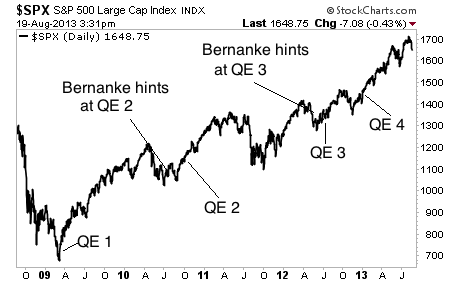
The most obvious culprit here is the Fed, which has stepped in following every market correction in the last four year, either with the promise of a new round of QE or outright announcement of a new round of QE.

Other Central Banks have mirrored these moves. Indeed, since 2007, Central Banks have cut interest rates over 512 times. They’ve also expanded their collective balance sheets by over $10 trillion.
The problem with this is that all of these strategies were not fully thought through.
Consider the following. The Fed has only $50 billion or so in capital. With the Fed now owning over 30% of the ten-year market, every time bonds drop and yields rise, the Fed will eraseALL of this capital. Indeed, Mark Hussman of Hussman Funds notes that even a 100 basis point increase in yields will wipe out the Fed’s capital six times over.
And therein lies the core problem: by expanding its balance sheet so dramatically, the Fed has in effect spread the financial crisis from a private banking level to a public/ sovereign level. Put another way, when the next Crisis hits, it will not be Wall Street banks that go bust but the Fed itself.

Anyone who believes the Fed can “exit” this position is delusional. The single biggest trade for the last four years has been frontrunning the Fed’s asset purchases. When the Fed reverses course and begins selling assets, everyone will dump Treasuries in anticipation.
Indeed, we are already witnessing this with foreign nations selling Treasuries in record amounts in June when the Fed first hinted at tapering its QE programs. Japan and China alone dumped $40 billion that month (of a total $66 billion sold by foreigners that month).
By the way, this was the single largest Treasury dump by foreigners since August 2007. We all remember what followed that (the first round of this Crisis).
Sure, the Fed could print money to deal with this. But if Treasuries begin to collapse while the Fed is already buyingthem… and it can only buy more by money printing, then it’s GAME SET MATCH for Bernanke’s QE, the Fed, and the US economy.
On that note, I’ve already prepared readers of my Private Wealth Advisory newsletter with a number of targeted investment strategies designed to help them not only manage risk, but produce outsized profits during the coming Crash.
My clients saw a 7% portfolio return in 2008, at a time when the market fell 35%.
We also locked in 73 straight winning trades during the Euro Crisis, producing a total portfolio return of 34% at a time when the market was falling rapidly.
And today, we’re taking action to prepare for another round of intense volatility. In fact, we’ve already started another winning streak, having locked in 13 straight winners since May. And by the look of things, we’re about to close our 14th and 15th shortly (one is already up 12% in just two weeks already. 
For more market insights and commentary, visit us at:
www.gainspainscapital.com
Best Regards
Graham Summers

Banksters Blowing ‘Secure’ Bubbles


Watch the full Keiser Report E487 on Thursday!
In this episode of the Keiser Report, Max Keiser and Stacy Herbert discuss the fact that banks are lobbying to force credit unions to become banks in order to destroy the Move Your Money competitive threat. They also discuss frontrunning the NSA and the digital AIDS they’ve spread. In the second half, Max talks to former government official, Catherine Austin Fitts of Solari.com about extricating yourself from the tapeworm economy.

The Fed’s Game Plan is to Stagflate and Lie! – WallStForMainSt


In this podcast, Wall St for Main St team gave their thoughts on what is going in the economy, stock market and the commodities sector. We talked about why we think the Federal Reserve will not pull back their QE program, why investors and Main Street should expect more stagflation in the economy due to high taxes, over regulation, bad fiscal and monetary policies. Also, we gave an update on the gold and silver market. Plus much more!

FBI Partners with Banks and Blames Mortgage Fraud on Poor Borrowers