Thursday, August 1, 2013

Bank Of England Helped Reichsbank Sell Its Nazi Gold
We previously showed hard evidence of the Bank of England’s complicit hiding of the truth about the quality of Bundesbank gold stored in the Fed’s vaults. A few weeks later in
a “completely unrelated” action, the Bundesbank dramatically shifted
its recent stance, and demanded that its gold be repatriated into its
own vaults (and we now know the impact that has had on the
paper-physical paper markets). However, in yet another one of the ‘darkest episodes in central banking history’ the FT reports, the Bank of England facilitated the sale of gold that was looted by the Nazis after their invasion of Czechoslovakia in 1938. Of
course, judging today’s central bankers by this ethical (and
potentially criminal) behavior of over 70 years ago is unfair but it is
notable that the pattern of whatever-it-takes and at-all-costs
decisions, coupled with pervasive opacity and stark unaccountability,
appear to have been formed a long time ago.
Via The FT,

So just how powerful is the Central Bank?
Via The FT,
This episode did not go unnoticed in the US press…

And the full archive is here:
Via The FT,
The Bank of England played a vital role in one of the darkest episodes in central banking history, facilitating the sale of gold looted by the Nazis after their invasion of Czechoslovakia in 1938.It would appear they knew what the right thing to do was… but politics meant ignore the ethics for the preservation of the status quo…
According to a hitherto unpublished history of the BoE’s activities in and around the second world war, the UK’s central bank sold gold on behalf of the Reichsbank – which Germany’s central bank had seized from its Czech counterpart – after the UK government had frozen all Czech assets held in Britain following the Nazi invasion.
…
The episode has long weighed on the reputation of the BIS. However, what has received less attention is the role of the BoE in the affair…

So just how powerful is the Central Bank?
Via The FT,
…the UK’s central bank prioritised the appeasement of the BIS over the British government’s wishes to freeze the sale of Czech assets.Read the full story at the FT.
…
The history, written by BoE officials and completed in 1950 but never published, also records that the UK central bank sold gold after this date on behalf of the Nazis –and without waiting for the consent of the British government – on the back of pressure from the BIS.
…
The documents also show that Montagu Norman, then governor of the BoE, was opaque in his communications with John Simon, the chancellor at the time, when pressed on whether the central bank still held the Czech gold.
This episode did not go unnoticed in the US press…

And the full archive is here:
OBAMACARE: Pays Not To Work… SURVEY: Many Disability Recipients Admit They Could Work
OBAMACARE: Pays not to work
Be careful you don’t fall off the Obamacare “cliff” when the boss asks you to put in some overtime.
Working more could ultimately mean thousands of dollars less for you under a quirk in the new health-care law going into effect this fall. This could prompt some people to cut back on their hours to avoid losing money.
“Working more can actually leave you worse off,” the price-comparison siteValuePenguin.com notes in a new analysis.
“It’s sort of an absurd scenario,” said Jonathan Wu, ValuePenguin.com’s co-founder. “It’s something for people to be aware of.”
In that scenario, an individual or family whose annual income surpasses maximums set by the federal government—if only by $1—will totally lose subsidies available to buy health insurance under the Affordable Care Act.
The loss of those subsidies in some cases will mean that people potentially would have been better off financially if they had worked less during the year, Wu said. And they then would have to work significantly more to make up for the lost subsidy.
…
SURVEY: Many Disability Recipients Admit They Could Work
Recipients of federal disability checks often admit that they are capable of working but cannot or will not find a job, that those closest to them tell them they should be working, and that working to get off the disability rolls is not among their goals.
More baffling, most have never received significant medical treatment and not seen a doctor about their condition in the last year, even though medical problems are the official reason they don’t work. Those who acknowledge they’re on disability because they can’t find a job say they make little effort to find one, according to a Washington Examiner analysis of federal survey results.
Unearned disability, called SSI, is for individuals who have petitioned to be classified as disabled. Many of them have never worked and have never paid into Social Security. Earned disability, or SSDI, is for those who have held jobs for significant periods of time and paid at least partially into Social Security before becoming disabled.
http://washingtonexaminer.com/exography-many-disability-recipients-admit-they-could-work/article/2533626
Be careful you don’t fall off the Obamacare “cliff” when the boss asks you to put in some overtime.
Working more could ultimately mean thousands of dollars less for you under a quirk in the new health-care law going into effect this fall. This could prompt some people to cut back on their hours to avoid losing money.
“Working more can actually leave you worse off,” the price-comparison siteValuePenguin.com notes in a new analysis.
“It’s sort of an absurd scenario,” said Jonathan Wu, ValuePenguin.com’s co-founder. “It’s something for people to be aware of.”
In that scenario, an individual or family whose annual income surpasses maximums set by the federal government—if only by $1—will totally lose subsidies available to buy health insurance under the Affordable Care Act.
The loss of those subsidies in some cases will mean that people potentially would have been better off financially if they had worked less during the year, Wu said. And they then would have to work significantly more to make up for the lost subsidy.
…
SURVEY: Many Disability Recipients Admit They Could Work
Recipients of federal disability checks often admit that they are capable of working but cannot or will not find a job, that those closest to them tell them they should be working, and that working to get off the disability rolls is not among their goals.
More baffling, most have never received significant medical treatment and not seen a doctor about their condition in the last year, even though medical problems are the official reason they don’t work. Those who acknowledge they’re on disability because they can’t find a job say they make little effort to find one, according to a Washington Examiner analysis of federal survey results.
Unearned disability, called SSI, is for individuals who have petitioned to be classified as disabled. Many of them have never worked and have never paid into Social Security. Earned disability, or SSDI, is for those who have held jobs for significant periods of time and paid at least partially into Social Security before becoming disabled.
http://washingtonexaminer.com/exography-many-disability-recipients-admit-they-could-work/article/2533626
Catherine Austin Fitts-The Big Question is How Violent will Things Get?
http://usawatchdog.com/old-system-str… Catherine Austin Fitts of Solari.com says, “I think bail-ins are coming . . . the big question is not will we be able to get out insured deposits. I think the big question is how violent will things get?” Fitts biggest worry is not financial collapse. She says, “I don’t think the people who run the U.S. military or run the United States government are going to say we’re happy to collapse rather than go to war. They are going to go to war. They’re going to shake somebody down.” Fitts goes on to add, “I think gold is the greatest form of insurance you can have during this transition period.” Join Greg Hunter as he goes One-on-One with money manager Catherine Austin Fitts.
Why Are The Chinese Gobbling Up Real Estate And Businesses In Detroit?
 End of the American Dream – by Michael Snyder
Something very strange is happening to Detroit. Once upon a time, it was the center of American manufacturing and it had the highest per capita income in the United States. But now the city is dying and the Chinese are moving in to pick up the pieces. Lured by news stories that proclaim that you can buy homes in Detroit for as little as one dollar, Chinese investors are eagerly gobbling up properties. In some cases, this is happening dozens of properties at a time. Not only that, according to the New York Times “dozes of companies from China” are investing in businesses and establishing a presence in the Detroit area. If this continues, will Detroit eventually become a city that is heavily dominated by China?
At this point, not too many others appear interested in saving Detroit. Right now, there are approximately 78,000 abandoned buildings in Detroit and about one-third of the entire city is either vacant or derelict. People have been moving out in droves and there are only about 700,000 residents left.
For many Americans, Detroit is about the last place that they would want to live. But to many Chinese, this sounds like a perfect buying opportunity. According to a recent Fox News report, real estate agents in Detroit are being overwhelmed with inquiries from China…
Downtown Detroit is home to one of the worst housing markets in the country, as prices of homes have collapsed and foreclosures have soared in the city’s depressed economy.And these buyers appear to be quite serious. One buyer reportedly bought 30 properties recently, and other buyers say that they want to purchase even more homes than that…
But some Chinese investors hungry for real estate are hoping Detroit’s losses will be their gain. After Detroit filed for bankruptcy July 18, Motor City property has been a hot topic on China’s social media platform, Weibo, according to a Quartz.com report.
News of the bankruptcy, coupled with a Chinese TV report in March that claimed you could buy two houses in Detroit for the same price as a pair of leather shoes, has piqued investors’ interest.
And it appears to be translating into real interest; Caroline Chen, a real estate broker in Troy, Michigan, says she’s received “tons of calls” from people in mainland China.Meanwhile, according to the New York Times, dozens of Chinese companies are moving into the city…
“I have people calling and saying, ‘I’m serious—I wanna buy 100, 200 properties,’” she tells Quartz, noting that one of her colleagues recently sold 30 properties to a Chinese buyer. “They say ‘We don’t need to see them. Just pick the good ones.’”
Dozens of companies from China are putting down roots in Detroit, part of the country’s steady push into the American auto industry.Of course this is not just happening in Detroit. The truth is that the Chinese are buying up real estate, businesses and natural resources all over the country.
Chinese-owned companies are investing in American businesses and new vehicle technology, selling everything from seat belts to shock absorbers in retail stores, and hiring experienced engineers and designers in an effort to soak up the talent and expertise of domestic automakers and their suppliers.
While starting with batteries and auto parts, the spread of Chinese business is expected to result eventually in the sale of Chinese cars in the United States.
But they seem to have a particular interest in Detroit.
Perhaps someone should tell them that Detroit is not actually a very safe place these days. The violent crime rate is five times higher than the national average, and the murder rate in Detroit is 11 times higher than it is in New York City.
If you call the police, it takes them an average of 58 minutes to respond. And sometimes the people that are committing the crimes are actually Detroit police officers. In fact, one Detroit police officer was involved in robbing a gas station just last week…
A Good Samaritan snapped photos of what appeared to be two men impersonating police officers involved in a pistol-whipping and robbery outside a Citgo gas station on Detroit’s east side on July 21.Detroit is a dying, bankrupt city. There does not seem to be much hope of a turnaround for Detroit any time soon.
Once Fox 2 aired those photos, an even more disturbing picture developed.
“Several unidentified police officers were working this particular robbery case, recognized one of the suspects in the photographs as being a member of the Detroit Police Department,” Chief James Craig said Monday.
Now under arrest are two police sergeants, a 47-year-old officer and 20-year veteran of the Detroit Police Department and his 42-year-old buddy from the police academy, who is a former DPD cop and 17-year veteran of the St. Clair Shores Police Department. The later recently received a distinguished service award.
“In fact, they were police officers, just not working on-duty at the time,” Craig said.
So why are the Chinese gobbling up so much real estate and so many businesses in Detroit?
That is a very good question.

As The Crisis Deepens, Gold Flows East – Part 3 (of 3)
by GoldCore
Today’s AM fix was USD 1,331.50, EUR 1,002.79 and GBP 875.35 per ounce.
Yesterday’s AM fix was USD 1,322.25, EUR 996.65 and GBP 864.05 per ounce.
Gold fell $3.10 or 0.23% yesterday and closed at $1,326.30/oz. Silver fell $0.12 or 0.6% and closed at $19.72.
Gold climbed today supported by increased fund buying on target for its largest monthly gain since January 2012, fuelled by hopes for a continuation of money printing and bond buying by central banks. The U.S. Federal Reserve’s policy statement is at 1800 GMT, but unlike the last meeting, Chairman Ben Bernanke will not hold a news conference to give any further guidance.
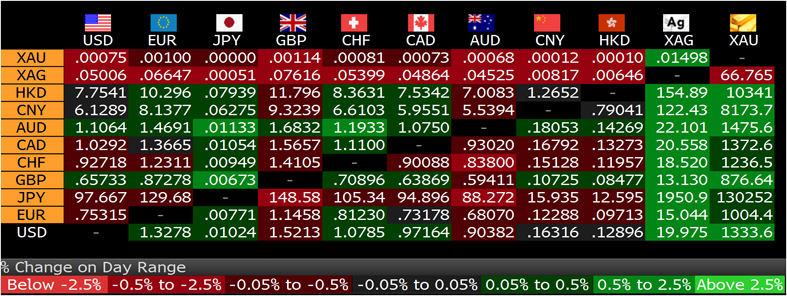
Cross Currency Table – (GoldCore)
In today’s Market Update we end this 3 part series with a closer look at one of Sanders’ key arguments: that the Consumer Price Index or CPI has been manipulated since the early 1980’s in the U.S. and has continued unabated by successive administrations. According to Sanders, not only is the CPI manipulated but the reporting of the employed / unemployed numbers is also erroneous. There has been no improvement in employment number since 2008. Indeed, employment has stagnated since the late 1980s. The U.S. is not alone and the UK government has also ‘rejigged’ what the CPI basket contains so that it can return statistics that mask the real inflation rate(s).
It was timely therefore that on July 27th, just before we released this month’sInsight, John Mauldin penned a very prescient piece on his blog titled ‘An Ugly Secular Trend in Part-Time Work: The Emergence of a US Underclass – A Lost Generation.’ According to Mauldin, ‘the redefinition of part-time as less than 29 hours a week and the new costs associated with full-time employment due to Obamacare simply accelerated a trend already set into motion.’
Mauldin reports that the precipitous decline in full time jobs in the U.S. started back in 2002 and accelerated after 2008. The number of part time jobs has risen by 3m, while full time jobs have decreased by a similar amount. Though U.S. centric, Mauldin’s observations point to a fundamental change in how the social and economic structures of our economies are changing.
Lump this into the mix with the challenges around energy, the instability of the global banking system, the high unemployment rates, particularly among the youth and interest rates at unsustainably low levels, it would be reckless to report that the world economy is either on the brink of or on the road to recovery. Gold is a finite resource, the Chinese central bank continues to acquire gold quietly and without declaring…..for now.
It’s worth repeating: In the shadow of this game, gold looks like a solid investment.
When The Data Is Bad, Make Up The Data
Analysts of the situation appear to fall broadly into two camps: deflationists who rightly fear the unemployment and demand destruction inherent in QE and ZIRP and hyper-inflationists who equally rightly fear the unrestricted debt monetization inherent in QE.
We can safely ignore those who support this suicidal socio-political policy mix as being more interested in attending Davos with eye candy on their arm or securing an elite sinecure than in working to maintain social stability and the broadest possible survival rate in the challenging decades to come.
The truth is that what we are seeing is the destruction of the world monetary system in the most thorough way imaginable. This is not exactly deflation nor inflation. For more than forty years since the “opening” of China by Kissinger and Nixon, wealth has been siphoned out of the West by the assumption of ever more leverage. No majority in any western industrial democracy would have voted for this, hence the need for “free trade” agreements the consequence of which has been the effective disenfranchisement of organised labour.
Nor could it have happened had governments and markets not colluded in the progressive vandalising of government economic statistics. Beginning with the Reagan administration, which exchanged the housing component of CPI for something called “imputed rent” during the housing bubble of the early 80s, and given an intellectual veneer by the Boskin Commission during the Bush the Elder administration, headline U.S. consumer price inflation (CPI-U) has been deliberately and systematically understated.
This has served several purposes. First it reduces government liabilities in programs such as government pensions and social security that are indexed to the inflation rate. Second, it serves to increase the net present value of financial assets and thereby encourage public investment in the markets, the better to keep the bull running.
The abuse of hedonic measurement, which seeks to assign a value to qualitative improvements in products, substitution of CPI components with the highest prices on with “equivalents” that are cheaper on the assumption that consumers will switch in response to price signals are two tricks of the trade.

Nor is the abuse of data confined to the CPI. In recent years employment and unemployment measurements have been inflated and deflated respectively by not counting those who are so “discouraged” that they stop looking for mainstream employment and counting those with multiple part time jobs as though they have as many bodies as jobs. A better measure is employment as a % of the population, not an arbitrarily defined “work force.”
There has been no improvement to the employment numbers since 2008. Indeed, employment has stagnated since the late 1980s.

To download a copy of ‘As The Crisis Deepens, Gold Flows East,’ please clickhere.
Today’s AM fix was USD 1,331.50, EUR 1,002.79 and GBP 875.35 per ounce.
Yesterday’s AM fix was USD 1,322.25, EUR 996.65 and GBP 864.05 per ounce.
Gold fell $3.10 or 0.23% yesterday and closed at $1,326.30/oz. Silver fell $0.12 or 0.6% and closed at $19.72.
Gold climbed today supported by increased fund buying on target for its largest monthly gain since January 2012, fuelled by hopes for a continuation of money printing and bond buying by central banks. The U.S. Federal Reserve’s policy statement is at 1800 GMT, but unlike the last meeting, Chairman Ben Bernanke will not hold a news conference to give any further guidance.
Cross Currency Table – (GoldCore)
In today’s Market Update we end this 3 part series with a closer look at one of Sanders’ key arguments: that the Consumer Price Index or CPI has been manipulated since the early 1980’s in the U.S. and has continued unabated by successive administrations. According to Sanders, not only is the CPI manipulated but the reporting of the employed / unemployed numbers is also erroneous. There has been no improvement in employment number since 2008. Indeed, employment has stagnated since the late 1980s. The U.S. is not alone and the UK government has also ‘rejigged’ what the CPI basket contains so that it can return statistics that mask the real inflation rate(s).
It was timely therefore that on July 27th, just before we released this month’sInsight, John Mauldin penned a very prescient piece on his blog titled ‘An Ugly Secular Trend in Part-Time Work: The Emergence of a US Underclass – A Lost Generation.’ According to Mauldin, ‘the redefinition of part-time as less than 29 hours a week and the new costs associated with full-time employment due to Obamacare simply accelerated a trend already set into motion.’
Mauldin reports that the precipitous decline in full time jobs in the U.S. started back in 2002 and accelerated after 2008. The number of part time jobs has risen by 3m, while full time jobs have decreased by a similar amount. Though U.S. centric, Mauldin’s observations point to a fundamental change in how the social and economic structures of our economies are changing.
Lump this into the mix with the challenges around energy, the instability of the global banking system, the high unemployment rates, particularly among the youth and interest rates at unsustainably low levels, it would be reckless to report that the world economy is either on the brink of or on the road to recovery. Gold is a finite resource, the Chinese central bank continues to acquire gold quietly and without declaring…..for now.
It’s worth repeating: In the shadow of this game, gold looks like a solid investment.
When The Data Is Bad, Make Up The Data
Analysts of the situation appear to fall broadly into two camps: deflationists who rightly fear the unemployment and demand destruction inherent in QE and ZIRP and hyper-inflationists who equally rightly fear the unrestricted debt monetization inherent in QE.
We can safely ignore those who support this suicidal socio-political policy mix as being more interested in attending Davos with eye candy on their arm or securing an elite sinecure than in working to maintain social stability and the broadest possible survival rate in the challenging decades to come.
The truth is that what we are seeing is the destruction of the world monetary system in the most thorough way imaginable. This is not exactly deflation nor inflation. For more than forty years since the “opening” of China by Kissinger and Nixon, wealth has been siphoned out of the West by the assumption of ever more leverage. No majority in any western industrial democracy would have voted for this, hence the need for “free trade” agreements the consequence of which has been the effective disenfranchisement of organised labour.
Nor could it have happened had governments and markets not colluded in the progressive vandalising of government economic statistics. Beginning with the Reagan administration, which exchanged the housing component of CPI for something called “imputed rent” during the housing bubble of the early 80s, and given an intellectual veneer by the Boskin Commission during the Bush the Elder administration, headline U.S. consumer price inflation (CPI-U) has been deliberately and systematically understated.
This has served several purposes. First it reduces government liabilities in programs such as government pensions and social security that are indexed to the inflation rate. Second, it serves to increase the net present value of financial assets and thereby encourage public investment in the markets, the better to keep the bull running.
The abuse of hedonic measurement, which seeks to assign a value to qualitative improvements in products, substitution of CPI components with the highest prices on with “equivalents” that are cheaper on the assumption that consumers will switch in response to price signals are two tricks of the trade.
Nor is the abuse of data confined to the CPI. In recent years employment and unemployment measurements have been inflated and deflated respectively by not counting those who are so “discouraged” that they stop looking for mainstream employment and counting those with multiple part time jobs as though they have as many bodies as jobs. A better measure is employment as a % of the population, not an arbitrarily defined “work force.”
There has been no improvement to the employment numbers since 2008. Indeed, employment has stagnated since the late 1980s.
To download a copy of ‘As The Crisis Deepens, Gold Flows East,’ please clickhere.
U.S. GROWTH: 1.7%, 1st Q GDP revised to 1.1% from 1.8%, Markets unconvinced, fall, Income inequality rose faster under Obama than Bush or Clinton
US economy grows at 1.7 pct. pace in 2nd quarter
http://apnews.myway.com/article/20130731/DA7SG7EO0.html
1st Q GDP revised to 1.1% from 1.8%
On the economic front, U.S. economic growth unexpectedly accelerated in the second quarter, with the GDP growing at a 1.7 percent annual rate, up from the first-quarter’s downwardly revised 1.1 percent expansion pace, according to the Commerce Department. Economists polled by Reuters had forecast the economy growing at a 1.0 percent pace.
And private employers added 200,000 jobs in July, topping economists’ expectations in an encouraging sign for the labor market recovery. Economists surveyed by Reuters had forecast the ADP National Employment Report would show a gain of 180,000 jobs.
http://www.cnbc.com/id/100927100
Futures lower despite upbeat GDP, private sector employment report
http://www.cnbc.com/id/100927100
Obama Calls Income Gap ‘Wrong’ — After Widening It
…
As a result, 121% of the gains in real income during Obama’s recovery have gone to the top 1%. By comparison, the top 1% captured 65% of income gains during the Bush expansion of 2002-07, and 45% of the gains under Clinton’s expansion in the 1990s.
The Census Bureau’s official measure of income inequality — called the Gini index — shows similar results. During the Bush years, the index was flat overall — finishing in 2008 exactly where it started in 2001.
It’s gone up each year since Obama has been president and now stands at all-time highs.
…
Read More At Investor’s Business Daily: http://news.investors.com/ibd-editorials/073013-665705-income-gap-grew-sharply-under-obama.htm#ixzz2acw2DF9z
Follow us: @IBDinvestors on Twitter | InvestorsBusinessDaily on Facebook
The new GDP methodology: What you need to know
U.S. economy over $500 billion larger due to new definitions
http://www.marketwatch.com/story/the-new-gdp-methodology-what-you-need-to-know-2013-07-31?siteid=bnbh
http://apnews.myway.com/article/20130731/DA7SG7EO0.html
1st Q GDP revised to 1.1% from 1.8%
On the economic front, U.S. economic growth unexpectedly accelerated in the second quarter, with the GDP growing at a 1.7 percent annual rate, up from the first-quarter’s downwardly revised 1.1 percent expansion pace, according to the Commerce Department. Economists polled by Reuters had forecast the economy growing at a 1.0 percent pace.
And private employers added 200,000 jobs in July, topping economists’ expectations in an encouraging sign for the labor market recovery. Economists surveyed by Reuters had forecast the ADP National Employment Report would show a gain of 180,000 jobs.
http://www.cnbc.com/id/100927100
Futures lower despite upbeat GDP, private sector employment report
http://www.cnbc.com/id/100927100
Obama Calls Income Gap ‘Wrong’ — After Widening It
…
As a result, 121% of the gains in real income during Obama’s recovery have gone to the top 1%. By comparison, the top 1% captured 65% of income gains during the Bush expansion of 2002-07, and 45% of the gains under Clinton’s expansion in the 1990s.
The Census Bureau’s official measure of income inequality — called the Gini index — shows similar results. During the Bush years, the index was flat overall — finishing in 2008 exactly where it started in 2001.
It’s gone up each year since Obama has been president and now stands at all-time highs.
…
Read More At Investor’s Business Daily: http://news.investors.com/ibd-editorials/073013-665705-income-gap-grew-sharply-under-obama.htm#ixzz2acw2DF9z
Follow us: @IBDinvestors on Twitter | InvestorsBusinessDaily on Facebook
The new GDP methodology: What you need to know
U.S. economy over $500 billion larger due to new definitions
http://www.marketwatch.com/story/the-new-gdp-methodology-what-you-need-to-know-2013-07-31?siteid=bnbh
Subscribe to:
Posts (Atom)