Tuesday, December 14, 2010
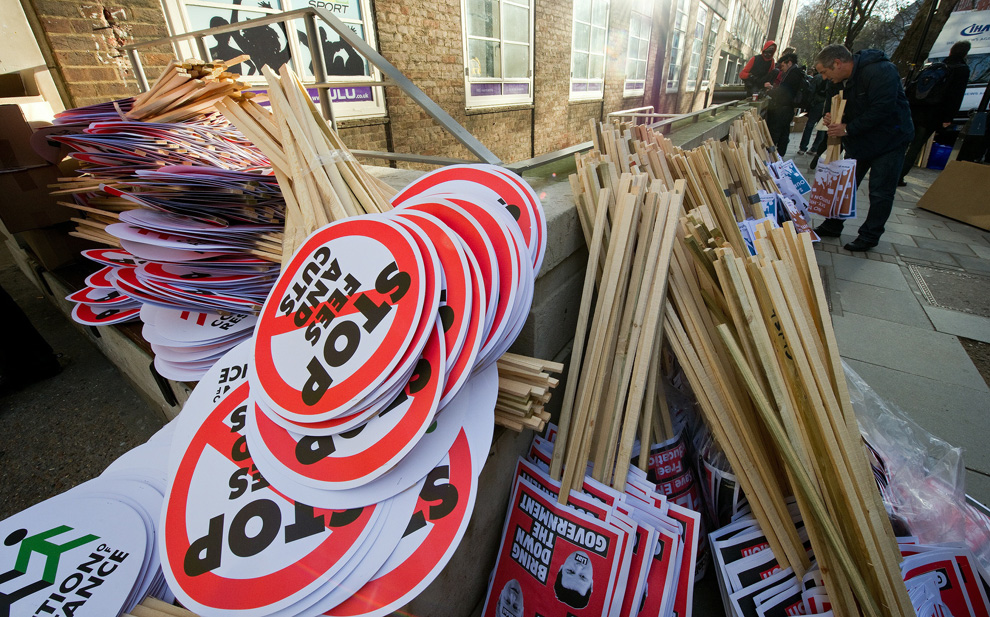
London tuition fee protest

We Have a New College Debt Queen
After detailing college graduates with $97,000 and $120,000 in debt, I thought I had reached the peak of "bad ways to finance college." I was so, so wrong.
Here's the story of a young lady who has $200k in college debt (from an undergraduate degree alone.) Yikes! Her words:
The severity of my situation goes a bit deeper than "I owe this money, help me" - I am actually forced to live with my parents (forced = I am lucky! But...) as the monthly payments for just my private loans are currently $891 until Nov 2011 when they increase to $1600 per month for the following 20 years... attached is my payment plan. I also mentioned I have a job - which is great! And I probably have my college education to thank for that! Except there is still no way to make these monthly payments, and live on my own as a contributing member of society. Neither of my parents, nor I, really knew how this would pan out — unfortunately — and now that I'm here, I see no real light at the end of the tunnel.
Ugh! Here's another person who simply didn't think through the college/education/debt/earning issues in advance -- and now she's paying for it.
But she's got another great idea! She's set up a website so people can donate and help her pay off her debt. Yeah, that's gonna be money well spent.
Let me say this again in the hopes that a future college student (or his parents) will read this: to get the most financial benefit out of college, you must compare expected costs with expected post-graduation incomes. And you HAVE to do this before you decide which college to attend and how much you'll borrow (if any) to go there.
And be sure to read Thoughts on the "New" Way to Go to College before you take any actions. It will save you thousands of dollars.
As for the student above, I can't muster much sympathy. I suggest she puts her nose to the grindstone, makes as much as she can, saves as much as she can, and pays off as much of the loan as soon as possible. Yes, it will take her several years to do so, but if she works at it, she may just end up making lemonade out of lemons. I imagine hearing of her in ten years -- she'll have a best-selling book, a well-read blog, and be all over speaking to people on how she paid off $200k in college loans in five years. Here's hoping! ;-)
Wall Street's Sneaky New Way to Make Bank from Struggling Homeowners
"I just couldn't come up with the money," said Walker, 67, a former hotel worker who makes do on a monthly Social Security check.
Barely more than a year after a taxpayer bailout of major financial institutions, Bank of America and the hedge fund, Fortress Investment Group, spotted a fresh money-making opportunity - collecting the tax debts of tens of thousands of people like Walker. The bank and hedge fund can add interest charges and fees, and they bundled the debts as securities for investors.
In late May and early June, proxies for the two institutions quietly bought hundreds of millions of dollars in homeowners' property tax debts in Florida by bidding at a series of online auctions held by county tax collectors. They didn't use their names but donned multiple other identities, dominating the auctions and repeatedly bidding on the same parcels - in the case of Walker's small home, more than 8,000 times.
Then, in September, Bank of America's securities division packaged $301 million worth of the tax liens it and Fortress had acquired into bonds pitched privately tomajor investors. The anticipated return - estimated at between 7 to 10 percent - is possible because buyers of tax debts can assess a panoply of interest charges and other fees. When the debt goes unpaid long enough, the liens buyer can seize properties through foreclosure.Because the bonds were sold privately, there's no public record indicating who purchased them, the prices paid, or the anticipated return. Moody Investment Services spokesman Tom Lemmon said the type of offering, known as a tax lien securitization trust, is fairly uncommon. Bank of America, he added, may make additional offerings in future years.
A Bank of America spokesman, while otherwise declining comment, said that the bank and Fortress had not acted together in bidding in the auctions.
Bank of America spokesman William Halldin said by email: "Our bids were made independent of any other organization. Any suggestion that they weren't independent is simply incorrect."
Fortress, which is headed by former Fannie Mae chief Daniel Mudd, had no comment.
The Florida securities deal illustrates how financial institutions, including some beneficiaries of federal bailout dollars, are actively creating new ways to profit from the financial distress of homeowners. Acting as surrogate tax collectors, they can help local governments quickly and efficiently bolster their budgets by tens of millions of dollars and in some cases find new owners for dilapidated property. Miami-Dade County, for instance, took in more than $374 million in June 2009 from the sale of about 60,000 property tax liens.
Yet no one is looking out for property owners who suddenly find themselves in debt to the new Wall Street taxman. The growing $5 billion tax lien market goes largely unwatched and unregulated because rules haven't kept pace with the industry's flourishing growth in economic hard times, the Huffington Post Investigative Fund has found in a review of the industry.
While federal officials have recently tightened regulations to protect consumers from a variety of debt collection tactics, private tax collectors aren't on their radar. Meanwhile, many county tax officials say they simply lack the manpower to police the sales and collection process more closely.
"There's an opportunity for sophisticated investors to come in and make a lot of money until the law is able to catch up. That's the reality of what's been happening," said Robert Lawless, a law professor at the University of Illinois and expert on consumer credit issues.
A Secretive Banking Elite Rules Trading in Derivatives
The men share a common goal: to protect the interests of big banks in the vast market for derivatives, one of the most profitable — and controversial — fields in finance. They also share a common secret: The details of their meetings, even their identities, have been strictly confidential.
Drawn from giants like JPMorgan Chase, Goldman Sachs and Morgan Stanley, the bankers form a powerful committee that helps oversee trading in derivatives, instruments which, like insurance, are used to hedge risk.
In theory, this group exists to safeguard the integrity of the multitrillion-dollar market. In practice, it also defends the dominance of the big banks.
The banks in this group, which is affiliated with a new derivatives clearinghouse, have fought to block other banks from entering the market, and they are also trying to thwart efforts to make full information on prices and fees freely available.
Banks’ influence over this market, and over clearinghouses like the one this select group advises, has costly implications for businesses large and small, like Dan Singer’s home heating-oil company in Westchester County, north of New York City.
This fall, many of Mr. Singer’s customers purchased fixed-rate plans to lock in winter heating oil at around $3 a gallon. While that price was above the prevailing $2.80 a gallon then, the contracts will protect homeowners if bitterly cold weather pushes the price higher.
But Mr. Singer wonders if his company, Robison Oil, should be getting a better deal. He uses derivatives like swaps and options to create his fixed plans. But he has no idea how much lower his prices — and his customers’ prices — could be, he says, because banks don’t disclose fees associated with the derivatives.
“At the end of the day, I don’t know if I got a fair price, or what they’re charging me,” Mr. Singer said.
Derivatives shift risk from one party to another, and they offer many benefits, like enabling Mr. Singer to sell his fixed plans without having to bear all the risk that oil prices could suddenly rise. Derivatives are also big business on Wall Street. Banks collect many billions of dollars annually in undisclosed fees associated with these instruments — an amount that almost certainly would be lower if there were more competition and transparent prices.
Just how much derivatives trading costs ordinary Americans is uncertain. The size and reach of this market has grown rapidly over the past two decades. Pension funds today use derivatives to hedge investments. States and cities use them to try to hold down borrowing costs. Airlines use them to secure steady fuel prices. Food companies use them to lock in prices of commodities like wheat or beef.
The marketplace as it functions now “adds up to higher costs to all Americans,” said Gary Gensler, the chairman of the Commodity Futures Trading Commission, which regulates most derivatives. More oversight of the banks in this market is needed, he said.
But big banks influence the rules governing derivatives through a variety of industry groups. The banks’ latest point of influence are clearinghouses like ICE Trust, which holds the monthly meetings with the nine bankers in New York.
Under the Dodd-Frank financial overhaul, many derivatives will be traded via such clearinghouses. Mr. Gensler wants to lessen banks’ control over these new institutions. But Republican lawmakers, many of whom received large campaign contributions from bankers who want to influence how the derivatives rules are written, say they plan to push back against much of the coming reform. On Thursday, the commission canceled a vote over a proposal to make prices more transparent, raising speculation that Mr. Gensler did not have enough support from his fellow commissioners.
The Department of Justice is looking into derivatives, too. The department’s antitrust unit is actively investigating “the possibility of anticompetitive practices in the credit derivatives clearing, trading and information services industries,” according to a department spokeswoman.
J.P. Morgan and the Great Silver Caper
There’s a lot of rumor, buzz, innuendo, chitchat and scuttlebutt about the precious metals markets these days. Most of the chitchat is about J.P. Morgan and silver. Rumor has it that J.P. Morgan has amassed a whopping short position in silver.
The scuttlebutt, according to Scott Rubin of Benzinga.com, is that “J.P. Morgan holds a giant short position in silver. Furthermore, some observers are accusing the bank of acting as an agent for the Federal Reserve in the market…I.e., a lower silver price helps maintain the relative appeal of the US dollar…
“By selling massive amounts of paper silver in the futures market,” Rubin continues, “J.P. Morgan has been able to suppress the price of the precious metal. It is believed that these short positions are naked (i.e. they are not backed by any physical silver).”
If the silver price were falling, Morgan’s (alleged) short position would be lauded as a stroke of genius. But since the silver price is soaring, Morgan’s (alleged) short position looks much less laudable.
“In recent days,” Rubin notes, “rumors have been swirling on the Internet that J.P. Morgan’s massive short position is about to blow up in its face in the form of an almighty short squeeze and potential COMEX default, as large traders demand physical delivery of silver that COMEX does not have in its vaults.”
Based on some of the latest conjecture, Morgan’s short position totals a whopping 3.3 billion ounces. If, therefore, the buzz about J.P. Morgan and silver is even half true, the prestigious investment bank could be cruisin’ for bruisin’.
For perspective, 3.3 billion ounces is roughly equal to:
1) One third of all the world’s known silver deposits;
2) Two times the world’s approximate stockpiles of silver bullion;
3) Four times the annual mined supply of silver;
4) 30 times the inventory of silver at the COMEX.
To repeat, short positions – even titanic ones – are no big deal, as long as the price of the underlying asset is falling. But if, inconveniently, it is rising, the spaghetti can hit the fan in spectacular and gruesome fashion.
The silver price is rising…a lot. From less than $10 an ounce two years ago, the silver price has more than tripled. Therefore, if J.P. Morgan does, in fact, hold a 3.3 billion ounce short position, every one-dollar increase in the silver price would produce a loss of $3.3 billion…at least on paper.
Unfortunately, Morgan cannot simply unwind this trade with a couple of mouse-clicks in an E*trade account. The position is too large, both in relation to the world’s physical supplies of silver and in relation to the paper “supplies.” (Morgan holds almost half of all short positions on the COMEX, which is essentially a “paper market” – participants rarely take delivery of physical silver).
To make matters even more dicey for Morgan, the supplies of physical silver are disappearing rapidly from the marketplace. Increasingly, the kinds of folks who invest in precious metals are also the kinds of folks who distrust intermediaries. These precious metals investors want to know that the shiny stuff is in their personal possession.
Meanwhile, the ETFs that hold precious metals are soaking up massive quantities of physical metal. Over the last 12 months, the silver ETFs around the globe have increased their holdings by nearly 100 million ounces – or almost as much silver as the entire inventory of the COMEX. The trend in gold is identical.

Therefore, as a result of soaring demand from both individual investors and ETFs, the physical stockpiles of gold and silver are atrophying in relation to the paper claims on both metals. This is not a pleasant picture for a short seller of silver.
Furthermore, the kinds of folks who tend to buy gold and silver are also the kinds of folks who have contempt for Wall Street…and for Wall Street banks like J.P. Morgan. So it should come as no surprise that a grassroots campaign has formed – the sole purpose of which is to punish J.P. Morgan for its attempted manipulation of the silver market.
“A viral campaign (Crash JP Morgue Video [below]) to buy a physical silver and ‘crash’ the bank is now spreading like wildfire on the Internet,” Rubin reports. “Just Google, ‘Crash JP Morgan Buy Silver’ [to learn more about it]… Those who wish to participate in squeezing the living daylights out of J.P. Morgan, may want to consider buying physical silver, silver futures and SLV.”
Maybe this story about J.P Morgan’s short position in silver is mere innuendo. Maybe not. But two facts are irrefutable:
- J.P. Morgan is already under investigation by the CFTC for manipulating the silver market. “The investigation into the bank can be traced back to November 2009,” Rubin reports, “when London metals trader and whistleblower Andrew Maguire contacted the CFTC to report market manipulation prior to it actually occurring.”
- Precious metals investors are increasingly keen to get their hands on physical gold and silver, rather than mere paper facsimiles.
December 11, 2009
Eric J. Fry has been a specialist in international equities since the early 1980s. He was a professional portfolio manager for more than 10 years, specializing in international investment strategies and short-selling. Mr. Fry launched the sometimes abrasive, mostly entertaining and always insightful Rude Awakening. His views and investment insights have appeared in numerous publications including Time, Barron’s, Wall Street Journal, International Herald Tribune, Business Week, USA Today, Los Angeles Times, San Francisco Chronicle and Money. He appears regularly on business news stations like CNBC and Fox.


Copyright © 2009 Daily Reckoning« CHART SHOCK: Fed's balance sheet grows to record size »
After flattening out, it's headed higher once again with QE2. One question, when the Fed wants to sell MBS and other securities, who's gonna buy?

---
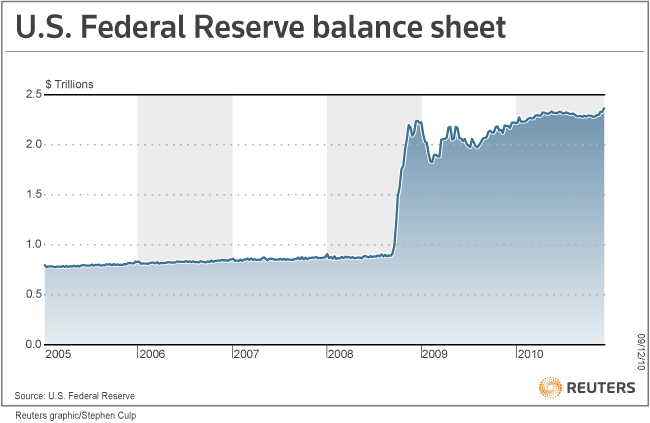
(Source -Reuters) The U.S. Federal Reserve's balance sheet expanded for a sixth straight week, bolstered to a record by purchases of Treasuries, Fed data released on Thursday showed.
The balance sheet, a broad gauge of Fed lending to the financial system, rose to $2.364 trillion in the week ended Dec. 8 from $2.329 trillion the previous week.

Last month, the U.S. central bank began a second bout of quantitative easing, known as QE2. The Fed expects to buy about $600 billion in U.S. government debt purchases over an eight-month period in an effort to stimulate the economy.
The balance sheet exceeded the previous record of $2.333 trillion set in May as the Fed was about to end its initial round of bond purchases that involved $300 billion of Treasuries and $1.425 billion in mortgage-related securities.
The Fed's QE2 follows its use of proceeds from maturing mortgage securities in its portfolio to buy Treasuries -- a move that started in August. Since that time, it has purchased about a combined $175 billion in Treasuries.
The central bank's holdings of U.S. government securities totaled $949.61 billion on Wednesday, up from $917.45 billion last week.
---
« 60 Minutes - John Boehner's Deficit Pledge »
Scroll down for more VIDEO...
---
Video - From tonight's broadcast - Runs 1 minute
Symbolic, much? There was no mention of cutting Congressional salaries, just staff budgets. Cut the war machine, John. Oh that's right, you'd rather raise the retirement age for Social Security to 70 so that you can pay for 10 more years of war in Afghanistan.
---
More clips...
Video - This is a very political clip that was made during the campaign.
#
Video - Where is John Boehner...
The Founding Fathers went to Ohio, looking for John Boehner. They scoured the tanning salons, golf courses, and corn fields of Ohio's 8th District. But they couldn't find him anywhere. Ever since Rep. Boehner promised VIP access to any lobbyist who could bundle $100,000, it seems that none of his constituents have seen him around town either.
---
Related stories...
---