Thursday, September 16, 2010

To get back to 5 percent unemployment we would need to add 285,000 jobs per month for 5 consecutive years.

The biggest problem facing many working and middle class families is the structural changes in our employment base. By this point in any “recovery” the private sector would be adding a tremendous amount of jobs. Yet there really is very little recovery for the typical American. The stock market is performing “well” for the moment but it is back to levels from a decade ago. Without a job however, there is little consolation that stock values are soaring on thin trading by a few large banks. Without a recovery in jobs there really is no economic recovery. Of course much of the media has a hard time even understanding how tough times are for most Americans. To put this into perspective, we would need to add 285,000 jobs per month for 5 consecutive years just to get to a healthy unemployment rate of 5 percent. The last time the private sector added that many jobs in one month was back in March of 2006 at the height of the housing bubble.

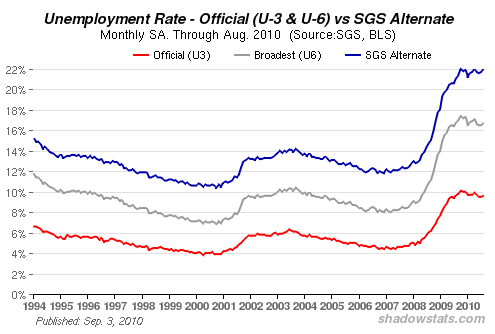
Let us look at the persistently high unemployment rate:
unemployment rate

One of the more discouraging one-liners on the media is when people say, “well with a 9.7 percent unemployment rate that means that 90.3 percent are employed.” First, this doesn’t account for those working part-time jobs wanting full-time employment. If we include this dataset the unemployment rate leaps up over 16 percent. Keep in mind that if someone is working 10 hours a week at Wal-Mart and lost their construction job this person doesn’t show up in the headline number. Next, 4 out of 10 Americans work in the low paying service sector. That is why even after accounting for these nuances in unemployment, we have many “fully employed” that are making barely enough to get by. The colloquial term that I have seen for this is the working poor.

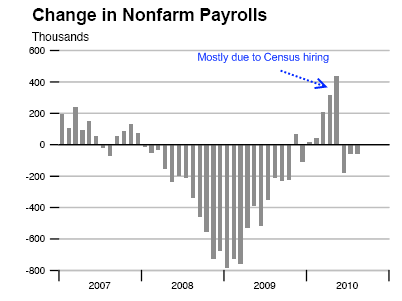
You might have seen this chart as good news:
nonfarm payrolls

The recent move up has virtually everything to do with government hiring (i.e., Census workers). Now that we have removed that, you can see that job growth is weak. In past recessions residential building usually was the match that ignited the recovery. But the problem this time is we have built way too much housing and have an enormous amount of vacant units. On top of that, you have close to 300,000 foreclosure filings per month still being filed adding a new pipeline for future inventory. The housing bubble was built over a decade and will have employment repercussions for years to come.

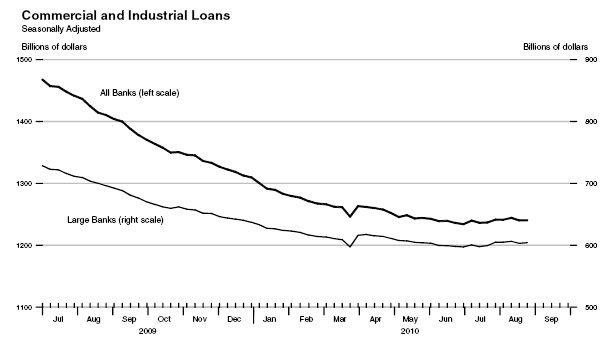
If we were really having a recovery, you would expect commercial loans to expand simply to meet new demand out in the market. Yet commercial real estate is in its own bubble and lending for this sector has moved only in one way:
commercial loans

Now don’t you think if this were a true recovery that more commercial loans would be hitting the market? Of course but the employment sector is in shambles. Consumer demand without a paycheck will take a hit. We know that the top 1 percent don’t spend as much as say the middle class in proportion to their income. Without solidifying our employment base, we should expect to see more strains on consumption which is a big part of our economy.

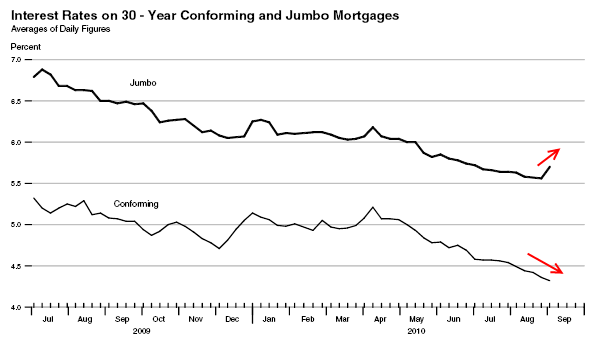
Mortgage rates are at all time lows yet housing has contracted severely:
mortgage rates

These are historical lows for 30 year fixed mortgages. Yet housing isn’t really responding. Why? The housing bubble at the core, was always a problem about employment. That is why the only way home prices soared up was through a once in a lifetime debt bubble. The recipe was perfect since many loans were so easy to get that the stagnant wages were never a problem. They were just ignored. But even now with very loose lending standards people are having a tough time qualifying without tax credits because their incomes are either low or unstable.

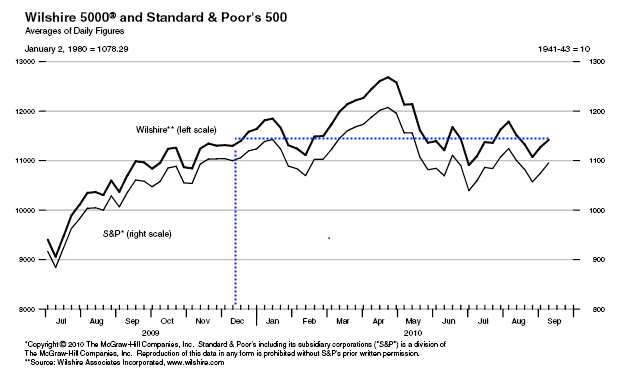
Even the recovery in the stock market is stalling out:
stock values

Stock values are back to levels seen in December of last year. If we expand the chart out, we are back to levels seen a decade ago. You would have done just as well by keeping your money in a CD or a savings account than putting it into the stock market. The stalling out should be obvious when you think that many of the companies listed on the exchange sell to consumers. If consumers are tightening their belts then demand will also falter. It is a troubling feedback loop.

Some jobs are not coming back. And older workers are facing similar issues to younger workers:

“(LA Times) Laid off in June 2008 from her $45,000-a-year post, Veasley-Fields at first wasn’t overly concerned. A college graduate, she had always enjoyed steady employment, including a long stint as a research manager at consulting firm McKinsey & Co. She crafted a crisp resume, networked through job clubs and navigated online employment sites like the seasoned researcher that she is.

But weeks stretched into months, with hundreds of unanswered job applications. California’s jobless rate in July stood at 12.3%, the third-highest in the nation, behind Nevada and Michigan. Veasley-Fields’ unemployment benefits have run out, her credit cards are maxed. She fears losing the tidy mid-Wilshire District bungalow where she and her 77-year-old husband are raising two granddaughters. Above all, she’s stunned that a middle-class life that took decades to build could unravel so quickly. She recently visited a food bank to secure enough staples to feed the girls.”

In big metro areas we are accustomed to the coldness of not knowing our neighbors. We only find out how tough things are when we see the impersonal statistics. And the issues in the employment base have been going on for years now:

“LOUISVILLE, Ky. (AP) — A General Electric spokeswoman described the response as overwhelming as about 2,500 people picked up applications Wednesday for about 200 jobs in Louisville.

The company will continue taking applications through Thursday for the positions at Appliance Park.

The new hires will replace GE workers who are retiring.”

The above article was from 2008. The recent data shows that for every one job opening six people are applying for it. I’ll be comfortable in calling this a recovery when we start adding 285,000 per month consistently. I just don’t see that but I hope I am wrong here.

Greek debt crisis fuels fears of European sovereign default

Figures released this month on some of Europe’s weakest economies, including Greece, Ireland and Spain, point to the threat of a second continent-wide recession.

New figures from the Greek statistics agency show that the country’s recession deepened in the second quarter. This was the seventh successive quarter registering a decline in economic growth. Growth fell by 1.8 percent, compared to the first three months of the year. This was worse than the 1.5 percent forecast in official estimates. In the first quarter of the year, gross domestic product (GDP) contracted 0.8 percent. Over the second quarter, public consumption declined 8.4 percent and private consumption by 4.2 percent. Over the past year, GDP has fallen by 3.7 percent.

Tax increases on fuel, alcohol and tobacco have helped drive the inflation rate to a 13-year high of 5.5 percent.

Unemployment year-on-year to June rose by 3 percent to 11.6 percent, according to official figures. Among 15-to-24-year-olds, the rate is significantly higher, at 32.5 percent. This is even before hundreds of thousands of public sector workers set to lose their jobs join the dole queues.

Elected last October, the Greek social democratic PASOK party government is imposing a €30 billion austerity programme in return for a €110 billion bail-out package agreed in May with the European Union and International Monetary Fund.

Contrary to the claim that the worst of the economic crisis is over as a result of the bailout, leading economists have warned that Greece will be unable to pay back its mountain of debt, with some forecasting that it will ultimately be forced to abandon the euro currency.

Speaking to the European House Ambrosetti forum at Lake Como earlier this month, German economist Hans-Werner Sinn, head of the IFO Institute in Munich, said, “This tragedy does not have a solution.”

Greece would have defaulted in the period between April 28 and May 7 had the money not been promised by the EU, he said:

“Greece would have been bankrupt without the rescue measures. All the alternatives are terrible but the least terrible is for the country to get out of the eurozone, even if this kills the Greek banks.”

Sinn warned, “We are in the second Greek crisis right now, today. The policy of forced ‘internal devaluation’, deflation, and depression could risk driving Greece to the edge of a civil war. It is impossible to cut wages and prices by 30 percent without major riots”.

Critical to establishing the €110 billion bailout was the fear among European governments that a default by Greece on its debt obligations might result in financial “contagion” in other countries, such as Portugal and Spain. Crucially, the money lent to Greece would go back to pay the banks, particular those in France, Germany and the UK, which collectively hold 80 percent of Greek sovereign debt. The UK is not part of the eurozone, but UK-based banks have lent money to Greece.

A report issued in July by the Washington-based Centre for Economic and Policy Research explained this fundamental aim of the bailout plan:

“Europe and the IMF are not so much providing Greece with fresh finance but, most of all, shielding the European financial system from up to 200 billion euros of losses that could result from a Greek default. Curiously, almost one quarter of Greek debt is located in the UK (and Irish) financial sector. The obvious beneficiaries of the Euro Area governments’ package are not Greek workers and citizens, who will suffer from severe budget cuts and recession, but financial centres such as the City of London.”

The Greek government hoped that the bailout would safeguard the economy against further pressure from global capital markets. Within the space of a few months, this strategy has already failed. The markets have continued to speculate that Greece will default on its debt and “spreads” on longer-term Greek government debt have continued to lengthen. Ambrose Evans-Pritchard warned in the Daily Telegraph September 3, “Spreads on longer-term Greek government debt have surged back to crisis levels of about 800 basis points, implying a high risk of default.”

Further speculation against Greece and its banks took place last week following the announcement by the National Bank of Greece (NBG), the country’s top lender, that it needed to raise €2.8 billion (£2.3 billion) in fresh capital. The NBG is planning to raise the funds with a share issue and by selling part of its holding in Turkish subsidiary Finansbank.

The NBG, as with other Greek banks, has had no access to interbank market lending and relies on European Central Bank funding. The move by the NBG to raise several billion euros in capital was endorsed by the government, which hailed it as a sign that the Greek banks were freeing themselves from overall dependency on the European Central Bank.

The Greek state is the largest single shareholder in NBG. Finance Minister George Papaconstantinou said the move “shows the trust of international investors in the Greek banking system and the wider local economy”.

The fact that the money markets thought otherwise was soon apparent, as shares in the NBG dropped as much as 12 percent.

The NBG was one of five Greek lenders to pass the European-wide stress tests in July. The tests were not designed to give an accurate account of the perilous state of European banking, but were merely a confidence-building exercise dictated by the banks themselves. Their purpose was to attempt to reassure the jittery money markets and stabilise the euro.

Summing up the decision of the bank to seek further liquidity, Nick Skrekas of the Wall Street Journal commented, “Even if NBG comfortably passed the European Union stress test in July, a deepening Greek recession has lead to spiralling provisions for bad loans, prompting the need for additional capital.

“In conjunction with trading losses on its Greek government bond portfolio, given rating agency downgrades and a sell-off on the local bond market, meant that second-quarter net profit fell 68 percent year-on-year.”

Speculation against government bonds in a number of other indebted countries has continued apace. Last week, investors drove up the price of financial insurance against an Irish government-bond default. Yields on Irish 10-year bonds rose above 6 percent for the first time since the launch of the euro.

In an attempt to stem the frenzied speculation, the Irish government announced that it would divide the state-owned Anglo Irish Bank Corp into two parts—one based on customer deposits and another “asset recovery bank”, which would hold its bad loans.

US business and economics analyst, Megan McArdle, commented on the decision, “It’s not a good sign when the government has to intervene to prevent a run on a bank that is already owned by the government, but apparently, that’s what it’s doing with Anglo-Irish bank”.

Commenting in the Irish Times, Fintan O’Toole, wrote in apocalyptic tones, “The choice is now stark: do we go on being ‘good Europeans’ at the cost of destroying our own society or do we become ‘bad Europeans’, lose the trust of our European partners, but save ourselves?”

“There comes a point of existential crisis when even the meekest of countries has to put its vital national interests (first). We are at that point now.”

In a September 8 Daily Telegraph column on the sovereign debt crisis, Evans-Pritchard drew attention to the crisis in Ireland and stressed that this was a critical European-wide problem. “Credit default swaps (CDS) for Portugal, Spain, Italy, and Belgium have all surged this week,” he noted. According to Markit, the international financial information services company, the “stress gauge for the [eurozone] group is now higher than during the debt crisis, when the EU launched its €440 billion bail-out fund and the European Central Bank began buying eurozone bonds.”

The article cited the comments of Joachim Fels, the chief global economist at Morgan Stanley, who concluded that “one or several governments” may soon have to resort to the rescue mechanism. Fels warned that the stress testing of the European banks had failed to instil any lasting confidence, and concluded, “Neither the European sovereign debt crisis nor the banking sector crisis has been resolved, and both continue to mutually reinforce each other”.

The International Monetary Fund has sought to play down the risk of a nation defaulting on its debt. The IMF said in a September 1 report that “current market indicators of default risk seem to reflect some market overreaction”.

This evaluation was in contradiction to the results of an IMF study that detailed governmental debt sustainability internationally. The study researchers concluded that many countries are now running unsustainable levels of debt and have virtually no “fiscal space”. Fiscal space was defined by the IMF as the difference between the current level of public debt and a debt limit implied by each country’s own record of fiscal adjustment. The fiscal space indices essentially measure how much scope a nation has to borrow from financial institutions before the markets shuts off the supply of funds by demanding unsustainable interest rates.

“In particular, Greece, Italy, Japan, and Portugal appear to have the least fiscal space, with Iceland, Ireland, Spain, the United Kingdom, and the United States also constrained in their degree of fiscal manoeuvre” the study said.

The risk of Greece or another indebted European nation defaulting on its debt looks increasingly likely, as the CDS traders at major banks and hedge funds target them to take advantage like vultures to a decaying corpse.

Even if Greece meets all the obligations of its austerity programme, the IMF has calculated that it will have a rising sovereign debt ratio of 145 percent of GDP by 2014. This compares to a ratio of 115 percent in 2009.

Collapsing America

All governments lie, kill and misuse public funds, but these calculated habits are amplified manifold during wars. We're in two now, aiming for a third. Japan, whose land we're still occupying 65 years after Hiroshima, has just announced sanctions against Iran beyond what the U.N. mandated. South Korea swiftly followed suit. It's surprising to see these two countries so in sync, until one remembers that they have become American cheerleaders for decades. Rah, rah, bomb Tehran! A murderous chorus is rising, yet again. Countries that aren't our client states can be counted with two hands, even those missing fingers from an exploding grenade.

Universal outrage has been drummed up over the case of an Iranian woman about to be stoned to death for adultery. She's also implicated in the murder of her husband, for which she may be hanged. This second, more serious crime has been left out of many news stories. America also executes, but it doesn't stone, especially for a bit of ticklish fun on the side. We inject, electrocute, gas, hang and shoot our condemned. We're more humane that way. Forever bureaucratic, we pay attention to procedural niceties.

Our objection, then, is not to capital punishment, but to certain methods. Stoning is barbaric. We don't stone, period, except during one of our serial wars, where we will stone entire communities back to the Stone Age. But that's war, buddy. We also use phosphorous and cluster bombs, plant landmines that will last generations. To rectify and avenge the stoning of one woman, someone we don't really care about, whose name we can't even pronounce, we'll flatten Iran, maybe by Thanksgiving.

The United States is concerned about women worldwide. It is touched and outraged by one Afghan woman, Aisha, whose nose was sliced off by her Taliban husband. To defend her honor, it has killed hundreds of thousands of her brothers and sisters. To protect her, it has destroyed her country. It's the principle that matters. We care about the individual, at least those who are useful to our agendas. It's the masses we don't give a flying whoopee about. How can we not raise our voices, for example, when an imprisoned prostitute – hardly a criminal, really, even less so than adulterer – is left in a cage, to be baked to death for at least four hours in 107-degree heat? Her captors ignored her pleas for water. They wouldn't even allow her to use the bathroom, so she soiled herself before passing out. She was still alive, however, when finally taken to the hospital, where doctors allowed her to die. Incredibly, no charges have been filed. Such barbarity and judicial callousness deserve our fullest condemnations, except that hardly anyone has heard of Marcia Powell, 48, who died in an Arizona prison in May of 2009. The mainstream media ignore her, because her abject death cannot be exploited for political purposes. We're not trying to bomb Arizona.

Needing to kill, a government will lie before, during and after splattering blood. Eschewing subtlety, it prefers to speak in slogans and clipped, cartoonish sentences. They hate us for who we are. We must fight them over there, so we don't have to fight them over here. We're trying to root out the bad guys. Adopting this lingo, many Americans are dubbing the community center and mosque near Ground Zero a "jihad mosque" or a "victory mosque." In Lower Manhattan last week, I saw a man carrying a sign, "EVERYTHING I EVER NEEDED TO KNOW ABOUT ISLAM I LEARNED ON 9/11." Another displayed a caricature of "IMAM OBAMA." There was an effigy of a tied up Palestinian, complete with keffiyeh, with this placard, "OBAMA: With a name like HUSSAIN we understand. Bloomberg: what the f@&k is your excuse?"

Totalitarianism always breeds idiocy. Lies that go unchallenged lead to more preposterous lies. Idiocy is also the manure from which totalitarianism rises. On September 11, 2001, the entire world saw America symbolically imploded, but our actual collapse is ongoing. It is relatively gradual, unlike the three, yes, three, World Trade Center buildings that tumbled onto their own foot prints. For the last nine years, we have endured an unending stream of lies and idiocy, none more grotesque than the official explanation to what happened that tragic day.

Despite being lied to repeatedly, almost daily, Americans are strangely gullible to incoherent, even ridiculous narratives dished up by their government. Brainwashed by the bromide that their nation is always a force for good, anywhere, worldwide, Americans can't imagine that Washington could be complicit in the murder of its own citizens. Ignored is the fact that it has done so many times before, and since, 9/11. Using false pretexts to invade Iraq, our government has caused the death of over four thousand Americans, more than the number who perished on 9/11.

I don't know what happened that day, but it makes no sense to me that World Trade Center #7 fell down without being hit by anything. It makes no sense to me that it collapsed exactly the same way as the twin towers, as if imploding. It makes no sense that the passport of Satam al Suqami, one of the alleged hijackers, could be found on the ground, when entire skyscrapers were being pulverized. I also don't understand how no military jets could intercept any of the three planes that hit their targets that day. The first tower was struck at 8:46AM, the Pentagon at 9:40AM, nearly an hour later, with no effective response from our vaunted military. I used to take buses to and from the Pentagon Transit Center. I knew the building wasn't very tall, so it struck me as weird how an airliner could hit it from the side. Why fly parallel to the ground, nearly shaving it, to strike such a low target? Why not just dive into it? There are red flags all over this incident, yet many sane, reasonable people will become completely unhinged at the slightest suggestion that the official version doesn't add up. Our government lies all the time, but when it comes to this one incident, we shouldn't question anything? Even National Review, of all places, pointed out visa irregularities among the alleged hijackers, how they could enter the U.S. without the proper paperwork.

After Martin Luther King was killed in 1968, his family refused to believe the official explanation. They fought and fought until an assassination conspiracy trial was scheduled in 1999. Presented with extensive evidences, a jury concluded that, yes, the federal, state and local governments all had a hand in Dr. King's murder, and that James Earl Ray was not the shooter. The King family did what any sane, loving family would do. Coretta Scott King explained, "We had to get involved because the system did not work. Those who are responsible for the assassination were not held to account for their involvement [...] It has been a difficult and painful experience to revisit this tragedy, but we felt we had an obligation to do everything in our power to seek the truth."

On September 11, 2001, someone stabbed America. She's being murdered right now. As Americans, we need to get to the heart of this, because this madness and deceit are perpetuating themselves. If we don't have the courage and clarity to confront this evil, we won't regain our sanity or move forward. We might as well be dead. We're dying. As with the King murder and so much else, you cannot expect the system to convict itself. It will lie and lie until the truth hardly matters.

* Linh Dinh is the author of two books of stories and five of poems, with a novel, 'Love Like Hate', scheduled for July. He's tracking our deteriorating socialscape through his frequently updated photo blog, State of the Union.

Iran frees detained U.S. woman on $500,000 bail

TEHRAN, Iran (AP) — Iran released an American woman on a bail of $500,000 Tuesday more than a year after she was detained, but authorities said they were not considering the immediate release of two companions arrested with her.

The announcement came days after conflicting statements by Iranian authorities on whether Sarah Shourd would be freed as the process was complicated by political feuds among the leadership and questions over how a payment could be made for her freedom without violating international sanctions.

The English-language Press TV reported that Shourd, 32, had been released "on a bail of $500,000" but did not give more details. Iran's judiciary, meanwhile, issued a statement saying the "pretrial detention" of the two American men — Shane Bauer and Josh Fattal — has been extended for two more months.

Her family had said it was having difficulty raising the money. However, Tehran's chief prosecutor Abbas Jafari Dowlatabadi said later that the bail had been paid to an Iranian bank in Muscat, Oman.

"The judge issued the release order and Ms. Shourd was simply set free and she can leave Iran if she wants to," he told Press TV. He said the cases of the two American men, both 28, will be sent to the revolutionary court and "there is no talk of releasing those two right now."

Shourd's lawyer, Masoud Shafiei, said she had been released but was still undergoing formalities inside the Evin Prison, where she has been held in solitary confinement. He said he had no information about her departure route or any details about bail.

He later was quoted by the state news agency IRNA as saying Shourd planned to travel to Oman where her mother already was waiting for her, but that could not be confirmed and there were conflicting reports that she would go to the Qatari capital of Doha.

A spokesman for the Swiss Foreign Ministry, Lars Knuchel said the release had not been formally confirmed but "we are very confident that things are moving into the right direction."

The U.S. broke off ties with Iran after the 1979 Islamic Revolution, and Switzerland handles U.S. interests in Iran.

Shourd and her two friends were detained along the Iran-Iraq border on July 31, 2009 and accused of illegally crossing the border and spying in a case that has deepened tensions with Washington. Their families say they were hiking in Iraq's scenic north, and that if they crossed the border, they did so unwittingly.

The stage was set for Shourd's release last week when Ahmadinejad said he intervened as a gesture of Islamic compassion at the end of the holy month of Ramadan. However, the judiciary quickly humbled the president by saying it was in charge of the case and would set the rules — in the form of the largest known bail for any high-profile Westerner jailed in the past year.

Shortly after judicial officials announced the bail on Sunday, Shourd's lawyer predicted she could walk free in "two or three days."

Shourd's mother says she has serious medical problems, including a breast lump and precancerous cervical cells.

Moves to release Shourd have been accompanied by political jockeying in Iran between Ahmadinejad and his more conservative rivals.

Nora Shourd's phone message box was full when the AP tried reaching her for comment. A New York publicist working with the families, Samantha Topping, did not immediately return a phone call seeking comment. A message on the cell phone of Cindy Hickey, mother of Shane Bauer, referred calls to Topping.

Belgian Catholic Church sex abuse: we feared compensation claims

Belgium's Roman Catholic Church did not apologise for decades of endemic child sexual abuse by its clerics because an official apology would triggered a flood of expensive compensation claims, a senior bishop has admitted.


Belgian Catholic Church sex abuse: we feared compensation claims
Archbishop of Mechelen-Brussels and Primate of Belgium Andre-Joseph Leonard (L) holds a news conference with Guy Harpigny Photo: REUTERS

Guy Harpigny, the bishop of Tournai and the senior cleric responsible for rooting out sex abusers within the Belgian church's ranks, has further inflamed outrage by confessing that financial concerns over litigation stopped an official apology.

"We did not dare. If you officially apologise, then you are acknowledging moral and legal responsibility. Then there are people who ask for money and we don't know what lawyers and the courts will do about that," he said.

There has been widespread anger that Belgium's bishops have failed to apologise and begged for more time to deal with an independent report that uncovered sex abuse committed by at least 91 priests, other clergy or church workers in every congregation in Belgium, taking place over four decades.

At least 13 of the victims had committed suicide following the abuse, the report found last week, in an investigation fuelled by the resignation of the bishop of Bruges after he admitted abusing his nephew and trying to cover it up.

San Deurinck, 65, a Catholic activist who tried to commit suicide after he was abused by two priests as a teenage boy, has called on the Church to "respect victims" and to ensure justice by handing paedophile priests over to the police.

"I always had hope, but then I lost it," he said. "Let the Church understand that justice must do her work. The Church must comply to respect of victims."

Belgian bishops and the Vatican have also clashed over whether the Pope should punish Roger Vangheluwe, the former bishop of Bruges, who plunged the church crisis in April after admitting that he had abused his nephew and had tried to pay off the family.

Federico Lombardi, the Vatican spokesman, said on Monday, that the Pope had no plans for further action after a "quick decision" by the Pontiff "to accept the former bishop's resignation"

"Vangheluwe is no longer allowed to say mass in public. At the moment I have no knowledge of other specific measures that will be taken," said Father Lombardi.

But speaking on Tuesday, Bishop Harpigny called on the Pope to "defrock Vangheluwe", with or without a full ecclesiastical trail

"I would prefer a trial by the church authorities. This would be more honest. But any signal would be a good one," he said.

"Vangheluwe has chosen his own punishment and the Vatican does nothing."

Climategate whitewashers squirm like maggots on Bishop Hill's pin

Just back from the House of Lords for the launch of the Global Warming Policy Foundation’s report on the failings of the three Climategate inquiries.

The official inquiries, as we know, found nothing untoward in any of the Climategate emails – nor in the behaviour of the scientists responsible for them. But the GWPF’s report, by Andrew “Bishop Hill” Montford, begs to differ. At the conference, one journalist asked Montford to try to summarise the juiciest of his allegations. Montford found this difficult: so many and varied are the failings of the three whitewash inquiries, he simply couldn’t decide which ones to choose.

Here, for example, are just a few criticisms of the Oxburgh whitewash.

The panel appears to have been deliberately selected to have a majority who would not address the review objectively and to exclude sceptical views entirely.

UEA appointed Oxburgh as chairman of the panel in the full knowledge that he had conflicts of interest.

UEA restricted the scope of the Oxburgh inquiry to published papers only, avoiding the serious allegations related to the IPCC activities of CRU staff.

The scope was further restricted to the conduct of the scientists. UEA had led the Science and Technology Committee members to believe that the quality of CRU’s scientific work would be re-assessed. The committee’s chairman, Phil Willis, felt that the UEA had misled them.

Lord Oxburgh’s report misled the public by stating that the papers were chosen ‘on the advice of the Royal Society.’

Lord Rees said that he had consulted with experts about the papers. In fact he had only discussed them with Sir Brian Hoskins, who had said he did not know CRU’s works.

While we’re on Lord Oxburgh, it’s worth reminding ourselves just how entirely unsuited to chairing a supposedly neutral inquiry on AGW this man is. Here’s an interview he gave to Guardian in 2005 in which he reveals why corporate Quislings like himself have so strong an interest in pushing the AGW agenda:

Oxburgh advocates that government uses the controls at its disposal: “Regulate biofuels. Or subsidise. Or tax” – any incentive really, but “what we don’t want to see is in two years’ time the government simply becoming bored with climate change after we’ve invested a lot of our shareholders’ money.”

Perhaps the most shocking new revelation in Andrew Montford’s report is that Sir Muir Russell appears to have been given evidence at the beginning of his inquiry that [paleoclimatologist] Keith Briffa had “taken steps that might be construed as an attempt to block Freedom of Information requests.”

Despite this, the Muir Russell report claimed “we have seen no evidence of any attempt to delete information in respect of a request already made.”

Hmm. Curiouser and curiouser.

The Shoddy Climategate Inquiries

Andrew Montford is the author of The Hockey Stick Illusion: Climategate and the Corruption of Science. If you’re looking for one volume during the upcoming holiday season to share with friends who haven’t been following matters closely, it’s a great choice. No one with an open mind can read that book and not conclude there’s something seriously amiss in climate science.

Today, the Global Warming Policy Foundation has released a 54-page report (PDF here) authored by Montford. Titled “The Climategate Enquiries,” it examines three investigations conducted in the wake of the release of the Climatic Research Unit (CRU) documents into the public domain in late 2009.

Those inquires were intended to restore public confidence, but they have done nothing of the sort. I haven’t had an opportunity to read Montford’s report in its entirety, but below are some of his findings:

Regarding the Parliamentary Inquiry:

  • Comments made by Phil Willis suggest that he was not a neutral chairman.
  • The select committee appears to have accepted that scientists can leave out important information about the reliability of their results when presenting findings to policymakers.
  • The committee did not consider the issue of cherrypicking of data despite having several examples put to them.
  • The committee appears to have exonerated [Phil] Jones of the charge of fabrication without any evidence to justify such a conclusion.
  • The committee dismissed allegations of threats to [scientific] journals on the basis of explanations provided by Jones. No attempt was made to obtain evidence from the journal editors themselves.
  • The select committee does not appear to have investigated a serious
    allegation of a breach of scientific standards.
  • Although the committee are clear that the law of freedom of information
    was flouted, no attempt seems to have been made to identify the individuals responsible.

Regarding the Climate Change Emails Review aka the Muir Russell report:

  • Despite concerns that some of the appointed CCE panel members were unsuitable, the committee accepted [Muir] Russell’s vague expressions of hope that they would act in an objective fashion.
  • Only two interviews were held with key [Climatic Research Unit] staff. The majority of the panel, including the chairman, Sir Muir Russell, did not attend.
  • No interviews were held with critics of the CRU.
  • The panel appear to have exonerated CRU staff of undermining the peer review process without any evidence beyond unrecorded statements from Phil Jones. The panel themselves acknowledge that such uncorroborated testimony is inadequate.
  • The panel misunderstood the nature of the [Intergovernmental Panel on Climate Change] process, almost certainly affecting their conclusions in result.
  • The panel refused to publish the evidence of one of the most important
    witnesses [David Holland].
  • The panel failed to ask Jones whether he had deleted emails, but said they had not seen anything to suggest he had, despite having evidence to the contrary.
  • The panel failed to consider important evidence of breaches of Freedom of Information legislation.

Regarding the Scientific Assessment Panel aka the Oxburgh report:

  • The panel appears to have been deliberately selected to have a majority who would not address the review objectively and to exclude sceptical views entirely.
  • [The University of East Anglia] appointed [Ronald] Oxburgh as chairman of the panel in the full knowledge that he had conflicts of interest.
  • The papers examined by the panel were selected by UEA and appear to have been cleared with [Phil] Jones himself.
  • Lord Rees said that he had consulted with experts about the papers. In fact he had only discussed them with Sir Brian Hoskins, who had said he did not know [the Climatic Research Unit's] work.
  • Many of the papers examined were obscure and had not been questioned by critics. Many of the papers that had been criticised were not examined.
  • Contrary to the strong recommendation from the Science and Technology Committee, the inquiry did not carry out its interviews in public, nor did it make notes, recordings or transcripts of interviews.
  • At least one panellist had serious concerns over CRU science and how it was used in the [Intergovernmental Panel on Climate Change] reports. There was no word of these concerns in the Oxburgh panel report.

..

~Andrew Montford’s blog appears here

~if ordering The Hockey Stick Illusion from Canada, this source is quick & dependable