Monday, August 30, 2010

The Great Collapse of the Chicago Climate Exchange

Plagued by a free fall in carbon emissions prices and the perennial failure of Washington to pass any binding Cap and Trade Bill, it seems that the Chicago Climate Exchange is on its last leg, announcing that it will be scaling back its operations.

Chicago Climate Exchange or CCX, is North America’s sole voluntary, legally binding greenhouse gas trading and carbon “offset” projects in North America and Brazil. Rueters reported on Aug 11th that Intercontinental Exchange Inc, the operating body who purchased the struggling CCX in May this year, will be scaling back major operations this month, a move that includes massive layoffs. This is likely due to the complete market free-fall of their only product… carbon emissions.

Anthony Watts from the climate watchdog website Watts Up With That posts a graph from the CCX which shows carbon prices dropping like a stone, bottoming out this week at the embarrassingly low figure of 10 cents per tonne. Compare this to trading prices during its brief hay day in May and June 2008 where market highs reached $5.85 and $7.40 respectively, and you can say that most investors will be evaluating carbon as one of today’s more worthless commodities.

What a difference a year makes. It’s been nine months since the world watched the bottom drop out of a much-hyped UN Climate Summit in Copenhagen back in Dec 2009, with its neo-colonial agenda exposed within the first days of the summit. One of the keystones of the Climate Change alarmist movement was its audacious attempt to create a functioning market by monetizing the atmospheric trace gas known as CO2. Since last year, a number of scandals like Climategate have penetrated mainstream conversation, putting a rather awkward limp in the once nimble Man-Made Global Warming movement. Hence, apocalyptic frenzies and fears have dissipated and carbon prices around the world have continued to be pummelled by the market.

A Financial ‘Boondoggle’

Unlike most real markets, the carbon market was created by banks and governments so that new investment opportunities could seamlessly dovetail with specific government policies. It’s a fantasy casino based on a doctrine of pure science fiction. Certainly, gaming the system has always been at the top on the agenda of the new green eco-trader. Most people, investors included, might innocently ask the fundamental question, “what’s the point of having a CO2 commodities market?” The answer to that question should be obvious by now, and you can certainly look to the initial stakeholders in the various international climate trading bodies for a ‘Who’s Who’ list of individuals that have actively been pushing the global warming concept from its inception.

As American’s own CCX nears total collapse, climate alarmists and their vested partners are pinning their hopes on Europe. With most European countries happily singing from the same EU song sheet, institutional investment in the carbon market has seen a slightly more sustained existence. Europe’s socialized historical habit of subsidizing anything and everything means that it has been a better safe haven for something as radical as a carbon market. Many financial analysts would say that carbon requires a relatively steady price of around €40 a tonne in order to spur industrial investment in cleaner technologies, but unfortunately, Copenhagen failed and the announcements of emissions cuts are not coming as expected. Perhaps the reality gap is beginning to set in between governments’ political capital in climate change and the peoples’ ability to believe in global warming. Either way, the market will not be able to deliver such lofty figures, which is why real investors are getting out of the carbon market in 2010.

The front end of this game of ‘supply and demand’ is heavily reliant on EU governments making lofty announcements about future emissions targets. The logic here is that cutting emissions increases demand for EU carbon allowances. In the absence of such a restriction of the market, it was expected that the price would fall, and naturally that’s exactly what happened. In 2008, it cost €31 to pump out a ton of CO2, but today it will set you back about half that at €15. You will be hard pressed to find any financial wizard/pundit giving a sermon on a bullish carbon market in the near future- it’s just not happening anymore.

On the back end of the game, things are a bit shadier to say the least- some might call it a recipe for corruption. The industrial monopoly power giants and other green businesses who are ‘well connected’ are of course, being allocated free EU Carbon Allowances until 2012, but from 2013 some sectors will have to pay for 20% of their allowances (those with weaker political influence in Brussels), rising each year to 60% in 2020. Many government/power company ‘green initiatives’ will automatically result in high energy price to consumers, which naturally means guaranteed profit increases for those same corporations (see Enron).

Off-set scam

Carbon trading is underpinned by an equally dodgy product called ‘carbon off-sets”, most of which are taken on face value by the buyer. Not based on an actual ton of carbon emitted, rather governing agencies are issuing certificates for a fictional commodity of emissions not emitted. A rather wild concept. Worse than this however, it is near impossible to verify which of these thousands of so-called off-set projects in the developing world are actually legitimate. In the coming years, we will no doubt see or read a number exposes detailing the depths of this fantastic green scam.

Get in early and then get out

The formula: create an investment vehicle, hype the new commodity, buy low, watch share prices rise, sell high. The result is money, lots of it. In some cases it’s been about driving up the share prices of companies Gore’s group has already invested in. The fact that the original shareholders of the CCX have already bailed out with their sale to Intercontinental Exchange Inc. for a modest $600 million earlier this year only reinforces the reality that its creators have already lost faith in their elaborate invention. Likewise, the self-styled leaders of the climate change crusade Maurice Strong and Al Gore have already cashed in carbon fortunes already, whilst other active politicians like US President Barrack Obama, and United Nations IPCC Chief Rajendra K. Pachauri are engaged in similar play with their own financial interests in the Carbon Markets.

Like all government rigged quasi-commercial schemes, the only real beneficiaries are the initial shareholders- a special inner circle who are naturally ahead of the curve knowing about legislation and policy before it comes into existence. They are sometimes called the great and the good, the in-crowd, or the smartest men in the room (again, see Enron). Of these, almost all have jumped ship out of the market while their preferred shares- or in the case of the larger energy and manufacturing monopolies, their gratis “carbon allowances” given to them free by their governments- are still worth something. If you’re on the inside, it’s simple: get in early, make money and then get out.

Climate change based on science fiction

Pointing out the obvious is always a painful thing in the world of human affairs. The real reason for the complete and total failure of the concept behind trading an atmospheric gas like CO2 is something few within the green block will dare to even mention now, and it’s the same reason why the whole movement will go down in history as one of the most flamboyant efforts in the history of economics. It’s not just hubris. The whole idea behind making CO2 a commodity was to make it expensive and thus reduce the amount produced, which would (they hoped) reduce the effect of anthropogenic(man-made) global warming, or ‘climate change’ as it’s now commonly referred to. There was only one massive problem with this equation- there has been no global warming since 1998. So despite the hundreds of millions, perhaps billions spent on research and computer models addressing this possibility, no scientist or body has been able to show that man’s CO2 contribution has had any effect on the global temperature. Another massive blind spot for climatists is their almost religious denial that the sun might have any effect on the earth’s climate (studies show that it does, of course)- a major sore spot in any debate on global warming.

The movement was a merger of radical Collectivist ideas and huge financial opportunities. Men like Maurice Strong looked for their moral positions to be anchored by a small group of hand-picked ‘scientific authorities’, a latter day technocracy if you will. On the opportunist side we also see those same scientists who have made their careers, many millions of dollars over the last decade alone, on grants to prove that global warming was somehow happening. Other financial opportunists will include Al Gore, scores of companies like Carbon Fund and a number of charities soliciting donations to save the planet, all of whom were hoping to cash in on this non-event until its financial opportunities eventually die out.

If you step back and marvel at the timing and combination of the climate change movement and carbon trading business it’s enough to make you dizzy. Never has the world seen a more stunning collusion between government and big business, a tango that makes fascist enterprises like Mussolini’s Italy or Franco’s Spain look like student internships.

Still hoping for some silver lining in this otherwise cloud of failure, most diehard green activists are laying the blame on governments for giving away too many free carbon coupons in recent years. Certainly there is a valid economic point there, but greens were all too eager to get into bed with Wall Street and the Fabian Socialists in order to realize their dream of a new utopia. The current color-blind global financial system based on derivatives, futures and sub-prime gambling products will eventually take down the carbon market altogether, as speculators prey on untapped markets, selling more worthless paper to an ever decreasing naive minority. In the wake of the dot com boom and the housing boom, Wall Street certainly tried to make environmentalism sexy and trendy for investors, but we can see now that the results speak for themselves- CO2, a penny stock for kids. “Roll up, roll up. Anyone want a tonne of CO2 for 10 cents?”

In the end it’s just another age-old tale of grovelling academics, big business, politics, power and money. So it doesn’t require an expert to tell you that the carbon market was doomed to fail from the beginning.

—-

US-Europe scandal may paralyze IMF

ime
Download
International Monetary Fund. © Flickr.com/David Boyle/cc-by

The International Monetary Fund (IMF) may lose its board of directors amid the escalating scandal between the United States and Europe over the ways to reform this financial institution. The scandal came as a bombshell, while IMF’s spokesman Gerry Rice said there was nothing to worry about.

It all started with Europe’s refusal to give some of its 9 seats in the 24-member board of the International Monetary Fund to emerging markets. It should be noted that the fund’s lending capacity is distributed in compliance with the members’ voting power. Naturally, the European board, which has been dominating since the IMF was founded, will not yield power and thus sabotage the decision made by the leaders of last year’s G20 summit in Pittsburg.

At the summit, the sides reached a historical compromise, assuming obligations to redistribute IMF quota shares in favor of developing economies, expert with the Finance Academy of the Russian Government Boris Rubtsov said.

Obviously, while China, India, Brazil, and Russia are gaining strength, their role in decisions by the International Monetary Fund should also increase. I think it would be logical if both the US and Europe yield some of their seats, said Rubtsov.

IMF’s new executive board is expected to assume office on November 1st this year. According to the organization’s official spokesman Gerry Rice, there is no cause for concern, even though the US and Europe failed to reach a compromise within a year. If the latter eventually refuses to lose some seats, Washington will not give ground too. The US may once again use the blocking stake and frustrate the decision on re-electing the current board of directors, as it happened last week. The International Monetary Fund will prove incapable of making any further decisions unless a compromise is reached between the two sides.

Of course, it is possible to form a restricted board, but in this case African countries will be out of the running. And this may result in a more prominent political scandal.

Remaking the board members’ areas of responsibility will also prove painful, since many of them represent the interests of not only their countries.

Another obstacle for seeking a possible way out is Europe’s inability to promptly make permanent decisions, especially if it needs to yield some of the privileges to developing countries.

Family win 18 year fight over MMR damage to son: £90,000 payout is first since concerns over vaccine surfaced

A mother whose son suffered severe brain damage after he was given the controversial MMR vaccine as a baby has been awarded £90,000 compensation.

The judgment is the first of its kind to be revealed since concerns were raised about the safety of the triple jab.

Robert Fletcher, 18, is unable to talk, stand unaided or feed himself.

Lovely boy: Robert Fletcher with his mother Jackie at the age of  14

Lovely boy: Robert Fletcher with his mother Jackie at the age of 14

He endures frequent epileptic fits and requires round-the-clock care from his parents Jackie and John, though he is not autistic.

He suffered the devastating effects after being given the combined measles, mumps and rubella vaccine when he was 13 months old.

The Department of Health had always denied that the jab was the cause of Robert’s disability.

But now, in a judgment which will give hope to hundreds of other parents whose children have been severely affected by routine vaccinations, a medical assessment panel consisting of two doctors and a barrister has concluded that MMR was to blame.

Robert’s mother Jackie said the money would help with his care, though she described the amount as ‘derisory’.

Her first application for compensation under the Government’s Vaccine Damage Payment Scheme was rejected in 1997 on the grounds that it was impossible to prove beyond reasonable doubt what had caused Robert’s illness.

But Mrs Fletcher appealed and in a ruling delivered last week, a new panel of experts came to a different conclusion.

Healthy: Robert in the bath as baby before he had the MMR jab

Healthy: Robert in the bath as baby before he had the MMR jab

In a six-page judgment, they said: ‘Robert was a more or less fit boy who, within the period usually considered relevant to immunisation, developed a severe convulsion... and he then went on to be epileptic and severely retarded.

‘The seizure occurred ten days after the vaccination. In our view, this cannot be put down to coincidence.

'It is this temporal association that provides the link. It is this that has shown on the balance of probabilities that the vaccination triggered the epilepsy.

'On this basis, we find that Robert is severely disabled as a result of vaccination and this is why we allowed the appeal.’

The ruling will reignite the debate over the safety of common childhood vaccines, although it makes clear that Robert’s case does not involve autism.

There is one other reported case of a family being given compensation as a result of an MMR jab.

But Mrs Fletcher said she believed the compensation award to Robert was the first to a surviving MMR-damaged person since controversy erupted in 1998 when the now discredited Dr Andrew Wakefield raised concerns about a possible link between the combined MMR injection and autism.

He has since been struck off the medical register.

Affected: Robert with his parents as a five-year-old. He is unable  to stand, feed himself and speaks very little

Affected: Robert with his parents as a five-year-old. He is unable to stand, feed himself and speaks very little

The Government refuses to say how many awards have been directly attributed to this jab rather than other inoculations against illnesses such as diphtheria or whooping cough.

Details of successful claims involving vaccine-damaged children are seldom publicised because the Department of Health is thought to be anxious not to encourage a rush of applications.

Figures released in 2005 under the Freedom of Information Act revealed that tribunals had paid out £3.5 million over the previous eight years.

The Department for Work and Pensions, which administers the Vaccine Damage Payment Scheme, said: ‘We do not hold any information on how many awards have been MMR-related.

'It is not a requirement when a case is being assessed for the medical adviser to state which vaccine the damage has been attributed to.

'Nor is it a requirement to list the disabling condition that gave rise to the award.’

The controversy over a suggested link between MMR and autism erupted in 1998 when Dr Wakefield published a paper in The Lancet medical journal.

His work has since been discredited and earlier this year Dr Wakefield, who has moved to America, was struck off the medical register after the General Medical Council ruled that he had acted against the interests of patients and ‘failed in his duties as a responsible consultant’.

Campaign: Robert's mother Jackie set up JABS - a pressure group  which provides advice and support to families affected by vaccinations

Campaign: Robert's mother Jackie set up JABS - a pressure group which provides advice and support to families affected by vaccinations

Robert Fletcher does not suffer from autism. But Mrs Fletcher, from Warrington, Cheshire, said the ruling would give hope to hundreds of other parents fighting to prove that their children’s disabilities were caused by the MMR injection.

Mrs Fletcher set up and runs pressure group JABS - Justice, Awareness and Basic
Support.

Around 2,000 families seeking compensation for their vaccine-damaged children are registered with the group, which provides advice and support.

‘My husband John and I have battled for 18 years for the cause of Robert’s disability to be officially recognised,’ she said.

‘We were told the vaccine was perfectly safe. Like most people, we trusted what the doctors and nurses were putting to us.

'Robert is nearly 19 but mentally he is like a 14-month-old toddler. He can’t stand unaided and he is doubly incontinent.

'He can’t speak except to say “Hi, Mum” or “Hi, Daddy”.

‘We chop up his food and have to anticipate all his needs. He is prone to various illnesses and last week suffered around 40 severe epileptic seizures.

Discredited: Dr Andrew Wakefield was struck off by the GMC after  it found his research into the possible effects of MMR was flawed

Discredited: Dr Andrew Wakefield was struck off by the GMC after it found his research into the possible effects of MMR was flawed

'In April this year, we thought we’d lost him. He contracted a chest infection and had to go to hospital for several days.

‘He is such a lovely boy. When he’s not ill, he’s so cheerful and seems to take everything on the chin. In between seizures he says “Hi, Mum” and tries to kiss me.

‘The money is a derisory amount though it will help with making adaptations to the house for Robert’s benefit.

'What matters is the recognition that MMR was the reason this happened.’

The first doctor who assessed Robert under the compensation scheme in 1996 concluded that he had suffered a ‘simple febrile convulsion with no long-lasting consequences’.

Although he agreed that Robert had a degree of disability, he refused to accept that the MMR vaccine was to blame.

At this month’s appeal, evidence was given by a leading expert on vaccine-damaged children, paediatric neurologist Dr Marcel Kinsbourne. He explained the biological changes which had occurred in Robert’s brain following the vaccination.

The one-day hearing was chaired by a barrister sitting with two doctors, Professor Sundara Lingam, a former consultant at Great Ormond Street Hospital for Children, and Dr Adrian Allaway.

In a dissenting judgment, Professor Lingam said he believed Robert was ‘genetically predisposed to epilepsy and that the vaccination triggered it rather than caused it.

'Robert would have developed epilepsy in any event, even if he had not had the vaccination’.

But Professor Lingam was overruled by his two colleagues.

In their final judgment, they accepted that MMR had caused Robert’s illness but added: ‘We would stress that this decision is fact-specific and it should not be seen as a precedent for any other case.

'In particular, it has no relevance to the issue... as to whether there is a link between the MMR vaccine and autism.’

Last night, Tory MP Nadine Dorries, a member of the powerful Commons Health Committee, said: ‘If an independent panel has reached the conclusion that there has been a link between the MMR vaccine and the brain damage suffered by this boy in this case, then it is fair to assume that there could be as many as thousands of children and parents in the same position.

‘There should be full and easy access to all documentation relating to the judgment for any parent or professional to read and assess.’

Dr Michael Fitzpatrick, a London GP whose own son is autistic, said: ‘It is a very important principle that parents should be compensated in cases of this kind.

'But although a causal link has been established in law in this instance, exhaustive scientific research has failed to establish any link between MMR and brain damage.

'This case should not make parents feel any different about the safety of the vaccine.’

The Department of Health said: ‘This decision reflects the opinion of a tribunal on the specific facts of the case and they were clear that it should not be seen as a precedent for any other case.

'The safety of MMR has been endorsed through numerous studies in many countries.’


New hope for parents who claim MMR jab blighted their children

By SALLY BECK

For MMR campaigners, the Robert Fletcher ruling is a small but significant milestone in their efforts to prove that the vaccine is not safe for a few children, even though the Government insists it is and that serious reactions are rare.

The triple jab was introduced in 1988, and has been given to millions of children as part of their vaccination schedule, which includes inoculations for 12 diseases.

The vast majority of children suffer no more than redness and swelling around the injection site or a fever that can be easily treated.

But a small number suffer serious reactions. The official figure is one in a million, but campaigners believe that is an underestimate.

Up to 2,000 parents remain convinced their children have suffered significant harm from MMR but have been unable to prove it.

This new decision will give them hope, even though compensation panels do not officially recognise autism claims.

Campaigner Polly Tommey, who edits the magazine The Autism File and believes her son Billy is autistic because of MMR, says: ‘This is fantastic news. Now doctors can’t tell me that the MMR is safe.

'This payout is evidence that it is not safe. It’s interesting that they will look at epilepsy
and not autism, and you have to ask why.

'Is it because the compensation would be billions?’

Parents have tried to get the medical profession and the Government to investigate their claims that MMR damaged their children but have failed so far.

A group of parents brought a case in 1993 which was blocked after their legal aid was withdrawn in 2003.

They claimed for various injuries including autism, Guillain-Barre syndrome, epilepsy, sensorineural deafness, diabetes and arthritis.

Robert’s mother Jackie Fletcher, who set up the vaccine campaign group JABS, is one of a group of parents who continued to fight.

His compensation comes 12 years after the London-based paediatrician Andrew Wakefield claimed a link between MMR and autism.

He was struck off this year after the General Medical Council judged his research to be flawed.

Claiming compensation for any vaccine-related disability is notoriously difficult.

Mrs Fletcher said: ‘Only one in 200 parents who applies to the Vaccine Damage Payment Scheme is successful in receiving compensation.

'Claims for autism are not considered. There are 120 MMR cases waiting to be heard, but none is for autism.’

In America, 4,000 parents are claiming compensation for MMR damage, but again the courts will not officially look at cases where autism is mentioned.

However, cases involving autism do slip through the net.

Bailey Banks, who suffered seizures 16 days after receiving the MMR jab and was diagnosed with pervasive developmental disorder, an autistic condition, was paid compensation.

So was Ben Zeller, who suffered seizures, while Hannah Poling, who is autistic, was paid in secret.

Another 1,820 cases of brain damage caused by vaccines in the U.S., including MMR, have been settled in private.

Mrs Fletcher hopes that the 2,000 families registered with JABS will be awarded legal aid to continue their cases.

She says: ‘We plan to talk to our MP Andy Burnham about the anomalies in the Vaccine Damage Payments Act, the main one being that you can apply for compensation only if a child has died after the age of two.

'We have a number of children on our books who died younger after receiving MMR, but they are not eligible to claim.

'Most vaccines are given at two, three and four months old, so this rule makes no sense.

‘Robert was 13 months old when he had his seizure and, under the rules today, he wouldn’t be eligible to claim.’

U.S. staff told to send children out of Mexican city

(Reuters) - The U.S. government told staff at its consulate in Monterrey to send their children out of the northern Mexican city where drug violence has been escalating, the consulate said on Friday.

The decision follows an apparent kidnap attempt outside an elite private school attended by children of U.S. consulate staff, amid rising drug violence in Mexico's business capital that has surged since the start of this year.

"U.S. government personnel from the consulate general are not permitted to keep their minor dependents in Monterrey," a U.S. Embassy spokeswoman said in Mexico City. "As of September 10, no minor dependents, no children of U.S. government employees will be permitted in Monterrey," she added.

Suspected drug hitmen attacked a group of security guards working for Latin America's top beverage maker, Femsa, outside the American School in Monterrey on August 20, in what the consulate said was "an attempted kidnapping targeting the relatives of a local business executive."

Two of the bodyguards were killed and their bodies returned to the company's offices, police said.

Monterrey, once considered one of Latin America's safest cities and a top regional business center, has seen a dramatic spike in violence since the start of this year, when a split between two local drug cartels turned to all-out war.

The powerful Gulf cartel and its former allies, the Zetas, are fighting over smuggling routes into the United States across northeastern Mexico, sucking Monterrey into the conflict, with more than 450 drug killings this year.

(Reporting by Robin Emmott and Missy Ryan; editing by Stacey Joyce)

Make Sure the Bunker is Well Stocked

Robert Herz was forced to resign from his job as as chairman of the Financial Accounting Standards Board (FASB) because he insisted that the banks assign a fair value to their assets. That's not what you'll read in the papers, but it's true just the same. Herz was a major proponent of mark-to-market accounting, a simple means of determining the value of a bond or security by comparing the price of similar assets sold at market. In other words, Herz is a defender of universally-accepted accounting principles, which is why he was terminated, er, I mean, resigned. According to the Wall Street Journal:

"A new front has opened up in the war over mark-to-market accounting. Suddenly banks find themselves with an unexpected advantage in the fight over how they should value their vast holdings of financial instruments…

Mr. Herz had backed a recent proposal to expand the use of market-value accounting to banks’ loan books....Now, with Mr. Herz out of the picture, the future of the rule change may be in doubt."

Pretty nifty, eh? As soon as Herz became a nuisance for the banks, he got his pink slip. Surprise, surprise. It's just more evidence that the country is ruled by a Financial Mafia. Think of it like this: If you or I went to the bank to secure a loan using a dilapidated old bicycle and couple bags of empty cat food cans as collateral, we'd be ushered to the door by two beefy security guards who'd toss our sorry ass onto the street pronto. But when the banks use their putrid mortgage-backed sludge to borrow in the repo markets (or to conceal their true condition from investors), they get high-fives from bondholders and regulators alike. Herz threatened to blow the lid off the whole charade by exposing the extent to which the banks are doctoring their balance sheets and hiding the red ink on their books. Only he was sent packing (resigned?) before he got a chance to clean up the system. This is from the Huffington Post:

".... Herz's departure wasn't expected; his current five-year term runs for another two years...Herz has been "an effective investor advocate to improve the quality of financial reporting standards around the world." ..... Banks were forced in the aftermath of the financial crisis to write down trillions of dollars of securities tied to subprime mortgages, gutting their balance sheets even though the assets could eventually recover their value." (Huffington Post)

"Recover their value"? Not bloody likely. These toxic turkeys will never recover their value because they were fraudulent loans made to people who don't have the wherewithal to repay the balance. The whole thing was a scam from the get go, which is why Herz got the ax. Without "creative accounting" techniques (think Enron), the insolvency of the system would be exposed which, of course, the banksters cannot allow. Thus, Herz got the boot. End of story.

HIGH FREQUENCY CHICANERY: Update on the May 6 "Flash Crash"

Here's something else to munch on from Dennis K. Berman of the Wall Street Journal:

"Today, small investors are fleeing the equities markets in droves, according to data from the Investment Company Institute, pulling out a net $34 billion from stock funds so far this year.....They say, "I still feel like someone is screwing me......trading feels different than it used to."

Righto. Berman traces the problem to its source, the "inscrutable interplay between myriad exchanges and high-frequency traders, whose volume now accounts for an estimated two-thirds of all trading"..."a market that many perceive as tainted and prone to gaming by a cadre of insiders."

That sounds like an admission that the market is rigged?

High-frequency trading (HFT) is algorithmic-computer trading that finds "statistical patterns and pricing anomalies" by scanning the various stock exchanges. It's high-speed robo-trading that oftentimes executes orders without human intervention. HFT allows one group of investors to see the data on other people's orders ahead of time and use their supercomputers to buy in front of them. It's called frontloading, and it goes on every day right under the SEC's schnoz.

In an interview on CNBC, market analyst Joe Saluzzi was asked if the big HFT players were able to see other investors orders (and execute trades) before them. Saluzzi said, "Yes. The answer is absolutely yes. The exchanges supply you with the data, giving you the flash order, and if your fixed connection goes into their lines first, you are disadvantaging the retail and institutional investor."

Today's market is configured in a way that the only reliable way to make money is by increasing volume and trading on myriad venues. We're talking about gains of mere pennies per trade on zillions of trades. The problem is that--when there's a glitch in the system--the high frequency bullyboys head for the exits taking an ocean of liquidity with them. That leads to a "Flash Crash" like the one on May 6 when the markets tumbled nearly 1,000 points in a matter of minutes. And, guess what; there's nothing to prevent a similar cataclysm from taking place in the future, because nothing's changed. Everything is exactly as it was before the crash, which makes another disaster a virtual certainty.

There appears to be general agreement about the nature of the problem. Here's Berman again:

"When BlackRock Inc. surveyed 380 financial advisers earlier this summer about the flash crash, their perceptions said it all: The mayhem had been primarily caused by an "overreliance on computer systems and some types of high frequency trading" strategies that roam the market en masse, looking to pick off pennies of profit." ("A Market Solution That Put Investors in a Fix", Dennis K. Berman, Wall Street Journal)

No one wants to fix the problem, because then the big players would lose boatloads of money. So the vehicle continues to speed faster and faster down the mountain veering wildly from one side of the road to the other. How long before it jumps the guardrail and plunges to the bottom of the canyon? Stay tuned....

Capital Hill is awash in Wall Street's filthy lucre, which means that congress will block any law that threatens the main profit-centers of the big banks or brokerage houses. HFT, complex derivatives, securitization and repo transactions will all be preserved in their present state until the next big tremor rumbles through lower Manhattan bringing the markets down in a thunderous roar. Make sure the bunker is well stocked.

http://www.informationclearinghouse.info/article26260.htm

America's Top Military Chief: Debt is Main Threat to U.S. National Security ... Pentagon Must Cut Spending

In February 2009, the head of U.S. intelligence - Dennis Blair - said that the global financial crisis was the largest threat to America's national security. All of America's intelligence agencies apparently agreed.

The same month, the chairman of the Joint Chiefs of Staff - Admiral Mullen - also agreed.

Now, Mullen is focusing on a specific economic threat. Specifically, Mullen is focusing on the debt:

The national debt is the single biggest threat to national security, according to Adm. Mike Mullen, chairman of the Joint Chiefs of Staff. Tax payers will be paying around $600 billion in interest on the national debt by 2012, the chairman told students and local leaders in Detroit.

“That’s one year’s worth of defense budget,” he said, adding that the Pentagon needs to cut back on spending.

But at least war is good for the economy, right? At least spending on defense will help the economy recover and climb out of this pit of debt, no?

Actually, no.

Nobel-prize winning economist Joseph Stiglitz has said that war can be very bad for the economy. For example, in 2003, Stiglitz wrote:

War is widely thought to be linked to economic good times. The second world war is often said to have brought the world out of depression, and war has since enhanced its reputation as a spur to economic growth. Some even suggest that capitalism needs wars, that without them, recession would always lurk on the horizon.

Today, we know that this is nonsense. The 1990s boom showed that peace is economically far better than war. The Gulf war of 1991 demonstrated that wars can actually be bad for an economy.
Stiglitz has said that this decade's Iraq war has been very bad for the economy. See this, this and this.

And as the New Republic noted last year:

Conservative Harvard economist Robert Barro has argued that increased military spending during WWII actually depressed other parts of the economy.

Also from the right, Robert Higgs has done good work showing that military spending wasn't the primary source of the recovery and that GDP growth during WWII has been "greatly exaggerated."

And from the left, Larry Summers and Brad Delong argued back in 1988 that "five-sixths of the decline in output relative to the trend that occurred during the Depression had been made up before 1942."

As I noted in January:

All of the spending on unnecessary wars adds up.

The U.S. is adding trillions to its debt burden to finance its multiple wars in Iraq, Afghanistan, Yemen, etc.

Two top American economists - Carmen Reinhart and Kenneth Rogoff - show that the more indebted a country is, with a government debt/GDP ratio of 0.9, and external debt/GDP of 0.6 being critical thresholds, the more GDP growth drops materially.

Specifically, Reinhart and Rogoff write:

The relationship between government debt and real GDP growth is weak for debt/GDP ratios below a threshold of 90 percent of GDP. Above 90 percent, median growth rates fall by one percent, and average growth falls considerably more. We find that the threshold for public debt is similar in advanced and emerging economies...
Indeed, it should be obvious to anyone who looks at the issue that deficits do matter.

A PhD economist told me:
War always causes recession. Well, if it is a very short war, then it may stimulate the economy in the short-run. But if there is not a quick victory and it drags on, then wars always put the nation waging war into a recession and hurt its economy.
You know about America's unemployment problem. You may have even heard that the U.S. may very well have suffered a permanent destruction of jobs.

But did you know that the defense employment sector is booming?

As I pointed out in August, public sector spending - and mainly defense spending - has accounted for virtually all of the new job creation in the past 10 years:
The U.S. has largely been financing job creation for ten years. Specifically, as the chief economist for BusinessWeek, Michael Mandel, points out, public spending has accounted for virtually all new job creation in the past 10 years:

Private sector job growth was almost non-existent over the past ten years. Take a look at this horrifying chart:

longjobs1.gif

Between May 1999 and May 2009, employment in the private sector sector only rose by 1.1%, by far the lowest 10-year increase in the post-depression period.

It’s impossible to overstate how bad this is. Basically speaking, the private sector job machine has almost completely stalled over the past ten years. Take a look at this chart:

longjobs2.gif

Over the past 10 years, the private sector has generated roughly 1.1 million additional jobs, or about 100K per year. The public sector created about 2.4 million jobs.

But even that gives the private sector too much credit. Remember that the private sector includes health care, social assistance, and education, all areas which receive a lot of government support.

***

Most of the industries which had positive job growth over the past ten years were in the HealthEdGov sector. In fact, financial job growth was nearly nonexistent once we take out the health insurers.

Let me finish with a final chart.

longjobs4.gif

Without a decade of growing government support from rising health and education spending and soaring budget deficits, the labor market would have been flat on its back.

Indeed, Robert Reich lamented this month:
America’s biggest — and only major — jobs program is the U.S. military.
Back to my January essay:
Raw Story argues that the U.S. is building a largely military economy:

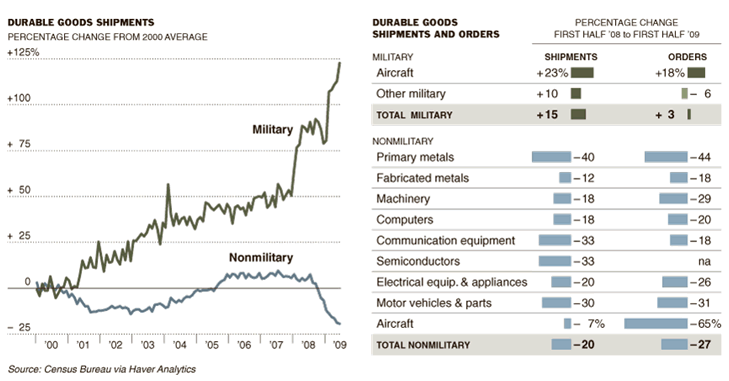
The use of the military-industrial complex as a quick, if dubious, way of jump-starting the economy is nothing new, but what is amazing is the divergence between the military economy and the civilian economy, as shown by this New York Times chart.

In the past nine years, non-industrial production in the US has declined by some 19 percent. It took about four years for manufacturing to return to levels seen before the 2001 recession -- and all those gains were wiped out in the current recession.

By contrast, military manufacturing is now 123 percent greater than it was in 2000 -- it has more than doubled while the rest of the manufacturing sector has been shrinking...

It's important to note the trajectory -- the military economy is nearly three times as large, proportionally to the rest of the economy, as it was at the beginning of the Bush administration. And it is the only manufacturing sector showing any growth. Extrapolate that trend, and what do you get?

The change in leadership in Washington does not appear to be abating that trend...[121]
So most of the job creation has been by the public sector. But because the job creation has been financed with loans from China and private banks, trillions in unnecessary interest charges have been incurred by the U.S.And this shows military versus non-military durable goods shipments:


[Click here to view full image.]

So we're running up our debt (which will eventually decrease economic growth), but the only jobs we're creating are military and other public sector jobs.

PhD economist Dean Baker points out that America's massive military spending on unnecessary and unpopular wars lowers economic growth and increases unemployment:
Defense spending means that the government is pulling away resources from the uses determined by the market and instead using them to buy weapons and supplies and to pay for soldiers and other military personnel. In standard economic models, defense spending is a direct drain on the economy, reducing efficiency, slowing growth and costing jobs.
A few years ago, the Center for Economic and Policy Research commissioned Global Insight, one of the leading economic modeling firms, to project the impact of a sustained increase in defense spending equal to 1.0 percentage point of GDP. This was roughly equal to the cost of the Iraq War.

Global Insight’s model projected that after 20 years the economy would be about 0.6 percentage points smaller as a result of the additional defense spending. Slower growth would imply a loss of almost 700,000 jobs compared to a situation in which defense spending had not been increased. Construction and manufacturing were especially big job losers in the projections, losing 210,000 and 90,000 jobs, respectively.

The scenario we asked Global Insight [recognized as the most consistently accurate forecasting company in the world] to model turned out to have vastly underestimated the increase in defense spending associated with current policy. In the most recent quarter, defense spending was equal to 5.6 percent of GDP. By comparison, before the September 11th attacks, the Congressional Budget Office projected that defense spending in 2009 would be equal to just 2.4 percent of GDP. Our post-September 11th build-up was equal to 3.2 percentage points of GDP compared to the pre-attack baseline. This means that the Global Insight projections of job loss are far too low...

The projected job loss from this increase in defense spending would be close to 2 million. In other words, the standard economic models that project job loss from efforts to stem global warming also project that the increase in defense spending since 2000 will cost the economy close to 2 million jobs in the long run.
The Political Economy Research Institute at the University of Massachusetts, Amherst has also shown that non-military spending creates more jobs than military spending.

So we're running up our debt - which will eventually decrease economic growth - and creating many fewer jobs than if we spent the money on non-military purposes.
As I wrote last month:

It is ironic that America's huge military spending is what made us an empire ... but our huge military is what is bankrupting us ... thus destroying our status as an empire.

Even Admiral Mullen seems to agree:

The Pentagon needs to cut back on spending.

“We’re going to have to do that if it’s going to survive at all,” Mullen said, “and do it in a way that is predictable.”

Indeed, Mullen said:
For industry and adequate defense funding to survive ... the two must work together. Otherwise, he added, “this wave of debt” will carry over from year to year, and eventually, the defense budget will be cut just to facilitate the debt.
Secretary of Defense Robert Gates agrees as well. As David Ignatius wrote in the Washington Post in May:

After a decade of war and financial crisis, America has run up debts that pose a national security problem, not just an economic one.

***

One of the strongest voices arguing for fiscal responsibility as a national security issue has been Defense Secretary Bob Gates. He gave a landmark speech in Kansas on May 8, invoking President Dwight Eisenhower's warnings about the dangers of an imbalanced military-industrial state.

"Eisenhower was wary of seeing his beloved republic turn into a muscle-bound, garrison state -- militarily strong, but economically stagnant and strategically insolvent," Gates said. He warned that America was in a "parlous fiscal condition" and that the "gusher" of military spending that followed Sept. 11, 2001, must be capped. "We can't have a strong military if we have a weak economy," Gates told reporters who covered the Kansas speech.

On Thursday the defense secretary reiterated his pitch that Congress must stop shoveling money at the military, telling Pentagon reporters: "The defense budget process should no longer be characterized by 'business as usual' within this building -- or outside of it."

California students get tracking devices

RICHMOND, Calif.—California officials are outfitting preschoolers in Contra Costa County with tracking devices they say will save staff time and money.

The system was introduced Tuesday. When at the school, students will wear a jersey that has a small radio frequency tag. The tag will send signals to sensors that help track children's whereabouts, attendance and even whether they've eaten or not.

School officials say it will free up teachers and administrators who previously had to note on paper files when a child was absent or had eaten.

Sung Kim of the county's employment and human services department said the system could save thousands of hours of staff time and pay for itself within a year.

It cost $50,000 and was paid by a federal grant.