Monday, July 12, 2010

US banks' role in Mexican drug trade

Ever wonder why it is the border between Mexico and the US is not really a secure border?
And, why the Obama administration is coming down so hard on Arizona for enforcing immigration/border crossing laws?

Could it be, because the US administration really doesn't want a secure US/Mexican border? One that may impede that which is being transported across the border?

A DC-9 jet lands in the port city of Ciudad del Carmen, 500 miles east of Mexico City
The crew attempts to keep soldiers away by saying their is a dangerous oil spill.
The soldiers become suspicious and check the plane. What do they find?
They found 128 black suitcases, packed with 5.7 tons of cocaine, valued at $100 million. The stash was supposed to have been delivered from Caracas to drug traffickers in Toluca, near Mexico City, prosecutors later found. Law enforcement officials also discovered something else.

The smugglers had bought the DC-9 with laundered funds they transferred through two of the biggest banks in the United States: Wachovia Corp. and Bank of America Corp.

This was no isolated incident. Wachovia, it turns out, had made a habit of helping move money for Mexican drug smugglers. San Francisco's Wells Fargo & Co., which bought Wachovia in 2008, has admitted in court that its unit failed to monitor and report suspected money laundering by narcotics traffickers - including the cash used to buy four planes that shipped a total of 22 tons of cocaine.

The admission came in an agreement that Wachovia struck with federal prosecutors in March, and it sheds light on the largely undocumented role of U.S. banks in contributing to the violent drug trade that has convulsed Mexico for the past four years.

Wachovia admitted it didn't do enough to spot illicit funds in handling $378.4 billion for Mexican currency exchange houses from 2004 to 2007. That's the largest violation of the Bank Secrecy Act, an anti-money-laundering law, in U.S. history - a sum equal to one-third of Mexico's current gross domestic product.

So Wachovia strikes a deal with federal prosecutors? Which means, we have to know this is a token plea. Meant to ensure the masses, to create the perception, the government is getting tough. But, would they government really 'get tough' on the banksters?


Now for a word from an insider who quit the bank in disgust-

"It's the banks laundering money for the cartels that finances the tragedy," said Martin Woods, director of Wachovia's anti-money-laundering unit in London from 2006 to 2009.

Woods says he quit the bank in disgust after executives ignored his documentation that drug dealers were funneling money through Wachovia's branch network.

"If you don't see the correlation between the money laundering by banks and the 22,000 people killed in Mexico, you're missing the point," he said.


Banks profits, open borders and chaos. Money laundering for drug traffickers. If you don't see the correlation, your missing the point.

This bit of news is made much more credible, not that I had any doubts, of the bankers involvements with drug trafficking, when you recall this older posting February 11/2009

Wow, Drug money flowed into banks!

The United Nations' crime and drug watchdog has indications that money made in illicit drug trade has been used to keep banks afloat in the global financial crisis, its head was quoted as saying on Sunday.

Standard operating procedure for the banks. Laundering drug money. So very profitable!!!

Mortgage Investors Turn to State Courts for Relief

INVESTORS who lost billions on boatloads of faulty mortgage securities have had a hard time holding Wall Street accountable for selling the things in the first place.

For the most part, banks have said they can’t be called out in court on any of this because they had no idea that so many of these loans went to people who lacked the resources to make even their first mortgage payment.

Wall Street firms were intimately involved in the financing, bundling and sales of these loans, so their Sergeant Schultz defense rings hollow. They provided hundreds of millions of dollars in credit to dubious underwriters, and some even had their own people on site at the loan factories. Many Wall Street firms owned mortgage lenders outright.

Because many of the worst lenders are now out of business, investors in search of recoveries have turned to the banks that packaged the loans into securities. But successfully arguing that Wall Street aided lenders in a fraud is tough under federal securities laws. This is largely a result of Supreme Court decisions barring investors from bringing federal securities fraud cases that accuse underwriters and other third parties as enablers.

Where there’s a will, however, there’s a way. And state courts are proving to be a more fruitful place for mortgage investors seeking redress, legal experts say.

In late June, for example, Martha Coakley, the attorney general of Massachusetts, extracted $102 million from Morgan Stanley in a case involving Morgan’s extensive financing of loans made by New Century, a notorious and now defunct lender that was based in California.

Morgan packaged the loans into securities and sold them to clients, even after its due diligence uncovered problems with the underlying mortgages that New Century fed to the firm, Ms. Coakley said. In settling the matter, Morgan neither admitted nor denied the allegations. Her investigation is continuing.

One of the most interesting aspects of this case “is the active role of state regulators relying upon state law to protect investors,” said Lewis D. Lowenfels, an authority on securities law at Tolins & Lowenfels in New York. “This state focus may well fill a void left by the U.S. Supreme Court’s increasingly narrow interpretation of the antifraud provisions of the federal securities laws as well as the relatively few S.E.C. enforcement actions initiated in this area.”

Last Friday, an investment management firm that lost $1.2 billion in mortgage securities it bought for clients filed suit in Massachusetts state court against 15 banks, accusing them of abetting a fraud. The firm, Cambridge Place Investment Management of Concord, Mass., purchased $2 billion in mortgage securities from the banks, and it says the banks misrepresented the risks in the underlying loans — both in prospectuses and sales pitches.

The complaint says the banks misled Cambridge Place by maintaining that the mortgages in the securities it bought had met strict underwriting requirements related to the borrowers’ ability to repay the loans. Cambridge also contends it relied on the banks’ claims of having conducted due diligence to verify the quality of the loans bundled into the securities.

The complaint also details the anything-goes lending practices during the subprime mortgage boom.

Interviews in the complaint with 63 confidential witnesses turned up such gems as Fremont Investment & Loan, which had been based in California, approving loans for pizza delivery men with reported monthly incomes of $6,000, and management at Long Beach Mortgage, also in California, directing underwriters to “approve, approve, approve.”

One Long Beach program made loans to self-employed borrowers based on three letters of reference from past employers. A former worker said some letters amounted to “So-and-so cuts my lawn and does a good job,” adding that the company made no attempt to verify the information, the complaint stated.

Such tales are hardly shockers. But they provide important context when Cambridge moves up the ladder to the banks that bundled and sold the loans.

For example, the complaint contended that Credit Suisse, from whom it bought $88 million of mortgage securities in 2005 and 2006, told Cambridge of its “superior” due diligence, including a performance review of every loan. Three-quarters of these loans are delinquent, in default, foreclosure, bankruptcy or repossession, the complaint said.

Bear Stearns, now a unit of JPMorgan Chase, sold Cambridge $65 million of securities. It owned three mortgage lenders and told Cambridge it sampled the loans it sold to check underwriting procedures, borrower documentation and compliance, the complaint said.

Among others named in the suit are Bank of America, Barclays, Citigroup, Countrywide, Deutsche Bank, Goldman Sachs, Merrill Lynch, Morgan Stanley and UBS. All of those, as well as Credit Suisse and JPMorgan, declined to comment.

CAMBRIDGE’S lawyers brought its case in Massachusetts under laws barring those who sell securities from making false statements about them or omitting material facts. Jerry Silk, a senior partner at Bernstein Litowitz Berger & Grossmann who represents Cambridge, said, “This case represents yet another example of Wall Street banks’ failure to live up to their basic responsibility to investors — to tell the truth about the securities they are selling.”

Mr. Silk’s firm has jousted with Wall Street underwriters before. In 2004, it recovered $6 billion in a suit against banks that underwrote debt issued by WorldCom, the defunct telecom. Denise L. Cote, the federal judge overseeing that matter, concluded that because investors rely so heavily on underwriters, courts must be “particularly scrupulous in examining the conduct,” she said.

It is too soon to tell if investors will recover losses in mortgage securities. But the efforts are reminiscent of those in the mid-90s against brokerage firms that cleared trades and provided capital to dubious penny-stock outfits such as A. R. Baron and Sterling Foster.

For decades, companies that cleared such trades — Bear Stearns was a big one — escaped liability for fraud at these so-called “bucket shops.” But regulators went after clearing firms by accusing them of facilitating such acts; in a 1999 lawsuit, the Securities & Exchange Commission accused Bear Stearns of enabling a fraud at A. R. Baron. Bear Stearns paid $35 million in fines and restitution to settle the case.

If trust in capital markets is to return, investors must be able to believe what they read in prospectuses. Without that minimum standard, how can Wall Street expect the markets to function again?

Fake prescription drugs surpass heroin earnings


Roller-coaster ride: Intel's share price this year (Bloom...

Number of the day

$450,000

That's how much pharmaceutical counterfeiters can make from $1,000 in seed money, according to Aline Plancon, an Interpol officer who investigates the fake-prescription-drug trade. Compare that with heroin, where $1,000 will only earn a return of $20,000, she estimates. One seller of fake Viagra - among the most frequently copied medicines - allegedly made enough to buy a beachside villa in Spain, a diamond-studded Rolex and a flat in London.

Hear here

"We feel like we've got the wind at our back. We're getting a good hearing on

the issues that matter to us."

Barry Meyer, chairman of Warner Bros., on how the Obama administration is helping fight movie piracy. The Department of Homeland Security used a soundstage at Walt Disney Studios last month to announce the seizure of nine websites that allegedly trafficked in illegal movie downloads. Hollywood executives say Obama is more focused on the issue than George W. Bush was.

Heads up

Intel will report second-quarter financial results Tuesday, kicking off the earnings season for technology companies. The Santa Clara chipmaker blew away expectations in the first quarter, thanks to resurgent demand for personal computers. The shares have dropped since then, dragged down by concerns that Intel will struggle to maintain that kind of growth.

This article appeared on page D - 1 of the San Francisco Chronicle

Hundreds of Federal Agents Fall Victim to Ponzi Scheme

(July 8) -- FBI agents are supposed to unearth scams, not become victims of them. This time is different.

Some 300 retired and current federal agents -- representing the FBI, the Drug Enforcement Administration and Immigration and Customs Enforcement -- collectively invested tens of millions of dollars of retirement money in what turned out to be a Ponzi scheme allegedly run by a Florida man who committed suicide last month, an attorney in the case said.

The FBI and the Securities and Exchange Commission are now investigating and trying to recover funds.

"There are definitely [agents] who have lost their life savings," Fort Lauderdale attorney Michael Goldberg, who is representing the victims, told AOL News.

The reaction of the agents? "Pretty much what you expect," Goldberg said. "Shock and anger."

Behind it all, authorities said, was a self-described retirement investment adviser named Kenneth Wayne McLeod, 48. For years McLeod served as a trusted adviser to federal agents around the country, making free financial projections for retirement and in some cases offering high-yield returns of 8 to 10 percent on certain investments, according to an SEC filing in the case.

On June 22, McLeod was found dead in Jacksonville, Fla., of a gunshot wound.

His Florida-based companies, Federal Employee Benefits Group Inc. and F&S Asset Management Group Inc., appear to have been shut down and all assets frozen, authorities said. Calls to both numbers went unanswered this afternoon and the voice mails were full.

McLeod allegedly mentioned to prospective clients the names of many federal agents he knew, including straitlaced FBI Director Robert S. Mueller III, according to the website Gang Land News, which reported on the story today.

"[McLeod] would tell people that Bob Mueller was a friend of his," a retired FBI agent told Gang Land News. "The guy was a real charmer. He would say that he and Bob were best of friends and that Bob and his wife used to stay at his place all the time. The worst thing about this is that this creep scammed hard-working GS-13s and GS-14s [federal employees]."

Mueller did in fact rent vacation properties in Amelia Island, Fla., for several years, Gang Land News reported. But Michael Kortan, the chief FBI spokesman, said in a statement that even if McLeod had owned one of those properties, Mueller had no idea who he was renting from.

"The director had no personal or professional relationship with Mr. McLeod, nor did he engage in any financial dealings of any kind with him," Kortan stated.

According to the SEC, McLeod for years put on retirement seminars that federal agencies paid as much as $15,000 for. He offered some investments with such companies as Fidelity, which the FBI said appeared to be safe. But others investments appeared to be fraudulent.

In many instances, he offered high returns -- 8 to 10 percent -- through bonds.

"The security of the government bonds was a key element of McLeod's deception but he never purchased any bonds," the SEC said in a statement on June 25. "Instead, he used the investors' retirement savings to conduct a Ponzi scheme, to pay himself and to pay for lavish entertainment, including annual trips to the Super Bowl for himself and 40 friends."

FBI special agent Jeff Westcott of the Jacksonville, Fla., office, which is investigating the matter, told AOL News that McLeod had "an air of credibility."

The irony and embarrassment of the case are clear to many agents around the country. And at the SEC, the unusual set of circumstances is not lost on officials.

Glenn Gordon, SEC associate regional director for the Miami Regional Office, said, "I am not aware personally of another case where this was the target audience."

Was the Social Security Money “Borrowed” or “Stolen”?

In December, the Obama deficit-reduction commission will make recommendations for budget cuts that will then be voted on, with an up or down vote, by the lame-duck Congress. Already, there is much speculation that Social Security will be one of the big targets. The rationale for cutting Social Security seems to be that, during such difficult economic times, everything should be a candidate for the chopping block, and that the public should support such cuts out of a sense of patriotism.

The flaw in this argument is that Social Security has not contributed a dime to the budget deficits or the soaring national debt. Social Security is funded exclusively by payroll taxes (also known as FICA taxes), paid into the fund by working Americans. In 1983, the payroll tax was increased substantially in response to the recommendations, the previous year, of the Greenspan Commission on Social Security Reform.

Prior to 1983, Social Security had operated on a “pay-as-you-go” basis with each generation responsible for paying for the benefits of the generation that preceded them. The 1983 legislation changed the nature of Social Security funding. In addition to paying for the benefits of the preceding generation, as was customary, the baby boomers were also required to pay additional taxes to partially pre-fund their own retirement. The net result is that the baby boomers have paid more into Social Security than any other generation. Yet they are often made scapegoats and blamed for the Social Security funding problem. I am not a baby boomer, but I am very sympathetic to them. They are getting a bum rap.

The intent of the 1983 legislation was to generate large Social Security surpluses for the next 30 years that were supposed to be saved and invested, in order to build up a large reserve in the trust fund that could later be drawn down to pay benefits to the baby boomers. The 1983 payroll tax hike has generated more than $2.5 trillion that is supposed to be in the trust fund. If the trust fund actually held this amount in real assets, full Social Security benefits could be paid until at least 2037 without any changes. Unfortunately, none of the surplus revenue was saved or invested in anything. It was all spent by the government on wars and other government programs without making any provisions for repaying the money.

Over the past 25 years, five presidents, and the members of Congress, have participated in the great Social Security scam. All Social Security contributions made by working Americans, except the amount which was needed to pay current retirement benefits, has been funneled into the general fund and used for non-Social Security purposes. Some like to say that the government just “borrowed” the money during the time period when it was not needed to pay benefits.

But borrowing implies repayment, and no provisions for repayment have been made. The government did not enact future tax increases that would automatically kick in when the Social Security money was needed. Neither did they enact legislation that would end other spending programs once the Social Security money was needed so the money could be transferred to the trust fund. The government spent the Social Security money, pure and simple, without making any provisions for future repayments. The IOUs in the trust fund are not marketable, and they could not be sold to anyone even for a penny on the dollar. The Social Security trustees confirmed the worthlessness of the IOUs in the 2009 Social Security Trustees Report with the following words:

Neither the redemption of trust fund bonds, nor interest paid on those bonds, provides any new net income to the Treasury, which must finance redemptions and interest payments through some combination of increased taxation, reductions in other government spending, or additional borrowing from the public.

In order for Social Security to pay full benefits after 2016, it will be necessary for the government to begin repaying the money it has spent on other things. This will mean increased taxes and/or additional borrowing. Neither of these is politically popular, and there is no assurance that future politicians will be willing to raise taxes to pay for the irresponsible behavior of past politicians. If the money is not repaid in full, with interest, it will have been stolen by the government from working Americans who paid into the fund.

Since Social Security would be fully funded until at least 2037 if the government had not used the money for other things, the only reason that politicians are advocating cuts in Social Security benefits is the fact that the government does not have the money with which to pay its debt to Social Security. Given the fact that Section 13301 of the Budget Enforcement Act of 1990 made it a violation of federal law to use Social Security revenue for non-Social Security purposes, it is hard to justify using the word “borrow” to refer to any of the Social Security money spent after 1990, even if it is eventually paid back.

Boycott Israel campaign wants Israel to abide by international law

Neve Gordon explains the simple purpose of the Boycott, Divestment and Sanctions movement, which seeks to end the occupation and, in Israel, is operating against the background of a developing proto-fascist mindset and dramatically shrinking public discourse.

There is a considerable amount of misunderstanding about the Boycott, Divestment and Sanctions (BDS) movement. As John Berger explained a while back, BDS is not a principle but a strategy; it is not against Israel but against Israeli policy; when the policy changes BDS will end.
“[The Boycott, Divestment and Sanctions movement] arises from the realization, following years of experience, that the occupation will not end unless Israelis understand that it has a price.”

BDS is also not about a particular solution to the Israeli-Palestinian conflict, but rather the demand that Israel abide by international law and UN resolutions. It is accordingly something that you can support if you are for a two state solution or a one state solution. You can even support it as a Zionist. It arises from the realization, following years of experience, that the occupation will not end unless Israelis understand that it has a price.

In a sense, the fact that a boycott is required is a sign of weakness following the polarization and marginalization of the left in Israel. On the one hand, we have more or less used all the other weapons we have in the arsenal of non-violent resistance and the situation on the ground is only getting worse. On the other hand, we are witnessing the development of a proto-fascist mindset in Israel. I am, for example, extremely anxious about the extent that the space for public debate in Israel is shrinking.

One of the ways of silencing any dissent is through the demand for loyalty, so that a slogan you hear a lot now is “no citizenship without loyalty”. This slogan reflects the inversion of the republican idea that the state should be loyal to the citizen and is accountable for inequities and injustices. It is a manifestation of the complete reversal of the republican relationship between state and loyalty and the adoption, instead, of a logic similar to the one that informed Mussolini’s Italy. It is – as Gramsci once said – part of the morbid symptoms of our times.

“I have received more death threats following my criticism of the flotilla fiasco than ever before.”

One of the expressions of these symptoms is the increasingly violent attitude towards any kind of dissent within Israel. I have received more death threats following my criticism of the flotilla fiasco than ever before. When I walk on campus people ask in jest if I am wearing a bullet proof vest. Such jokes have a menacing undertone. Therefore, it is not all that surprising that only three professors in Israel openly support a boycott; many others are in the closet because supporting BDS is not considered to be a legitimate form of critique and people who back it are in danger of being punished.

And yet, there is also a sense that the pro-government proponents have gone too far. They are not only targeting people on the far left, but practically everyone who is even slightly critical of government policies.

A couple of months ago a high school principal who objected to military officers coming in to speak to his pupils, was all but crucified. Clearly, the outrage of so many Israeli academics against the assault on academic freedom has little to do with the boycott, but is rather against the attempt to silence any kind of critique.

There is an ever-growing sense that public discourse in Israel is dramatically shrinking. Thus, the provost of Haifa University, who courageously criticized the minister of education and the assault on academic freedom, is by no means a left-winger but is simply outraged at the current developments. He would never otherwise support my stance on the boycott.

Dumbing Down Society Pt 2: Mercury in Foods and Vaccines

Even though mercury is known to degenerate brain neurons and disrupt the central nervous system, it is still found in processed foods and mandatory vaccines. In this second part of the series examining the intentional dumbing-down of society, this article will discuss the presence of mercury in common foods and vaccines.


The first article in this series – Dumbing Down Society Pt 1: Foods, Beverages and Meds – looked at the effects of aspartame, fluoride and prescription pills on the human brain. These substances all cause a decrease of cognitive power which, on a large scale, leads to a dumbing down of the population that is ingesting them. This second article focuses on another toxic product found in everyday foods and mandatory vaccines: mercury.

Mercury is a heavy metal naturally found in the environment. However, it is not suitable for human consumption, as it is extremely harmful to the human body, especially the brain. While some people say that anything can be consumed in moderation, many experts agree that no amount of mercury is safe for the human body. Despite this and the many studies concerning the negative effects of mercury, the heavy metal is continually added to mandatory vaccines and processed foods.

Mercury is known to cause brain neuron degeneration and to disturb the central nervous system. Direct exposure to the metal causes immediate and violent effects:

“Exposure to high levels of metallic, inorganic, or organic mercury can permanently damage the brain, kidneys, and developing fetus. Effects on brain functioning may result in irritability, shyness, tremors, changes in vision or hearing, and memory problems.”
- Source

Most people do not come in direct contact with mercury, but are exposed to small doses at a time, resulting in a slow but steady poisoning of the brain. As the years go by, the effects of the substance impairs judgment and rational thinking, decreases memory and disrupts emotional stability. In other words: It makes you dumber.

Mercury has also the unfortunate ability to transfer from pregnant woman to their unborn babies. According to the Environmental Protection Agency, mercury passed on to the fetus during pregnancy may have lasting consequences, including memory impairment, diminished language skills and other cognitive complications.

It has been highly publicized that mercury is found in dangerous quantities in seafood, such as tuna, swordfish and tilefish. This creates a rather ironic situation: Instead of making you smarter because of all the Omega-3 they contain, the fish produce exactly the opposite effect on the brain due to mercury poisonning.

Unfortunately, mercury is also found in other products: vaccines and high-fructose corn syrup.

“I think it’s absolutely criminal to give mercury to an infant.”
- Boyd Haley, Ph.D., Chemistry Department Chair, University of Kentucky

Mercury is found in great quantities in mandatory vaccines. Before we get into the details of it, here are some facts about vaccines in America as noted by Dr. Sherri Tenpenny:

  • The U.S. government is the largest purchaser of vaccines in the country. In fact, nearly 30 percent of the Centers for Disease Control’s (CDC) annual budget is composed of purchasing vaccines and ensuring vaccination is completed for every child in the country.
  • Private insurance companies, which do the best liability studies, have completely abandoned coverage for damage to life and property due to: Acts of God, nuclear war, nuclear power plant accidents and … vaccination.
  • Laws have been passed to protect vaccine manufactures from liability, while at the same time, state laws require parents to inject their children with up to 100 vaccination antigens prior to entering school. If a vaccine injury–or death–occurs after a vaccine, parents cannot sue the doctor, the drug company or the government; they are required to petition the Vaccine Court for damages, a process that can take years and often ends with a dismissal of the case.
  • Each state has school vaccination laws that require children of appropriate age to be vaccinated for several communicable diseases. State vaccination laws mandate that children be vaccinated prior to being allowed to attend public or private schools. Failure to vaccinate children can not only result in children being prohibited from attending school, but their parents or guardians can receive civil fines and criminal penalties. Schools don’t usually tell parents is that in every state, an exemption exists allowing parents to legally refuse vaccines while still allowing their children to attend school.
  • The medical industry advocates vaccines, often demanding that parents vaccinate their children in order to remain under their doctor’s care. A sizable portion of a pediatrician’s income is derived from insurance reimbursement for vaccinations. The ever-expanding vaccination schedule that includes increasingly more expensive vaccines has been a source of increased revenues for vaccinating doctors.

Thimerosal

A child receives approximately 21 vaccines before the age of six and 6 more before the age of 18, for a total of 27 shots during childhood. Many of these injections contain Thimerosal, a preservative added to the shots, made of 49% mercury. The unprecedented use of mercury on children has created a generation of cognitively impaired children.

“The symptoms experienced by children exposed to mercury are real and can be directly linked to the vaccines they were given as infants. It’s ironic that the vaccines given to these young people are meant to protect them, when in fact they are adversely affecting their neurological development.”
- Source

On top of causing an entire generation of babies to have their brains damaged, the use of Thimerosal in vaccines has been linked by many scientists to the staggering rise of autism in the past two decades. Did the dumbing-down campaign go too far?

“In children who are fully vaccinated, by the sixth month of life they have received more mercury from vaccines than recommended by the EPA. There are many similarities in symptoms between mercury toxicity and autism, including social deficits, language deficits, repetitive behaviors, sensory abnormalities, cognition deficits, movement disorders, and behavioral problems. There are also similarities in physical symptoms, including biochemical, gastrointestinal, muscle tone, eurochemistry, neurophysiology, EEG measurements, and immune system/autoimmunity.”
- Source

Due to the suspected link between vaccines and autism, more than 5,000 U.S. families have filed claims in a federal vaccine court against the companies producing the vaccines. In most cases, the plaintiffs received no compensation and all correlation between the illness and vaccines was denied by the defendants. A public relations war has been going on for years, as studies and counter-studies have appeared, proving or denying the links between vaccines and autism, depending where they originate from. The studies claiming that vaccines are safe have often been funded by the very companies that produce them.

Despite the denials, Thimerosal is slowly–and silently–being phased out of vaccines for babies. Not too long after the phasing out began, cases of autism have sharply dropped in the country.

“Published in the March 10 issue of the Journal of American Physicians and Surgeons, the data show since mercury was removed from childhood vaccines, the reported rates of autism and other neurological disorders in children not only stopped increasing but actually dropped sharply – by as much as 35 percent. Using the government’s own databases, independent researchers analyzed reports of childhood neurological disorders, including autism, before and after removal of mercury-based preservatives.

According to a statement from the Association of American Physicians & Surgeons, or AAPS, the numbers from California show that reported autism rates hit a high of 800 in May 2003. If that trend had continued, the reports would have risen to more than 1,000 by the beginning of 2006. But the number actually went down to 620, a real decrease of 22 percent, and a decrease from the projection of 35 percent.
- Source

The phasing out of Thimerosal from vaccines intended for children is all well and good, but the preservative is still found in many vaccines intended for adults. Did someone realize that mercury in vaccines is too strong for children, making them sick and ultimately unproductive, but perfect to dumb-down fully developed adults? The ruling class is not looking to create a generation of autistic people who would need constant care, but a mass of “useful idiots” that can accomplish repetitive and mind-numbing tasks, while accepting without questioning what they are being told.

As of today, Thimerosal is still found in Influenza vaccines, commonly known as the flu shot. Those shots are seasonal, meaning that patients are encouraged to come back every winter to get their yearly vaccine/dose of mercury.
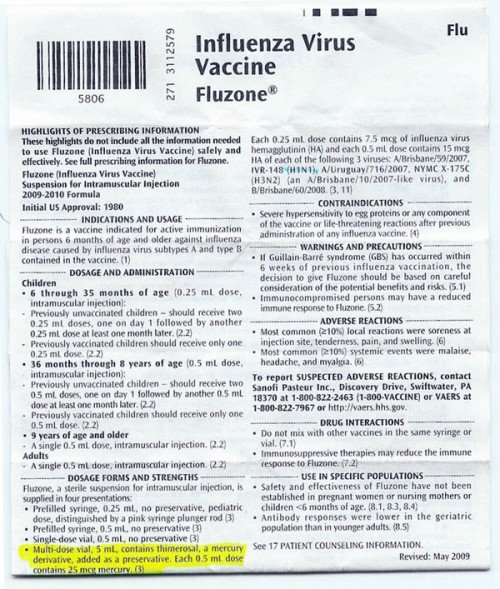
Makers of the Influenza vaccine say it boasts a “solid health record,” meaning the shot does not seem cause observable illnesses. What is NEVER discussed, however, is the slow and gradual brain neuron degeneration most individuals go through, year after year, due constant mercury poisoning. This process of slowing down brain functions is not easily observable nor quantifiable but it is still happening on a world-wide scale. If mercury can completely disrupt the fragile minds of children enough to possibly cause autism, it will, at the very least, impair fully developed minds.

Almost as if created to generate demands for vaccines, new diseases appear periodically around the world that, with the help of mass media scare campaigns, cause people to beg their officials for the miracle shot that they are told will cure everybody.

H1N1, also known as the Swine Flu, was the latest of those scary diseases that terrified millions of people for several months. When the shot became available, heavily promoted and massive vaccination campaigns sprung around the world. One fact that was not promoted: Swine flu was often easily curable, and not very different than the “regular” flu. Another fact that was not promoted: Most of the flu shots contained Thimerosal.

Depopulation?

Other than simply dumbing down the population, vaccines might be aiding in depopulation efforts. In a speech in April 2010, Bill Gates mentioned the use of vaccines in the effort to reduce world population.

“Gates made his remarks to the invitation-only Long Beach, California TED2010 Conference, in a speech titled, “Innovating to Zero!.” Along with the scientifically absurd proposition of reducing manmade CO2 emissions worldwide to zero by 2050, approximately four and a half minutes into the talk, Gates declares, “First we got population. The world today has 6.8 billion people. That’s headed up to about 9 billion. Now if we do a really great job on new vaccines, health care, reproductive health services, we lower that by perhaps 10 or 15 percent.

In plain English, one of the most powerful men in the world states clearly that he expects vaccines to be used to reduce population growth. When Bill Gates speaks about vaccines, he speaks with authority. In January 2010 at the elite Davos World Economic Forum, Gates announced his foundation would give $10 billion (circa ¤7.5 billion) over the next decade to develop and deliver new vaccines to children in the developing world.”
- Source