Wednesday, June 15, 2016

The Treasury 'grossly exaggerated' the economic and financial impact of Brexit, says academic review - and Cameron and Osborne are 'treating us like children'

  • Most economic models found Brexit would make little difference to UK economy, according to Cass Business School
  • But the Government has ignored waves of research in 'biased' report
  • London City University professor brands Treasury a 'propoganda machine'
  • Economics professor says Cameron and Osborne have used 'highly prejudiced' Treasury reports to 'ramp up the scaremongering' over Brexit
  • Says it's 'no different from the way kids are frightened into doing what their parents want'  
  • But Remain says Cass report is 'riddled with false claims' and includes 'no new analysis'  

The Treasury 'grossly exaggerated' the impact of leaving the EU on Britain's finances, according to an academic review published today. 
Most economic modelling has found that a Brexit vote in the June 23 referendum would make little difference to Britain's economy, the study by the influential Cass Business School concluded. 
It said the Government had ignored waves of research in favour of publishing 'highly prejudiced' reports warning the UK would be poorer by £4,300 per household by 2030 and be hit by an immediate recession. 
And in a damning verdict on George Osborne's approach to the referendum campaign, author Dr David Blake, a professor of Pension Economics at Cass Business School at City University London, accused the Treasury of becoming a 'propoganda machine' for the EU. 
But a Remain spokesman dismissed the Cass report as 'riddled with false claims' that includes 'no new analysis' and said the Treasury report included a wide review of economic studies of Brexit. 
David Cameron and George Osborne (right) delivered a blood-curdling Treasury analysis last month warning of economic chaos if voters back Brexit 
Professor Blake's report on the 'extraordinary abuse of economic models' found the system used by the Treasury would generate predictions that the UK would be better off signing up to the euro and every country in the world would benefit from joining the EU.
David Cameron and Mr Osborne 'have used the reports to ramp up the scaremongering', he claimed.

'There is doom-mongering on every page of the two reports,' Professor Blake said. 'It's no different from the way children are frightened into doing what their parents want. We are all being treated like children.'

TWO POLLS GIVE 6-POINT LEAD TO BREXIT AS POUND PLUNGES AGAIN 

Two new polls tonight indicated Brexit was six points ahead in the referendum race with just 10 days to go.
The surveys - both by ICM with one done by phone and the other online - showed an increase in the lead for leave from four points to six.
Both polls by the firm, carried out between June 10 and today, showed Leave on 53 per cent to Remain on 47 per cent. The new data follows a poll last week with a 10-point Brexit lead.
The results have contributed to continued market turmoil as the main FTSE-100 stock index closed down on the day.
The pound tumbled again this morning and continued to have another rollercoaster day, slipping again as the new polls were released.
Against the backdrop of another day dominated by debate over immigration, the new polls will increase the sense of panic within David Cameron's Remain campaign that the referendum could be slipping away.
Voters with postal ballots are already returning their papers and most voters will go to the polls in just 10 days time, on June 23. 
Polling expert John Curtice told the Guardian, who commissioned today's ICM surveys: 'These results are consistent with the generality of numbers over the last couple of weeks, in which there has been some weakening in the remain position.
'It was already plain that this race was far closer than the prime minister intended, and he must now be feeling discomfort at the thought that the outcome really could be in doubt.'
He added: 'The British Treasury has in effect become a propaganda machine for a political institution led by [European Commission president] Jean-Claude Juncker - a man who has declared his hostility to 'democratic choice' when it comes to the wishes of the European people. 
'This whole exercise is utterly dangerous for democracy.'
The Treasury's research assumes the UK would be unable to negotiate more favourable trading arrangements than it has now with either the EU or the rest of the world, according to the academic.
Using economic models that focused on international rather than European trade 'it might well have found that the UK would be better off leaving the EU', he said.
Change inevitably means some people will gain while others lose out, but by 'focusing only on economic issues, the Treasury's two reports present a highly prejudiced case for remaining in the EU', Professor Blake said.
'Most of the other economic models that have examined the economic consequences of Brexit - and which have been entirely ignored by the Treasury - find that it will make little difference to the UK's economy whether the UK stays in or leaves the EU,' he added.
'This is consistent both with Greenland's experience of leaving the EU in 1985 and with Ireland's experience of ending currency union with the UK in 1979 - neither of which is considered in the Treasury reports.' 
The Treasury has published two major reports on the impact of leaving the EU on Britain's economy and public finances. 
Presenting the second of the reports last month, which warned of 800,000 job losses and rising mortgage costs, Mr Cameron described voting for Brexit as the 'self-destruct option' that would shrink the economy by 1 per cent in a single quarter. 
In the first of the Treasury reports, it predicted each household could be £4,300 worse off every year by 2030, forecasting that the economy will fall by more than 6 per cent by the end of next decade.  
ICM released two more polls today, carried out over the past three days, both of which showed a six point leader for the Brexit campaign 
Responding to the Cass report, a Remain campaign spokesman said: 'The Cass report is riddled with false claims and includes no new analysis. It claims that most other models predict very little impact from Brexit. This is completely untrue.
'The Treasury paper includes a wide review of other studies and there is an overwhelming consensus amongst economists, as polls have shown, that Brexit would be damaging. 
'All serious independent organisations, including the IMF and OECD, have warned of the negative economic effects of Brexit.
'Those who have done their own work in this area--including the London School of Economics--have found that if anything the Treasury may have understated the impact of leaving the EU.
Finally, the Cass report claims that Britain could strike better trade deals outside the EU. The expert body here is the World Trade Organisation: both the current and former director generals have warned that new arrangements would take years to negotiate, trade outside the EU would be very difficult and no substitute for access to the single market.
'It is this report, not the Treasury's, that is totally out of step with the facts and economic consensus on Brexit.' 
The highly critical verdict on the Treasury's Brexit warnings came as two new polls tonight indicated Brexit was six points ahead with just 10 days to go until the June 23 referendum.
The surveys - both by ICM with one done by phone and the other online - showed an increase in the lead for leave from four points to six.
Both polls by the firm, carried out between June 10 and today, showed Leave on 53 per cent to Remain on 47 per cent. The new data follows a poll last week with a 10-point Brexit lead.
The results have contributed to continued market turmoil as the main FTSE-100 stock index closed down on the day.
The pound tumbled again this morning and continued to have another rollercoaster day, slipping again as the new polls were released.
Against the backdrop of another day dominated by debate over immigration, the new polls will increase the sense of panic within David Cameron's Remain campaign that the referendum could be slipping away.  

Economic Collapse: European Optima Bank Has Failed & Banco Popular Bail Out


Report Notes:
http://www.zerohedge.com/news/2016-06…

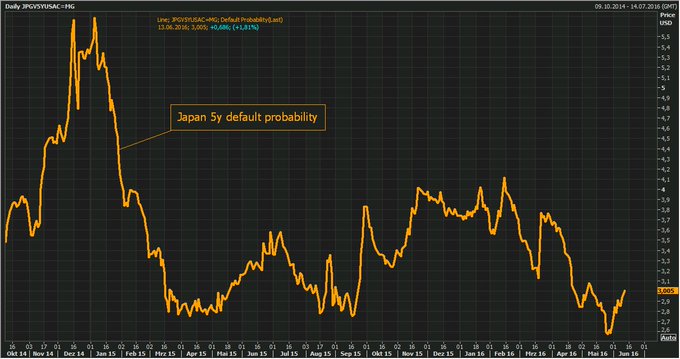
Fitch cuts Japan credit outlook to negative, citing delay of consumption tax increase.

Fitch cuts credit outlook to negative, citing delay of consumption tax increase. https://www.fitchratings.com/site/pressrelease?id=1005944 …

It Is Time for Trump to Talk About Debt Repudiation

by Dave Hodges
Nothing short of debt repudiation can save the average American worker from the scourge of a third world existence. This article takes a snap shot view of wages, employment, labor participation, retirement issues and the insurmountable debt faced by America.

fed res covvering 400 dollar expense
The above statistic might be the good news. Approximately 62% of Americans have less than $1,000 in their savings accounts and 21% don’t even have a savings account, according to a new survey of more than 5,000 adults conducted by Google Consumer Survey for personal finance website GOBankingRates.com.
I marvel at the brazen ignorance we see from so many would-be experts on network television as they tell us how much the economy has recovered. Recently, American income statistics were released which showed that 51% of all Americans make less than $30,000 per year.
The economic situation in this country grows even more bleak when, according tothe National Wage Index, 40% of all Americans are making less than $20,000 per year. The federal government considers a family of four living on an income of less than $24,250 to be impoverished.

Most Americans Never Expect to Fully Retire

At the inception of Obamacare, and following the Supreme Court mandate making Obamacare mandatory, I wrote and which detailed how Obamacare would become the number reason why Americans would not be able to retire. In short, Obamacare is twice as expensive than the exorbitant manage care companies, that Obama promised to reign in with Obamacare. In the article, I detailed how Obamacare was going to dramatically increase taxes, 19 new taxes to be specific. That article can be accessed by clicking here.
fed res funding retirement
With the nation on the edge of economic insolvency, retirement, in its traditional form, will not be experienced by very many Americans.

Unemployment Rate vs. Labor Participation

The unemployment rate in America according to Obama is 4.7%. However, noted economists John Williams and Joseph Meyer tell a different story. When they exclude all the government exemptions in arriving at a true unemployment figure, they both say that America has a 23-25% underemployment and underemployment rate. This is devastating and represents depression like numbers.
As important as the unemployment rate is, labor participation is even more important. Today, America has about 98 million full time workers. In contrast, there are 101 millions of working age that are not employed on a full time basis. This means that one-third of the country is disenfranchised from mainstream America. The coming election and resulting financial policies means very little to these people. And on the verge the 33% disenfranchised rate, average American young adults are on the verge of joining this group.
Today, nearly 25 million adults, or 57 percent of all young adults between 18 and 24 still live at home with their parents because they’re unemployed or underemployed. These adults are attempting to pay off student loans or save money to buy a home, save money for school or to save money for any number of other reasons. While having your parents as your roommates may make financial sense, it is devastating for a person’s self-esteem and it is the kiss of death for one’s marriage choices. Trulia’s survey found that only 5% of unmarried adults would consider dating someone who lived at home with their parents.
The majority of college graduates considered their college experience a waste of time as 70% of all surveyed college graduates wish that they had spent more time preparing for real jobs skills rather than the purely academic focus they pursued while in school. 
It would appear that the regret expressed by so many college students is well-grounded in fact, as there are more than 100,000 janitors and 317,000 waiters and waitresses that have college degrees. Many of these young adults will be joining the disenfranchised very soon. The country is falling apart.

The Debt

There are three numbers, related to the debt, that I have cited dozens of times:
  1. National debt-$21 trillion
  2. Unfunded mandated liabilities (e.g. social security, medicare)- $240 trillion
  3. Credit swap derivatives debt- $1.5 quadrillion.
The IRS collects about $2 trillion dollars annually. How will these debts ever be paid off. The short answer is that they can never be paid off.
The only solution to these issues, at least to begin with, is debt repudiation. Tell the banks where to go. Tell Wall Street to take a hike. Let the present system fall, we can rebuild. However, we cannot sustain this model as the statistics in this article demonstrate!
Donald Trump, you need to start talking about debt repudiation to these crime syndicates called Wall Street and the banks.

One bank down in Euro-land, another one needs an urgent cash injection

by Secular Investor
EuroZone
Interesting news this week as Belgium-based Optima Bank has been shut down by both the National Bank of Belgium (which also acts as the Belgian regulating body) as well as the ECB. According to the national supervisor, the bank  would have been unable to meet its commitments to its clients and was forced to cease all banking activities after some potentially fraudulent transaction were unveiled.
It’s surprising to see the main media have tried to keep this silent as even the website of the National Bank of Belgium didn’t bother to issue the press release in English (whereas all other press releases on the home page can be read in English). There’s no statement from the ECB either, nor has this news been translated on the English version of website of the state-owned national television station.
The situation is so bad the regulator has already immediately tasked the special fund organizing the Deposit Guarantee Scheme to start paying out the clients of the bank, even though Optima Bank hasn’t filed a bankruptcy procedure just yet. The urgency of the need to pay the clients does indicate the situation is extremely bad and even though it’s a very small one (it had closed the savings accounts division last year), there are two more important things you need to keep in mind.
Bank 2
Source: HLN.be
First of all, Optima was one of the banks which tried to attract new customers with sky-high interest rates. Suspiciously high, we might add. This reminded us of the Deutsche Bank promo in Belgium which also promised ultra-high interest rates on some of its products (as referenced on ZeroHedge here), as Optima clearly had a real need to see a cash inflow.
But secondly, and this is even more important, according to the official filings, the National Bank of Belgium had already effectively taken control of Optima Bank by appointing a ‘special commissioner’ to approve all transactions. Even though the NBB has only revoked the banking license just a few days ago, that special commissioner was already appointed in the first half of May.
That creates a completely new question. Are there other banks in the Eurozone which are under extremely strict supervision by the national (or supranational) regulators? If a Central Bank doesn’t even announce when a special commissioner is being appointed, how can the public be sure its deposits are safe? What else is going on in the Eurozone behind closed doors? Why did Banco Popular for instance need an emergency capital raise if it argued earlier it was strong enough to weather its real estate storm, sending the stock to a multi-decade low?
Bank 1
Source: Bloomberg
In fact, Banco Popular was one of the banks that had been definitively cleared by the European Central Bank in its 2014 study which was supposed to have a stricter overview of the entire sector. With one Belgian failing bank and a Spanish bank needing an emergency injection of 2.5B EUR, the credibility of the banking sector in the Eurozone has taken an additional hit, as Banco Popular still has one of the worst bad loan coverage ratios in the eurozone (the total amount of provisions accounts for less than 40% of the total value of the non-performing loans).
If you thought the crisis in the European banking sector was over, think again. Part 2 is just about to start.

U.S. Bankruptcy Court Approves 154 Aeropostale Store Closings


PHOTO CREDIT: WIKIPEDIA
()  The U.S. Bankruptcy Court granted a final order approving Aeropostale’s motion for store closing sales and the assumption of liquidation consulting agreements.
As previously reported, “The key component of the Debtors’ restructuring strategy is to right-size their operations by closing unprofitable stores. Such closures will help stem the Debtors’ significant cash burn, increase the Debtors’ liquidity, and allow the Debtors to focus their reorganization efforts around a smaller footprint of more profitable stores. The Debtors and their advisors have identified 154 stores that require prompt closure (the ‘Closing Stores’).”


Court-filed documents continue, “The Closing Stores include 113 of the Debtors’ approximately 770 stores operating in the United States and all 41 of the Debtors’ stores operating in Canada. In formulating the list of Closing Stores, the Debtors considered, among other factors, historical store profitability, recent sales trends, the geographic market in which the store is located, the potential to realize negotiated rent reductions with applicable landlords, and specific circumstances related to a store’s performance.”
In addition, “The Debtors are seeking interim approval to apply the Store Closing Procedures to the Closing Stores given the significant operating losses continuing in the Closing Stores in the aggregate, the Debtors’ liquidity constraints, and the budget set forth in the Debtors’ proposed postpetition financing facility. To run a seamless and efficient large-scale store closing process and to maximize the value of the assets being sold, the Debtors require and are also seeking authority to assume their liquidation consulting agreements (the ‘Liquidation Consulting Agreements’) with Tiger Capital Group and Great American Group (the ‘Liquidation Consultant’), liquidation consulting firms that the Debtors have determined in their business judgment are capable of performing the required tasks and have proposed favorable terms.”

Friday, June 10, 2016

Banks confront negative interest rates with plans to store titanic bundles of money on-site

duck tales
(CORY DOCTOROW)  The world’s central banks, freaked out about huge leverage by financial institutions and borrowers and unwilling to engage in economic stimulus themselves, have been moving interest rates lower and lower, until now, many banks are offering negative interest rates, meaning that buying $100 worth of treasury bills today will return $99 in cash tomorrow — hoping that this will incentivize banks to issue enough loans to make up for politically impossible governmental fiscal stimulus.
Retail banks, who normally transfer much of their reserves into t-bills, are unwilling to lose money in the deal, and so they’re pondering the alternative: just literally piling up mountains of cash in their vaults, where at least they won’t have to pay for the privilege of loaning it to a government.
The logistics of storing millions in cash are formidable, from security and insurance to the fact that the European Central Bank has discontinued the €500 note, making the resulting piles of cash much, much bigger.
This isn’t just a story about the absurdity of vaults full of cash, though: record low interest rates are gutting the pensions of savers who thought they had enough for comfortable annuities but are discovering that interest rates are so low that annuities won’t even provide subsistence. This creates impossible dilemmas, like, “Do I just start living on my capital and hope I die before it runs out?” or “Do I rely on my working age children, who are themselves trying to save for sky-high property down payments and support their kids, to support me, too?”
Economists are way way late in the game acknowledging the need for more demand by calling for more fiscal spending.
But central banks ex the Fed act as if they can force business to take up the slack, as if banks can noodle them full of loans like geese and they will be forced to invest and hire as a result.
Second is that banks have to be leery of making any long-term loans now. Even though no end of ZIRP and negative interest rates is in sight, they know if the monetary authorities ever are in a position to increase interest rates, they will show losses on intermediate and long-term assets unless they have adjustable interest rates. And the losses will be biggest on the riskier loans, since credit spreads typically widen in a tightening cycle.
So it should come as no surprise that banks are starting to try to find ways to circumvent the central bankers’ nutty scheme. As we reported in March, some small Barvarian banks said earlier this year they were looking into keeping cash on premises rater than pay for parking deposits with the Bundesbank. Yesterday, Commerzbank saber-rattled that it might follow suit. . Japanese banks are also trying to slip the leash. From the Financial Times: