Project Innocence has been operating as a counter-balance against a justice system the is complete insane. In the federal prison, only about 4% of the people are even there for violence. The Ohio Project Innocence has won a victory where men have finally been released holding the record for the longest wrongfully held – 39 years.
It was 1975, Ricky Jackson and two other young black men were charged and convicted of the murder of a white businessman in Cleveland. The sole evidence against Ricky was testimony provided by an alleged eyewitness, who was 12 at the time. Ricky has met that child who is a man today. He has bluntly stated that he feels no anger. He understands the system and that the witness is typically rehearsed and coerced and becomes a victim of the system themselves.
Monday, April 27, 2015
Just US – Its a Business Exploiting Others for Personal Gain

America’s unintended strong-dollar policy worries top Fed officials, and may delay rate hikes
The strong U.S. dollar and an unsteady
global economy are emerging as primary concerns for Federal Reserve
officials as they prepare for a policy meeting next week to consider the
timing of the first interest-rate increase since before the financial
crisis.
The Fed already has said it is unlikely to raise rates next week and officials in recent interviews and public comments have signaled a rate increase in June has become less likely because the economy slowed in the first quarter.
As they discuss the outlook beyond midyear, officials are increasingly weighing how much the strong dollar might have hurt the prospects of achieving their economic forecast of annual growth of around 2.5%, gradual increases in inflation and continued declines in unemployment.
Fed officials have said they won’t raise rates until they’re confident inflation is on track to rise toward their 2% target, and they want to see the job market keep improving. A stronger currency tends to undermine exports because it makes them more expensive. That slows growth and potentially hiring. Meantime, the strong currency holds down the prices of imports and broader inflation.
http://www.wsj.com/articles/feds-rate-decisions-hang-on-dollar-growth-concerns-1429695005
The Fed already has said it is unlikely to raise rates next week and officials in recent interviews and public comments have signaled a rate increase in June has become less likely because the economy slowed in the first quarter.
As they discuss the outlook beyond midyear, officials are increasingly weighing how much the strong dollar might have hurt the prospects of achieving their economic forecast of annual growth of around 2.5%, gradual increases in inflation and continued declines in unemployment.
Fed officials have said they won’t raise rates until they’re confident inflation is on track to rise toward their 2% target, and they want to see the job market keep improving. A stronger currency tends to undermine exports because it makes them more expensive. That slows growth and potentially hiring. Meantime, the strong currency holds down the prices of imports and broader inflation.
http://www.wsj.com/articles/feds-rate-decisions-hang-on-dollar-growth-concerns-1429695005
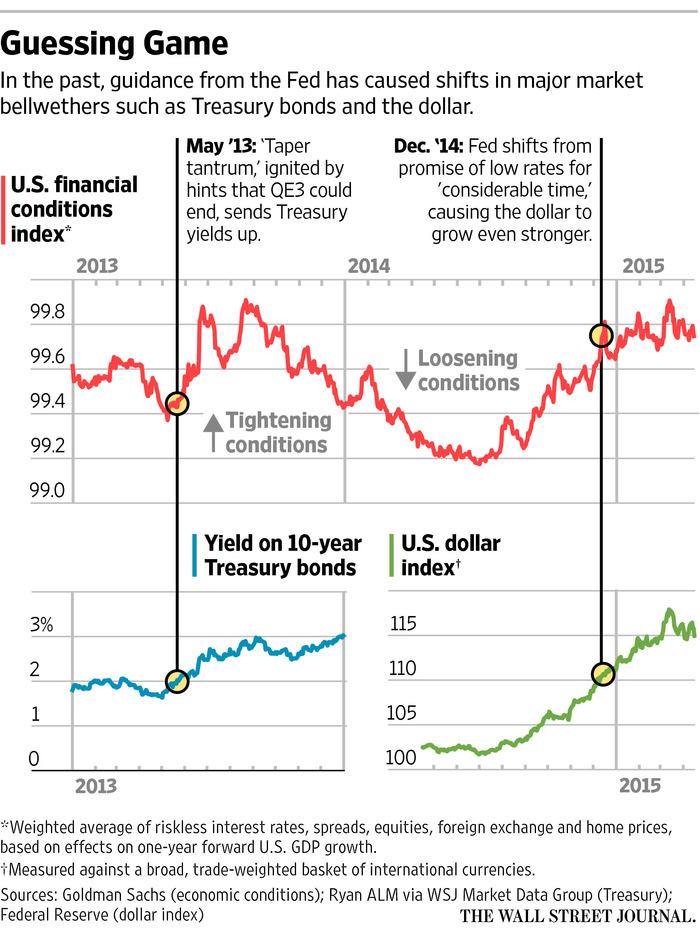

America's unintended strong-dollar policy worries top Fed officials, and may delay rate hikes http://on.wsj.com/1PwLvwi
Mobile Payments “To Increase By 1000 Percent” In 2015
(Tech Week) 2015 could be the year in which mobile payments really explode into the mainstream, according to a new report.
Research by Deloitte, published in its annual Technology, Media & Telecommunications (TMT) Predictions report, predicts that in-store mobile payments will increase by more than 1,000 percent worldwide this year.
This year, about 10 percent of the base of smartphones worldwide will be used to make an in-store payment at least once a month, compared to less than half a percent (led by early adopters in Japan) of about 450 million smartphones in mid-2014.
2015 will be the first year in which the multiple prerequisites for mainstream adoption – satisfying financial institutions, merchants, consumers and device vendors – have been sufficiently addressed, the report says.
The huge rise in the number of NFC-enabled smartphones will also be a crucial factor, particularly in mobile payment technology being spread across developing markets, Deloitte says.
As more and more consumers become familiar with the process and more merchants in more markets begin accepting such methods of payments, both the volume of NFC smartphone transactions and the range of spend value will increase steadily over time, the report adds.
Research by Deloitte, published in its annual Technology, Media & Telecommunications (TMT) Predictions report, predicts that in-store mobile payments will increase by more than 1,000 percent worldwide this year.
This year, about 10 percent of the base of smartphones worldwide will be used to make an in-store payment at least once a month, compared to less than half a percent (led by early adopters in Japan) of about 450 million smartphones in mid-2014.
2015 will be the first year in which the multiple prerequisites for mainstream adoption – satisfying financial institutions, merchants, consumers and device vendors – have been sufficiently addressed, the report says.
The huge rise in the number of NFC-enabled smartphones will also be a crucial factor, particularly in mobile payment technology being spread across developing markets, Deloitte says.
As more and more consumers become familiar with the process and more merchants in more markets begin accepting such methods of payments, both the volume of NFC smartphone transactions and the range of spend value will increase steadily over time, the report adds.
Cash Bans Grow as Central Bankers Plan Centralized Future: Bitcoin to the Rescue?
(Evander Smart) Paper currency, or cash, is a fairly recent man-made, really a bank made, concept. As I’ve covered previously,
paper money is a convenience of a modern society, but many things have
acted as money throughout history. Throughout most of history, outright
bartering of goods and services was the way of the world. We’ve used
feathers, gold, beads, “tally sticks”, coins, and now paper currency to
transmit value from one person to another. And much like the newspaper
has been replaced by the Internet version of your newspaper, paper money
is getting sent to Evolution’s Scrap Yard, courtesy of your central
banking system’s design on capital controls.
Before I do that, let me cover why the article needs to be written about cash and its impending demise in the first place. What is going on with cash? First, you need to have recognized a little thing called inflation, the increase of currency into circulation. If you are American, for example, your government loves to tell you that inflation is a mere 2% per year and often less than that. Doesn’t that sound lovely? They have this economy thing all under control, right? Perianne Boring wrote an excellent article for Forbes regarding what the real rate of inflation is versus the company line your government feeds you. More like 5%, and rising, is where it’s at, and that was a couple of years ago. If you have shopped for beef, or cars, or anything else the government takes out of their CPI measures, you know what I’m talking about. “Quantitative Easing” is another measure used by a government that has the net effect of increasing inflation, the actual money supply in an economy. The European Union has learned this trick from the United States, and they are in the process of debasing their currency with it as we speak. A lot of the inflation increase is due to economic pyramid schemes like Quantitative Easing. This has been going on for many years now, and taxpayers pay the bill while central bankers reap the rewards. It’s a good system, as long as you are a banker or in government, and aren’t a peasant.
Now, with an estimated 5% inflation per year and as your economic foundation, destroying the currency’s value on a daily basis, what if you wanted to phase out cash altogether? Many people do not know that in almost all modern civilizations, over 90% of all economic transfers are done digitally, not in common “cash” currency. You may spend $10-20 USD in cash on occasion, but your bank or your military sends one hundred million as a wire transfer. You are using debit cards, credit cards, Paypal, and new tools like Bitcoin and Apple Pay for the vast majority of your bill paying and daily purchases. So is cash just an outdated option, like the newspaper is for your search for news? Maybe it is time to retire cash?
One party that loves the idea, which should be a huge red flag, is your central banker. All of the sudden, besides the inflation and “Quantitative easing” killing dollar value from the inside, banks are working with regulators to make cashl less convenient to use. Creating an atmosphere where it will be phased out, banned by regulation. There are three recent attacks on cash that should tell you something is up.
Citigroup’s economic czar Willem Buiter has a plan that should help the situation, at least if you are a bank. If you are smart enough to hold onto your cash, and not fall prey to the bank’s games of charging you for bank deposits, this is bad for central banking. You may learn that you do not need them or are not beholden to them to live a full life. This realization may destabilize the economy as a whole, or at least their part in it. To prevent this, you can be punished in three new and exciting ways.
French Finance Minister Michel Sapin looks to beta-test a ban on cash to fight terrorism. How brave of him! This is in response to the Charlie Hebdo office attack that killed 17 people in January, allegedly by Islam extremists, partially funded by cash. Still, many critics say “a false flag” to create policy, like 9/11 and Sandy Hook. The alleged attackers used cars, watches and shoes as well, but no ban was announced on their future use in France.
Looks like the cash concept is getting put on a blacklist
It is oh so easy to think of the eventual loss of physical currency as a sign of technological progress. Just a sign of the times and out advancement past this vestige of the past. This is true to some extent. Yet, I would argue cash has an almost intrinsic value that is actually necessary for modern society, now more than ever. How so? Well, you need to look at the bigger geopolitical world view to get an idea of what losing cash as an option means.Before I do that, let me cover why the article needs to be written about cash and its impending demise in the first place. What is going on with cash? First, you need to have recognized a little thing called inflation, the increase of currency into circulation. If you are American, for example, your government loves to tell you that inflation is a mere 2% per year and often less than that. Doesn’t that sound lovely? They have this economy thing all under control, right? Perianne Boring wrote an excellent article for Forbes regarding what the real rate of inflation is versus the company line your government feeds you. More like 5%, and rising, is where it’s at, and that was a couple of years ago. If you have shopped for beef, or cars, or anything else the government takes out of their CPI measures, you know what I’m talking about. “Quantitative Easing” is another measure used by a government that has the net effect of increasing inflation, the actual money supply in an economy. The European Union has learned this trick from the United States, and they are in the process of debasing their currency with it as we speak. A lot of the inflation increase is due to economic pyramid schemes like Quantitative Easing. This has been going on for many years now, and taxpayers pay the bill while central bankers reap the rewards. It’s a good system, as long as you are a banker or in government, and aren’t a peasant.
Now, with an estimated 5% inflation per year and as your economic foundation, destroying the currency’s value on a daily basis, what if you wanted to phase out cash altogether? Many people do not know that in almost all modern civilizations, over 90% of all economic transfers are done digitally, not in common “cash” currency. You may spend $10-20 USD in cash on occasion, but your bank or your military sends one hundred million as a wire transfer. You are using debit cards, credit cards, Paypal, and new tools like Bitcoin and Apple Pay for the vast majority of your bill paying and daily purchases. So is cash just an outdated option, like the newspaper is for your search for news? Maybe it is time to retire cash?
One party that loves the idea, which should be a huge red flag, is your central banker. All of the sudden, besides the inflation and “Quantitative easing” killing dollar value from the inside, banks are working with regulators to make cashl less convenient to use. Creating an atmosphere where it will be phased out, banned by regulation. There are three recent attacks on cash that should tell you something is up.
Now that the Keynesian economists have tried and failed at stimulating the economy with 0% central banking interest rates, the European Union is phasing in negative interests rates. You may have noticed over the past several years you have received almost no interest on your money in the bank. Now, you can look forward to paying to keep your cash in a bank account, on top of monthly fees, transaction fees, ATM fees and other banking hustles you already endure.
Citigroup’s economic czar Willem Buiter has a plan that should help the situation, at least if you are a bank. If you are smart enough to hold onto your cash, and not fall prey to the bank’s games of charging you for bank deposits, this is bad for central banking. You may learn that you do not need them or are not beholden to them to live a full life. This realization may destabilize the economy as a whole, or at least their part in it. To prevent this, you can be punished in three new and exciting ways.
The details would only serve to confuse the issue, but the point is central banking cartels have an idea on how to begin to get cash banned or taxed. Saying central bankers have influence over economic policy and regulation is like saying the Block Chain has influence over the Bitcoin ecosystem. If the banking elite is beginning to throw around words like “abolish” or “ban” currency, you might want to start listening up. Economic regulations can make you either unable to get it or not want to deal with it due to regulation, inflation and taxation within a matter of months. The benefits of this, we’ll cover in a moment.
- Tax Currency
- Abolish Currency
- Remove the fixed exchange rate between currency and central bank reserves
Cash is used by terrorists, so…..
Governments hide behind the word “terrorism” more than bitcoin exchanges hide behind the word “hacked“. If a government wants to do anything to their citizens, just say the word “terrorism”, and they can do anything, starting with taking away your freedoms. It’s a playbook well-used and highly effective, if highly deceptive, at a minimum.French Finance Minister Michel Sapin looks to beta-test a ban on cash to fight terrorism. How brave of him! This is in response to the Charlie Hebdo office attack that killed 17 people in January, allegedly by Islam extremists, partially funded by cash. Still, many critics say “a false flag” to create policy, like 9/11 and Sandy Hook. The alleged attackers used cars, watches and shoes as well, but no ban was announced on their future use in France.
“It’s a terrorism that is low cost to carry out but has a major impact,” Sapin told a news conference. “This low-cost terrorism feeds on fraud, money laundering and petty trafficking,” said Michel Sapin at a recent press conference.So in response, France will begin to over-regulate cash with the following measures, to stop “terrorism”:
Women’s crisis: Women retire with 2/3 the savings of men, live six to eight years longer and have higher medical costs. 90% of women are single in their final years.
Here is what we know: The retirement savings crisis is enormous. By some estimates, Americans are under-saved by up to $14 trillion. This number may in fact be understated, because it assumes Social Security and Medicare solvency – a big if. And the solutions to this problem are generally assumed to be a real negative for the economy.
But here’s the dot that few have connected: The retirement savings crisis is also a women’s crisis.
That’s because women retire with two-thirds the savings of men, live six to eight years longer and have higher medical costs. Plus, 80 percent of women are single in their final years.
And it may be getting worse: Women’s labor-force participation is dropping, which suggests we’re moving in the wrong direction, considering that retirement savings tend to be driven by lifetime wages.
By looking at this issue through the gender lens, the solutions take on a decidedly different character. They become less about an inevitable, looming wealth transfer and more about increasing the economic engagement of women. And thus the focus of the national discussions about advancing women in the workplace, the focus moves from we-should-do-this-because-it’s-the-fair-thing-to-do to we-should-do-this-because-it-helps-solve-a-ridiculously-large-problem.
Taking money from hard working Americans to redistribute to others has ALWAYS failed & results in distributing misery


Taking money from hard working Americans to redistribute to others has ALWAYS failed & results in distributing misery
A historical documentary film that discusses the concepts of money, debt, taxes, and describes their development from biblical times onward.
Uploaded on Feb 15, 2012
The Money Masters is a 1996 three and a half
hour non-fiction, historical documentary film that discusses the
concepts of money, debt, taxes, and describes their development from
biblical times onward. It also covers the history of fractional-reserve
banking, central banking, monetary policy, the bond market, and the
Federal Reserve System in the United States.
Subscribe to:
Posts (Atom)