Sunday, April 28, 2013

Economic collapse and price controls on commodities!
Right now there is price manipulation happening in virtually all
markets!! Stocks, bonds, commodities, etc. There is a very big
unintended consequence of the artificial suppression of commodity prices
that I want you to think about. We all now are seeing how the price of
gold and silver on the comex is no where near what costs to acquire the
physical. That is because the premium (or the markup from the spot
price). I believe this is happening in most commodity markets to try and
hide TRUE inflation. The problem is we will see a greater discrepincy
between the spot price and the actual price. Think about gas??? In
2007ish the price of a barrel was about the same as it is today, yet we
were only paying $1.50ish then for a gallon of gas. Today, They have
manipulated the price of oil to “artificial” price however the “actual”
price to us is virtually double!!!!! This is very similar in many
commodities…
Here is the big problem, my belief is that before we see the huge price spikes in commodities we will first see SHORTAGES!!!! This is a direct result of the manipulation!!! What we are seeing in the precious metals today with a decoupling between the spot price and “actual” price will hit other commodities as well! IMHO!!!
Price controls tend to lead to shortages!
What will this mean for us potentially? Price controls and the free market tend to be at odds? So a farmer who knows he can get twice as much in China will gladly sell to China for double. Think… Oil, food, Precious Metals, imports will all be affected!
Please people remember the gas lines of the 1970′s because of price controls/lack of supply!!! Now imagine that on most commodities! That is whats coming!!
MaxMad
General election under way in Iceland
Iceland's voters tipped to punish ruling coalition over tax rises and austerity measures to shore up nation's finances.
http://aje.me/ZUvmVk
| Iceland
goes to the polls in a general election expected to punish the ruling
Social Democrat coalition over the austerity measures to bring the
economy back from the brink. The last opinion poll published before voting booths were due to open on Saturday showed that the opposition centre-right coalition was likely to make major gains four years after it was ousted over its handling of a dire financial crisis. Iceland's 235,000 eligible voters began casting their ballots at 0900 GMT and the first results are expected shortly after polls close at 2200 GMT. The ruling coalition which dragged Iceland back towards economic viability after the 2008 banking crisis faces backlash amid promise of tax cuts and debt relief by the opposition. "To me, this election is about whether my daughter will be able to keep her house or not," said Thury Steinthorsdottir, 55, who runs a small bed and breakfast in Laugarvatn, 30km east of the capital, Reykjavik. "The crash wiped out all the equity on her house and she's now working 70-80 hours a week with three children just to keep up with payments. This can't go on anymore." Polls favour Bjarni Benediktsson, the 43-year-old leader of the Independence Party, who has a slight lead over the Progressive Party's Sigmundur David Gunnlaugsson, 38. Al Jazeera's Tim Friend, reporting from Reykjavik, said voters were hoping for a return to the success that Iceland enjoyed before the 2008 economic meltdown. "In the intervening time, parties they elected in - the left of centre Social Democrats - have had to introduce some pretty tough austerity measures and I think people, particularly with their mortgages here, are finding it very hard going," he said. Benediktsson told Al Jazeera that taxes were too high, while Progressive Party leader Gunnlaugsson said that Iceland first had to tackle household debt because it was hindering the development of the economy. "What is now missing in the economy is new job creation and new investment," Benediktsson said. Coalition government Their two parties, which have led the polls through much of the campaign, have, often jointly, been in power for nearly 30 years before the crash. They are expected to form a coalition.
Outgoing Prime Minister Johanna Sigurdardottir, of the Social Democrats farewelled about 300 supporters on Friday after she previously announced her retirement from politics at the age of 70. Sigurdardottir's leftist coalition was swept to power in 2009 amid a wave of angry protests, as Icelanders blamed the then centre-right coalition government for allowing the country's financial sector to balloon out of control. It caused the three main banks to collapse and pushing the island nation to the brink of bankruptcy. The election campaign has focused on voters' discontent over four years of tax rises and austerity measures to shore up the state's finances to meet international lenders' demands. For much of her mandate, Sigurdardottir has implemented the stern instructions laid out by the International Monetary Fund, which lent Iceland $2.1bn from 2008 to 2011. Economic growth, a respectable 2.6 percent in 2011, slowed to 1.8 percent last year and some forecast a further slowdown this year as lack of investment weighs on output. Voter discontent is visible in the unprecedented number of political parties that have exploded onto the scene. Fifteen parties will vie for the 63 seats in the Althing, or parliament. One of them, the online file-sharing activist movement Pirate Party, could be the first of its kind elected to a national parliament. |
|
|
Source:
Al Jazeera And Agencies
|
US GDP is about to get a lot bigger
The economy will grow by 3% in July because of a shift in how the government measures output, especially of intangible assets.
 Starting
in July, the U.S. gross domestic product will officially jump by 3%.
The change isn't due to some miraculous economic event but rather from a
shift in the way the government looks at statistics in the digital age.
Brent Moulton, an associate director at the Commerce Department's Bureau of Economic Analysis, says the revised benchmark economic number will take into account billions of dollars in intangible assets that have previously been left out.
"We’re capitalizing research and development," Moulton told the Financial Times, "and also this category referred to as entertainment, literary and artistic originals, which would be things like motion picture originals, long-lasting television programs, books and sound recordings."
For example, according to the FT, the output of iPads produced by Apple (AAPL +2.16%) is currently included in GDP, but the R&D needed to create those iPads isn't. With the changeover this summer, R&D will now be considered an investment and will add to the overall measured size of the economy.
Shortfalls in defined-benefit pension plans will also be reevaluated. "We will now show a liability for underfunded plans, which particularly has large ramifications for the government sector," said Moulton, "where both at the state level and the federal level we have large underfunded plan."
The revisions will make the U.S. one of the first countries to adopt a new international standard for tallying up GDP figures.
Other BEA officials say the changes aren't expected to alter views of economic trends and cycles over the past several years -- but they're not sure how the revised data and methodology will affect the future.
"We are carrying these major changes all the way back in time -- which for us means to 1929," Moulton told the FT, "so we are essentially rewriting economic history."
The new accounting will apparently add the equivalent of a country the size of Belgium to the international economy. And it might also, according to Management Today, prompt other countries to follow Washington's lead because "the U.S. provides the de facto standard for GDP measurement around the globe."
Central Banking with “Other People’s Gold”: A Multi-billion Treasure Trove in Lower Manhattan
Germany is repatriating its gold reserves from the New York
Federal Reserve. This decision has created a frenzy in the gold market.
But that is just the tip of the iceberg.
According to the NY Fed, there are (2012) approximately 530,000 gold bars, with a combined weight of circa 6,700 metric tonnes stashed away in the Fed’s Lower Manhattan vaults.
These are official figures which are impossible to verify.
The gold is stored in the fifth sub-floor of the New York Fed building on Liberty Street. The vaults on the bedrock of Manhattan Island are located 80 feet below street level.
Each of the 530,000 gold bars weighs 400 troy ounces, or about 12.44kg.
At today’s market value of approximately US$1700 dollars a troy ounce, the New York Fed has within its vaults a multi-billion dollar treasure trove.
The 400-ounce gold bar is quoted at $677,640.
A 1kg gold bar is quoted at about $55,000. (purchase price)
Each metric tonne of gold is worth approximately $55 million.
The total value of the New York Federal Reserve’s gold bullion trove of 6700 tonnes is a staggering $368.5 billion.
But according to the New York Federal Reserve: “We do not own the gold. We are mere custodians.”
 A wall of gold bricks in the
globally owned collection at the Federal Reserve Bank of New York.
(Photo courtesy of the New York Fed’s press center)
The gold is in “safe-keeping” on behalf of more than 60 sovereign countries and a few organizations. Close to 98 per cent of the gold bullion stored in the NY Fed’s lower Manhattan vaults, according to the Fed, belongs to central banks of foreign countries.
The remaining 2 per cent “is owned by the United States and international organizations such as the IMF.”
Germany’s central bank owns a total of 3400 tonnes of gold. According to recent reports, a staggering 69 per cent of its gold bullion bars (namely 2346 tonnes) are held in custody at the New York Federal Reserve, the Bank of England and the Banque de France.
The NY Federal Reserve Bank holds in custody 1536 metric tonnes of gold owned by the Bundesbank of the Federal Republic of Germany, 22.9 per cent of its total gold holdings in custody (6700 tonnes).
The Bundesbank has announced that it will repatriate “all of its 374 metric tonnes stored at the Banque de France (11 per cent of its total reserves), and 300 metric tonnes held in the vault of the New York Fed, reducing its share in the US from 45 per cent to 37 per cent.” .
Two other European countries, namely Italy and the Netherlands, have significant yet undisclosed gold bullion reserves held in custody in the vaults of the NY Federal Reserve Bank. There are no immediate plans to repatriate this bullion.
While the NY Federal Reserve Bank does not actually own the gold, it is guardian of a multibillion-dollar gold treasure, which indelibly provides ‘collateral’ (at virtually no cost) as well as ‘leverage’ in its multibillion-dollar central banking operations, often at the expense of its European partners.
Foreign countries around the world were pressured after World War II into depositing their gold reserves, not within the vaults of their own central banks, but in that of the world’s foremost imperial power.

A view of the strongroom of the Swiss National Bank SNB in Berne. (Reuters)
According to the NY Federal Reserve:
Germany’s decision to repatriate part of its gold has sent a cold shiver into the gold and forex markets.
The German Federal Court of Auditors has recently called for an official inspection of German gold reserves stored at the New York Federal Reserve, “because they have never been fully checked.”
Are these German bullion reserves held in the vaults of Lower Manhattan ‘separate’ or are they part of the Federal Reserve’s fungible ‘big pot’ of gold assets.
According to the Fed, “the gold is not commingled between account holders.”
Does the New York Federal Reserve Bank have “Fungible Gold Assets to the Degree Claimed”?
Could the Fed reasonably handle a process of homeland repatriation of gold assets initiated by several countries simultaneously?
According to the Fed, there are 122 separate gold accounts mainly held by the central banks of foreign countries, as well as a few organizations including the International Monetary Fund.
Most of the 122 accounts are held by the central banks of sovereign countries, which in addition to their gold accounts have statutory agreements with the NY Federal Reserve.
 An employee of Deutsche Bundesbank uses a metal analysis device on a gold bar. (Reuters / Lisi Niesner)
Instead of gold bullion, national central banks (with the exception of the US) hold US dollar paper instruments as ‘reserves’. Gold reserves under national jurisdiction are central to establishing sovereignty in monetary policy, without depending on the Federal Reserve which holds a nation’s gold bullion in safe-keeping in its Lower Manhattan vault.
National sovereignty requires the repatriation of the gold bullion deposited in custody with the NY Fed. The leverage and collateral in all monetary transactions largely accrues to the NY Federal Reserve Bank rather than to the owners of the bullion deposited in custody.
Follow the example of Germany. Repatriate your gold.
In a related development, both China and Russia are dumping their US dollars and building up their gold reserves.
In turn, both China and Russia have boosted domestic production of gold, a large share of which is being purchased by their central banks.
Michel Chossudovsky for RT
According to the NY Fed, there are (2012) approximately 530,000 gold bars, with a combined weight of circa 6,700 metric tonnes stashed away in the Fed’s Lower Manhattan vaults.
These are official figures which are impossible to verify.

The gold is stored in the fifth sub-floor of the New York Fed building on Liberty Street. The vaults on the bedrock of Manhattan Island are located 80 feet below street level.
Each of the 530,000 gold bars weighs 400 troy ounces, or about 12.44kg.
At today’s market value of approximately US$1700 dollars a troy ounce, the New York Fed has within its vaults a multi-billion dollar treasure trove.
The 400-ounce gold bar is quoted at $677,640.
A 1kg gold bar is quoted at about $55,000. (purchase price)
Each metric tonne of gold is worth approximately $55 million.
The total value of the New York Federal Reserve’s gold bullion trove of 6700 tonnes is a staggering $368.5 billion.
But according to the New York Federal Reserve: “We do not own the gold. We are mere custodians.”
The gold is in “safe-keeping” on behalf of more than 60 sovereign countries and a few organizations. Close to 98 per cent of the gold bullion stored in the NY Fed’s lower Manhattan vaults, according to the Fed, belongs to central banks of foreign countries.
The remaining 2 per cent “is owned by the United States and international organizations such as the IMF.”
Germany’s central bank owns a total of 3400 tonnes of gold. According to recent reports, a staggering 69 per cent of its gold bullion bars (namely 2346 tonnes) are held in custody at the New York Federal Reserve, the Bank of England and the Banque de France.
The NY Federal Reserve Bank holds in custody 1536 metric tonnes of gold owned by the Bundesbank of the Federal Republic of Germany, 22.9 per cent of its total gold holdings in custody (6700 tonnes).
The Bundesbank has announced that it will repatriate “all of its 374 metric tonnes stored at the Banque de France (11 per cent of its total reserves), and 300 metric tonnes held in the vault of the New York Fed, reducing its share in the US from 45 per cent to 37 per cent.” .
Two other European countries, namely Italy and the Netherlands, have significant yet undisclosed gold bullion reserves held in custody in the vaults of the NY Federal Reserve Bank. There are no immediate plans to repatriate this bullion.
While the NY Federal Reserve Bank does not actually own the gold, it is guardian of a multibillion-dollar gold treasure, which indelibly provides ‘collateral’ (at virtually no cost) as well as ‘leverage’ in its multibillion-dollar central banking operations, often at the expense of its European partners.
The New York Fed’s gold vault on the basement floor of its main office building in Manhattan provides account holders with a secure location to store their monetary gold reserves.In other words, the Fed runs its operation ‘with other people’s gold’, using this huge treasure as ‘collateral’ to back its various financial undertakings.
None of the gold stored in the vault belongs to the New York Fed or the Federal Reserve System. The New York Fed acts as the guardian and custodian of the gold riches on behalf of account holders, which include the US government, foreign governments, other central banks and official international organizations.
Foreign countries around the world were pressured after World War II into depositing their gold reserves, not within the vaults of their own central banks, but in that of the world’s foremost imperial power.

A view of the strongroom of the Swiss National Bank SNB in Berne. (Reuters)
According to the NY Federal Reserve:
“Much of the gold in the vault arrived during and after World War II as many countries wanted to store their gold reserves in a safe location. Holdings in the gold vault continued to increase and peaked in 1973, shortly after the United States suspended convertibility of dollars into gold for foreign governments.” (emphasis added)For many countries, part of the US dollar proceeds of commodities sold to the US, were converted into gold at 32 dollars an ounce (1946-71) and then ‘returned’ – so to speak – to the US for deposit in the vaults of the NY Federal Reserve.
Germany’s decision to repatriate part of its gold has sent a cold shiver into the gold and forex markets.
The German Federal Court of Auditors has recently called for an official inspection of German gold reserves stored at the New York Federal Reserve, “because they have never been fully checked.”
Are these German bullion reserves held in the vaults of Lower Manhattan ‘separate’ or are they part of the Federal Reserve’s fungible ‘big pot’ of gold assets.
According to the Fed, “the gold is not commingled between account holders.”
Does the New York Federal Reserve Bank have “Fungible Gold Assets to the Degree Claimed”?
Could the Fed reasonably handle a process of homeland repatriation of gold assets initiated by several countries simultaneously?
According to the Fed, there are 122 separate gold accounts mainly held by the central banks of foreign countries, as well as a few organizations including the International Monetary Fund.
Following the verification process, the gold is moved to one of the vault’s 122 compartments, where each compartment contains gold held by a single account holder. In rare cases, small deposits are placed on separately numbered spaces on shelves in a ‘library’ compartment shared by several account holders. Each compartment is secured by a padlock, two combination locks and an auditor’s seal. Compartments are numbered rather than named to maintain confidentiality of the account holders.The New York Fed does not indicate in any of its reports, including its annual financial statements, the names of the countries and account holders.
Most of the 122 accounts are held by the central banks of sovereign countries, which in addition to their gold accounts have statutory agreements with the NY Federal Reserve.

Money and National sovereignty
America’s Unipolar World hinges on sustaining the US dollar as a global reserve currency. US hegemony in monetary matters is supported by the custody in the USA of gold bullion reserves on behalf of more than 60 countries.Instead of gold bullion, national central banks (with the exception of the US) hold US dollar paper instruments as ‘reserves’. Gold reserves under national jurisdiction are central to establishing sovereignty in monetary policy, without depending on the Federal Reserve which holds a nation’s gold bullion in safe-keeping in its Lower Manhattan vault.
National sovereignty requires the repatriation of the gold bullion deposited in custody with the NY Fed. The leverage and collateral in all monetary transactions largely accrues to the NY Federal Reserve Bank rather than to the owners of the bullion deposited in custody.
Follow the example of Germany. Repatriate your gold.
In a related development, both China and Russia are dumping their US dollars and building up their gold reserves.
In turn, both China and Russia have boosted domestic production of gold, a large share of which is being purchased by their central banks.
Michel Chossudovsky for RT
Subprime by any other name: FHA insured loans are least appealing financing option for home sellers. The psychology of rising home prices.
FHA insured loans
filled a giant void from the private mortgage market exiting the game
by brute force as the housing bubble burst. One thing is certain when
it comes to consumer psychology especially with such an emotional
decision like buying a home. People have wine expectations but come
with beer budgets and this is especially true in housing. Becoming
accustomed to low down payment mortgages, the bust in housing was a hard
retreat for many Americans. In the 1970s and 1980s nothing down or
close to it was left to the late night infomercials for those too
inebriated to sleep before midnight. Most people knew this was a tiny
pipedream. It was only until the 2000s that this became a common
pathway to owning a home. FHA insured loans
with a 3.5 percent down payment are now viewed as the subprime of
current loans. Even recent potential home seller surveys confirm this
perception.
Seller’s perception on loans
People are under the impression that sellers are somehow oblivious to the differing financing options out in the market. A recent Redfin survey asked potential home sellers what kind of financing option would they choose for their buyers?

Is it surprising that FHA is at the bottom of the list? And keep in mind this is for sellers in various regions. For prime locations, I assure you the figures are much more skewed. Why would anyone take an offer with such little skin in the game when you can simply go with an all-cash offer and know escrow will close without a problem? It really is a no brainer.
On the side of buyers, FHA insured loans have actually gotten much more expensive with mortgage insurance. It is crazy that FHA mortgage insurance premiums can add up to 1.55 percentage points to your overall effective FHA mortgage rate. That is very high in this rock bottom interest environment. Why is the rate so high? Because of legacy defaults but also the reality that you are giving people 30x leverage right off the bat.
FHA loan volume picked up right in line with the burst of the housing bubble:

Over $1.1 trillion in FHA insured loans are now outstanding. Keep in mind FHA insured loans were never intended to be a big part of the market. For many years they have consumed a large part of all mortgage originations. Even in Southern California FHA insured loans make up 22.9 percent of all purchases (another 34 percent came from all cash buyers).
It is abundantly clear that the government and banks are all in on the housing market. We’ve recently talked about the reemergence of interest only mortgages. The market is now tilting to a full sense that home prices cannot and will not go down, regardless of underlying economic fundamentals. What is tenuous about this recovery is that it is being spurred on by massive monetary intervention that has never been witnessed in history. So those that claim they have a sense as to how this is all going to play out have a much better crystal ball. Yet one thing seems certain in the short-term and human nature and behavior is not going to evolve just because we had the worse financial crises since the Great Depression. Take a look at another piece of data from the Redfin survey:

Two big things jump out at me here. The first is that more people are planning to sell because home prices are going up. That makes sense. Yet adding more inventory is likely to help in keeping prices in place or lowering them depending on how much is put on the market. The next one is the “enough equity” section. Obviously perceptions are changing and many underwater homeowners are now reemerging from their negative equity positions.
In most of the country, owning a home makes a whole lot of sense today. Rock bottom interest rates and home prices that have adjusted from the peak make it a sensible move. In higher priced regions, the decision isn’t so clear cut. It is interesting that some think $200,000 is chump change when it comes to a down payment. Yet compounding $200,000 at 7 percent over 10 years will get you close to $400,000 during this time. Will a $600,000 home suddenly rise to $800,000 in this period if incomes are not going up? Right now homes are reaching max levels courtesy of all cash buying, hot foreign money flowing in, and people now leveraging up and entertaining interest only loans again. At least with the interest only loans of today, you need 20 percent down. FHA insured loans are not exactly the Ferrari option in the housing market.
Seller’s perception on loans
People are under the impression that sellers are somehow oblivious to the differing financing options out in the market. A recent Redfin survey asked potential home sellers what kind of financing option would they choose for their buyers?
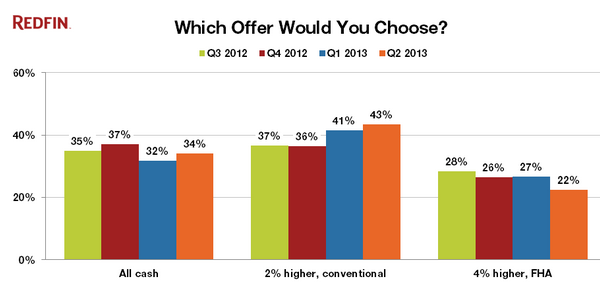
Is it surprising that FHA is at the bottom of the list? And keep in mind this is for sellers in various regions. For prime locations, I assure you the figures are much more skewed. Why would anyone take an offer with such little skin in the game when you can simply go with an all-cash offer and know escrow will close without a problem? It really is a no brainer.
On the side of buyers, FHA insured loans have actually gotten much more expensive with mortgage insurance. It is crazy that FHA mortgage insurance premiums can add up to 1.55 percentage points to your overall effective FHA mortgage rate. That is very high in this rock bottom interest environment. Why is the rate so high? Because of legacy defaults but also the reality that you are giving people 30x leverage right off the bat.
FHA loan volume picked up right in line with the burst of the housing bubble:
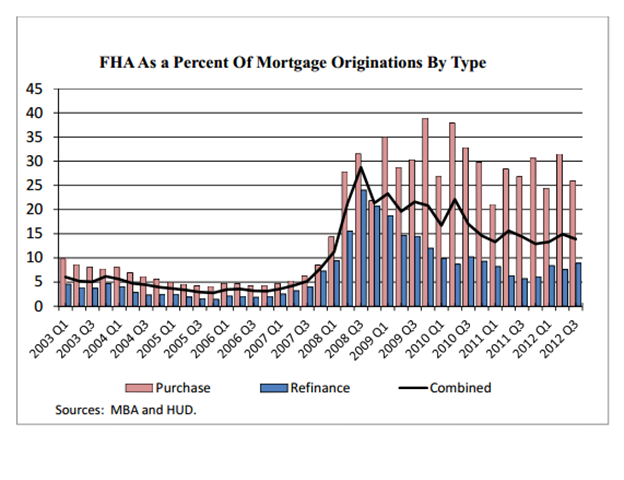
Over $1.1 trillion in FHA insured loans are now outstanding. Keep in mind FHA insured loans were never intended to be a big part of the market. For many years they have consumed a large part of all mortgage originations. Even in Southern California FHA insured loans make up 22.9 percent of all purchases (another 34 percent came from all cash buyers).
It is abundantly clear that the government and banks are all in on the housing market. We’ve recently talked about the reemergence of interest only mortgages. The market is now tilting to a full sense that home prices cannot and will not go down, regardless of underlying economic fundamentals. What is tenuous about this recovery is that it is being spurred on by massive monetary intervention that has never been witnessed in history. So those that claim they have a sense as to how this is all going to play out have a much better crystal ball. Yet one thing seems certain in the short-term and human nature and behavior is not going to evolve just because we had the worse financial crises since the Great Depression. Take a look at another piece of data from the Redfin survey:
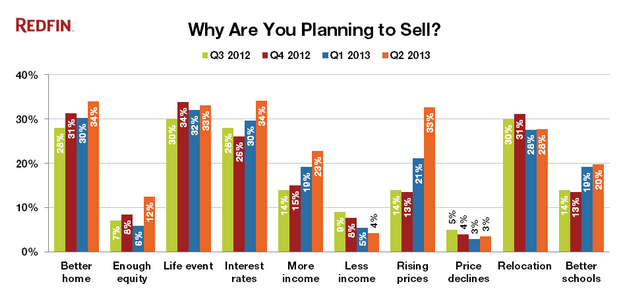
Two big things jump out at me here. The first is that more people are planning to sell because home prices are going up. That makes sense. Yet adding more inventory is likely to help in keeping prices in place or lowering them depending on how much is put on the market. The next one is the “enough equity” section. Obviously perceptions are changing and many underwater homeowners are now reemerging from their negative equity positions.
In most of the country, owning a home makes a whole lot of sense today. Rock bottom interest rates and home prices that have adjusted from the peak make it a sensible move. In higher priced regions, the decision isn’t so clear cut. It is interesting that some think $200,000 is chump change when it comes to a down payment. Yet compounding $200,000 at 7 percent over 10 years will get you close to $400,000 during this time. Will a $600,000 home suddenly rise to $800,000 in this period if incomes are not going up? Right now homes are reaching max levels courtesy of all cash buying, hot foreign money flowing in, and people now leveraging up and entertaining interest only loans again. At least with the interest only loans of today, you need 20 percent down. FHA insured loans are not exactly the Ferrari option in the housing market.
Subscribe to:
Posts (Atom)