Fabian Calvo of TheNoteHouse.us predicts, “The Fed balance sheet will
likely be $5 trillion in toxic assets by the end of 2014.” Calvo thinks
what is going on behind the scenes will one day come to light, and it
won’t be pretty. Calvo says, “It’s kind of like Enron. When it falls
apart, then you realize what level of corruption and deceit was really
taking place. . . . It’s a trillion times worse than Enron.” Join Greg
Hunter as he goes One-on-One with real estate investor Fabian Calvo.
A Trillion Times Worse than Enron-Fabian Calvo (You Tube)
Thursday, March 7, 2013

Greece - La Troïka a-t-elle acheté le retour de la drachme?
Greek Finance Minister Venezuelos is accused of having purchased Greek exit from the Euro. This is especially heinous,
6 years of suicides and business collapse, and also because he lied his way to IMF rescue.
6 years of suicides and business collapse, and also because he lied his way to IMF rescue.
L'ex- ministre grec des Finances vient de porter
de lourdes accusations contre la Troïka. En aout 2011, les émissaires
de la BCE, du FMI et de la Commission européenne auraient proposé au
gouvernement grec "des fonds pour organiser une sortie en douceur de l'euro". Ces propos, rapportés par le quotidien grec Ekathimerini,
sont très embarassants pour la Troïka car ils contredisent le discours
officiel selon lequel une sortie de la Grèce n'était pas souhaitable,
Athènes ayant sa place au sein de la zone euro.
Si elles ne sont pas encore corroborées, ces accusations sont toutefois plausibles. Qu'est-ce qui aurait pu inciter Evangelos Venizelos à révéler de tels faits? Il faut replacer ces propos dans leur contexte. La scène a eu lieu hier au Congrès du parti socialiste grec, le PASOK. Monsieur Venizelos, qui a notamment été ministre de la Défense, vice-président du gouvernement et ministre des Finances, était sans doute très énervé.
Premièrement, son parti, qui partageait le pouvoir avec les Conservateurs depuis 1974, a été laminé aux dernières élections (12,2% des suffrages). Et la chute se poursuit: selon plusieurs sondages, seuls 7 à 8% des électeurs voteraient aujourd'hui pour le PASOK.
Deuxièmement, Evangelos Venizelos est mis en cause dans le maquillage des comptes publics grecs. Il ne s'agit pas de la désormais célèbre sous-estimation du déficit intervenue il y a une dizaine d'années afin de faciliter l'adhésion à la zone euro. Les coupables sont déjà connus. Non, il s'agit ici de la surestimation du déficit en 2009 qui a eu pour effet de précipiter l'intervention du FMI et de justifier les plans de rigueur.
Troisièmement, le prédécesseur de Monsieur Venizelos a préféré laisser celui-ci en première ligne et n'a même pas jugé nécessaire de participer au Congrès de son parti. George Papandreou, Président de l'Internationale Socialiste, avait mis en oeuvre les premiers plans de rigueur. Il partage avec Monsieur Venizelos la responsabilité de la guerre enclenchée contre le peuple grec. Et de l'effondrement électoral du PASOK. Mais à l'heure des bilans politiques, Monsieur Papandréou est absent...
On conçoit donc l'énervement de Monsieur Venizelos hier. Et dans de telles circonstances, ses propos peuvent sembler plausibles. Ils pourraient aussi expliquer pourquoi les dirigeants européens ont feint la surprise à l'automne 2011 au sujet du referendum proposé par Papandreou, alors que ce dernier les en avait informé.
Il existe toutefois une deuxième possibilité: ces déclarations sont peut-être pour Monsieur Venizelos la tentative désespérée, dans une situation politique très difficile, d'apparaître pour ce qu'il n'est pas: un dirigeant capable de résister et de dire non à la Troïka. “Then we received proposals to receive funding so there would be a velvet exit from the euro. We rejected them.”.
Enfin, et c'est l'hypothèse qui a ma préférence, les deux explications ne sont pas nécessairement contradictoires...
Si elles ne sont pas encore corroborées, ces accusations sont toutefois plausibles. Qu'est-ce qui aurait pu inciter Evangelos Venizelos à révéler de tels faits? Il faut replacer ces propos dans leur contexte. La scène a eu lieu hier au Congrès du parti socialiste grec, le PASOK. Monsieur Venizelos, qui a notamment été ministre de la Défense, vice-président du gouvernement et ministre des Finances, était sans doute très énervé.
Premièrement, son parti, qui partageait le pouvoir avec les Conservateurs depuis 1974, a été laminé aux dernières élections (12,2% des suffrages). Et la chute se poursuit: selon plusieurs sondages, seuls 7 à 8% des électeurs voteraient aujourd'hui pour le PASOK.
Deuxièmement, Evangelos Venizelos est mis en cause dans le maquillage des comptes publics grecs. Il ne s'agit pas de la désormais célèbre sous-estimation du déficit intervenue il y a une dizaine d'années afin de faciliter l'adhésion à la zone euro. Les coupables sont déjà connus. Non, il s'agit ici de la surestimation du déficit en 2009 qui a eu pour effet de précipiter l'intervention du FMI et de justifier les plans de rigueur.
Troisièmement, le prédécesseur de Monsieur Venizelos a préféré laisser celui-ci en première ligne et n'a même pas jugé nécessaire de participer au Congrès de son parti. George Papandreou, Président de l'Internationale Socialiste, avait mis en oeuvre les premiers plans de rigueur. Il partage avec Monsieur Venizelos la responsabilité de la guerre enclenchée contre le peuple grec. Et de l'effondrement électoral du PASOK. Mais à l'heure des bilans politiques, Monsieur Papandréou est absent...
On conçoit donc l'énervement de Monsieur Venizelos hier. Et dans de telles circonstances, ses propos peuvent sembler plausibles. Ils pourraient aussi expliquer pourquoi les dirigeants européens ont feint la surprise à l'automne 2011 au sujet du referendum proposé par Papandreou, alors que ce dernier les en avait informé.
Il existe toutefois une deuxième possibilité: ces déclarations sont peut-être pour Monsieur Venizelos la tentative désespérée, dans une situation politique très difficile, d'apparaître pour ce qu'il n'est pas: un dirigeant capable de résister et de dire non à la Troïka. “Then we received proposals to receive funding so there would be a velvet exit from the euro. We rejected them.”.
Enfin, et c'est l'hypothèse qui a ma préférence, les deux explications ne sont pas nécessairement contradictoires...
Paul B. Farrell: Looking back 800 years, we now know bull-bear cycles are inevitable. Right now, the cycles are again peaking, will crash, making the right exits, then the next entrance.
Warning: Forget the cuts, your brain is sequestered. That’s the real problem: Your brain. That’s why the economy and markets will crash, a new Dow high notwithstanding. Why it’s inevitable. Bigger crash than 2008. Longer afterwards. No bank bailouts. Austerity worse than the Great Depression. Hunker down.
Listen closely: America’s big problem is our “sequestered”
brains. Meaning: “to remove, isolate, set apart, retire, withdraw into
solitude.” Think post-trauma stress, paralysis, amnesia, lobotomized,
entranced, just plain irrational. You’re out of it, incapable of acting
rational.
And not just you: Economists, politicians and media pundits all
have sequestered brains. They blab on endlessly about this or that of
their special interests hiding among the trillion-dollar war-and-peace
sequester cuts. Blab on and on. Myopic.
Why? Their brains are sequestered too. Millions of noisy
brains. But you can’t hear them, no matter what. Your brain is on a
different frequency. Only hears your set channels. That happens to your
sequestered brain.
In fact, our collective brain, America’s conscience, our
psyche, mind-set, even our soul is sequestered. America lapsed into a
trance, confused. Our entire nation’s rational brain has been
sequestered, collectively “removed, set apart, isolated, retiring,
withdrawn.”
Brain sequestration: read all about your biggest problem
This is also why 152 nations worldwide as well as America can’t see the light at the end of the tunnel. Why we’re blindly driving headlong into a massive economic and market collapse. Why we refuse to see it. Why? Our collective brain periodically goes through these cycles, in the economy, markets, drama, in our personal lives. But our sequestered brains can’t hear, never learn.
Still our noisy self-centered economists, politicians and media
pundits blab on, telling us: this time really is different. Why? They
too, says Shakespeare, have their prescribed “entrances and exits.” The
script never changes. Always the same drama, bull-bears, boom-busts,
recession-recoveries, prosperity and austerity. Like Lear, same play,
new actors, same result, always too late, main character blinded.
Flash forward. BusinessWeek just asked: “Why won’t anyone
listen to Alan Simpson and Erskin Bowles?” Two brilliant brains, they
see the oncoming train: A former GOP senator. Former Clinton chief of
staff. Been “touring the country almost nonstop, warning of America’s
impending fiscal doom,” for two years.
Yes, they see doomsday dead ahead. But few listen.
History repeats. History teaches. But, we never learn. Our
brains are sequestered, trapped, repeating an 800-year old drama that
you, me, all Americans and all world leaders can’t seem to escape.
Even Harvard historian Niall Ferguson, author of “The Ascent of
Money: A Financial History of the World,” admits economists Carmen
Reinhart and Kenneth Rogoff’s brilliant “This Time Is Different: Eight
Centuries of Financial Folly” is “the best empirical investigation of
financial crises ever published.”
But “This Time is Different” is much more than an 800-year
history of endless human “follies” through bull/bear, boom/bust cycles.
It is also the single best book on behavioral economics ever. It exposes
the shadowy side of the investor’s brain and the faux promise of
behavioral economics: “Just follow our advice, and your irrational brain
will become less irrational.”
Princeton psychologist Daniel Kahneman’s 2002 Nobel Prize in
Economics killed that theory. Investor’s decisions are always
irrational, because our brains are sequestered.800 years of historical proof: This time is never, never different
The fact is, the market’s roller-coaster ride of bull-bear
cycles will never end. It’s trapped in our brains and genes. Nobody can
stop America’s endless economic, market, financial and business cycles.
The big reason, Wall Street doesn’t want behavioral economists educating
Main Street to beat them.
If the promises really worked, investors would wise up and Wall
Street’s con game wouldn’t work. So they’ll keep replaying the script
in investors brains for the next 800 years. Here’s how Reinhart and
Rogoff explain the never-ending drama:
Brain sequester … fading memories, lessons forgotten, renewed arrogance
“This Time Is Different” is a “quantitative history of
financial crises in their various guises. Our message is simple: We have
been here before. No matter how different the latest financial frenzy
or crisis always appears, there are usually remarkable similarities from
past experience from other countries and from history.”
No country is immune: “Fading memories of borrowers and
lenders, policy makers and academics, and the public at large do not
seem to improve over time, so the policy lessons on how to ‘avoid’ the
next blow-up are at best limited.”
Delusions … we’re smarter, learned our lessons, old rules don’t apply
“The essence of the ‘this-time-is-different’ syndrome is
simple. It is rooted in the firmly held belief that financial crises are
things that happen to other people in other countries at other times;
crises do not happen to us, here and now.”
Each new generation convinces itself, like Silicon Valley did
in 1999, that “we are doing things better, we are smarter, we have
learned from past mistakes. The old rules of valuation no longer apply.”
And that each new boom, “unlike the many booms that preceded
catastrophic collapses in the past (even in our country), is built of
sound fundamentals, structural reforms, technological innovation, and
good policy. Or so the story goes.”
Similar self-delusional “stories” guarantee the cycle will repeat ad infinitum.
New technologies … new leaders, new regulations, but same old greed
“The lesson of history, then, is that even as institutions and
policy makers improve, there will always be a temptation to stretch the
limits. Just as an individual can go bankrupt no matter how rich she
starts out, a financial system can collapse under the pressure of greed,
politics and profits no matter how well-regulated it seems to be. …
Technology has changed … but the ability of governments and investors to
delude themselves, giving rise to periodic bouts of euphoria that
usually ends in tears, seems to have remained a constant.”
Excessive debt … one common problem repeating in all crises
“If there is one common theme to the vast range of crises … it
is that, excessive debt accumulation, whether it be by the government,
banks, corporations, or consumers, often poses greater systemic risks
than it seems during a boom.”
Our brains are sequestered, too irrational in good times as
well as bad. “Highly indebted governments, banks, or corporations can
seem to be merrily rolling along for an extended period, when bang —
confidence collapses, lenders disappear and a crisis hits. …”
Blinded … credit fuels success, arrogance, warning signs missed
Reminds us of 1999.“Highly leveraged economies … seldom survive
forever … history does point to warnings signs that policy makers can
look to access risk, if only they do not become too drunk with their
credit-bubble-fueled success and say, as their predecessors have for
centuries, this time is different” as leaders and followers all stay
“too drunk,” till too late.
“This Time Is Different” should be in every investor’s library —
it’s the best description of our financial history, the impact of
behavioral economics and why your sequestered brain is the real culprit
in Washington’s sequestration drama.
Looking back 800 years, we now know bull-bear cycles are
inevitable. The reason? Because our brains are sequestered, forever
vulnerable to this endless roller-coaster ride. And why, right now, the
cycles are again peaking, will crash, making the right exits, then the
next entrance.
No, this time really is not different. And, unfortunately,
Reinhart and Rogoff also tell us that in the process our sequestered
brains are also sabotaging capitalism, damaging America’s role in the
world and, sorry to say, killing your retirement.
Worse, the cycle will go on for another eight centuries. Prepare to hibernate.
Paul B. Farrell is a MarketWatch columnist based in San Louis Obispo, Calif. Follow him on Twitter @MKTWFarrell.Sequestration: The Failure of Elected Officials to Work Together
The dreaded “Sequester” has made landfall, but what exactly is it and
how does it affect the average citizen? Taking a by the numbers
approach to this political mess can hopefully help break it down into
easily understandable terms present the situation as it is: a failure on
the part of our elected officials to work together for the sake of the
country.
The “Sequestration”, according to the official White House website, is a series of unwanted tax cuts mandated by law that were placed above the heads of congress and the president sort of like a tremendous stone weight meant to incentivise them to work together and act to reduce the national deficit by $4 trillion, $2.5 trillion of which had already been achieved in the previous decade. As the deadline drew near the supposed reaction was that congressional members and the president would come together to avert what seemed to be basically a self inflicted wound (the stone falling on top of the nation’s head). Ideally, the deficit reduction would be a balanced combination of spending cuts and tax increases that presented political gains for both parties and gave the American people what they needed. Unfortunately, the executive and legislative branches of our government failed to reach an agreement and thus the question must be asked, who will be affected by the drastic cuts? Programs like Medicaid, Social Security, Food Stamps, and general welfare are exempt from the sequester. Likewise, military personnel are protected from the cost saving measures, though other features of the federal budget concerning the Defense Department and the various other national security agencies’ discretionary budgets are in danger of downsizing. Other areas that will feel the effect of the mandatory slashes are labor, health care, education, transportation, etc.
If the sequestration remains in place unchanged the economic outlook is dire. This year alone, its projected that some 750,000 jobs will be lost due to the severe cuts, and national economic growth will slow by .6%. Its up to the president and congress to act if the U.S. is going to be able to avoid regression into economic sluggishness.
The “Sequestration”, according to the official White House website, is a series of unwanted tax cuts mandated by law that were placed above the heads of congress and the president sort of like a tremendous stone weight meant to incentivise them to work together and act to reduce the national deficit by $4 trillion, $2.5 trillion of which had already been achieved in the previous decade. As the deadline drew near the supposed reaction was that congressional members and the president would come together to avert what seemed to be basically a self inflicted wound (the stone falling on top of the nation’s head). Ideally, the deficit reduction would be a balanced combination of spending cuts and tax increases that presented political gains for both parties and gave the American people what they needed. Unfortunately, the executive and legislative branches of our government failed to reach an agreement and thus the question must be asked, who will be affected by the drastic cuts? Programs like Medicaid, Social Security, Food Stamps, and general welfare are exempt from the sequester. Likewise, military personnel are protected from the cost saving measures, though other features of the federal budget concerning the Defense Department and the various other national security agencies’ discretionary budgets are in danger of downsizing. Other areas that will feel the effect of the mandatory slashes are labor, health care, education, transportation, etc.
If the sequestration remains in place unchanged the economic outlook is dire. This year alone, its projected that some 750,000 jobs will be lost due to the severe cuts, and national economic growth will slow by .6%. Its up to the president and congress to act if the U.S. is going to be able to avoid regression into economic sluggishness.
Dow Down 50% Against Gold Since Last Record Dow in October 2007
by Gold Core

Today’s AM fix was USD 1,574.00, EUR 1,207.98 and GBP 1,043.42 per ounce.
Yesterday’s AM fix was USD 1,584.25, EUR 1,214.82 and GBP 1,044.33 per ounce.
Silver is trading at $28.68/oz, €22.10/oz and £19.09/oz. Platinum is trading at $1,596.70/oz, palladium at $736.00/oz and rhodium at $1,200/oz.
Gold rose $1.20 or 0.08% yesterday in New York and closed at $1,575.00/oz. Silver surged to a high of $29.07 and fell down to $28.51, but it still finished with a gain of 0.42%.

Cross Currency Table – (Bloomberg)
Gold edged higher in Asian and European trading today, supported by modest physical demand in Asia and from central banks. This continuing demand is creating expectations that prices will consolidate at current levels before moving higher again.

Dow Gold Ratio, 2003-2013 – (Bloomberg)
Prices have been range bound between $1,564/oz and $1,587/oz over the past few weeks which suggests consolidation.

INDU Index Weekly, 2003-2013 – (Bloomberg)
Currency debasement is being seen internationally and will again benefit gold in the medium and long term. The second round of money printing by the Federal Reserve pushed spot gold prices to a record nominal high of $1,920.94/oz in September 2011.
Given continuing debasement new record nominal gold highs and indeed inflation adjusted gold highs over $2,400/oz will almost certainly be seen in the coming months.
This currency debasement and ‘stimulus’ on a scale never before seen in financial and monetary history contributed to the Dow Jones Industrial Average reaching a new record high yesterday.

Gold Price Weekly, 2003-2013 – (Bloomberg)
The Dow Jones Industrial Average hit a new high yesterday, surpassing the previous high of 14,164 on 9 October 2007 leading to proclamations that ‘happy times are here again.’
However, importantly in gold terms, the Dow has not made any gains whatsoever, rather it has fallen by 50% (see chart).
In gold terms the DJIA has fallen from above 18 to 9.05 today and this clearly shows how the DJIA is not a good barometer for the health of an economy – especially one completely dependent on ultra loose monetary policies.
NEWS
Gold drifts on growth hopes; Asia buying lends support - Reuters
Gold Futures Advance on Stimulus Bets, Physical Demand - Bloomberg
Korea Joins Russia, Kazakhstan in Boosting Gold Holdings - Bloomberg
Turkish Feb Gold Imports Rise To 17.34 Tonnes - CNBC
COMMENTARY
Dow Jones High Should Not Be Mistaken For Growth In US Economy – The Guardian
Keiser Interviews Fekete About Paper Versus Physical Gold – You Tube
The Last Time The Dow Was Here… – Zero Hedge
Video: Byron Wien: Gold To Reach $1,900/oz - Bloomberg
For breaking news and commentary on financial markets and gold, follow us onTwitter.
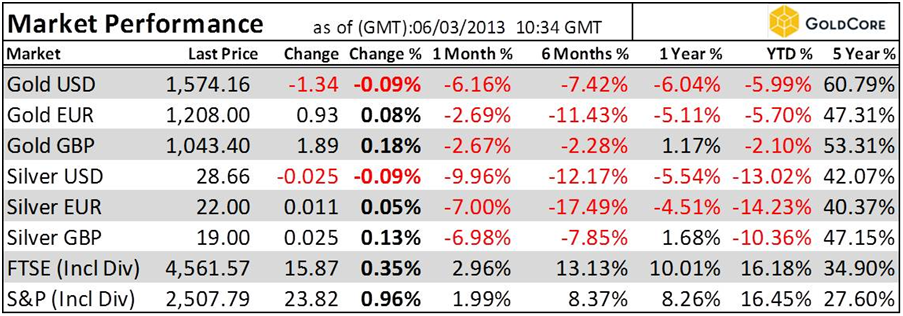
Today’s AM fix was USD 1,574.00, EUR 1,207.98 and GBP 1,043.42 per ounce.
Yesterday’s AM fix was USD 1,584.25, EUR 1,214.82 and GBP 1,044.33 per ounce.
Silver is trading at $28.68/oz, €22.10/oz and £19.09/oz. Platinum is trading at $1,596.70/oz, palladium at $736.00/oz and rhodium at $1,200/oz.
Gold rose $1.20 or 0.08% yesterday in New York and closed at $1,575.00/oz. Silver surged to a high of $29.07 and fell down to $28.51, but it still finished with a gain of 0.42%.
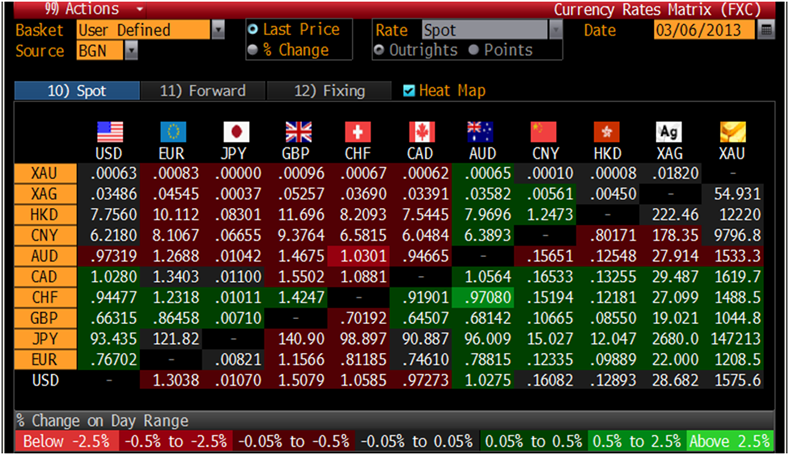
Cross Currency Table – (Bloomberg)
Gold edged higher in Asian and European trading today, supported by modest physical demand in Asia and from central banks. This continuing demand is creating expectations that prices will consolidate at current levels before moving higher again.

Dow Gold Ratio, 2003-2013 – (Bloomberg)
Prices have been range bound between $1,564/oz and $1,587/oz over the past few weeks which suggests consolidation.

INDU Index Weekly, 2003-2013 – (Bloomberg)
Currency debasement is being seen internationally and will again benefit gold in the medium and long term. The second round of money printing by the Federal Reserve pushed spot gold prices to a record nominal high of $1,920.94/oz in September 2011.
Given continuing debasement new record nominal gold highs and indeed inflation adjusted gold highs over $2,400/oz will almost certainly be seen in the coming months.
This currency debasement and ‘stimulus’ on a scale never before seen in financial and monetary history contributed to the Dow Jones Industrial Average reaching a new record high yesterday.
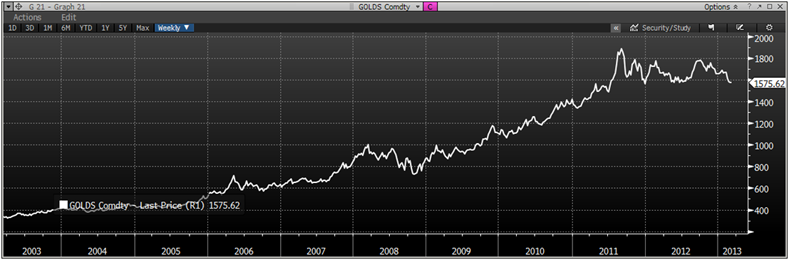
Gold Price Weekly, 2003-2013 – (Bloomberg)
The Dow Jones Industrial Average hit a new high yesterday, surpassing the previous high of 14,164 on 9 October 2007 leading to proclamations that ‘happy times are here again.’
However, importantly in gold terms, the Dow has not made any gains whatsoever, rather it has fallen by 50% (see chart).
In gold terms the DJIA has fallen from above 18 to 9.05 today and this clearly shows how the DJIA is not a good barometer for the health of an economy – especially one completely dependent on ultra loose monetary policies.
NEWS
Gold drifts on growth hopes; Asia buying lends support - Reuters
Gold Futures Advance on Stimulus Bets, Physical Demand - Bloomberg
Korea Joins Russia, Kazakhstan in Boosting Gold Holdings - Bloomberg
Turkish Feb Gold Imports Rise To 17.34 Tonnes - CNBC
COMMENTARY
Dow Jones High Should Not Be Mistaken For Growth In US Economy – The Guardian
Keiser Interviews Fekete About Paper Versus Physical Gold – You Tube
The Last Time The Dow Was Here… – Zero Hedge
Video: Byron Wien: Gold To Reach $1,900/oz - Bloomberg
For breaking news and commentary on financial markets and gold, follow us onTwitter.
More Controversial Obama Appointments
Stephen Lendman
Activist Post
Throughout his tenure, he ignored the best, brightest, most honorable and well qualified. He chose cabinet and other top picks he should have spurned.
He did again. He addressed reporters in the White House East Room. He "announc(ed nominations for) three outstanding individuals to help us tackle some of our most important challenges."
He chose Sylvia Burwell as new Office of Management and Budget (OMB) director. She replaces Jeffrey Zients. She's president of the Walmart Foundation. Previously she was Bill & Melinda Gates Foundation Global Development Program president. She prioritized profit making over goodwill.
In 2001, she joined the Gates Foundation. From 2002 - 2006, she was executive vice president, CEO and executive director.
Earlier she was Clinton's OMB deputy director, assistant to the president, and deputy chief of staff. She served Treasury Secretary Robert Rubin in the same capacity.
Prior to entering government, she did financial consulting. She did so for McKinsey & Company.
She's a Trilateralist. She's a Council on Foreign Relations member. She serves on MetLife's board of directors. She belongs to the Nike Foundation Advisory Group.
She's an Aspen Institute member. She serves on its Strategy Group. It's an elitist club. It's international and influential. It's comprised of businessmen, politicians, bureaucrats, and like-minded figures. They're up to no good.
Center for Economic Policy & Research economist Dean Baker called her appointment "cause for concern."
Author and filmmaker Kenneth Harvey said it's "unnerving to suddenly find (Obama) in bed with Walmart."
The Nation magazine said it "wielded (the foundation's) massive budget to expand the retail giant's influence at all levels of government and to pave the way for store expansions."
The Nation obtained a previously unreported document. It's titled "Recognizing the Walmart Foundation For Its Good Works."
It tells organizations "we are looking to the grantees that turn to the Walmart Foundation for funding to help us spread the word."
Expect Burwell to sail through confirmation easily.
Obama chose Ernie Moniz as new Energy Secretary. He replaces Steven Chu.
He was Clinton's Energy Department Under Secretary. He advised on overseas and DOE research and development, energy and environment technologies, national security, and various science issues.
He oversaw the national laboratory system. Doing so included national security programs, stockpile stewardship, and non-proliferation.
Earlier he was MIT Professor of Physics. He was its Institute of Technology's Energy Initiative director. It's funded by corporate heavyweights. They include BP, Chevron and Saudi Aramco.
Moniz directed research on coal's future, nuclear energy and natural gas. He sought corporate backing to do so. He's in bed with powerful interests he's beholden to.
Expect them to take full advantage. Expect him to comply willingly.
Environmental groups are concerned. On February 21, Inside Climate News headlined "Moniz: Shale Gas Boom a Low-Carbon Solution - for Now," saying:
He drew lots of fire for being "pro-industry." It made him Obama's top choice.
A Food and Water Watch statement said "His appointment to the DOE could set renewable energy development back years." It's circulating a petition against him.
He doesn't return requests for interviews. Perhaps he'll feel otherwise now. He believes natural gas is "part of our energy solution for some time."
He calls hydraulic fracking a "game-changer." No politician in his view will "walk away from this," he said.
He calls environmental risks manageable. They "can be mitigated to acceptable levels through appropriate regulation and oversight." He said it knowing not to expect it.
Big Oil gets what it wants. He's comfortable working with energy giants. He believes doing so will influence America's energy future positively.
Earlier Moniz was Clinton's Associate Director for Science in the Office of Science and Technology Policy.
His research interests include theoretical nuclear physics. He was MIT's Bates Linear Accelerator Center director.
He served numerous universities, national laboratories, professional societies, and government agencies. He did so in advisory roles. Expect easy confirmation.
Obama chose Gina McCarthy EPA head. She's an air quality expert. She's EPA's Office of Air and Radiation assistant administrator. She'll replace Lisa Jackson if confirmed.
She'll be involved in the Keystone XL Pipeline construction project. It's a controversial 1,661-mile Alberta, Canada to Port Arthur, TX initiative.
Environmental groups strongly oppose it. They do so for good reason.
If completed, it'll carry toxic tar sands oil from Western Canada to refineries on America's Gulf coast. It'll pass through environmentally sensitive areas.
They're in six states. They include waterways and the Ogallala Aquifer. It's one of the world's largest. In America, it supplies about 30% of the nation's irrigation ground water.
Friends of the Earth says Keystone XL "will carry one of the world's dirtiest fuels: tar sands oil." Its route "could devastate ecosystems and pollute water sources, and would jeopardize public health."
If completed, it'll double America's dirty tar sands oil supply. It'll increase environmental toxicity.
Big Oil wants it. So do Republicans and conservative Democrats. Expect Obama to go along. He always does. McCarthy's job is facilitating it. He chose her for that purpose. She's got other corporate priorities to serve.
Her rhetoric has no bearing on policy. She's beholden to powerful interests. Earlier she was Connecticut Department of Environment Protection commissioner. She served from 2004 - 2009.
From 1999 - 2003, she was Massachusetts Office of Commonwealth Development deputy secretary of operations. She served five state governors. Mitt Romney was one.
Environmentalists hope she'll address their concerns more responsibly. She wasn't chosen to do so. She's beholden to energy giant interests. So are Burwell and Moniz.
What corporate America wants, it gets. It's in good hand with all three.
Activist Post
Throughout his tenure, he ignored the best, brightest, most honorable and well qualified. He chose cabinet and other top picks he should have spurned.
He did again. He addressed reporters in the White House East Room. He "announc(ed nominations for) three outstanding individuals to help us tackle some of our most important challenges."
He chose Sylvia Burwell as new Office of Management and Budget (OMB) director. She replaces Jeffrey Zients. She's president of the Walmart Foundation. Previously she was Bill & Melinda Gates Foundation Global Development Program president. She prioritized profit making over goodwill.
In 2001, she joined the Gates Foundation. From 2002 - 2006, she was executive vice president, CEO and executive director.
Earlier she was Clinton's OMB deputy director, assistant to the president, and deputy chief of staff. She served Treasury Secretary Robert Rubin in the same capacity.
Prior to entering government, she did financial consulting. She did so for McKinsey & Company.
She's a Trilateralist. She's a Council on Foreign Relations member. She serves on MetLife's board of directors. She belongs to the Nike Foundation Advisory Group.
She's an Aspen Institute member. She serves on its Strategy Group. It's an elitist club. It's international and influential. It's comprised of businessmen, politicians, bureaucrats, and like-minded figures. They're up to no good.
Center for Economic Policy & Research economist Dean Baker called her appointment "cause for concern."
Author and filmmaker Kenneth Harvey said it's "unnerving to suddenly find (Obama) in bed with Walmart."
The Nation magazine said it "wielded (the foundation's) massive budget to expand the retail giant's influence at all levels of government and to pave the way for store expansions."
The Nation obtained a previously unreported document. It's titled "Recognizing the Walmart Foundation For Its Good Works."
It tells organizations "we are looking to the grantees that turn to the Walmart Foundation for funding to help us spread the word."
Expect Burwell to sail through confirmation easily.
Obama chose Ernie Moniz as new Energy Secretary. He replaces Steven Chu.
He was Clinton's Energy Department Under Secretary. He advised on overseas and DOE research and development, energy and environment technologies, national security, and various science issues.
He oversaw the national laboratory system. Doing so included national security programs, stockpile stewardship, and non-proliferation.
Earlier he was MIT Professor of Physics. He was its Institute of Technology's Energy Initiative director. It's funded by corporate heavyweights. They include BP, Chevron and Saudi Aramco.
Moniz directed research on coal's future, nuclear energy and natural gas. He sought corporate backing to do so. He's in bed with powerful interests he's beholden to.
Expect them to take full advantage. Expect him to comply willingly.
Environmental groups are concerned. On February 21, Inside Climate News headlined "Moniz: Shale Gas Boom a Low-Carbon Solution - for Now," saying:
He drew lots of fire for being "pro-industry." It made him Obama's top choice.
A Food and Water Watch statement said "His appointment to the DOE could set renewable energy development back years." It's circulating a petition against him.
He doesn't return requests for interviews. Perhaps he'll feel otherwise now. He believes natural gas is "part of our energy solution for some time."
He calls hydraulic fracking a "game-changer." No politician in his view will "walk away from this," he said.
He calls environmental risks manageable. They "can be mitigated to acceptable levels through appropriate regulation and oversight." He said it knowing not to expect it.
Big Oil gets what it wants. He's comfortable working with energy giants. He believes doing so will influence America's energy future positively.
Earlier Moniz was Clinton's Associate Director for Science in the Office of Science and Technology Policy.
His research interests include theoretical nuclear physics. He was MIT's Bates Linear Accelerator Center director.
He served numerous universities, national laboratories, professional societies, and government agencies. He did so in advisory roles. Expect easy confirmation.
Obama chose Gina McCarthy EPA head. She's an air quality expert. She's EPA's Office of Air and Radiation assistant administrator. She'll replace Lisa Jackson if confirmed.
She'll be involved in the Keystone XL Pipeline construction project. It's a controversial 1,661-mile Alberta, Canada to Port Arthur, TX initiative.
Environmental groups strongly oppose it. They do so for good reason.
If completed, it'll carry toxic tar sands oil from Western Canada to refineries on America's Gulf coast. It'll pass through environmentally sensitive areas.
They're in six states. They include waterways and the Ogallala Aquifer. It's one of the world's largest. In America, it supplies about 30% of the nation's irrigation ground water.
Friends of the Earth says Keystone XL "will carry one of the world's dirtiest fuels: tar sands oil." Its route "could devastate ecosystems and pollute water sources, and would jeopardize public health."
If completed, it'll double America's dirty tar sands oil supply. It'll increase environmental toxicity.
Big Oil wants it. So do Republicans and conservative Democrats. Expect Obama to go along. He always does. McCarthy's job is facilitating it. He chose her for that purpose. She's got other corporate priorities to serve.
Her rhetoric has no bearing on policy. She's beholden to powerful interests. Earlier she was Connecticut Department of Environment Protection commissioner. She served from 2004 - 2009.
From 1999 - 2003, she was Massachusetts Office of Commonwealth Development deputy secretary of operations. She served five state governors. Mitt Romney was one.
Environmentalists hope she'll address their concerns more responsibly. She wasn't chosen to do so. She's beholden to energy giant interests. So are Burwell and Moniz.
What corporate America wants, it gets. It's in good hand with all three.
The Dow Hits An All-Time High! Translation: A Bubble Is Always Biggest Right Before It Bursts
By Michael

Reckless money printing by Federal Reserve Chairman Ben Bernanke has pumped up the Dow to a brand new all-time high. So what comes next? Will the Dow go even higher? Hopefully it will. In fact, it would be great if the Dow was able to hit 15,000 before it finally came crashing down. That would give all of us some more time to prepare for the nightmarish economic crisis that is rapidly approaching. As you will see below, the U.S. economy is in far, far worse shape than it was the last time the Dow reached a record high back in 2007. In addition, all of the long-term trends that are ripping our economy to shreds just continue to get even worse and our debt just continues to explode. Unfortunately, the Dow has become completely divorced from economic reality in recent years because of Fed manipulation. All of this funny money that the Federal Reserve has been cranking out has made the wealthy even wealthier, but this bubble will not last for too much longer. What goes up must come down. And remember, a bubble is always biggest right before it bursts.
Fortunately, it looks like an increasing number of people out there are starting to recognize that the primary reason why stocks have been going up is because of the Fed. Just check out this excerpt from a recent article by the USA Today editorial board…
The Fed has dramatically distorted the market in an attempt to make things look good, but now the financial markets are completely and totally addicted to easy money. Is there any chance that the Fed will be able to take away that easy money without causing disaster?
There are only a few ways that this current scenario can play out. The following is what Stanley Druckenmiller recently told CNBC…

So what happens when the amount of money in an economy rises rapidly?
Well, if I remember Econ 101 correctly, that would mean that prices should go up.
And that is exactly what has happened. And since most of the money that the Fed has created has gone into the financial system first, it should not be a surprise that we have seen a bubble in financial assets.
In a previous article that I wrote last September, I warned that QE3 would cause stocks to go up…
No way.
As I have also written about previously, the money printing that the Fed is doing right now is not nearly enough to stop the mammoth derivatives crisis that is coming.
A derivatives crisis was one of the primary reasons for the financial crash of 2008, but most Americans still have no idea what derivatives are.
They can be very complex, but I think that it is easiest just to think of them as side bets.
When someone buys a derivative, they are not buying anything real. They are simply betting that something will or will not happen.
For example, if you bet $100 that the Chicago Cubs will win the World Series this year, would you be “investing” in anything real?
Of course not.
Well, it is the same with most derivatives.
Today, Wall Street has become the biggest casino in the entire world and trillions of dollars of very reckless bets have been made.
In fact, most Americans would be absolutely shocked to learn how exposed to derivatives some of our largest financial institutions are. The following is an excerpt from one of my previous articles entitled “The Coming Derivatives Panic That Will Destroy Global Financial Markets“…
So enjoy this little stock market bubble while you can.
It will end soon enough.
And of course stocks should not be this high in the first place. The underlying economic fundamentals do not justify these kinds of stock prices whatsoever.
A recent CNN article noted that the last time the Dow hit a record high that unemployment in the U.S. was much lower…
Just consider the following data points…
-The percentage of the civilian labor force in the United States that is actually employed has been steadily declining every single year since 2006.
-In 2007, the unemployment rate for the 20 to 29 age bracket was about 6.5 percent. Today, the unemployment rate for that same age group isabout 13 percent.
-According to one study, 60 percent of the jobs lost during the last recession were mid-wage jobs, but 58 percent of the jobs created since then have been low wage jobs.
-Median household income in America has fallen for four consecutive years. Overall, it has declined by more than $4000 during that time span.
-At this point, an astounding 53 percent of all American workers make less than $30,000 a year.
That is the other side of the Fed’s insidious money printing. Incomes in the United States are going down, but the cost of living is skyrocketing. This is squeezing millions of Americans out of the middle class…
I wish I could tell you that things were going to get better, but unfortunately there are all kinds of indications that things are about to get even worse for the U.S. economy. If you doubt this, just read this article and this article.
Yes, the Dow is at an all-time high. But do you want to know what else has hit an all-time high up in New York?
Homelessness.
The following is from a recent report in the New York Times…
But the Dow just hit a record high so we should all be wildly happy, right?
Hopefully we can get more Americans to understand that the “prosperity” that we are enjoying right now is just an illusion. It isn’t real. It is a bubble created by reckless money printing by the Fed and reckless borrowing by the U.S. government. If you can believe it, the U.S. government borrowed another 253 billion dollars during the month of February alone.
The Fed and the U.S. government will continue to engage in this kind of reckless behavior until the bubble eventually bursts.
So what should all the rest of us do?
We should be feverishly preparing for the hard times that are coming. As Daisy Luther recently wrote about, one of the most important things to do is to create an emergency fund. Instead of going out and blowing your money on the latest toys and gadgets, set some money aside so that you will have something to live on if the economy crashes and you suddenly lose your income.
Just remember what happened back in 2008. Millions of Americans suddenly lost their jobs, and because many of them had no financial reserves, a lot of Americans suddenly could not pay their mortgages and they lost their homes.
So put some money away in a place where it will be safe – and that does not mean the stock market.
Jim Cramer of CNBC and a lot of the other talking heads on the financial news channels are trying to encourage ordinary Americans to jump into “the bull market” right now and make some money, and many people will take their advice.
But the truth is that a bubble is always biggest right before it bursts.
This bubble is awfully big right now, and I don’t know how much larger it can possibly get.

We just got another big reason for caution as stocks make new highs
Short Sales Decline 53% as Bull Market Enters Fifth Year
Investors reduced bearish stock bets to the lowest level since at least 2007 as the bull market in American equities begins its fifth year.
Short sales in the Standard & Poor’s Composite 1,500 Index fell to 5.6 percent of shares available for trading in February, down from a record 12 percent during the credit crisis and the lowest ever in data compiled by Bespoke Investment Group and Bloomberg starting six years ago. The last time the number of shares borrowed and sold short approached this level, the equity gauge lost 3.3 percent in the next three months….
Reckless money printing by Federal Reserve Chairman Ben Bernanke has pumped up the Dow to a brand new all-time high. So what comes next? Will the Dow go even higher? Hopefully it will. In fact, it would be great if the Dow was able to hit 15,000 before it finally came crashing down. That would give all of us some more time to prepare for the nightmarish economic crisis that is rapidly approaching. As you will see below, the U.S. economy is in far, far worse shape than it was the last time the Dow reached a record high back in 2007. In addition, all of the long-term trends that are ripping our economy to shreds just continue to get even worse and our debt just continues to explode. Unfortunately, the Dow has become completely divorced from economic reality in recent years because of Fed manipulation. All of this funny money that the Federal Reserve has been cranking out has made the wealthy even wealthier, but this bubble will not last for too much longer. What goes up must come down. And remember, a bubble is always biggest right before it bursts.
Fortunately, it looks like an increasing number of people out there are starting to recognize that the primary reason why stocks have been going up is because of the Fed. Just check out this excerpt from a recent article by the USA Today editorial board…
The Federal Reserve’s purchases have driven interest rates to near zero. This has stimulated the economy but not without cost. Savers, particularly older ones trying to live on income from their investments, are starved for safe options. They’ve been forced into stocks, which is one reason the market has been acting as if it’s on steroids. Further, with borrowing costs low, Congress and the White House have less incentive to rein in the national debt. Rock-bottom interest rates have also distorted markets.Those sentiments were echoed by Gordon Charlop, a trader at Rosenblatt Securities, during a recent appearance on CNBC…
The best indication that the Fed’s bond-buying purchases are pushing stocks up artificially is that investors run for cover whenever there is a hint that the Fed might change course, as happened recently. On Monday, billionaire superinvestor Berkshire Hathaway CEO Warren Buffett told CNBC that markets are on a “hair trigger” waiting for signs of change from the Fed. The market is “hooked on the drug” of easy money, Dallas Fed President Richard Fisher told Reuters.
Fisher’s comparison of Fed policies to a drug is apt. Markets might not like the idea of the drug being withdrawn now, when the Fed holds a portfolio of $3 trillion. But the withdrawal symptoms will be a lot worse once the portfolio grows to $4 trillion, or more.
“The Wizard of the Fed, Ben [Bernanke], has done a great job propping up the market, but the question is how does the wizard move the pin from the balloon without blowing the whole thing up?” said Charlop. “This is getting out of balance and he’s got to figure out a way to justify the levels that we’ve gotten to and draw back on some of the stimulus.”Of course, in the end, the bursting of this bubble is going to be very messy.
The Fed has dramatically distorted the market in an attempt to make things look good, but now the financial markets are completely and totally addicted to easy money. Is there any chance that the Fed will be able to take away that easy money without causing disaster?
There are only a few ways that this current scenario can play out. The following is what Stanley Druckenmiller recently told CNBC…
“I don’t know when it’s going to end, but my guess is, it’s going to end very badly; and it’s going to end very badly because, again, when you get the biggest price in the world, interest rates, being manipulated you get a misallocation of resources and this is going to end in one of two ways – with a malinvestment bust which we got in ’07-’08 (we didn’t get inflation). We got a malinvestment bust because of the bubble that was created in housing. Or it could end with just monetizing the debt and off we go in inflation. So that’s a very binary outcome – they’re both bad.”What the Fed has done to the money supply in recent years has been absolutely unprecedented. Just check out how our money supply has skyrocketed since the last financial crisis…
So what happens when the amount of money in an economy rises rapidly?
Well, if I remember Econ 101 correctly, that would mean that prices should go up.
And that is exactly what has happened. And since most of the money that the Fed has created has gone into the financial system first, it should not be a surprise that we have seen a bubble in financial assets.
In a previous article that I wrote last September, I warned that QE3 would cause stocks to go up…
So what have the previous rounds of quantitative easing accomplished? Well, they have driven up the prices of financial assets. Those that own stocks have done very well the past couple of years. So who owns stocks? The wealthy do. In fact, 82 percentof all individually held stocks are owned by the wealthiest 5 percent of all Americans. Those that have invested in commodities have also done very nicely in recent years. We have seen gold, silver, oil and agricultural commodities all do very well. But that also means that average Americans are paying more for basic necessities such as food and gasoline. So the first two rounds of quantitative easing made the wealthy even wealthier while causing living standards to fall for all the rest of us. Is there any reason to believe that QE3 will be any different?So will stocks continue to go up indefinitely?
Of course not.
No way.
As I have also written about previously, the money printing that the Fed is doing right now is not nearly enough to stop the mammoth derivatives crisis that is coming.
A derivatives crisis was one of the primary reasons for the financial crash of 2008, but most Americans still have no idea what derivatives are.
They can be very complex, but I think that it is easiest just to think of them as side bets.
When someone buys a derivative, they are not buying anything real. They are simply betting that something will or will not happen.
For example, if you bet $100 that the Chicago Cubs will win the World Series this year, would you be “investing” in anything real?
Of course not.
Well, it is the same with most derivatives.
Today, Wall Street has become the biggest casino in the entire world and trillions of dollars of very reckless bets have been made.
In fact, most Americans would be absolutely shocked to learn how exposed to derivatives some of our largest financial institutions are. The following is an excerpt from one of my previous articles entitled “The Coming Derivatives Panic That Will Destroy Global Financial Markets“…
It would be hard to overstate the recklessness of these banks. The numbers that you are about to see are absolutely jaw-dropping. According to the Comptroller of the Currency, four of the largest U.S. banks are walking a tightrope of risk, leverage and debt when it comes to derivatives. Just check out how exposed they are…When the derivatives crash happens, there won’t be enough money in the entire world to fix it.
JPMorgan Chase
Total Assets: $1,812,837,000,000 (just over 1.8 trillion dollars)
Total Exposure To Derivatives: $69,238,349,000,000 (more than 69 trillion dollars)
Citibank
Total Assets: $1,347,841,000,000 (a bit more than 1.3 trillion dollars)
Total Exposure To Derivatives: $52,150,970,000,000 (more than 52 trillion dollars)
Bank Of America
Total Assets: $1,445,093,000,000 (a bit more than 1.4 trillion dollars)
Total Exposure To Derivatives: $44,405,372,000,000 (more than 44 trillion dollars)
Goldman Sachs
Total Assets: $114,693,000,000 (a bit more than 114 billion dollars – yes, you read that correctly)
Total Exposure To Derivatives: $41,580,395,000,000 (more than 41 trillion dollars)
That means that the total exposure that Goldman Sachs has to derivatives contracts is more than 362 times greater than their total assets.
So enjoy this little stock market bubble while you can.
It will end soon enough.
And of course stocks should not be this high in the first place. The underlying economic fundamentals do not justify these kinds of stock prices whatsoever.
A recent CNN article noted that the last time the Dow hit a record high that unemployment in the U.S. was much lower…
Consider this. When the Dow hit its now old record high back in October 2007, the economy was still in good shape — although it was just a few months away from the beginning of the Great Recession.And that same article also pointed out that GDP growth and housing prices were also much stronger back in 2007…
The unemployment rate in October 2007 was 4.7%. In January of this year, the unemployment rate was 7.9%.
Gross domestic product grew 3% in the third quarter of 2007. Revised figures from the government last week showed that GDP in the fourth quarter of 2012 rose a scant 0.1%. But I guess that’s good news considering the first estimate showed a 0.1% decline.We have never even come close to recovering from the last economic crisis. Most Americans seem to have forgotten how good things were back then, but a recent Zero Hedge article included some more points of comparison between October 2007 and today…
And despite all the hoopla about the steady recovery in the housing market over the past year, real estate is still in a bear market. The most recent level of the S&P Case-Shiller 20-City Home Price Index, one of the most widely watched gauges of the health of housing, is still 24% below where it was in October 2007.
- Dow Jones Industrial Average: Then 14164.5; Now 14164.5
- Regular Gas Price: Then $2.75; Now $3.73
- GDP Growth: Then +2.5%; Now +1.6%
- Americans Unemployed (in Labor Force): Then 6.7 million; Now 13.2 million
- Americans On Food Stamps: Then 26.9 million; Now 47.69 million
- Size of Fed’s Balance Sheet: Then $0.89 trillion; Now $3.01 trillion
- US Debt as a Percentage of GDP: Then ~38%; Now 74.2%
- US Deficit (LTM): Then $97 billion; Now $975.6 billion
- Total US Debt Oustanding: Then $9.008 trillion; Now $16.43 trillion
- US Household Debt: Then $13.5 trillion; Now 12.87 trillion
- Labor Force Particpation Rate: Then 65.8%; Now 63.6%
- Consumer Confidence: Then 99.5; Now 69.6
Just consider the following data points…
-The percentage of the civilian labor force in the United States that is actually employed has been steadily declining every single year since 2006.
-In 2007, the unemployment rate for the 20 to 29 age bracket was about 6.5 percent. Today, the unemployment rate for that same age group isabout 13 percent.
-According to one study, 60 percent of the jobs lost during the last recession were mid-wage jobs, but 58 percent of the jobs created since then have been low wage jobs.
-Median household income in America has fallen for four consecutive years. Overall, it has declined by more than $4000 during that time span.
-At this point, an astounding 53 percent of all American workers make less than $30,000 a year.
That is the other side of the Fed’s insidious money printing. Incomes in the United States are going down, but the cost of living is skyrocketing. This is squeezing millions of Americans out of the middle class…
When Debbie Bruister buys a gallon of milk at her local Kroger supermarket, she pays $3.69, up 70 cents from what she paid last year.Perhaps you can identify with this. Perhaps your paychecks are about the same as they used to be back in 2007 but the cost of living has gone up dramatically since then.
Getting to the store costs more, too. Gas in Corinth, Miss., her hometown, costs $3.51 a gallon now, compared to less than three bucks in 2012. That really hurts, considering her husband’s 112-mile daily round-trip commute to his job as a pharmacist.
I wish I could tell you that things were going to get better, but unfortunately there are all kinds of indications that things are about to get even worse for the U.S. economy. If you doubt this, just read this article and this article.
Yes, the Dow is at an all-time high. But do you want to know what else has hit an all-time high up in New York?
Homelessness.
The following is from a recent report in the New York Times…
An average of more than 50,000 people slept each night in New York City’s homeless shelters for the first time in January, a record that underscores an unsettling national trend: a rising number of families without permanent housing.And apparently families and children have been hit particularly hard over the past year…
More than 21,000 children—an unprecedented 1% of the city’s youth—slept each night in a city shelter in January, an increase of 22% in the past year, the report said, while homeless families now spend more than a year in a shelter, on average, for the first time since 1987. In January, an average of 11,984 homeless families slept in shelters each night, a rise of 18% from a year earlier.Of course New York is far from alone. There has been a surge in homelessness all over the United States. In fact, at this point more than a million public school students in the United States are homeless. This is the first time that has ever happened in U.S. history.
But the Dow just hit a record high so we should all be wildly happy, right?
Hopefully we can get more Americans to understand that the “prosperity” that we are enjoying right now is just an illusion. It isn’t real. It is a bubble created by reckless money printing by the Fed and reckless borrowing by the U.S. government. If you can believe it, the U.S. government borrowed another 253 billion dollars during the month of February alone.
The Fed and the U.S. government will continue to engage in this kind of reckless behavior until the bubble eventually bursts.
So what should all the rest of us do?
We should be feverishly preparing for the hard times that are coming. As Daisy Luther recently wrote about, one of the most important things to do is to create an emergency fund. Instead of going out and blowing your money on the latest toys and gadgets, set some money aside so that you will have something to live on if the economy crashes and you suddenly lose your income.
Just remember what happened back in 2008. Millions of Americans suddenly lost their jobs, and because many of them had no financial reserves, a lot of Americans suddenly could not pay their mortgages and they lost their homes.
So put some money away in a place where it will be safe – and that does not mean the stock market.
Jim Cramer of CNBC and a lot of the other talking heads on the financial news channels are trying to encourage ordinary Americans to jump into “the bull market” right now and make some money, and many people will take their advice.
But the truth is that a bubble is always biggest right before it bursts.
This bubble is awfully big right now, and I don’t know how much larger it can possibly get.
We just got another big reason for caution as stocks make new highs
Short Sales Decline 53% as Bull Market Enters Fifth Year
Investors reduced bearish stock bets to the lowest level since at least 2007 as the bull market in American equities begins its fifth year.
Short sales in the Standard & Poor’s Composite 1,500 Index fell to 5.6 percent of shares available for trading in February, down from a record 12 percent during the credit crisis and the lowest ever in data compiled by Bespoke Investment Group and Bloomberg starting six years ago. The last time the number of shares borrowed and sold short approached this level, the equity gauge lost 3.3 percent in the next three months….
Subscribe to:
Posts (Atom)