The term "skunk works" comes from a tiny Lockheed Martin facility run by chief engineer Kelly Johnson in the 1940s, which started in a tent next
to a malodorous manufacturing plant. That tiny space designed and built
America's first jet fighter in just 143 days, and created a philosophy
for rapid innovation which companies copy to this day.
Now, as more companies have to do more with less, many are moving
away from giant research centers and towards building something like a
lean startup inside their companies. Others have the luxury of a different model, where secretive labs work on projects that may never see the light of day.
Skunk works can refer to following a set of 14 rules and restrictions
set out by Johnson, but we're using a broader definition. These are the
places where some of the world's most talented thinkers and engineers
are given time and freedom to create something fascinating.
Everyone from giant defense contractors to retailers like Walmart and Nordstrom are putting their brightest minds in dedicated labs to attempt to jump ahead of the competition. Here's where they do it.
Saturday, February 23, 2013


GoldCore Insight - Currency Wars: Bye Bye Petrodollar – Buy, Buy Gold
Today’s AM fix was USD 1,580.00, EUR 1,196.15 and GBP 1,034.78 per ounce.
Yesterday’s AM fix was USD 1,568.50, EUR 1,189.34 and GBP 1,030.96 per ounce.
Silver is trading at $28.65/oz, €21.80/oz and £18.81/oz. Platinum is trading at $1,611.50/oz, palladium at $731.00/oz and rhodium at $1,175/oz.
Gold climbed $12.30 or 0.79% yesterday in New York and closed at $1,576.90/oz. Silver surged to a high of $28.88 and finished with a gain of 0.53%. Euro gold climbed back to €1,196/oz and platinum lost $32.50 to $1,613/oz.

Cross Currency Table – (Bloomberg)
Gold recovered on Friday, adding to gains yesterday on news that the U.S. economy is still faltering and concerns that the U.S. Fed’s QE will continue despite assertions to the contrary.
The U.S. economic growth stalled in Q4, and the jobless rate rose up to 7.9% this January.
Investors will look for clues in Bernanke’s testimony before the U.S. Congress on Tuesday and Wednesday. However, the fiscal cliff drop is still dangerous as the U.S. government will embark on spending cuts, debt limits and the U.S. Fed has every reason to keep its stimulus package in place.
Smart money bought the dip yesterday, especially in China where premiums in Shanghai were nearly $20/oz over market prices.
In the Eurozone, the EU commission said today that Europe will not recover until 2014.
Fearful investors continued liquidating positions in ETFs like SPDR Gold Trust, which saw its largest one day fall in positions yesterday in the past year and a half.

Gold Spot $/oz, 5 days – (Bloomberg)
GoldCore Insight - Currency Wars: Bye Bye Petrodollar – Buy, Buy Gold
Currency wars are probably one of the greatest risks posed to the wealth of nations today.
In September 2010, Guido Mantega, Brazil's finance minister, warned that an "international currency war" had broken out, as governments around the globe peg their currencies and devalue their currencies against each other.
His comments were echoed by senior Russian and Chinese officials.
The G20 said last week that there would be no currency wars and some central bankers such as the ECB's Mario Draghi have recently dismissed talk of "currency wars" as excessive.
Sir Humphrey, the wily civil servant in 'Yes Prime Minister', always stressed how important it was “to never believe anything until it is officially denied.”
Competitive currency devaluations are in effect a continuation of currency debasement. Debasement is simply the devaluing of one's currency or money. In ancient and medieval history it used to be done through the clipping of gold and silver coins.
Today it is done through excessive money creation through the printing of, and indeed the electronic creations of billions and billions of dollars, pounds, euros and other fiat currencies. Indeed, today central bankers are creating billions and billions of electronic money simply by pressing a few buttons on a computer.
Currency wars are set to deepen as most industrial nations in the western world are close to insolvent and look on the verge of recessions – potentially deep ones.
The fiscal situation of the U.S., the largest economy in the world, is appalling with the national debt having increased from $5.7 trillion in 2000 to over $16.5 trillion today.
Besides the U.S. national debt of over $16.5 trillion, the U.S. has off balance sheet debt or unfunded liabilities of between $70 trillion and $100 trillion.
The U.S. will never be able to pay these debts back and so it will attempt to inflate them away through currency devaluation. This poses risks to the global reserve currency status of the dollar - especially as the world moves to a multi polar world where India, Russia, Brazil and China exert their increasing economic and political power.

XAU/GBP Currency – (Bloomberg)

XAU/EUR Currency – (Bloomberg)
This is why it is important to consider the energy money nexus and to look holistically at the world of energy and money as Chris Sanders has done in this interesting insight.

Currency wars and the threats posed to the U.S. dollar as the global reserve currency of the world, make owning physical gold essential to all who wish to preserve wealth in the coming years.
We do not endorse the opinions of guest contributors but where we find an argument interesting and potentially valuable to our clients and the public in helping to protect and grow wealth we share it.
Yesterday’s AM fix was USD 1,568.50, EUR 1,189.34 and GBP 1,030.96 per ounce.
Silver is trading at $28.65/oz, €21.80/oz and £18.81/oz. Platinum is trading at $1,611.50/oz, palladium at $731.00/oz and rhodium at $1,175/oz.
Gold climbed $12.30 or 0.79% yesterday in New York and closed at $1,576.90/oz. Silver surged to a high of $28.88 and finished with a gain of 0.53%. Euro gold climbed back to €1,196/oz and platinum lost $32.50 to $1,613/oz.

Cross Currency Table – (Bloomberg)
Gold recovered on Friday, adding to gains yesterday on news that the U.S. economy is still faltering and concerns that the U.S. Fed’s QE will continue despite assertions to the contrary.
The U.S. economic growth stalled in Q4, and the jobless rate rose up to 7.9% this January.
Investors will look for clues in Bernanke’s testimony before the U.S. Congress on Tuesday and Wednesday. However, the fiscal cliff drop is still dangerous as the U.S. government will embark on spending cuts, debt limits and the U.S. Fed has every reason to keep its stimulus package in place.
Smart money bought the dip yesterday, especially in China where premiums in Shanghai were nearly $20/oz over market prices.
In the Eurozone, the EU commission said today that Europe will not recover until 2014.
Fearful investors continued liquidating positions in ETFs like SPDR Gold Trust, which saw its largest one day fall in positions yesterday in the past year and a half.
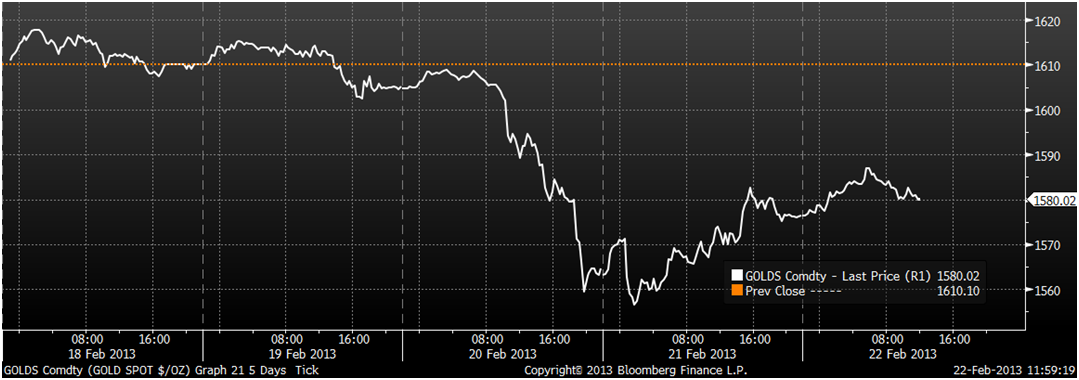
Gold Spot $/oz, 5 days – (Bloomberg)
GoldCore Insight - Currency Wars: Bye Bye Petrodollar – Buy, Buy Gold
Currency wars are probably one of the greatest risks posed to the wealth of nations today.
In September 2010, Guido Mantega, Brazil's finance minister, warned that an "international currency war" had broken out, as governments around the globe peg their currencies and devalue their currencies against each other.
His comments were echoed by senior Russian and Chinese officials.
The G20 said last week that there would be no currency wars and some central bankers such as the ECB's Mario Draghi have recently dismissed talk of "currency wars" as excessive.
Sir Humphrey, the wily civil servant in 'Yes Prime Minister', always stressed how important it was “to never believe anything until it is officially denied.”
Competitive currency devaluations are in effect a continuation of currency debasement. Debasement is simply the devaluing of one's currency or money. In ancient and medieval history it used to be done through the clipping of gold and silver coins.
Today it is done through excessive money creation through the printing of, and indeed the electronic creations of billions and billions of dollars, pounds, euros and other fiat currencies. Indeed, today central bankers are creating billions and billions of electronic money simply by pressing a few buttons on a computer.
Currency wars are set to deepen as most industrial nations in the western world are close to insolvent and look on the verge of recessions – potentially deep ones.
The fiscal situation of the U.S., the largest economy in the world, is appalling with the national debt having increased from $5.7 trillion in 2000 to over $16.5 trillion today.
Besides the U.S. national debt of over $16.5 trillion, the U.S. has off balance sheet debt or unfunded liabilities of between $70 trillion and $100 trillion.
The U.S. will never be able to pay these debts back and so it will attempt to inflate them away through currency devaluation. This poses risks to the global reserve currency status of the dollar - especially as the world moves to a multi polar world where India, Russia, Brazil and China exert their increasing economic and political power.
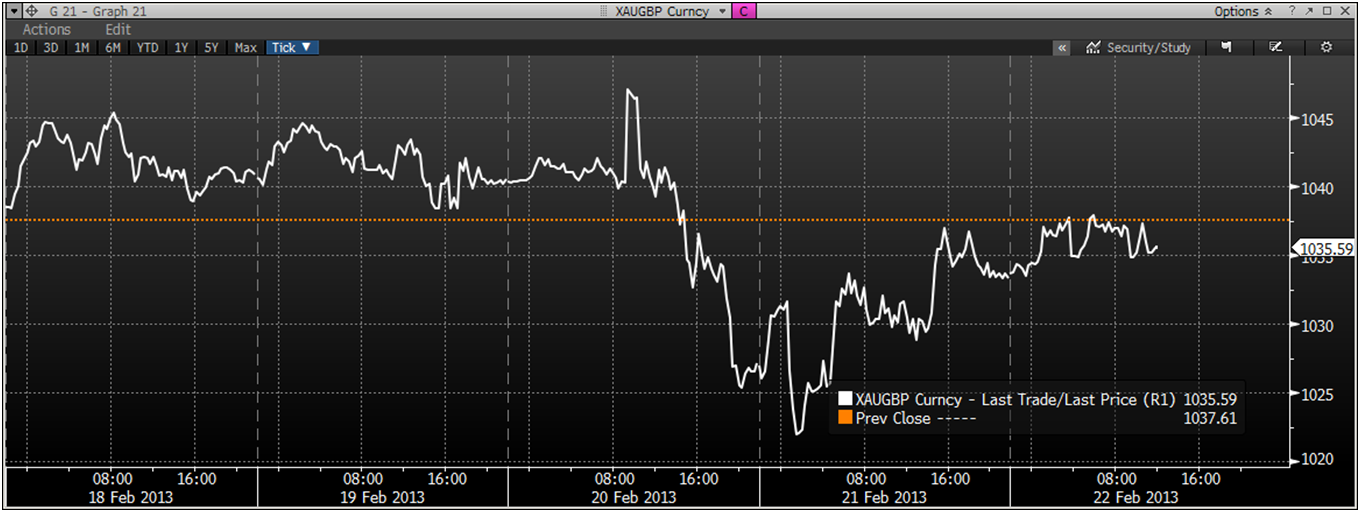
XAU/GBP Currency – (Bloomberg)
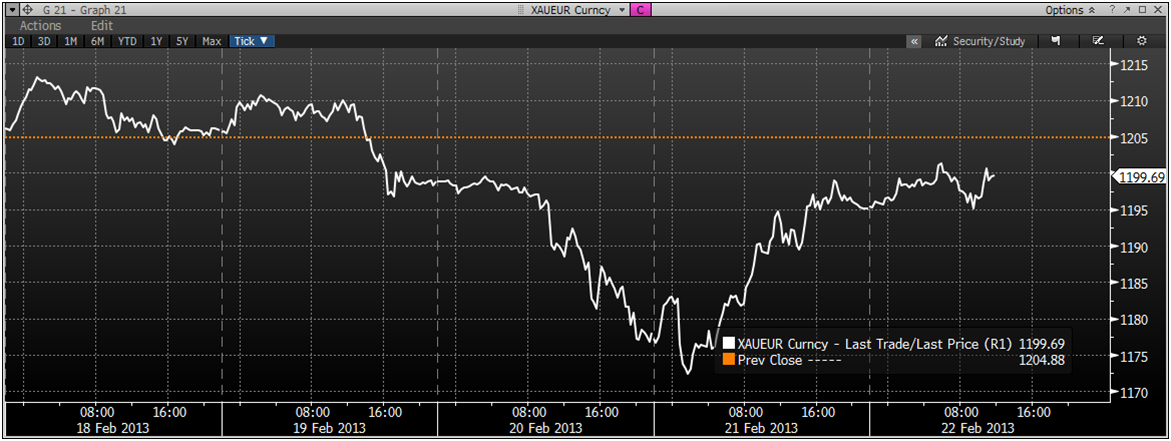
XAU/EUR Currency – (Bloomberg)
This is why it is important to consider the energy money nexus and to look holistically at the world of energy and money as Chris Sanders has done in this interesting insight.
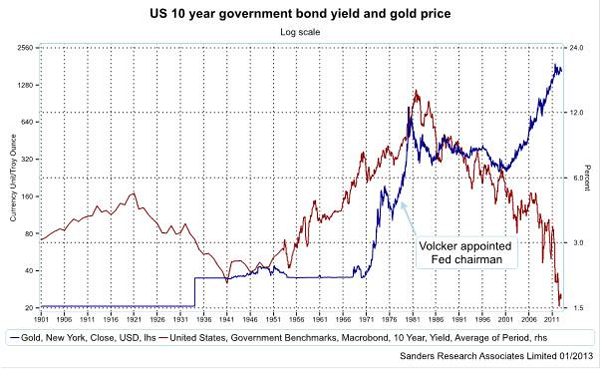
Currency wars and the threats posed to the U.S. dollar as the global reserve currency of the world, make owning physical gold essential to all who wish to preserve wealth in the coming years.
We do not endorse the opinions of guest contributors but where we find an argument interesting and potentially valuable to our clients and the public in helping to protect and grow wealth we share it.
Is India's economy at a standstill?
| |||||||||||||||||||||||
Firefighters fund nixes Emanuel’s ideas on disability pay, gun stocks
Mayor Rahm Emanuel isn’t used to being
told “no,” but that’s the answer he has gotten from the firefighters
pension fund this week on two major issues: duty disability reform and
his call for the fund to dump its stock with assault weapons
manufacturers.
Two motions were made at Wednesday’s
meeting of the Chicago Firefighters Annuity and Benefits Fund — one to
divest $173,000 in Smith & Wesson stock, the other to ride herd over
the 390 firefighters and paramedics who together collect $27 million a
year in taxpayer-funded duty disability pay.
Both motions failed — by 5-2 on guns and
4-3 on duty disability reform — prompting City Comptroller Amer Ahmad
to storm out of the meeting in disgust.
Contacted Thursday, Ahmad refused to
discuss the vote. His spokeswoman, Kathleen Strand, responded in an
email to the Chicago Sun-Times.
“The Mayor remains committed to standing
up against gun companies that stand in the way of commonsense reform
and will continue [to] seek out necessary reforms that protect taxpayer
dollars from fraud and abuse in the disability program,” Strand wrote.
“While we are disturbed by the fire
pension fund’s decision, we are more so encouraged by the those funds —
including laborers, police, municipal, and teachers — that have chosen
to stand with us against these gun companies.”
A mayoral confidant, who asked to remain
anonymous, denounced the back-to-back votes as “shameful” and
politically motivated by Emanuel’s demand for contract and pension fund
concessions from Chicago firefighters.
“It’s a consistent pattern of behavior.
They’re just not dealing in reality. There’s a whole attitude of fight
and resist everything,” the Emanuel confidant said. “Just to say, ‘We’re
against it’ because the mayor is for it — it’s not embarrassing to the
mayor. They embarrassed themselves. That’s not an ideology. There’s no
principle there.”
Tony Martin, secretary of the
firefighters pension fund, said the fund has “a very nominal amount
considering the $1 billion size of our portfolio” invested in Smith
& Wesson.
“There was no motion to adopt a broad
divestment policy from assault weapons manufacturers. It was one
specific manufacturer,” Martin said. “There was no intent to embarrass
anybody. My trustees are always trying to do the right thing for the
right reason. We’re concerned about our fiduciary duty to our
participants. The goal is to put them first.”
Among other things, the disability
reforms would have required firefighters and paramedics who receive
disability pay to get more frequent medical checkups and provide the
pension fund with more information about their second jobs.
Emanuel proposed the reforms in response to a series of Chicago Sun-Times stories about alleged disability abuses.
The newspaper reported that the police
disability system includes 347 officers, covering a range of conditions,
from the most severely disabled to others who are able to work, who
have gone on to new careers while on disability and, in some cases,
moved away while continuing to collect a city check and other benefits.
The series highlighted two officers who never served a single day on the
street. They went on disability after sustaining injuries during
training at the police academy.
The Chicago Fire Department is less than
half the size, but it has 390 people on disability leave at an annual
cost of $27 million. Only eight disabled firefighters have returned to
work since 2003.
After the Connecticut school massacre, Emanuel made national headlines by broadening his push for an assault weapons ban.
He argued that it was time to hit gun
manufacturers in the pocketbook — by pressuring government pension funds
in Chicago and around the nation to dump their weapons stock.
Ahmad likened the political pressure tactic to the movement that helped end apartheid in South Africa.
Despite lingering bitterness after the
seven-day strike by Chicago Public Schools teachers, the teachers
pension fund announced a plan to get rid of the $260,000 in stock with
three manufacturers of assault weapons.
The teachers pension fund insisted that the divestiture started before Emanuel launched his campaign.
HYPERINFLATION ALERT: Gas Prices Surge More Than 30 Cents in a Month in NE..60 cents in FLorida…. Oil Industry Analyst: Local Gas Prices Could Soon Be As Bad As California
 in Newton continue their upward march, with the price for a gallon of regular up more than a quarter in the past month.
AAA Southern New England said its survey of prices in Massachusetts on Monday found self-serve, regular unleaded averaging $3.72 per gallon, four cents higher than a week ago and up 31 cents over the past month.
http://newton.patch.com/articles/gas-prices-surge-more-than-30-cents-in-a-month-are-you-driving-less-b4d6cc66
This story is from Feb 1-13
Oil Industry Analyst: Local Gas Prices Could Soon Be As Bad As California
Clips from the story
BOSTON (CBS) – New England could be the new California when it comes to gas prices, according to oil industry analyst John Kilduff.
Why? The main reason is a lack of gas refineries in this part of the country.
“Just this week, Hess announced the closure of a big refinery that makes just gasoline in New Jersey,” Kilduff told WBZ NewsRadio 1030 Friday.
He said oil companies are cutting back massively in refining capacity and that means we’re all going to be paying the price for that.
But if the demand for gasoline is so high and prices are up, why are these companies closing refineries?
“It’s the energy industry seemingly working against consumers.”
But, Kilduff says there is a silver lining to this cloud.
“A little bit of pain at the pump is a good sign for all of us in terms of our economy going forward.”
http://boston.cbslocal.com/2013/02/01/oil-industry-analyst-local-gas-prices-could-soon-be-as-bad-as-california/
I am having a hard time believing that last little bit..
—-
Southern California sees record one-month rise in gasoline prices
Southern California has seen its biggest ever one-month rise in gasoline prices
, according to the Automobile Club of Southern California’s weekend gas watch.The average price for a gallon of regular gasoline in the varying regions of Southern California has now climbed 57 to 59 cents since last month.
http://www.latimes.com/business/autos/la-fi-hy-southern-california-gasoline-prices-20130221,0,374632.story
Auto Club: Gas Prices Post Record One-Month Jump
In the Inland Empire, the average per-gallon price is $4.276, up 10.6 cents from last week, 58 cents higher than last month, and 23 cents more than last year.
http://murrieta.patch.com/articles/auto-club-gas-prices-post-record-one-month-jump
James Grant: 'Bernanke's Helicopter Needs A Bailout'
'Money in search of mischief and likely to find it.'
"The Fed's balance sheet
is exploding. They have added over $3 trillion in new securities since
QE began. Bernanke's money printing is counter-productive and is why
the economy won't recover. If it were as easy as printing money or
creating credit to levitate an economy or to reactivate business
activity the world would have been richer many generations ago."Jim Grant with Lauren Lyster yesterday on her new show. Lyster and her producer Demetri Kofinas closed shop at Capital Account on RT a few weeks and just popped up over at Yahoo Tech Ticker.
Special bonus clip below of Lauren Lyster and a mini-skirt leg-kick.
---
Yahoo Tech Ticker
As expected, the Federal Reserve announced Wednesday it
will continue its $85 billion monthly bond-buying stimulus program
until the economy improves. The central bank also pledged to keep
interest rates near zero until the national unemployment rate falls to
at least 6.5%, and as long as inflation stays in line with its 2%
target. Ahead of the Fed announcement the Commerce Department
reported 2012 fourth quarter GDP fell for the first time since 2009.
The 0.1% contraction is indicative of the "low-level virus" attacking
the domestic economy, says Grant. In fact, Grant believes the Fed's
perpetual low-interest rate policy will lead to the next big economic
crisis in this country: the bursting of the bond bubble.
---
reported 2012 fourth quarter GDP fell for the first time since 2009.
The 0.1% contraction is indicative of the "low-level virus" attacking
the domestic economy, says Grant. In fact, Grant believes the Fed's
perpetual low-interest rate policy will lead to the next big economic
crisis in this country: the bursting of the bond bubble.Lauren Lyster Bonus:
Happy Friday. Lauren Lyster leg kick in short skirt at 24 second mark.
UPDATE - I found this Krugman/Henry Blodget interview while at Yahoo. More deficit-spending nonsense from the false prophet.
Subscribe to:
Posts (Atom)