Larry Summers is a pretentious
Keynesian fool, but I refer to him as the Great Thinker’s Vicar on Earth
for a reason. To wit, every time the latest experiment in Keynesian
intervention fails——as 84 months of ZIRP and massive QE clearly have—–he
can be counted on to trot out a new angle on why still
another interventionist experiment or state sponsored financial fraud is
just the ticket.
Right now he is leading the charge for the greatest stroke of
foolishness yet conceived. Namely, negative interest rates based on
the rubbish theory that the “natural” money market rate of interest is
at an extraordinarily low point. Accordingly, the central bank should
drive the “policy rate” to sub-zero levels in order to achieve the
appropriate level of “accommodation” in an economy that refuses to
attain “escape velocity”.
As can’t be pointed out often enough, however, there is no such
economic ether as “accommodation”. It’s just a blanket cover story for
what Keynesian central bankers believe they are accomplishing by pegging
interest rates below market clearing levels and by bending and mangling
the yield curve to cause more investment.
But after 86 months it is evident that all of this putative monetary
“accommodation” has failed. Falsifying the cost of money and capital can
only work if it causes households and businesses to borrow more than
they would otherwise; and to then lay credit based spending for
consumption and investment goods on top of what can be funded out of
current production and income. Another name for that is leveraging
private balance sheets and thereby stealing production and income from
the future.
With $62 trillion of public and private debt outstanding the US
economy has hit a economic barrier called Peak Debt. For all practical
purposes, it can be measured as the macroeconomy’s aggregate leverage
ratio at 3.5X national income. That represents fully two turns of extra
debt on the economy relative to the stable 1.50X ratio that prevailed
during periods of war and peace and boom and bust during the century
before 1970.
Stated differently, the Fed and other central banks have led the
world economy into a planetary LBO over the last two decades or so. In
the case of the US, the two extra turns of debt resulting from that
rolling LBO amount to about
$35 trillion.
Yes, that’s a load of anti-growth ballast that explains why there has
been no “escape velocity”, and why the rate of real final sales growth
since Q4 2007 is only 1.2% compared to peak-to-peak historical rates of
2.5% to 3.5%. And I use peak-to-peak advisedly because it is now clear
after the recently released December business sales and inventory
numbers that we are on the verge of a recession, if not already in one.
Yet the Vicar and his compatriots in the Eccles Building and on Wall
Street insist on pushing harder on the credit string——even though Peak
Debt means that household debt is still $400 billion below its pre-
crisis peak and that the entire $2 trillion gain in business debt has
been recycled back into the Wall Street casino via stock buybacks and
mindless M&A deals. Real net investment in business plant, equipment
and technology, in fact, is actually still below its 2007 peak, and
even the level which had been attained at the turn of the century.
So that brings us to the harebrained theory of negative interest
rates and the supposed collapse of the natural rate of interest in the
money market. The latter is just unadulterated economic voodoo. It makes
Art Laffer’s magic napkin look like a model of scientific formulation
by comparison.
The truth is, there is only one “natural rate” of interest, and
that’s the one produced in an honest financial marketplace via the
interaction of savers and borrowers. No such rate now exists and hasn’t
for decades owing to the massive intrusion of the Fed in the money
market. Indeed, as a purely physical matter, even the so-called Federal
funds market no longer exists because the Fed has asphyxiated it under a
flood of $3.5 trillion of bond-buying and the resulting giant surplus
of bank deposits.
So Summers is apparently speaking for the kid who killed his parent
and then threw himself on the mercy of the courts on the grounds that he
was an orphan. That is, interest rates are in the graveyard of history
because the central banks buried them there.
Interest rate pegging and the Fed’s wealth effects doctrine have
failed completely, but now Keynesians like Summers claim the
contra-factual.
That means the Keynesian medicine didn’t work because the Fed didn’t
pump enough drugs into the nation’s quasi-comatose body economic. So now
we have to dig even deeper into the netherworld of financial repression
in order to align borrowing costs with a non-existent natural rate of
interest.
It’s another case of a policy target confected from whole cloth just like the 2% inflation target.
But there is one overwhelming practical problem with NIRP. To wit, if
pushed deeper and broader than just a few basis points of negative
yield on deposits of excess bank reserves at the central bank, NIRP will
surely cause a flight to old-fashioned bank notes.
Lo and behold, after all these years of doctoring the economy,
Professor Summers and fellow travelers like Professor Sands at Harvard,
have up and joined the war on crime!
But their newfound abhorrence of crime amounts to an economist’s
version of the NRA mantra that guns don’t kill, people do. In this case,
it might be said that criminals don’t launder money, avoid taxes
and commit act of terrorism, large denomination bills do!
Of course, the latter have been around for centuries. Yet suddenly
every NIRP advocate on the planet has joined the campaign to abolish
large bills including the Benjamin Franklin here and the EUR 500 note on
the other side of the pond.
Thus, Professor Summers opined as followed in a recent Washington Post op ed:
The fact that — as Sands points out — in
certain circles the 500 euro note is known as the “Bin Laden” confirms
the arguments against it. Sands’ extensive analysis is totally
convincing on the linkage between high denomination notes and crime. He
is surely right that illicit activities are facilitated when a million
dollars weighs 2.2 pounds as with the 500 euro note rather than more
than 50 pounds as would be the case if the $20 bill was the high
denomination note. And he is equally correct in arguing that technology
is obviating whatever need there may ever have been for high
denomination notes in legal commerce.
Let’s see. A million dollars worth of weed currently weighs about
200 pounds. If push came to shove couldn’t El Chapo have the mules who deliver it to the street carry
50 pounds of
bills on the backhaul? Better still, if drug money laundering is such a
huge social blight, why not legalize the drug trade and turn the
business over to Phillip Morris?
They would surely use digital money to pay their vendors. And if
we want to get rid of tax evasion does the good professor really believe
that Wall Street high rollers and silicon valley disrupters or just
every day rich people actually get paid for whatever they do in bank
notes?
The fact is, it is gardeners, waitresses and delivery boys who get
paid in cash, not people with meaningful incomes. Yet bringing such
slackers to justice doesn’t require the abolition of cash in any event.
Just exempt them from income and payroll taxes entirely and let them pay
their social dues at the cash register when they purchase goods and
services.
In short, there is one reason alone for the sudden campaign to
abolish large denomination bills. It is a necessary predicate for the
imposition of NIRP. That is to say, it would pave the way for central
bank mandated confiscation of the wealth and savings of millions of
American citizens in the pursuit of a cockamamie theory that would bring
about the final destruction of honest price discovery and financial
discipline in the Wall Street casino.
Surely, there is not much more of such destructive intervention that
can be tolerated before the booby-traps of leverage and risk that have
been built up over the last two decades, but especially since the
financial crisis, blow sky high. Indeed, the very idea that the foolish
advocates of Keynesian central banking would even entertain the notion
of providing outright subsidies to carry trade gamblers—–and that’s
where money market NIRP would end up——is a warning sign of the danger
that lurks in the financial misty deep.
Central bankers have been massively and relentlessly deforming
financial markets and rewarding the most outlandish and unstable forms
of leveraged gambling and risk-taking throughout the warp and woof of
the financial system, but have no more clue about the financial time
bombs they have planted than they did last time around when CDS and CDOs
squared were erupting everywhere.
It is only a matter of time, and a few more bear market rallies
before the meltdown commences again. Indeed, when the impending global
recession becomes fully evident, the gamblers in the Wall Street casino
will panic like never before.
After a 30-year bubble, they have come to believe that the central
banks are infallible and that all economic downturns and market
corrections are quickly remedied with new rounds of monetary stimulus.
But that is not a permanent financial truth; it’s a false generalization
based on a fabulous one-time monetary trick that is already played out.
To wit, central banks have used up their dry powder. After more than
two decades of reckless monetary pumping, they are now stranded on the
zero bound and possessed of hideously bloated balance sheets.
So the correction scenario this time will be very different. There
will be no quick reflation, meaning that the liquidation of economic
malinvestments and overvalued financial assets will run for years.
In fact, during the coming down-cycle, the central banks may turn out
to be wreckers, not saviors. As they resort to increasingly novel
and illogical maneuvers such as negative interest rates (NIRP) they are
generating fear, not confidence.
There can be no better proof than what has transpired in Japan since
its lunatic central banker, Haruhiko Kuroda, announced a shift to NIRP
within days after he said it was off the table. Since his January 29
statement, however, the Japanese stock market has plunged by 16% from
its early January level and 25% since last summer’s peak, thereby wiping
out much of the three-year long stock bubble generated by Abenomics.
 ^N225
^N225 data by
YCharts
Nor is Japan’s stumble an isolated case. Warning signs on the epochal
shift now underway continue to accumulate on all fronts. The bellwether
economies of Asia started the year with a sharp plunge including a
11.5% export decline compared to last January in China, a 13.5% drop in
India and an 18.5% plunge in South Korea.
Likewise, Germany ended 2015 with an unexpected decline in exports
and industrial production, while Japan’s trade figures also slipped
badly—-with exports down 8% and imports off by 18% versus prior year.
Consequently, the Japanese economy posted a recessionary 1.4%
contraction of GDP in Q4.
There is no better weathervane on the global economy than the Baltic
Dry Index because it captures the daily pulse of global shipments of
grains, iron ore and the rest of the commodity complex. The fact that it
has now plunged to an all-time low since records began in 1985
underscores that worldwide industrial activity is sinking rapidly.

In response to these deflationary currents, financial markets have
retreated sharply on a worldwide basis. Among 44 significant
international equity markets, nearly half are already in bear market
territory as signaled by a drop of 20% or more from recent highs. And
some of the most pivotal markets in the world——-Germany (DAX), Japan and
China—–are down by 30% or more.

Not surprisingly, these drastic declines have so far only dented the
surface on Wall Street. The unreconstructed bulls are already saying
that the correction is over and are urging their clients to once again
buy the dip. Nearly ever one of the major banking houses have year-end
price targets for the S&P 500 well above current levels. These
include a gain of 11% at Goldman, 15% at Morgan Stanley, 16% at
Barclay’s and 17% at RBC Capital.
A cynic might dismiss this ebullience as merely an exercise in the
usual Wall Street hockey stick game. After all, you can’t sell stock,
ETFs and other financial products to investors when you are projecting a
down market, and so they never do.
Yet chalking these dubious targets off to salesmanship would be to
underestimate the magnitude of the coming crash.The truth of the matter
is that Wall Street gamblers, like the Jim Carrey character in
The Truman Show,
have lived in the bubble for so long that they no longer even remotely
grasp the artificiality and unsustainability of the entire financial
system.
We think the chart below puts this in perspective. For the better
part of three decades, the financial system in the US has been expanding
at nearly twice the rate of GDP growth. Even a vague familiarity with
the laws of compound arithmetic reminds us that the resulting
ever-widening gap between economic output and the market value of stock
and debt obligations can’t continue.
But there is an even larger point. Namely, that the weakening
performance of the US economy during the last two decades did not
warrant the drastic increase in the capitalization rate implied by the
chart in the first place.
Stated differently, equities and debt must ultimately be supported by
interest and dividends extracted from the flow of national income
(GDP). Historically, the stable
US financial capitalization rate—that is, the combined value of debt and
equity outstanding— had been about
2.0X national income.
But beginning with Greenspan’s conversion to money printing after the
financial meltdown of October 1987, the capitalization rate begin to
steadily climb and never looked back.
Now it amounts to nearly
5.4X national
income. Yet this has occurred during a period when the trend growth rate
of the US economy has been cut in half——from more than 3.0% per annum
to less than 1.5% during the last decade or so.
Measured in dollar totals, the sum of equity and debt outstanding in the US in 1987 was
$11 trillion. Today it exceeds
$93 trillion. No wonder asset gatherers like BLK have exploded in scale!
But that’s also why they are heading for a big fall. As the
post-bubble epoch of global recession and financial deflation and
liquidation unfolds, the $93 trillion US financial bubble shown below
will contract sharply, as will its equivalent worldwide total of $300
trillion.

So we are looking at tens of trillions financial asset shrinkage in
the years ahead. And nowhere will that implosion be more dramatic than
in the ETF sector.
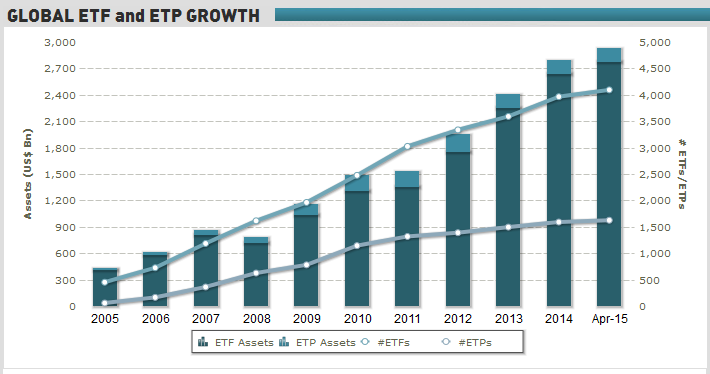
As shown in the chart below, the number of these entities has grown
from about 600 to 5,500 in the last 12 years, and AUM has exploded from
$450 billion to $3 trillion.
That’s a 17% compound rate of growth since 2003.Even more significantly, almost all of that growth occurred after the 2008 financial crisis.

So let’s cut to the chase. Prior to Greenspan’s dotcom bubble, ETFs
did not even exist, and they would never thrive on an honest free
market. That’s because their fundamental appeal is to professional
speculators and traders and to homegamers who like to bet on the
financial ponies.
By contrast, there is no reason why real long-term investors would
want to own a huge, motely basket of banking stocks or energy stocks or
the likes of the biotech ETF’s portfolio. The latter includes 150
different stocks including nearly 100 start-ups whose science is
extremely difficult to assess and whose P&Ls are largely
non-existent.
The sole purpose of the IBB, therefore, was to enable speculators
to pile on to the momentum trade in biotech stocks which incepted in
about 2012. This momentum trend was then turbo-charged by the inflow of
speculative capital into this sector through IBB and other ETF’s.
The same thing happened with the energy ETFs. One of the major
ETF baskets in this sector is called XLE and it includes 40 energy
companies ranging from giant integrated producers like Exxon to refiners
like Valero, to oilfield services companies like Halliburton, to small
E&P companies like Newfield Exploration. The iShares equivalent is
called IXC and it even more diversified with 96 companies spread among
an even greater diversity of sizes, specializations and geographies.
Needless to say, no long-term investor would possibly believe
that such a dog’s breakfast can be rationally analyzed or diligenced at
the company specific level. After all, the whole point of competitive
markets is to sort out the winners, losers and also-rans at the sector,
industry and sub-industry level. So buying the entire industry amounts
to embracing self-cancelling financial noise and undoing all the hard
work of Mr. Market at the operating performance level.
Exchange traded funds, at bottom, are a product of the financial casinos, not the free market. They offer
traders and speculators the chance to “bet on black” for just hours,
days or weeks at a time based on little more than headlines and
momentum. Not surprisingly, the XLE has now completed a round trip to
nowhere during the last five years as the oil bubble re-erupted and then
collapsed.
 XLE
XLE data by
YCharts
The implication is straight forward. The ETF boom functioned as a
market accelerator on
the way up. Speculative capital poured into these proliferating funds,
and then was intermediated by Wall Street market makers into incremental
demand for the thousands of individual stocks that comprise them.
This magnifying effect is important to understand because it
highlights the artificiality and instability of today’s stock markets.
To wit, every time an ETF started trading above the net asset value of
the underlying stocks, fund providers issued new ETF shares to market
makers. The latter, in turn, bought up a basket of shares on the stock
exchanges representing the asset mix of the fund and swapped them for
the ETF shares.
We call this the Big Fat Bid that helped undermine the two-way market
forces that ordinarily keep speculation in check. But now that the
worldwide financial bubble is cracking, we believe the dynamic will
begin playing out in reverse. That is, ETFs will now become the Big
Fat Offer that takes the market down at an accelerating pace.
The reason is straight forward. The $3 trillion world of ETFs is not
an investor marketplace. It is a casino where the fast money moves in
and out of short term rips, bubbles and flavors of the moment; and also a
dangerous place where naïve retail investors have been lured to roll
the dice on their home trading stations.
So as the global economy and financial markets slide into the long,
deflationary cycle ahead, the hot money will flee sinking ETFs at an
accelerating pace, thereby leaving homegamers shocked to find that they
have been fleeced by Wall Street yet again. At length, retail level
panic will ensue, causing a thundering implosion of the ETF sector.
What lies ahead for retail investors is probably worse. That’s
because ETFs inherently embody a liquidity mismatch. Almost invariably
the underlying stocks are not as liquid as the ETF shares which
represent them.
This means that retail investors may be faced with painful episodes in which ETF shares gap down violently to
deep discounts relative
to their net asset value. Accordingly, if shareholders have attempted
to protect their portfolios with stop orders, they may handed sharp
losses; or they may just panic and sell.
The market plunge on August 26th last year provided a foretaste. In
today’s markets, “trading halts” occur when a stock moves up or down too
quickly relative to the trading range contained in market circuit
breakers. Ordinarily, about 40 such trading halts occur each day, but
during the August 26th plunge there were almost 1,300 such occurrences.
And 78% involved ETFs, not individual stocks.
This is crucial because ordinarily only one-third of trading halts
involved ETF shares. Stated in round numbers, there are ordinarily about
15 ETF trading halts per day, but on August 26th that number soared to
1,000.
Moreover, during this trial panic, the risk of large pricing gaps was
painfully evident. The Vanguard consumer staples ETF called VDC. for
example, plunged by
32% that day while the underlying holdings of the fund dropped by only
9%. Retail investors who panicked or who were sold out by stop loss orders were taken to the cleaners by the market makers.
The point here is not a plea for SEC regulation. Far from it!
Instead, the implication is that after a few more such episodes
during the unfolding bear market——-which must inexorably happen due to
the liquidity mismatch—–retail investors will become thoroughly
disgusted with ETFs. They will then head for the hills right behind the
fast money on Wall Street.
Yet ETF are only one of the many FEDs (financially explosive devices)
that have been fostered by our rogue central bankers. Wait until $700
trillion of financial derivatives start living up to the name Warren
Buffett gave them before he went all in using them (“financial WMDs”).
Come to think of it. The crime does not lie in the anti-social
behavior our Ben Franklin’s may occasionally facilitate. The crime is
that we are ruled by a self-perpetuating elite of monetary cranks who
have become so desperate that they want to eliminate something so
irrelevant and harmless as hand-to-hand currency.