UBS has warned that the seven-year cycle in equities is rolling over, we could see a sharp 30% correction in stocks and that as per the headline of their ‘Technical Outlook 2016′, it is time to “buy gold”.
In their just released research note entitled ‘The 7-Year Cycle in Equities Is Rolling Over … Buy Gold!’,
analysts Michael Riesner and Marc Müller believe the bear market that
has dominated the price of gold since 2011 is nearing a bottom, with the
“basis for the next multi-year bull market” now taking hold: “Gold we expect to move into a major 8-year cycle bottom in 2016, as the basis for a new multi-year bull market.” “Gold has been trading in a cyclical bear market since 2011. In 2016, we expect gold and gold mines moving into an 8-year cycle bottom as the basis for the next multi-year bull market. Initially, we see gold profiting as a safe haven and as of 2017, gold could profit from the US dollar moving in a major top and starting a bear market.” “In contrast to the underlying secular trend in commodities (which has turned bearish) we see gold (which is in our view a currency and not a commodity) still trading in a secular bull market. Pattern
wise we continue to see the 2011/2016 cyclical bear market in the same
context as the 1975/1976 bear cycle in gold. Keep in mind, in the
mid-70s gold lost 43% of its value from its January 1975 top before
another gold bull market started into the January 1980 bubble peak. It
is amazing to see that with a loss of 45% from its August 2011 top into
the early December 2015 low, the decline in gold has more or less exactly the same proportion as in the mid-70s. Furthermore,
there are still a lot of market commentators who say that the August
2011 top in gold was the top of a bubble. According to the average gains
we have seen in historical financial bubbles, the gold bull run from
2001 into 2011 (760%) was far away from any bubble territory. In the first gold bubble, gold gained 2400%. In the 1903 to 1929 Dow bubble, the Dow Jones Industrial gained 1200%. The 1979-1989 Nikkei bubble came in at around 2000% and the 1980 – 2000 Nasdaq bubble topped out a +3900%. So if gold moves into a bubble, we would need to see a gold price of minimum $3,300, and in this case we would still talk about a low bubble phenomena such as the 1903 – 1929 Dow Jones bubble!!”
The research and charts are well worth a read and can be accessed here Precious Metal Prices 14 Jan LBMA Gold Prices: USD 1,090.75, EUR 998.03 and GBP 759.10 per ounce 13 Jan LBMA Gold Prices: USD 1,081.80, EUR 1,000.00 and GBP 749.04 per ounce 12 Jan LBMA Gold Prices: USD 1,094.95, EUR 1,008.76 and GBP 756.92 per ounce 11 Jan LBMA Gold Prices: USD 1,104.70, EUR 1,014.08 and GBP 758.18 per ounce 8 Jan LBMA Gold Prices: USD 1,097.45, EUR 1,009.86 and GBP 750.67 per ounce Breaking Gold News and Commentary Today – Click here
Investigators reportedly visited sites belonging to Renault on January 7
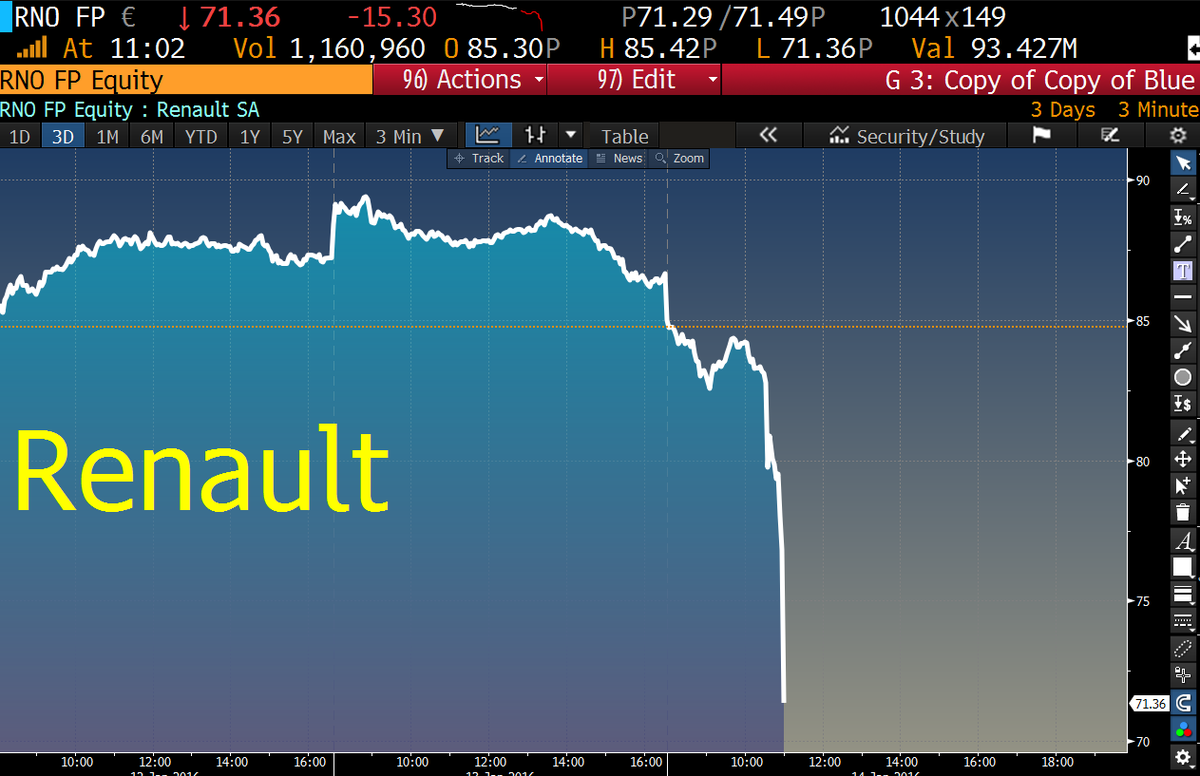
Renault shares fell by as much as 20 per cent on Thursday
after reports that investigators had seized computers from the car
manufacturer in an alleged probe into emissions testing.
Investigators visited sites belonging to Renault on January 7, according to AFP.
Florent Grimaldi, an official with the CGT union at the company’s
operations in Lardy, France, told Bloomberg that investigators had
visited Renault sites involved in standards and emissions testing, which
he said gave the impression that the probe is related to emissions."The reaction in its share price is one of shareholder panic, pure
and simple. That's why its share price fell 19% within just 60 minutes
of trading in the mid-morning session," said Joshua Raymond, CFD and FX
broker at XTB.com.
The investigation comes after Volkswagen was ordered to recall 8.5 million cars in Europe following the discovery by a US regulator that it had been cheating on emissions tests.
French authorities investigating Volkwagen in Europe had said they
would widen the probe to cover all carmakers, including Renault and
Peugeot. France's environmental regulator had also been monitoring
vehicles to check the difference between emissions results in test and
real-world situations.
Renault confirmed that some of its sites were raided by anti-fraud
investigators and said it is cooperating with the investigation.
The car maker said the investigators had decided to carry out extra
checks on parts and in factories but that no defeat devices had been
found so far.
High
frequency trading (HFT) and other ways to cheat markets are now being
surpassed by advancements in machine learning which are now growing
within financeGetty Images
Cyberwarfare
waged by terrorists using weaponised algorithms and artificial
intelligence – it sounds like something straight out of "The Fear Index"
by Robert Harris, or maybe the plot of a James Bond flick. But this is
the new reality and we should be scared – very scared.
High
frequency trading technologies have infiltrated markets over the last
decade leading to unprecedented episodes of volatility and flash
crashes, leaving regulators as bewildered as everyone else. Technology
which was once confined to investment banks or hedge fund managers has
made its way into the retail space, and it can be relatively easily
modified. In addition, recent advancements in machine learning and AI
are entering a number of fields, including finance.
Kristian Kristiansen of QuantAlliance, which develops trading algorithms focused on Forex and commodities, told IBTimes UK:
"Weaponised algos [algorithms] are software specifically designed to
manipulate stock markets and start a market crash. The effect of this is
not only a loss of assets, but the creation of fear that will manifest
in investors. It will prevent them from creating further investment, or
they will make significant downgrades in the amounts they invest. This
in return will have a serious impact on any economy, even one as big as
the US.
"The scary thing is that software like this is pretty easy to make,
and can be constructed for a very low cost. It's only possible because
the majority of trades are currently performed by algos. The software
I'm talking about will simply 'trick' the algos to sell and this will
create a chain reaction in other algos and spark a crash."
Kristiansen
believes there are too many blue chip algorithms with vast sums under
management, relying on analysis of market orders. The problem is that
orders can be made without being executed. "I can place an order to sell
stocks worth hundreds of millions of dollars, and never actually do it.
But other algos can see I placed the order and many of them will react
to this," said Kristiansen.
Flash crash
"If
just one big algorithm reacts and actually starts selling as a result
of my actions, this will start a chain reaction with others. And you
have to keep in mind many algos are specifically designed to follow
other algos. There are even algos designed to follow the ones who are
following. It could get very bad very fast. Look at the flash crash of
2010."
The 2010 trillion dollar flash crash lasted approximately 36 minutes. Navinder Singh Sarao,
a trader who operated from his parents' house in suburban West London,
is being blamed for "spoofing" the markets and triggering the crash.
Sarao amassed nearly £30m using his moderated trading software. But
market commentators have said blaming a single trader for the crash is
like blaming lightning for starting a fire.
High
frequency trading (HFT) and other ways to cheat markets are now being
surpassed by advancements in machine learning which are now growing
within finance. The British artificial intelligence (AI) company
DeepMind Technologies was acquired by Google in 2014, and investment
firms like Bridgewater Associates and Highbridge Capital have been
tapping innovations in big data using techniques previously confined to
universities.
Machine learning
Machine
learning and algorithmic trading will apply intelligence to markets, as
opposed to HFT techniques which used raw speed to cheat them. "It
doesn't help to be the fastest, if your opponent can predict your
moves," notes Kristiansen.
He said when QuantAlliance tested its
first basic AI algorithm it only took it five days before it "invented"
the Martingale system all by itself with no human input. In a martingale
betting strategy the gambler, who wins his stake if a coin comes up
heads and loses it if the coin comes up tails, doubles his bet after
every loss so that the first win would recover all previous losses plus
win a profit equal to the original stake. The system assumes the gambler
has infinite wealth; in reality the exponential growth of bets would
eventually bankrupt "unlucky" gamblers.
"It simply learned this
was a mathematical solution to win. I really don't think people
understand the fundamentals of AI, or that it's already a reality," said
Kristiansen.
Kristiansen thinks intelligent algorithms will learn
how HFT algos are cheating and outperform them. "AI algos will simply
reverse engineer the advanced HFT algos from the large banks and hedge
funds, and force the banks to change their focus to AI algos if they
don't want to be outperformed."
Fight algos with algos
Kristiansen
maintains that intelligent algorithms are the best defence against
nefarious technology of the sort associated with flash crash trading. He
believes that regulators have taken the wrong approach, trying to find
ways to regulate algorithms since the 2010 flash crash, some of which
will come into force in 2017 as part of MiFID II.
"To be honest I
think the regulations coming in 2017 are already too late. I believe
algorithms are moving more in the direction of machine learning and
artificial intelligence."
Regarding the regulation of HFT
algorithms, the violations will likely be small and almost impossible to
uncover, he said. Trying to introduce vanilla algorithms – out of the
box and turnkey solutions – will mean poor performance and leave markets
even more open to manipulation.
Kristriansen sees a future where
algorithms are running on markets purely to investigate what other
algorithms are doing, to detect when one of them is up to no good.
He
said: "The point is not whether algorithms are good or bad, but whether
we should focus on the fact that algorithmic trading could be
deliberately weaponised just as computers and phones can be weaponised
for cyberattacks. It's a yin and yang situation where algorithms are
both the threat and the solution. One thing is certain, if you try to
fight the robots as a human, you will lose. Algorithms are here to stay,
whether we like it or not. Just like computers.
"We have not yet
seen criminals or terrorists weaponise algorithms for attacks, but the
future will surely bring this at some point. When it happens, the safest
thing for investors is to have their investments in other algorithms."
The yen was slightly higher against the dollar and other currencies
in Asia Thursday, as investors bought the perceived safety of the
Japanese currency following renewed volatility in Asian stocks.
Tracking an overnight selloff after further oil price weakness, the greenback
USDJPY, +0.10%
fell to as low as ¥117.29
during Asia trade before bouncing back to ¥117.77 with Y¥117.68 late
Wednesday in New York.
Brent crude
LCOG6, +1.68%
, the global benchmark, dropped below $30 barrel intraday for the first time since 2004 amid a global supply glut and fears of a deepening slowdown in China.
Indonesia’s risk-sensitive rupiah was weaker against the U.S. dollar after explosions and gunfire hit the capital Jakarta. The dollar rose to as high as 13,990 Indonesia rupiah
USDIDR, +0.58%
from IDR13,932 before the explosions. A risk-averse mood persisted in Tokyo after the Dow Jones Industrial Average
DJIA, -2.21%fell 2.2% to its lowest level since late September.
The Nikkei Stock Average
NIK, -2.68%
was down 2.7% at 17,240.95,
after briefly falling below the 17,000 level for the first time since
Sept. 29 2015. Meanwhile, the benchmark Shanghai Composite Index
SHCOMP, +1.97%
was up 1%.
But the
dollar showed enough resilience to stay around ¥117.50 with dip buying
kicking in to support the greenback. After confirming the dollar’s
downside around ¥116.70 earlier this week, there seems to be dollar
buying orders from a broader range of investors including Japanese
importers especially during Tokyo hours.
“I can feel
uncertainty,” given U.S. stocks’ steep decline despite the relatively
healthy state of the U.S. economy, said Takuya Kanda, senior researcher
at Gaitame.Com Research Institute.
“It looks the market has
overreacted” to the oil price decline, but that also suggests the market
remains uncertain about future course of the global economy, he said,
adding that markets were not fully considering the positive aspects of a
low oil price environment.
The Japanese currency was also stronger against the euro
EURJPY, +0.23%
which briefly hit ¥127.75
before regaining to ¥128.05 midday compared with ¥128.05 late Wednesday.
The U.K. pound
GBPJPY, +0.11%
touched as low as ¥168.84, its
cheapest level since October 2014, before recovering to ¥169.74 midday.
The Australian dollar
AUDJPY, +0.09%
fell to as low as ¥81.22 midday from ¥81.98.
In other currency-pair trading, the euro
EURUSD, +0.1103%
gained against the dollar with
the common currency changing hands at $1.0873 from $1.0833.
The WSJ Dollar Index
BUXX, +0.00%
a measure of the dollar against a basket of major currencies, was up 0.07% at 91.18.
China may have already overtaken U.S. in electric-vehicle sales
Faraday Futures
An electric-car boon in China is good news for Faraday Future’s concept cars, and others.
China may have already overtaken the U.S. in sales of electric cars,
although whether that rapid pace is sustainable is another story.
That’s
from analysts at Barclays, who said in a note clients Wednesday that
annual sales of electric vehicles in China may grow by about 44% a year
until 2020, and are expected to have reached 220,000 units in 2015. That
would contrast with less than 120,000 electric cars sold in the U.S.
also last year.
That speedy growth scenario would knock China’s annual oil demand by around 1%, the analysts said.
It would also be a boon to U.S. electric car makers such as Tesla Motors Inc.
TSLA, +0.28%
and traditional U.S. car
makers, which have announced plans to launch more electric cars or offer
electric options of existing models.
Just last week, General Motors Co.
GM, +0.36%
introduced at the Las Vegas’ Consumer Electronics Show its new Chevrolet Bolt EV, arriving at dealerships in late 2016 with a price tag of $30,000.
Ford Motor Co.
F, -0.82%
has announced plans for new
electric cars, including an electric version of its Focus sedan. Also at
the Las Vegas show, Faraday Future Inc., a company with close ties with
a Chinese web television company, introduced a new electric “concept” car. The company has said it will build a new factory outside Las Vegas.
China
is focusing on pure electric vehicles rather than hybrids, and
prioritizing buses and public-utility vehicles as a means to combat
pollution and traffic congestion, the Barclays analysts said. The
country has also enacted policies encouraging infrastructure
development, such as a push to add more charging stations.
China
waives sales tax and the annual license tax for EVs, and local benefits
are common, particularly in major cities concerned about congestion and
smog. For example: In Beijing, electric-car buyers do not have
participate in the monthly license lottery.
Barclays estimated
that with subsidies and tax benefits, the cost of buying an EV in China
is similar to that of a internal-combustion engine car.
EV sales
in China have grown rapidly since 2014, and the Barclays analysts said
they expect “a continued acceleration in sales to lift China above the
U.S. as the world’s largest EV market in 2015.” There’s increasing
optimism that EVs “are finally taking off in China,” they said.
The
Chinese government has set a target to lift EV sales to 1.5 million
vehicles, or 5% market share, by 2020, from 75,000 in 2014.
That
acceleration is still at early stages and is based on strong government
support, so questions remain as to whether China can keep that pace.
Constraints in battery supplies and a slower-than-expected
infrastructure buildup are some of the pitfalls.
Even in a world
were expectations meet reality, the potential effect of China’s EV
penetration on the country’s oil demand might be modest in the next five
years, the Barclays analysts said.
Over 30 million workers don’t have access to a retirement plan from their employers
Depending on where you live, you may have less access to a retirement plan from your employer — and that can hurt your nest egg.
Roughly
40% of workers — that’s more than 30 million full-time, private-sector
workers ages 18 to 64 — don’t have access to a retirement plan from
their employer such as a 401(k), according to a report released Wednesday from The Pew Charitable Trusts.
In
some states, the situation is worse than others: In Florida, which has
the worst access rate, just 46% of workers could take advantage of a
company-sponsored retirement plan (Texas and New Mexico are the only
other states with rates of less than 50%). Meanwhile, in Wisconsin,
which had the best access rate, 70% have access to a company-sponsored
retirement plan.
This matters because access
to a retirement plan from your employer predicts participation in the
plan, which, in turn, predicts total retirement savings. Fully 85% of
workers with access to a plan participate in it, and, not
coincidentally, the states with the lowest (Florida) and highest
(Wisconsin) access rates to employer-sponsored retirement plans, also
had the lowest (38%) and highest (61%) participation rates.
Furthermore, as the Employee Benefit Research
Institute notes, “workers are more likely to save in a retirement plan
at work than they are to save on their own through an IRA.” That may
explain why employer-sponsored plans represent such a large portion of
workers’ retirement savings.
Nearly half of workers say that
their savings in their employer-sponsored retirement savings plan will
be a “major” source of income for them in retirement, the highest of all
the criteria (just 31% of workers, for example, say Social Security
will be a major source of retirement income for them), EBRI data shows.
Meanwhile, only about one in four workers think their IRA will be a
major source of retirement income for them.
Although just
because you work at a company that doesn’t offer a retirement plan,
doesn’t mean you can’t save or that you’ll be undersaved; plenty of
Americans without a company plan make regular contributions to an IRA or
other savings vehicle.
Furthermore, Americans as a whole, both
those with and without company plans, are undersaved for retirement -- a
problem that’s gotten worse in recent decades, as Obama alluded to when
addressing the joint session of Congress in his State of the Union
address Tuesday: “It’s not much of a stretch to say that some of the
only people in America who are going to work the same job, in the same
place, with a health and retirement package, for 30 years, are sitting
in this chamber…for everyone else, especially folks in their 40s and
50s, saving for retirement or bouncing back from job loss has gotten a
lot tougher.”
Indeed, 28% of American workers have less than
$1,000 in savings and investments; and another roughly 30% have between
$1,000 and $24,999. Most workers don’t have enough money to retire Total savings and investments, 2015
The market bears just keep winning in the new year.
The S&P 500 has slumped into correction territory, and Chinese stocks today briefly traded in bear-market territory. ZeroHedge is gleefully reporting that a “legendary” J.P. Morgan quant sees the beleaguered S&P
SPX, -2.50%
getting more grizzly. That’s
using the common definitions for correction and bear territory — drops
of 10% and 20%, respectively, from closing highs.
Any silver
lining in these dark clouds? Well, at least analysts are getting a bit
more creative in their finger-pointing after each market dive. Sure,
they’re still blaming China’s economic slowdown and crude oil’s crash,
but U.S. consumer-discretionary stocks are now key culprits. Yes, we’re looking at you, Netflix
NFLX, -0.28%
and BorgWarner
BWA, -9.52%
.
Here’s another possible reason for hope: Some investors are embracing Chinese stocks, and not just the buyers from Beijing suspected of orchestrating today’s upside reversal by the Shanghai Composite.
“We
don’t believe in the gloom and doom scenarios,” says Dave Garff of
Accuvest Global Advisors, referring to the China angst. “You have to
look at the recent poor momentum as a negative, but on balance, the
positives outweigh the negatives.” More from Garff in the call of the
day.
Today’s chart is upbeat, suggesting that oil could find a
bottom at last. But the stat of the day tosses red meat to the bears, as
it gives the latest damage estimate for global stocks in this
not-so-happy new year.
Key market gauges
S&P
ESH6, +0.21%
and Dow
YMH6, +0.27%
futures are pointing to a
slightly higher open, but they were up more earlier, and let’s not
forget that yesterday’s morning gains didn’t stick. Chart watchers see
head-and-shoulders patterns and potential for “the most important session the U.S. markets
DJIA, -2.21%
have had in four years.” Europe
SXXP, -2.18%
is falling, and non-Chinese Asian markets closed with losses. The Shanghai Composite
SHCOMP, +1.97%
undercut its August closing low before turning positive. Oil
CLG6, +1.18%
and gold
GCG6, -0.10%
are higher, as a key dollar index
DXY, -0.03%
drops.
The call
Accuvest
This table is alphabetical. The top-ranked nations are Japan, Korea, Germany, China, Hong Kong and Taiwan.
Accuvest’s Garff says his
shop’s investing strategy is to search each month for “countries that
provide the best opportunities in global markets going forward.”
In
their latest look-see, China has moved up to fourth-best nation, and
investors therefore should overweight that country, according to
Accuvest’s model. That model looks at four factors: fundamentals
(earnings and economic growth), momentum (relative strength), risk and
valuation (relative and absolute).
“We want to be as
dispassionate as possible, and not be swayed by market commentary and
sentiment,” Garff told MarketWatch in an email. “As always, our views
could change next month, but for the moment, we continue to like China.”
He acknowledges the many good reasons for steering clear of
China, including suspect data from the government and listed companies,
as well as Beijing’s various missteps as it manages its economy and
financial markets. But Accuvest’s president and chief investment officer
argues the U.S. has “similar issues” with data, while a growing middle
class and other demographics are on Beijing’s side as the economy slows
and changes.
The stat
$3.2 trillion — That’s the value
wiped out by this year’s global stock swoon, according to data as of
Wednesday’s close from Howard Silverblatt at S&P Dow Jones Indices.
He tracks the loss via the S&P Global Broad Market Index. Last week,
the damage amounted to $2.5 trillion, according to other data trackers.
The buzz
GoPro
GPRO, -25.46%
is poised to plunge in today’s session after announcing job cuts and disappointing quarterly sales
late Wednesday. Fewer of us than anticipated are wearing video cameras
to show off our exciting lives, but there is no shortfall when it comes
to dark humor or bearish comments:
What’s that screeching
sound? Maybe oil bulls? But wait, it’s strangely harmonious. Oh, it’s a
“bullish bat harmonic” etched by crude futures. Greg Harmon over at
Dragonfly Capital has flagged this chart pattern, as he says oil might
“hold here and reverse.”
You probably know the head and
shoulders, or the cup with handle, but maybe not this formation named
after everyone’s favorite flying mammal. The bat harmonic has to do with
geometric patterns and price turning points, as Investopedia puts it.
“Oil
looks oversold from the momentum indicators, but as traders say,
‘oversold can get oversolder,’” Harmon writes. Note his chart below
showing oil’s bat harmonic is dated Tuesday, and crude gained Wednesday
and is rising this morning. Go here for all of Harmon’s harmonic musings.
The economy
Watch for weekly jobless claims at 8:30 a.m. Eastern Time, along with a report on import and export prices.
On the Fed front, St. Louis Federal Reserve President James Bullard is slated to give a speech at 8:15 a.m. Eastern.
Across
the Atlantic, European Central Bank President Mario Draghi is expected
to speak at 9 a.m. Eastern. Investors also will be digesting ECB minutes
and the Bank of England’s rate announcement.
The quote
“I
asked him if I made four times what the average person made, why
couldn’t I retire four times earlier? He assured me it didn’t work that
way, but I wasn’t sold on his reasons. ... The idea of freedom and
having my time be my own, sleeping in, reading and traveling, [now] THAT
was the life I craved.” — a lawyer who retired at age 33 in a Q&A with blogger Mr. Money Mustache, who is known for spending less and retiring at 30.
Random reads
GoPro could try sponsoring this Minnesota man who’s creating his own frigid fun.
We have a winner in that big Powerball lottery that captivated those who pay no heed to statistics.
Snoop Dogg barks at Bill Gates after Microsoft’s gamer network goes down.
A “Friends” reunion is happening, and Oscar nominations are due to hit this morning.
Sorry, Sean Penn. El Chapo was actually interested in a Mexican actress, and he apparently hadn’t heard of you. Need to Know starts early and is updated until the opening bell, but sign up hereto
get it delivered once to your email box. Be sure to check the Need to
Know item. The emailed version will be sent out at about 7:30 a.m.
Eastern.




 Faraday Futures


 Accuvest
 Getty Images
