Thursday, September 17, 2015

CENSUS: 46.7 Million In Poverty

homeless

(WASHINGTON)  The wallets of America’s middle class and poorest aren’t seeing any extra money, the U.S. Census reported Wednesday, a financial stagnation experts say may be fueling political dissent this campaign season.
The Census Bureau, in its annual look at poverty and income in the United States, said both the country’s median income and poverty rate were statistically unchanged in 2014 from the previous year.
Median income — the point where half of the households have income below it and half have income above it — showed no statistically significant change, despite the small drop to $53,700 in 2014 from 2013’s $54,500. Median income is a broad measure of the economic health of the middle class.
The poverty rate also showed no statistically significant change. In 2014, the poverty rate in the United States was 14.8 percent, which was the same as in 2013. The poverty rate had dropped in 2013 from 15 percent in 2012, the first such drop since 2006.
There were 46.7 million people in poverty, which is also a statistically similar number from the previous four years. In 2014, a family with two adults and two children was categorized as in poverty if their income was less than $24,008.
Census officials said they weren’t surprised by the flat numbers. “It’s not unusual for it not to go down two years in a row,” said Trudi J. Renwick, chief of the Poverty Statistics Branch in the bureau’s Housing and Household Economic Statistics Division.
The White House focused on the fact that some of the numbers increased, though census officials noted the change was not significant. “Real median income for family households rose $408 in 2014, while real median income for non-family households also rose but overall median household income declined,” administration officials said in a news release.
Republicans argued that the stagnating numbers reveal a need for change to the country’s welfare programs.
“Our current approach to fighting poverty, though well-intended, is failing too many Americans,” said House Ways and Means Committee Chairman Paul Ryan, a Wisconsin Republican. “This disappointing data, five years into an economic recovery, underscores the need for a new effort to modernize our country’s safety net programs.”
The latest numbers will feed into the 2016 political debate, with both parties trying to position themselves as advocates for the middle class.
The numbers may explain some of the political furor going on in the country, said Lawrence Mishel, president and CEO of the liberal Economic Policy Institute. “Anyone wondering why people in this country are feeling so ornery need look no further than this report,” Mishel said. “Wages have been broadly stagnant for a dozen years and median household income peaked in 1999.”
The Census report also showed that the number of uninsured Americans dropped in 2014, as the big coverage expansion in President Barack Obama’s law took effect. The share of the population uninsured the whole year was 10.4 percent, or 33 million people. When compared to 2013, nearly 9 million people gained coverage. A recent government survey that includes data from the first three months of this year shows that the uninsured rate continued to fall in 2015.
The report also said:
— Asian households had the highest median income in the United States at $74,300 in 2014. The median income for non-Hispanic white households was $60,300, for black households $35,400 and Hispanic households $42,500. The median income for white households decreased by 1.7 percent between 2013 and 2014, while there was no statistically significant change for black, Asian, and Hispanic households.
— The 2014 median earning of men was $50,400, while the median earning for women was $39,600. Neither number was statistically different from 2013.
— The median income of households maintained by the foreign-born increased 4.3 percent while the median income of households maintained by a native-born person declined 2.3 percent. The income of naturalized citizens and noncitizens were not statistically different from the year before.
— The number of men and women working full-time, year-round jobs increased by 1.2 million and 1.6 million, respectively, between 2013 and 2014. Census officials said the change suggested a shift from part-time, part-year work status to full-time, year-round employment.

Robert Shiller: Signs showing that we’re in a bubble

CNBC, Released on 9/15/15
“Earnings have grown so rapidly, and history suggests that earnings don’t usually keep growing like that.”
“People are forgetting long-term thinking.”
 http://marketsanity.com/robert-shiller-signs-showing-that-were-in-a-bubble/

It’s Official:The American Middle Class Has Been Set Back A Quarter Century

economic collapse

(Matt Phillips)  More than six years after the end of the Great Recession, America’s middle class is still waiting for its recovery.
Inflation-adjusted US median household incomes suffered another flat year in 2014. In newly-released data, the Census Bureau pegged real US median household incomes at $53,657, statistically flat from the previous year. (The median income is the exact midpoint of US income distribution—half of households in the nation have incomes that are higher, and half have incomes that are lower.)
Over the long term, the picture is pretty clear. Effectively, inflation-adjusted US median household incomes are still roughly where they were in 1989, when they hit $53,306. That means the American middle class hasn’t made durable progress for 25 years ago. And median household incomes are still more than 6.5% below the peak back in 2007, when they were $57,357.
1
It should come as little surprise that household incomes have stagnated in recent years. After all, nominal wage gains this time around have been downright puny by the standards of other recent economic recoveries.
The stubborn refusal of household incomes to rise remains a frustrating hangover from the Great Recession, the worst US economic downturn since the Great Depression. But the data shows American standards of living began falling long before Lehman Brothers went bust seven years ago this week. Aside from a brief increase during the worst of the housing boom that preceded the Great Recession, US household incomes have been on a downward trend for around 15 years.
Why?
As per usual, economists have a number of different explanations. Some, such as MIT’s David Autor, point to increased polarization of the US labor market, where so-called “middle-skill” jobs—such as sales, office and administrative and factory workers—are increasingly being replaced by automated technologies. Such jobs represented roughly 60% of US employment back in 1979. By 2007 these jobs only amounted to 49%. By 2012, they were a mere 46%, Autor wrote in a 2012 paper. Unsurprisingly, wage growth for these types of jobs has been much slower than it has been for professional, technical and managerial jobs.
Increasingly, researchers are also looking at trade as a culprit. Trade—while beneficial to consumers buying cheaper goods—has hammered blue-collar wages in the US. An influential paper published last year found that workers who were forced to switch from manufacturing to lower-skill jobs between 1983 and 2002 saw real wage declines of anywhere from 12 to 17 percentage points. Some six million US manufacturing jobs were lost over that period. An update to that paper, which pulls results forward to 2008 finds an additional two million lost manufacturing jobs.
In other words, the benefits of trade are unevenly spread. Consumers with safe jobs win by getting access to cheaper products. Workers who compete with lower-cost foreign factory workers lose their jobs at the plant and have to take more fragile, lower-paid positions.
But there’s one class of American workers who seem blissfully unaware of the deleterious aspects of trade: Politicians. Democrats and Republicans have found precious little to agree on in recent years. But free trade is one of the things they seem to be able to get together on.
And there’s probably a good reason for that: They usually don’t spend their time with the blue collar crowd. (Reports have put the percentage of millionaires in Congress at more than 50%.)

The Dirty Secret About Money that is Finally Being Exposed to the Masses

Phillip J. Watt, Contributor
Waking Times
Don’t you think it’s sad that so many people suffer from poverty, homelessness, unemployment, addiction and socioeconomic disadvantage in general? What about the fact that the majority of us haven’t found real peace in life because we’re all fighting to survive in a world which actually has more than enough resources for everybody? We find it sad, especially because all of these issues are either created or amplified by the ‘economic’ and ‘social’ systems that we have designed for the people of earth.
First, we need to change the way that we economize our global society because the suffering it causes is evidently pandemic, especially the boom/bust cycles that screw the livelihoods of the people whilst the rich get richer at everyone else’s expense. Simply, this transformation is fundamental to the future health, prosperity and vitality of our people. To evolve it will no doubt be a challenging and complex process, but that needn’t stop us; we are now at the ideal stage to deeply consider the ways we could collectively move forward.

The Purpose

This article is designed to amplify the collective awareness of a ‘private‘ central banking system that works for the 0.1% but doesn’t work for the people. Governments and citizens-of-earth alike need to transparently engage in an honest discussion about not just the removal of this system, but also the potential models we could implement to improve the global economy for our future.
Of course there will be disagreements on which way we should progress, but that’s not the point. There are so many people who are already aware of this necessity and who support different models and methodologies, so instead of this article being a ‘this way or the highway’ approach, its fundamental goal is to get people to join forces, as well as help more of us to be aware of and supportive towards the need for this massive change.
The harsh truth is that we have arrived at the doorstep of the next Global Financial Crisis. As it unfolds, collectively we will be unable to hide from the immense financial problems that plague us, including our enslavement to debt. It will no doubt shake and wake many from their slumber because of the impacts it will have on their own lives. Yet it’s not all doom and gloom; this might just be a blessing in disguise because it is an opportunity for the masses to join the awakening community and participate in the discussion on how we move forward both in the short and long-term future.

The Dirty Secret about Money

Ask yourself this question: did you know that governments can never run out of money? Don’t stress, not many people do. The truth is we operate under a fiat system where money is no longer backed by gold, so governments can create as much money as they want and direct it according to the economic and social needs of their nation.
No deficit. No surplus.
This is only possible of course if each individual country removes the ‘private’ central bank that controls the money of their nation, as well as stops selling their debt (bonds) to other private and foreign stakeholders. Simply, each government can take back the power to manage their countries money and remove the central banking system which is run by private families that make their living off governments (the tax system) and other banking institutions.
If you think this all sounds insane, you’re right. Why don’t governments just create the money themselves so they don’t have to rely on a tax system, as well as pay interest to rich families? The answer is that the so-called elite have their tentacles spread right through society, including the big multinational corporations that ‘purchase’ political campaigns and therefore government policy. They’re controlling our money and our minds.
Finally, the dirty secret about money is making its way to the masses.
There are alternative economic models already designed by legitimate economists which would effect this change to the way money is created. Steve Keen, an Aussie economist who works at Kingston University in London, is one of them. He has created a system called Debt Deflation, which also includes Quantitative Easing for the people, instead of for the finance and banking industry. Another alternative model is called Modern Monetary Theory (MMT), which is supported by Bill Mitchell from the University of Newcastle. There are many economists all over the world that also support the implementation of this system, which means the creation of community-based, publicly-operated central banks that fund all the essential services a society needs.
There are of course longer term solutions too, which I covered in a previous article. Here is an excerpt:
There are several approaches to transforming our social system to one in which everybody is cared for and nobody slips through the safety net. One is Ubuntu and Contributionism, whilst another is the Resource Based Economy. The tireless work carried out by Jacque Fresco and The Venus Project, as well as Peter Joseph and the Zeitgeist Movement, have illustrated the logic and methodology to undertake a transition to an economy where all resources and services are provided for free and each individual is inspired and encouraged to contribute their innate strengths and acquired skills for the benefit of their community.

The Result

Can you see the implications of this systemic revolution? Can you see the positive impacts if we changed how money is created for society? There would always be enough cash to create jobs in the public sector when the private sector slumps, virtually creating full employment. Once it rebounds, jobs could be transferred back. In addition, a living wage could be implemented to help combat poverty and other socioeconomic disadvantage. This is so revolutionary that we could actually start dealing with these stubborn issues that plague our so-called modern society.
Education would also be provided for free. All the infrastructure that a nation needs could be built. The energy industry could be transitioned into renewable and footprint-free production. Food could be locally organised in a healthy and community-friendly way. The possibilities are endless.
Very few people are talking about this. Why? This is partly because the mainstream media, which is either owned or controlled by those who benefit from this system, will not give this option airtime or credibility. They allege to debunk it with dinosaur economists who are either paid or brainwashed to maintain the status quo. Meanwhile, the 99.9% continue to be treated like inferior beings and enslaved to debt.

Those in the awakening community know the truth though. The fact remains that this isn’t some fairy tale idea; we really could change the way that we economise our societies so that everybody benefits, not just the self-appointed ruling class. Furthermore, anyone who says “it will cause inflation” or some other Keynesian regurgitation, have no idea what they’re talking about, so it’s best to listen to the real experts on this one.

Final Thoughts

There was a US president that attempted to bring down this central banking tyranny. His name was John Fitzgerald Kennedy (JFK) and he was assassinated before he could implement it. Coincidence? Watch this documentary and decide for yourself.
The reality is that if you’re not angry after reading all of this, then you haven’t understood it. If you are, then good; you should be. We all should make this matter THE priority for ourselves and our future generations, especially now that the world has just begun the initial phase of another economic depression which will last the next several years. That is of course, unless we do something about it.
In addition, the other facts that we all should focus on is that each country has the innate power to highly regulate their finance sector and ensure criminal consequences for fraudulent banking, something that the only country that had the guts to do anything about was Iceland. This is also imperative to transforming our economy into a fair and just system for all.
In any case, we encourage each and every one of you to spend the time researching the following links. Before or afterwards, if you believe that we need transformations to our economic and monetary structures, then please sign the following petition and share within your network.
Ultimately, it is at this critical time in our history that we need to come together to intelligently and morally design an economy that works for everybody, our future generations and our natural systems.

World Holds Breath, Waits for “Death of the Dollar”

Wolf Richter wolfstreet.com, www.amazon.com/author/wolfrichter

Dismantling the dollar hegemony one yuan at a time.

I’ve been asked many times about the impending “death of the dollar.” I know some folks who expect the dang thing to die. They’re already envisioning the spectacle. An entire industry has sprung up to prepare and equip people for the moment when the dollar dies. It’s like insurance, the theme goes: hopefully you’ll never need it.
But the dollar is a human creation, a fiat currency. It doesn’t have a life of its own. It’s managed, rigged, and manipulated. It’s an accounting entity, a (lousy) store of value, and a means of handling transactions so you don’t have to barter your first-born for a Lexus.
As longs as it’s useful, the powers that be are going to keep it around. But over the long term, the dollar will do what it has done since the Fed was put in charge of it 100 years ago: it will lose value.

And the “strong dollar” these days? Ah, the irony!

It’s causing mayhem in the emerging markets where governments, corporations, and even consumers borrowed in dollars to save on interest. Now that their currencies are collapsing against the dollar, it’s getting very expensive to service these dollar debts, and they’re going to explode, and the holders of these debts are going to eat some big losses, unless they get bailed out again.
This “strong dollar” dents US exports and boosts imports. US corporations use it liberally as an excuse for their sorry revenues and earnings.
This is the value of the dollar in relationship to other currencies. These relationships are rigged to the nth degree. They go up and down and react to a million things, including central bank jawboning and monetary policies.

The actual value of the dollar? Don’t look!

It’s expressed in what the dollar can still buy in the US. And it’s terrible.
In terms of consumer goods and services, a single dollar isn’t buying much anymore. It used to buy a night in a hotel. After decades of inflation, Motel 6 came along and offered standard rooms for $6 a night. That was in the seventies. Now people don’t even remember where the name came from.
In my entire life, there were only three quarters – during the Financial Crisis – when the published data indicated that the dollar actually gained value in terms of consumer goods and services. The rest of my life, the dollar lost value, sometimes at a breath-taking pace, other times more leisurely.
In terms of assets, the dollar is more quixotic. It can lose value even faster. It now takes $1.2 million to buy a median home in San Francisco, likely a two-bedroom apartment in a so-so neighborhood. In 1993, the same median home in the same neighborhood cost around $250,000. It’s not that apartments have gotten bigger or better. It’s that the dollar has plunged in value against other assets.
Same thing happened in stocks, bonds, classic cars, art: the dollar buys hardly anything anymore.
But the dollar has a vicious way of suddenly reversing course and soaring in value against assets such as stocks or real estate. This makes people nervous. They call it a “crash,” and they try to get out of these assets, and in the process, the dollar becomes the most desirable asset out there, and suddenly you can buy stuff with it again [The Bull Market in Cash Is On].

Waning dollar hegemony in international trade.

The dollar has dominated the world as an international trading currency. The Petrodollar is an example. Suffice it to say that the euro was created in part to break the dollar’s hegemony and knock it off its pedestal as sole trading-currency superpower.
In 2005, the Eurozone was still abuzz with possibilities. Soon, it would price the oil it would buy from Saudi Arabia in euros. Trade would be de-dollarized. It didn’t take all that long before the euro debt crisis put the kibosh on those ambitions, but the euro has nevertheless become the second-largest trading currency in the world.
In its September 1 report, SWIFT noted that in July, 43.6% of global payments were in dollars; 28.5% were in euros. These percentages are very volatile, and there were months when the euro beat out the dollar. Number three was the UK pound at 8.7%. Number four, the Japanese yen at 2.9%. And number five, the Chinese yuan at 2.3%. Yuan use has been climbing, particularly in Asia, but it’s still just a tiny speck.
So the “de-dollarization” of trade is happening. But it’s happening at a glacial pace. Even when the dollar gets knocked off its perch as the number-one trading currency years down the road, it will remain, given the size of the US economy, among the top three.

The buck was never the sole reserve currency.

Reserve currencies are those that are held in large enough quantities by governments and central banks as part of their foreign exchange reserves. The IMF tracks this, and there are many of them. The dollar is number one and the euro number two.
The currency composition of official foreign exchange reserves in Q1 2015 put the dollar at 64.1% and rising from its recent low of 61% in 2013. But in the halcyon days of the mid to late 1990s at the eve of the euro, it accounted for about 71%.
The euro dropped to 20.7% in Q1, down from its peak in 2009 of 27.6%. The debt crisis did more than just destroy the economy of Greece. It destroyed the once growing confidence in the euro among central banks! If the debt crisis hadn’t happened – if pigs could fly – the euro would by now be at rough parity with the dollar. That was the pipedream of the euro architects.
The Japanese yen rose to 4.2%, highest since 2002, somewhat ironically as the Bank of Japan has vowed to devalue the yen, and then has proceeded to do so very successfully. In 1995, the yen still accounted for 6.8%. The UK pound was in fourth position at 3.9%. The Canadian dollar and the Australian dollar share fifth place, at 1.9% each.
The Chinese yuan is not among them. But it will eventually be anointed a serviceable reserve currency. Gradually, it will begin to show up on central bank balance sheets. These changes happen at a glacial pace. But they do happen, and eventually, inevitably, the yuan will play a major role as reserve currency.
One thing is certain: in the foreseeable future, neither the euro nor the yuan can knock the dollar off its perch as number one reserve currency.

But the buck stops here.

Real cash-in-fist, however, is on the way out. The war on cash has been declared. And younger folks don’t even carry cash. Electronic payments dominate. The anonymity of paying with cash, so dear to folks like me, means nothing to them. And putting hundred-dollar bills under the mattress makes the bed uneven. So someday, the dollar as cash-in-fist will be truly dead.
But for the remainder? A former colleague called me during the market turmoil in August, apparently to network. It’s been a while, so I asked her how she’s doing. “Like the Dow,” she said. “Everything’s still there, but a lot lower.”
And that will be the long-term fate of the dollar.

The Biggest Silver & Gold Scam In History

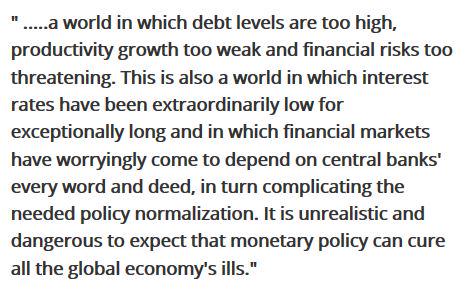
From the Bank of Int’l Settlements Qrtly report: “…a world in which debt levels are too high, productivity growth too weak and financial risks too threathening… It is unrealistic and dangerous to expect that monetary policy can cure all the global economy’s ills.”

From the Bank of Int'l Settlements Qrtly report (!!)