Friday, March 20, 2015

Local ice cream shop debuts new flavor, Michigan Pot Hole

SCREENSHOT FROM FREEP AND COURTESY OF ASHBY'S STERLING ICE CREAM
  • Screenshot from Freep and courtesy of Ashby's Sterling Ice Cream

We all hate pot holes — this young lady especially — but one local business is actually trying to help clean up Michigan's roads, Ashby's Sterling Ice Cream.

This Shelby Township sweet shop recently launched a brand new flavor, Michigan Pot Hole, and plans to donate 1 percent of sales from the product to the state for road repairs.

"It's kind of tongue in cheek and meant to be fun," Ashby's marketing director Dianne Tunison told the Freep recently.

So what exactly is this new flavor like? Ashby's described it on its website as "thick, black-tar fudge in chocolate ice cream with chunks of chocolate asphalt."

We'll give it a try.

Mind Boggling: Unsold Cars Wasting Away


Website: odometer.com
Source credit: odometer.com
Photography credits: belongs to their respective owner(s) and not to me.
Link: http://www.odometer.com/rides/10497/1…

Falling Interest Causes Falling Wages

Changes in the value of a loan are zero sum
monopolymoney2
Putting the Hurt on Labor

Interest rates have been falling for over three decades. Conventional economics has two things to say about this. One, inflation expectations are falling. Monetarists believe that the interest rate is set based on bond traders’ predictions of future price increases. Two, if employment and GDP are weak, then the central bank should increase the money supply. By increasing the money supply, it will cause rising prices, and somehow that causes workers to get hired. Federal Reserve Chair Janet Yellen wrote a paper defending this absurd claim (which I criticized).

Monetary policy is actually putting the hurt on labor. Let’s look at why. Workers are employed by businesses, so we must look at the incentives that push on businesses. Businesses constantly face a choice among several alternatives. They choose based on the desire to make profit and avoid losses. Monetary policy affects their decisions, because it distorts the profitability of every path.

Consider one common tradeoff: hiring labor versus buying expensive tools. Management decides based on which costs less. The more expensive a tool, the more attractive it becomes to hire workers and vice versa. Since most companies borrow when they buy tools, the most immediate cost of a tool is the monthly payment. When the rate of interest falls, the monthly payment falls as well. This puts downward pressure on employment and wages (I wrote about this here).

A falling interest rate impacts the wage by a subtler, but more powerful process. In a recent article, Professor Antal Fekete describes it:


“First we dwell a little longer on the problem of the present value of a cash flow (defined as the sum of individual payments discounted at the prevailing rate of interest, each for the period of time between now and when it becomes payable in the future.) Since the rate of interest is being cut, discount at a lower rate is involved. Therefore the present value of the cash flow is increased…

What does this mean for the terms of trade of those who need a cash flow for survival, such as all pensioners and all wage earners? Well, the price they have to pay for the cash flow is just its present value. Any cut in the rate of interest by the central bank affects them adversely. Their terms of trade deteriorates. For example, if the rate of interest is cut in half, then they have to pay twice as much for the same cash flow as before the cut. In practical terms this means that wage earners have to work roughly twice as hard to continue earning wages at the same level …”

Antal-Fekete
Present Value of Future Payments

Let’s take a step back and cover some essential background material and then we’ll get back to this point. One differentiator of Fekete’s economics is in his concept of the loan. Others think of it as an exchange of present goods for future goods, but he had an insight. The essential characteristic of a loan is that it involves an exchange of wealth and income. Fekete describes one party, often a retiree, as having cash but not income. The other party, typically an entrepreneur, has income but not cash. The deal benefits both.

The retiree needs the income to buy groceries, without consuming his life’s savings. Earning interest provides him an income for the rest of his life, without fear of outliving his savings. The entrepreneur wants to build a business without having to waste years saving up for the investment. Borrowed capital enables him to quickly build productive capacity. This new production will increase his income.

We can think of the loan as the purchase of an income stream. Cash up front is traded for an income paid over time. By definition, and by nature, the amount of cash paid is equal to the value of the stream of payments to be made in the future. The value of this series of future payment is not simply the arithmetic sum. It is the sum of the present values of those payments.

Let’s look at the concept of the present value of a future payment. Suppose someone will pay $500 one year from today. Do you value it at $500 right now? No, a future payment is always discounted, to compensate for locking up the cash for a year, and of course the risk of nonpayment. We need a way of determining how much $500 in one year is worth today. To calculate the discount, we use the prevailing interest rate. If the interest rate is 10%, then this $500 payment is discounted by $50. It is worth $450 today.

The value of a future payment rises if the interest rate falls. For example, if the interest rate falls 5%, then the discount is only $25. That makes the payment worth $475 today. If this is not clear, then it may help to think through a few examples. Consider payments due years in the future. This idea—that present value varies inversely with interest—is a key principle.

Changes in the value of a loan are zero sum. If the rate of interest falls, then the lender gains at the expense of the borrower. This conclusion is counter-intuitive and thus controversial, but it should not be. The income stream is worth more. This is the loss suffered by the borrower, and the gain enjoyed by the lender.

For example, here is a 5-year loan at 10% interest. If payments are made annually, then each is $263.80.

Table : Loan Amortization

Year 1 2 3 4 5
Start Balance $1,000.00 $836.20 $656.02 $457.82 $239.80
Interest $100.00 $83.62 $65.60 $45.78 $23.98

The straight arithmetic sum of five $253.80 payments is $1,319. However the present value of the loan is less than that, because each future payment must be discounted. Here’s what that looks like.

Table : Discounting each payment

Year 1 2 3 4 5 Total
Payment $263.80 $263.80 $263.80 $263.80 $263.80 $1,319
Present Value $239.82 $218.02 $198.20 $180.18 $163.80 $1,000

The present value of the income stream works out to be exactly the amount of the loan. The first table shows the loan amortization, with an annual $263.80 payment covering current interest plus fully amortization. The second table shows the discounting of each payment. This is an elegant validation of the theory.

Now, let’s look at what happens if the prevailing interest rate drops to 5%. The loan payments don’t change. However, the present value of those payments does.

Table : Discounting at a lower interest rate

Year 1 2 3 4 5 Total
Payment $263.80 $263.80 $263.80 $263.80 $263.80 $1,319
Present Value $251.24 $239.27 $227.88 $217.03 $206.69 $1,142

Discounted at only 5%, the same payments have a higher net present value—14.2% higher.

A loan with a longer term is more sensitive to changes in interest rate. The present value of a 10-year loan, for example, increases by 25.6% with the same change in interest rate.

The great economist Ludwig von Mises was aware of the impact of interest on long duration loans. He looked at the combination of two extremes, zero interest and a perpetual income stream.

He wrote:

“If the future services which a piece of land can render were to be valued in the same way in which its present services are valued, no finite price would be high enough to impel its owner to sell it. Land could neither be bought nor sold against definite amounts of money…”

In other words, at zero interest the present value of land is infinite (as land produces income in perpetuity). For a perpetual income, each halving of the interest rate doubles the present value.

640px-Ludwig_von_Mises
Ludwig von Mises
Photo via Ludwig von Mises Institute

Accounting shines a spotlight on this phenomenon. However, it’s no moot abstraction. The loss to the borrower is real. No one would argue that the capital gain of a bondholder is somehow unreal. They should not argue against the loss of the bond issuer. It is the loss of the latter which provides the gains of the former. Proper accounting should always match reality. So what, in reality, is going on?

The Burden of Debt


Another way of thinking of the present value is the burden of debt. The more the rate falls, the more the debt load bears down on the borrower. The present value of an income stream is what any investor would pay to buy it. It is also what the debtor must pay to liquidate it.

Sometimes the best return for the owners is to sell the firm. However, that often requires paying off the debt. If that’s impossible, then the best option is off the table. The inability to liquidate debt causes many problems. So long as an enterprise has a dollar of debt, it’s an overhang. The lower the interest rate falls, the larger the overhang grows.

Let’s tie this all back to the worker. We can now see the connection between the wage and the loan. Both are an income stream, a set of payments to be made in the future. As with the loan, the present value of wages rises when interest falls. The employer is doubly squeezed, once by the increasing burden of debt, and twice when burden of wages increases too.

Something has to give. Either the worker must work harder, or else the employer must cut his pay. It’s a simple matter of survival for the employer. No firm can remain in business for long, if it allows liabilities to rise unchecked.

If productivity cannot be increased, and wages cannot be decreased, then the business must cut costs elsewhere. Often this amounts to substituting one form of capital loss for another, such as neglecting maintenance or research.

Now we’re ready to revisit the tradeoff of labor and capital, and tie our thesis together. The wages of labor are a series of future payments, but the price of a machine is paid up front. As the interest rate falls, the present value of both rises. That is, the present value of wages rises and the present value of the machine rises also.

When interest falls, wages subtract from the enterprise value and machines add to it. How perverse is that? How would you respond, if you were managing a business?

The central banks may say that increasing the money supply causes rising wages and increased employment. However, they increase money supply via bond purchases. This pushes bond prices up, which is the same think as pushing the interest rate down. It causes irreparable harm to employers, and consequently, to workers.


Change in Real WagesAnnual change in real wages, via Zerohedge – click to enlarge.

Dr. Keith Weiner is the president of the Gold Standard Institute USA, and CEO of Monetary Metals.  Keith is a leading authority in the areas of gold, money, and credit and has made important contributions to the development of trading techniques founded upon the analysis of bid-ask spreads.  Keith is a sought after speaker and regularly writes on economics.  He is an Objectivist, and has his PhD from the New Austrian School of Economics.  He lives with his wife near Phoenix, Arizona.

Things Are Unraveling At An Accelerating Rate

Those who brought their consumption forward can no longer add to present consumption
european-stocks
by Charles Hugh Smith | Peak Prosperity

Does anyone else have the feeling that things are not just unraveling, but that the unraveling is gathering speed?

Though quantifying this perception is more interpretative than statistical, I think we can look at the ongoing debt crisis in Greece as an example of this acceleration of events.

The Greek debt crisis began in 2011 and reached a peak in 2012. The crisis was quelled by new Eurozone/IMF loans to Greece, and European Central Bank chief Mario Draghi’s famous “whatever it takes speech” in late July, 2012.

The Greek debt crisis quickly went from “boil” to “simmer,” where it stayed for almost two-and-a-half years. But no one with any knowledge of the gravity and precariousness of the situation expects the latest “extend and pretend” deal to patch everything together for another two years.  Current deals are more likely to last a matter of months, not years.

We can discern the same diminishing returns in Federal Reserve/central bank interventions, as the initial rounds of quantitative easing pushed stock and bond markets higher for years at a time, while the following interventions generated lower returns.

What factors are reducing the positive effects of intervention and causing increased volatility? Let’s start with the engine behind every central bank/state intervention and every “save” of the status quo: debt.

Debt Brings Forward Consumption & Income

Debt has one primary dynamic: borrowing money to consume something in the present brings forward consumption and income.  Economists describe trading future income for consumption today as bringing consumption forward. And since debt must be repaid with interest, bringing consumption forward also brings income forward.

Let’s say we want to buy a vehicle with cash, and it will take five years to save up the lump-sum purchase cost.  We forego current consumption to save for future consumption.

If we get a 100% auto loan now, we get the use of the vehicle (present-day consumption) and in exchange, we sacrifice some of our income over the next five years to pay back the auto loan. We brought consumption forward, and in essence took future income and brought it forward to pay for the consumption we’re enjoying today.

We can best understand the eventual consequence of this dynamic with a simplified household example. Let’s say a household has $2,000 a month in net income, i.e. after taxes, healthcare insurance deductions, etc., and rent (or mortgage payments), basic groceries and utilities consume $1,000 of this net income. That leaves the household with $1,000 in disposable income.

At the risk of boring finance-savvy readers, let’s briefly cover the difference between net income and disposable income. Net income can be earned (wages, salaries, net income from a sole proprietor enterprise, etc.) or unearned (dividends, interest income, rents, etc.) Net income can only rise by making more money or reducing taxes. There are limits to our control of these factors. In a stagnant economy, it’s tough to find better-paying jobs and harder to demand higher wages from employers.  Since governments’ expenditures are rising, taxes are also going up; it’s difficult for most wage-earners to cut their total tax load by much.

Disposable income is more within our control, as it is fundamentally a series of trade-offs between current consumption and future income/savings: if we choose to consume now, we have less income to save for future consumption or investments.  If we sacrifice consumption today, we have more money in the future for consumption or investing. If we borrow money to consume today, we’ll have less future income because a slice of our future income must be devoted to pay down the debt we took on to consume today.

If our household borrows money to buy a vehicle and the payment is $500 per month, the household’s disposable income drops from $1,000 to $500. If the household takes on other debt (credit cards, student loans, etc.) with payments of $500 per month, the household’s disposable income is zero: there is no money left to dine out, go to movies, pay for lessons, etc.

In effect, all of the future income for years to come has been spent.

The Only Trick To Expand Debt: Lower Interest Rates

There are only two ways to support additional debt: either increase net income, or lower the rate of interest on new and existing loans to free up disposable income.  Suppose our household refinances its auto loan to a much lower rate of interest and transfers its credit card debt to a lower-interest rate card.  Huzzah, each monthly payment drops by $100, and the household has $200 of disposable income to spend on current consumption or on more loans. Let’s say the household chooses to buy new furniture on credit with the windfall. This new consumption brought forward pushes the monthly debt payments back up to $1,000.

This additional debt-based consumption profits two critical players in the economy: the state (i.e. all levels of government) and the financial sector. The state benefits from the higher taxes generated by the sales, and the financial sector profits from transaction fees and the interest earned on the new loans.

The household’s consumption and debt rose as a result of lower interest rates, but there is a limit on this dynamic: lenders have to charge enough interest to service the loan, reap a profit and compensate shareholders for the risk of default.

If lenders fail to properly assess the risk of default. They will be unprepared to absorb the losses incurred as marginal borrowers default en masse. This places the lender’s own solvency at risk.

Using this trick to enable further expansion of debt thus creates a systemic risk that borrowers will over-borrow and lenders will not have sufficient reserves to absorb the inevitable losses as marginal borrowers default and other borrowers suffer declines in disposable income that trigger further defaults.

In other words, the trick of lowering interest rates yields diminishing returns: the more debt that is enabled,  the thinner the margins of safety and thus the greater the systemic risks rise in direct correlation with rising debt loads.

The Trick To Increase Consumption: Punish Savers

While lowering interest rates increases disposable income and enables an expansion of debt, it also generates a disincentive for households to forego current consumption by saving disposable income rather than spending it.  Near-zero interest rates actively punish savers by reducing the interest income earned on low-risk savings accounts and certificates of deposit (CDs) to near-zero. Savers are pushed into either investing in high-risk markets that benefit the financial sector or by spending rather than saving—a choice that benefits the state, as more spending generates taxes for the state.

The Global Expansion Of Debt Has Increased Systemic Risks

These are the basic dynamics of the entire global economy: interest rates have been pushed to near-zero to punish savers and encourage expansion of debt-based consumption. But this inevitably leads to a reduction in disposable income and current consumption, as debt brings forward both consumption and income.

Once the borrowers have maxed out their borrowing power, there is no more expansion of debt or additional debt-based consumption.  This is known as debt saturation: flooding the financial sector with more credit no longer boosts borrowing or brings consumption forward.

Those who brought their consumption forward can no longer add to present consumption, as their future income is already spoken for.

That’s where the global economy finds itself today.


This vast expansion of debt on the backs of marginal borrowers and the expansion of risky investments has greatly increased the systemic risk of losses from defaults arising from over-extended borrowers.

No wonder every attempt to further expand debt-based consumption is yielding diminishing returns: net income is stagnant virtually everywhere in the bottom 95% of the populace, and further declines in interest rates are increasingly marginal as rates are near-zero everywhere that isn’t suffering a collapse in its currency.

The diminishing returns manifest in three ways: the gains from each round of central-bank tricks are declining, the periods of stability following the latest “save” are shrinking and the amplitude of each episode of debt crisis is expanding.

That things are speeding up is not just perception—it’s reality.

In Part 2: The Coming Age Of Confiscation, we’ll look at the threat of the other fundamental driver of rising instability: the broken-logic TINA (there is no alternative) mind trap our global leaders are mired in. As the trajectory of the status quo worsens for all the reasons discussed above, government will become increasingly heavy-handed in appropriating the remaining wealth in order to keep things stumbling on just a little bit longer — justifying its actions by claiming it “has no other choice”.

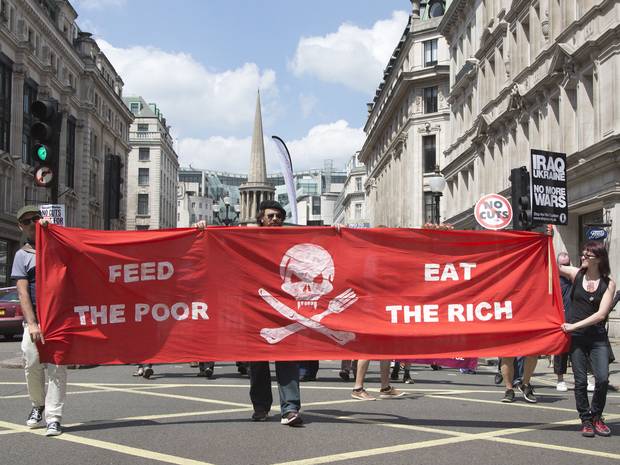
The rich are 64% richer than before the recession, while the poor are 57% poorer

View image on Twitter
The rich are 64% richer than before the recession, while the poor are 57% poorer http://ind.pn/18xfDqA 
 
The gap between richest and poorest has dramatically widened in the past decade as wealthy households paid off their debts and piled up savings following the financial crisis, a report warns today.
By contrast, the worst-off families are far less financially secure than before the recession triggered by the near- collapse of several major banks. They have an average of less than a week’s pay set aside and are more often in the red.
Younger workers have fallen behind older people while homeowners – particularly those who have paid off their mortgages – have become increasingly affluent compared with their neighbours who are paying rent.
http://www.independent.co.uk/news/uk/home-news/britains-divided-decade-the-rich-are-64-richer-than-before-the-recessionwhile-the-poor-are-57-poorer-10097038.html


Ebola crisis: Sierra Leone lockdown to hit 2.5m people

(AFRICA)  Sierra Leone is to enforce a three-day lockdown of key parts of the country to try to contain the Ebola epidemic.
There have been 3,702 reported deaths from Ebola in the West African nation.
A three-day curfew in September, keeping people at home under quarantine, was hailed as a success by authorities, despite some criticism.
The country’s National Ebola Response Centre says a new lockdown will come into place next week. It will affect close to 2.5m people.
While the number of cases has slowed since the peak of the outbreak, the virus is far from eradicated.
In the seven days leading up to March 15, there were 55 new cases in Sierra Leone, and 90 in neighbouring Guinea.
The number of new cases in Liberia – where most deaths have occurred – has not been registered.
Palo Conteh, the head of the NERC, told the AFP news agency that the curfew would take place across the Western Area of Sierra Leone, a part of the country that includes the capital, Freetown.
The districts of Bombali and Port Loko will also be affected.
“The lockdown will be conducted from March 27 to March 29 and will be like the one we conducted in September last year,” said Mr Conteh.
“The government and partners are hopeful that latent cases that are now not being reported or recorded will come out.”
Mr Conteh said that health workers will visit every house in the areas affected by the lockdown. They will remind people about the dangers of touching corpses and taking patients to traditional healers.
In other developments:
  • Guinea’s president Alpha Conde has called for a new push to eradicate Ebola after a rise in cases. On the weekend, a government report said 21 people were infected in a single day, compared to an average of eight a day;
  • A UN spokesman tells the BBC: “We are still seeing too many infections taking place” in Sierra Leone;
  • Liberia’s government is to pay $5,000 (£3,391) to the families of each of the 179 health workers who died from the virus there.
There have been 10,216 deaths due to Ebola, according to the World Health Organization.
The majority of those deaths have been in three West African countries – Liberia, Guinea and Sierra Leone.
The economic effect of the outbreak has been severe in Sierra Leone.
The World Bank estimates that the revenue of some parts of the population has dropped by as much as 40%, and that close to 180,000 people have lost work as a result of the crisis.
Despite dozens of new cases every week, the government is determined to meet a target to eradicate Ebola by 15 April.

The Quiet Plan to Sell Off America’s National Forests

(Claire Moser)  A proposal to seize and sell off America’s national forests and other public lands could make its way into the House GOP’s budget resolution when it is announced this week.
In a recent memo to the House Budget Committee, Rep. Rob Bishop (R-UT), chair of the House Natural Resources Committee, proposed that America’s public lands be transferred to state control. He then requested $50 million of taxpayer money to be spent to enable transfers to “start immediately.” The memo states that public lands “create a burden for the surrounding states and communities,” and “the solution is to convey land without strings to state, local, and tribal governments.”
Bishop’s plan and similar proposals to give away America’s public lands are controversial. A majority of voters in those regions believe the proposals would likely result in states having to raise taxes, open prized recreation areas to drilling and mining, or sell lands to private interests to cover the substantial costs of management.
Despite these concerns — and despite the fact that these proposals are extremely expensive, unpopular, and most importantly, unconstitutional — there is a strong likelihood that Rep. Bishop’s request will be included in the House GOP’s budget, thanks to intensive lobbying efforts by a handful of right-wing politicians and special interest groups.
As reported by E&E Daily, the American Lands Council (ALC), an organization founded by Utah state Rep. Ken Ivory (R), hired a lobbyist at the end of last year to “educate congressional lawmakers on the benefits of relinquishing federal lands to the states.” Federal lobbying disclosure formsshow that the ALC paid the lobbyist, Michael Swenson, $150,000 for just three months of lobbying work.
Swenson, whose other clients include a Utah mining company, has denied being paid the sum. He told E&E the lobbying disclosure form was a “mistake,” and that he was paid just $20,000 in the last quarter of 2014.
ALC’s lobbying payments have drawn additional scrutiny because the organization’s budget is dependent on taxpayer money, contributed by county governments in the West. According to the Center for Western Priorities (CWP), 47 county governments have spent a total of more than $219,000 for ALC membership. Most of these county governments receive substantial federal grant money through the Payment in Lieu of Taxes Program (PILT), raising questions about whether American taxpayer dollars are being channeled to fund lobbying of the federal government. A federal law, known as the Byrd Amendment, prohibits the use of federal funds from a grant to be used for lobbying federal officials.
A recent flood of state-level proposals to seize and sell off America’s public lands is the result, in part, of efforts by the Koch-backed American Legislative Exchange Council (ALEC) to disseminate ‘model legislation’ to conservative lawmakers in Western states.
The state of Utah is thus far the only state to have passed such a measure, however. In 2012, the Utah legislature passed a bill demanding public lands be transferred to state control by December 2014. The state plans to sue the federal government and is currently accepting proposals to launch a $2 million fight.
Politicians in nine other states are also developing and advancing similar legislative proposals, supported by expensive taxpayer-funded studies. According to a CWP analysis, Western states have spent a total of $816,000of taxpayer funds on such studies in recent years.
Whether Rep. Bishop’s proposal makes it into the House GOP budget or not, the Congressman has made it clear that disposing of national forests and public lands will be one of his top priorities as chair. The House Republican majority is expected to release its 2016 budget resolution this week.