Saturday, May 3, 2014

GoldCore Reports Half of Italy’s Gold is Held in New York Fed Vault; Is Repatriation Possible?

by GoldCore
Today’s AM fix was USD 1,285.00, EUR 927.26 and GBP 761.03 per ounce.
Yesterday’s AM fix was USD 1,283.00, EUR 924.15 and GBP 759.04 per ounce.
Gold fell $5.50 or 0.43% yesterday to $1,284.90/oz. Silver slipped $0.13 or 0.68% yesterday to $19.06/oz.
Please note GoldCore is closed for a Bank Holiday, this Monday, May 5th, reopening May 6th.
Gold remained in range bound trading yesterday and into this morning, fluctuating between $1,280 and $1,285/oz. Likewise, silver traded in a narrow band between $18.90 and $19.10/oz. The precious metals appear to be treading water while awaiting the open of New York morning trading, and the release of the latest U.S. non-farm payroll figures today.
Consensus payroll data estimates from surveyed economists indicate improving expectations for April and a possible drop in the unemployment rate. Any surprises in the U.S. payroll data today could be the catalyst to move the gold price out of its very narrow trading pattern, although given that it’s the end of the trading week, the short term direction for gold may not become apparent until next week.
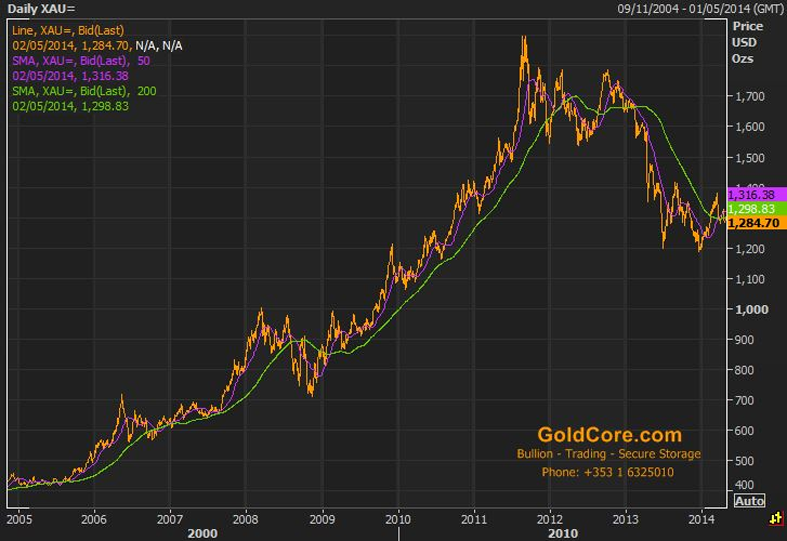
Gold in USD Simple Moving Averages, 9 Years – (Thomson Reuters)
Italy May Have Over 1,000 Tonnes Of Gold At The New York Fed
Written by Ronan Manly for GoldCore

Italy’s central bank, the Banca d’Italia, has recently published an important document detailing the storage locations and composition of the country’s gold reserves. The document confirms that Italy’s gold is held across four vault locations, three of which are outside Italy.
This is a significant announcement given that the Banca d’Italia is the world’s third largest official holder of gold after the U.S. and Germany. Italy officially holds 2,451.8 tonnes of gold, worth more than €72 billion (US$ 100 billion) at current market prices [1].
In the detailed three page report focusing exclusively on its gold reserves (and only published in Italian), the Banca d’Italia reveals that 1,199.4 tonnes, or nearly half the total, is held in the Bank’s own vaults under its Palazzo Koch headquarters on Via Nazionale in Rome, while most of the other half is stored in the Federal Reserve Bank gold vault in New York. The report also states that smaller amounts are stored at the Bank of England in London, and at the vaults of the Swiss National Bank in Bern, Switzerland.
The Gold in RomeOf the 1,199.4 tonnes held in Rome, 1,195.3 tonnes are in the form of gold bars, with 4.1 tonnes held as gold coins (871,713 coins). There are 95,493 bars in the Rome vault, most of which are the standard trapezoidal shaped bars, however the holdings also include brick shaped U.S. Assay Office bars produced by the U.S. Assay Office, and another bar type which the Bank d’Italia refers to as ‘panetto’ (or loaf) shaped ‘English’ bars.
Like other major European central banks, the Banca d’Italia’s gold reserves were mainly accumulated during the late 1950s and early 1960s. Although Italy was already an important official gold holder during the first half of the 20th century, it still only held 402 tonnes of gold as of 1957. However, from 1958 until the late 1960s, the country’s gold reserves increased nearly 600% to exceed 2,560 tonnes by 1970[2].
Since 1970, Italy’s gold holdings have remained fairly constant, although at times some of the gold has been used in various financial transactions such as gold collateral against a German loan during the 1970s, and as contributions to the European Monetary Cooperation Fund (EMCF) and more recently to the European Central Bank (ECB).
The RAI Broadcast, the BIS and BernWhile the report from the Banca d’Italia appears to be the first official written confirmation that documents the exact storage sites of its gold reserves, the four storage locations were previously confirmed to Italian TV station RAI in 2010 when an RAI presenter and crew were allowed to film a report from inside the Bank’s gold vaults in Rome.
In the RAI broadcast for an episode of ‘Passaggio a Nord Ovest’, the presenter Alberto Angela states that in addition to Rome, the Italian gold is stored at the Federal Reserve Bank in New York, the Bank of England in London, and at the Bank for International Settlements (BIS) in Switzerland. The reporter uses the exact words “Banca dei Regolamenti Internazionali”.
The BIS connection was also confirmed in August 2009, when Italian newspaper “La Repubblica” published an article about Italy’s gold, stating that it was held in Rome, at the Federal Reserve in New York, in the vaults of the the Bank of England, and in the ‘vaults’ of the BIS in Basel.
This apparent contradiction between, on the one hand, the RAI and La Repubblica, who both state that some of the Italian gold is stored with the BIS in Switzerland, and on the other hand, the Banca d’Italia’s own document which states that its gold in Switzerland is stored at the Swiss National Bank (SNB) in Bern, is not really a contradiction since the BIS does not have its own gold storage facilities in Switzerland. The BIS simply uses the SNB’s gold vaults in Bern.
The BIS confirms this fact on its web site, under foreign exchange and gold services, where it states that it offers its clients “safekeeping and settlements facilities available loco London, Bern or New York”.[3] The term loco refers to settlement location for precious metals transactions.
By confirming that it stores gold at the Swiss National Bank in Bern, the Banca d’Italia has also inadvertently confirmed that the Swiss National Bank’s gold vaults are located in Bern. While this was generally known, the SNB currently will not confirm this fact publically and does not go beyond saying that it stores its own gold “domestically and internationally” in “decentralised” locations.[4]
However, Bern based Swiss newspaper “Der Bund” published an article in 2008 stating that the SNB’s gold vaults are in Bern, specifically underneath the Bundesplatz square which is adjacent to the SNB’s headquarters at No. 1 Bundsplatz. The SNB has two headquarters, one in Bern, the other in Zurich.
So it appears that the Italian gold in Switzerland is on deposit with the BIS (either earmarked or as a sight deposit) and is, at the same time, stored in Bern at the SNB vaults. Therefore the RAI and La Repubblica reports and the Banca d’Italia report are most likely both all in agreement, since they are merely saying the same thing, just in different ways. Another possibility is that the BIS sight deposit was converted back to earmarked gold in the SNB vault sometime since the 2010 RAI broadcast.
The reason for the confusion is because the Banca d’Italia will not confirm any of these details about how their gold in Bern is held, and they stated last week that they cannot comment beyond what is published in their April document.
Some of the details in the Bank’s gold reserve document were also confirmed a week prior to its publication when three Italian senators from Beppe Grillo’s political party Movimento 5 Stelle (Five Star Movement), namely, the party treasurer Giuseppe Vacciano, Andrea Cioffi and Francesco Molinari, visited the Rome vault on 31st March 2014.
The senators’ report states that as well as the 1,199.4 tonnes of gold held in Rome, “the remainder is mostly deposited at the Federal Reserve”, but also at the Bank of England and at “la Banca Centrale Svizzera” (which is the Swiss National Bank). The senators also reported that “For confidentiality reasons we were not notified of the exact extent of the deposits in different countries”.
Italian Gold in New YorkAs per the senators’ experience, the Banca d’Italia document does not specify how much of the Italian gold is held in New York, London and Bern, beyond stating that most of the gold that is not stored in Rome is stored in New York. However, the document does state that “the bulk” of foreign stored gold is in New York with “contingents of smaller size” located in London and Bern, so essentially it implies that the London and Bern holdings are not very large.
Of the 1,252.4 tonnes not in Rome, technically, a majority of this figure is anything greater than 626.2 tonnes. So with a simple calculation, there is at least 626.2 tonnes of Italian gold in New York.  But given that the “bulk” of 1,252.4 tonnes is in New York as the Bank’s document implies, and that “most of the remainder” not in Rome is in New York as the senator’s comments imply, then there could be anywhere up to between 1,000 tonnes and 1,200 tonnes of Italian gold in the FRB in New York.
In fact, 522 tonnes of this Italian gold that was earmarked at the Federal Reserve in New York in September 1974 was used as gold collateral for the Bundesbank loan to Italy during the first gold loan to Italy between 1974 and 1976. This collateral rose to 543 tonnes between 1976 and 1978.
London – The Bank of EnglandIt is possible using historical data and records of Italian gold movements to estimate how much, or how little, Italian gold may be in London.
It would appear that the Banca d’Italia does not hold very large amounts of gold in London. During the late 1960s, mainly between 1966 and 1968, the Banca d’Italia moved most of their gold that was stored at the Bank of England back to Italy. Regular shipments were exported and delivered to the Bank’s vaults in both Rome and Milan. By the end of 1969, the Banca d’Italia held less than 1,000 gold bars in London, or just under 400,000 ounces (approx. 12 tons).
Therefore, since Italian gold reserves have not in total changed very much since 1969, it would be realistic to assume that the Banca d’Italia’s London gold holdings have not changed very much since 1969, unless gold was moved back to London (or swapped back to London) after 1969. This would only make sense if it had been moved back to London for a specific reason such as to allow Italian gold lending through the London market. Gold lending only really began in London in the mid-1980s, and there is no public record that the Italians have engaged in gold lending through London.
Bern, SwitzerlandHistorical records from the BIS show that there wasn’t any Italian gold left in Bern after WWII, so whatever Italian balance is in Bern has been built up since 1946. It’s interesting to note that Sweden and Finland both recently published the international locations of their gold reserves, and revealed that only very small percentages of their gold is kept in the SNB vaults in Switzerland. Of Sweden’s 125.7 tonnes of gold reserves, only 2.8 tonnes or 2.2% is stored with the SNB vaults[5]. For Finland, only 7%, or 3.4 tonnes of its 49 tonnes of gold reserves are stored with the SNB in Switzerland[6].
If this Swedish-Finnish 2-7% range of allocations at the SNB was applied to the Italian gold that is reported to be outside Italy, it would work out at between 25 tonnes and 87.6 tonnes of Italian gold held at the SNB vaults in Bern. Assuming that there is very little Italian gold in London (400,000ozs or about 12 tonnes), and only a small allocation in Bern, then there could be nearly 1,200 tonnes of Italian gold at the Federal Reserve in New York.
Gold Audits and RepatriationThe Banca d’Italia state in their gold document that external auditors verify the gold held in Rome each year in conjunction with the Bank’s own internal auditors. The external auditors also verify the gold held abroad using annual certificates issued by the central banks that act as the depositories i.e.
This sound very similar to the way the German gold reserves stored abroad was audited. i.e. the gold stored abroad is not physically audited at all (although the Bundesbank did describe recently in quite a vague way that their gold in New York was recently audited by some of their own appointed representatives).
Given the widespread recent media coverage of the German Bundesbank’s plans to repatriate 300 tonnes of its gold reserves from the Federal Reserve in New York to the Bundesbank’s headquarters in Frankfurt, it will be interesting to see whether, in time, a critical mass is reached in Italian public opinion or even in Italian political opinion that would lead to the Banca d’Italia raising a similar request to the Federal Reserve.
The fact that the initial gold repatriated from New York by the Bundesbank needed to be melted down and recast (suggesting that it was low grade coin bars), does not inspire confidence that the Banca d’Italia might not face a similar problem if it attempts any gold repatriation from New York.
Source Links (all in Italian):
Banca d’Italia gold document, April 2014
http://www.bancaditalia.it/media/chiarimenti/riserve-auree.pdf
Movimento 5 Stelle video of visit to Bank: https://www.youtube.com/watch?v=RNbGc2P677s
[1] Excluding the IMF, Italy is the world’s third largest official gold holder; including the IMF, Italy is the world’s fourth largest gold holder.
[2] Central Bank Gold Reserves, An Historical perspective since 1845, Timothy Green, Research Study No. 23, November 1999, WGC
Click Here to for GoldCore’s Essential Guide for Storing Gold in Singapore

We Are In Big Big Big Trouble! This Is Truly Horrifying. And It’s Not Temporary, It Is A Trend.


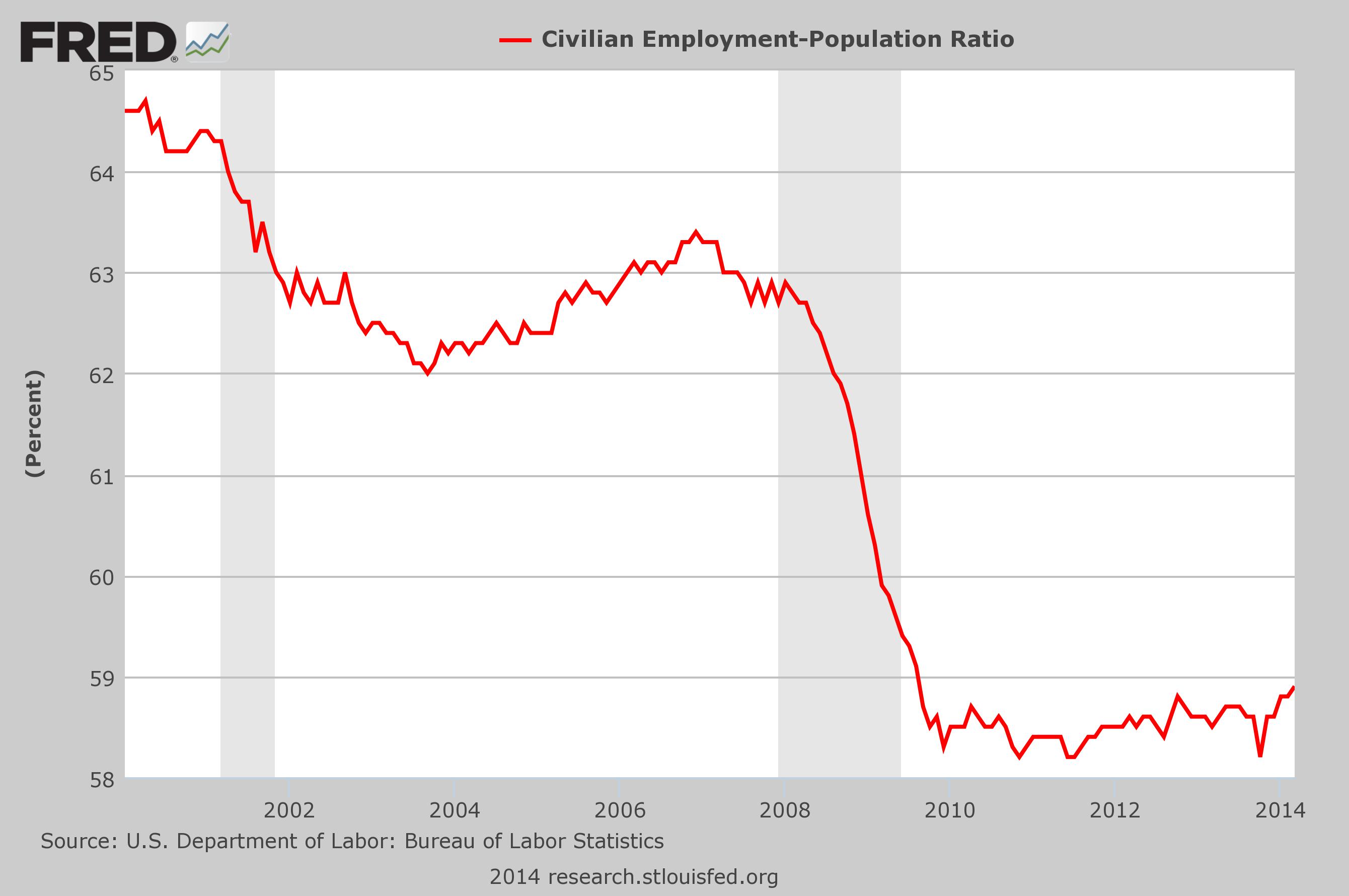
No, the economy is most definitely not “recovering”.  Despite what you may hear from the politicians and from the mainstream media, the truth is that the U.S. economy is in far worse shape than it was prior to the last recession.  In fact, we are still pretty much where we were at when the last recession finally ended.  When the financial crisis of 2008 struck, it took us down to a much lower level economically.  Thankfully, things have at least stabilized at this much lower level.  For example, the percentage of working age Americans that are employed has stayed remarkably flat for the past four years.  We should be grateful that things have not continued to get even worse.  It is almost as if someone has hit the “pause button” on the U.S. economy.  But things are definitely not getting better, and there are a whole host of signs that this bubble of false stability will soon come to an end and that our economic decline will accelerate once again.  The following are 17 facts to show to anyone that believes that the U.S. economy is just fine…
#1 The homeownership rate in the United States has dropped to the lowest level in 19 years.
#2 Consumer spending for durable goods has dropped by 3.23 percent since November.  This is a clear sign that an economic slowdown is ahead.
#3 Major retailers are closing stores at the fastest pace that we have seen since the collapse of Lehman Brothers.
#4 According to the Bureau of Labor Statistics, 20 percent of all families in the United States do not have a single member that is employed.  That means that one out of every five families in the entire country is completely unemployed.
#5 There are 1.3 million fewer jobs in the U.S. economy than when the last recession began in December 2007.  Meanwhile, our population has continued to grow steadily since that time.
#6 According to a new report from the National Employment Law Project, the quality of the jobs that have been “created” since the end of the last recession does not match the quality of the jobs lost during the last recession…
  • Lower-wage industries constituted 22 percent of recession losses, but 44 percent of recovery growth.
  • Mid-wage industries constituted 37 percent of recession losses, but only 26 percent of recovery growth.
  • Higher-wage industries constituted 41 percent of recession losses, and 30 percent of recovery growth.
#7 After adjusting for inflation, men who work full-time in America today make less moneythan men who worked full-time in America 40 years ago.
#8 It is hard to believe, but 62 percent of all Americans make $20 or less an hour at this point.
#9 Nine of the top ten occupations in the U.S. pay an average wage of less than $35,000 a year.
#10 The middle class in Canada now makes more money than the middle class in the United States does.
#11 According to one recent study, 40 percent of all Americans could not come up with $2000 right now even if there was a major emergency.
#12 Less than one out of every four Americans has enough money put away to cover six months of expenses if there was a job loss or major emergency.
#13 An astounding 56 percent of all Americans have subprime credit in 2014.
#14 As I wrote about the other day, there are now 49 million Americans that are dealing with food insecurity.
#15 Ten years ago, the number of women in the U.S. that had jobs outnumbered the number of women in the U.S. on food stamps by more than a 2 to 1 margin.  But now the number of women in the U.S. on food stamps actually exceeds the number of women that have jobs.
#16 69 percent of the federal budget is spent either on entitlements or on welfare programs.
#17 The number of Americans receiving benefits from the federal government each month exceeds the number of full-time workers in the private sector by more than 60 million.
Taken individually, those numbers are quite remarkable.
Taken collectively, they are absolutely breathtaking.
Yes, things have been improving for the wealthy for the last several years.  The stock market has soared to new record highs and real estate prices in the Hamptons have skyrocketed to unprecedented heights.
But that is not the real economy.  In the real economy, the middle class is being squeezed out of existence.  The quality of our jobs is declining and prices just keep rising.  This reality was reflected quite well in a comment that one of my readers left on one of my recent articles…
It is getting worse each passing month. The food bank I help out, has barely squeaked by the last 3 months. Donors are having to pull back, to take care of their own families. Wages down, prices up, simple math tells you we can not hold out much longer. Things are going up so fast, you have to adopt a new way of thinking. Example I just had to put new tires on my truck. Normally I would have tried to get by to next winter. But with the way prices are moving, I decide to get them while I could still afford them. It is the same way with food. I see nothing that will stop the upward trend for quite a while. So if you have a little money, and the space, buy it while you can afford it. And never forget, there will be some people worse off than you. Help them if you can.
And the false stock bubble that the wealthy are enjoying right now will not last that much longer.  It is an artificial bubble that has been pumped up by unprecedented money printing by the Federal Reserve, and like all bubbles that the Fed creates, it will eventually burst.
None of the long-term trends that are systematically destroying our economy have been addressed, and none of our major economic problems have been fixed.  In fact, as I showed inthis recent article, we are actually in far worse shape than we were just prior to the last major financial crisis.
Let us hope that this current bubble of false stability lasts for as long as possible.
That is what I am hoping for.
But let us not be deceived into thinking that it is permanent.
It will soon burst, and then the real pain will begin.

Friday, May 2, 2014

Market To Drop 30%? Q1 Growth Fell Into Negative Territory, Margin Debt Takes A Turn From All-time High Levels, Treasury Yields Tumble To 11-Month Lows


Margin debt takes a turn from all-time high levels. Be concerned?
 
CLICK ON CHART TO ENLARGE
It doesn’t matter until it matters! Will a decline in margin debt from all-time highs matter this time? Doug Short each month does an excellent analysis on margin debt and the latest update is now out.  (see current info here) 
In the past margin debt at historical levels didn’t seem to matter, until margin debt started decreasing. The above chart highlights that at each (1), margin debt was at historical highs and then turned south and the S&P 500 soon followed.
In my humble opinion one should not look at margin debt as the holy grail to portfolio construction. It has been a good tool in helping to know when to overweight and underweight towards risk assets.
Margin debt has been swiftly pushing higher for the past 8 months in a row and now slipped a little this past month. IF….IF margin debt should start decreasing swiftly, history would suggest something different is taking place in the mind of aggressive investors.
NYSE Margin Debt Slips For The First Time In 8 Months
The Markets Just Sounded the Death Knell For QE
Globally Central Banks have kept an eye on the Bank of Japan, which announced the single largest QE program relative to its GDP in history. That one single QE program announced in April 2013 is equal to over 20% of Japan’s GDP. But things turned sout…
Everyone’s Q1 GDP Estimates Turn Negative
Yesterday, the BEA announced Q1 GDP climbed just 0.1%. 
This afternoon, Wall Street is saying it’s even worse.
Citing weak construction spending data, several firms’ GDP tracking models now show Q1 growth fell into negative territory.
“Residential construction was a bright spot, rising 0.7% on the month and standing 15.2% above year-ago levels,” noted Barclays’ Cooper Howes. “Nonresidential construction fell 0.1%, however, and there were downward revisions to February and January. On the whole, this lowered our GDP tracking estimate three-tenths, to -0.2%.”
Macroeconomic Advisers, a widely cited source for GDP estimates, said its model fell 10 bps to -0.1%, also weaker-than-expected construction spending below BEA assumptions.
If It Wasn’t For Obamacare, Q1 GDP Would Be Negative
Here is a shocker: for all the damnation Obamacare, which according to poll after poll is loathed by a majority of the US population, has gotten if it wasn’t for the (government-mandated) spending surge resulting from Obamacare, which resulted in the biggest jump in Healthcare Services spending in the past quarter in history and added 1.1% to GDP …
Treasury Yields Tumble To 11-Month Lows; Stocks Hold Near Record Highs
It was not a Tuesday, and it was not a Fed day – so stocks closed red. Volume was dismal. TheRussell 2000 tested its 200DMA once again (and bounced) but was unable to sustain that strength. Once again the biggest news was the continued collapse in Treasury yieldsas a combination of massive spec positioning short “because rates have to go up” and the ugly reality of macro weakness combined to send rates to 2014 lows (and 11-month lows for 30Y yields). This is the biggest year-to-date drop in 30Y yields since 2000. The Dow’s weakness meant it lost its gains for 2014. Despite ongoing USD weakness (driven by GBP and EUR strength), commodities traded lower with silver worst today (red for 2014), copper weak, and gold and oil flat to modestly lower. VIX was pummeled down to almost 13 midday (which makes perfect sense ahead of NFP – why would anyone hedge that?) but leaked higher as bond market reality set in during the afternoon. The ubiquitous very-late-day VIX slam pulled stocks higher in a buying panic but failed to get the S&P, Dow, or Russell green on the day.
 …
Small Caps fell 30%+ twice when this took place…its back!
 
CLICK ON CHART TO ENLARGE
When the Russell has been hot on a 5-year annualized basis, it has cooled off… to the tune of 30%+ declines in 1999 and 2007.
Now the Russell has had a higher 5-year annualized return than the 1999 and 2007 peaks! Also the Russell is back at the top of its rising channel, where it has found some resistance.
Will it be different this time? From a 5-year annualized performance, “it is different this time” as it has been hotter than the 1999 & 2007 peaks.
What will the results be? Above my pay grade. Premium Members shorted the Russell 2000 several weeks ago due to this situation, with a stop at resistance.
Stock Market Headed for a 1987-Style Crash
Like it or not, bad luck is just around the corner for investors.
After stacking up five years of gains, the stock market is starting to look awfully wobbly. And the likely result will be a crash as bad or even worse than what was seen in 1987.
That’s what analyst Marc Faber believes, anyway: “I think it’s very likely that we’re seeing, in the next 12 months, an ’87-type of crash,” he recently told CNBC. “And I suspect it will be even worse.”

Federal Reserve: What GDP Data? Things Are Swell!


Today’s Fed statement apparently didn’t sit too well with Brian. Check out today’s show to hear his latest rant about the Central Bank’s “increasingly convoluted approach to supporting the U.S. economy.”

Fed fueling century’s ‘greatest bubble’: Stockman


“I think the Fed is now inflating the greatest and third bubble yet of this century,” Stockman said. “The Russell 2000, even though it’s come off a little bit, is still trading at 80 time trailing earnings. That’s crazy, and you can say that about many other sectors of the market.” 

Mandatory Drug-Testing in Cleveland Area Catholic High Schools Motivated By Profit?

One of the big news items this week has to do with St. Edward High School, St. Ignatius High School and Gilmour Academy all kicking off a mandatory drug-testing program for their students in the fall. It's an interesting story because no other schools in Northeast Ohio presently test their students for drug use.
Another interesting point of fact is that the president and CEO of Massachusetts-based Psychemedics - the company that will be conducting the tests - is Raymond Kubacki, brother of St. Edward High School President James Kubacki. The former is a St. Ignatius grad himself and a member of that school's athletic hall of fame.
Since 1991, Raymond Kubacki has helmed Psychemedics, and he's now posting $7+ million in revenue on a quarterly basis. The intersection of private schools and the drug-testing market is a budding one. He told the Worcester Business Journal in December 2013, "Our primary focus is workplace drug testing. Secondarily would be emerging markets and one of those would be schools and colleges."
K.C. McKenna, vice president of admissions and marketing at St. Edward High School, says the decision to work with Psychemedics came after several years of research led by an internal committee.
"Really, this came about as a proactive, preventative measure. There was nothing in our own community that necessarily prompted this. This is not a reactionary endeavor by any means," he tells Scene. "Our committee, which included members of our board of trustees, a member of our faculty and other members of our administration, looked at the issue as a whole and arrived at the Psychemedics decision. Certainly, Jim knew a little more about the process because of his brother being involved, but his brother being CEO of that company in no way led to us making the decision to use Psychemedics."
On the ground, the Psychemedics initiative will affect about 980 students at St. Ed's (along with 340 at Gilmour and 1,500 or so at St. Ignatius). The hair testing costs $39 to $50 a pop
more @ http://www.clevescene.com/scene-and-heard/archives/2014/04/29/president-of-drug-testing-company-is-brother-of-st-edward-high-school-president

The American Empire Crumbles Before Our Eyes Right Here at Home

As America‘s new economy starts to look more like the old economy of the Great Depression, the divide between rich and poor, those who have made it and those who never will, seems to grow ever starker. I know. I’ve seen it firsthand.
Once upon a time, I worked as a State Department officer, helping to carry out the occupation of Iraq, where Washington’s goal was regime change. It was there that, in a way, I had my first taste of the life of the 1%. Unlike most Iraqis, I had more food and amenities than I could squander, nearly unlimited funds to spend as I wished (as long as the spending supported us one-percenters), and plenty of U.S. Army muscle around to keep the other 99% at bay. However, my subsequent whistleblowing about State Department waste and mismanagement in Iraq ended my 24-year career abroad and, after a two-decade absence, deposited me back in “the homeland.”
I returned to America to find another sort of regime change underway, only I wasn’t among the 1% for this one. Instead, I ended up working in the new minimum-wage economy and saw firsthand what a life of lousy pay and barely adequate food benefits adds up to. For the version of regime change that found me working in a big box store, no cruise missiles had been deployed and there had been no shock-and-awe demonstrations. Nonetheless, the cumulative effects of years of deindustrialization, declining salaries, absent benefits, and weakened unions, along with a rise in meth and alcohol abuse, a broad-based loss of good jobs, and soaring inequality seemed similar enough to me. The destruction of a way of life in the service of the goals of the 1%, whether in Iraq or at home, was hard to miss. Still, I had the urge to see more. Unlike in Iraq, where my movements were limited, here at home I could hit the road, so I set off for a look at some of America‘s iconic places as part of the research for my book, Ghosts of Tom Joad.
Here, then, are snapshots of four of the spots I visited in an empire in decline, places you might pass through if you wanted to know where we’ve been, where we are now, and (heaven help us) where we’re going.
On the Boardwalk: Atlantic City, New Jersey
Drive in to Atlantic City on the old roads, and you’re sure to pass Lucy the Elephant. She’s not a real elephant, of course, but a wood and tin six-story hollow statue. First built in 1881 to add value to some Jersey swampland, Lucy has been reincarnated several times after suffering fire, neglect, and storm damage. Along the way, she was a tavern, a hotel, and — for most of her life — simply an “attraction.” As owning a car and family driving vacations became egalitarian rights in the booming postwar economy of the 1950s and 1960s, all manner of tacky attractions popped up along America’s roads: cement dinosaurs, teepee-shaped motels, museums of oddities, and spectacles like the world’s largest ball of twine. Their growth paralleled 20 to 30 years of the greatest boom times any consumer society has ever known.
Between 1947 and 1973, actual incomes in the United States rose remarkably evenly across society. Certainly, there was always inequality, but never as sharp and predatory as it is today. As Scott Martelle’s Detroit: A Biography chronicles, in 1932, Detroit produced 1.4 million cars; in 1950, that number was eight million; in 1973, it peaked at 12 million. America was still adeveloping nation — in the best sense of that word.
Yet as the U.S. economy changed, money began to flow out of the working class pockets that fed Lucy and her roadside attraction pals. By one count, from 1979 to 2007, the top 1% of Americans saw their income grow by 281%. They came to control 43% of U.S. wealth.
You could see it all in Atlantic City, New Jersey. For most of its early life, it had been a workingman’s playground and vacation spot, centered around its famous boardwalk. Remember Monopoly? The street names are all from Atlantic City. However, in the economic hard times of the 1970s, as money was sucked upward from working people, Boardwalk and Park Place became a crime scene, too dangerous for most visitors. Illegal drug sales all but overtook tourism as the city’s most profitable business.