Tuesday, September 24, 2013

Italy’s Oldest Bank Monte Paschi “Bails-In” Bondholders to Tune of $650 Million!

DIESELBOOM’s template has just struck again, as Italy’s oldest bank Monte Paschi has just announced it will halt all coupon payments on Tier 1 bondholders, effectively bailing in $650 million in bondholders notes to recapitalize the bank!
Gold Eagle 2

As Bloomberg reports, Monte Paschi bondholders just received a $650 million haircut:

Banca Monte dei Paschi di Siena SpA said it suspended interest payments on three hybrid notes after European authorities demanded bondholders contribute to the restructuring of the bailed out Italian lender.
The world’s oldest bank said in a statement that it won’t pay interest on about 481 million euros ($650 million) of outstanding hybrid notes issued through MPS Capital Trust II and Antonveneta Capital Trusts I and II. Under the terms of the undated notes, the Siena, Italy-based lender is allowed to suspend interest without defaulting and doesn’t have to make up the missed coupons when payments resume.

In the new world we’re in advises Bloomberg, governments impose losses wherever possible in order to keep the TBTF banks afloat:

“In the new world we’re in, bondholders pick up the tab when they can be forced to,” said John Raymond, an analyst at CreditSights Inc. in London. “State aid rules impose losses where possible.”

While the Monte Paschi bail-in for now is limited to Tier 1 bondholders, the bank made it clear it likely will not be able to continue paying Tier 2 bondholders much longer either:

While the bank is halting payments on the bonds that make up its Tier 1 capital, the most-junior layer of debt capital instruments, it also has the equivalent of about 2.6 billion euros of more-senior Upper Tier 2 debt in three issues in euros and pounds.
While Monte Paschi is making payments on these notes, it isn’t clear that it will be able to go on doing so, said Raymond.

Do you suppose that the ISDA will rule that a bondholder bail-in qualifies as a default, resulting in the payout of CDS contracts?

The cost of insuring against losses on Monte Paschi’s subordinated debt rose, with credit-default swaps covering 10 million euros of the bank’s junior bonds for five years costing 2.1 million euros in advance and 500,000 euros annually, according to data provider CMA. That signals a 49.5 percent probability of default within that time.
Swaps pay the buyer face value in exchange for the underlying securities or the cash equivalent should a borrower fail to adhere to its debt agreements.

Rep. Nancy Pelosi: Nothing left to cut in budget — ‘the cupboard is bare’

House Minority Leader Nancy Pelosi says Republican-led efforts to rein in government spending are pointless because there is nothing left to cut in the almost $4 trillion-a-year federal budget.
“The cupboard is bare. There’s no more cuts to make. It’s really important that people understand that,” Mrs. Pelosi, California Democrat, said in an interview broadcast Sunday on CNN’s “State of the Union.”

“We cannot have cuts just for the sake of cuts.”
The federal budget has doubled in size in 12 years, from $1.9 trillion in 2001 to $3.8 trillion this year.

The Ongoing Evisceration of the Middle Class… Courtesy of the Fed

by Phoenix Capital Research

Finally the mainstream media is beginning to get the problems with the Federal Reserve.
The Fed claims it can generate a “recovery.” It cannot. The Fed’s devaluation of our currency is the very reason why the economy is a disaster.
According to the NY Times the average net worth for Middle class Americans in 2010 was 6% lower adjusted for inflation than their average net worth in 1989.
As the Times notes, these folks are “more educated and worked more hours, on average, and had children at a later age” than their 1989 counterparts. But none of these compensated for the fact that costs of living have skyrocketed between then and now.
As the articles notes, housing costs 56% more than in 1989, our of pocket healthcare expenses rose 155%, college expenses are up in the double digits.
The Fed is responsible for the Dollar devaluation that caused this. The Fed is the one that eviscerated the Middle Class. Its policies have lowered the quality of life for Americans. Period. End of story.
The fact that we’re now relying on these same folks to somehow fix the problems they created by endorsing even more aggressive versions of the very policies that created these problems is a dead end.
Sure, stocks will rise, but adjusted for inflation, Gold was a better investment since we left the Gold standard in 1968. Indeed, the only time stocks outperformed Gold from 1968 onward was during the Tech Bubble.
And the Fed wants us to pile into stocks now while it’s boosting inflation?
We all know how bubbles end: BADLY.
The time to prepare for this is not once the collapse begins, but NOW, while stocks are still rallying. Stocks take their time moving up, but when they crash it happens VERY quickly.

For more market insights and commentary, visit us at:
www.gainspainscapital.com
Best Regards
Graham Summers

WARNING: Current Situation On The Financial Markets Worse Than Before The Lehman Bankruptcy, Large Bearish Wick In S&P 500 Takes Place As Inflows Hit Record Levels!


U.S. Economy Stagnates Even With Massive Printing
I don’t know how long this sort of Fed induced lunacy can continue, but real signs are pointing to an economy that is still stagnating even with the trillions of dollars of money printing.
http://srsroccoreport.com/u-s-economy-stagnates-with-massive-printing/u-s-economy-stagnates-with-massive-printing/
Too Big To Fail Is Now Bigger Than Ever Before
We are witnessing a consolidation of the banking industry that is absolutely stunning. Hundreds of smaller banks have been swallowed up by these behemoths, millions of Americans are finding that they have to deal with these banking giants whether the…
http://theeconomiccollapseblog.com/archives/too-big-to-fail-is-now-bigger-than-ever-before
U.S. faces prospect of more ‘jobless recoveries,’ economists warn
The U.S. looks set to face a future of “jobless recoveries” from economic downturns, as part of growing pattern of chronic unemployment following recessions, a major new study warns.
http://america.aljazeera.com/articles/2013/9/19/u-s-may-face-morejoblessrecoveriesstudy.html
And Now The Real, Uncomfortable Reason Workers Are Getting More And More Screwed
A famously depressing chart is the “Labor’s Share” of GDP, which shows how much of our total income is going to laborers instead of capital-holders.
It’s been on a pretty steady downtrend over the last several decades.

laborshare
Read more: http://www.businessinsider.com/what-explains-the-decline-in-labor-share-2013-9#ixzz2fckPrRDN
Author Sanghoee: Income Inequality Will Crash US Economy ‘Like a House of Cards’
In one of the sternest warnings yet about America’s growing income inequality, a former banker is predicting the American economy will come crashing down like a house of cards if we don’t deal with the issue.
Sanjay Sanghoee, an author and political and business commentator, in an article for The Huffington Post, cites numerous statistics to support his view.
Inequality is greater than it’s been since the 1920s. Average income in the U.S. is $51,000, but $717,000 for the top 1 percent.
Two-thirds of minimum-wage earners live below the poverty line. The top 1 percent owns 42 percent of America’s wealth and has raked in 95 percent of all income gains since 2008.
http://www.moneynews.com/newswidget/income-inequality-wealth-wage/2013/09/20/id/526898?promo_code=11BF3-1&utm_source=11BF3Investment_Watch_Blog&utm_medium=nmwidget&utm_campaign=widgetphase1
BIS: The most powerful bank in the world announces the crash
The Bank for International Settlements (BIS) is the current situation on the financial markets as worse than before the Lehman bankruptcy. The warning of the BIS could be the reason why the U.S. Federal Reserve decided to continue indefinitely to print money: Central banks have lost control of the debt-tide and give up.
The decision by the U.S. Federal Reserve to continue indefinitely to print money (here ) might have fallen on “orders from above”.
Apparently, the central banks dawns that it is tight.
Very narrow.
The most powerful bank in the world, the Bank for International Settlements(BIS) has published a few days ago in its quarterly report for the possible end of the flood of money directly addressed – and at the same time described the situation on the debt markets as extremely critical. The “extraordinary measures by central banks” – aka the unrestrained printing – had awakened in the markets the illusionthat the massive liquidity pumped into the market could solve the fundamental problems (more on the huge rise in debt - here ).
http://translate.google.de/translate?hl=de&sl=de&tl=en&u=http%3A%2F%2Fdeutsche-wirtschafts-nachrichten.de%2F2013%2F09%2F19%2Fbiz-die-maechtigste-bank-der-welt-kuendigt-den-crash-an%2F

Large bearish wick in S&P 500 takes place as inflows hit record levels!

CLICK ON CHART TO ENLARGE
A large bearish wick took place this past week in the S&P 500 as inflows hit record highs!
http://blog.kimblechartingsolutions.com/2013/09/large-bearish-wick-in-sp-500-takes-place-as-inflows-hit-record-levels/

$17 Trillion U.S. National Debt? Try $211 Trillion

by GoldCore
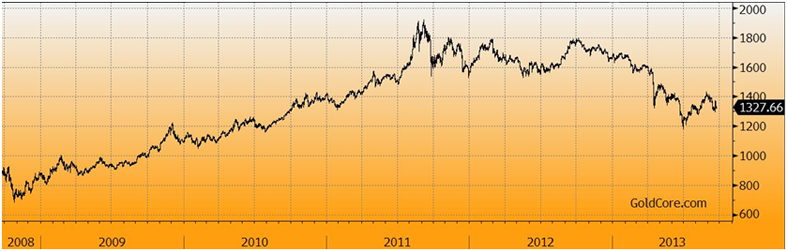
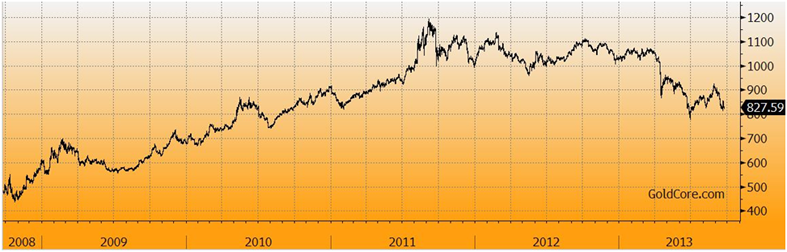
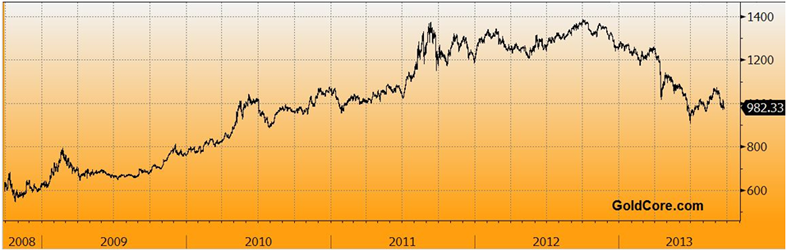
Today’s AM fix was USD 1,321.75, EUR 978.71 and GBP 824.34 per ounce.
Friday’s AM fix was USD 1,355.25, EUR 1,002.18 and GBP 845.39 per ounce
Gold dropped $39.30 or 2.92% Friday, closing at $1,325.30/oz. Silver slid $1.27 or 5.84%, closing at $21.74. At 3:32 EDT Friday, Platinum fell $31.30 or 2.1% to $1,427.50/oz, while palladium slipped $18.53 or 2.5% to $713.97 /oz. Gold was up 0.16% and silver was down 2.03% on the week.
Gold has been up and down in choppy trading in London today as investors digest the U.S. Fed’s decision to wait on tapering until perhaps next month. Comments on Friday from James Bullard, the St. Louis Federal Reserve Bank President affected the markets.  He said, “a reduction of the Fed’s $85 billion monthly bond purchase program beginning in October was possible and that the Fed can be patient in deciding when to scale back its pace of asset purchases”.
In Germany’s elections, Chancellor Angela Merkel is on her way for a third term as German leader after her party, the Christian Democratic Union (CDU) scored its best federal election result since 1990. However, it appears likely she has lost her coalition partner, the Free Democratic Party (FDP) as they failed to secure the required 5% threshold necessary and will be without Bundestag representation for the first time in its 65-year history.
Gold is finding support by the increasing consensus that the current Federal Reserve Vice Chair, Janet Yellen, will take over from Bernanke. Gold got a boost Thursday after a senior White House official’s remarked that Yellen is a leading candidate to replace Bernanke when he steps down.
Yellen, a strong supporter of Bernanke’s policies, should keep U.S. interest rates low for an extended period of time and she is very dovish, contrary to recent revisionism.
The U.S. national debt continues to surge higher every day and is now at $16.95 trillion and will soon surpass the $17 trillion mark.
When Standard & Poor’s reduced the U.S.’s credit rating from AAA to AA-plus, it was the first time the U.S. ever suffered a downgrade to its credit rating. The S&P took this action despite the plan Congress passed last week to raise the debt limit.
The downgrade, S&P said, “reflects our opinion that the fiscal consolidation plan that Congress and the administration recently agreed to falls short of what, in our view, would be necessary to stabilize the government’s medium-term debt dynamics.”
It’s those medium- and long-term debt problems that also worry economics professor Laurence J. Kotlikoff, who served as a senior economist on President Reagan’s Council of Economic Advisers. He says the national debt, which the U.S. Treasury has accounted at about $14 trillion, is just the tip of the iceberg.
“We have all these unofficial debts that are massive compared to the official debt,” Kotlikoff tells David Greene, guest host of weekends on All Things Considered. “We’re focused just on the official debt, so we’re trying to balance the wrong books.”
Kotlikoff explains that America’s “unofficial” payment obligations — like Social Security, Medicare and Medicaid benefits — jack up the debt figure substantially.
Laurence J. Kotlikoff served as a senior economist on President Ronald Reagan’s Council of Economic Advisers and is a professor of economics at Boston University
“If you add up all the promises that have been made for spending obligations, including defense expenditures, and you subtract all the taxes that we expect to collect, the difference is $211 trillion. That’s the fiscal gap,” he says. “That’s our true indebtedness.”
We don’t hear more about this enormous number, Kotlikoff says, because politicians have chosen their language carefully to keep most of the problem off the books.
“Why are these guys thinking about balancing the budget?” he says. “They should try and think about our long-term fiscal problems.”
According to Kotlikoff, one of the biggest fiscal problems Congress should focus on is America’s obligation to make Social Security payments to future generations of the elderly.
“We’ve got 78 million baby boomers who are poised to collect, in about 15 to 20 years, about $40,000 per person. Multiply 78 million by $40,000 — you’re talking about more than $3 trillion a year just to give to a portion of the population,” he says. “That’s an enormous bill that’s overhanging our heads, and Congress isn’t focused on it.”
“We’ve consistently done too little too late, looked too short-term, said the future would take care of itself, we’ll deal with that tomorrow,” he says. “Well, guess what? You can’t keep putting off these problems.”
To eliminate the fiscal gap, Kotlikoff says, the U.S. would have to have tax increases and spending reductions far beyond what’s being negotiated right now in Washington.
“What you have to do is either immediately and permanently raise taxes by about two-thirds, or immediately and permanently cut every dollar of spending by 40 percent forever. The [Congressional Budget Office's] numbers say we have an absolutely enormous problem facing us.”
UBS has updated their short-term gold targets today, increasing their one-month forecast to $1,450/oz from $1,250/oz and three-month to $1,375/oz from $1,350/oz citing the U.S. Fed’s decision not to reduce its QE program as positive for gold. Additionally the U.S. fiscal and debt ceiling debates are imminent. Oct. 1st is the U.S. government shutdown date to be avoided and the market rhetoric will increase gold’s safe haven status. Finally, UBS analyst Edel Tully noted the upcoming wedding and festival season in India followed by the Chinese Lunar New Year will all increase physical demand for the yellow metal.
NEWS

U.S. Government Is Insolvent- Eric Sprott: Bonds Are for Losers – We Will See People Moving Into Gold and Silver


http://usawatchdog.com/u-s-government… - The CEO of Sprott Asset Management, Eric Sprott, says, “We’re buying more bonds on a daily basis, and rates still went higher, which is why I can definitively say the Fed lost control of the bond market. That is why they could not ‘taper’ because who’s going to buy all the bonds? Bonds are for losers.” Join Greg Hunter as he goes One-on One with gold and silver expert Eric Sprott who manages $8 billion.

Sunday, September 22, 2013

ECB ready to act to help credit market if needed: Liikanen

MILAN (Reuters) - The European Central Bank is ready to boost liquidity in the credit market by issuing another long-term loan if necessary, ECB Governing Council member Erkki Liikanen was quoted as saying on Sunday by Italy's Corriere della Sera newspaper.
The ECB carried out so-called long-term refinancing operations (LTROs) to ease funding strains at the height of the euro zone debt crisis.
"I am ready to act, if necessary," Liikanen told the paper, when asked if another such loan was planned. He did not give a timeline for any such move.
Markets have already begun to speculate on the chances of another of the operations which saw the ECB flood banks with more than 1 trillion euros ($1.35 trillion) in cheap three-year loans in late 2011 and early 2012.
The ECB's Governing Council, in contrast with the U.S. Federal Reserve's move towards reining in stimulus, has said it is willing to take further steps to keep market interest rates low given continuing concerns over European growth.
($1 = 0.7402 euros)
(Reporting by Agnieszka Flak; Editing by Mark Potter)