India’s Scrap Gold Sales Jump on “Liquidity Crisis” as US Policy Splits G20 Summit
LONDON DELIVERY gold rose back to last week’s closing level of
$1395 per ounce Thursday morning, reversing an overnight drop of 1.0%
as Asian stock markets rose but Europe stocks held flat.
The central banks of Japan, the UK and the Eurozone all kept their monetary policies unchanged at today’s monthly meetings.
US Treasury bonds fell ahead of private US jobs data – expected to
show a slight fall in new hiring, before Friday’s official Non-Farms
Payrolls release.
Silver prices meantime joined gold bullion in rising back to last
week’s finish, unwinding last night’s 1.5% drop to trade back above
$23.50 per ounce.
“China’s seeing robust gold sales this year,” said Duan Shihua at
Shanghai Leading Investment Management, commenting today to Bloomberg
after official data showed gold bullion imports to the world’s
second-largest economy rising 12% in July from June to 113 tonnes.
“The high prices in China’s domestic market in July encouraged importers.”
Gold bullion premiums in China, over and above the benchmark London
settlement price, averaged some 2.1% in July, according to Bloomberg.
Gold that month began a 20% rise from 3-year lows. Physical gold
contracts on the Shanghai Gold Exchange ended today 0.8% above London
spot.
Premiums on gold in India meantime – the world’s No.1 consumer nation – fell hard today, Singapore’s Business Times reports, dropping $5 per ounce as wholesalers reacted to Wednesday’s relaxation of the summer import ban by the Reserve Bank.
Indian gold bullion imports could still be limited to just 300 tonnes
over the next 12 months, according to the Gem & Jewellery Export
Promotion Council’s Pankaj Parekh – down from almost 900 tonnes in 2012.
“Due to yesterday’s circular, people are expecting consignments will start soon,” says Haresh Soni, chairman of All India Gems & Jewellery Trade Federation.
Tight supplies and high gold premiums also mean “Scrap [supply] is
increasing every day,” says Soni, because “people are reselling
jewellery” as well as gold bars and coins.
“Investors are selling gold all across the country,” agrees
Prithviraj Kothari, director of the Bombay Bullion Association and
managing director of leading dealer Riddhisiddhi Bullions Ltd
“There is a liquidity crisis and people are selling and putting the money in the bank. There is a huge amount of scrap supply coming into the market.”
Indian premiums fell Thursday to $25-30 per ounce, down from as high as $40 earlier this week.
Commenting on the US Federal Reserve’s apparent plans to start
tapering its $85 billion per month QE program in September, “The G20
Summit is an important forum to seek an international climate that is
beneficial for all countries,” said Indian prime minister Manmohan Singh
ahead of joining the meeting of top 20 economy leaders in St.Petersburg
today.
Faced with a current account crisis which has driven the Rupee to
record lows on the currency markets, down 17% for 2013 to date, “India
has emphasised [to the US] there has to be a predictability about the
withdrawal,” adds secretary for economic affairs Arvind Mayaram, “as it
has a spill-over impact on the emerging markets.”
The Mumbai stock market meantime jumped 2.1% on Thursday, led by the
fastest surge in banking shares for more than two years, after new
central bank governor Raghuram Rajan announced a “swap line” for foreign
currencies worth some $10 billion, plus fresh deregulation of the
sector.
“It’s all about restoring confidence and that Rajan has definitely
done,” says Sunil Singhania at the $15bn Reliance Capital Asset
Management Ltd.
Dominating the G20 summit, however, will likely be arguments between
Russia and other Syria allies with the US-aligned Western nations over
the Assad regime’s apparent chemical weapons attack on unarmed civilians
two weeks ago.
Backing the Kremlin’s stance, “Military action would have a negative impact on the global economy,”
said China’s vice finance minister Zhu Guangyao at a press briefing
today, “especially on the oil price – it will cause a hike.”
Crude oil ticked half-a-per cent higher on Thursday morning, taking Brent back above $115 per barrel.
“The United States – the main currency issuing country – must
consider the spill-over effect of its monetary policy,” Zhu also said,
“especially the opportunity and rhythm of its exit from the ultra-loose
monetary policy.”
Adrian Ash
Friday, September 6, 2013

China backs Russia over Syria, warns against strike's economic repercussions
China
warned on Thursday that military intervention in Syria would hurt the
world economy and push up oil prices, reinforcing Vladimir Putin's
attempts to talk US President Barack Obama out of air strikes.
Putin was isolated on Syria at a Group of Eight meeting in June, the last big meeting of world powers, but now has China to back him at the G20 summit in Russia's former imperial capital.
"Military action would have a negative impact on the global economy, especially on the oil price - it will cause a hike in the oil price," Chinese Vice Finance Minister Zhu Guangyao told a briefing before the start of the G20 leaders' talks.
In Beijing, Foreign Ministry spokesman Hong Lei reiterated that any party resorting to chemical warfare should accept responsibility for it but said unilateral military actions violate international law and would complicate the conflict.
Like Moscow, Beijing has veto powers on the United Nations Security Council. Obama is unlikely to win Security Council approval for military action but is seeking the approval of the US Congress.
Putin has said he would like to hold one-on-one talks with Obama but a Kremlin spokesman said no such meeting was planned. Last month, Obama pulled out of talks with Putin that had been scheduled for Wednesday, and US-Russian ties are in freefall.
Foreign ministers from key states in the G20 - which includes all five permanent UN Security Council members - will also discuss Syria on the sidelines of the meeting.
Any G20 decision on Syria would not be binding but Putin would like to see a consensus to avert military action in what would be a significant triumph on international law.
Russia and China also joined forces in warning about the potential impact of the Fed ending its bond-buying programme to stimulate the economy. Zhu urged the United States to be "mindful of the spillover effects and work to contribute to the stability of the global financial markets and the steady recovery of the global economy".
In particular, Zhu warned leaders ahead of the G20 summit that a US military strike on Syria could have negative consequences on the world economy, particularly on rising oil prices.
Source and full story: Voice of Russia and agencies
Putin was isolated on Syria at a Group of Eight meeting in June, the last big meeting of world powers, but now has China to back him at the G20 summit in Russia's former imperial capital.
"Military action would have a negative impact on the global economy, especially on the oil price - it will cause a hike in the oil price," Chinese Vice Finance Minister Zhu Guangyao told a briefing before the start of the G20 leaders' talks.
In Beijing, Foreign Ministry spokesman Hong Lei reiterated that any party resorting to chemical warfare should accept responsibility for it but said unilateral military actions violate international law and would complicate the conflict.
Like Moscow, Beijing has veto powers on the United Nations Security Council. Obama is unlikely to win Security Council approval for military action but is seeking the approval of the US Congress.
Putin has said he would like to hold one-on-one talks with Obama but a Kremlin spokesman said no such meeting was planned. Last month, Obama pulled out of talks with Putin that had been scheduled for Wednesday, and US-Russian ties are in freefall.
Foreign ministers from key states in the G20 - which includes all five permanent UN Security Council members - will also discuss Syria on the sidelines of the meeting.
Any G20 decision on Syria would not be binding but Putin would like to see a consensus to avert military action in what would be a significant triumph on international law.
Russia and China also joined forces in warning about the potential impact of the Fed ending its bond-buying programme to stimulate the economy. Zhu urged the United States to be "mindful of the spillover effects and work to contribute to the stability of the global financial markets and the steady recovery of the global economy".
In particular, Zhu warned leaders ahead of the G20 summit that a US military strike on Syria could have negative consequences on the world economy, particularly on rising oil prices.
Source and full story: Voice of Russia and agencies
The TSA Racket is Now Selling Your Basic Rights Back to You
The TSA announced today that they will be accepting payments to give you back your basic rights
in airports — if passengers pay to sign up for the TSA Precheck
program, they can keep their shoes, belts and jackets on, leave laptops
in their cases, and not have to remove liquids and gels from carry-ons.
The $85 pizzo also requires fingerprinting, and will be available in
100 airports by the end of the year. The program had previously been
limited to frequent flier members from "select airlines".No word on how this new protection plan will affect Hindus, passengers with light sabers, or three-year-olds. http://gawker.com/the-tsa-racket-is-now-selling-your-basic-rights-b...
U.S. Silver Coin Sales Top 2012- Record Store Of Value Buying
by GoldCore
Today’s AM fix was USD 1,391.75, EUR 1,054.60 and GBP 891.06 per ounce.
Yesterday’s AM fix was USD 1,403.75, EUR 1,065.63 and GBP 899.67 per ounce.
Gold fell $17.90 or 1.27% yesterday, closing at $1,393.90/oz. Silver slid $0.73 or 3.01%, closing at $23.53. Platinum fell $36.72 or 2.4% to $1,492.28/oz, while palladium slipped $20.53 or 2.9% to $696.27/oz.
Gold edged off again, on the prospect of a decrease in quantitative easing and the uncertainty surrounding the U.S. military action in Syria. The nonfarm payrolls number on Friday is critical and there is also a private report due out today that may show U.S. employment has increased. This all points to a clear decision on tapering at the FOMC meeting later this month.

Silver in U.S. Dollars, 5 Year – (GoldCore)
Sales of American Eagle silver coins by the U.S. Mint this year surpassed the total for all of 2012 as store of value buyers buy silver at a record pace due to continuing inflation and systemic risk .
About 33.75 million ounces of the silver coins were sold so far in 2013, compared with 33.74 million in all of 2012 according to data on the mint’s website as reported by Bloomberg.
In January, sales reached an all-time high of 7.498 million, and averaged 3.65 million a month since then as demand heads closer to the annual record of 39.868 million reached in 2011.
Silver prices surged into a bull market last month and have gained 29% from a 34-month low on June 28, sparked by demand for precious metals as an alternative asset.
Holdings in exchange traded funds backed by silver rose to a record 20,082 metric tons on August 30 and are up 5.9% so far in 2012. Bets on higher prices for the precious metal advanced for the three straight weeks, data from U.S. Commodity Futures Trading show.
Imports by China, the world’s biggest consumer after the U.S., rose for three straight months through July.
The U.S. Mint suspended sales of silver coins for more than a week in January because of a lack of inventory. Sales of gold and silver coins may rise to a record this year if demand continues at the current pace, Richard Peterson, acting director of the mint, said in an interview on June 5th.
The premium charged by dealers surged to 25% in April, the highest since 2008, after the gold and silver price crash.

Gold Silver Ratio, 5 Year – (GoldCore)
Silver reached a 31-year high of $49.845 an ounce in April 2011 after Lehman Brothers collapsed and as global central banks expanded their balance sheets, boosting the precious metal’s appeal as a hedge against systemic risk, economic collapse and inflation.
Silver remains well below its record inflation adjusted high in 1980, it’s important real record high of over $140/oz.
Since 2003, we have consistently said that silver was likely to surpass its real high in the coming years. The gold silver ratio is likely to trend lower and revert to its long term average and its geological ratio of 15 to 1 as a huge amount of silver has been used in industrial applications in recent years.
Silver above it’s real record high in 1980 seems likely due to increased industrial, investment and, potentially most importantly, store of value demand for what remains a very rare precious metal in a time of universal currency debasement.
Today’s AM fix was USD 1,391.75, EUR 1,054.60 and GBP 891.06 per ounce.
Yesterday’s AM fix was USD 1,403.75, EUR 1,065.63 and GBP 899.67 per ounce.
Gold fell $17.90 or 1.27% yesterday, closing at $1,393.90/oz. Silver slid $0.73 or 3.01%, closing at $23.53. Platinum fell $36.72 or 2.4% to $1,492.28/oz, while palladium slipped $20.53 or 2.9% to $696.27/oz.
Gold edged off again, on the prospect of a decrease in quantitative easing and the uncertainty surrounding the U.S. military action in Syria. The nonfarm payrolls number on Friday is critical and there is also a private report due out today that may show U.S. employment has increased. This all points to a clear decision on tapering at the FOMC meeting later this month.
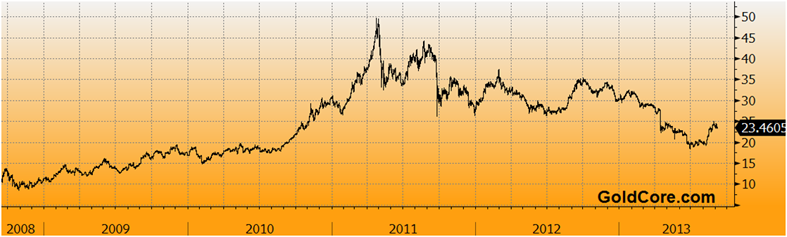
Silver in U.S. Dollars, 5 Year – (GoldCore)
Sales of American Eagle silver coins by the U.S. Mint this year surpassed the total for all of 2012 as store of value buyers buy silver at a record pace due to continuing inflation and systemic risk .
About 33.75 million ounces of the silver coins were sold so far in 2013, compared with 33.74 million in all of 2012 according to data on the mint’s website as reported by Bloomberg.
In January, sales reached an all-time high of 7.498 million, and averaged 3.65 million a month since then as demand heads closer to the annual record of 39.868 million reached in 2011.
Silver prices surged into a bull market last month and have gained 29% from a 34-month low on June 28, sparked by demand for precious metals as an alternative asset.
Holdings in exchange traded funds backed by silver rose to a record 20,082 metric tons on August 30 and are up 5.9% so far in 2012. Bets on higher prices for the precious metal advanced for the three straight weeks, data from U.S. Commodity Futures Trading show.
Imports by China, the world’s biggest consumer after the U.S., rose for three straight months through July.
The U.S. Mint suspended sales of silver coins for more than a week in January because of a lack of inventory. Sales of gold and silver coins may rise to a record this year if demand continues at the current pace, Richard Peterson, acting director of the mint, said in an interview on June 5th.
The premium charged by dealers surged to 25% in April, the highest since 2008, after the gold and silver price crash.

Gold Silver Ratio, 5 Year – (GoldCore)
Silver reached a 31-year high of $49.845 an ounce in April 2011 after Lehman Brothers collapsed and as global central banks expanded their balance sheets, boosting the precious metal’s appeal as a hedge against systemic risk, economic collapse and inflation.
Silver remains well below its record inflation adjusted high in 1980, it’s important real record high of over $140/oz.
Since 2003, we have consistently said that silver was likely to surpass its real high in the coming years. The gold silver ratio is likely to trend lower and revert to its long term average and its geological ratio of 15 to 1 as a huge amount of silver has been used in industrial applications in recent years.
Silver above it’s real record high in 1980 seems likely due to increased industrial, investment and, potentially most importantly, store of value demand for what remains a very rare precious metal in a time of universal currency debasement.
Thursday, September 5, 2013
Investors seek balance between central banks, Syria and rebounding economy
By Richard Hubbard
LONDON (Reuters) - European government bond yields were at near
1-1/2 year highs on Thursday and the dollar clung close to six week
peaks on a combination of a better global economic outlook, nervousness
about Syria and pending central bank meetings.Russia and China, meanwhile, both warned the U.S. ahead of the G23 meeting in St Petersburg that the end of the Federal Reserve's bond-buying program could have a profound impact on the global economy.
The European Central Bank and Bank of England were both expected to leave interest rates unchanged, but investors were looking for statements reiterating pledges to keep rates low given recent stronger economic data.
ECB President Mario Draghi "is going to want talk down the prospects of recovery a little bit and get people's feet on the ground," said Will Hobbs, head of equities strategy at Barclays Wealth.
European money market rates have been moving higher recently in response to stronger economic data and on expectations the Federal Reserve is set to begin unwinding its stimulus, possibly as soon as later this month.
Analysts see little options for the bank other than just maintaining a soft tone in communication, sending German 10-year bond yields have risen to 1-1/2 year highs of 1.981 percent.
Earlier the Bank of Japan voted unanimously to maintain its monetary stimulus, while declaring the world's third-largest economy was on a recovery path, sending the yen briefly above 100 to the dollar, a six week low.
In the emerging markets India's new central bank chief began his tenure in spectacular fashion by unveiling measures to support the currency and the banking sector that sent the main NSE (.NSEI) share index up 3.3 percent and boosting the rupee.
The rupee rose to as high as 65.53 per U.S. dollar, pulling well away from a record low around 68.85 set last week.
The gain in Indian stocks and a slight rise in Tokyo's shares after the BOJ decision helped lifted Asia equity prices <.miapj0000pus> by 0.6 percent, to near a three week high.
European share markets (.FTEU3) were up 0.5 percent in early trade, gaining ground for the second day in a row and hitting its highest level since August 27.
"People are waiting for cues from the central banks, and there is just no real trend on the market at the moment," said Guillaume Dumans, co-head of research firm 2Bremans.
The euro last traded at $1.3185, down slightly against the stronger dollar and not far from a six-week low of $1.3138.
MSCI world equity index <.miwd00000pus> was up 0.1 percent following a second day of gains on Wall Street spurred by another set of upbeat U.S. data, which included the strongest monthly rise in car sales during August since October 2007.
"Strong car sales in the U.S. again lifted market confidence in the economy, and lifted expectations that the U.S. Federal Reserve will start cutting back its stimulus this month," said Isao Kubo, an equity strategist at Nissay Asset Management.
SYRIA ACTION
Markets remained cautious about Syria as a possible U.S. military strike moved one step closer after a Senate committee voted in favor of action, clearing the way for a vote in the full Senate, likely next week.
The possible military strike against Syria in reaction to its alleged use of chemical weapons and the Fed's decision to reduce its stimulus were expected to dominate discussions at a meeting of leaders from the Group of 20 developed and developing economies in St Petersburg.
In a note prepared for the meeting the IMF warned that emerging countries were particularly vulnerable to a tightening of U.S. monetary policy.
It urged strengthened global
action to revitalize growth and better manage risks, adding some
downside risks have become more prominent.
U.S. President Barack Obama meanwhile was expected to use the
meeting to win international backing for a military strike against Syria
and this was keeping a floor under oil marketsBrent crude rose 56 cents to $115.47, while U.S. oil was up 64 cents to $107.97.
(Additional reporting by Blaise Robinson. Editing by Jeremy Gaunt)
India markets rally, new RBI chief fuels confidence but faces some skeptics
By Abhishek Vishnoi and Swati Bhat
MUMBAI (Reuters) - The rupee rallied and shares surged on Thursday
after India's new central bank chief unveiled measures to support the
ailing currency, providing a shot of confidence for investors unnerved
by the country's worst economic crisis in two decades.However, amid the euphoria over Reserve Bank of India Governor Raghuram Rajan's energetic Wednesday debut, investors warned he cannot by himself repair an economy mired by slowing growth and a record high current account deficit that has helped fuel a drop in the rupee of as much as 20 percent this year.
Rajan faces pressure from investors to roll-back the central bank's controversial steps to defend the rupee by draining cash from the market and raising short-term interest rates at a time when investors are clamoring for ways to boost growth.
The government has struggled to push through politically tough reforms needed to fix the economy, and elections due by next May raise the prospect of expensive populist spending that could threaten the country's sovereign credit rating, which is one notch above junk status.
"This is certainly not the bottom. Rajan means business, but most of his measures are just statements of intent, especially in the light of government finances being so precarious," said G. Chokkalingam, managing director and chief investment officer at Centrum Wealth Management.
"The continued deceleration of the industrial economy, the fiscal conditions, and the Fed tapering worries will continue to weigh," he said.
On Thursday, however, skepticism was trumped by euphoria over Rajan, a prominent former chief economist at the International Monetary Fund, who unexpectedly unveiled a flurry of proposals in his first day at the helm of the central bank.
The rupee rose as much as 2.3 percent to 65.53 per dollar, well off the record low 68.85 hit on August 28, when it was down more than 23 percent from its 2013 peak.
The main NSE (NSI:^NIFTY) share index rose as much as 3.3 percent, propelled by lenders such as HDFC Bank (HDBK.NS), which surged after new steps outlined by Rajan that included increasing overseas borrowing limits for banks. But the index was still down more than 10 percent from its May highs.
The new measures to prop up the rupee included providing exporters and importers more flexibility in hedging their forward currency contracts, as trading firms had long complained about regulation that left them unable to quickly cope with rapid currency movements.
Rajan faces difficult decisions ahead, including navigating uncertain global conditions marked by rising military tension over Syria, which is pushing up India's oil import bill, and the prospect of an end to U.S. monetary stimulus.
The RBI has been the main line of defense against the rupee so far, with previous Governor Duvvuri Subbarao having opted to sacrifice near-term economic growth, putting interest rate cuts on hold in a quest for financial stability.
With economic growth remaining weak, investors are already clamoring for the RBI to change course.
"I will not give in to the personality and sentiment. I will look at data," said Phani Sekhar, a fund Manager at Angel Broking in Mumbai.
"The governor has no control on fiscal policy so what do you expect the RBI to do? If Rajan continues focusing on inflation, his newly found fan club will vanish sooner than later."
IN SEARCH OF REFORMS
Asia's third-largest economy is suffering from sluggish investment as well as slowdowns in the manufacturing and services sectors.
Investors have expressed little faith that New Delhi can push through substantial reforms, such as a hike in subsidized fuel prices, that could help revive confidence in the economy.
Measures the government has passed, including curbs to gold imports and opening up sectors for foreign investments, have been dismissed as too small or not helpful enough by markets.
India's lower house of parliament approved changes aimed at luring foreign asset managers to run retirement funds on Wednesday, but foreign firms say the new law is unlikely to immediately trigger a flood of investment.
The rupee is by far the biggest decliner among the Asian countries tracked by Reuters, even more than the 13 percent fall in the Indonesian rupiah, a country also suffering from a current account deficit and concerns about economic growth.
Economists say the government will ultimately need to step in to provide more long-lasting support for the rupee.
"India's myriad cyclical and structural impediments will continue to hold back the economy for the time being, and risks of a deeper crisis are non-trivial," Deutsche Bank wrote.
"But (Wednesday's) statement
shows a fresh and cohesive vision of monetary and financial sector
policy from a newly appointed central bank governor can shine a
much-needed light on India's promise and potential."
(Writing by Rafael Nam; Additional reporting by Subhadip Sircar; Editing by Tony Munroe & Kim Coghill)
Bye, Bye, American Pie
US intransigence in the face of a war-weary world will mean
the end of the country as we know itby Daniel
Patrick Welch
It actually shouldn’t be that much of a shock. For the last twelve years at least, Americans have watched their country drift into the shadows of international law abroad and onto the shoals of fascism at home. Inexorably, the weight of imperial overstretch has crippled an economy already on a constant war footing and led to the steady erosion of civil liberties once taken for granted.
At one point, Democrats cried out in (what turns out to be mock) horror when one of the Bushmen smirked at the Geneva Convention as ‘quaint.’ Outrageous! Squeaked the remnants of an American “Left.” No more. As drones are poised to darken the skies like a plague of locusts, intelligence agencies can read all of our communications even as we write them, and the general criminalization of dissent has accelerated without objection because, after all, the guy doing it has a -D after his name.
And now, nary a peep from so-called ‘progressives’ in Congress as a Democrat and his lurking, smooth-talking Consigliore use the same lies and fabrications to shove yet another war down our throats, all neatly packaged in Red, White and Blue, the specter of National Security—in short, the same old bullshit we've heard before.
But it’s not the same—that’s the point. And it’s a shame the fools in congress are too stupid (most of them, apparently) to see it. Showing the delusional thinking that is now seemingly required to hold and keep public office, one particularly deranged congresswoman actually told Wolf Blitzer that “dozens” of countries stood ready to support the US’ aggressive war against Syria, though she couldn't name them offhand. Debbie Wasserman Schultz actually said “I mean we have, from the briefings that I've received, there are dozens of countries who are going to stand with the United States, who will engage with us on military action and also that back us up.”
Oh, okay then. Micronesia will send staples, and Samoa is serving drinks. The problem is that, inside the bubble of American “thought,” these people really think that mobilizing the ‘international community’ is the same a papering an audience for a bad musical on a weeknight. It is all just a cynical farce to them. They don’t know, or don't care, that the whole world sees this for the fraud that it is. The Obama regime is about to make the biggest mistake in history.
This is not hyperbole. Bush had far more support going into Iraq, and Saddam had far less. His case for war, filled with lies and fabricated ‘evidence’ and ginned up ‘intelligence’ findings, is far better than the US’ current position—a complete crock of shit to the whole world, but that somehow smells like roses to the US Congress. The government has ceased to function as a representative body, and is completely divorced from the interests of the American people. Don’t want to trust such a judgment to an old commie like me? Take it from a former president—Jimmy Carter. Mr. Peanut himself admitted there is ‘no functioning democracy’ currently in the US. The arrogance of Obama’s War Council is stunning. Russia, China, and Iran have given repeated warnings—stern, clear, and unequivocal, against such an illegal and foolhardy course of action. The world has had it with American intransigence. It makes no difference whether an illegal war of aggression is ‘authorized’ by a compliant US Congress. Zero.
No matter what happens from here on out, the balance of power is already shifting, away from the US and its vassal states toward BRICS and the nations of the Global South. Even if the US regime does not attack (in itself a poor choice of words since it has been arming and funding foreign mercenaries in Syria for over two years), a too-patient world is ready to muzzle the rabid dog that is the US. China, while keeping mostly cool, has let it be known that if a strike does go ahead, that others should offer assistance to resist. This is as clear a shot across the bow as there is, and should give US warmakers pause.
What it means is that Syria, as a sovereign state, is justified in calling on its allies for help, by which it means Iran and its store of Russian Sunburn missiles, or Hezbollah and its own Chinese C-802 missiles, or Russia itself with its S300, S400 & S500 missiles. This is the real red line, and the US already crossed it in Libya. Putin has said that the Americans are acting like a monkey with a grenade in the Middle East. To put a finer zoological point on it, the Panda and the Bear are not fucking around. They have decided, and rightly so, that the US is too dangerous and must be stopped. If Obama goes ahead with this maniacal and murderous plan, China, Russia, Iran and Hezbollah will help Syria sink a few US destroyers, sending hundreds and perhaps thousands of kids to the bottom of the Mediterranean—they have as much as said so. They—not the US—will be within their rights and within international law to do so.
Mourn now, not later. And mourn at least equally for the kids your kids kill and for your kids who are killed in return. Don't go running for the flag or screaming for revenge. Don't accuse those of us who shouted from the rooftops of being un-American, or try to bully us into abandoning our principles and join the call for blood. This is wrong. It is illegal. It is as predictable as it is preventable. Even some tepid ‘antiwar’ types have it wrong when they say the US can’t be the world’s policeman. This misses the mark: the real point is that we have no moral authority to do so , and the whole world knows it. The criminal cabal in Washington is so obsessed with its own greatness that is has stood history on its head. In his long, insidious career of lies and obfuscation, Merchant of Death John Kerry finally got something inadvertently right: this *is* a Munich moment. But of course, true to form, he has it backwards. And Chamberlain‘s first name is not Neville, it’s Vlad. And he may give Obama and his henchmen a Nuremberg Moment.
Writer, singer, linguist and activist Daniel Patrick Welch lives and writes in Salem, Massachusetts, with his wife, Julia. Together they run The Greenhouse School.. Translations of articles are available in over two dozen languages. Links to the website are appreciated.
© 2013 Daniel Patrick Welch
It actually shouldn’t be that much of a shock. For the last twelve years at least, Americans have watched their country drift into the shadows of international law abroad and onto the shoals of fascism at home. Inexorably, the weight of imperial overstretch has crippled an economy already on a constant war footing and led to the steady erosion of civil liberties once taken for granted.
At one point, Democrats cried out in (what turns out to be mock) horror when one of the Bushmen smirked at the Geneva Convention as ‘quaint.’ Outrageous! Squeaked the remnants of an American “Left.” No more. As drones are poised to darken the skies like a plague of locusts, intelligence agencies can read all of our communications even as we write them, and the general criminalization of dissent has accelerated without objection because, after all, the guy doing it has a -D after his name.
And now, nary a peep from so-called ‘progressives’ in Congress as a Democrat and his lurking, smooth-talking Consigliore use the same lies and fabrications to shove yet another war down our throats, all neatly packaged in Red, White and Blue, the specter of National Security—in short, the same old bullshit we've heard before.
But it’s not the same—that’s the point. And it’s a shame the fools in congress are too stupid (most of them, apparently) to see it. Showing the delusional thinking that is now seemingly required to hold and keep public office, one particularly deranged congresswoman actually told Wolf Blitzer that “dozens” of countries stood ready to support the US’ aggressive war against Syria, though she couldn't name them offhand. Debbie Wasserman Schultz actually said “I mean we have, from the briefings that I've received, there are dozens of countries who are going to stand with the United States, who will engage with us on military action and also that back us up.”
Oh, okay then. Micronesia will send staples, and Samoa is serving drinks. The problem is that, inside the bubble of American “thought,” these people really think that mobilizing the ‘international community’ is the same a papering an audience for a bad musical on a weeknight. It is all just a cynical farce to them. They don’t know, or don't care, that the whole world sees this for the fraud that it is. The Obama regime is about to make the biggest mistake in history.
This is not hyperbole. Bush had far more support going into Iraq, and Saddam had far less. His case for war, filled with lies and fabricated ‘evidence’ and ginned up ‘intelligence’ findings, is far better than the US’ current position—a complete crock of shit to the whole world, but that somehow smells like roses to the US Congress. The government has ceased to function as a representative body, and is completely divorced from the interests of the American people. Don’t want to trust such a judgment to an old commie like me? Take it from a former president—Jimmy Carter. Mr. Peanut himself admitted there is ‘no functioning democracy’ currently in the US. The arrogance of Obama’s War Council is stunning. Russia, China, and Iran have given repeated warnings—stern, clear, and unequivocal, against such an illegal and foolhardy course of action. The world has had it with American intransigence. It makes no difference whether an illegal war of aggression is ‘authorized’ by a compliant US Congress. Zero.
No matter what happens from here on out, the balance of power is already shifting, away from the US and its vassal states toward BRICS and the nations of the Global South. Even if the US regime does not attack (in itself a poor choice of words since it has been arming and funding foreign mercenaries in Syria for over two years), a too-patient world is ready to muzzle the rabid dog that is the US. China, while keeping mostly cool, has let it be known that if a strike does go ahead, that others should offer assistance to resist. This is as clear a shot across the bow as there is, and should give US warmakers pause.
What it means is that Syria, as a sovereign state, is justified in calling on its allies for help, by which it means Iran and its store of Russian Sunburn missiles, or Hezbollah and its own Chinese C-802 missiles, or Russia itself with its S300, S400 & S500 missiles. This is the real red line, and the US already crossed it in Libya. Putin has said that the Americans are acting like a monkey with a grenade in the Middle East. To put a finer zoological point on it, the Panda and the Bear are not fucking around. They have decided, and rightly so, that the US is too dangerous and must be stopped. If Obama goes ahead with this maniacal and murderous plan, China, Russia, Iran and Hezbollah will help Syria sink a few US destroyers, sending hundreds and perhaps thousands of kids to the bottom of the Mediterranean—they have as much as said so. They—not the US—will be within their rights and within international law to do so.
Mourn now, not later. And mourn at least equally for the kids your kids kill and for your kids who are killed in return. Don't go running for the flag or screaming for revenge. Don't accuse those of us who shouted from the rooftops of being un-American, or try to bully us into abandoning our principles and join the call for blood. This is wrong. It is illegal. It is as predictable as it is preventable. Even some tepid ‘antiwar’ types have it wrong when they say the US can’t be the world’s policeman. This misses the mark: the real point is that we have no moral authority to do so , and the whole world knows it. The criminal cabal in Washington is so obsessed with its own greatness that is has stood history on its head. In his long, insidious career of lies and obfuscation, Merchant of Death John Kerry finally got something inadvertently right: this *is* a Munich moment. But of course, true to form, he has it backwards. And Chamberlain‘s first name is not Neville, it’s Vlad. And he may give Obama and his henchmen a Nuremberg Moment.
Writer, singer, linguist and activist Daniel Patrick Welch lives and writes in Salem, Massachusetts, with his wife, Julia. Together they run The Greenhouse School.. Translations of articles are available in over two dozen languages. Links to the website are appreciated.
© 2013 Daniel Patrick Welch
Subscribe to:
Posts (Atom)