Wednesday, July 24, 2013

Obama Seeking to Take Credit and Set Course for Economy

Doug Mills/The New York Times
President Obama speaking in May in Baltimore, where he discussed the economy and jobs.

WASHINGTON — President Obama is restarting a major effort this week to focus public attention on the American economy, a strategy aimed at giving him credit for the improving job market and lifting his rhetoric beyond the Beltway squabbles that have often consumed his presidency. 


The new effort, which begins with a major address on Wednesday followed by as many as six economic-themed speeches over the next two months, reflects how often world events, his political adversaries and his own competing agenda have conspired to knock him off that subject. Republicans were already mocking Mr. Obama on Monday, noting that his speeches were among many campaign-style efforts over the last five years to jump-start an economic conversation with Americans.
The United States economy has grown steadily but slowly for more than four years, with home prices, stocks and retail sales rebounding from their lows in 2009. The economic growth has not resulted in large job gains, but there has been a turnaround in longstanding pessimism among Americans about their financial futures. A New York Times/CBS News poll conducted in early June found Americans increasingly positive in their views of the nation’s economy. Nearly 4 in 10 in the poll said the condition of the economy was very good or fairly good, the most in Mr. Obama’s presidency.
“We have come a long way since the depths of the Great Recession,” Jay Carney, the president’s spokesman, said Monday.
But the White House strategy brings risks, given that the economy is not yet close to full recovery from the financial crisis. Mr. Carney quickly added that “we have more work to do.”
Even as they sought to build anticipation for Mr. Obama’s address at Knox College in Illinois on Wednesday, White House officials acknowledged the constraints on the president, especially since political gridlock in Washington has persisted through dozens of previous efforts at public outreach by Mr. Obama.
The economic speeches will not contain sweeping new proposals, senior administration officials said Monday. Nor are they intended to break the hardening stalemate on economic issues between the president and his Republican adversaries in Congress. Instead, they are largely repackaged economic proposals that the president has offered for years. Aides said they did not anticipate the speeches leading to a breakthrough with Republicans on looming fiscal fights.
That admission may suggest that the president’s advisers recognize how little the president — any president — can do to alter the country’s economic trajectory when global forces increasingly shape the financial system in the United States and the domestic political system has ground to a standstill.
In Congress, House and Senate spending bills for the coming fiscal year are so far apart that few lawmakers believe common ground can be found to pass them. Instead, the government may have to be financed come October by a stopgap measure that largely keeps spending at current levels with no changes to meet Mr. Obama’s priorities — and both sides say even that is likely to be problematic.
Mr. Obama’s adversaries on Monday were quick to point out that the president has frequently set out on similar campaign-style efforts to redefine or restate his economic agenda, often accompanied by rhetoric from his advisers about a new direction or emphasis. Congressional Republicans said they were incredulous that Mr. Obama planned to use another set of speeches instead of legislative negotiations to advance his economic agenda.
“It’s a cliché, but if all you’ve got is a hammer, everything looks like a nail,” said Michael Steel, a spokesman for the House speaker, John A. Boehner of Ohio. “They don’t know how to do anything else.”
In the fall of 2011, Mr. Obama addressed a joint session of Congress to unveil a $447 billion jobs bill that has not passed. In 2012, as his re-election campaign neared its end, he renewed his vision with a 20-page economic plan. In his State of the Union address in February, the president refocused on the economy after beginning his second term focused on gun control, immigration, climate change and gay rights. And just this past May, Mr. Obama announced he was restarting his “Middle Class Jobs and Opportunity Tour,” with stops in Baltimore and Austin, Tex.
“They’ve been saying the same thing for four years,” said Don Stewart, a spokesman for Senator Mitch McConnell of Kentucky, the Republican leader in the Senate. “The previous Democrat Congress passed his agenda — Obamacare, the stimulus, thousands of pages of regulations — and the economy is treading water. More taxes, more regulation, and more failures to unleash American energy jobs are not the answer.”
Administration officials on Monday conceded that the president was partly to blame for the debates in Washington veering away from the economic issues that many Americans believe are the most important. One official said that it was incumbent on Mr. Obama to shift the overall focus of the conversation in Washington, but acknowledged that has not happened.
The officials also criticized Republicans, especially in the House, for seizing on what the White House says are overblown scandals: the targeting of nonprofit groups at the Internal Revenue Service and the actions of officials after the attacks in Benghazi, Libya.
They said that some of the distractions in Washington have been out of Mr. Obama’s control: the 2010 oil spill from the Deepwater Horizon well in the Gulf of Mexico; Hurricane Sandy’s destruction late last year and the tornadoes in Oklahoma City in May; tensions in the Middle East and even the Trayvon Martin verdict.
Administration officials said the timing of the president’s speeches was broadly related to the looming fiscal deadlines that are likely to cause bitter fights in Congress later this fall. But they said the president wanted to avoid using the speeches as a negotiating platform over legislative programs, saying he would not offer a to-do list for Congress.
“Our economic vision is not focused solely on the skirmishes that occur on Capitol Hill,” Mr. Carney told reporters.
Mr. Obama’s adversaries in Congress are nonetheless eager to engage him in the trenches. Spending bills winding their way through the House threaten to do profound damage to the president’s priorities. Although Mr. Obama has said he will not negotiate terms to raise the nation’s debt limit, Congressional Republicans say they will not let the deadline pass without concessions, either on programs like Medicare or on an overhaul of the tax code.

Dalia Sussman contributed reporting from New York.

Gold Surges 3% – COMEX Default May Lead To $3,500/oz To $50,000/oz

by GoldCore

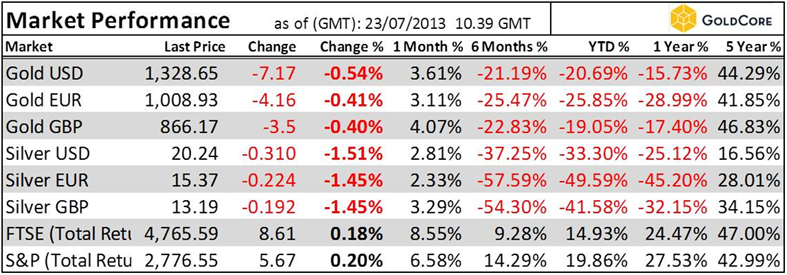
Today’s AM fix was USD 1,326.75, EUR 1,007.10 and GBP 864.84 per ounce.
Yesterday’s AM fix was USD 1,313.75, EUR 998.21 and GBP 859.22 per ounce.
Gold climbed $39.30 or 3.04% yesterday and closed at $1,333.70/oz.
Silver surged $0.97 or 4.98% and closed at $20.46.

Gold Prices/Fixes/Rates/Vols – (Bloomberg)

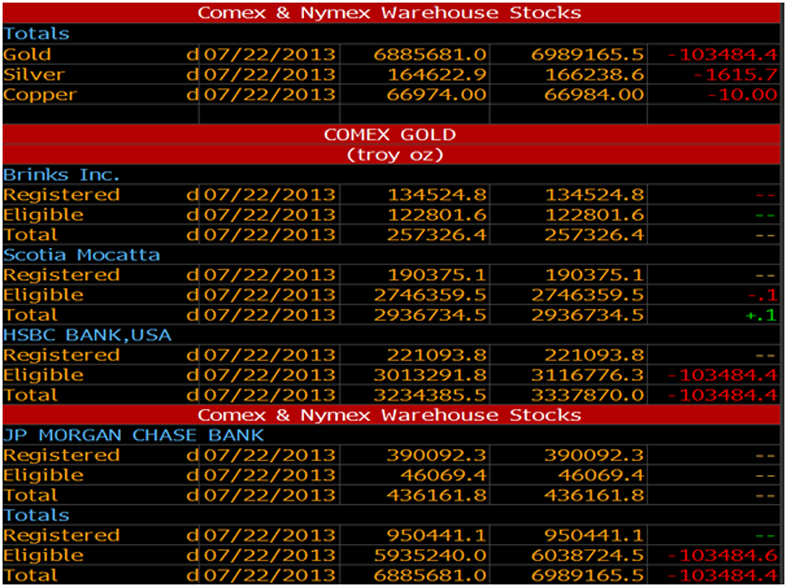
Gold surged over 3% yesterday due to what appears to be have been significant short covering due to concerns about gold backwardation and the continual haemorrhaging of gold inventories from the COMEX.
Concerns about a default on the COMEX, once the preserve of a few observant market watchers, are becoming more widespread  as we appear to be witnessing a run on the highly leveraged bullion banking system.
Very robust physical demand from the Middle East, Asia and particularly China and a decline in the dollar also helped prices log their biggest one-day gain in over a year and their first close above $1,300 an ounce in nearly five weeks.
Gains in silver futures, meanwhile, outpaced gold’s rise, with silver surging 5%.
Gold may have been higher also due to the weak U.S. dollar which is under pressure from poor U.S. home sales and comments from Bill Gross, PIMCO co-chief investment officer, who said he expected the Fed won’t tighten policy before 2016.
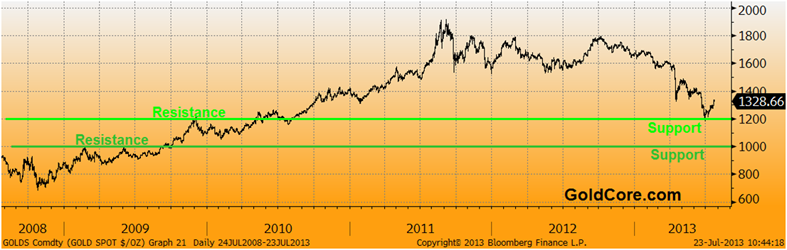
Gold has recovered nearly $150 or more than 12% in less than a month since hitting a three-year low of $1,180/oz on June 28th. Gold has made the strong gains due to robust physical demand as seen in the still high premiums in Asia.
Respected investor and precious metals guru, Jim Sinclair has again warned of a risk of a default on the COMEX and said that gold prices will rise to $3,500/oz and that gold at $50,000/oz is “not out of the question.” 

Sinclair, the successful gold and silver investor and a former adviser to the Hunt Brothers in their liquidation of silver from 1981 to 1984,  said in a posting on his blog that was emailed out to subscribers that:
“The cause of today’s spectacular rise in the gold price is the reality that with Friday continues large drops in the Comex warehouse gold inventory. No cogent argument can be formed against the reality that because of the continued fall in gold inventory that within in 90 days or sooner the Comex must change its delivery mechanism.”
Sinclair, said that the COMEX would have to move to cash settlement as they do not have nearly enough gold bullion to make deliveries and warned that owners of futures may be forced to accept payment in the form of the SPDR GLD ETF. This which would make them unsecured creditors of the bullion banks who are the custodians and sub custodians of the SPDR GLD.
He said that this could lead to the GLD ETF being “destroyed” and said that “it is a truism in gold that which is convertible into gold will in fact be converted over time.”

Comex Gold Inventory Data

Sinclair was likely alluding to a form of Gresham’s Law where bad money drives out good and where ‘bad’ or more risky gold investments are driven out by ‘good’ or safer gold ‘investments’ such as physical bullion in your possession or allocated in a vault outside the banking system.
Gold rose yesterday and Sinclair said, “because those knowledgeable know the inevitability of the changing of the Comex contract.”

“There is no question this is the emancipation of physical gold from the fraud of no gold, paper gold. The emancipation will cause physical gold exchanges to take birth and to be the discovery mechanism for the price of gold. This is the end of the ability to use paper gold future contracts as a mechanism to make the gold price sing and dance at the will of the manipulators.
With manipulation coming to an end the true value of gold will be discovered by the cash exchanges that are now taking birth. The advent of the cash spot exchanges around the world is the natural demise of the Comex.
GOFO (Gold Forward Offered Rate) is screaming this truth. The warehouse inventory of every futures gold exchanger is screaming this. The fact that there is no meaningful above ground supply of gold is screaming this. The fact that most of the central banks supply of gold is leased is screaming this.
There is no reason why gold cannot move up hundreds of dollars a day when the Comex changes their spot contract settlement, as they must, as they will, very soon.”

Support & Resistance Chart – (Bloomberg)

With regard to price, Sinclair said that “gold will trade well above $3,500/oz and those who have lived in the gold market like me for now 53 years know it”.
The respected investor said that “a price of $50,000 for gold is not out of the question as a result of its emancipation from “fraudulent paper, no gold, paper gold.”
Mr. Sinclair has a good track record and it is believed that he has insider knowledge due to his family history and relationships with key players on Wall Street.
He predicted back in the early 2000’s with gold below $300 an ounce that gold would reach $1,650 within a decade. Now he is talking about “quantitative easing to infinity” and a similar trajectory for gold and silver prices.
Sinclair is highly respected amongst precious metal buyers due to being extraordinarily generous with his knowledge and his time in recent years. His writings on his website  JSMineset and his free email have protected tens of thousands of people around the world.
This year he has undertaken conferences where hundreds of people have turned up in Los Angeles, London and New York City for highly informative, interactive, question and answer sessions and is holding more conferences around the world in the coming months.

Shuffle of stored aluminum benefits banks, not consumers

The strategy increases aluminum pricing and is just one way Wall Street is capitalizing on loosened federal regulations to sway a variety of commodities markets, a New York Times probe found.

 By DAVID KOCIENIEWSKI

MOUNT CLEMENS, Mich. — Hundreds of millions of times a day, thirsty Americans open a can of soda, beer or juice. And every time they do it, they pay a fraction of a penny more because of a shrewd maneuver by Goldman Sachs and other financial players that ultimately costs consumers billions of dollars.
The story of how this works begins in 27 industrial warehouses in the Detroit area where Goldman stores customers’ aluminum. Each day, a fleet of trucks shuffles 1,500-pound bars of the metal among the warehouses.
Goldman has choreographed this dance to exploit pricing regulations set up by an overseas commodities exchange, an investigation by The New York Times has found. The back-and-forth lengthens the storage time. And that adds many millions a year to the coffers of Goldman, which owns the warehouses and charges rent to store the metal.
It also increases prices paid by manufacturers and consumers across the country.
Tyler Clay, a forklift driver who worked at the Goldman warehouses until early this year, called the process “a merry-go-round of metal.”
Only a tenth of a cent or so of an aluminum can’s purchase price can be traced back to the strategy. But multiply that amount by the 90 billion aluminum cans consumed in the United States each year — and add the tons of aluminum used in things like cars, electronics and house siding — and the efforts by Goldman and other financial players has cost American consumers more than $5 billion over the last three years, say former industry executives, analysts and consultants.
The inflated aluminum pricing is just one way Wall Street is capitalizing on loosened federal regulations to sway commodities markets, according to financial records, regulatory documents and interviews with people involved in the activities.
The maneuvering in markets for oil, wheat, cotton, coffee and more have brought billions in profits to investment banks while consumers pay more.
Wall Street’s ownership of warehouses, pipelines and other commodity-related assets will be the focus of a hearing Tuesday by a Senate Banking, Housing & Urban Affairs subcommittee. Commodity warehousing is also being reviewed by the Commodity Futures Trading Commission.
In the case of aluminum, Goldman bought Metro International Trade Services, one of the country’s biggest traders of the metal. More than a quarter of the supply of aluminum available on the market is kept in the company’s Detroit-area warehouses.
Before Goldman bought Metro International three years ago, warehouse customers used to wait an average six weeks for their purchases to be located, retrieved and delivered to factories. But now the wait has grown more than 20-fold — to more than 16 months, industry records show.
Longer waits might be written off as aggravating, but they make aluminum more costly nearly everywhere in the country because of the arcane formula used to determine the metal’s cost on the spot market.
Goldman Sachs says it complies with all industry standards and there is no suggestion these activities violate any laws. Metro International, which declined to comment, in the past has attributed the delays to logistical problems, including a shortage of trucks and forklift drivers, and the administrative complications of tracking so much metal.
But interviews with several current and former Metro employees, as well as someone with direct knowledge of the company’s business plan, suggest the longer waiting times are part of the company’s strategy and help Goldman increase its profits from the warehouses.
“It’s a totally artificial cost,” said Jorge Vazquez, managing director at Harbor Aluminum Intelligence, a commodities consulting firm. “It’s a drag on the economy. Everyone pays for it.”

Tuesday, July 23, 2013

Three banks decline Buena Vista School District for last-minute loan

Buena Vista Schools reopen on May 20, 2013 after two-week shutdown
A faculty member arrives for the first day of class at Buena Vista High School Monday morning, May 20, 2013 after the school district was shut down for two weeks due to budgetary problems. (Jeff Schrier | MLive.com)

BUENA VISTA TOWNSHIP, MI — Buena Vista School District officials have fewer than five hours to find a private loan to keep the struggling district afloat.
Superintendent Deborah Hunter-Harvill said she’s contacted five banks about a loan, and three have sent messages in writing to decline.
“As the deadline looms, I’m staying upbeat and positive,” she said. “So far, I don’t have anything.”
On Thursday, July 17, State Superintendent Mike Flanagan and State Treasurer Andy Dillon gave Buena Vista and Inkster schools two days — until 5 p.m. Monday — to secure a private loan or face dissolution. Inkster officials already had started the process, and state officials gave Buena Vista the same option.
Buena Vista Board of Education President Randy L. Jackson last week called the deadline unreasonable but said district officials would fight to get the necessary funding.

If Buena Vista leaders are unable to find a loan, a lead on loan or viable operation plan for the fall, the Saginaw Intermediate School District will dissolve the district and redraw boundaries with neighboring districts. If the intermediate district failed to act, Flanagan and Dillon would step in.

Flanagan and Dillon said Buena Vista meets all six requirements for dissolution under a new state law.

Buena Vista School District ran out of money to make payroll after the Michigan Department of Education stopped state funding to recoup money overpaid to educate students not served by the district.
As a result, Buena Vista closed for two weeks in May. The district's deficit elimination plan, submitted to the state, was accepted on the third try. That allowed the state to release up to $460,000 in state aid, and classes resumed. The last day of school was June 26.
The district has a $3.7 million budget deficit, a $2 million loan due to the state treasury in 2014 and less than $2,000 in the bank.

Another Key Wall Street Master of the Universe to Elude Penalties for Alleged Fraud

MARK KARLIN, EDITOR OF BUZZFLASH AT TRUTHOUT
banksters7 22Goldman Sachs, JP Morgan Chase...Just Fill in the Blank. Card is Transferable to Any Wall Street Master of the Universe.No, this is not yet another commentary about a top Wall Street player escaping potential criminal charges.  Criminal charges?  Are you kidding?  Going to jail or even being criminally indicted is about as likely for a Wall Street master of the universe as Edward Snowden getting a free ride on Air Force One and joining the Obama family on a Christmas vacation trip to Disney World.
No this column is about a key Wall Street executive, Blythe Masters, who the New York Times (NYT) reports is likely to escape even US government-assessed civil damages for what is alleged fraudulent trading (to increase profit) of electricity prices in California and Michigan:
Even as the nation’s top energy regulator is poised to extract a record settlement from JPMorgan Chase over accusations that it manipulated power markets, the agency is expected to spare a top bank lieutenant who federal investigators initially contended made “false and misleading statements under oath,” according to people briefed on the matter.
Blythe Masters, a seminal Wall Street figure who is known for developing exotic financial instruments, emerged this spring at the center of an investigation by the Federal Energy Regulatory Commission [FERC] into accusations of illegal trading in the California and Michigan electricity markets.
Of course, BuzzFlash at Truthout cannot say whether or not the allegations against Ms. Masters are accurate or provable, but the NYT notes:
The regulator [FERC] found that JPMorgan designed trading “schemes” that converted “money-losing power plants into powerful profit centers,” a commission document said.
While the commission and JPMorgan are negotiating a settlement for about $500 million, the people briefed on the matter said, Ms. Masters is not expected to face a separate action....
Months earlier, investigators planned to recommend that the regulator find Ms. Masters, who holds a powerful position within JPMorgan as the head of its commodities business, “individually liable.” But as the investigation progressed, these people said, top energy regulatory officials have been leaning toward not pursuing any civil charges against Ms. Masters....
Ms. Masters formed close ties with Jamie Dimon, the bank’s chief executive, who has moved to shore up support for her, according to people close to the bank. The two were bound by their belief that the commodities business was critical to JPMorgan’s growth.
Would that be the Jamie Dimon who sloughed off the Libor scandal, is BFF of President Obama, and who receives government coordinated protection from time to time?  Yes it is.
As for Masters, she is not just a member of the Wall Street impunity crowd that controls much of the nation's wealth (unless their gambles fail and they request taxpayer subsidies to bail them out). According to the NYT, Ms. Masters is one of the primary creators of the very exotic financial "instruments" that were a key contributor to the US economic crash of 2008:
Within Wall Street, Ms. Masters is widely considered a pioneer for her use of credit derivatives, the complex financial products that played a central role in the 2008 financial crisis. Rising through the ranks of JPMorgan — she was the youngest managing director at 28 — Ms. Masters became one of the most powerful executives on Wall Street, propelled by a vision that the products could radically remake the banking industry.
Okay, time for a recap.  JP Morgan Chase is negotiating to pay a $500 million fine for manipulation of energy markets, reportedly overseen by Masters. FERC is backing off holding the person who allegedly masterminded the scheme accountable.
How many times have we said this? It's deja vu all over again.
No one is even discussing, as far as the NYT reveals, criminal prosecution.  As has been standard for the Obama administration, the $500 million fine would come out of the company's balance sheet, which would affect stock holders but not the executives who oversaw the scheme.
A July 18th NYT article starkly states:
Under “pressure to generate large profits,” investigators said in the March document, traders in Houston devised a solution. Adopting eight different “schemes” between September 2010 and June 2011, the traders offered the energy at prices “calculated to falsely appear attractive” to state energy authorities....
In the March document, the investigators elaborated on the bank’s pushback. The 70-page document said that the bank “planned and executed a systematic cover-up” of documents that exposed the trading strategy, including profit and loss statements.
The investigators also traced some of the obfuscating to Ms. Masters. After California authorities began to object to the bank’s trading strategy, Ms. Masters “personally participated in JPMorgan’s efforts to block” the state authorities “from understanding the reasons behind JPMorgan’s bidding schemes,” the regulator, known as FERC, said.
The investigators also cited an April 2011 e-mail in which Ms. Masters ordered a “rewrite” of an internal document that questioned whether the bank had skirted the law. The new wording: “JPMorgan does not believe that it violated FERC’s policies.”
Again, we don't know if these charges would be proved true or not in a regulatory agency hearing or court of law, but if they are accurate, wouldn't this constitute fraud?
And why is Jamie Dimon willing, it appears, to pay a half billion dollar fine out of his company's piggy bank if the accusations are false?
Good questions, but when you have Wall Street "sovereign financial immunity," the answers don't really matter, do they?
JP Morgan Chase executives are even paying fines with someone else's money.
(Photo: DonkeyHotey)

Europe's crisis states should fight back with a 'debtors' cartel'

Public debt levels are rocketing in almost every country of the eurozone periphery. Debt ratios are already crossing the point of no return in Portugal and Italy, and is nearing the danger zone in Ireland.

Public debt levels are rocketing in almost every country of the eurozone periphery. Debt ratios are already crossing the point of no return in Portugal and Italy, and is nearing the danger zone in Ireland.
Portugal's debt has just blown through the upper limits set by the EU-IMF Troika, reaching to 127.2pc of GDP in the first quarter of 2013. Photo: Bloomberg


The latest figures from Eurostat are shocking even to those who never believed that combined fiscal and monetary contraction -- made worse by bank curbs -- could have any other result than a faster rise in debt trajectories.
Portugal's debt has just blown through the upper limits set by the EU-IMF Troika, reaching to 127.2pc of GDP in the first quarter of 2013. This is fifteen percentage points higher than a year ago, the bitter fruit of austerity overkill. The Portuguese people have suffered year after year of cuts only to find themselves sinking deeper into a debt swamp.
Italy's debt has hit 130.3pc -- compared to 123.8pc a year ago -- rapidly spiralling beyond the safe threshold for a country without its own sovereign currency and central bank.
In Ireland, public debt has leapt by 18 points to 125pc in a single year. This is partly `pre-funding' to cover borrowing needs for 2014, but a slide back into recession accounts for a big chunk.
The former head of the IMF's team in Ireland, Professor Ashoka Mody, has called for "a complete rethinking" of the austerity strategy. He confirmed what the Irish trade unions and others have said along: that fiscal overkill is self-defeating, especially if compounded by tight money.
"Given the debt dynamics, if debt levels remain where they are and growth remains where it is, there is never going to be a reduction in the debt ratio the foreseeable future. Moving away from austerity at this stage is a sensible course of action," he said.
Ireland is certainly not a basket case. It has a fat trade surplus. Exports are 105pc of GDP, compared to 30pc or less most for Club Med. It is well able to compete at the current exchange rate.
Ireland's policy of austerity cuts and "internal devaluation" has done wonders for the trade account, but only at the cost of an even deeper debt-deflation crisis. This is the fundamental contradiction of EMU crisis strategy in every high-debt country. The more these economies deflate wages, the more they raise the real cost of debt.
In Ireland's case -- as in Spain -- this debt burden is the legacy of an almighty credit boom that was itself caused by EMU and years of negative real interest rates. The details are spelled out in a study entitled "What went wrong in Ireland" by Patrick Honohan, now central bank governor.
"These countries are walking a very fine line," said Marchel Alexandrovich from Jeffereies Fixed Income. "Once debt gets to the 130pc level there is a risk that markets will start to wake up. The moment truth could come as soon as political stability is called into question in any one of these countries."
Portugal has been flirting with just such a crisis ever since the finance minister and austerity chief, Vitor Gaspar, stormed out three weeks ago.
Portuguese bond rose Monday in a relief rally after the country's president backed down from threats to call a snap election, agreeing instead to let the crippled coalition of premier Pedro Passos Coelho limp on.
Yields on 10-year bonds fell 42 basis points to 6.2pc, back where they were before the constitutional crisis erupted. Yet it is a strange state of affairs when failure to form a "national salvation government" is greeted with delight by the markets. "The politics of economic reform in Portugal have become even more treacherous, and it is very unlikely that the political wounds that have opened up can be healed," said sovereign debt strategist Nicholas Spiro.
"Mr Passos Coelho's authority has now been undermined, and aggressive austerity has in any case completely failed. The public debt burden is rising at a frightening pace," he said.
The IMF warned last month that the debt outlook remains "very fragile" and that any external shock could push the country over the edge. It said a serious crisis could force the state to take on contingent liabilities and push debt to "clearly unsustainable" levels.
The country has to raise 23pc of GDP in funding this year and 22pc next year, when it is supposed to return to capital markets. External debt has reached 230pc of GDP. Nominal GDP has contracted over each of the last two years, causing the "denominator effect" to play havoc with debt dynamics.
Portugal's denouement is fraught with risk. Europe's leaders have given a solemn pledge that they will never again impose haircuts on banks, pension funds, and other investors holding EMU sovereign debt, tacitly recognizing that their experiment in Greece was calamitous.
So what will they do when the time comes? Do they impose tangible losses on German, Dutch, and French taxpayers for the first time? Does German finance minister Wolfgang Schauble ask the Bundestag to write a line into the budget worth €10bn or €15bn marked "Losses in Portugal", admitting at last that EMU bail-outs cost real money?
Or do the creditor states resile from this pledge -- as they have resiled from others -- and set off panic flight from Spanish debt, with instant knock-on effects in Italy?
Besides, having now imposed the "Cyprus template" of losses on bank depositors above €100,000 as was all bond-holders if lenders get into trouble, how can they hope to contain systemic banking crisis in Portugal if investors start to fear that the situation is getting out of hand again.
Societe Generale says EU leaders may tempted, unwisely, to think it is safe to impose private haircuts on the grounds own northern banks have greatly reduced their exposure top these countries. This how accidents happen.
There ought to be a point in this wretched saga when it is clear to the victim states, if it is not clear already, that solidarity rhetoric from the northern powers is contemptible deception, that the North still refuse to accept its joint responsibility for capital and trade imbalances that lie behind the EMU debacle, and still refuse to recognize that excess northern savings flooded Club Med, with the complicity of the European Central Bank.
There is condign retort to the creditor cartel. The peoples of southern Europe could at any time choose to form their own debtors cartel and turn the tables.
They could confront the creditors with a stern ultimatum. Either you change the entire structure of EMU crisis policy, agree to a reflation strategy, and accept your share of the clean-up costs for this collective disaster, or we repudiate our debts.
Either you meet us half way, or we take long overdue steps to protect our societies against mass unemployment, and to prevent our industrial base.
The current batch of Club Med leaders are too embedded in the EU Project to embrace such an idea, and still seemingly persuaded that recovery is nigh, so they allow themselves to be picked on one by one by the creditors cartel.
The current course is untenable. Markets may tolerate EMU debts of 130pc for a while, but they unlikely to tolerate levels nearing 140pc, or even any prospect of it.
The harsh truth is Europe failed to use the five year of the largesse created by the US Federal Reserve and the Chinese credit system after the Lehman crisis to resolve its internal mess. It needlessly pushed southern Euroland into a double-dip recession and ran a 1930s contraction policy.
It is time for Southern Europe to look after its own interest once again.


Detroit bankruptcy filing paves the way for assault on workers

Michigan Republican Governor Rick Snyder and Kevyn Orr, the emergency manager overseeing the financial restructuring of Detroit, defended their decision to force the city into Chapter 9 bankruptcy at a press conference Friday.

The WSWS needs your support!

Your donations go directly to financing, improving, and expanding the web site.
Donate
The bankruptcy of Detroit, a city of 700,000 people, is the largest municipal bankruptcy in US history. It sets the stage for draconian attacks on workers and pensioners, the gutting of what remains of city services, and the sell-off of public assets to pay creditors.
The events in Detroit are being watched by local governments across the United States and will set a precedent for a nationwide assault on the pensions of public sector workers. Orr, who was appointed by Snyder last March, is seeking a ruling from a US judge that bankruptcy proceedings can be used to abrogate pension agreements, even those, as in the case of Michigan, that are protected under the state Constitution. The city owes about $9 billion to its retiree pension and health benefit funds.
Michigan Governor Snyder with Detroit Emergency Manager Orr at the press conference
Shortly after the press conference, a Michigan Circuit Court judge ruled that the bankruptcy filing violated the state Constitution by threatening to diminish the pension benefits of Detroit city workers. The governor’s office is appealing the ruling, which will likely be put on hold while the bankruptcy case proceeds in federal court.
Snyder oozed pious hypocrisy in his opening remarks, feigning concern for the plight of Detroit residents. At the same time, he praised billionaires like Quicken Loans Chairman Dan Gilbert and Little Caesar’s owner Mike Ilitch, who are buying up downtown property on the cheap in the hopes of turning a quick profit as developers pour money into the downtown area.
Both Snyder and Orr repeatedly cited “legacy costs”—that is, the pensions and health care benefits of the city’s 31,000 active and retired workers—as a major factor in the decision to file for bankruptcy. Under a proposal that Orr advanced earlier this year, pension funds would receive just 10 cents on the dollar for billions in the city’s unfunded pension obligations. Orr likewise proposed an immediate freeze on future pension payments and to shift retirees onto Medicare or privately-controlled health care exchanges under Obama’s Affordable Care Act. Current employees would also see drastic cuts in health benefits and the loss of employer-paid pensions.
The Obama administration, while signaling its support for the bankruptcy filing in Detroit, has made clear there will be no federal money made available to assist the city. This despite the $85 billion a month that the Federal Reserve is pumping into Wall Street through its “quantitative easing” program.
When a reporter for the World Socialist Web Site asked Orr why the city was only offering pension funds 10 cents on the dollar while some banks holding Detroit’s debt were being offered 75 cents on the dollar, the emergency manager defended his actions citing “the realities” of the situation.
Another reporter asked Snyder if city assets like Belle Isle and artwork from the Detroit Institute of Art would be put up for sale as part of the bankruptcy settlement. Snyder replied that “all the assets of the city need to be considered as part of this process.”
A WSWS reporter asked Snyder how he and Orr could claim that there was no money for pensions when hundreds of millions of dollars, including public money, are being poured into downtown development. In response the governor first cited years of waste and mismanagement of the pension system. He then cynically claimed to sympathize with the plight of the retirees.
For their part, the city worker unions have refused to mobilize their membership to oppose the moves by Orr and Snyder and only protested that the union leadership was excluded from the process of attacking worker’s pensions. In a statement on the bankruptcy filing, American Federation of State County and Municipal Employees (AFSCME) President Lee Saunders complained that the governor and the emergency manager had acted without first entering into negotiations with the unions. “Despite assurances from Snyder’s hand-picked financial manager Kevyn Orr that AFSCME would have ample opportunity to discuss alternatives, they unilaterally embarked on this treacherous path without meaningful input from those who would be most affected.”
Detroit city workers and residents responded to the proposal to rob them of their pensions with anger and disgust.
Ken, a worker contacted by the WSWS on Friday, said, “By calling workers’ pensions ‘legacy costs,’ they are saying our lives have no value. Jones Day [Kevyn Orr’s law firm] will make a killing off of this. They will handle the bankruptcy, no doubt, and the workers will be on the losing end.”
“The decision to file for bankruptcy is unfair and biased,” said Trandi, a former Ford employee and current city worker. “They are going after the workers but are protecting the businesses.”
“It is pitiful,” said Barbara, a retiree who has lived in the city for eleven years. “I have never seen anything like it. The reason they are doing the bankruptcy to me, boils down to the people who are running the city, the politicians and the rich business people. They are stealing the money.”
She was especially angry about the contrast between the vast investments and public subsidies for upscale downtown development and the savage attack on working class living conditions and city services. “They just take, take, take, take,” she continued. “They never do anything for the city. They want to build up the downtown and let the rest of us starve. How can we stand it?. They have been doing the same thing for 60 years, but it is just now coming to a head.
“Coleman Young was doing the same thing and the white mayor that was in office before him. They all do it. They are just for the rich people— white, black, or whatever. Race does not matter.
“They want Detroit to be just for the rich. They want us, the working people who have lived here all of our lives, to move out. That’s all it is.”