by
GoldCore

Today’s AM fix was USD 1,232.00, EUR 945.51 and GBP 806.07 per ounce.
Yesterday’s AM fix was USD 1,229.00, EUR 942.85 and GBP 799.97 per ounce.
Gold fell $53.20 or 4.17% yesterday and closed at $1,224.10/oz. Silver slid to a low of $18.421 and finished down 5.46%.

Cross Currency Table – (Bloomberg)
Gold inched upward today after investors and speculators viewed the
recent price falls as excessive and some began to dip their toes back
into the market.
Gold tumbled to its lowest level in nearly three years yesterday
after concentrated selling in electronic trading on the COMEX, less
liquid Asian trading Tuesday night that led to stop loss orders being
triggered and further price falls.
Bullion dealers, mints and refineries have seen a small increase in
clients liquidating physical bullion in June but nothing that would
justify the scale of price weakness seen. There has been a small bit of
panic selling which suggests capitulation and the market may be close to
exhausting itself to the downside.
There are also many retail and wealthy buyers looking to accumulate at these lower prices – both in western markets and in Asia.
Physical demand remains robust internationally especially in China
and India where premiums are moving higher again. In China, physical
demand remains robust and premiums remain at elevated levels near
$35/oz. In India, premiums charged shot to $20 an ounce overnight from
$8-$10 on Tuesday.
Demand in both countries and in Asia in general is set to continue due to real and valid concerns about currency devaluations.
Despite futures prices falling in India to their lowest in more than a
month, gold premiums doubled as dealers struggled to meet surging
demand after a ban on bullion consignment imports.
India, the world’s biggest buyer of gold, now requires importers to
pay upfront for inventory, making it difficult for smaller jewellers
with lower working capital to source supplies. The government also
raised the import duty to 8% in May. India has ruled out a blanket ban
on gold imports or any increase in customs duty from the current 8%.
Attempts to prevent Indians from buying
gold are
contributing to them buying poor man’s gold, or silver. There has been a
massive increase in silver demand in India in recent months and the
governments meddling and controls in the gold market will likely led to
even more demand for silver.
While India imported 1,900 tonnes of silver in 2012, in the first five months of 2013 alone, imports have touched 2,400 tonnes.

Silver in USD, 5 Year – (GoldCore)
According to industry estimates, silver imports during the
January-March quarter stood at 760 tonnes. Imports shot up 720 tonnes in
April alone, and in May, they further swelled by 920 tonnes.
Gold Coin and Bar Sale Controls Create Deep Concern In India
Gold buyers in India are concerned after the India Gems &
Jewellery Trade Federation asked its 42,000 member companies to stop
selling gold coins and bars from July 1. The Indian government is
believed to have put pressure on the powerful trade group in order to
curtail India’s massive demand for gold.

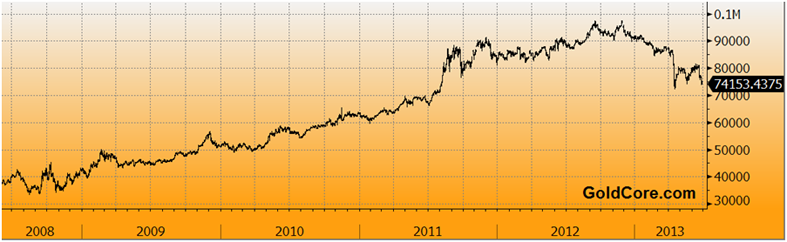
Gold in Indian Rupees (2008 to 2013)
Indians are seeking ways to circumvent any prohibition and acquire
gold which is the most popular form of saving in India. Many are
concerned about the status of gold savings schemes that they had
invested in to accumulate gold coins for future use.
The All India Gems and Jewellery Trade Federation, which represents
90% of jewellers, had come out with an open call on Monday to its
members to stop selling gold bars and coins.
This has triggered a lot of concerns among consumers who have put
their money in a few gold savings schemes – some of which were launched
during the recent crash of the gold price in April.
Assuaging fears, president of the Madras Jewellers and Diamond
Merchants’ Association Jayantilal Challani said, “Though we have asked
our members to stop sales of coins by July 1, all the schemes will
continue and consumers will get the promised quantity of gold, but may
be in the form of jewellery of their choice.”
However, this has caused a lot of concern among the public as they
stand to lose out due to the very high premiums on jewellery versus
those on coins and bars. There are concerns that gold dealers will use
this as an opportunity to sell much more expensive jewellery.
Another unintended consequence of the Indian government’s extremely
anti gold policies will be the growth of smuggling and a black market in
gold.
Ironically, it may also lead to Indian people, particularly the
wealthier middle classes and high net worth Indians to store their
bullion in safe jurisdictions which treat gold favourably such as Hong
Kong, Singapore and Zurich. In a worst case scenario, it could lead to
capital flight.