Saturday, June 1, 2013

What Is Wrong With The Economy Today

Nobody ever got successful by “getting a job”
People don’t get successful, by being employees, and therefore having the system be against them collecting money..
People only get successful by starting businesses or franchising them, and therefore having the system be in FAVOR, of them collecting money.
That’s a difference between being a businessman, and being a worker looking for “jobs”
You know whats wrong with the economy ?
We became a nation of employees who rely on 1 man for their pay, instead of customers.
That’s what is ultimately wrong with the economy.
People are not taking advantage of capitalism..
Capitalism can only help you, if you take advantage of it..
I have a phrase I like to use…
You can’t be successful, by having the system of money and profits and productivity be AGAINST YOU..
This is an employee… “do you like me?”
This is a businessman “how may I help you today?”
The day you ask somebody else, if they like you, that’s the day you are going to be a failure.
You can only be successful by asking people “how may I help you today”

Lindsay

“New Currency Order”: US Dollar Losing Reserve Status And The Japanese Yen, Swiss Franc and Yuan Are Gaining

The Dying Dollar and the Rise of a New Currency Order
For years now, the collapse of the dollar has been in the cards. Recent developments show mounting pressure on the dollar’s reserve currency status. With a major international deflation going on, the threat of inflation through money printing is unreal. However, should the dollar’s reserve currency status end, the repatriation of trillions of petro- and eurodollars could lead to a strongly inflationary scenario.
The roles of a reserve currency are to finance international trade and to function as a store of value for Governments. Until the second world war it used to be the British pound, but with the demise of the British Empire, the pound lost its international relevance and was overtaken by the dollar. This was formalized in the 1944 Bretton Woods system. All other currencies were fiat currencies, but pegged to the dollar, which in turn was pegged to Gold at 40 dollars an ounce and redeemable for international trading partners.
…
Conclusion
We are seeing the advent of the new currency order. There will be a number of more or less equal blocks: a dollar zone, a Yuan/BRICS zone and the euro, with the Yen and the Pound as lesser entities. These will later be able to converge to even more ‘cooperation’, in the Money Power’s relentless march towards World Currency.
These units will be at least partially Gold backed, implying long term deflationary pressures. Central Banks are buying Gold in major quantities, creating the interesting question why Gold prices have not risen in the last 18 months.
…
The hyperinflation scare that the Austrians have been promoting because of ‘money printing’ is ridiculous: we are in a stagflationary depression and prices are rising because of speculation, not because of excess money. But when the dollar loses its current status, long term price rises will become the norm.
The Greatest Depression has only just started.
http://realcurrencies.wordpress.com/2013/04/07/the-dying-dollar/
CNBC: US Dollar Losing Reserve Status
The U.S dollar is shrinking as a percentage of the world’s currency supply, raising concerns that the greenback is about to see its long run as the world’s premier denomination come to an end.
When compared to its peers, the dollar has drifted to a 15-year low, according to theInternational Monetary Fund, indicating that more countries are willing to use other currencies to do business.
While the American currency still reigns supreme — it constitutes $3.72 trillion, or 62 percent, of the $6 trillion in allocated foreign exchange holdings by the world’s central banks — the Japanese yen, Swiss franc and what the IMF classifies as “other currencies” such as the Chinese yuan are gaining.
…
“If the dollar loses status as the world’s most reliable currency the United States will lose the right to print money to pay its debt. It will be forced to pay this debt,” Bove said. “The ratings agencies are already arguing that the government’s debt may be too highly rated. Plus, the United States Congress, in both its houses, as well as the president are demonstrating a total lack of fiscal credibility.”
Bove is not the only one sounding the reserve currency alarm, though the issue has fallen off the front pages as hopes for a sustained U.S. recovery have taken hold and the stock market has surged to near-record highs.
http://www.cnbc.com/id/100461159
Kyle Bass, who knows a thing or two about economics and finance, recently spoke to a senior member of the Obama administration about their planned solutions for fixing the U.S. economy and trade deficit.
When I asked a senior member of the Obama administration last week, ‘How are we going to grow exports if we won’t allow nominal wage deflation?’
He says, ‘we’re just going to kill the dollar.’
http://www.thedailysheeple.com/economic-solution-senior-obama-official-we-are-going-to-kill-the-dollar_012013

U.S. Meat Processor in $4.7 Billion Sale to Chinese Company.

Shuanghui International Holdings Ltd., China’s biggest pork producer, agreed to acquireSmithfield Foods Inc. (SFD) for about $4.72 billion to boost supplies for the nation that’s the biggest consumer of the meat.
Closely held Shuanghui, parent of Henan Shuanghui Investment & Development Co. (000895), will pay $34 a share for the Smithfield, Virginia-based producer, both companies said today in a statement. The offer is 31 percent more than yesterday’s closing share price.
China’s consumption of pork is rising with the expansion of its middle class while there are questions being asked about the safety of the country’s food supply. Smithfield’s livestock unit is the world’s largest hog producer, bringing about 15.8 million of the animals to market a year, according to the company’swebsite. It owns 460 farms and has contracts with 2,100 others across 12 U.S. states.
http://www.bloomberg.com/news/2013-05-29/shuanghui-group-said-to-near-agreement-to-buy-smithfield-foods.html

DANGER! DANGER! DANGER! We Are Obviously In The Final Euphoric Parabolic Phase of A Third Stock Market Bubble

This could be the No. 1 reason to expect a stock market correction

From Gold Scents: “The market is now stretched further than any other time in the last three decades…”
I’m going to start off today and show you what Fed policy has given us over the last decade and a half. What the Fed has accomplished has been one bubble after another.
…


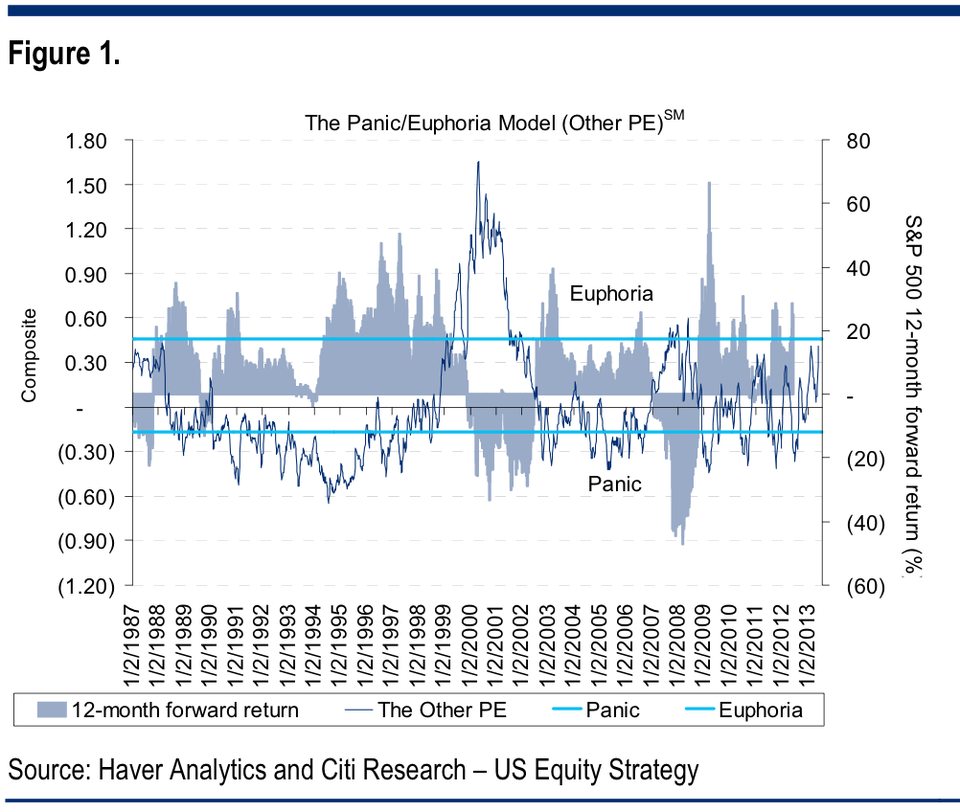
CITI: The Stock Market Is Getting Dangerously Close To ‘Euphoria’ Territory

A “meaningful spike.”
….
Complacency and euphoria are the types of things that will exacerbate market volatility should a sell-off come.
Here’s Levkovich’s chart of the Panic/Euphoria model:

citi panic euphoria
Citi Research

What you should know about the surge in stock buybacks - ”Is this another case of ‘here we go again?’”


From Global Economic Trend Analysis: Factset Buyback Quarterly has an interesting series of charts and facts on corporate share buybacks.
Here is my favorite chart in the series.
 
Aggregate Buybacks: Dollar-value share repurchases amounted to $93.8 billion over the fourth quarter and $384.3 billion for 2012. The fourth quarter total is in-line with that of Q3, but represented year-over-year growth of 9.6%.
Sector Trends: The Information Technology and Health Care sectors spent the most on quarterly repurchases ($19.8 billion and $14.4 billion, respectively) in Q4 2012. However, of the sectors that averaged $2 billion or more in quarterly share repurchases since 2005, the Industrials sector showed the largest sequential and year-over-year growth (30.6% and 59.4%) in dollar-value buybacks.
Buyback Conviction: Dollar-value buybacks amounted to 79.1% of free cash flow on a trailing twelve month basis, which is the largest value since Q3 2008. The Consumer Discretionary and Consumer  Staples sectors both spent more than 100% of their free cash flow (116.7% and 114.2%, respectively). The Energy and Utilities sectors spent $35.8 billion and $1.4 billion, respectively, on buybacks, despite generating negative free cash flow (-$25.7 billion and -$23.5 billion). The Consumer Discretionary sector also led all sectors in repurchasing the most shares relative to its size. Over the trailing twelve months, the sector repurchased shares that amounted to 4.5% of the sector’s average shares outstanding over the year.
Timing Suspect at Best 
One look at the above chart is all it takes to see most shares are bought back at high prices rather than low prices….

NYSE Margin Debt Rises To New All Time High As Net Worth Slides To Record Low

From zerohedge: With everything else in uncharted territory: central bank balance sheets, the stock market, global debt, it was only a matter of time before that old-school indicator of exuberance - margin debt - also joined the ranks of things that are “off the charts.” Never one to disappoint (except when Waddell and Reed dumps a “massive” 75,000 ES trade which promptly kills its liquidity replenishment points of course), the NYSE has reported that April margin debt, as expected, hit all time records, just in time for the S&P’s own all time high fireworks spectacular.  Rising from the just shy of summer of 2007 levels posted in March, or $380 billion, April margin debt not surprisingly rose to a record high of $384 billion. Additionally, even when netting out account credit metrics, such as Free Credit Cash and Credit Balances in margin accounts, total investor net worth just hit an all time record low of ($106) billion.
In short: investors have never been more levered.

…

Warning: A “bond vortex” could be just around the corner

From Bruce Krasting: I got an email from a friend who runs money for a hedge fund that got my interest:
“May want to take a look at convexity vortex in mbs market and implications…” 
“Convexity vortex”? What’s that about? A bit more from this fellow, I’ll call him “MP”:
Some familiar with it say the vortex is 19 bps away… 2.2% on ten year treasury, 3% on the CMM… if breaks, MBS holders subject to extension and duration risk. Would now have to increase convexity hedging. Would lead to price gaps and significant selling. With shortage of treasuries due to bernank and co. and low liquidity, could be very disruptive.
That got me interested. A layman’s explanation of convexity:
When mortgage interest rates fall, the probability that an individual will re-finance a mortgage increases. When mortgage interest rates increase, the likelihood of a re-financing of the mortgage goes down. Therefore, in a rising rate environment, the average life of a pool of mortgages increases.
For example, if a bond fund held Mortgage Backed Securities (MBS) with an assumed 10-year average life, AND interest rates rose, the average life of the MBS portfolio would be extended for a few years. This is convexity.
The last thing that a bond manager wants in a rising rate environment is to have the average maturity of the portfolio extended, as this adds to the losses. As a result, MBS players hedge their portfolios against “duration risk” by shorting Treasuries (ten-year paper).
The higher rates go (and the speed that rates are increasing) forces more and more of the convexity selling.
MP believes that there is a magic number of around 2.2% on the ten-year bond that will bring out an avalanche of convexity selling. The 2.2% tipping point is very close to where the T-bond sits today.
The fellow who brought this to my attention is a perm-bear on bonds. Given that, I sought out a confirmation from another guy (call him JH) who has been bullish on bonds for many years. JH sits on the bond desk of a big international bank. When I posed the question to the Bond Bull I got a surprising response…

Peak Gold: Demand Will Soar As Global Supplies Dwindle *Video*

Mac Slavo
May 31st, 2013
SHTFplan.com

peakgold
It’s been said that all of the gold mined throughout the history of mankind could fit into just three Olympic-sized swimming pools.
With rising fuel and labor costs, successful mining operations have been few and far between, simply because there’s very little, if any, easily accessible gold, as well as its close cousin silver, left in the ground. According to Peak Resources, the supply of gold is now so limited that just 1 in 1600 new gold projects ever get off the ground. One of the key reasons for this is because mine operators have to dig deeper and spend much more money than ever before – often times just to break even.
When you consider the supply fundamentals, and couple them with the high levels of demand experienced in recent months, you can see that regardless of what is listed as the official ‘paper market’ price, gold is likely going much higher. And that’s before we even get into the monetary expansion aspect of the discussion.
While economists like Federal Reserve Chairman Ben Bernanke vehemently deny gold’s value as a mechanism of exchange, and leading market analysts take to writing obituaries for gold’s demise amid recent price swings, the fact is that all signs point to a continuation of the long-term trend.
Gold is going higher.
Michael Wittmeyer, the President of leading online gold and silver dealer JM Bullion, shares the sentiment of many precious metals investors regarding recent price movements:
There seems to be a segregation between paper and physical metals at the moment, as physical demand has never been so strong, yet metals continue to slide in the paper markets and fail to find support at any of the historical key levels thus far.
My personal recommendation is to stay the course, try to lock in the lower prices to average in a lower overall cost-basis on your metals portfolio, and stay focused on the big picture, where the fundamental reasons to own physical metals are as strong as ever.
If you’ve been paying attention, then you’ve no doubt realized that the fundamentals Mr. Wittmeyer speaks of are pretty clear cut.
The big picture is that the fundamentals for gold, despite a massive hit to its price in recent months, have not changed.
The following micro-documentary explains why we may well be on the cusp of Peak Gold, a turning point in the precious metals market that will continue to strain supply while demand across the world explodes to unprecedented levels:
Gold has no flag or allegiance… as the fiat currencies get devalued to deal with the sovereign debt crisis, gold demand will soar.
The problem and opportunity we see is that the supply is already maxed out. So, if a wave of demand comes, we can see the gold price move rapidly on supply and demand fundamentals.
The inflation will simply be icing on the cake.
Via Peak Resources:

So, the question is, do we follow the direction of Federal Reserve Chairman Ben Bernanke, who suggests gold is simply a relic, and focus our investments on his preferred asset class – the US dollar denominated Treasury Bond?
Or, do we side with over 5,000 years of history, which has shown precious metals to be the go-to store of wealth during times of uncertainty and upheaval?

Top 1% Own 39% Of All Global Wealth: Hoarding Soars As We Hurtle Toward Economic Oblivion

By Michael
Little Boy - Poverty In Africa - Photo by Herman Pieters
According to a study that was just released by Boston Consulting Group, the wealthiest one percent now own39 percent of all the wealth in the world.  Meanwhile, the bottom 50 percent only own1 percent of all the wealth in the world combined.  The global financial system has been designed to funnel wealth to the very top, and the gap between the wealthy and the poor continues to expand at a frightening pace.  The global elite continue to hoard wealth and heap together enormous mountains of treasure in these troubled days even though the economic suffering around the planet continues to grow.  So exactly how have the global elite accumulated so much wealth?  Well, one of the primary ways is through the use of debt.  As I have written about previously, there is about 190 trillion dollars of debt in the world but global GDP is only about 70 trillion dollars.  Our debt-based global financial system systematically transfers wealth from us and our governments into the hands of the global elite.  And of course the gigantic banks and corporations that the elite control are constantly gobbling up everything of value that they can find: natural resources, profitable small businesses, real estate, politicians, etc.  Money, power, ownership and control are becoming very, very tightly concentrated at the top of the food chain, and that is a very dangerous thing for humanity.  When too much money and power gets into too few hands, it almost always results in tyranny.
What will eventually happen when the global elite have ALL the wealth?
Will the rest of us work as serfs in a system that they have iron-fisted control over?
And what if they decide that they don’t really need billions of people working for them?  Will they decide to implement population control measures in order to reduce the number of “useless eaters”?  It is already happening in China and other highly centralized societies.
When all of the economic rewards of a society go to a very small handful of people, it tends to be very destabilizing.  We have seen this again and again throughout history.
When people have everything taken away from them and they have nothing left to lose, they tend to become very desperate.  And right now we are rapidly hurtling toward a time of great global instability.  Anger and frustration are growing all over the globe, and the rate at which the gap between the wealthy and the poor is widening seems to be accelerating.  Just check out these numbers…
-The wealthiest 1 percent of the global population now owns 39 percentof all the wealth on the planet.
-According to a report that was released last summer, the global elite have up to 32 TRILLION dollars stashed in offshore banks around the planet.
-According to a study conducted by Credit Suisse, the bottom two-thirds of the global population owns just 3.3% of all the wealth.
-A study by the World Institute for Development Economics Research discovered that the bottom half of the world population ownsapproximately 1 percent of all global wealth.
-It is estimated that the entire continent of Africa only ownsapproximately 1 percent of the total wealth of the world.
-Approximately 1 billion people throughout the world go to bed hungry each night.
-If you can believe it, more than 3 billion people currently live on less than 2 dollar a day.
In the world that we live in, money equals power.  And the more money that the top one percent accumulate, the more power they will accumulate as well.
So exactly who are the top one percent?  I discussed this at length in my previous article entitled “Who Runs The World? Solid Proof That A Core Group Of Wealthy Elitists Is Pulling The Strings“.  The global elite are absolutely obsessed with power and control and they have been working to implement their agenda for a very long time.  In the end, they hope to unite the entire planet under a monolithic global system that they control.  They are actually quite open about this – it is just that most people do not want to believe it.

The gap between the wealthy and the poor is rapidly growing in the United States as well.  Sadly, this means that the middle class is steadily disappearing as the ranks of those that are living in povertycontinues to increase.
But of course not everyone is doing badly in the U.S. right now.  In fact, those that own stocks have had lots of reasons to celebrate in recent months.
So who owns stocks?
Well, the wealthy do of course.  In fact, approximately 60 percent of all individually held stocks are owned by the top 5 percent of all Americans.
During the last recession, Americans lost 16 trillion dollars of wealth.  Since then, about 45 percent of that wealth has been “recovered”, but the vast majority of that “recovery” has been due to rising stock prices.  The following comes from a recent Washington Post article…
From the peak of the boom to the bottom of the bust, households watched a total of $16 trillion in wealth disappear amid sinking stock prices and the rubble of the real estate market. Since then, Americans have only been able to recapture 45 percent of that amount on average, after adjusting for inflation and population growth, according to the report from the St. Louis Fed released Thursday.
In addition, the report showed most of the improvement was due to gains in the stock market, which primarily benefit wealthy families. That means the recovery for other households has been even weaker.
“A conclusion that the financial damage of the crisis and recession largely has been repaired is not justified,” the report stated.
Once upon a time, the United States had the largest and most thriving middle class in the history of the world.  That was a great thing.  But now the middle class is being destroyed and government dependence has surged to an all-time high.
The following are some of the incredible statistics that show how wide the gap between the wealthy and the poor in America is becoming…
-The wealthiest 1 percent of all Americans now own more than a thirdof all the wealth in the United States.
-In the United States today, the wealthiest one percent of all Americans have a greater net worth than the bottom 90 percent combined.
-According to Forbes, the 400 wealthiest Americans have more wealth than the bottom 150 million Americans combined.
-The six heirs of Wal-Mart founder Sam Walton have as much wealth as the bottom one-third of all Americans combined.
-On average, households in the top 7 percent have 24 times as much wealth as households in the bottom 93 percent.
-Between 2009 and 2011, the wealth of the bottom 93 percent of all Americans declined by 4 percent, while the wealth of the top 7 percent of all Americans increased by 28 percent.
-The poorest 50 percent of all Americans collectively own just 2.5% of all the wealth in the United States.
-The top 0.01% of all Americans make an average of $27,342,212.  The bottom 90% make an average of $31,244.
For much more on how poverty is rising and the middle class is being destroyed, please see my recent article entitled “22 Facts That Prove That The Bottom 90 Percent Of America Is Systematically Getting Poorer“.
Obviously we have a huge problem here.
With each passing day, poverty is rising and more people are becomingdependent on the government.
So what is the solution to this mess?
Please feel free to voice your opinion by posting a comment below…

EU Diminishes Austerity: Is It a Trend Yet?

European countries to be allowed to ease austerity... The European Commission has said it will allow some EU member states to slow their pace of austerity cuts, amid concerns over growth. France, Spain, Poland, Portugal, the Netherlands and Slovenia are all being given more time to complete their austerity plans. France will get two more years to bring its budget deficit below 3% of GDP. Commission president Jose Manuel Barroso said the extra time must be "used wisely" to lift competitiveness. − BBC
Dominant Social Theme: Everything is just fine in the EU. We are making some minor adjustments.
Free-Market Analysis: Again we note a shifting of the EU conversation. The implacable authoritarian rigor of the Eurocrats is moderating, and we believe it is because the EU economy is in such wretched shape that its leaders fear outright rebellion.
This was mentioned by German officials the other day and we wrote an article about it, commenting on the sudden concern that such individuals were evincing.
In fact, this is a new phase for the EU. If we are correct, those at the top fear they have gone too far. It is one thing to create an economic disaster in order to deepen a political union; it is another to live with it for a number of years.
Desperation inures people to risk and alienates them from the civil systems that have been built up around them. If the Eurocrats are raising a generation that simply does not believe in regulatory democracy because they have seen it doesn't work, then where does that leave the great federal experiment?
It is an uneasy balancing act, as we have long pointed out, and we think we see in these anti-austerity policies the beginning of an unfreezing of Brussels's severity. Maybe the Southern PIGS are not so lazy after all.
Or perhaps the Eurocrats are simply frightened, finally, that the entire authoritarian edifice they've erected is about to come crashing down. Either way, their attitude seems to be shifting.
The measures came as part of the European Commission's country-specific recommendations. Spain, Poland and Slovenia will also get two more years to bring down their budget deficits though spending cuts and tax increases. The Netherlands and Portugal are having their timetables extended by one year.
Even Europe's stronger economies, including Germany, are being urged to allow wage increases and increase flexibility in the jobs market to improve competitiveness. With regard to the UK, the commission's report includes recommendations for action on the housing supply and rental market, more affordable and better quality childcare, and improving youth training.
It also says that there is not enough transport spending. 'Demanding' timetable Europe remains broadly in recession. The 17-member eurozone shrank by 0.2% in the first three months of the year, and is expected to register negative growth for 2013 as a whole. There has been concern that the focus on fiscal consolidation in many EU states has worsened the economic situation.
This month, the central bank in Frankfurt cut interest rates to a record low of 0.5% and said it was "ready to act if needed". In an official statement, the Commission said the extra time should be used to enact reforms. "Giving more time for certain member states to meet their agreed objectives is designed to enable them to accelerate efforts to put their public finances into order and carry out overdue reforms," it said.
"Reform efforts must be stepped up to credibly produce the required outcomes within the new deadlines and excessive deficits must be corrected." Mr Barroso stressed that the decision to allow some member states to slow the pace of austerity was made on purely economic and financial grounds, rather than for political reasons.
The article also makes mention of increased stimulation by the European Central Bank, a significant and illegal act. But this brings up the issue of what seems to be the Eurocrats ultimate plan, which is to deepen the controlling federal elements of the EU while fighting a rearguard action against public fatigue and rage.
It is a very important issue, this balancing act, though little reported on. As the EU unwinds economically, the fate of the union and certainly the euro hangs in the balance. That's why we may be seeing these slight signs of retreat.
Conclusion: The import is significant from a political, economic and investment standpoint. We shall need more evidence to consider whether this is becoming a dominant or subdominant social theme. But if the Eurocrats begin to back away from austerity in full cry, we shall be more confident in asserting that their plans have shifted and their agenda delayed by what they have themselves wrought out of arrogance and hubris.

Bilderberg 2013: Attendees Scared as Protestors Accumulate

The Bilderberg Group’s meeting in Britain this year could prove to be a spectacle, as protesters and journalists aaccumulate over security budget concerns.

VIRGINIA: June 2012 - Bilderberg attendee Heather Reisman (born August 28, 1948) is a Canadian businesswoman. Reisman is the founder and chief executive of the Canadian retail chain Indigo Books and Music. (Photo: Shepard Ambellas, Intellihub.com)
VIRGINIA: June 2012 – Bilderberg attendee Heather Reisman (born August 28, 1948) is a Canadian businesswoman. Reisman is the founder and chief executive of the Canadian retail chain Indigo Books and Music. (Photo: Shepard Ambellas, Intellihub.com)
Intellihub.com
May 30, 2013
BRITAIN — For the first time in fifteen years the secretive Bilderberg Group will be meeting on British soil at the Watford Hotel, starting June 6th. Amongst the attendees will be some of the most diabolic, powerful, wealthy, royalty, politicians, head’s of state, and white collar criminals from all corners of the globe.
However, the pressure has intensified for the secretive Bilderburg Group in recent times, as thousands of protestors attended last years meeting which took place in Chantilly Virginia. This event was documented by Intellihub.com’s founder and director, Shepard Ambellas, and his crew as a historical ‘turning point’.
This year protestors and citizens alike are catching on, that their ‘tax dollars’ are being used to protect this private cabal. In fact, the Telegraph reports, “Hertfordshire police have refused to release the cost of security for the event, which has previously drawn anti-capitalist demonstrators in other locations around the world.
However, they are in talks with the Home Office about a grant for “unexpected or exceptional costs” that is only given out if it threatens the stability of the force’s policing budget. The final bill would have to total more than one per cent of the police force’s overall spend – or about £1.8 million – for the grant to be successful.”
Locals are not happy with the expenditures.
Henry De Castries, Chairman of AXA, and Peter Thiel are set to attend in 2013

Please Comment below!


Sources: 

^http://www.telegraph.co.uk/news/politics/10089131/British-taxpayers-to-pay-millions-towards-secretive-Bilderberg-meeting-security.html
^http://intellihub.com/about-us/staff-writers-contributors/shepard-ambellas/