Capitalism is based on managing its inherent crises. It is also
based on the need to maximise profit, beat down competitors, cut
overheads and depress wages. In the 1960s and 70s, in the face of
increasing competition from abroad, the US began to outsource
manufacturing production to bring down costs by using cheap foreign
labour. Other countries followed suit. Even more jobs were lost through
the impulse to automate. To provide a further edge, trade unions and
welfare were attacked in order to suppress wages at home. Problem
solved. Or was it?
Not really. As wages in the west stagnated or decreased and
unemployment increased, the market for goods was under threat – if
people have less money to buy things, then what to do? New problem, new
‘solution’ – lend people money and create a debt-ridden consumer
society. Of course, it produced great opportunities for investors in
finance, and all kinds of dubious financial derivatives and products
were created, sold to the public and repackaged and shifted around the
banking system. That market became saturated and the debt bubble burst.
This time around the ‘solution’ is to print money and give bailouts to
the banks to cover their gambling losses and to get them lending once
again. With a huge hole appearing in state coffers due to the bailouts
and national debt spiraling during the years of neo-liberalism, the
current crisis has become an opportunity for the finance sector to exert
long-term debt-related control over sovereign states, including public
asset stripping via ‘austerity’.
On a global level, as local democracy is usurped by the influence of
international finance and powerful corporate interests under the guise
of ‘globalisation’, traditional agricultural practices and local
economies have been ‘structurally adjusted’ (via single-crop
export-oriented policies to earn foreign currency to pay off debt, dam
building to cater for what became a highly water intensive
chemical-based industry, more loans and indebtedness and the unnecessary
shifting food around the planet) and farmers forced from their land.
The fact that such people can then at least swarm to some sprawling,
overburdened city and, if lucky, get a few dollars a day job in an
outsourced sweatshop or call centre is somehow passed off as
capitalism’s ‘economic miracle’.
It’s apparent that, as the academic David Harvey states, the problems
created by capitalism don’t get solved, they just get shifted around.
Nowhere is this epitomized more clearly than the role of US agribusiness
in India.
According to Jeffrey M Smith from the Institute for Responsible
Technology, Russia, China and the EU were not the pushovers for GMOs
that US agribusiness hoped they would be. However, with the US having
sanctioned the opening up of India’s nuclear energy sector and, in
return, its agribusiness and retail giants having actively shaped the
Knowledge Agreement on Agriculture, India might well be proving to be an
easier option.
Before GMOs became news in India, it was already clear that US
agribusiness could not provide real solutions to the agrarian problems
it had created with its ‘Green Revolution’. According to Gautam Dheer’s
recent piece in India’s Deccan Herald newspaper (1), agriculture in
Punjab (the ‘Green Revolution’s’ original poster boy) is facing an
inevitable crisis, in terms of pesticide use causing cancer, falling
crop yields and groundwater depletion. The model it has adapted is
unsustainable. Indeed, what is happening in Punjab could be the tip of
the iceberg as far as chemical agriculture in India (and elsewhere) is
concerned.
And now evidence is mounting that agribusiness can’t provide genuine
solutions to the problems it has also created through its GMOs, seed
patenting and monopolies either.
A recent report in Business Standard (2) stated that such Bt cotton
(GMOs represent the ‘Green Revolution’s’ second coming) yields have
dropped to a five-year low. India approved Bt cotton in 2002 and within a
few years yields increased dramatically. However, Glenn Davis Stone,
Professor of Anthropology and Environmental Studies at Washington
University in St. Louis, has noted that most of the rise in productivity
had nothing to do with Bt cotton. (3)
What’s more, since Bt has taken over, yields have been steadily
worsening. According to the article in Business Standard (2), it seems
bollworms are developing resistance. Contrary to what farmers were
originally told, the Monsanto spokesperson quoted in the Business
Standard piece says that such resistance is to be expected. Stone says
when Bt cotton arrived in India, farmers were told that they wouldn’t
have to spray any more. All that farmers had to do was plant the seeds
and water them regularly. They were told that, as the genetically
modified seeds are insect resistant, there was no need to use huge
amounts of pesticides.
The premise adopted by the GM sector was that for years people had
tried to change ‘backward’ tradition-bound practices of these farmers.
But now all you have to do is give them the magic biotech seed.
Now that resistance has appeared, Stone notes that, according to
Monsanto’s spokesperson, it’s all the Indian farmers’ fault! The
spokesperson explains in Business Standard that ‘limited refuge
planting’ is one of the factors that may have contributed to pink
bollworm resistance. Using the ‘wrong’ biotech seed is another.
The answer from the biotech sector to combat falling yields is
continuous R&D to develop new technologies to stay ahead of insect
resistance. Innovation from the GM sector is going to guarantee higher
yields. Isn’t that what we were hearing ten years ago? Of course it is.
It’s a massive con-trick.
Stone says that yields started dropping after 2007/8. After 2006/7,
the number of Bt hybrid seeds being offered to farmers jumped from 62 to
131 to 274; by 2009/10 there were 522. Despite this, farmers’ yields
are steadily dropping. And the way forward – more of the same!
The failing technology can always be replaced with more
destined-to-fail technology, but one that at least offers a short-term
fix. In the meantime, the Indian government effectively subsidises US
agribusiness via compensation given to farmers whose cotton crops have
failed, as is the case in Maharashtra (4).
Now that the government and Western agribusiness have conspired to
set the corporate controlled merry-go-round in motion, there may be
little chance of getting off. Having had control stripped from them,
farmers may well be forever beholden to US agribusiness which took their
power.
Privately owned agribusiness, as is the way with capitalism in
general, is based on short-termism. Its predator corporations in India
are merely engaged in managing and thus profiting from the crises they
themselves have conspired to produce with their destruction of
traditional agriculture and local economies and their chemical inputs
and genetic engineering. By its very nature, as part of the logic of
capitalism,US agribusiness is designed to stumble from one crisis to the
next. And it will do so by hiding behind the banners of ‘innovation’ or
‘research and development’.
And with each new ‘fix’, with each technology, with each new
pesticide, herbicide, GM innovation, we become further removed from
working in harmony with nature as we attempt to dominate it with some or
other biotechnology that further damages both ourselves and the
environment. But, it’s all good business. And that’s all that really
matters. There’s always money to be made from blaming the victims (in
this case, farmers) for the mess created and from a continuous state of
crisis management (aka ‘innovation’ and bombarding farmers with a
never-ending stream of new technologies); and, as we are well aware in
India’s case, there’s money to be made from the suffering of others.
Ultimately, this is what capitalism is all about: planned
obsolescence – planned obsolescence of its products, in order that
profits can be made from a stream of new ‘wonder’ products and, as far
as India is concerned, planned obsolescence of its farmers as
agribusiness sets out to uproot tradition and shape farming in its own
chemical and genetically engineered image.
Capitalism doesn’t solve its problems, it just shifts them around.
And part of the great con-trick is that it attempts to pass off its
endless crises and failures as brilliant successes.
Thursday, February 21, 2013

I-Team: Boston Cemetery Workers Forced To Take Drastic Pay Cuts
BOSTON (CBS) – It’s hard labor.
Every day, nine workers maintain hundreds of thousands of graves at the New Calvary, Mt. Calvary, Mt. Benedict and St. Mary’s Cemeteries in Boston.
Bob Lawler, the owner of Lawler and Crosby Funeral Home, says he’s known the workers for decades. “They’ve been there 30, 35 years. And these guys are the best. They know exactly what they’re doing.”
But the workers were forced to take drastic pay cuts: A 13 percent slash in pay for two straight years. This reduced their base salaries down to almost $30,000 a year with deep cuts in benefits as well.
A worker, who asked us to hide his identity for fear he would be fired for speaking out, describes the pay cuts as devastating. “It’s just done in such a cold, calculated way,” He says. “It’s unconscionable what they have done to this workforce.”
He’s talking about the bosses, the 12 board members of the Boston Catholic Cemetery Association.
They cut the workers’ pay, but they keep paying themselves as a group more than two hundred thousand dollars a year for working only 5, 7 or 12 hours a week.
Board member Joe Leonard didn’t want to talk about their priorities, and told the I-Team, “Please leave now or I’ll call the police and have you arrested for trespassing.”
The I-Team went looking for Boston Catholic Cemetery Association Board President Walter May. May pays himself $36,000 a year for 12 hours of work a week. He also hired his grandson after laying off three longtime workers. We found May at his insurance company. He told the I-Team, “It’s none of your business. You know, we’re a private business. I really don’t know what Channel 4 is poking around in our business for.”
But State Senator Mike Rush says it is other people’s business. “They are a not-for-profit, and because of that I think every taxpayer in the Commonwealth of Massachusetts has a right to know.”
State Rep. Ed Coppinger says he wants to know, “What’s going on behind the scenes and are their finances in order?”
Sen. Rush and Rep. Coppinger are pushing a bill that would force all cemetery associations to open their books.
For the workers, it’s a matter of financial survival.
The worker tells us, “It’s heartbreaking, it just breaks your heart. It’s crushing.”
The Cemetery Association’s lawyer says the pay cuts were the result of a union contract bargained in good faith.
Sen. Rush and Rep. Coppinger have now asked the Inspector General and Attorney General to investigate.
Gold's Regular Morning Mugging
Not everyone is a morning person. And few people like Mondays.
But if you're a precious metals investor, mornings – especially Mondays – are brutal.
Below are the daily gold price charts (source: Kitco) for each Monday (or Tuesday, if Monday was a holiday) since early this year. The current day's gold price is noted by the bright green line. The morning takedown is highlighted by the orange oval.


The first is that the price suppression is commencing increasingly in advance of the start of the NYMEX's open outcry process at 8:20am EST (i.e., how trading happens at the NYMEX). This suggests that it's being done on behalf of powerful players granted permission to circumvent the rules.
 The second is that the volume levels in this pre-open trading is
similar to that seen during active hours. That is very unusual in
markets, and exceptionally high.
The second is that the volume levels in this pre-open trading is
similar to that seen during active hours. That is very unusual in
markets, and exceptionally high.

[Update: after initially writing this, I noticed Zero Hedge posted a related analysis today of the takedowns in silver for the month of February so far. Like gold, the selling is concentrated in the first few hours of the day on the NYMEX]
Instead, this is behavior one would expect to see if powerful interests wanted to suppress the price of gold: hit the price hard and early at the start of the trading week to prevent the price from building upward momentum, as well as to make capital think twice before entering the gold market.
Who is doing this selling at the market open? Is it TBTF ("too big to fail") banks making profit on large short positions? Is it the Fed, through proxies, keeping the gold price contained so as not to signal how badly QE is devaluing the dollar? Allegations swarm across the Internet that it's one of these – or both. But we don't know for certain. The exchanges don't make that information available to the public.
But while these charts above are not enough evidence to prove that the gold price is being manipulated, they sure exhibit the symptoms one would expect to see if it is.
So, the big question is: if the precious metals market is being manipulated, is it wise to be in it?
History is littered with the bodies of investors whose investment thesis was right, but whose timing was wrong. Even though precious metals investors may be correct in their fundamental rationale for buying gold, can the precious metals markets remain held in check (or driven further down) for long enough that it's not worth the risk of owning the metals at all right now?
From our perspective here at Peak Prosperity, for all of the reasons explored in the Crash Course and discussed here daily, we firmly believe that fundamentals will ultimately matter most. And when they fully express themselves, there will be a tremendous re-pricing of assets – largely higher for tangible assets that require energy to obtain, and markedly lower for paper claims on wealth (stocks, bonds, and their derivatives).
But as we've often said, the corrective process may very well take much longer than we ever expected to arrive. Frankly, we're amazed that the system has held together so well over the past 5 years with all of the thin-air money printing, trillion-dollar deficits, and $100 oil. If you are playing to the fundamentals, as we are, you need to be eyes-wide-open that you may be frustrated for far longer than you'd like to be.
So, if you decide to bet on the continued success of the status quo, your choices are easy: Get in the paper markets and go long. The Fed will be adding $85 billion of liquidity rocket fuel each month for the rest of the year to push the prices of your paper investments even higher.
But if you choose the fundamentals, here are a few important guidelines to keep in mind:
But every time we go through the exercise of challenging our assumptions, we walk away feeling certain that our charted course is the correct one – and that at some point, fundamentals will prevail.
As for what those fundamentals are, there's a seminal piece Chris wrote back in 2011 called The Screaming Fundamentals for Owning Gold and Silver that is even more true today. I highly recommend revisiting it.
Chris has mentioned many times that this market feels an awful lot like 2007, when asset prices powered ever higher month after month, even though the underlying data was deteriorating fast. As then, he sees a high and rising potential for a violent correction that will take the market by surprise and vaporize a lot of wealth before players are able to react.
It's times like these when you need to have the courage of your convictions and hold fast to whatever course of action you have decided upon after careful, considered analysis. During these trying periods, it's helpful to converse with a community of like-minded thinkers who can help remind you of the facts underlying your rationale – which is why I recommend joining PeakProsperity.com's Gold & Silver Group if you own PMs. It's a great source of both informational and emotional support.
Chris and I will continue to closely track the developments in the precious metals markets and report back on any material changes to our outlook as they develop. In the meantime, we'll be holding fast. We hope you'll be doing the same, too.

But if you're a precious metals investor, mornings – especially Mondays – are brutal.
The Evidence
The precious metals are routinely sold off at or soon after the 8:20am EST morning open of the New York NYMEX exchange.Below are the daily gold price charts (source: Kitco) for each Monday (or Tuesday, if Monday was a holiday) since early this year. The current day's gold price is noted by the bright green line. The morning takedown is highlighted by the orange oval.
Monday, January 7
Gold is taken down $10 immediately after the 8am NYMEX openMonday, January 14
A late breaking rally begun on the London exchange is quickly contained at the NYMEX open, and then beaten down nearly $10. Notice that the previous Friday's gold price action (the bright blue line) also showed the same behavior at the same time, but with an even more severe response once the NYMEX opened.Monday, January 21
The 8am sell-off is smaller here (only a few $), but still noticeable.Monday, January 28
Again, a sell-off happens after the 8am open. Note again how the previous Friday's action was similar, but even more severe.Monday, February 4
Finally, an outlier. While there was an initial dip in the first hour of the NYMEX, the price took off soon after. So let's not count this one.Monday, February 11
An immediate $14 drop at the 8am open. The downward momentum started in London, but the vertical downdraft once the NYMEX opened is unmistakable.Tuesday, February 19
While less sharp, the steady selling clearly begins at 8am, beating gold down $12 to the technically significant $1,600 threshold.Volume & Timing
Running the above data by Chris, he noted two additional observations.The first is that the price suppression is commencing increasingly in advance of the start of the NYMEX's open outcry process at 8:20am EST (i.e., how trading happens at the NYMEX). This suggests that it's being done on behalf of powerful players granted permission to circumvent the rules.
Silver
For those wondering, the daily price charts for silver indicate measurably similar action during these gold takedowns. Not in exact lockstep, but directionally similar both in degree and timing.[Update: after initially writing this, I noticed Zero Hedge posted a related analysis today of the takedowns in silver for the month of February so far. Like gold, the selling is concentrated in the first few hours of the day on the NYMEX]
...they appear to be strangely collected in a brief four hour window at the start of the day... the black line is the average of the day's performance in February across the dates selected.
Charts: Bloomberg

The Conundrum
It's hard to swallow that these charts are evidence of a free and efficient market. Otherwise, a pattern this predictable would be quickly removed as traders and HFT algos piled in to a "sure" bet.Instead, this is behavior one would expect to see if powerful interests wanted to suppress the price of gold: hit the price hard and early at the start of the trading week to prevent the price from building upward momentum, as well as to make capital think twice before entering the gold market.
Who is doing this selling at the market open? Is it TBTF ("too big to fail") banks making profit on large short positions? Is it the Fed, through proxies, keeping the gold price contained so as not to signal how badly QE is devaluing the dollar? Allegations swarm across the Internet that it's one of these – or both. But we don't know for certain. The exchanges don't make that information available to the public.
But while these charts above are not enough evidence to prove that the gold price is being manipulated, they sure exhibit the symptoms one would expect to see if it is.
So, the big question is: if the precious metals market is being manipulated, is it wise to be in it?
History is littered with the bodies of investors whose investment thesis was right, but whose timing was wrong. Even though precious metals investors may be correct in their fundamental rationale for buying gold, can the precious metals markets remain held in check (or driven further down) for long enough that it's not worth the risk of owning the metals at all right now?
The Decision
As I laid out in Time To Choose, investors are facing a junction where they need to make a decision. Since rising markets and fiscal policy have divorced themselves from fundamentals, the gap between "what is" and "what should be" is widening. The weighting of your capital allocation needs to be based on which side you see winning out here.From our perspective here at Peak Prosperity, for all of the reasons explored in the Crash Course and discussed here daily, we firmly believe that fundamentals will ultimately matter most. And when they fully express themselves, there will be a tremendous re-pricing of assets – largely higher for tangible assets that require energy to obtain, and markedly lower for paper claims on wealth (stocks, bonds, and their derivatives).
But as we've often said, the corrective process may very well take much longer than we ever expected to arrive. Frankly, we're amazed that the system has held together so well over the past 5 years with all of the thin-air money printing, trillion-dollar deficits, and $100 oil. If you are playing to the fundamentals, as we are, you need to be eyes-wide-open that you may be frustrated for far longer than you'd like to be.
So, if you decide to bet on the continued success of the status quo, your choices are easy: Get in the paper markets and go long. The Fed will be adding $85 billion of liquidity rocket fuel each month for the rest of the year to push the prices of your paper investments even higher.
But if you choose the fundamentals, here are a few important guidelines to keep in mind:
- Build your core position in allocated (or better, personally held) physical bullion. It will never go to $0, you've removed or minimized counter-party risk, it can't be rehypothecated, and is often the most anonymous way to acquire PMs.
- If you invest in "paper" gold, do it with money you can afford to lose. Risks of all sorts (price manipulation, counter-party risks, market shortages, rule changes, trackability, etc.) are all much higher. Read the prospectuses carefully, and make sure to only invest in those funds that fully back their shares with bullion (vs. futures contracts).
- Don't use leverage. Don't let your enthusiasm make you vulnerable. Many leveraged ETFs lose money over time due to transaction costs even if the metals rise. And when the markets stay flat for prolonged times – or worse, go down – they can be widowmakers.
A Time to 'Hold Fast'
It's only human to have your confidence shaken when the market acts so completely differently than you think it should for so prolonged a time. Chris and I feel the same pain, both constitutionally as well as in our wallets, as much of our net worth is invested in the PMs.But every time we go through the exercise of challenging our assumptions, we walk away feeling certain that our charted course is the correct one – and that at some point, fundamentals will prevail.
As for what those fundamentals are, there's a seminal piece Chris wrote back in 2011 called The Screaming Fundamentals for Owning Gold and Silver that is even more true today. I highly recommend revisiting it.
Chris has mentioned many times that this market feels an awful lot like 2007, when asset prices powered ever higher month after month, even though the underlying data was deteriorating fast. As then, he sees a high and rising potential for a violent correction that will take the market by surprise and vaporize a lot of wealth before players are able to react.
It's times like these when you need to have the courage of your convictions and hold fast to whatever course of action you have decided upon after careful, considered analysis. During these trying periods, it's helpful to converse with a community of like-minded thinkers who can help remind you of the facts underlying your rationale – which is why I recommend joining PeakProsperity.com's Gold & Silver Group if you own PMs. It's a great source of both informational and emotional support.
Chris and I will continue to closely track the developments in the precious metals markets and report back on any material changes to our outlook as they develop. In the meantime, we'll be holding fast. We hope you'll be doing the same, too.
(click on image if in need of dramatic inspiration)
Gold Bull Market `Still Intact' Says HSBC's Respected Steel
Today’s AM fix was USD 1,602.00, EUR 1,195.34 and GBP 1,045.76per ounce.
Yesterday’s AM fix was USD 1,613.50, EUR 1,208.80 and GBP 1,041.57 per ounce.
Silver is trading at $29.07/oz, €21.83/oz and £19.9/oz. Platinum is trading at $1,664.50/oz, palladium at $753.00/oz and rhodium at $1,225/oz.
Gold fell $4.00 or 0.25% yesterday in New York and closed at $1,604.90/oz. Silver slipped to a low of $29.22 before it also rebounded, but it still finished with a loss of 1.31%.

Cross Currency Table – (Bloomberg)
Gold fell to $1,591/oz today, as market digests data about a possible global recovery occurring which is sending investors to riskier assets. German business sentiment hit its greatest level in 3 years adding to the optimism.
The yellow metal is being bolstered by Asian bargain hunters and prices usually fall off when their markets close.
Shanghai Gold Exchange most active futures and spot gold contracts fell to their lowest levels in 7 months.
Chartists note the "death cross" formation on the spot gold chart, where the 50-day moving average is dropping below its 200-day moving average, which hints that a pullback could be on the way.
The RSI or Relative Strength Index which has fallen below 30 since late last week shows that the market has been oversold.
Investors will examine the wording in the minutes of the U.S. Federal Reserve's latest policy meeting, due at 1900 GMT.

Gold Spot $/oz, 23FEB11-20FEB13 – (Bloomberg)
James Steel, HSBC analyst, talks about the outlook for gold and silver markets. He speaks with Sara Eisen, Alix Steel and Adam Johnson of Bloomberg and recently just revised his silver forecast.

James Steel, HSBC analyst (USA Inc) interviewed by Bloomberg
Alix Steel : What triggered the steep decline on Friday, February 15th? You had Ben Bernanke and G20 saying the global economy was improving. China was out of the market for the Lunar New Year holiday. Plus, major fund holder George Soros was dumping his position in GLD. Did that create a sentiment shift out of gold for momentum players?
Jim Steel: What you've seen this year longer term are the following:
3 Key Items taken out of the picture
1. Disruption of the fiscal cliff.
2. Hard landing in China has not materialized, outlook is better there.
3. Withdrawal of Greece from EU.
These key items all helped support the gold market. However, these risks have diminished. Therefore, gold is a barometer of geo political & economic events.
Alix Steel: Were this long term or short term investors (referring to the Friday)?
Jim Steel: Short term in duration. If you look at the COMEX over last 12 years not any one week has any of the major funds not owned gold, they have only reduced their positions.
Alix Steel: Why would anyone want to own gold? It’s a safe haven during times of crisis and things are getting better, and it doesn't pay a dividend and George Soros is selling 100 million of his gold holdings.
Jim Steel: Well you don't get much of a yield on most things. Negative real interest rates is supportive of gold bullion going forward and also there is still uncertainty in the currency markets and gold is an alternative form of currency.
Alix Steel: We haven't really seen a lift from the currency wars rhetoric?
Jim Steel: Still its within a broad range that the bull market is still intact. Don't forget it was only a few years ago when Obama took office and gold was around $900/oz.
Adam Johnson: Silver and palladium why not buy them?
Jim Steel: We're moderately bullish on all the precious metals. We adjusted our silver forecast up to $33/oz from $32/oz for this year based on electronic strength in that space as 1/2 of it goes to industrial applications.
Adam Johnson: What are precious metals correlating to?
Jim Steel: That's what makes gold interesting, the Dunbar quant team in London have researched that gold is uncorrelated for risk on and risk off assets. It is precisely that which makes it interesting to portfolio managers.
Today: (GoldCore Webinar ) - How to Protect and Grow Your Wealth
Join us for a webinar today Wednesday 20th February at 1pm with guest presenter Eddie Hobbs. Eddie will provide valuable insight into the outlook for the US and the global economies. He will also outline why he believes that gold, and now also silver, are important from a diversification point of view for Irish people who wish to both protect and grow their wealth in the coming years.
Join Eddie in this 45 minute webinar as he untangles the complexity of the global economy and how it will affect you, and presents his findings in a no-nonsense and easy-to-understand manner.
Click here to register.
Yesterday’s AM fix was USD 1,613.50, EUR 1,208.80 and GBP 1,041.57 per ounce.
Silver is trading at $29.07/oz, €21.83/oz and £19.9/oz. Platinum is trading at $1,664.50/oz, palladium at $753.00/oz and rhodium at $1,225/oz.
Gold fell $4.00 or 0.25% yesterday in New York and closed at $1,604.90/oz. Silver slipped to a low of $29.22 before it also rebounded, but it still finished with a loss of 1.31%.

Cross Currency Table – (Bloomberg)
Gold fell to $1,591/oz today, as market digests data about a possible global recovery occurring which is sending investors to riskier assets. German business sentiment hit its greatest level in 3 years adding to the optimism.
The yellow metal is being bolstered by Asian bargain hunters and prices usually fall off when their markets close.
Shanghai Gold Exchange most active futures and spot gold contracts fell to their lowest levels in 7 months.
Chartists note the "death cross" formation on the spot gold chart, where the 50-day moving average is dropping below its 200-day moving average, which hints that a pullback could be on the way.
The RSI or Relative Strength Index which has fallen below 30 since late last week shows that the market has been oversold.
Investors will examine the wording in the minutes of the U.S. Federal Reserve's latest policy meeting, due at 1900 GMT.
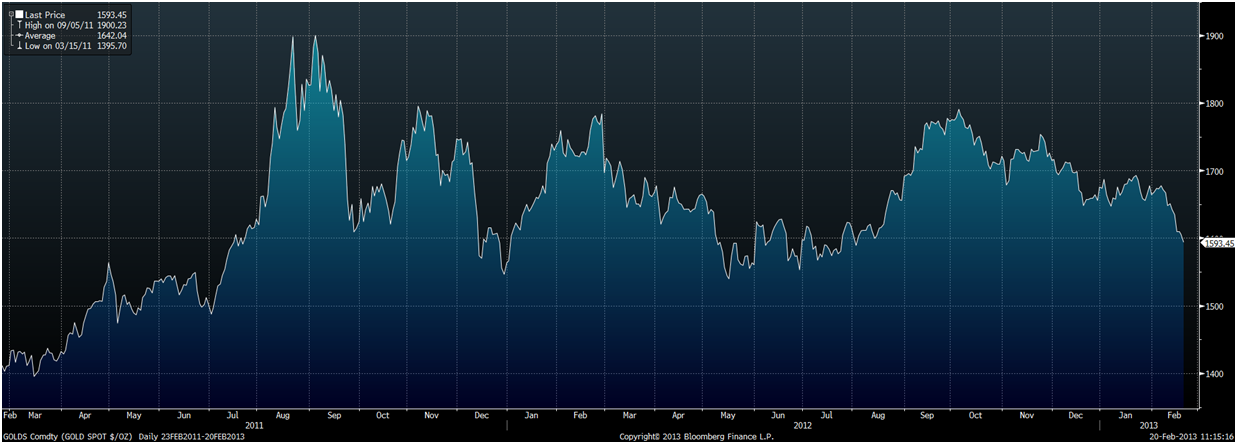
Gold Spot $/oz, 23FEB11-20FEB13 – (Bloomberg)
James Steel, HSBC analyst, talks about the outlook for gold and silver markets. He speaks with Sara Eisen, Alix Steel and Adam Johnson of Bloomberg and recently just revised his silver forecast.

James Steel, HSBC analyst (USA Inc) interviewed by Bloomberg
Alix Steel : What triggered the steep decline on Friday, February 15th? You had Ben Bernanke and G20 saying the global economy was improving. China was out of the market for the Lunar New Year holiday. Plus, major fund holder George Soros was dumping his position in GLD. Did that create a sentiment shift out of gold for momentum players?
Jim Steel: What you've seen this year longer term are the following:
3 Key Items taken out of the picture
1. Disruption of the fiscal cliff.
2. Hard landing in China has not materialized, outlook is better there.
3. Withdrawal of Greece from EU.
These key items all helped support the gold market. However, these risks have diminished. Therefore, gold is a barometer of geo political & economic events.
Alix Steel: Were this long term or short term investors (referring to the Friday)?
Jim Steel: Short term in duration. If you look at the COMEX over last 12 years not any one week has any of the major funds not owned gold, they have only reduced their positions.
Alix Steel: Why would anyone want to own gold? It’s a safe haven during times of crisis and things are getting better, and it doesn't pay a dividend and George Soros is selling 100 million of his gold holdings.
Jim Steel: Well you don't get much of a yield on most things. Negative real interest rates is supportive of gold bullion going forward and also there is still uncertainty in the currency markets and gold is an alternative form of currency.
Alix Steel: We haven't really seen a lift from the currency wars rhetoric?
Jim Steel: Still its within a broad range that the bull market is still intact. Don't forget it was only a few years ago when Obama took office and gold was around $900/oz.
Adam Johnson: Silver and palladium why not buy them?
Jim Steel: We're moderately bullish on all the precious metals. We adjusted our silver forecast up to $33/oz from $32/oz for this year based on electronic strength in that space as 1/2 of it goes to industrial applications.
Adam Johnson: What are precious metals correlating to?
Jim Steel: That's what makes gold interesting, the Dunbar quant team in London have researched that gold is uncorrelated for risk on and risk off assets. It is precisely that which makes it interesting to portfolio managers.
Today: (GoldCore Webinar ) - How to Protect and Grow Your Wealth
Join us for a webinar today Wednesday 20th February at 1pm with guest presenter Eddie Hobbs. Eddie will provide valuable insight into the outlook for the US and the global economies. He will also outline why he believes that gold, and now also silver, are important from a diversification point of view for Irish people who wish to both protect and grow their wealth in the coming years.
Join Eddie in this 45 minute webinar as he untangles the complexity of the global economy and how it will affect you, and presents his findings in a no-nonsense and easy-to-understand manner.
Click here to register.
Pound tanks to €1.14 as Bank governor Sir Mervyn throws his weight behind more QE despite inflation risk
The pound slumped against the euro
and dollar as it emerged Bank of England governor Sir Mervyn King now
favours more emergency money printing to save Britain from a triple-dip
recession.
Sterling fell nearly 1 per cent to a 15-month low against the euro of €1.14 (87p to the euro) and hit a fresh seven-month low of $1.53 (65p) against the US dollar. The pound has now dropped a startling 7 per cent versus the euro and 5 per cent against the US dollar since the start of the year.
Sir Mervyn's change of heart was revealed in the latest monetary policy committee minutes, which showed that he and fellow rate-setters David Miles and Paul Fisher called for another £25billion in quantitative easing after growth figures showed the economy shrank at the end of 2012.
 A triple-dip recession would be confirmed if there is another decline in the current quarter, but
the trio were outvoted 6-3 as the MPC decided more targeted measures
would be more effective - particularly as the Banks latest quarterly
forecast warned that inflation was set to rise above the current 2.7 per
cent and remain above the 2 per cent target until early 2016.
A triple-dip recession would be confirmed if there is another decline in the current quarter, but
the trio were outvoted 6-3 as the MPC decided more targeted measures
would be more effective - particularly as the Banks latest quarterly
forecast warned that inflation was set to rise above the current 2.7 per
cent and remain above the 2 per cent target until early 2016.
The last time there was a similar 6-3 split on the BoE's monetary policy committee was in June 2012, and the following month a majority backed a £50billion pound increase in asset purchases.
In recent months, only Miles has supported an increase in QE from the current £375billion level.
Today's minutes said regarding inflation: 'The committee agreed that, as long as domestic cost and price pressures remained consistent with inflation returning to target in the medium term, it was appropriate to look through the temporary, albeit protracted, period of above-target inflation.
'Today sterling weakened against the US dollar and the euro as it was unveiled in the MPC minutes that three of the members, including the Governor, voted to increase the quantitative easing programme by £25billion to £400billion.
'However because of all the negative sentiment surrounding sterling, some missed the good news released at the same time. Record levels of employment in the UK.
'If one looked at a chart since the beginning of the year one would imagine that the UK economy compared to Europe was falling off a cliff.
'However structurally things are quite sound in the UK as within a sovereign debt crisis record levels of employment should be seen as a positive for a currency as this means less money spent by the Government to pay for jobless claims and more tax revenue.
'In the bigger picture FX is a ratio market which is a barometer for comparing the state of one economy against the other.
'It’s good to see that Europe has managed to survive the sovereign debt crisis; however structurally they still have lots of high hurdles and one of these is the level of unemployment up at 11.7 per cent at the last count.
'Sentiment can turn like the tide; however structural issues are harder to turn. At some stage sterling will reach a point like an elastic band when it has stretched too far!'
'Attempting to bring inflation back
to target sooner by removing the current policy stimulus more quickly
than currently anticipated by financial markets would risk derailing the
recovery and undershooting the inflation target in the medium term.'
Economists polled by Reuters had not expected the central bank to restart QE due to persistent inflation and its hope that other stimulus measures like the Funding for Lending Scheme will prove sufficient.
When the latest inflation forecasts were released, Sir Mervyn did not rule out more QE but said the benefit they could provide to the economy was getting smaller.
He predicted a slow recovery over the next three years after two years of stagnation due to a mix of eurozone turmoil, government austerity and high inflation hurting on consumer spending.
At its February meeting, the MPC also voted unanimously to keep rates at a record low of 0.5 per cent, and to reinvest the first proceeds of the QE programme which amount to around £6.6billion.
It is the first time since QE was launched in 2009 that any of the Government bonds, or ‘gilts’, purchased under the scheme have reached maturity. If the BoE didn't reinvest the proceeds they would be cancelled given that all the money in the QE programme was conjured out of thin air in the first place.
Although the pound took a battering at the prospect of more QE - indicating currency traders believe an interest rate rise that would revive enthusiasm for sterling remains a very distant prospect - stock investors welcomed the news and pushed the FTSE 100 up 32.7 points to 6,411.8 by early afternoon.
Howard Archer, economist at forecaster IHS Global Insight, said: 'With economic activity likely to remain fragile and limited, we believe that the BoE will eventually decide to give the economy a further helping hand with some more QE.
'This could very well happen in the second quarter or shortly after Mark Carney takes over as BoE Governor in July.
'Unless the news on the economy is really dire over the coming weeks, we suspect that the MPC will prefer to hold fire on any more QE until at least well into the second quarter given that consumer price inflation is set to hit 3% in the near term.
'Meanwhile, we expect interest rates to remain at 0.50% through 2013, and highly likely through 2014 as well.'
Archer added: 'Although the minutes of the February MPC meeting did not state that the pound may need to fall further to support exports and help the economy rebalance, the increased prospect of more stimulative action is likely to keep sterling under pressure.'
 Samuel Tombs, economist at Capital
Economics, said: 'February's UK MPC minutes provide another clear
demonstration of the committee's increasingly flexible approach to
inflation targeting.
Samuel Tombs, economist at Capital
Economics, said: 'February's UK MPC minutes provide another clear
demonstration of the committee's increasingly flexible approach to
inflation targeting.
'No member voted for tighter policy, despite the fact that the latest inflation report forecasts showed inflation on track to be well above the 2 percent target in two years' time.
'Today's minutes have therefore made us more comfortable with our view that more QE is likely this year, particularly if GDP growth continues to fall short of the committee's expectations.'
Alan Clarke, economist at Scotiabank, said: 'This kind of signal is designed to quash people speculating about rate hikes.
'When you've got the Bank of England forecasting inflation above target for the two years ahead, you don't want people to start speculating about rate hikes or tightening or the end of stimulus.'
Chris Saint, senior currency analyst at financial service firm Hargreaves Lansdown, said: 'The pound has now dropped a startling 7 per cent versus the euro and 5 per cent against the US dollar since the start of the year, amid growing fears the BoE might inject more monetary stimulus to guard against the threat of a triple-dip recession.
'The Bank’s latest policy meeting minutes vindicated these fears this morning.'
Sterling fell nearly 1 per cent to a 15-month low against the euro of €1.14 (87p to the euro) and hit a fresh seven-month low of $1.53 (65p) against the US dollar. The pound has now dropped a startling 7 per cent versus the euro and 5 per cent against the US dollar since the start of the year.
Sir Mervyn's change of heart was revealed in the latest monetary policy committee minutes, which showed that he and fellow rate-setters David Miles and Paul Fisher called for another £25billion in quantitative easing after growth figures showed the economy shrank at the end of 2012.
Sterling tanks: Pound fell off a cliff after Sir
Mervyn's surprise change of heart on QE was revealed in the latest BoE
minutes (Source: Yahoo! Finance)
The last time there was a similar 6-3 split on the BoE's monetary policy committee was in June 2012, and the following month a majority backed a £50billion pound increase in asset purchases.
In recent months, only Miles has supported an increase in QE from the current £375billion level.
Today's minutes said regarding inflation: 'The committee agreed that, as long as domestic cost and price pressures remained consistent with inflation returning to target in the medium term, it was appropriate to look through the temporary, albeit protracted, period of above-target inflation.
IS THE POUND NOW TOO LOW?
Currency expert Chris Towner of foreign exchange broker HiFX writes:
'Sterling is weakening on the back of sentiment which is often the case in the FX markets. 'Today sterling weakened against the US dollar and the euro as it was unveiled in the MPC minutes that three of the members, including the Governor, voted to increase the quantitative easing programme by £25billion to £400billion.
'However because of all the negative sentiment surrounding sterling, some missed the good news released at the same time. Record levels of employment in the UK.
'If one looked at a chart since the beginning of the year one would imagine that the UK economy compared to Europe was falling off a cliff.
'However structurally things are quite sound in the UK as within a sovereign debt crisis record levels of employment should be seen as a positive for a currency as this means less money spent by the Government to pay for jobless claims and more tax revenue.
'In the bigger picture FX is a ratio market which is a barometer for comparing the state of one economy against the other.
'It’s good to see that Europe has managed to survive the sovereign debt crisis; however structurally they still have lots of high hurdles and one of these is the level of unemployment up at 11.7 per cent at the last count.
'Sentiment can turn like the tide; however structural issues are harder to turn. At some stage sterling will reach a point like an elastic band when it has stretched too far!'
Economists polled by Reuters had not expected the central bank to restart QE due to persistent inflation and its hope that other stimulus measures like the Funding for Lending Scheme will prove sufficient.
When the latest inflation forecasts were released, Sir Mervyn did not rule out more QE but said the benefit they could provide to the economy was getting smaller.
He predicted a slow recovery over the next three years after two years of stagnation due to a mix of eurozone turmoil, government austerity and high inflation hurting on consumer spending.
At its February meeting, the MPC also voted unanimously to keep rates at a record low of 0.5 per cent, and to reinvest the first proceeds of the QE programme which amount to around £6.6billion.
It is the first time since QE was launched in 2009 that any of the Government bonds, or ‘gilts’, purchased under the scheme have reached maturity. If the BoE didn't reinvest the proceeds they would be cancelled given that all the money in the QE programme was conjured out of thin air in the first place.
Although the pound took a battering at the prospect of more QE - indicating currency traders believe an interest rate rise that would revive enthusiasm for sterling remains a very distant prospect - stock investors welcomed the news and pushed the FTSE 100 up 32.7 points to 6,411.8 by early afternoon.
Howard Archer, economist at forecaster IHS Global Insight, said: 'With economic activity likely to remain fragile and limited, we believe that the BoE will eventually decide to give the economy a further helping hand with some more QE.
'This could very well happen in the second quarter or shortly after Mark Carney takes over as BoE Governor in July.
'Unless the news on the economy is really dire over the coming weeks, we suspect that the MPC will prefer to hold fire on any more QE until at least well into the second quarter given that consumer price inflation is set to hit 3% in the near term.
'Meanwhile, we expect interest rates to remain at 0.50% through 2013, and highly likely through 2014 as well.'
Archer added: 'Although the minutes of the February MPC meeting did not state that the pound may need to fall further to support exports and help the economy rebalance, the increased prospect of more stimulative action is likely to keep sterling under pressure.'
Rate prediction: Plunge in pound indicates
currency traders believe an interest rate rise that would revive
enthusiasm for sterling remains a very distant prospect
'No member voted for tighter policy, despite the fact that the latest inflation report forecasts showed inflation on track to be well above the 2 percent target in two years' time.
'Today's minutes have therefore made us more comfortable with our view that more QE is likely this year, particularly if GDP growth continues to fall short of the committee's expectations.'
Alan Clarke, economist at Scotiabank, said: 'This kind of signal is designed to quash people speculating about rate hikes.
'When you've got the Bank of England forecasting inflation above target for the two years ahead, you don't want people to start speculating about rate hikes or tightening or the end of stimulus.'
Chris Saint, senior currency analyst at financial service firm Hargreaves Lansdown, said: 'The pound has now dropped a startling 7 per cent versus the euro and 5 per cent against the US dollar since the start of the year, amid growing fears the BoE might inject more monetary stimulus to guard against the threat of a triple-dip recession.
'The Bank’s latest policy meeting minutes vindicated these fears this morning.'
Are We Days Away From A Financial Collapse? Americans Haven’t Spent This Much On Gas In Nearly Three Decades, With The Exception of 2008, Investors Are Finally Dropping Their Fear And Went All In On Stock Market, Currency Wars Are Starting To Look A Bit Much Like 1931
Americans Haven’t Spent This Much Of Their Paycheck On Gas In 30 Years
4%.
Paid over $4.00 a gallon this weekend. This high this early in the year brings the gas price back on the macro radar screen.
The EIA notes,
Gasoline expenditures in 2012 for the average U.S. household reached $2,912, or just under 4% of income before taxes, according to EIA estimates. This was the highest estimated percentage of household income spent on gasoline in nearly three decades, with the exception of 2008, when the average household spent a similar amount.
“This hurts seriously,” says Brian Sozzi, chief equities analyst NBG Productions, warning that next week Americans will feel “payroll shock.”
The balance of power now rests with Japan, according to the bank, as Japan’s policy-makers’ more dovish approach looks set to bring the world a step closer to a currency war.
…
A Currency War Has Broken Out And Is Intensifying: Japan Will Keep Printing Until Nikkei Hits 13,000, The Fed Is Buying $85 Billion A Month Until Unemployment Hits 6.5%, ECB Launched Unlimited Bond Buying To Cap Governments’ Borrowing Costs, Venezuela And Egypt To Devalue Their Currency…
Paid over $4.00 a gallon this weekend. This high this early in the year brings the gas price
back on the macro radar screen.The EIA notes,
Gasoline expenditures in 2012 for the average U.S. household reached $2,912, or just under 4% of income before taxes, according to EIA estimates. This was the highest estimated percentage of household income spent on gasoline in nearly three decades, with the exception of 2008, when the average household spent a similar amount.
2% Payroll Tax Cut Expiration Is a Bigger Deal Than You Think: Sozzi
For as picked over and criticized as the Fiscal Cliff deal has been over the last few days, a tax break getting less attention than may have been expected is the one thing that impacts anyone taking home a paycheck. With the expiration of a temporary Social Security payroll tax everyone’s take home pay just fell 2%. The question is whether or not the reduction is going to be more of a problem than most investors think.“This hurts seriously,” says Brian Sozzi, chief equities analyst NBG Productions, warning that next week Americans will feel “payroll shock.”
CNBC: Currency Wars Return, 1930s Style: Who Will Lose Out?
As countries try to weaken their currencies to boost exports, the risk of a currency war similar to events seen in the 1930s has heightened, and policymakers are making sure they are on the winning side, according to Morgan Stanley.The balance of power now rests with Japan, according to the bank, as Japan’s policy-makers’ more dovish approach looks set to bring the world a step closer to a currency war.
…
A Currency War Has Broken Out And Is Intensifying: Japan Will Keep Printing Until Nikkei Hits 13,000, The Fed Is Buying $85 Billion A Month Until Unemployment Hits 6.5%, ECB Launched Unlimited Bond Buying To Cap Governments’ Borrowing Costs, Venezuela And Egypt To Devalue Their Currency…
Currency wars Are Starting To Look A Bit Much Like 1931
Bank Of America CEO Gets A Raise, Moynihan's $12.1M Beats Jamie Dimon's Pay
Here’s a sign of the banking times: Bank of America CEO Brian Moynihan was paid more than JPMorgan Chase chief Jamie Dimon in 2012.
 Moynihan was awarded some $12.1 million last year including a $950,000 salary and 926,238 in BofA shares at $12.03 each, according to a filing the bank made today.
Moynihan‘s compensation did not include a cash bonus as is typical for many financial firms when compensating their CEOs.
The missing cash bonus is not so surprising for Moynihan though. The head of the bank has been under pressure to revive the struggling bank and increase capital by increasing earnings, selling off non-core business units and cutting costs. BofA hit major trouble back in 2011 when its shares were trading for around $5 and investors questioned Moynihan’s ability to save the bank.
But the stock has recovered majorly, rallying over 60% in 2012 as Moynihan executed on his plan to cut costs and raise capital without issuing new shares.
Still, the bank isn’t taking any chances by awarding Moynihan big bucks. Though his compensation is up from 2011 when he took a $8.1 million pay package his salary this year remains locked at $950,000.
BofA knows it still has a lot to prove to investors and regulators as it climbs out of the ugly mess created by its merger with Countrywide which has resulted in billions in losses, fines and settlements for the bank. Next month, results from the Fed’s stress test will show just how far along BofA has come and whether or not it will be able to give investors bigger dividends.
Moynihan‘s 2012 compensation is up there, actually about a million more than JPM’s Jamie Dimon, whose pay package was $11.5 million for last year including a $1.5 million salary and $10 million in restricted stock. That’s a big cut for Dimon who in the previous year saw a pay package of $23 million. Dimon‘s big pay cut was the result of his bank’s massive London whale trading loss in May which cost it $6 billion.
Last month Jefferies Group said it was paying its CEO $19 million including a $1 million salary, a $5 million cash bonus (which he apparently voluntarily reduced from $8 million) and $13 million in stock.

Bank Of America chief, Brian Moynihan
Moynihan‘s compensation did not include a cash bonus as is typical for many financial firms when compensating their CEOs.
The missing cash bonus is not so surprising for Moynihan though. The head of the bank has been under pressure to revive the struggling bank and increase capital by increasing earnings, selling off non-core business units and cutting costs. BofA hit major trouble back in 2011 when its shares were trading for around $5 and investors questioned Moynihan’s ability to save the bank.
But the stock has recovered majorly, rallying over 60% in 2012 as Moynihan executed on his plan to cut costs and raise capital without issuing new shares.
Still, the bank isn’t taking any chances by awarding Moynihan big bucks. Though his compensation is up from 2011 when he took a $8.1 million pay package his salary this year remains locked at $950,000.
BofA knows it still has a lot to prove to investors and regulators as it climbs out of the ugly mess created by its merger with Countrywide which has resulted in billions in losses, fines and settlements for the bank. Next month, results from the Fed’s stress test will show just how far along BofA has come and whether or not it will be able to give investors bigger dividends.
Moynihan‘s 2012 compensation is up there, actually about a million more than JPM’s Jamie Dimon, whose pay package was $11.5 million for last year including a $1.5 million salary and $10 million in restricted stock. That’s a big cut for Dimon who in the previous year saw a pay package of $23 million. Dimon‘s big pay cut was the result of his bank’s massive London whale trading loss in May which cost it $6 billion.
Last month Jefferies Group said it was paying its CEO $19 million including a $1 million salary, a $5 million cash bonus (which he apparently voluntarily reduced from $8 million) and $13 million in stock.
Subscribe to:
Posts (Atom)