Saturday, February 16, 2013

Currency Wars Often Lead to Trade Wars … Which In Turn Can Devolve Into Hot Wars

d Currency Wars Often Lead to Trade Wars ... Which In Turn Can Devolve Into Hot Wars

Currency War → Trade War → Hot War?

According to numerous high-level insiders, the global currency war is accelerating:
And Japan’s escalation of the currency war has caused leaders in the Eurozone (more), Norway, Sweden, South Korea, Taiwan, Columbia, Mexico, Peru, Chile, Venezuela and many other regions to devalue or consider further devaluing their currencies. China may be joining as well.  (And James Rickard and Reggie Middleton think that Germany’s demand for its gold is part of the currency war.)
We’ve been in a global currency war for years.
As the Wall Street Journal asked in 2010:
Beggar-thy-neighbor currency devaluations proved ruinous for the global economy in the 1930s. Is the world setting off down the same slippery slope again?
Yes, we are.
Despite drivel from ignorant sources, currency wars don’t help the average person.
Quantitative easing – the main lever to depreciate currency – hurts the little guy and only helps the super-elite.
Former Secretary of Labor Robert Reich points out that a weak dollar makes everyone poorer … and any new jobs created by a a policy of devaluation are low-wage jobs.
Economist Mark Thoma noted in 2010:
While the positive effects a currency war produced in the 1930s [many disagree] are unlikely to reappear, there is a chance of large negative effects such as a simultaneous trade war or the breakdown of the international monetary system, so let’s hope a currency war can be avoided.
Philadelphia Federal Reserve Bank president Charles Plosser notes that currency wars would only hurt world trade and the economies that were involved.
The IMF noted in 2010 that currency wars “would represent a very serious risk to the global recovery”.
Even Paul Krugman is not that keen on currency wars.

Trade Wars

It is widely accepted that currency wars can lead to trade wars. As Time notes:
A competitive devaluation game can turn into a trade war, whereby losing countries start slapping tariffs on imports and exports to punish countries deemed to be “manipulating” their currencies. Trade wars, of course, make stuff more expensive for everyone, and that’s just about the last thing global consumers – increasingly squeezed by rising unemployment and inflation – need.
Nouriel Roubini agrees.
Indeed, there are signs that currency war induced trade wars are already starting.  And see this.

Hot Wars

Brazilian president-elect Rousseff said in 2010:
The last time there was a series of competitive devaluations … it ended in world war two.
Billionaire investor Jim Rogers says:
Trade wars always lead to wars.
Top trend forecaster Gerald Celente has said for years that currency wars turn into trade wars … which in turn lead to hot wars.
Jim Rickards agrees:
Currency wars lead to trade wars, which often lead to hot wars. In 2009, Rickards participated in the Pentagon’s first-ever “financial” war games. While expressing confidence in America’s ability to defeat any other nation-state in battle, Rickards says the U.S. could get dragged into “asymmetric warfare,” if currency wars lead to rising inflation and global economic uncertainty.
Indeed, trade wars have been leading to hot wars for thousands of years.  For example, the war between Rome and Carthage – leading to elephants in the mountains surrounding Rome – essentially started as a trade war.
Indeed, with top economic forecasters predicting war, the American policy of using the military to contain China’s growing economic influence, and the U.S. considering economic rivalry to be a basis for war, the global currency and trade wars are creating a tinderbox.

Dollar Sibor May Be Discontinued Amid Global Rate-Rigging Probe

Singapore’s central bank and a group of lenders are in talks to put an end to the city-state’s U.S. dollar-linked interbank lending rate as regulators worldwide probe allegations of rigged benchmark borrowing costs, a person with knowledge of the matter said.
Members of the Singapore Foreign Exchange Market Committee examined the proposal in a Jan. 22 meeting, during a discussion of the Monetary Authority of Singapore’s review of benchmark rates, said the person, who asked not to be identified as the discussions are confidential. The group may instead use the U.S. dollar London interbank offered rate, the person said.

The banks are reviewing the process for setting the Singapore interbank offered rates amid a probe into the manipulation of key interest rates spanning markets from the U.S. and U.K. to Hong Kong and Japan. Barclays Plc, UBS AG and Royal Bank of Scotland Group Plc have been penalized $2.6 billion for rigging the U.K.’s Libor, and the scandal is now set to engulf interdealer brokers such as ICAP Plc.
Singapore’s central bank will probably announce changes to the benchmark rates and the process for setting them by the end of June, the person said. The Monetary Authority of Singapore doesn’t comment on its internal operations, a spokesperson for the regulator said yesterday.

Homeowners’ Mortgages

Sibor, used to price debt ranging from commercial term- loans to homeowners’ mortgages, is calculated on behalf of the Association of Banks in Singapore. Each day, the 12 contributing banks are asked how much it would cost to borrow Singapore dollars from each other for different periods from one month to 12 months. The three highest and lowest quotes are excluded, and the six in the middle of the range are averaged and published at 11:30 a.m. in Singapore.
The process of setting the benchmark rates is still under review, Ong-Ang Ai Boon, a director at the Association of Banks in Singapore, said yesterday. She declined to comment further.
In July, the Monetary Authority of Singapore said it’s looking into how banks set key interest rates, mirroring reviews under way in financial centers from Sweden to South Korea.
The city-state’s regulator is working with the group of banks and the currency traders’ committee to review how Sibor can be strengthened, and has also directed the banks to independently review their internal submission processes, Lawrence Wong, a senior minister of state who sits on the monetary authority’s board, said in Singapore’s parliament on Sept. 10.

Currency Speculation

On Sept. 24, the central bank said it asked the banks to extend their review to include non-deliverable forwards, a derivative traders use to speculate on the movement of currencies that are subject to domestic foreign exchange restrictions. UBS, based in Zurich, and RBS suspended at least three traders in Singapore as part of probes into the manipulation of those rates, two people with knowledge of the matter said in October.
The U.S. dollar Sibor rate was set yesterday at 0.15667 percent for overnight loans, and at 0.295 percent for a three- month tenure, according to ABS data compiled by Bloomberg. That compares with rates of 0.155 percent for overnight loans and 0.2901 percent for three-month loans in U.S. dollars that banks in London say they pay, figures from the British Bankers’ Association show.
The Singapore Foreign Exchange Market Committee will meet again next month, the person said. The group, which aims to set industry standards and a code of conduct for currency traders, has 20 members including the Monetary Authority of Singapore and the nation’s sovereign wealth fund, as well as banks including JPMorgan Chase & Co., UBS and RBS, according to its website.

Libor Fines

Lenny Feder, group head of financial markets at London- based Standard Chartered Plc, who chairs the SFEMC, declined to answer any questions when contacted on his mobile phone yesterday. Standard Chartered hosted the meeting last month at its Singapore offices, according to the person.
RBS, Britain’s biggest publicly owned lender, was fined $612 million by regulators in the U.K. and the U.S. last week for rigging the London interbank offered rate and similar benchmarks. The Edinburgh-based lender said it would recoup the U.S. portion of the penalty by shrinking its bankers’ bonus pool and clawing back awards from previous years.
More than a dozen traders made hundreds of attempts to manipulate yen and Swiss franc Libor between mid-2006 and 2010 to benefit their trading positions, sometimes colluding with other firms, the U.S. Commodity Futures Trading Commission said.
The attempts to manipulate Libor -- which are at the heart of the biggest and longest-running scandal in banking history -- flourished for years, even after bank supervisors were made aware of the system’s flaws.
The British Bankers’ Association, the lobby group that oversees Libor, is cutting currencies and maturities included in the benchmark where there is insufficient trading data to estimate borrowing costs accurately. The BBA will stop quoting rates in Australian and New Zealand dollars as well as the Canadian dollar, Danish kroner and Swedish kronor rates by June. The group will stop publishing interim maturities, such as the two-week, four-month, and eight-month tenors for all currencies at the end of May.

Facebook Gets a Multibillion-Dollar Tax Break

Facebook Founder and Chief Executive Officer Mark Zuckerberg addresses the TechCrunch Conference
Photograph by C Flanigan/WireImage
Facebook Founder and Chief Executive Officer Mark Zuckerberg addresses the TechCrunch Conference


It hasn’t drawn much attention, but Facebook’s first annual earnings report contains an accounting gem: a multibillion-dollar tax deduction for the cost of executive stock options and share awards.
Even though Facebook (FB) reported $1.1 billion in pre-tax profits from U.S. operations in 2012, it will probably pay zero federal and state taxes—and even receive a federal tax refund of about $429 million—according to a Feb. 14 statement from Citizens for Tax Justice.
The tax-research and -lobbying organization says companies such as Facebook should treat stock options the same in their reports to shareholders as they do in their tax filings. Citizens for Tax Justice calls the tax footnotes in Facebook’s Jan. 30 financial statement “an amazing admission,” but there’s nothing illegal about the breaks the company is claiming. Companies like Facebook are allowed to treat the cost of non-cash compensation, such as stock options, as an expense that reduces profits, essentially the way they treat cash compensation such as salaries.
The difference is that Facebook—unlike, say, General Motors (GM)—relies heavily on stock options and restricted stock units as a form of compensation. It paid out a lot during its years as a private company that it must now recognize on its income statement and balance sheet.
You won’t find any $429 million tax refund in Facebook’s financial statements. Indeed, the company says it had a $559 million federal tax liability in 2012. But that liability isn’t an actual payment. In a footnote, the company also said that it had a $1.03 billion “excess tax benefit” last year related to “stock option exercises and other equity awards.” That benefit is what flips the federal tax liability into a refund. (A small portion is applied against state taxes.)
Facebook says that it anticipates reducing its tax liability in the future by an additional $2.17 billion by using further net operating loss carry-forwards that it has banked.
Facebook spokeswoman Ashley Zandy declined to discuss the tax break but pointed to the transcript of Facebook executives’ conference call with analysts. On the call, Chief Financial Officer David Ebersman cited the accumulated tax benefits and noted that the company ended the fiscal year with nearly $10 billion in cash and investments, “giving us great flexibility and risk protection.”

SEC sues over Heinz option trading before buyout


(Reuters) - U.S. securities regulators filed suit on Friday against unknown traders in the options of ketchup maker H.J. Heinz Co, alleging they traded on inside information before the company announced a deal to be acquired for $23 billion by Warren Buffett's Berkshire Hathaway Inc and Brazil's 3G Capital.
The suit, in federal court in Manhattan, cites "highly suspicious trading" in Heinz call options just prior to the February 14 announcement of the deal. The regulator has frequently in past filed suit against unnamed individuals where it has evidence of wrongdoing, but is still trying to uncover the identities of those involved.
That trading, the suit said, caused the price of the particular call option they bought to soar 1,700 percent and generated unrealized profits of more than $1.7 million.
The regulator claims the traders are either in, or trading through accounts in, Zurich, Switzerland. The account had no history of trading in Heinz over the last six or so months.
It has also obtained an emergency order to freeze assets in the Swiss account linked to the trading. In the suit, the SEC refers to the account as the "GS Account" and in a statement Goldman Sachs Group Inc said it was cooperating with the regulator's investigation.
"Irregular and highly suspicious options trading immediately in front of a merger or acquisition announcement is a serious red flag that traders may be improperly acting on confidential nonpublic information," Daniel Hawke, chief of the SEC's Division of Enforcement's Market Abuse Unit said in a statement.
Representatives of Heinz and Berkshire Hathaway were unavailable for immediate comment. A 3G representative declined to comment. The founder of 3G, Jorge Paulo Lemann, is from Brazil, but has made a home in Switzerland since the 1990s. He has not been implicated in any wrongdoing related to the deal.
After the deal was revealed on Thursday, options market experts called Wednesday's trading "suspicious and incredibly well-timed." [ID:nL1N0BEBMR]
The suit marks the second time in less than six months that the SEC has taken action over a 3G acquisition. In September 2012, the regulator got a court order to freeze the assets of a Wells Fargo & Co stockbroker who allegedly traded on inside information about 3G's 2010 acquisition of Burger King.
In that case, the SEC said the stockbroker got the information from a client who had invested in one of 3G's funds.
The suit also marks the second time in two years that controversy has erupted over a Berkshire acquisition target.
In March 2011, Berkshire struck a deal to buy chemical company Lubrizol for $9 billion. Less than three weeks later, Berkshire said Buffett lieutenant David Sokol was resigning and disclosed he had been buying Lubrizol shares while pushing Buffett to acquire the company. The SEC dropped a probe into Sokol's trading earlier this year.
The suit is Securities and Exchange Commission v. Certain Unknown Traders in the Securities of H.J. Heinz Co, U.S. District Court, Southern District of New York, No. 13-1080.
(Reporting by Jonathan Stempel and Bernard Vaughan.; Writing by Ben Berkowitz.; Editing by Leslie Adler, David Gregorio Tim Dobbyn and Andre Grenon)

It’s the Interest, Stupid! Why Bankers Rule the World


In the 2012 edition of Occupy Money released last week, Professor Margrit Kennedy writes that a stunning 35% to 40% of everything we buy goes to interest. This interest goes to bankers, financiers, and bondholders, who take a 35% to 40% cut of our GDP. That helps explain how wealth is systematically transferred from Main Street to Wall Street. The rich get progressively richer at the expense of the poor, not just because of “Wall Street greed” but because of the inexorable mathematics of our private banking system.
This hidden tribute to the banks will come as a surprise to most people, who think that if they pay their credit card bills on time and don’t take out loans, they aren’t paying interest. This, says Dr. Kennedy, is not true. Tradesmen, suppliers, wholesalers and retailers all along the chain of production rely on credit to pay their bills. They must pay for labor and materials before they have a product to sell and before the end buyer pays for the product 90 days later. Each supplier in the chain adds interest to its production costs, which are passed on to the ultimate consumer. Dr. Kennedy cites interest charges ranging from 12% for garbage collection, to 38% for drinking water to, 77% for rent in public housing in her native Germany.
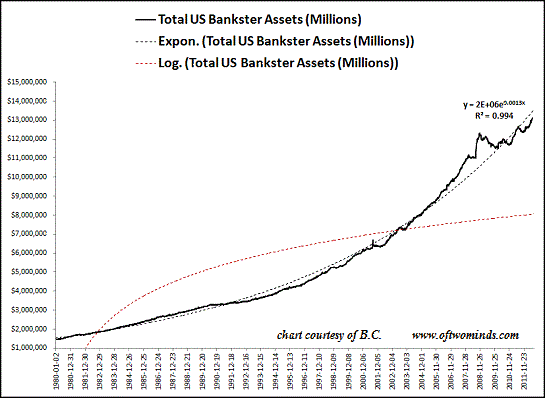
Her figures are drawn from the research of economist Helmut Creutz, writing in German and interpreting Bundesbank publications.  They apply to the expenditures of German households for everyday goods and services in 2006; but similar figures are seen in financial sector profits in the United States, where they composed a whopping 40% of U.S. business profits in 2006.  That was five times the 7% made by the banking sector in 1980.  Bank assets, financial profits, interest, and debt have all been growing exponentially.

http://www.oftwominds.com/blogsept12/cui-bono-Fed9-12.html.

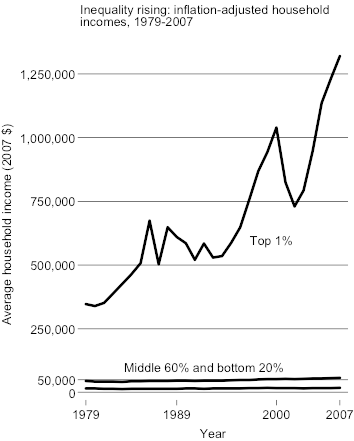
Exponential growth in financial sector profits has occurred at the expense of the non-financial sectors, where incomes have at best grown linearly.

http://lanekenworthy.net/2010/07/20/the-best-inequality-graph-updated/

By 2010, 1% of the population owned 42% of financial wealth, while 80% of the population owned only 5% percent of financial wealth.  Dr. Kennedy observes that the bottom 80% pay the hidden interest charges that the top 10% collect, making interest a strongly regressive tax that the poor pay to the rich.
Exponential growth is unsustainable. In nature, sustainable growth progresses in a logarithmic curve that grows increasingly more slowly until it levels off (the red line in the first chart above). Exponential growth does the reverse: it begins slowly and increases over time, until the curve shoots up vertically (the chart below). Exponential growth is seen in parasites, cancers . . . and compound interest. When the parasite runs out of its food source, the growth curve suddenly collapses.

People generally assume that if they pay their bills on time, they aren’t paying compound interest; but again, this isn’t true.  Compound interest is baked into the formula for most mortgages, which compose 80% of U.S. loans.  And if credit cards aren’t paid within the one-month grace period, interest charges are compounded daily.
Even if you pay within the grace period, you are paying 2% to 3% for the use of the card, since merchants pass their merchant fees on to the consumer.  Debit cards, which are the equivalent of writing checks, also involve fees.  Visa-MasterCard and the banks at both ends of these interchange transactions charge an average fee of 44 cents per transaction—though the cost to them is about four cents.
How to Recapture the Interest: Own the Bank
The implications of all this are stunning. If we had a financial system that returned the interest collected from the public directly to the public, 35% could be lopped off the price of everything we buy. That means we could buy three items for the current price of two, and that our paychecks could go 50% farther than they go today.
Direct reimbursement to the people is a hard system to work out, but there is a way we could collectively recover the interest paid to banks. We could do it by turning the banks into public utilities and their profits into public assets. Profits would return to the public, either reducing taxes or increasing the availability of public services and infrastructure.
By borrowing from their own publicly-owned banks, governments could eliminate their interest burden altogether.  This has been demonstrated elsewhere with stellar results, including in CanadaAustralia, and Argentina among other countries.
In 2011, the U.S. federal government paid $454 billion in interest on the federal debt—nearly one-third the total $1,100 billion paid in personal income taxes that year.  If the government had been borrowing directly from the Federal Reserve—which has the power to create credit on its books and now rebates its profits directly to the government—personal income taxes could have been cut by a third.
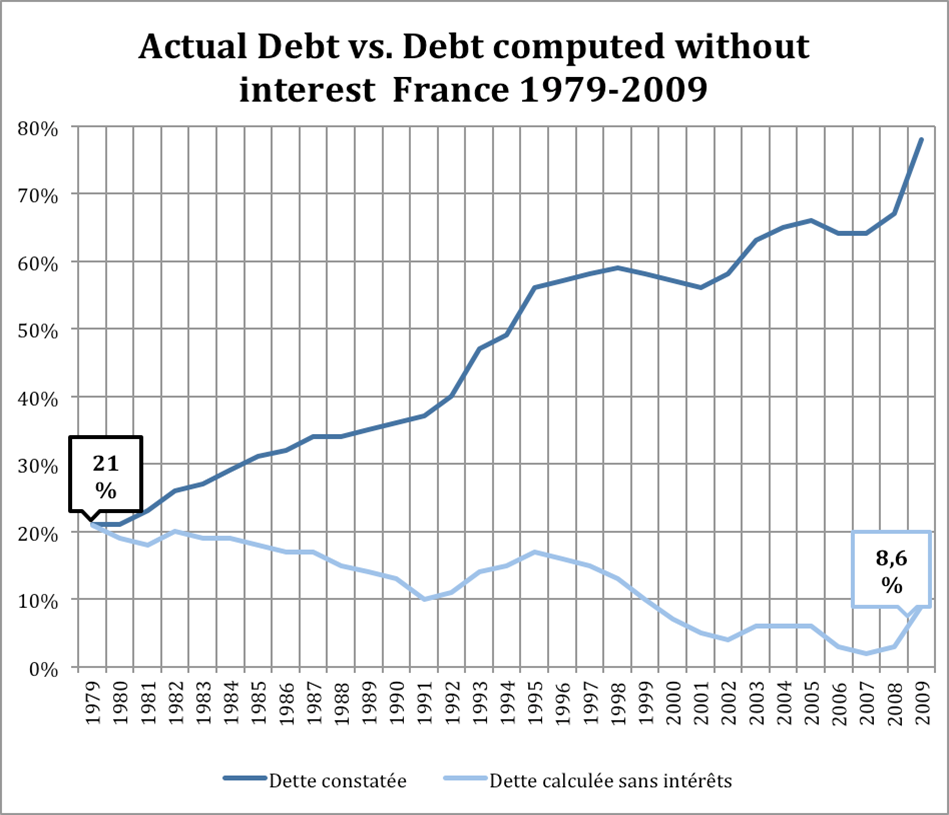
Borrowing from its own central bank interest-free might even allow a government to eliminate its national debt altogether.  In Money and Sustainability: The Missing Link(at page 126), Bernard Lietaer and Christian Asperger, et al., cite the example of France.  The Treasury borrowed interest-free from the nationalized Banque de France from 1946 to 1973.  The law then changed to forbid this practice, requiring the Treasury to borrow instead from the private sector.  The authors include a chart showing what would have happened if the French government had continued to borrow interest-free versus what did happen.  Rather than dropping from 21% to 8.6% of GDP, the debt shot up from 21% to 78% of GDP.
“No ‘spendthrift government’ can be blamed in this case,” write the authors. “Compound interest explains it all!”


More than Just a Federal Solution
It is not just federal governments that could eliminate their interest charges in this way. State and local governments could do it too.
Consider California.  At the end of 2010, it had general obligation and revenue bond debt of $158 billion.  Of this, $70 billion, or 44%, was owed for interest.  If the state had incurred that debt to its own bank—which then returned the profits to the state—California could be $70 billion richer today.  Instead of slashing services, selling off public assets, and laying off employees, it could be adding services and repairing its decaying infrastructure.
The only U.S. state to own its own depository bank today is North Dakota.  North Dakota is also the only state to have escaped the 2008 banking crisis, sporting a sizable budget surplus every year since then.  It has the lowest unemployment rate in the country, the lowest foreclosure rate, and the lowest default rate on credit card debt.
Globally, 40% of banks are publicly owned, and they are concentrated in countries that also escaped the 2008 banking crisis.  These are the BRIC countries—Brazil, Russia, India, and China—which are home to 40% of the global population.  The BRICs grew economically by 92% in the last decade, while Western economies were floundering.
Cities and counties could also set up their own banks; but in the U.S., this model has yet to be developed. In North Dakota, meanwhile, the Bank of North Dakota underwrites the bond issues of municipal governments, saving them from the vagaries of the “bond vigilantes” and speculators, as well as from the high fees of Wall Street underwriters and the risk of coming out on the wrong side of interest rate swaps required by the underwriters as “insurance.”
One of many cities crushed by this Wall Street “insurance” scheme is Philadelphia, which has lost $500 million on interest swaps alone.  (How the swaps work and their link to the LIBOR scandal was explained in an earlier article here.)  Last week, the Philadelphia City Council held hearings on what to do about these lost revenues.  In an October 30th article titled “Can Public Banks End Wall Street Hegemony?”, Willie Osterweil discussed a solution presented at the hearings in a fiery speech by Mike Krauss, a director of the Public Banking Institute.
Krauss’ solution was to do as Iceland did: just walk away. He proposed “a strategic default until the bank negotiates at better terms.” Osterweil called it “radical,” since the city would lose it favorable credit rating and might have trouble borrowing. But Krauss had a solution to that problem: the city could form its own bank and use it to generate credit for the city from public revenues, just as Wall Street banks generate credit from those revenues now.
A Radical Solution Whose Time Has Come
Public banking may be a radical solution, but it is also an obvious one. This is not rocket science. By developing a public banking system, governments can keep the interest and reinvest it locally. According to Kennedy and Creutz, that means public savings of 35% to 40%. Costs can be reduced across the board; taxes can be cut or services can be increased; and market stability can be created for governments, borrowers and consumers. Banking and credit can become public utilities, feeding the economy rather than feeding off it.

THE START OF 2008 ALL OVER AGAIN? Wal-Mart Says February Sales “Total Disaster”, Worst Monthly Start Since 2006, European Economic Data Disappointing, Two Billion Unemployed or Given Up Job Search Worldwide

IS THIS THE START OF 2008 ALL OVER AGAIN?

Do you remember 2008?  …and what led up to it?  Do you especially remember all of the assurances made that “everything would be OK”?
It smells again like 2008 but this time much MUCH worse.  Consumer debt levels have barely subsided from those back in 2008.  Taxes are higher and now biting which is a definite factor suppressing retail sales.  Gasoline prices are higher and unless you own oil stocks this is surely no benefit.  Derivatives outstanding are higher than they were yet “banks say” they are less leveraged (how can this be?).
NOTHING has changed since 2008.  Many ratios, balance sheets and financial standings are far worse now than entering that year, a crisis now can no longer be jawboned away by “don’t worry, we are the government and won’t let anything bad happen”.  This is the classic reverse “Boy who cried wolf”.  Credibility of the puppet-masters has been stained and lost, nothing could be worse in today’s monetary system.  “Credibility”, trust, CONFIDENCE! was the only thing that held the system together during the dark days of 2008-09, and it’s waning fast.  “Confidence” is also the key factor of “value” behind your currency…no matter where you live or who your central bank is.

Wal-Mart Stock Drops After It Says February Sales “Total Disaster”, Worst Monthly Start Since 2006


Wal-Mart shares are plunging as the firm reports a ‘total disaster’ in its February sales. Bloomberg obtained internal emails that note:
“In case you haven’t seen a sales report these days, February MTD sales are a total disaster,” Jerry Murray, Wal-Mart’s vice president of finance and logistics, said in a Feb. 12 e-mail to other executives, referring to month-to-date sales. “The worst start to a month I have seen in my ~7 years with the company.”

One senior executive summed it up perfectly – “Well, we just had one of those weeks here at Walmart U.S. Where are all the customers? And where’s their money?” The company notes the end of the payroll tax cut by Obama and asks ”We need to stop the stupid.”


Start Your Day With The Usual Disappointing European Economic Data


Europe Woes Deepen as Economies Contract

Worldwide Crisis: Two Billion Unemployed or Given Up Job Search

Tax increases, catering to government employees, and inflation pose serious threats to the goal of growing the private sector.
In reality, private sector development should be at the forefront of the global economic policy agenda. Just look at the numbers for proof of this reality. Worldwide, there are two-billion working-age adults currently unemployed and no longer seeking jobs. Another 1.5 billion are only marginally employed.
Locations and sectors with strong potential for job growth must be honed in on so we can achieve a faster pace of sustainable job creation.

Investors Yanked Billions Out Of US Stocks This Week

January’s historic fund flows may finally be starting to reverse.
This week, flows into equity mutual funds and ETFs around the world continued – but not in the United States.
Funds invested in U.S. stocks suffered $3.65 billion in outflows this week. The table above, via Jefferies, details the flows.

People Are Getting Extremely Optimistic And Ignoring The No. 1 Threat To Stocks. New Payroll Tax Increase Is Crashing US Economy REAL-TIME! Wal-Mart: There’s No Reason To Be Optimistic, Customers Are Working Hard To Adapt To The ‘New Normal!


Why the Market’s Ignoring the No. 1 Threat to Stocks

Investors who fled in fear over potentially massive tax increases associated with the “fiscal cliff” have barely broken a sweat over corresponding spending cuts that are only two weeks away.
The so-called sequestration of $110 billion a year in discretionary spending will happen March 1 if Congress does not come to an agreement.
With little indication that Washington is anywhere near a compromise similar to the one that avoided the full brunt of the fiscal cliff, markets could be expected to be in full panic mode.

Sentiment surveys and fund flows remain strongly bullish, and Citigroup’s Panic/Euphoria model is near euphoria stage, according to Tobias Levkovich, Citi’s chief equity strategist.
“Given potentially bitter fiscal policy battles linked to required tax and spending reforms in March, we expect some volatility in the next couple of months,” Levkovich said in a report. “However, our outlook for 2013 remains attractive given signals from valuation, implied earnings growth and credit conditions to name a few factors.”

NYSE Margin Debt Is Creeping Toward All-Time Highs Right Along With The S&P 500

Should we be worried?
Here’s an interesting bit of correlation (and causation?) for you.  Have a look at the chart I formulated below showing NYSE Margin Debt and the S&P 500.  The two data sets show a correlation over 85%.
Now, this is really interesting in that it melds with our work on  Monetary Realism and monetary theory quite nicely.  Using Werner’s concept of disaggregation of credit we can clearly formulate how credit is being used at various times to benefit from improvement in the stock market.  If you’re not familiar with the concept of disaggregation of credit please see here.  But, in short, it is based on the understanding that our monetary system is almost entirely built around credit and how banks issue credit to perform various functions.  These functions can be both good and bad.

A Scary Reality About Wal-Mart’s Customers Might Be Coming To A Head

Wal-Mart shares are tanking after the company’s executives called February sales a “total disaster.”
“Have you ever had one of those weeks where your best-prepared plans weren’t good enough to accomplish everything you set out to do?” Wal-Mart exec Cameron Geiger wrote in one of the emails reported by Renee Dudley at Bloomberg.
“Well, we just had one of those weeks here at Walmart U.S. Where are all the customers? And where’s their money?” Geiger asked.
Wal-Mart is facing a scary reality: the ailing finances of its core customers, Brian Sozzi, chief equities analyst at NBG Productions, told us.
“Wal-Mart shoppers are the barometer of the U.S. consumer, and these emails reflect common sense about customers,” Sozzi told us. “The consumer isn’t mentally or physically ready to spend on discretionary inventory and there’s no reason to be optimistic.”

“They are middle-class Americans and those aspiring to join the middle class,” Duke said. “Our customers are working hard to adapt to the ‘new normal,’ but their confidence is still very fragile. They are shopping for Christmas now and they don’t need uncertainty over a tax increase.”


WAL-MART Internal Email: ‘February sales total disaster … worst start to month in my 7 years’…
Wal-Mart and discounters such as Family Dollar Stores Inc. are bracing for a rise in the payroll tax to take a bigger bite from the paychecks of shoppers already dealing with elevated unemployment. The world’s largest retailer’s struggles come after executives expected a strong start to February because of the Super Bowl, milder weather and paycheck cycles, according to the minutes of a Feb. 1 officers meeting Bloomberg obtained.
Murray’s comments about February sales follow disappointing results from January, a month that Cameron Geiger, senior vice president of Wal-Mart U.S. Replenishment, said he was relieved to see end, according to a separate internal e-mail obtained by Bloomberg News.

What Happens to a Financial System When Its Two Biggest Pillars Collapse?

…Thus, we find that Europe’s primary political market props (EU leaders including ECB head Mario Draghi) are coming unraveled at the precise time that EU banks are showing warning signs and the most important EU economies are heading sharply south.
2013 is going to be a very interesting year for Europe.
So if you have not already taken steps to prepare for systemic failure, you NEED to do so NOW. We’re literally at most a few months, and very likely just a few weeks from Europe’s banks imploding, potentially taking down the financial system with them. Think I’m joking? The Fed is pumping hundreds of BILLIONS of dollars into EU banks right now trying to stop this from happening….
Spanish Core Inflation Up Even as Recession Deepens

El-Erian On Stocks: “Prices Are Artificially High – It’s Time to Take Profits”

El-Erian puts himself in the second camp.
We think that prices are artificially high, that maintaining them here is going to be hard as central banks become less effective, and that it’s time to book some profits and to wait for some better entry points,” he explains.
He clarifies that this is not a “Lehman moment.” But “prices that have gotten way ahead of what policy can deliver,”

Click image for full clip:


Felix Zulauf – We Have Never Seen Anything Like This In History

KWN: Here is what Zulauf had to say: “I think the world economy is still having difficulties. Some leading indicators are picking up a little bit, and the world is getting very optimistic that we have passed the crisis, we have solved the problem, and sentiment is very optimistic. Actually it is as optimistic in the stock market as it was in 2007.
We have entered a very dangerous territory, and I think the world economy will not deliver what people expect. You just saw the numbers coming out about the eurozone GDP in the fourth quarter, it was quite a bit weaker than expected and still in negative territory….


Excellent interview with G. Edward Griffin the author of Creature from Jekyll Island regarding inflation & The FED ! video!