Imagine for a moment that someone inherits a farm.
Let's say that the farm has good topsoil, a good well,
good breeding stock, good seed, and excellent farm
equipment in good repair. Prior to passing into the
control of the present owner the farm did a good business
selling vegetables, meat, and dairy products to the local
market, and it made a small profit.But let us suppose
for a moment that the present owner of the farm doesn't
understand farming, or isn't even really interested in
learning. The present owner has no objection to standing
around looking good, so he stays at the farm, standing in
front of it, looking good to passers by.
Of course, the bills still come in, so our farmer puts
them on his credit card. When that bill comes due he uses
another credit card, Then another. Pretty soon the
interest payments alone are higher than his bills and the
banks get nervous and call him. No problem. Our farmer
sells the tractor, takes the money around to the various
credit cards, the food store, the utilities, and pays off
all his bills. Then he stands around in front of the farm
looking good to passers-by, the lord of his domain.
Well, the bills still come in. Again the credit cards
get loaded up. So, this time our farmer sells the
harvester. Then later on, the cattle, then the chickens,
then the seeds, then he leases the well to his neighbor
and finally sells the top soil from his farm to another
farm down the road whose soil is getting tired. The cash
is taken around to the various creditors, the food store,
the utilities, etc.
Now at this point, our farmer thinks everything is
okay. The bills are paid, he has a little cash in his
pocket, and everything is fine.
Of course, you know better. The farm simply does not
exist any more; it's just an empty lot with a few
buildings, and soon they will be gone as well. The path
from the farmer's present condition to seizure of the
property for unpaid taxes is a foregone conclusion, even
if the farmer doesn't look far enough ahead to see it.
Poor, dumb, stupid farmer.
That farmer is our government, and our business
leaders.
Just as our hypothetical farm has lost its soil,
livestock, seed, and farm equipment, America has lost its
manufacturing ability. Short sighted business leaders,
with as little interest in manufacturing as our farmer
had in farming, decided their own personal bonuses would
be higher if they simply sold their factories rather than
ran them. After WW2, the 27 American TV companies
including Zenith, Emerson, RCA, GE, etc. led the world in
TV technology. Then, the owners of the patents on TV
technology decided they didn't need to dirty their hands
by actually making the TV sets themselves any more, and
they started selling licenses to manufacture, which the
Japanese bought.
By 1987, the only remaining American TV company was
Zenith. The patent holders get their money, but the
American products which can be sold overseas are gone,
along with the jobs to make them. (Today Zenith is owned by a Korean electronics company.)
The same happened in high-tech electronics. The
integrated circuit was invented in the United States. But
rather than focus on selling integrated circuits, the
companies that owned that technology sold the machines to
MAKE integrated circuits around the world, and now
America sells very few chips anywhere. The patent holders
have their money, but the cash flow from sales of
manufactured goods, and the jobs that go with them, are
gone. When Seymour Cray needed custom chips for his
supercomputers, he had to order them from Japan.
The same thing has been happening in aviation. The
airplane was invented in the United States, and through
the 60s, we sold a lot of them around the world. But
lately, all aircraft sales to foreign countries involve
"offsets", a portion of the core technology
that gets licensed to the purchasing nation and gets
manufactured there. Bit by bit, the core technology gets
bled off, taking with it jobs, and cash flow from the
sale of those manufactured products. Along the way, the
rights to manufacture American inventions outside America
leak away on a steadily increasing basis. Even the mighty
F-16 is now being manufactured overseas, under license.
To cover the loss of manufacturing jobs, our
government has invented the catch phrase "service
economy". This is the idiotic notion that we don't
need to actually sell manufactured products; that we can
grow and prosper our nation by doing each other's
laundry for a fee. To conceal the loss of manufacturing jobs, the
government has legislated into existence thousands upon
thousands of useless paper-shuffling jobs, and declared
their necessity by fiat. The most obvious is the income
tax which has been so obfuscated by the government that
half of you had to rely on an outside expert to figure
out just what all those incomprehensible words really
meant. By this device, the government has replaced those
jobs that made products to sell with an equal number of
jobs that produce nothing whatsoever of any worth, except
to keep the unemployment figures down. This
over-burdening of the American people with gratuitous
regulations and paperwork has accomplished nothing except
to obfuscate the loss of manufacturing jobs, and to
transform the American character from innovators and
inventors creating new products to that of minor clerks,
peeking under each other's seat cushions for lost change.
So, with most of our manufacturing now gone, just what
DOES America make? Trouble, mostly. With 4% of the
world's population and 18% of the economy, we have 50% of
all the lawyers, all looking to make a killing by looting
those few industries that still call America home (like
Microsoft). Kids don't want to be scientists and
engineers; they've seen how little such people are valued
in our country. Based on recent history, kids see the
"big bucks" are in corporate law, specifically
investment banking, leveraged buyouts, greenmail, junk
bonds, in short what other countries describe as
"trying to make money grow by shaking it side to
side".
With America's ability to actually produce products
that can compete on the open world market in decline,
it's no wonder that the balance of trade is the problem
it is. Nobody buys our export products because we just
don't make that many any more, and like or not, we have
to buy our appliances from the people who make them,
which are NOT Americans. (When Ampex invented the VCR,
they didn't even bother trying to find an American
company to make it, they immediately sold the rights to
Japan).
So, what do all these countries on the plus side of
the trade imbalance do with their surplus billions? Well,
they have been loaning it right back to us!
Our government engages in a practice politely called
"deficit spending". Other terms which would
aptly describe the practice include
"counterfeiting" and "check kiting",
but it all comes down to the same thing; spending money
one does not actually have.
What would be a prison offense for a normal citizen
was rendered legal for the government by the Federal
Reserve Act. This was not a popular piece of legislation.
In fact the Democrats had campaigned in 1912 on a
platform of rejection of the creation of a private bank
in charge of a fiat money system. Nevertheless, on
December 23, 1913, taking advantage of the absence of
congressmen opposed to the creation of a fiat monetary
system during the Christmas break, the Federal Reserve
Act was passed.
Years later, during the great depression, Congressman
Louis T. McFadden (who served twelve years as Chairman of
the Committee on Banking and Currency) asked for
congressional investigations of criminal conspiracy to
establish the privately owned 'Federal Reserve System'.
He requested impeachment of Federal officers who had
violated oaths of office both in establishing and
directing the Federal Reserve -- imploring Congress to
investigate an incredible scope of overt criminal acts by
the Federal Reserve Board and Federal Reserve Banks.
McFadden even suggested that the Federal Reserve
deliberately triggered the great stock market crash of
1929, in order to eventually force the passage of the
Emergency Banking Act of March 9, 1933, which suspended
the gold standard.
In describing the FED, McFadden remarked in the
Congressional Record, House pages 1295 and 1296 on June
10, 1932:
"Mr. Chairman, we have in this country one of the
most corrupt institutions the world has ever known. I
refer to the Federal Reserve Board and the Federal
reserve banks. The Federal Reserve Board, a Government
Board, has cheated the Government of the United States
and the people of the United States out of enough money to
pay the national debt. The depredations and the
iniquities of the Federal Reserve Board and the Federal
reserve banks acting together have cost this country
enough money to pay the national debt several times over.
This evil institution has impoverished and ruined the
people of the United States; has bankrupted itself, and
has practically bankrupted our Government. It has done
this through the misadministration of that law by which
the Federal Reserve Board, and through the corrupt
practices of the moneyed vultures who control it".
Why all the fuss over the gold standard?
Well it goes back to the original Founding Fathers and
the meaning of the word "dollar".
"Dollar" is actually a weight measure of
silver, 371.25 grains, to be exact. Our American silver
dollars are actually heavier, since other metals were
added for durability. But that 371.25 grains of silver
WAS the dollar, matching in weight an unbroken chain of
accepted monetary units that reached back through the
Spanish Milled Dollar, the Dutch Daller, back to the
German Thaler; the product of a silver mine which sold
its product in coins of an exact weight. The Coinage Act
of 1792 defined our dollar to exactly match in weight the
silver dollars in use around the world, and then defined
the gold dollar to be that amount of gold which would
equal the worth of silver in a silver dollar, 24.75
grains, 1/15 the weight of the silver in a silver dollar.
 |
 |
| US Silver Dollar |
US Gold Dollar (same scale) |
So, what's wrong with this? Nothing really. When you,
as a citizen, hold a silver dollar or a gold dollar in
your hand, you hold that actual worth of metal. Nothing
the government can do can change the worth of the money
in your control.
Take the Roman Silver Denarius pictured above. The
Roman Empire is long gone, but the money that Rome issued
still has worth because the coins themselves had inherent
worth. Long after the collapse of the empire, Roman
silver coins were still used as money, because the silver
in the coin itself did not depend on the issuing
government for its worth.
Of course, carrying around too much coin can be
bothersome, so many nations, including our own, issued
paper notes as a convenience. But that paper currency of
the nation was just a convenience. The gold and silver
certificates were merely "claim checks" for the
equivalent weight of gold or silver held in the treasury,
and which would be produced on demand when the
certificate was presented. But in the end, the lawful
dollar of the United States was 371.25 grains of silver, or
24.75 grains of gold.
The problem with this system from the point of view of
the government or the banks is that it limits the amount
of money they can work with. When the bank runs out of
silver or gold (or the equivalent certificates) it can no
longer lend any more money with which to earn interest.
When the government runs out of gold or silver (or the
equivalent certificates) it can no longer spend money
(just like the rest of us).
The immediate effect of ending the gold standard was
that with the paper dollar no longer legally dependent on
371.25 grains of silver or 24.75 grains of gold, more paper
dollars (now called "Federal Reserve Notes")
could be printed, their actual worth no longer under the control
of the citizens but under the control of the issuing
central bank, based on the total number of dollars
printed (or created as credit lines) divided by the estimated worth of the nation's assets. The more dollars
which are created out of thin air, the less each one is
worth.
A federal Reserve Note.
The swindle of the system is simple. The Federal
Reserve Bank hires the US Treasury to print up some
money. The Federal Reserve only actually pays the
treasury for the cost of the printing, they do NOT pay $1
for each 1$ printed. But the Federal Reserve turns around
and loans out that money (or credit line) to banks at
full face value, those banks which have exhausted their
deposits then loan that Federal Reserve fiat money to
you, and you must repay it in the full dollar value (plus
interest) in work product, even though the Federal
Reserve printed that money for pennies, or created it out
of thin air in a computer.
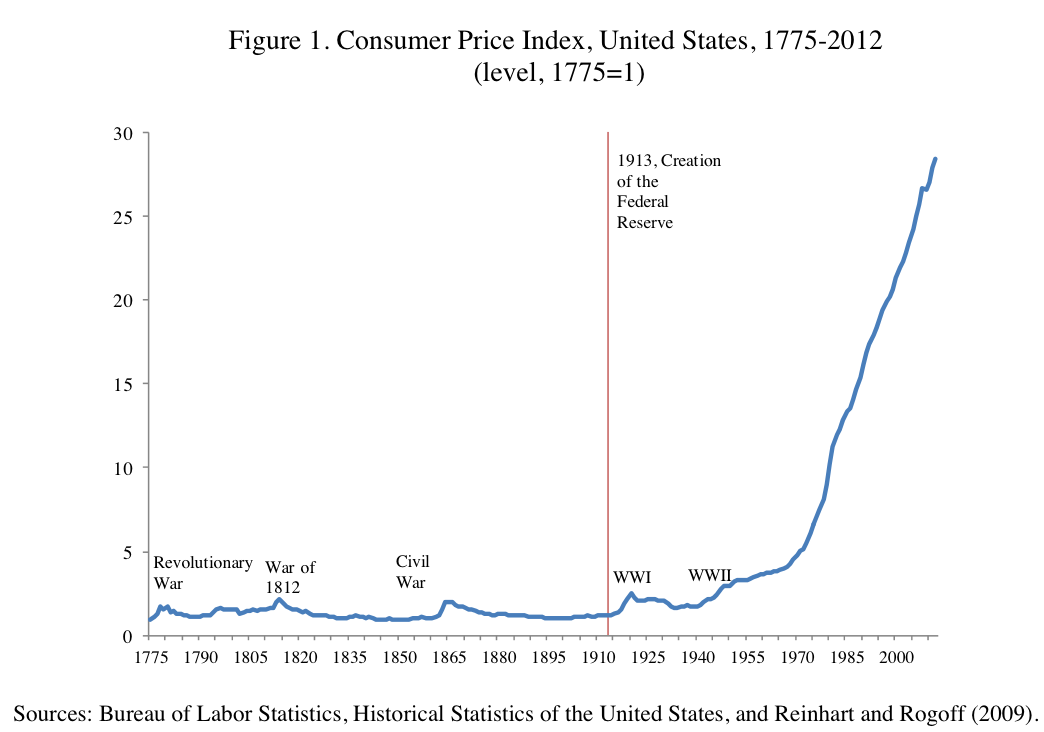
As the Federal Reserve overprints more money, the
money supply inflates, and too much money starts chasing
too few goods and services, which means prices go up. But
contrary to the charade put on by the Federal Reserve,
inflation doesn't just come and go due to some arcane
sorcery. The Federal Reserve can halt inflation any time
it wants to by simply shutting down those printing
presses. It therefore follows that both inflation and
recession are fully under the control of the Federal
Reserve. This means the cycle of inflation and recession is an intentional one; a gigantic heartbeat that pumps
paper certificates out to the working class, while pumping real wealth in to the owners of the banks.
Over time, that excess of printing has destroyed the
value of that dollar you think you have. If you want to
know by just how much, go out and try to purchase 371.25 grains of
silver right now. Usually, the deterioration is
gradual. Sometimes, it has to be obvious, such as the
1985 devaluation (done to halt the trade imbalance) which
triggered the Japanese real-estate grab in this country.
Many politicians have attempted to reverse this
process.
During the term of Abraham Lincoln, the banks demanded high
interest to fund the civil war, reaching as high as 24% to 36%. Lincoln,
rather than sell the country into permanent debt on the interest
bearing bank notes, ordered the US Treasury to issue new legal tender
popularly called Greenbacks, that funded the civil war without incurring
huge interest debts. The system worked so well there was popular
support for continuing the system after the end of the war, but issuance
of the Greenbacks was halted after Lincoln was assassinated.
John F. Kennedy issued an Executive Order 11110,
requiring the Treasury Department to start printing and
issuing silver certificates for the silver then remaining
in the US Treasury. Kennedy understood, as did Lincoln, that by returning to the constitution,
which states that only Congress shall coin and regulate
money, the soaring national debt could be reduced by not
paying interest to the bankers of the Federal Reserve
System, who print paper money then loan it to the
government at interest. This was the reason he signed
Executive Order 11110 which called for the issuance of
$4,292,893,815 in United States Notes through the U.S.
Treasury rather than the Federal Reserve
System.
John F. Kennedy's United States Note.
That same day, Kennedy signed a bill changing the
backing of one and two dollar bills from silver to gold,
adding strength to the weakened U.S. currency.
Kennedy's comptroller of the currency, James J. Saxon,
had been at odds with the powerful Federal Reserve Board
for some time, encouraging broader investment and lending
powers for banks that were not part of the Federal
Reserve system. Saxon also had decided that non-Reserve
banks could underwrite state and local general obligation
bonds, again weakening the dominant Federal Reserve
banks".
Kennedy's E.O. was never implemented following his
assassination, and shortly afterwards, United States
silver coins were taken out of circulation and replaced
with the copper clad slugs in use today. These two
events, the failure to print new silver certificates, and
the substitution of worthless slugs for our silver coins,
may explain why the Warren Commission included on its
panel John J. McCloy, a man with no experience in crime,
law enforcement, or national security, but who had been
the President of the Chase Manhattan Bank.
It should be noted that the banks themselves are still
using the gold standard. Accounts are still settled
between major national banks by the transfer of gold
bullion.
So here we are with a bank that legally counterfeits
the money you borrow but expects a full value (plus
interest) repayment. But what's good for the Federal
Reserve is good for the government itself, and this is
where we get back into that funny word "deficit
spending". The government spends more money than it
takes in. It has for many years now. The Federal Reserve,
being the only lawful source of this fiat money, prints
up the excess cash the government needs (or manufactures
a credit line in a computer). This extra cash is treated
as a loan, in order to keep the government overspending
from further eroding the worth of the dollar in the world
market. The government (meaning the taxpayers) is on the
hook for the full face value, plus interest.
But there's another problem. The government is
borrowing so much money that it drives the interest rates
up! You pay MORE interest on your mortgage, car loan, and
credit cards, because the government cannot balance its
books. That extra interest you pay is therefore another
hidden tax. The government, in its
"generosity", gives you a tax credit on
mortgage interest that is higher because of their own
borrowing!
During the 80s, as exports dropped, and jobs moved
from manufacturing to lower paying "service
sector" jobs, the US tax base declined. In order to
keep the jobless rate from rising, a massive defense
program called the Strategic Defense Initiative was
cranked up, but since this program produced no exportable
product, it produced no taxable sales revenues, and hence
the money poured into the project accelerated the
government decline into debt. Because manufacturing was
on the decline, fewer start-up companies were approaching
the lending institutions, so the government loosened up
the rules (while increasing the insurable deposit limit)
to allow "investments" in more high risk
ventures, most of which turned out to be frauds, or
worse, money laundering operations for drug criminals.
This includes Whitewater, Flowerwood, and Castle Grande.
Despite shifting the S&L loss primarily onto the
taxpayers (to reassure foreign investors that the
taxpayers still made America a safe place to park their
surplus cash) the government plunged further into debt.
In the 12 years of the Reagan/Bush(I) administrations,
the United States went from being the world's largest
creditor nation to the world's largest debtor. Many of
those nations which had enjoyed huge trade surpluses
started loaning that profit back to the United States
with the stipulation that we work on our manufacturing,
clean up our infrastructure, raise taxes, in short, clean
up our act, so that investment in America makes sense!
However, we didn't quite do that.
There has been some shuffling around to try to conceal
the real scope of the problem. Over the last several
years, the Federal Government has been sending less tax
money back to the states than it takes in in taxes. This
means that the states have to borrow MORE money to cover
their obligations. The net result is that the debt is
being transferred to the states, to conceal its true
size. The government will easily admit to a $3 trillion
"publicly held" debt, grudgingly concede that
it's "unfunded liability" brings that number to
almost $7 trillion, but the real hard truth is that total
government debt, state and federal, is now over $14
trillion dollars, or about 50,000 for every man, woman,
and child inside the United States. Since 1960, the
taxpayers have shelled out $15 trillion in interest
payments alone, while the principal continues to rise.
Yet another stunt the government has pulled is to
"borrow" from the various trust funds under its
control. Some $2 billion has vanished from the trust
accounts of Native Americans (presently suing the
Departments of the Interior and Treasury), and nearly �
of a TRILLION dollars has been removed from your Social
Security retirement trust fund and spent in the last 8
years.
If the government has to borrow your retirement money
when things are supposed to be so good, under what
conditions can it repay the money? Or is that government
IOU in your retirement account merely a promise to either
tax you a second time or stiff you on the benefits you
thought you were paying for?
In the last 8 years, during what are supposed to be
record setting good times, the Federal government has
nearly DOUBLED its debt load. The estimated interest on
the debt equals all the personal income tax paid by all
Americans. Our government is so deep in debt that it
cannot get out.

This brings us to the issue of collateral. We've
borrowed so much money the lenders are getting nervous.
Back during the Johnson administration Charles DeGaulle
demanded the United States collateralize the loans owed
to France in gold and started carting out the bullion
from the treasury. This caused several other nations to
demand the same and President Nixon had to slam the gold
window closed or the treasury would have been emptied,
since the United States was even then in debt for more
money than the treasury could cover in gold.
But Nixon had to collateralize that debt somehow, and
he hit upon the plan of quietly setting aside huge tracts
of American land with their mineral rights in reserve to
cover the outstanding debts. But since the American
people were already angered over the war in Vietnam,
Nixon couldn't very well admit that he was apportioning
off chunks of the United States to the holders of foreign
debt. So, Nixon invented the Environmental Protection
Agency and passed draconian environmental laws which
served to grab land with vast natural resources away from
the owners and lock it away, and even more, prove to the
holders of the foreign debt that US citizens were not
drilling. mining, or otherwise developing those
resources. From that day to this, as the government sinks
deeper into debt, the government grabs more and more
land, declares it a wilderness or "roadless
area" or "heritage river" or
"wetlands" or any one of over a dozen other
such obfuscated labels, but in the end the result is the
same. We The People may not use the land, in many cases
are not even allowed to enter the land.
This is not about conservation, it is about
collateral. YOUR land is being stolen by the government
and used to secure loans the government really had no
business taking out in the first place. Given that the
government cannot get out of debt, and is collateralizing
more and more land to avoid foreclosure, the day is not
long off when the people of the United States will one
day wake up and discover they are no longer citizens, but
tenants.
The following map shows the current extent of all
lands grabbed by the government under the guise of
environmentalism.
In short, the United States is in deep trouble. We
have lost a huge amount of our manufacturing capacity,
and those products we still make do not compete well on
the world market, despite the steady devaluation of the
dollar. In short we have vast debts to pay and little to
pay them with. Like the foolish Farmer we have sold the
machinery that allowed us to prosper, and we stand around
shaking our investment portfolios back and forth in the
hopes that the money inside will somehow grow all by
itself. It won't. It never has. The very best that can be
said is that money gets moved from one person to the
other.
Those nations and banks to whom we owe money have been
very patient indeed with us. They know that our economies
are so tightly entwined that what hurts America will hurt
them. But sooner or later, possibly after a market crash,
someone, in order to pay their own debts, will demand
their loans to the United States be paid. Rather than get
caught with "bad paper", there will be a run on
the United States government.
In addition to the government debt of $14 trillion,
our businesses are home to trillions more in foreign
investment, kept here by the promise that the American
taxpayer will be made to cover all losses. But with our
manufacturing in decline and our schools producing far
more lawyers than anything else, it should be obvious to
the prudent observer that the American taxpayer, even if
so inclined, may not be able to cover the losses of their
own government, let alone a foreign investor. That has to
be making them nervous as well.
This brings us to the "equities markets",
most notably the stock market. Over the last several
years a constant media harangue has assured us that the
soaring numbers of the stock market are the sole measure
of how good our economy is. But close examination of
those high-priced stocks reveals that most are heavily
over-valued; their price the result of market forces
rather than underlying worth (earnings ability).
Amazon.com, as one example, has had a terrific run-up of
its stock price, even though the company itself has yet
to show a profit.
The government has admitted to using covert means to
prevent a market downturn; to keep the stock prices at an
artificially high and overvalued level, in order to wave
those impressive numbers about as "proof" that
everything is okay so that the taxpayers go back to work
and pay more taxes. But in order to keep those stock
prices up above their actual worth, demand must be
maintained to keep the prices high. In other words, NEW
investors must constantly be brought into the bottom of
the pyramid to keep the prices of the stocks at the top
from dropping. Hence the onslaught of commercials luring
neophyte investors into the stock market via "online
trading". Like any Ponzi scheme, the stock market
will collapse when no more new buyers can be dragged in
at the bottom. As the market starts to stutter,
governments (most recently Britain) have moved to dump
huge reserves of gold onto the world market to depress
gold prices and deter investors from deserting the stock
market for gold.
Some years back I worked on the film version of
"The Day The Bubble Burst", and in between
playing a stock broker, I got to spend some time with the
show's consultant, Mr. William Hupt, who had been on the
trading floor in 1929 as it all fell apart. He still had,
framed, that last strip of ticker tape that ushered in
the Great Depression, and he shared some stories which
have a bearing on what is going on today.
The first story Bill shared is that there had been
early indications of a dangerously over-valued market,
running too deep on margin, and like the Plunge Protection
Team, the largest investment houses, in particular the
House of Morgan, attempted to reverse the early
corrections by purchasing large blocks of stock in order
to create market demand and drive the prices back up. It
worked all but the last time.
The second story Bill shared was that a friend of his,
riding up to his office in September of 1929, overheard
the elevator operator chatting about his own stock
portfolio, and his investments. Something about that
image of an elevator operator playing the market set off
warning signals, and Bill's friend immediately liquidated
his entire portfolio, just in time to miss the great
crash. Many people, including the actor Charlie Chaplin,
had recognized the "recruitment" of that
segment of society that did NOT have risk capital as new
investors as a desperate attempt to prop up an overvalued
market, and got out in time to save their own personal
fortunes.
In the end, there is no such thing as a free lunch.
You cannot make money grow in value by shaking it back
and forth from one bank to another. You cannot prosper a
nation by doing each other's laundry, or filling out
their government mandated and greatly obfuscated
paperwork, or flinging stock certificates around which
may have as little real worth as Federal Reserve Notes.
To make money, to show a profit, you must make products
that somebody else wants to buy, and sadly, that is a
capability the United States has allowed to slip away in
great measure. The "service economy" was
political propaganda to make the public believe that the
decline of our manufacturing ability was a good thing.
Our nation is broke, bankrupt, and having sold much of
its machinery and technology (or given it away to
political donors), is unable to easily return to those
endeavors which once made our nation great. Our
infrastructure is in decay (the percentage of roads in
the US with major damage doubled last year alone), our
public schools unable to produce a workforce able to
function in a high-tech manufacturing environment, and
those managers end engineers with manufacturing
experience have in great part been lured away to other
nations. The severity of our total government debt has
reached a point where the promise that the taxpayers can
be made to cover any foreign investment loss rings
hollow, because we can no longer pay the debts our
government has now.
Our nation is in trouble. We don't make many of the
products we used to make. Consequently we don't have the
products to sell that we used to. We don't even make most
of the products we need ourselves (like that computer
you're staring at this very moment). Result: we have a
massive trade imbalance. Cash is flowing out of the
nation, and it's not coming back in anywhere near as
fast. There's no way to spin it; that is a major problem.
Our nation is becoming poorer, it is hopelessly in debt,
and all the artificial escalation of stock prices cannot
conceal that.
And as the artificially pumped up stock market
continues to decline, the true scale of the economic
horror which is the product of decades of government
corruption, will become apparent to all. |