Tuesday, January 1, 2013

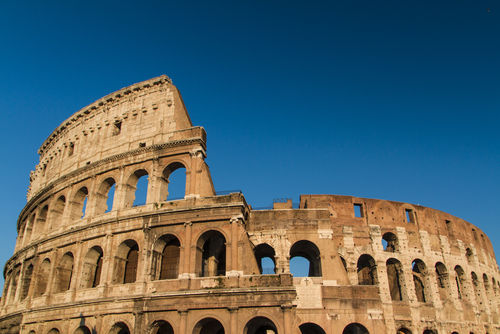
8 striking parallels between the U.S. and the Roman Empire

Is our republic coming to an unceremonious end? History may not be on America's side


8 striking parallels between the U.S. and the Roman Empire
This article originally appeared on AlterNet. 
 
 Lawrence Lessig’s Republic Lost documents the corrosive effect of money on our political process. Lessig persuasively makes the case that we are witnessing the loss of our republican form of government, as politicians increasingly represent those who fund their campaigns, rather than our citizens.Anthony Everitt’s Rise of Rome is fascinating history and a great read. It tells the story of ancient Rome, from its founding (circa 750 BCE) to the fall of the Roman Republic (circa 45 BCE).
When read together, striking parallels emerge — between our failings and the failings that destroyed the Roman Republic. As with Rome just before the Republic’s fall, America has seen:
1 — Staggering Increase in the Cost of Elections, with Dubious Campaign Funding Sources: Our 2012 election reportedly cost $3 billion. All of it was raised from private sources – often creating the appearance, or the reality, that our leaders are beholden to special interest groups. During the late Roman Republic, elections became staggeringly expensive, with equally deplorable results. Caesar reportedly borrowed so heavily for one political campaign, he feared he would be ruined, if not elected.
2 — Politics as the Road to Personal Wealth: During the late Roman Republic period, one of the main roads to wealth was holding public office, and exploiting such positions to accumulate personal wealth. As Lessig notes: Congressman, Senators and their staffs leverage their government service to move to private sector positions – that pay three to ten times their government compensation. Given this financial arrangement, “Their focus is therefore not so much on the people who sent them to Washington. Their focus is instead on those who will make them rich.” (Republic Lost)
3 — Continuous War: A national state of security arises, distracting attention from domestic challenges with foreign wars. Similar to the late Roman Republic, the US – for the past 100 years — has either been fighting a war, recovering from a war, or preparing for a new war: WW I (1917-18), WW II (1941-1945), Cold War (1947-1991), Korean War (1950-1953), Vietnam (1953-1975), Gulf War (1990-1991), Afghanistan (2001-ongoing), and Iraq (2003-2011). And, this list is far from complete.
4 — Foreign Powers Lavish Money/Attention on the Republic’s Leaders: Foreign wars lead to growing influence, by foreign powers and interests, on the Republic’s political leaders — true for Rome and true for us. In the past century, foreign embassies, agents and lobbyists have proliferated in our nation’s capital. As one specific example: A foreign businessman donated $100 million to Bill Clinton‘s various activities. Clinton “opened doors” for him, and sometimes acted in ways contrary to stated American interests and foreign policy.
5 — Profits Made Overseas Shape the Republic’s Internal Policies: As the fortunes of Rome’s aristocracy increasingly derived from foreign lands, Roman policy was shaped to facilitate these fortunes. American billionaires and corporations increasingly influence our elections. In many cases, they are only nominally American – with interests not aligned with those of the American public. For example, Fox News is part of international media group News Corp., with over $30 billion in revenues worldwide. Is Fox News’ jingoism a product of News Corp.’s non-U.S. interests?
6 — Collapse of the Middle Class: In the period just before the Roman Republic’s fall, the Roman middle class was crushed — destroyed by cheap overseas slave labor. In our own day, we’ve witnessed rising income inequality, a stagnating middle class, and the loss of American jobs to overseas workers who are paid less and have fewer rights.
7 — Gerrymandering: Rome’s late Republic used various methods to reduce the power of common citizens. The GOP has so effectively gerrymandered Congressional districts that, even though House Republican candidates received only about 48 percent of the popular vote in the 2012 election — they ended up with the majority (53 percent) of the seats.
8 — Loss of the Spirit of Compromise: The Roman Republic, like ours, relied on a system of checks and balances. Compromise is needed for this type of system to function. In the end, the Roman Republic lost that spirit of compromise, with politics increasingly polarized between Optimates (the rich, entrenched elites) and Populares (the common people). Sound familiar? Compromise is in noticeably short supply in our own time also. For example, “There were more filibusters between 2009 and 2010 than there were in the 1950s, 1960s and 1970s combined.”
As Benjamin Franklin observed, we have a Republic — but only if we can keep it.

Dennis Kucinich Accuses US Govt Leaders Of Creating A "Manufactured Crisis" To Screw Americans Again

Watch this link  ...

How Big Is the U.S. Debt?


For more details on the total Federal debt, start on slide 35 of this PowerPoint presentation: http://www.antolin-davies.com/presentations/ihs11a.ppt
Economics professor Antony Davies illustrates the size the U.S. federal government's debt and unfunded obligations. He breaks down the total U.S. debt and obligations into parts and compares them with the size of the GDP of countries around the world, showing the magnitude of America's fiscal situation.
Want to give that graph a closer look? Prof. Davies has made it available on his website here:
http://www.antolin-davies.com/conventionalwisdom/governmentdebt.pdf

Executives at collapsed Iceland bank jailed for fraud

REYKJAVIK (Reuters) - Two former executives at an Icelandic bank which collapsed in the 2008 financial meltdown were sentenced to jail on Friday for fraud which led to a 53 million euro loss, in the first major trial of Icelandic bankers linked to the crisis.
All three of the small North Atlantic island's top banks collapsed in quick succession in October 2008 due to big debts incurred during a rapid overseas expansion.
Glitnir was the first to fall after the collapse of Lehman Brothers caused international credit markets to freeze up.
A Reykjavik court sentenced Glitnir's former chief executive, Larus Welding, and former head of corporate finance, Gudmundur Hjaltason, each to nine months in jail, of which six months were suspended for two years. They had denied the charges.
Prosecutors said the two approved a loan to a company which owned shares in Glitnir so that the company could in turn repay a debt to Morgan Stanley.
The decision, taken outside the regular decision-making process, meant Glitnir was too exposed to the company and cost the bank at least 53.7 million euros (43 million pounds), the prosecution said.
The sentence was less than the jail terms of at least five years demanded by Iceland's special prosecutor, who is looking into alleged wrongdoing connected to the crisis.
"We have a conviction, which is of course the main thing," prosecutor Holmsteinn Sigurdsson told reporters outside the courtroom when asked whether he was disappointed with the length of the sentence.
The special prosecutor is also looking into alleged wrongdoing linked to the collapse of the other two former top banks, Landsbanki and Kaupthing.
(Reporting by Omar Valdimarsson; Writing by Patrick Lannin in Stockholm; Editing by Pravin Char)

Monday, December 31, 2012

Planned Layoffs Surge To 3-Month High, And Bloodbath May Not Be Over

 planned layoffs

Planned layoffs at U.S. firms rose for the third month in a row in November, partly driven by the bankruptcy of Hostess Brands, a report showed on Thursday.

Employers announced 57,081 job cuts last month, the highest level since May and up nearly 20 percent from 47,724 in October, according to the report from consultants Challenger, Gray & Christmas, Inc.

November's job cuts were also up 34.4 percent from the 42,474 seen a year ago.

With one month left of 2012, employers have announced 490,806 cuts in 2012, lower than 2011's total of 606,082 layoffs.

Twinkies To Blame?

The recent surge in layoffs is at least partly attributed to the bankruptcy of Twinkies maker Hostess in November. That accounted for 18,500 of the jobs lost. The computer industry, which has led layoffs for the year, cut 3,313 jobs last month.

"Job cuts this year have really been driven by a handful of large-scale cuts," Rick Cobb, executive vice president of Challenger, Gray & Christmas, said in a statement.

The approach of the Christmas holidays does not necessarily offer respite, Cobb said, pointing to the 11,000 job cuts that Citigroup announced on Wednesday as an example.

Wall Street Wields An Axe

The Citigroup job cuts were part of a larger bloodbath taking place on Wall Street in 2011 and 2012. According to Bloomberg Businessweek, Wall Street eliminated some 300,000 financial services jobs in the last two years. And experts predict that more layoffs on Wall Street will be coming in 2013.

"The knives are sharpened and ready," Jason Kennedy, chief executive officer of London-based search firm Kennedy Group, told Businessweek. "...Unless the markets pick up, there will be more cuts in the first half."

The Challenger report comes a day ahead of the key U.S. jobs report, which is forecast to show job growth slowed sharply in November in the wake of superstorm Sandy.

AOL Jobs contributed to this report.


If the Chinese Raided Ft. Knox, What Would They Find? (1/4 of What We Owe Them)

A great scene in the James Bond film “Goldfinger” is the dawn raid on Ft. Knox where Goldfinger and his Chinese henchmen break into the vaults and attempt to set off a nuclear explosion.
goldfinger6
Fast forward to today. Chinese is the larger holder of Federal debt outside of the US ($1.16 trillion), while Japan holds $1.13 trillion. The Federal Reserve, of course, is the largest holder of the Federal debt overall.
whoonsourdebt
Ft. Knox in Kentucky allegedly holds 147,200,000 ounces of gold bullion. At today’s price of $1,655.80 per ounce, a raid on Ft. Knox would yield $243,733,760,000.00 (or $243 billion). Or just about one quarter of the amount we owe China.
Stated differently, the entire gold reserve in Ft. Knox is not quite 25% of the current Federal budget deficit FOR ONE YEAR! THAT is how big of a problem government spending has become.
Of course, I don’t recommend that Goldfinger, the Chinese or Japanese raid Ft. Knox. But it might make for a tempting target for Democrats and Harry Reid trying to raise even more money to spend.
goldfinger
Is it my imagination or has Harry Reid gained a lot of weight since re-election?

Peter Schiff: Bond Market Leading to the Real Fiscal Cliff?

Watch this link ..... via