Saturday, March 17, 2012

History’s Biggest Heist? UK MP Says Fed Secretly Transferred $15 Trillion

UK Member of Parliament Lord James says nearly three years’ worth of analysis of gigabytes of data points to a secret Fed transfer of $15 Trillion in bonds

American Free Press
By Pat Shannan
March 13, 2012
History’s Biggest Heist?• Federal Reserve Bank of New York denies claims
On Feb. 16, 2012, Lord James of Blackheath made a request for Parliament to investigate the suspicious findings of nearly three years’ worth of analysis and data, complete with the delivery of gigabytes of documents to support his position.
What finally surfaces may expose the single biggest bank heist in world history.
The secret creation and transfer of $5 trillion or more on three occasions to places and persons still unknown—a total of over $15 trillion—could precipitate the collapse of the U.S. economy.
Is this the secret plan of those insiders from the beginning to destroy the United States?
Released from the House of Lords were further examples that Lord James says “expose the betrayal of not only the British and American nations by this secretive cabal of international banksters but [betray] the whole world’s banking system as well.”
In April and May 2009, according to Lord James’s report to the House of Lords, the situation started with the transfer of $5 trillion to Hong Kong Shanghai Banking Corp. (HSBC) in the United Kingdom.
Seven days later, another $5 trillion came to HSBC and three weeks later another $5 trillion. A total of $15.4 trillion is alleged to have been passed into the hands of HSBC for transfer to the Royal Bank of Scotland.
“I have been trying to sort out the sequence by which this money has been created and where it has come from for a long time,” he said.
“It starts off apparently as the property of Yohannes Riyadi, who has some claims to be considered the richest man in the world. I have seen some accounts of his showing that he owns $36 trillion in a bank.”
Lord James went on to cite an “astonishing” 2006 document—clearly showing the signatures of Alan Greenspan, as chairman of the Federal Reserve Bank of New York, and Timothy Geithner as a witness on behalf of the International Monetary Fund—that confirmed the deal took place.
However, a January report from the Federal Reserve Bank of New York denies it is involved in any grant program and says that it does not maintain grant money or any funds or accounts for individuals.
Although no mention of the secretive, mega-rich Rothschild clan has been made by Lord James, this is exactly the sort of scam that the Rothschilds have been pulling off for almost 300 years.
AFP will report further on this as details emerge, but meanwhile, readers need not bother looking for any updated news on this subject from Time, Newsweek, CNN, NBC or CBS. For some reason the Zionist-controlled media is not interested in this story. Go figure.
——
Pat Shannan is a contributing editor of American Free Press. He is also the author of several videos and books including One in a Million: An IRS Travesty, I Rode With Tupper and Everything They* Ever Told Me Was a Lie. All are available from FIRST AMENDMENT BOOKS. Call 1-888-699-6397 toll free to charge.
Source: The Intel Hub

What Closing The Straits Of Hormuz Will Mean In 3 Simple Charts

These 3 simple charts fully explain the shock waves that will be sent through the global economy if Iran decides to shut down in response to western military threats.

Zero Hedge reports:
While WTI hovers around $105.5 (slightly underperforming USD strength), Brent has notably outperformed with the Brent-WTI spread now edging towards $20 (from under $15 two weeks ago). Given the increasing tension, we thought it useful to get a grasp of just what an oil-supply shock means. BNP points out that in all but one of the historical oil price shocks of the last 40 years, equities have notably underperformed oil (understandably) but the higher the oil price rise, the higher the chance of negative absolute returns for stocks. We also note that oil prices tend to rise in anticipation of the crisis and then explode (so arguing that we are discounting an event is proved moot) and the impact (in lost supply) from closing the Straits of Hormuz is an order of magnitude larger than the next five largest events. Regionally, positioning favors the middle-eastern oil producers obviously with Asian EM nations set to suffer dramatically worse than DMs.
Here’s the fallout:
Global Oil Supply Shocks…

According to the IEA, 24% of the Global oil consumption passes through that strait. If tensions in Iran increases and this possibility becomes a reality then that would lead to a big tail event.
A further spike of 20% in the oil price will be a serious threat to the global economy and we believe in that scenario the equity prices will quickly decouple from the oil prices as we show above in retrospect to the previous oil price shocks.
Oil Price Action During Periods Of Shock…

And how to position regionally: Oil Consumption Minus Production As % of GDP…

Crucially the stage is not yet completely set for demand crushing oil spike although current levels will already be sufficient to drive sector rotation.
[Note how winners 2) Saudi, 3) Qatar and 6) UAE are all activity fueling the current unrest in Syria by supplying the rebels with arms. Of course if Iran is attack, each of those winners will stand to profit even more].
Source: Zero Hedge

Short sales and foreclosures made up 52 percent of all recent Southern California home sales – Lenders aggressively pricing lower-end properties to move. Two Pasadena examples.

The Southern California housing market is starting to have fewer places to hide in regards to zip codes immune to the correction.  The latest data shows a fractured market where over 52 percent of all home sales in the last month were distressed properties.  This is clearly not your father’s housing market.  We are deep into uncharted waters and as the shadow inventory begins to leak out into the market, we are starting to get a sense of how lenders are approaching the clearing out of inventory.  Much is being made about the recent jump in sales but put into context as you will see, is nothing more than bouncing along the bottom.  Some tend to think that once a bottom is reached that we will somehow have another boom.  That is highly unlikely unless the overall economy and more importantly, wages improve.  No one is going to buy a McMansion with a McDonald’s income anymore.  The boom lasted for a decade but was completely based on artificial mortgage products that no longer exist (and likely will never come back).  We will also look at the low end of the correction in mid-tier cities like Pasadena.

Southern California by the numbers
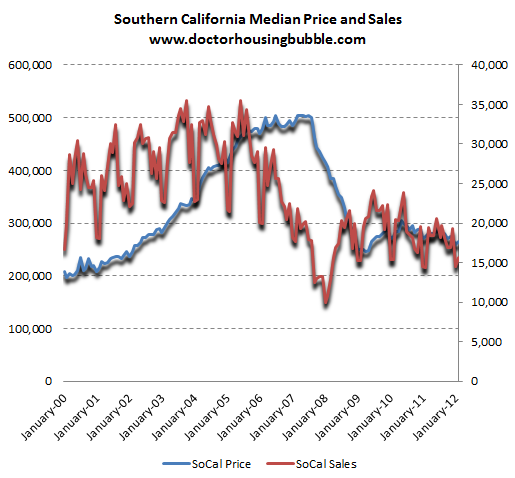
Southern California home sales are up by 8 percent year-over-year but what wasn’t in most headlines was that the median home price fell at the same time by 3.7 percent driven by investors and FHA first time home buyers looking at cheaper starter homes.  If you look at the chart, that jump barely even registers:
socal home prices and sales
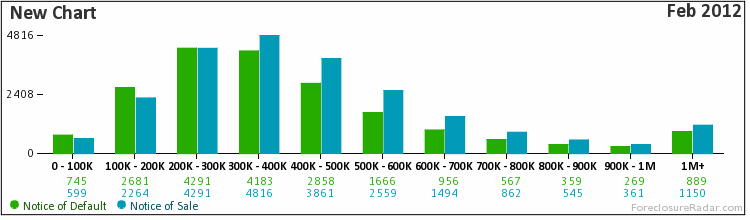
To put the current sales rate in perspective 23,000 homes sold in February of 2004 (over 50 percent more sales 8 years ago).  The shadow inventory is still large with properties with high mortgage balances:
foreclosures by price 2012
*California foreclosures
The bottom line is the market is hungry for cheaper properties however many sellers do not want to accept this fact so demand has shifted to short sales and REOs for the past couple of years.  If you want to see delusion in action take a look at Zillow’s “make me move” option and you will see it in full force.  Even with mortgage rates at record low prices and very generous products like FHA insured loans that only require 3.5 percent down, the market seems to be moving lower in mid-tier to upper-tier areas.
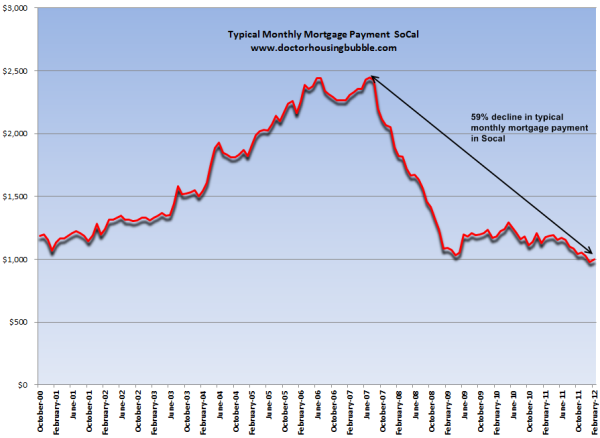
If we look at how much Southern California home buyers are committing to their mortgage payment we see that it has completely collapsed:
typical mortgage payment southern california
Californians are committing to roughly a 60 percent lower mortgage payment than they were from 2005 to 2007.  Let us look at Pasadena to see what is happening at the lower-end.
short sale condo pasadena
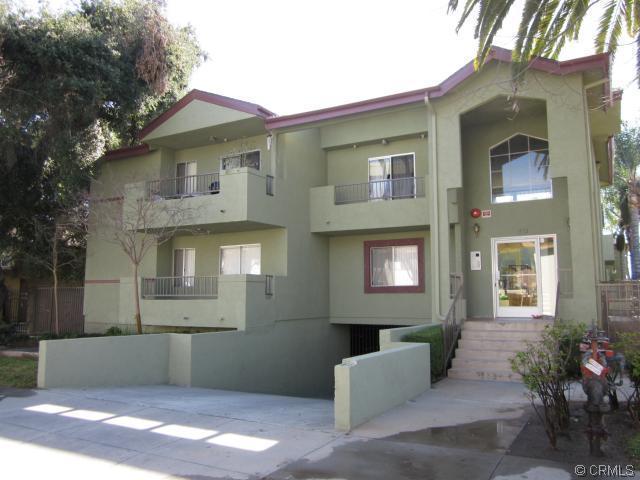
372 East Ashtabula Street #204 Pasadena, CA 91104
2 bedroom, 2 bathroom, 0 partial bath, 820 square feet, CONDO
This condo is listed as a short sale.  I’ve noticed more properties being listed as short sales on the MLS recently.  A big move has come from the condo section in various markets.  Not sure if banks are triaging the movement in shadow inventory and are choosing to move quicker on condo inventory.  The above condo is listed as a short sale.
The list price is $199,500.  Even with that price it has been on the MLS for over 200 days.  A few years ago it was:
“Prices only go up in Pasadena”
Then it was…
“Prices will remain steady in Pasadena”
Then it was…
“Prices will only go down a little in certain areas”
Then it was…
“Prices will only go down in bad areas”
Then it was…
“Prices will only go down on condos and a little on mid-tier areas”
You get the point.  The circles are closing in and problems hit from the bottom first.  A sub $200k condo with 2 beds and 2 bathrooms would have been snatched up in minutes anywhere in Pasadena only a few years ago.   Today it has lingered for over 200+ days.
Or take a look at the big price cuts now being done by banks on lower-end single family homes:
pasadena foreclosure
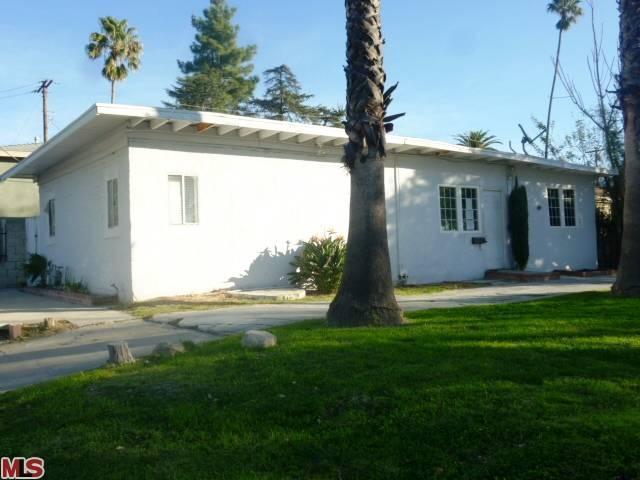
1430 Forest Ave Pasadena, CA 91103
2 beds, 1 bath 582 square feet
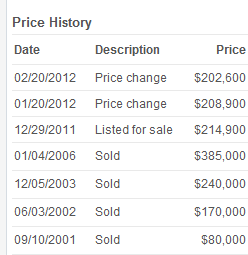
This is an example of how banks are now operating in 2012.  The place was listed for $214,900 on December 2011.  They reduced the price by $6,000 on January 2012.  It was reduced by another $6,300 in February of 2012.  The current list price is $202,600.
Look at the pricing history here:
pasadena foreclosure history
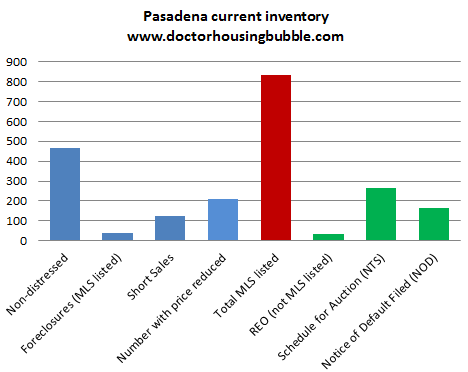
Someone paid $385,000 for this place in 2006.  As we have been saying, corrections take many years to play out and trust the data, Pasadena has a pipeline of distressed properties:
pasadena current inventory
This is one example of the many cities in Los Angeles that will face volatile price corrections in the next few years.  Banks in the last year have become more realistic.  Even in 2010 you would see lenders listing places for the actual balance and letting homes linger for months.  Now, on short sales and REOs that do hit the market they seem to be priced to move.  The shadow inventory is large and California mid-tier markets are in the process of seeing lower prices.

Mayor Bloomberg Visits Goldman Sachs to Show his Support After Whistleblower Revelations

The Intel Hub
March 16, 2012
Billionaire bankster and New York City Mayor Michael Bloomberg recently visited Goldman Sachs headquarters to show his support for one of the most corrupt companies in the history of America.
The visit comes after a departing employee became a major whistleblower and exposed the culture of corruption that is at the core of Goldman Sachs.
A Bloomberg Businessweek (owned by Mayor Bloomberg) article quoted the mayors spokesman as saying:
“The mayor stopped by to make clear that the company is a vital part of the city’s economy, and the kind of unfair attacks that we’re seeing can eventually hurt all New Yorkers.”
The whistleblower, a former executive director at Goldman Sachs, recently exposed the companies disgusting treatment of employees. He also singled out CEO Lloyd Blankfein.
The fact that Bloomberg openly visits and supports Goldman Sachs should be enough to identify him as nothing more than a corrupt gangster, working directly with the banksters who have literally destroyed this country from within.

Sinclair - Is the Fed Selling Europe’s Gold During Interventions

Today legendary trader and investor Jim Sinclair told King World News that a number of European countries are beginning to ask themselves where the gold is coming from which is being used for interventions in the gold market.  Sinclair also said some European countries are beginning to think it’s their gold, stored by the US Fed, which is being used for these interventions.  But first, here is what Sinclair had to say about the recent plunge in gold:  “Eric, this has been going on since $248 in gold.  Any idea or concern that this kind of intervention is going to cause the gold bull market to cease or shorten or even contain where it will potentially go is simply wrong.”

Jim Sinclair continues:

“Every time you intervene in any market or any time you intervene economically, it’s the same as using a controlled drug.  The first application gives you the best high you’ll ever have.  After that you have to do more and more just to near duplicate what you expected.

The selling down of the gold, what this means now is time....


“If in fact they can’t bring the market under the $1,600 level, then the demand here is beyond the willingness for intervention.  That means that if the demand is greater than the supply, the price is going to rise.  

If gold does go through $1,764 and stabilizes there, you are beginning an unwind in terms of gold cooperating with the management of perspective economics (MOPE).  (Central planners) would want gold to be very soft at a time when a credit event takes place in Greece, that very few of the participants and even bondholders knows yet exactly what happened.”

Jim Sinclair had predicted many European countries would want their gold back, which is being stored by the Fed in the US.  This movement is beginning to take hold in Switzerland and Germany as well as other countries.  When asked about his prediction beginning to take place, Sinclair responded, “It had to happen because we all ask ourselves the question, ‘Where does the gold come from on these attempts at intervention?’  Because it’s not simply paper gold, it’s also in the cash market.  There is a concern that the gold that’s being used to intervene might not be our (US) gold.  

Basically they (Germany, Switzerland and other countries) are now asking the question, where is the gold coming from?  There are two possibilities, Fort Knox or the Federal Reserve seller, in the cash sense.  Fort Knox, nobody knows what’s there.

Everybody knows what’s at the Fed, other people’s gold.  The trend that we discussed a long time ago which is really turning into a modest torrent, is to take back gold.  I mean the truth is what do the Germans need the Fed to store their gold for?  Are they afraid France will invade?  It doesn’t make any sense.”   

Jim Sinclair provides some extraordinary insights in this interview.  He discusses the gold plunge and what investors should expect next.   He also goes into detail about key events that are currently unfolding.  The KWN audio interview with Jim Sinclair is available now and you can listen to it by CLICKING HERE.

© 2012 by King World News®. All Rights Reserved. This material may not be published, broadcast, rewritten, or redistributed.  However, linking directly to the blog page is permitted and encouraged.

Eric King

Francis Cabrel Le monde est sourd


Bankers win.  The people pay.

One of my less scrupulous bosses once told me, "The way I like to win a race is to punch the other guy in the stomach and then yell, 'Let's race.'"

And I replied, "Well that may be all well and good, but if the guy you punch is Italian or Greek, I would not stop running at the finish line."

He was a Irish lad,  who having enjoyed a temporary run of luck, was left terribly over his head, pretty much in everything.  And as you might suspect, he ended badly, and took a lot of his type, whom he had gathered into his contrivances, down with him.  Its the little things that make life worth living.

No wonder the American derivatives dealers are leaving Europe.   They are probably just a few steps ahead of the pitchforks and torches.  Europeans keep a ledger of wrongs that never expires until the debts are paid.

The bad news is that they are coming home.

These Wall Street hooligans remind me of an old acquaintance of German descent, (nice fellow although a bit cheap, confirmed bachelor, good card player, but an unbearable drunk), who had been banned from so many pubs around his modest country home that we used to have to go over forty kilometers to get a drawn beer on the weekend. It got so bad that he finally gave up drinking altogether, just to save on gas. Found a nice woman, or rather I think she discovered him, and got married at fifty. Found his happiness. True story.


Bloomberg
Italy Said to Pay Morgan Stanley $3.4 Billion
By Nicholas Dunbar and Elisa Martinuzzi
Mar 16, 2012 10:10 AM ET

When Morgan Stanley (MS) said in January it had cut its “net exposure” to Italy by $3.4 billion, it didn’t tell investors that the nation paid that entire amount to the bank to exit a bet on interest rates.

Italy, the second-most indebted nation in the European Union, paid the money to unwind derivative contracts from the 1990s that had backfired, said a person with direct knowledge of the Treasury’s payment. It was cheaper for Italy to cancel the transactions rather than to renew, said the person, who declined to be identified because the terms were private.

The cost, equal to half the amount to be raised by Italy’s sales tax increase this year, underscores the risk derivatives countries use to reduce borrowing costs and guard against swings in interest rates and currencies can sour and generate losses for taxpayers. Italy, with record debt of $2.5 trillion, has lost more than $31 billion on its derivatives at current market values, according to data compiled by the Bloomberg Brief Risk newsletter from regulatory filings.

“These losses demonstrate the speculative nature of these deals and the supremacy of finance over government,” said Italian senator Elio Lannutti, chairman of the consumer group Adusbef.

The transaction may prompt regulators to push for greater transparency and regulation of how governments use derivatives, said the head of the European Parliament panel that deals with market rules.

“This latest revelation shows that we need to know a lot more,” Sharon Bowles, chairwoman of the economic and monetary affairs committee, said in an interview today. “I’m reluctant to have quite as many exemptions for central banks and countries” from transaction-reporting rules, she said.

Morgan Stanley said in a Jan. 19 filing with the U.S. Securities and Exchange Commission that it “executed certain derivatives restructuring amendments which settled on January 3, 2012” and reduced its Italian exposure by $3.4 billion.

Mary Claire Delaney, a spokeswoman for the New York-based firm, declined to comment further. Officials at the Italian treasury in Rome declined to comment on the contracts...

16 SHTF Barter Items to Stockpile

debtreckoning.com

by Tyler on March 12, 2012

Every good survivalist has a stockpile of things he or she recognizes their family may need to survive a natural or man-made disaster. However, many people forget the value of maintaining a barter store as well.

If things hit the fan, particularly in an economic collapse where the dollar is nearly worthless, a number of non-monetary goods will be more valuable than a fistful of dollar bills.

It’s also important to recognize that we can’t possibly store enough of every item to account for every scenario for an indefinite period of time. However, what we can do is have some items on hand to barter with neighbors to plug gaps in our preparations.

Imagine a neighbor with a large garden and some chickens trading a half dozen eggs and some squash for a box of ammo, or a small bottle of Vodka.

Consider stocking up on the following items, even if you have no plans to use them yourself, for their potential barter value.

16 Things to Stockpile with High Barter Value

Cigarettes. I hate smoking, and can’t stand being around anyone that smokes. Having said that, I recognize that in a SHTF situation many others will be cut off from their access to cigarettes, so there is plenty of barter potential.

Soap. Bars of soap, and even those little cleaning napkins/wipes that you get at the BBQ restaurants could be very valuable in a SHTF scenario. Ever see “The Book of Eli?”

Bullets. Obviously, it’s a good idea to have a decent store of ammo representing all calibers of the weapons you own. However, it is also a good idea to store extra ammo in common calibers (9mm, .22, .38, 12-guage shells, etc.) as a potential barter. After all, a gun without ammo is just an inacurate throwing object.

Alcohol. Alcohol could serve a variety of purposes in a SHTF situation. It is valuable as a potential bartering commodity, and it also has medicinal uses. Did you know Vodka is a great home remedy to counteract the reaction to poison ivy?

MREs. More portable and easier to barter than larger 5-gallon buckets, or even #10 cans of dried foods, MREs are great to have on hand for bartering. Keep a variety of flavors and different kinds of foods because you could be holding something that could complete a meal for a hungry person.

Silver Coins. Keep in mind this doesn’t necessarily mean only silver dollars with a full ounce of silver, but even older, less expensive coins with a high silver component (the 1964 Kennedy half-dollar, for example).

Detergent. Don’t think people are interested in bartering detergent? Check out the story about the recent rash of detergent thefts across the country. Apparently, Tide detergent on the black market is now referred to as “liquid gold.” Interesting.

Water bottles. To someone in bad need of water, a water bottle could be worth its weight in gold. Remember the rule of threes: you can live three minutes without air, three days without water, and three weeks without food. Store accordingly.

Matches and lighters. A box of matches is relatively inexpensive, but for someone needing to build a fire a pack of matches or a lighter could be very valuable. Be sure these are stored safely, and if they are not waterproof make them so by storing in a watertight container.

Sugar. My grandfather used to tell stories of things that were in limited supply in the Great Depression. Sugar was something he often mentioned. Imagine how easily you could win over a sweet-tooth with the promise of a bag of sugar in exchange for something you are short on.

Toilet paper. This one is rather self-explanatory, isn’t it? Sure, there are substitutes for Charmin, but who wants to keep using leaves when paper feels so much better.

Water Filters/Purifiers. Water purification drops and filters could mean the difference in offering family members treated water or potentially harmful, bacteria-infested water. Who’d be willing to trade for that?

Bleach. May be used to disinfect water, or keep living quarters and soiled clothing sanitized.

Batteries. Can be used to power up flashlights, radios, and other electronic devices.

Candles. Emergency candles would be a great barter item for those in need of providing some light to their living quarters without electricity.

What other items would you add to your barter store?