Friday, January 21, 2011

China devalues US buying power by 30%, Protects US Treasury Holdings

The trade imbalance between the US and China, a hot button between the nations for the last decade or so, is finally going to start to stabilize in the summer of 2011. However, it is doing so with a de facto devaluation of the US dollar and its buying power. The average American will see a spike in the price of everything from their favorite jeans and T-shirts, to the cost of some electronics.

The Chinese have decided to devalue the US dollar’s buying power, without devaluing the US Treasury holdings they hold. It is an elegant solution to their issues. It will be interesting to see if they can pull it off, while they try to prop up the European Sovereign debt markets at the same time.

The Chinese are attempting, successfully so far, to introduce the Yuan as a global currency in which to settle international trade. China is pumping into its own internal currency markets so much liquidity, they need an export market to develop for the Yuan or their own internal markets will overheat.

So China is going to start offering Yuan based savings accounts, to westerners as a vehicle in which to park capital. While this is a test case only, one might expect Yuan based accounts to be offered around the world sooner rather than later.

If western investors take to Yuan based cash accounts as a way to try and gain an increase in value, the transition will drive the western banks to be more proactive in adding convertibility into their systems. To start, they are offering these Yuan accounts at three US based branches.

The US Dollar devaluation will come in the form of an increase in the prices of all products. In reality it will represent the uniform cost push effects of inflation. The US can expect it on all Chinese based products of one form or another. The timing of the change is set to arrive with the products on the US shores in the summer of 2011.

“They’re going to go home with 35 percent less product than for the same dollars as last year,” particularly for fur coats and cotton sportswear, said Bennett Model, chief executive of Cassin, a Manhattan-based line of designer clothing. “The consumer will definitely see the price rise.”

China has no choice at this stage, but to pass on the cost of raw inflation to its customers. The era of cheap Chinese imports is over. The real impacts of higher commodity costs are going to push into the economy at different levels.

The weather impact on Australia has not hit the Chinese manufacturing capacity yet, but you can expect that diesel will increase significantly in the coming weeks, as China draws upon the world’s spare capacity to fuel their economy this spring.

The US had warned China to adjust its currency peg with the US, or suffer the consequences. Those consequences are now being going to be return to the US shores as expensive imports of dubious quality.

However, not all nations or economist agree with the stance the US is taking. Robert Mundell, Nobel Prize winning economist, and the proverbial father of the Euro, feels that the US is pushing China too hard in this regard.

Robert Mundell, Professor of Economics, Columbia University, said: “It’s a mistake to have China change the exchange rate. This is a bad way of changing something.

“A big appreciation in China would create deflation, aggravate poverty in the western part of the country, in the rural areas. It would be something that would in the long run come back to haunt China.”

Channel News Asia

China has no choice but to push the cost of the rising raw commodity prices onto their end consumers. The dirty secret of the runaway commodity bull market that started in the summer of 2010 is how much real inflation is raging inside of the Chinese economy in 2011.

“Four percent, China can bear it — beyond 5 percent, people will complain a lot,” said Huo Jianguo, president of the Chinese Academy of International Trade and Economic Cooperation here.

The Chinese people are reported to be experiencing painful levels of internal inflation on food staples. The hard reality is that in the global trade in fresh produce, requires that energy inflation is quickly pushed through to food prices. The Chinese government has reacted to these increases by rolling out Nixon like price caps on staples.

“Given that food prices are spearheading immediate inflationary pressures, supply-side measures should be more effective than rate hikes,” Qu Hongbin, the co-head of Asian economics research at the international bank HSBC, “There’s no need to panic, as Beijing has more than enough effective policy options to combat inflation.”

The real mark up of inflation will be higher, and across the board for buyers of Chinese products in the spring 2011 for the next Christmas buying season. This is going to introduce expectations of inflation in the US by the spring of 2012.

Victor Fung, the group chairman of Li & Fung in Hong Kong, a 35,000-employee trading company that supplies most of the world’s big retailers with Asian goods, said that contracts signed late last year would produce a jump of 10 to 20 percent in the import prices of consumer goods arriving at American ports by the second quarter of this year.

“By the middle of this year, you’ll see considerable diversion of trade away from China,” which will start to bring down the United States trade deficit with China, Mr. Fung said in an interview.

New York Times

The Chinese – US bilateral trade will show signs of leveling at a new lower rate, just as the European mess grows worse. This is the Catch-22 China now finds itself in. Europe has grown into China’s most important export market, just as the economy of Europe shudders from the fiscal and monetary policies of the area. China can handle the market adjustment to one of its major export markets, but can it handle both?

The Chinese could find themselves in a situation in 2012 where their largest two export markets have radically changed on them. This leaves their government open to domestic issues concerning the support they are providing to bankrupt western nations.

The US purchasers for organizations like Wal-Mart are international mercenaries. They will look to relocate their international low margin purchases to nations like Vietnam, the Philippines, and Africa, and to the Mexicali factories, once again.

The Chinese are going to find themselves priced out of the low end of the cheap product market. While their factories are the largest in the world and they employ armies of workers, the scale of large numbers is starting to work against the Chinese as a whole.

The increase in prices from most if not all world sources, will drive new changes to the US business models in the near future. It will be interesting to see where China and its exports are in that make up.

Confessions of a Macro Contrarian www.jackhbarnes.com

Insider Selling To Buying Ratio: DIV/0, As No Insiders Bought Any Stock In Prior Week

According to Bloomberg, in the week ended January 14 S&P 500 insiders sold $163 million worth of stock in 54 separate transactions. They bought exactly $0. That's right, in the last week, there was no insider purchasing. This is the first time in years (and possibly for ever) in which we have seen a week during which there was not one purchase by an insider. Surely, there is no need to comment on this result.

Source: Bloomberg

How the financial elite have dismantled the American middle class

top 1 percent share of wealth at levels not seen since the Great Depression. Goldman Sachs offering average bonuses of $430,000 while a record 43,200,000 Americans receive food stamps.


The U.S. economy is now operating like a finely tuned engine bent on dismantling the middle class and protecting the tiny elites in our nation that have learned to manipulate both political parties to their financial benefit. This did not occur over night but started in the 1970s when the U.S. government and investment banks juiced up the nation with deficit and debt spending. A single family cannot go into debt for a very long time without consequences but a rising housing market hid much of the inequality developing in our system for a very long time. It was an illusion of stability. The top 1 percent in our nation now control 43 percent of all financial wealth. These are levels not seen since the years before the Great Depression consumed the global economy. The fact of the matter is the top 1 percent has massively gained in real financial terms because of political maneuvering and selling out the middle class. Since these people protect their wealth through investment banks and tax breaks politicians have not dared touch these sacred cows or even asking banks to pay for their decades of personal irresponsible lending. In the end the elite have created a system where the working and middle class are paying for their own demise.

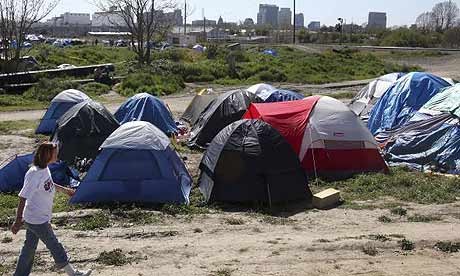
tent city

“(UK Guardian) A homeless encampment known as Tent City, in Sacramento, California, in 2009. Since the 1970s, real wages stopped growing and the gap between rich and poor expanded as the US economy slowed down after decades of growth. Photograph: Rich Pedroncelli/AP”

I find it disturbing that foreign news organizations are covering our financial reality better than local media outlets. This probably has to do with many large media outlets being controlled by the same Wall Street power brokers. This is no conspiracy story but a logical extension of money infiltrating and controlling politics, laws, and the trajectory of our economy moving forward. The above comes from the UK and shows a grim reality that many Americans do not want to face. Those that do face it are usually left voiceless (ironically the viral star Ted Williams was a homeless man with a golden voice). We have a very large problem with many people falling off of the economic radar. Tent cities are now a staple in many areas of the country and food banks are facing unprecedented demand for their services. Why is this occurring in the midst of a recovery? Well take a look at how many people now receive food assistance from the government:

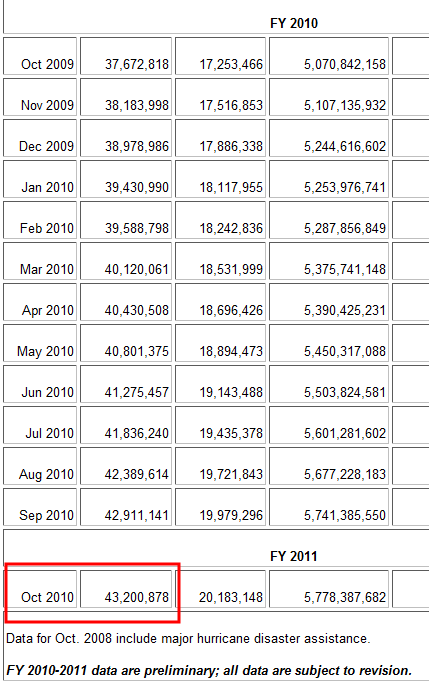
food stamp participation chart

Source: SNAP

The latest uninviting data shows 43,200,000 Americans receiving some form assistance, an all-time record that seems to be broken each month. This number has been moving up steadily for the entire decade. Many of these people are families that have been thrown off of the middle class track. With 1 out of 3 families with no retirement savings many people are one paycheck away from being homeless or being evicted, a fact confirmed by the record number of foreclosures in 2010. What is disturbing however is how many people are anesthetized by the mainstream media and somehow blame each other for these problems. Have they not noticed the record profits at investment banks? Did they miss the memo that Goldman Sachs, a bank that would not even be around without taxpayer support, is now going to give out bonuses that average $430,000? Did people forget that it took Wall Street years to create these financially destructive products to gamble away the wealth of average Americans and distribute it amongst themselves? While most working and middle class Americans operate in the rugged individualistic capitalism world of Social Darwinism many of the elite operate in a plutocracy model where they win no matter what outcome hits in the market. If they make a failed bet they can extort politicians and force their hands for bailouts.

“US employers took advantage of the changed situation: they stopped raising wages. When basic labour scarcity became labour excess, not only real wages, but eventually benefits, too, would stop rising. Over the last 30 years, the vast majority of US workers have, in fact, gotten poorer, when you sum up flat real wages, reduced benefits (pensions, medical insurance, etc), reduced public services and raised tax burdens. In economic terms, American “exceptionalism” began to die in the 1970s.”

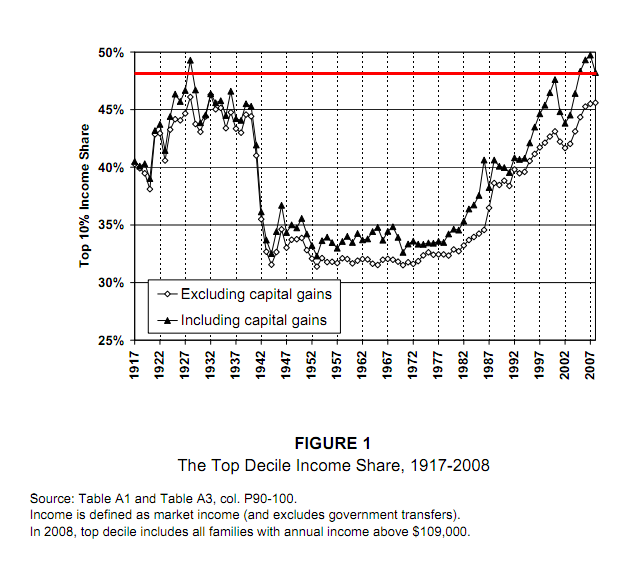
income inequality

The disparity is obvious by examining the above chart. Income is now flowing to the top 10 percent in a way that it has not since the 1920s all the while middle class American have been increasing productivity and have actually added more family members to the workforce merely to stay afloat. Half of all American workers make $25,000 a year or less. Wages have been stuck for over a decade and have gone virtually nowhere for a few decades in real terms. Yet these gains in productivity and favorable political climate have flowed one way:

“The rich, however, have got much richer since the 1970s, as every measure of US income and wealth inequality attests. The explanation is simple: while workers’ average real wages stayed flat, their productivity rose (the goods and services that an average hour’s labour provided to employers). More and better machines (including computers), better education, and harder and faster labour effort raised productivity since the 1970s. While workers delivered more and more value to employers, those employers paid workers no more. The employers reaped all the benefits of rising productivity: rising profits, rising salaries and bonuses to managers, rising dividends to shareholders, and rising payments to the professionals who serve employers (lawyers, architects, consultants, etc).”

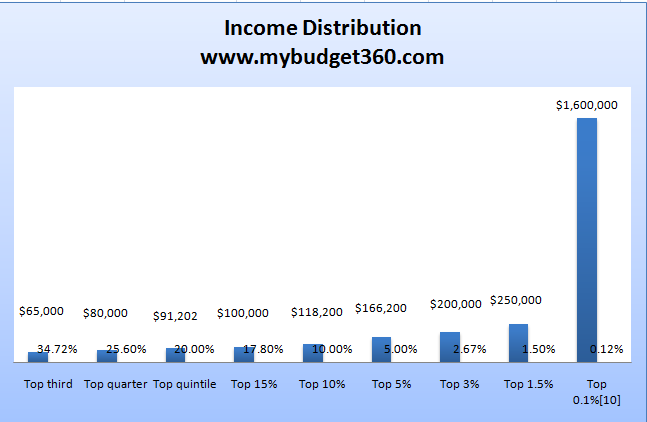
incomedistribution (1)

So even with the top 10 percent we see the inequality spike as we move up the chain. The narrative coming out of Wall Street is all of this was inevitable. That somehow the middle class disappearing is just the market working itself out. That is a blatant lie. If that were to be the case all big investment banks on Wall Street would be in the ash heap of history. That would be the market working things out. Instead, we have subsidized cronyism for the top 1 percent all at the expense of the working and middle class:

“Since the 1970s, most US workers postponed facing up to what capitalism had come to mean for them. They sent more family members to do more hours of paid labour, and they borrowed huge amounts. By exhausting themselves, stressing family life to the breaking point in many households, and by taking on unsustainable levels of debt, the US working class delayed the end of American exceptionalism – until the global crisis hit in 2007. By then, their buying power could no longer grow: rising unemployment kept wages flat, no more hours of work, nor more borrowing, were possible. Reckoning time had arrived. A US capitalism built on expanding mass consumption lost its foundation.”

Average Americans need to wake up and get a handle on the situation. College tuition now is even outpacing inflation compared to other sectors so it is likely that fewer Americans will gain the knowledge base needed to combat these entrenched interests without going into massive debt at these institutions. Many would rather be fixated on a homeless man with a golden voice instead of looking at where all the real gold is in our economy.

The Baltic Dry Index is Shouting "Danger, Will Robinson!" But Are Investors Listening?

[Editor's Note: The Baltic Dry Index (BDI) flashed serious warning signals ahead of the 2008 financial crisis. After dropping for its 35th-straight day yesterday (Thursday), what is this thinly followed index telling us now?]

Back in May 2008, when global investors still expected economic growth to continue, a thinly followed index began to broadcast a "red-alert" warning to those few who were watching.

The index proceeded to drop by more than 90% in the next six months.

Had you been watching - and heeded its warning - this index would have saved you from the fallout of the biggest financial crisis since the Great Depression.

And here's the thing. This index is updated five days a week and is readily available to anyone who wants to track it.

The index in question is called the "Baltic Dry Index," or BDI, and it once again merits a closer look: After peaking in May, the BDI has fallen for 35 straight days.

Is this another economic red alert, or merely a statistical red herring, like so many of the other economic reports that have appeared during the often-contradictory, whipsaw markets we've seen of late?

Let's take a closer look...

A Look Back at the Last Warning

The Baltic Dry Index is a number issued daily by the London-based Baltic Exchange. Not restricted to Baltic Sea countries, the index tracks worldwide international shipping prices of various dry bulk cargoes.

The index provides investors and others with an idea of how much it will cost to move major raw materials by sea (in bulk, hence the name). Taking in 26 shipping routes measured on a time-charter and voyage basis, the BDI covers Handymax, Panamax, and Capesize dry bulk carriers shipping a plethora of commodities - including coal, iron ore, and grain.

If we look back at the BDI plunge that presaged the "Great Recession," we can see that outside events coincided with the index decline.

Crude oil peaked at an all-time high in a speculative frenzy in July 2008, and then reversed course. In September and October we witnessed the "big unwind," as Lehman Bros. Holdings Inc. (OTC: LEHMQ) collapsed, American International Group Inc. (NYSE: AIG) was torpedoed by its credit-default-swap (CDS) business, and mortgage giants Fannie Mae (NYSE: FNM) and Freddie Mac (NYSE: FNM) imploded.

The index kept dropping as shipping companies parked their fleets. It let anyone who was following it know - in advance - that things were continuing to get worse.

When the index finally bottomed in December 2008, it established a bottom so low that it represented the ability to rent a 1,000-foot ore-class ship for less than the cost of the fuel it would burn if left to idle for a day. Ships that chartered for $48,000 back in May can now be had for $18,000 a day, a Lombard Street Research analyst told The Economist.

To the investors who watched this index, all of this was pretty obvious. Unfortunately, not many investors were watching.

And now the BDI is flashing "Red Alert" once again.

The Return-Trip Ticket

As important as it is to understand that a crash is imminent, I believe it's just as crucial to be ahead of the game by understanding when a rebound is at hand.

The Baltic Dry Index performs that early warning system function just as well. It had fully bottomed three months before U.S. stocks ended their sell-off. By January 2009, in fact, the BDI had signaled to "informed investors" that it was time to start nibbling again.

As a fund manager working to navigate the crash, I made sure that my shop relied on this index: Along with some other tools, the BDI provided us with insights about how the U.S. and global economies were behaving. It provided us with a panoramic view of what global manufacturers were doing with their raw ore reserves.

That brings us back to the present.

Back on the Tarmac

The BDI most recently topped out in May. As of yesterday (Thursday), it has already dropped 35 days in a row.

That's significant.

This string of "down days" is the longest in at least nine years, The Economist reported this week. During the crash of 2008, the index never fell 35 days in a row.

Today, the BDI is again flashing serious warning signs that not everything is as it appears. It may be warning us about the start of a "double-dip" recession, or it may be telling us that something even worse is at hand.

Historically, the Baltic Dry Index has shown itself to be the EKG of future industrial demand. And, right now, the BDI is screaming "Danger, Will Robinson!" to any investor who will read it and heed it as a true leading indicator.

If the price of refined copper is called "Dr. Copper," for its ability to ascertain the health of the demand for growth in an economy, the BDI is the daily heartbeat for near-term future industrial demand.

Combined, those two indicators can provide investors with a view of whether the world economy is growing or shrinking, based on the big picture of world demand for growth. Currently, the BDI is flashing serious warning signs to anyone who is looking at it.

The drop in the BDI index in 2008 was one of the most obvious signs of the real impact that the so-called "Great Recession" would have. From May 20, 2008 to Dec. 3, 2008, the BDI fell from its high of 11,793 to its low of 663 - a near-freefall of 94%.


Moves to Consider Now

Given the signals we're getting from the Baltic Dry Index, the question to ask is clear: Are you preparing your portfolio so it includes protection against a possible additional leg down in the market?

It may help to understand the specific moves you'd want to consider.

Remember, back in 2008 the BDI had dropped for nearly two months before crude oil hit that July record peak and then started to unwind.

We will want to keep an eye on other raw commodity prices for similar "topping" actions, as we watch for confirmation of weakness in our favorite natural resources.

When demand is dropping for raw bulk materials, and the inventory of refined products like copper is growing, we will know it is time to consider putting in a "short" play on some of our commodity futures via long-dated put options.

Action to Take: The odds of a double-dip recession escalate even as volume dries up during summer trading. Put tight stops on any speculative position that you would be uncomfortable holding through a "2008-like" financial event that could strike this fall. You want to have enough liquidity to be able to buy when the next "March-2009-like" market bottom occurs. It won't play out just like the last one, but there will be similarities. You will need the financial firepower - cash - to take advantage of such a great possible entry point. Be prepared.

[Editor's Note: Jack Barnes started his career at Franklin Templeton in 1997, working with the company's portfolio team in its fund-information department - just as the Asian contagion infected the Asian tiger countries. He launched his own RIA shop in 2003 just as the second Gulf War was breaking out. In early 2006, after logging a one-year return of nearly 83%, Forbes named Barnes the top stock picker in its "Armchair Investors Who Beat the Pros" competition. His two audited hedge funds generated double-digit returns in 2008. Last summer, Barnes retired to the beach - which is where he writes from now.]

What the US can learn from China

Click this link ......

Goldman Sachs Vs. J.P. Morgan: Which Insolvent Bank Is A Better Investment - Chris Whalen With Larry Kudlow - Video


CNBC Video - Jan. 19, 2011

Discussing earnings results for Goldman & JP Morgan, with Charles Bobrinskoy, Ariel Investments, and Christopher Whalen, Institutional Risk Analytics.

---

Solvency is not even a question...

The 4 largest banks are insolvent many times over. Their puny and massively over-leveraged capital bases would not just be wiped out, they would be turned into negative multiples of the original equity.

Then take the next step and understand that these same criminally fraudulent and insolvent institutions, are paying their executives $144 billion in bonuses this year, based on false accounting that was endorsed by Congress and jammed down the throats of FASB in June of 2009.

I wrote about the criminal insolvency of banks here.

And here:

* VIDEO: 120 Seconds Of Gerald Celente Kicking Wall Street's Ass - "$144B Bonus Is 49th Largest GDP In World!"

* What If The Bankers Gorged On A Record $144 Billion In Bonuses And No One Noticed

---

Bill Black has made the case recently here...

* William Black Calls On FDIC To Seize Bank Of America

* William Black With Dylan Ratigan: "There Is Bank Fraud Everywhere And BERNANKE Is Leading The Cover-Up," PLUS Part 2 Of 'Seize Bank OfAmerica'

---

12 Economic Collapse Scenarios That We Could Potentially See In 2011

What could cause an economic collapse in 2011? Well, unfortunately there are quite a few "nightmare scenarios" that could plunge the entire globe into another massive financial crisis. The United States, Japan and most of the nations in Europe are absolutely drowning in debt. The Federal Reserve continues to play reckless games with the U.S. dollar. The price of oil is skyrocketing and the global price of food just hit a new record high. Food riots are already breaking out all over the world. Meanwhile, the rampant fraud and corruption going on in world financial markets is starting to be exposed and the whole house of cards could come crashing down at any time. Most Americans have no idea that a horrific economic collapse could happen at literally any time. There is no way that all of this debt and all of this financial corruption is sustainable. At some point we are going to reach a moment of "total system failure".

So will it be soon? Let's hope not. Let's certainly hope that it does not happen in 2011. Many of us need more time to prepare. Most of our families and friends need more time to prepare. Once this thing implodes there isn't going to be an opportunity to have a "do over". We simply will not be able to put the toothpaste back into the tube again.

So we had all better be getting prepared for hard times. The following are 12 economic collapse scenarios that we could potentially see in 2011....

#1 U.S. debt could become a massive crisis at any moment. China is saying all of the right things at the moment, but many analysts are openly worried about what could happen if China suddenly decides to start dumping all of the U.S. debt that they have accumulated. Right now about the only thing keeping U.S. government finances going is the ability to borrow gigantic amounts of money at extremely low interest rates. If anything upsets that paradigm, it could potentially have enormous consequences for the entire world financial system.

#2 Speaking of threats to the global financial system, it turns out that "quantitative easing 2" has had the exact opposite effect that Ben Bernanke planned for it to have. Bernanke insisted that the main goal of QE2 was to lower interest rates, but instead all it has done is cause interest rates to go up substantially. If Bernanke this incompetent or is he trying to mess everything up on purpose?

#3 The debt bubble that the entire global economy is based on could burst at any time and throw the whole planet into chaos. According to a new report from the World Economic Forum, the total amount of credit in the world increased from $57 trillion in 2000 to $109 trillion in 2009. The WEF says that now the world is going to need another $100 trillion in credit to support projected "economic growth" over the next decade. So is this how the new "global economy" works? We just keep doubling the total amount of debt every decade?

#4 As the U.S. government and the Federal Reserve continue to pump massive amounts of new dollars into the system, the floor could fall out from underneath the U.S. dollar at any time. The truth is that we are already starting to see inflation really accelerate and everyone pretty much acknowledges that official U.S. governments figures for inflation are an absolute joke. According to one new study, the cost of college tuition has risen 286% over the last 20 years, and the cost of "hospital, nursing-home and adult-day-care services" rose 269% during those same two decades. All of this happened during a period of supposedly "low" inflation. So what are price increases going to look like when we actually have "high" inflation?

#5 One of the primary drivers of global inflation during 2011 could be the price of oil. A large number of economists are now projecting that the price of oil could surge well past $100 dollars a barrel in 2011. If that happens, it is going to put significant pressure on the price of almost everything else in the entire global economy. In fact, as I have explained previously, the higher the price of oil goes, the faster the U.S. economy will decline.

#6 Food inflation is already so bad in some areas of the globe that it is setting off massive food riots in nations such as Tunisia and Algeria. In fact, there have been reports of people setting themselves on fire all over the Middle East as a way to draw attention to how desperate they are. So what is going to happen if global food prices go up another 10 or 20 percent and food riots spread literally all over the globe during 2011?

#7 There are persistent rumors that simply will not go away of massive physical gold and silver shortages. Demand for precious metals has never been higher. So what is going to happen when many investors begin to absolutely insist on physical delivery of their precious metals? What is going to happen when the fact that far, far, far more "paper gold" and "paper silver" has been sold than has ever actually physically existed in the history of the planet starts to come out? What would that do to the price of gold and silver?

#8 The U.S. housing industry could plunge the U.S. economy into another recession at any time. The real estate market is absolutely flooded with homes and virtually nobody is buying. This massive oversupply of homes means that the construction of new homes has fallen off a cliff. In 2010, only 703,000 single family, multi-family and manufactured homes were completed. This was a new record low, and it was down 17% from the previous all-time record which had just been set in 2009.

#9 A combination of extreme weather and disease could make this an absolutely brutal year for U.S. farmers. This winter we have already seen thousands of new cold weather and snowfall records set across the United States. Now there is some very disturbing news emerging out of Florida of an "incurable bacteria" that is ravaging citrus crops all over Florida. Is there a reason why so many bad things are happening all of a sudden?

#10 The municipal bond crisis could go "supernova" at any time. Already, investors are bailing out of bonds at a frightening pace. State and local government debt is now sitting at an all-time high of 22 percent of U.S. GDP. According to Meredith Whitney, the municipal bond crisis that we are facing is a gigantic threat to our financial system....

"It has tentacles as wide as anything I’ve seen. I think next to housing this is the single most important issue in the United States and certainly the largest threat to the U.S. economy."

Former Los Angeles mayor Richard Riordan is convinced that things are so bad that literally 90% of our states and cities could go bankrupt over the next five years....

#11 Of course on top of everything else, the quadrillion dollar derivatives bubble could burst at any time. Right now we are watching the greatest financial casino in the history of the globe spin around and around and around and everyone is hoping that at some point it doesn't stop. Today, most money on Wall Street is not made by investing in good business ideas. Rather, most money on Wall Street is now made by making the best bets. Unfortunately, at some point the casino is going to come crashing down and the game will be over.

#12 The biggest wildcard of all is war. The Korean peninsula came closer to war in 2010 than it had in decades. The Middle East could literally explode at any time. We live in a world where a single weapon can take out an entire city in an instant. All it would take is a mid-size war or a couple of weapons of mass destruction to throw the entire global economy into absolute turmoil.

Once again, let us hope that none of these economic collapse scenarios happens in 2011.

However, we have got to realize that we can't keep dodging these bullets forever.

As bad as 2010 was, the truth is that it went about as good as any of us could have hoped. Things are still pretty stable and times are still pretty good right now.

But instead of using these times to "party", we should be using them to prepare.

A really, really vicious economic storm is coming and it is going to be a complete and total nightmare. Get ready, hold on tight, and say your prayers.