Tuesday, November 22, 2016

The Age of Disintegration: Political Disunity and Elites At War

In this war of the rising and fading elites, there is no common ground or incentive to compromise.
Historian Michael Grant identified profound political disunity in the ruling elite as a key cause of the dissolution of the Roman Empire. Grant described this dynamic in his excellent account The Fall of the Roman Empire.
The chapter titles of the book illuminate the complex causes of profound political disunity in the ruling elite:
The Gulfs Between the Classes: a.k.a. soaring income/wealth inequality: check.
The Credibility Gap: The Mainstream Media lauds itself and a self-serving, failing elite: check.
The Partnerships That Failed: the SillyCon Valley tech titans were supposed to “save” the neoliberal elite by managing social media the way the MSM managed broadcast propaganda/”news”: check.
The Groups That Opted Out: nobody “important” noticed those who opted out of the neoliberal Kool-Aid: check.
The Undermining of Effort: if I don’t get my way, I’ll block yours. There is no common ground left.
Is there any doubt about the profound political disunity in America’s ruling elite? I have addressed this many times over the past seven years, most recently a year ago in Profound Political Disunity Is Now Pitting Rising Elites Against Fading Elites(November 24, 2015).
Historian Peter Turchin explores the dynamic of social disintegration in his new book Ages of Discord. The cycle of social disintegration and integration is essentially universal to complex societies–a reality I recently discussed inUngovernable Nation, Ungovernable Economy (October 11, 2016)
The globalist, neoliberal, neoconservative consensus in the Ruling Elite has splintered, a reality I have described as a splintering of the Deep State, the unelected government that continues on regardless of which party or elected politico is currently in office.
I explored this years ago in Is the Deep State Fracturing into Disunity? (March 14, 2014) and more recently in Could the Deep State Be Sabotaging Hillary? (August 8, 2016), Why the Deep State Is Dumping Hillary(September 26, 2016) and These Blast Points on Hillary’s Campaign… Only The Deep State Is So Precise(October 31, 2016).
What few in the pundit class see is that significant segments of the Deep State view the neo-con neoliberal strategy as an irredeemable failure. But the camp of neoliberals and globalists will not concede defeat and relinquish their hubris-soaked power without a fight.
Indeed, it is clear that this fading sector of the Deep State is now throwing everything in its power at Trump, his appointees, and anyone who dares question the fake-progressive neoliberal neocon narrative.
The neoliberal Deep State’s mouthpiece Foreign Affairs is darkly equatingpopulism (i.e. Trump, Le Pen, et al.) with nascent fascism, the favorite fearmongering slander (along with racism) of the fading, discredited neoliberals.
Slander and managed news–and the slandering of any dissenting narratives as “fake news”, the ultimate irony of a regime that depends on propaganda and collusion for its survival— these are the weapons of a cornered, enraged beast that has lost the narrative battle but which refuses to cede its power or pay-to-play wealth.
In this war of the rising and fading elites, there is no common ground or incentive to compromise. Either the rising Elite’s agenda and narrative are completely destroyed and the globalist neoliberals remain ascendant, or the rising Elite’s narratives and agenda survive the furious onslaught of paid protesters, fake news protesting fake news, and the brainwashed supporters of the Neofeudal, Neo-Colonial pillaging machine known as (in the perfection of doublespeak) “progressive neoliberalism.”
The sad truth is a system of pay-to-play global racketeering that has enriched the top .1% at the expense of the bottom 95% for decades cannot be “progressive” unless the word has been turned on its head. The hubris of the neoliberal “progressives” knows no bounds, and they still cannot quite believe the debt-serfs rebelled against the neoliberals’ benign impoverishment of everyone outside their protected cliques.
The fading elite will render the nation ungovernable rather than concede its power, wealth and global influence. This is the inevitable result of profound political disunity, which arises when The Ruling Elite Has Lost the Consent of the Governed (October 20, 2016).
I recently discussed ungovernability and the loss of the consent of the governed with Max Keiser and Stacy Herbert: (from 12:50)
My new book is #8 on Kindle short reads -> politics and social science: Why Our Status Quo Failed and Is Beyond Reform ($3.95 Kindle ebook, $8.95 print edition) For more, please visit the book’s website.

Dear Mr. Trump, About Your 29 Ideas

Regarding your 29 proposals, here's a bit more than just the ranking you asked for. I'll start with the best:
7. Announce our official withdrawal from the TPP.
That's my favorite. Wonderful! We don't need any more trade agreements that empower corporations over governments and impose unpopular laws on people. Good riddance! Don't replace it with something worse, please!
8. Renegotiate NAFTA into terms that protect the American worker.
This could be a great one. I'm not clear why you wouldn't just tear up the treaty you've repeatedly called one of the worst treaties in history. You could negotiate bilateral agreements with other nations. There's no actual need for NAFTA. But if you're going to first try to renegotiate it, the U.S. worker needs the right to organize, among other rights. The workers of Canada and Mexico need to be considered. As does the natural environment that we and our kids all have to live in.
5. Introduce an infrastructure package to modernize our country.
This, too, could be terrific. Or it could be disastrous. Modernized countries have fast electric trains, solar and wind energy, pedestrian and bicycle paths, electric car chargers, sustainable agriculture, free hospitals for all human beings, and architecture that leans more toward the beautiful than the monumental. We could use more schools and parks, more farmers' markets, more urban gardens, and more places to vote. All of these dreams and much more could be easily achieved, even while radically boosting foreign aid, if the U.S. were to either cut military spending or tax billionaires or both. But you want to increase military spending and cut taxes on billionaires. Even if your idea of modernized infrastructure is coal mines and oil wells and highways, you have no way to pay for it -- thank goodness. And don't forget: the people who voted for you are obsessed with the debt, so don't even try that route.
20. Enact a five-year ban on White House and congressional officials becoming lobbyists after they leave government service.
This is good, as far as it goes. Why not 10 years both before and after? And why just lobbyists? Why not anyone profiting financially from a sector governed by the relevant government position? And why just the White House and Congress? Why not all government departments and agencies? Putting an oil profiteer in charge of the EPA is not solved by the fact that the EPA isn't in the White House.
25. Reform the Department of Veterans Affairs in order to provide proper treatment to America’s forgotten heroes.
This sounds good, if you actually mean it. But let's not call them heroes. Let's call them brave people who were abused by some of those recent wars you properly denounced during the campaign -- though you supported them when it mattered most.
26. Let veterans receive public VA treatment or attend the private doctor of their choice.
This could be good or bad. It could be a model for single-payer healthcare, or it could end up cheating veterans further. Watch the details.
28. Pass the Clean Up Corruption in Washington Act in order to “drain the swamp” that has polluted our capital for decades.
This could be good or bad depending on what in the world it means. If it means freeing democratic government from financial corruption, I'm all for it. If it just means a partisan purge, count me out. Both parties are rotten, and rotten because of the financial corruption.
29. Cancel every unconstitutional executive action, memorandum, and order issued by Obama.
Of course, this sounds great. But it ought to include abandoning the idea that presidents can write and rewrite and announce their noncompliance with laws. Obama's most unconstitutional action was announcing that he could choose which of Bush's signing statements to keep in place and which not to (and not even tell us which he kept and which he tossed, so that we couldn't even know what the "law" was). If you're just announcing the same thing, it's hardly an improvement. You could make this into something better by taking a principled position.
6. Unleash the Middle Class Tax Relief and Simplification Act, which will cut taxes for middle-class families and simplify the tax brackets in order to streamline the process.
By "Middle Class" do you mean those with incomes about $500,000? The trouble is that people with much smaller incomes also think of themselves as "middle class," and they think you mean them. But throwing them a crumb while massively slashing taxes on the wealthiest is not an answer to how you'll pay for that infrastructure.
2. Repeal and replace ObamaCare.
Yes, great. If you haven't backed off on this already, the key question is what you would replace it with. In private Hillary Clinton admitted what she would never say in public but we all know to be true: only single-payer will actually work.
12. Allow Americans to deduct childcare and eldercare from their taxes.
That's nice for people who pay taxes and for people who can afford childcare and eldercare. But what about everybody else? Countries with modernized infrastructure actually guarantee these rights for all.
17. Set the standard for an “America First” foreign policy that ends regime-change, nation-building, and instead focuses on a motto of peace through strength.
Ending overthrows and so-called nation-building, and investing in peace sound like "Whole World" ideas as well as "America First." These are the best policies for everyone -- depending what you mean by "strength" and what dangers lurk in that word. Thawing the Cold War that Obama and his predecessors created with Russia could be the most significant thing you do. Ceasing to continue and escalate and launch new wars would make you a hero to almost everyone on earth, including most of this country.
16. Introduce plan to defeat ISIS.
If this means ceasing to arm the region, cutting off support for ISIS, negotiating disarmament, and providing massive aid and reparations, count me in. If it means yet more of the bombing that Michael Flynn admits is counterproductive, count me out.
22. Pass the Restoring Community Safety Act in order to reduce crime, drugs, and violence in our cities, and provide funding for programs that train and assist local police.
The first half of this sounds great. There's no dispute that the most effective way to accomplish those goals is to provide better pre-schools and schools, better income security, better healthcare, better lives. But the second half seems to give the game away and transform this into yet more counter-productive militarization of police. The federal and foreign training of police, and the arming of them with weapons of war, has been disastrous. Why would you continue what does not work?
23. End Common Core and bring education supervision to local communities.
This could be good or hideous. Does it mean getting rid of all the dumb tests and focusing instead on teaching and learning and growing? Or does it mean continuing to profit the test makers at the expense of students while sneaking in the local "right" to teach that climate change is a Chinese hoax and the earth was created 6,000 years ago and wars make us safe and people who look different are inferior and other garbage along those lines?
1. Begin constructing the wall along the Southern border.
There IS a wall along the Southern border, and there are military coup governments south of there installed with U.S. support, creating a flood of refugees -- as has that NAFTA you say you're keeping but "renegotiating." This is a problem better addressed with your no-more-regime-changes policy than with a wall.
3. Appoint a strong constitutionalist to the Supreme Court in the mold of the late Justice Antonin Scalia.
This, of course, raises concerns with the item above that said you were going to pick which presidential "laws" are "Constitutional." Scalia's twisted view of the law should not be your guide.
4. Sign into law the Senate’s existing bill to build the Keystone Pipeline.
So much for modernized infrastructure. Welcome to the stone age.
9. Propose a constitutional amendment to impose terms limits on all members of Congress.
This is a counterproductive desperate solution to the problem of financial corruption mentioned above, and other types of corruption such as gerrymandering, media monopolization (you hate them, why not bust them?). Changing the face of the hack does not give us what we need, which is the power to unelect members of Congress. Once they're all lame ducks, the threat of unelecting them will be finally removed in its entirety. If you want people to be able to fire members of Congress and shout "You're fired!" give them bribery-free elections, publicly financed elections, free fair media on our air waves, no gerrymandering, fair ballot access, ranked choice voting, automatic voter registration, publicly hand counted paper ballots, etc., etc. You can't fix a broken system with something as superficial as term limits. The idea that you can feeds off the same emotion used to demonize Vladimir Putin and stir up a Cold War.
10. Lift the restrictions on the production of $50 trillion dollar’s worth of American energy, including shale, oil, natural gas, and clean coal.
There goes the planet. Forget anything else you do, good or bad. You'll now be despised by the world.
11. Cancel billions of dollars in payments to U.N. climate change programs, and use that money to fix our own country.
"Billions of dollars" sounds impressive, but this is a few billion dollars to mitigate the damage. This is not a solution or a serious problem. The U.S. dumps about $1 trillion a year into militarism. You could transform this country and the rest of the world for a fraction of it. You could amaze your harshest critics.
13. End all federal funding to sanctuary cities that circumvent the law in order to provide protection to illegal immigrants.
Stop obsessing over people who happen to have changed their location without marrying you. This is not what anybody needs, and in the not-so-long term people are going to look at what their lives and the lives of others are like, not at whether you've been cruel to some scapegoat.
14. Begin removing the more than two million criminal illegal immigrants.
See #13 above.
15. Suspend immigration from regions compromised by terrorism and where vetting cannot safely occur.
Since there's been no demonstration that vetting cannot safely occur, this should be fine if you're honest. Remember they lied about this for the Japanese internment camps. They claimed there was no way to vet them, knowing that there was. Their lies were later exposed, the enterprise denounced as an historic shame, and reparation payments made to the victims.
18. End bans on offshore drilling in order to end our dependence on Middle East oil and make America energy independent.
Destroying the planet forever in order to squeeze out a few more years of fossil fuel profits is pure stupidity. If the earth had a Donald Trump he'd fire you right now, not even wait for a commercial break.
19. Cut the government regulations that lead businesses to leave our country in the first place.
Yeah? You want slavery and open sewers? This is what businesses leave for. If you bust the giants and invest in small enterprises, while bringing up standards globally, you can turn this around without wrecking the world.
21. End the defense sequester in order to rebuild our depleted military.
Wake up, man! This is not a time for dreaming. The U.S. military is a monstrosity the world has never seen before and never will again if it survives this period. It cannot be maintained, and pretending it's depleted doesn't help. You know what else doesn't help? The U.S. is the top weapons dealer to the rest of the world. U.S. weapons are fighting U.S. weapons and U.S. troops. What ought to be depleted is weapons dealing. And as long as you boost military spending, the pressure for more wars will be intense. To reduce wars, you have to reduce military spending. Eisenhower knew this. A four-year-old can grasp it. The evidence bears it out over the centuries. Yet U.S. culture denies it. We have to get this right!
24. Pass school-choice measures that redirect education dollars to give parents the right to send their kids to the public, private, charter, magnet, religious, or home school of their choice.
This requires trashing the First Amendment, hardens a caste society, weakens our communities, and makes our children dumb.
27. Direct the Secretary of the Treasury to label China a currency manipulator.
Of course if you end one cold war and launch another, people are going to remember only the one you started.

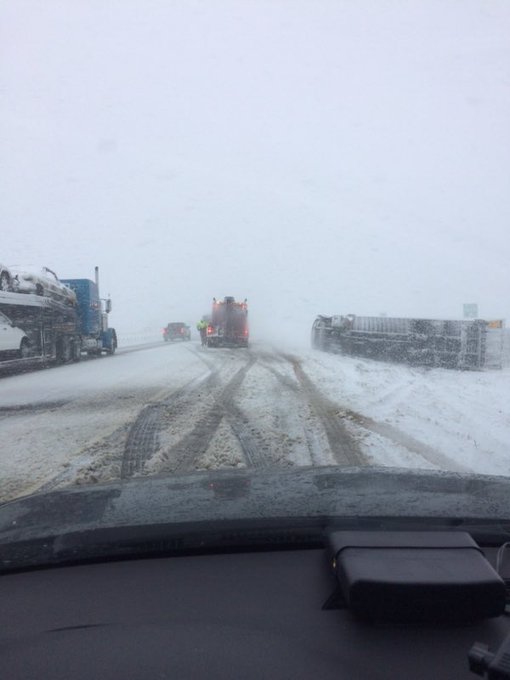
First Winter Storm of the Year Kills Two, Causes Hundreds of Crashes


A winter storm moving across the Northern United States has caused two deaths and hundreds of crashes as it moves into the Northeast. A large part of the United States has been plagued by its first heavy snow of the year.
The Minnesota State Patrol said the winter storm caused 450 crashes and 860 spinouts as it moved east. Two people died Friday in separate two-vehicle crashes on icy highways, and a trooper suffered minor injuries Saturday when a motorist struck his squad car on Interstate 94 near Alexandria as the trooper was responding to another incident, according to the patrol.
"People can be a little overconfident," said Frank Giannasca, senior meteorologist for The Weather Channel, who warned people to drive carefully. "A lot of times, that first storm anywhere can be a mess in terms of cars sliding off the road and accidents."
The snow is expected to continue through most of northern Pennsylvania and part of upstate New York. It will then head into western and northern New England, where it is expected to dissipate heading into Tuesday. Many of those areas could expect up to a foot of snow, perhaps even two. Cities and towns downwind of the Great Lakes will likely get hit worst.
"Please be very cautious, because we're going to see a lot more wintry scenes playing out," Danielle Banks, a meteorologist for The Weather Channel, said Sunday night. And "we've got more coming on board for localaes across the Northeast."
Powerful wind gusts up to 50 mph are expected through Monday. More than 17,000 customers were without power Sunday night in the Rochester, New York, Rochester Gas & Electric said, thanks to downed power lines and fallen tree limbs.
Numerous departures and arrivals were canceled or delayed Sunday at Greater Rochester International Airport, NBC station WHEC reported.
The storm seems to have brought winter with it, as it is carrying typical late-November, early-December temperatures, cutting short a temperate autumn across the United States.
"It's a 25- to 30 degree drop," Giannasca said. "It's a bracing slap in the face."
The Northeast and Mid-Atlantic states will see temperatures in the 30s and the 40s, while the Southeast can expect it to drop to the 50s and the 60s. Homeless shelters around Boston were near capacity Sunday night as temperatures dropped, New England Cable News reported.
Moving into December, temperatures are expected to stabilize and settle into typical winter weather patterns.
"It probably will feel like it should going into December," Giannasca said.

ABERCROMBIE & FITCH TO CLOSE HUNDREDS OF STORES AS SHOPPERS SHUN BRAND…

More bad news for retail as Abercrombie & Fitch will be closing down hundreds of stores. According to this CNBC report 50% of the retailers leases will be up in the next 18 months making store closings a no brainer for this struggling retailer.
Abercrombie & Fitch‘s store fleet may be getting another haircut.
Roughly 50 percent of the retailer’s 745 U.S. leases are up for renewal over the next 18 months, the company said Friday. With profits under pressure, this window gives management the opportunity to continue pruning the company’s footprint without being penalized for exiting space early.
Though management did not outline how many of its domestic stores could potentially close, it plans to shutter 35 locations in the fourth quarter through natural lease expirations. That’s in addition to the 15 stores it’s closed so far this year.
“I would not be surprised if half of those [locations up for renewal] end up closing,” Garrick Brown, Cushman & Wakefield’s vice president of retail research for the Americas, told CNBC.
Between the Abercrombie & Fitch and Hollister brands, the company has shuttered more than 350 stores over the last six years.

Monday, November 21, 2016

EURO PLUNGE: Single currency could 'COLLAPSE' against dollar amid record losing streak

THE euro has plunged to its lowest level against the dollar since December 2015, as experts warned the currency could collapse next week amid concerns for the eurozone economy.


Investors have frantically dumped the single currency over 10 consecutive trading sessions - the worst performance since the euro was introduced in 1999. 

Head of the European Central Bank (ECB) Mario Draghi failed to ease fears after warning that the eurozone recovery depends on action by monetary policymakers. 

Since the start of November the single currency has tumbled by around five per cent against the dollar, to sit at around 1.0584. 
euroGETTY
The euro has plunged against the dollar
The two currencies are set to reach parity and the euro could even dip below one.
Mr Draghi's comments were seen as a hint that the ECB is set to extend its trillion euro money-printing programme in another desperate bid to shore up the economy. 

But the US central bank - the Federal Reserve - is moving in the opposite direction and is expected to raise interest rates next month. 

As a result, the dollar has experienced a huge rally.
Fawad Razaqzada, market analyst at Forex.com, said: "The EUR/USD is still limping, now below 1.06. 

"It could absolutely collapse next week as the dollar appreciates further. 

"The market seems convinced that the Fed will hike interest rates in December and tighten its belt further in 2017. 

"Meanwhile the ECB and other major central banks are widely expected to maintain their current extremely loose policy stances intact well into 2017 at the very least. 

"As such, the dollar is getting stronger across the board, but especially against currencies where the central bank is still uber-dovish such as the euro."

Five things to know about Trump's infrastructure plan

Five things to know about Trump's infrastructure plan
Buzz is growing around President-elect Donald Trump's plans for a massive infrastructure package.
Republican and Democratic lawmakers frustrated by the lack of significant federal transportation spending are hopeful they can work with Trump on a bill, making it one of the few bipartisan issues that could see action next year.
Construction stocks soared following Trump’s acceptance speech in which he pledged to rebuild the country’s crumbling infrastructure, according to the Wall Street Journal.
“We are going to fix our inner cities and rebuild our highways, bridges, tunnels, airports, schools, hospitals,” Trump said. “We’re going to rebuild our infrastructure, which will become, by the way, second to none. And we will put millions of our people to work as we rebuild it.”
While the final details of Trump’s plan are still in flux, the real estate mogul has offered clues on the campaign trail about how he would work to repair the nation’s ailing transportation system.
Here are five things to know about Trump’s infrastructure ideas.

Trump's plan relies heavily on private financing
A 10-page white paper posted on Trump’s campaign website last month makes private financing the cornerstone of his infrastructure plan.
The proposal would offer $137 billion in federal tax credits to private investors who want to back transportation projects, which the blueprint says would unleash up to $1 trillion worth of infrastructure investment over 10 years.
Historically, the country’s infrastructure is financed through state and local governments using a mix of their own revenues, federal highway aid and issued bonds.
But the sketch of Trump’s proposal claims that construction costs tend to be higher and take longer when the government builds projects instead of the private sector.
“The Trump infrastructure plan features a major private sector, revenue neutral option to help finance a significant share of the nation’s infrastructure needs,” the outline says. “This innovative financing option would serve as a critical supplement to existing financing programs, public-private partnerships, Build America Bonds, and other prudent funding opportunities.”

Private funding won't help all projects
mp’s private financing plan, however, say that private investors would only fund projects that have tolls or user fees that can recoup investment costs.
Therefore, critical infrastructure needs like repairing aging pipes, deepening ports or fixing existing roads and bridges without tolls may go neglected under Trump’s plan.
Public-private partnerships (PPPs) “only work on projects that create revenues,” said Rep. Peter DeFazio (D-Ore.), ranking member on the Transportation and Infrastructure Committee. “The vast majority of the national highway system, and our bridge problems and all our transit problems, do not generate revenues. It will not help them.”
Public-private partnerships allow private firms to bid on transportation projects, build and maintain the project for a set amount of time, and recover costs through tolls or set state payments.
The Congressional Budget Office says only 14 highway projects have been completed using PPPs with private financing.
While most transportation advocates agree that getting more private capital off the sidelines is beneficial overall for the nation’s infrastructure, they also caution that it’s only one tool in the tool belt.
“If it’s managed well, it’s a wonderful way of creating a hamburger helper, in terms of increasing the overall level of investment,” said Norman Anderson, president and chief executive officer of CG/LA Infrastructure.

Trump wants to cut regulatory ‘red-tape’
In his infrastructure package, Trump wants to tackle the “mountain of red tape” that slows down construction projects.
“Infrastructure projects across the U.S. are routinely delayed for years and years due to endless studies, layer-upon-layer of red-tape, bureaucracy, and lawsuits—with virtually no end in sight,” his campaign website says. “This increases costs on taxpayers and blocks Americans from obtaining the kind of infrastructure that is needed for them to compete economically.”
Rolling back regulatory hurdles could be a key factor in attracting conservative support for Trump’s infrastructure plan in Congress. One of the major critiques of President Obama’s “shovel-ready” transportation projects in the 2009 economic stimulus plan was that they took too long to get off the ground.
But thus far, his proposal has been light on details about exactly how he would cut red tape.
Trump's website simply notes that he wants to link spending to reforms that “streamline permitting and approvals, improve the project delivery system, and cut wasteful spending on boondoggles.”

Trump thinks the plan would pay for itself
Trump claims his infrastructure proposal would be revenue neutral because it would pay for itself.
His blueprint assumes that the tax credits offered to private investors would be offset by tax revenue from new wages to construction workers and new profits from contractors.
“Importantly for the government budget, there will not be much of a time gap between the granting of the credit and receipt of the tax payments under the Trump plan,” the summary says.
But a research fellow for the Competitive Enterprise Institute called many of the financing specifics of the plan “dubious.”
If Trump’s final plan isn’t revenue neutral, it could spell trouble for the bill’s fate in Congress. Fiscal conservatives on Capitol Hill are already warning the president-elect that they will not support any legislation that adds to the deficit.
“If Trump doesn’t find a way to pay for it, then I think the majority of us, if not all of us, are going to vote against it,” Rep. Raúl Labrador (R-Idaho), a member of the House Freedom Caucus, said at a Heritage Foundation event Wednesday.

Trump’s open to ideas — including from Democrats
Trump has laid out his basic vision for infrastructure spending, but his plan is far from finalized.
Just this week, Trump’s transition team said it was exploring whether to establish a national infrastructure bank, which has long been favored by Democrats but gone nowhere under a GOP-led Congress.
That talk shows his team is willing to explore new policy ideas — even Democratic ones.
In Congress, though, Republicans are leaning toward taxing corporate earnings that are stored abroad when that money returns to the U.S., a process called "repatriation," and using that revenue to pay for infrastructure spending.
“I look forward to working with the administration,” said Rep. Mario Diaz-Balart (R-Fla.), chairman of the Appropriations Subcommittee on transportation. “I’ve always had the attitude that it doesn’t matter if the idea is brought up by a Republican member or Democratic member. The issue is: Are there good ideas?”

Italy’s Crisis Turns into a Multi-Headed Hydra

Making Retail Investors pay.

By Don Quijones, Spain & Mexico, editor at WOLF STREET.

Bank stocks have surged just about everywhere since Trump’s election, with one exception: Italy. In the last month only one large Italian bank has seen its shares rise, and that’s the 500-year old bank at the center of Italy’s banking crisis, Monte dei Paschi di Siena, whose nearly worthless shares jumped to €0.24.

All the Wrong Signals

Shares of Italy’s other large banks have suffered heavy losses. Over the past week alone, shares of Italy’s largest bank, Unicredit, plunged 15%, as did the shares of Banca Popular and UBI Banca. Shares of Italy’s second largest bank, Intesa Sanpaolo, fell just under 10%.
The recent losses compound what’s been a miserable year for Italy’s banking stocks. The best performing stock is the investment bank Mediobanca, which is down a mere 24% for 2016. During the same period, Unicredit has shed over 60%, UBI Banca 65%, Banco Popolare 80%, and Monte dei Paschi 85%.
It’s not just banks’ shares that are flashing all the wrong signals. UniCredit’s five-year credit default swap surged to 221.2 basis points on Friday, meaning it now costs €221,200 to insure €10 million of UniCredit’s debt against default over five years.

A Multi-Headed Hydra

As with all major crises, Italy’s current predicament is a multi-headed hydra. It’s a banking crisis, an economic crisis, a debt crisis, and a political crisis all rolled into one, and all coming to a head at the same time.
Italy’s economy has been in reverse ever since it joined the euro 17 years ago. Since 2007, its GDP has shrunk by a staggering 10%. In the meantime its public debt has continued to grow, reaching 135% of GDP today, the highest level of any Eurozone country with the exception of Greece. And now the yield on Italy’s 10-year bond is on the rise, hitting 2.09% on Friday in a NIRP world, its highest point in over 13 months.
Investors are worried about two things: the very real prospect of a government defeat in the upcoming referendum on constitutional reforms (a subject I covered last week) and Italy’s blossoming banking crisis.
The government’s solution to that crisis has been to create two woefully underfunded, deeply opaque bad banks — Atlante I and Atlante II — whose job it’s been to hoover up the worst of the toxic debt off the banks’ balance sheets. Atlante I and II don’t have enough firepower to steady even Italy’s smallish regional banks, like Veneto Banca, which keep coming back for more handouts, let alone the likes of Monte dei Paschi or Uncredit, each of which has tens of billions of euros of nonperforming loans (NPLs) festering on their books.
Two weeks ago when Giuseppe Guzzetti, a senior Italian banker who helped create the two bad banks, admitted that after six months of frenzied activity Atlante II is already “out of breath.”
Meanwhile, JP Morgan Chase’s last-ditch rescue of Monte dei Paschi continues to flounder, as shareholders who have already lost €8 billion in two previous capital expansions seem strangely reluctant to provide the bank with another €5 billion in fresh capital. That has left MPS and its handsomely compensated rescuers little choice but to unveil Plan Y this week, which essentially involves offering holders of the bank’s subordinate bonds a debt-for-equity swap.

Making Retail Investors Pay

Debt-for-equity swaps are a feature of debt restructuring. Put simply, for MPS to restructure its debts, the current owners will have to be diluted or wiped out. To all intents and purposes that has already happened, as MPS’s stock price has barrel-bombed from over €10 in early 2013 to €0.24 today — a 98% decline.
As for the bank’s creditors, they’re invited to become new owners of the reborn entity, by trading in roughly €5 billion worth of subordinate bonds at remarkably generous terms — 85% of face value for those holding junior tier 1 debt and 100% for those with slightly less junior tier 2 bonds — in return for one billion euro’s worth of equity. It’s a shitty deal and there’s no telling just high or low that equity will go, but it’s probably the best they’ll get.
Normally, subordinate debt is the sole preserve of sophisticated investors. But not in Italy. Almost half of Italian banks’ subordinate bonds are owned by retail investors, a dark legacy of banks using their customers as a piggy bank for cheap funding. Put simply, misselling subordinated debt to unsuspecting depositors was “the way they recapitalized the banking system,” as Jim Millstein, the U.S. Treasury official who led the restructuring of U.S. banks after the financial crisis, told Bloomberg earlier this year.
Now some of those retail investors, many of whom are traditional voters of Matteo Renzi’s centre-left party, are on the verge of being bailed in. It’s Renzi’s worst nightmare, at the worst possible time: the swap scheduled to take place on Nov 28, just 6 days before referendum day.

A Classic Prisoner’s Dilemma

An even greater danger is that the swap fails, as individual bondholders decline to participate in the hopes that other bondholders do, leaving them with a safer bond, rather than iffy equity, in a recapitalized bank that still pays a juicy interest rate. As the Wall Street Journal points out, it’s a classic prisoner’s dilemma. If the swap fails, the EU’s bail-in rules will probably kick in, including the forced conversion of subordinate bonds.
In such an event, the risk of contagion cannot be overstated. Many of Italy’s other banks face very similar problems to MPS. They include Unicredit, the country’s sole global systemically important bank (G-SIB), which hopes to dump tens of billions of euros worth of impaired assets in the coming months as well as raise €10-13 billion in new capital from investors, over double the amount that MPS has spectacularly failed to muster. By Don Quijones, Raging Bull-Shit.
Italy is in the middle of a blossoming banking crisis, and now this. Read…  The Global “Populist” Doom Tour Swings to Italy