Wednesday, June 15, 2016

Are We Nearing the End of the EU Experiment?

by Frank Holmes, CEO, U.S. Global Investors
Global slowdown worries high Indias booming economy
Right out of the gate, I want to thank everyone who took time out of their busy schedules to tune in to our gold webcast last Wednesday. I also want to thank Aram Shishmanian, CEO of the World Gold Council, for joining me as our special guest. His deep insights into gold investing were well articulated and highly appreciated. If you happened to miss it live, I urge you to catch the replay, which we’ll be posting on usfunds.com soon. Look for it!
If you’re a serious investor—and because you’re reading this, I have to assume that you are—gold is looking more and more like a crucial trade. Fewer than two weeks remain before United Kingdom voters decide on whether the country will continue to be a member of the European Union (EU) or become the first-ever to leave it. The “Brexit,” as it’s come to be known, is arguably the most consequential political event of 2016—perhaps even more so than the U.S. presidential election in November—with far-reaching implications.
Global slowdown worries high Indias booming economy
Should the U.K. leave, it will certainly underline the question many people have about the EU’s viability. And remember, this is a group of countries that collectively has the world’s second largest gross national product (GDP), followed by China.
But whatever happens, “the European Union is not going to remain the same,” as Aram put it during the webcast. “The euro is still very unstable, and I think we could easily see an environment in which trade barriers will increase and currency wars will increase. Regrettably, we could have a weaker global economy.”
With this as the threat, “gold’s role is one of wealth protection,” Aram said.

Taking Precautions Against an Unknowable Future

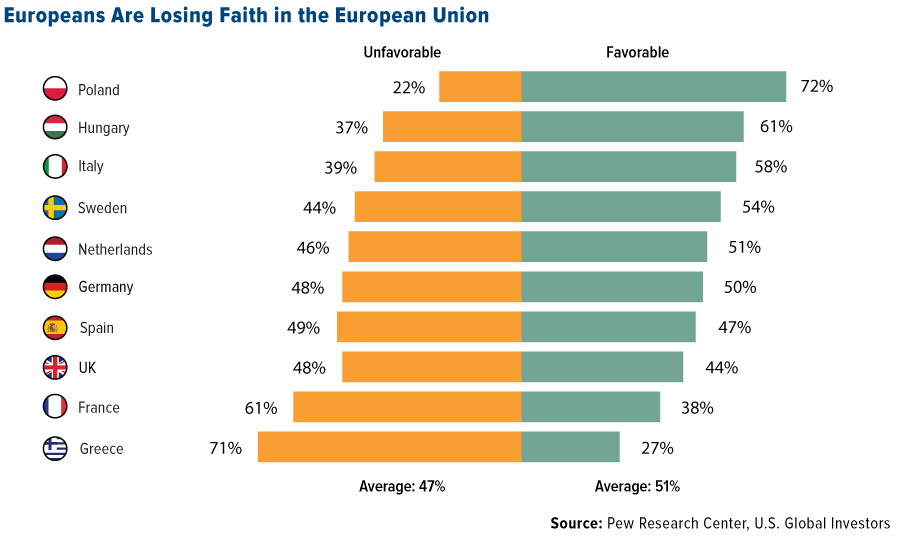
Even Europeans are beginning to lose confidence in the European experiment. The Pew Research Center recently polled nearly 10,500 Europeans from 10 separate EU countries on their favorability of the 28-member bloc. Nearly half of all respondents—47 percent—held an unfavorable view.
Trust in the European Central Bank (ECB) continues to falter as well. In a blistering note titled “The ECB must change course,” Deutsche Bank called out the central bank for “threatening the European project as a whole for the sake of short-term financial stability.” The ECB’s actions have “allowed politicians to sit on their hands with regard to growth-enhancing reforms.” The longer the bank persists with a negative interest rate policy, the more damage it will inflict upon Europe, Deutsche added.
Meanwhile, Frankfurt-based Commerzbank is considering stashing physical cash in pricey vaults instead of keeping it with the ECB, whose policies are cutting into bank profitability.
Speaking to the World Gold Council’s Gold Investor newsletter this month, former Governor of the Bank of England Mervyn King criticized the ECB’s negative rate policy, saying: “If you repeatedly bring down interest rates to try and persuade people to spend today rather than tomorrow, it works for a while. But they become increasingly resistant to being asked to spend their resources now rather than save for the future.”
Like Aram and others, Governor King sees gold as a likely solution. “There is clearly a need to take some precautions against an unknowable future,” he said, which is the same argument for having health insurance.
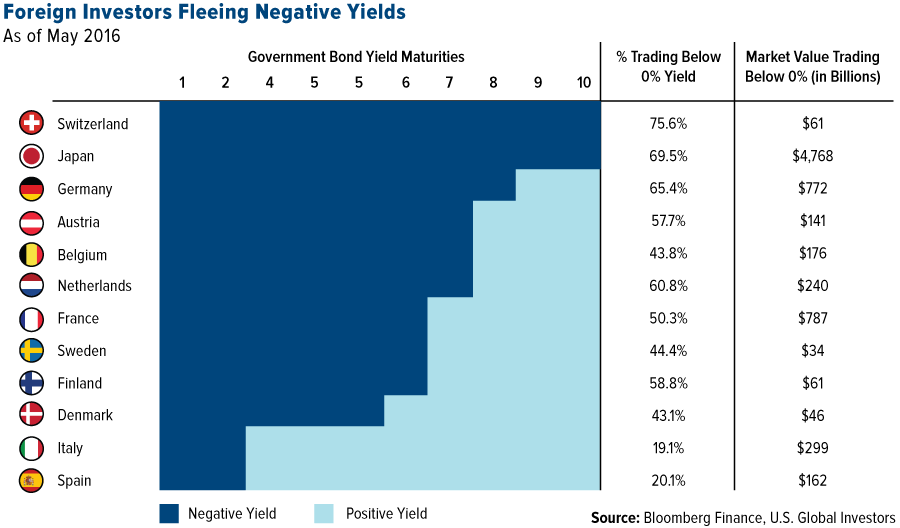
Negative rate policies are having a huge effect on bond yields, as you can see below. Over $10 trillion worth of government debt across the globe carried a negative yield as of the end of April. (In a tweet last week, legendary bond guru Bill Gross called it “a supernova that will explode one day.”) In Switzerland, three quarters of all government bonds right now actually charge investors interest. Real harm is being done to retirees, who have had to pick up part-time work at Walmart or become Uber drivers to offset lost interest on their savings and pensions.
This is prompting investors to look elsewhere, including the U.S. municipal bond market, which has attracted $632 billion in assets this year alone as of June 1. Of that amount, more than $22 billion has flowed into muni mutual funds, the best start to a year since 2009. Between that year and the end of 2015, the amount of U.S. municipal debt held by foreign investors climbed 44 percent, validating its appeal as an investment with a history of little to no drama, even during times of economic turmoil and periods of rising and lowering interest rates.
$1,400 Gold this Summer?

George Soros
Joining Aram in seeing the Brexit as further proof of impeding economic troubles is billionaire investor George Soros. After a hiatus of conducting any personal trading, the 85-year-old is back in the game—this time with some bearish investments. In the first quarter, he purchased a $264 million stake in Barrick Gold, the world’s largest gold producer, and a million shares in precious metals streaming company Silver Wheaton. It appears he’s added to both positions, indicating a bet against the broader equity market.
Now, with a Federal Reserve rate hike looking more and more unlikely this month, gold is expected to resume its bull run, according to Australia and New Zealand Bank Group (ANZ) commodity strategist Daniel Hynes. This, along with a possible Brexit, could push the yellow metal to $1,400, a price we haven’t seen in three years this month.
Paradigm Capital also sees the rally picking up where it left off in May, noting that gold’s trajectory so far this year resembles the one it took in 2002, the first full year of the last bull market, which carried the metal to $1,900 in 2011. “The resemblance is rather striking,” Paradigm writes.
The investment dealer forecasts gold to reach nearly $1,400 by year-end after a dip in October. It also maintains its position that this particular bull run will peak at $1,800 sometime during the next three to four years.
Whether or not this turns out to be the case is beside the point. Savvy investors—not to mention central banks and governments—recognize gold’s historical role in minimizing the impact of inflation, negative rates and currency depreciation. This is what I call the Fear Trade, and I always advocate up to a 10 percent weighting in gold that includes gold stocks as well as bullion, coins and jewelry.

Catching Up with Sectors and Industries

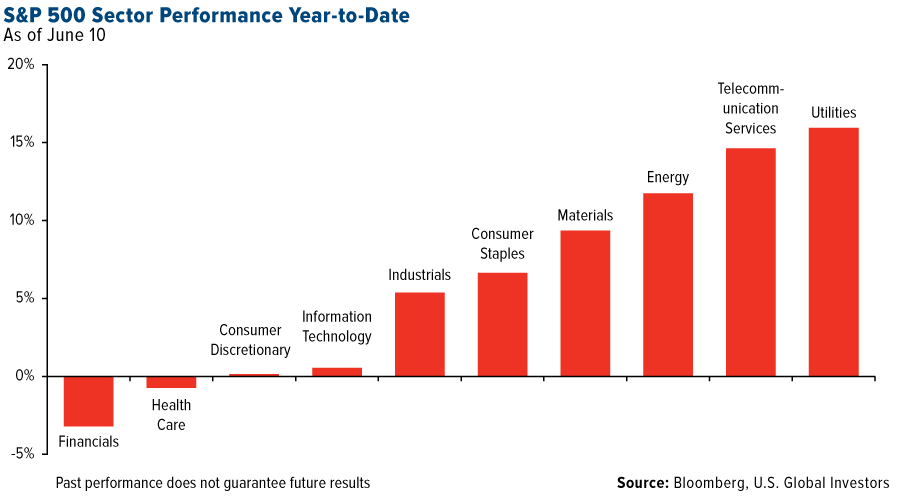
Because we’re near the halfway mark of 2016, I thought you’d be interested to see what the top performing sectors and industries were for the year so far.
As for sectors, utilities is on top, delivering more than 15 percent so far. Jittery investors, worried about slow global growth and geopolitical threats, have moved into defensive stocks such as water and electricity providers and telecommunications companies, many of which offer steady dividends in a low-yield world. Financials, as you might imagine, have been hurt by interest rate uncertainty.
Below I’ve highlighted the 10 best performing industries for the year, and interestingly enough, metals and mining companies, particularly those involved in the gold space, lead all others. Spot gold is up 20 percent so far, but amazingly gold miners have doubled investors’ money. Metals and mining companies have rallied more than 53 percent.
Many of the top-performing companies this year had some of the biggest declines last year because of impaired balance sheets. To maintain their performance long-term, they will need to show earnings.

WalMart stops accepting Visa cards for payments! “Too expensive”, they say.

June 11, 2016 – Following an evaluation of credit card transaction fees in Canada and the rest of the world, we have concluded the fees applied to Visa credit card purchases remain unacceptably high.
Walmart’s purpose is to save customers money so they can live better. We are committed first and foremost to this purpose, which requires us to keep costs as low as possible.
To ensure we are taking care of our customers’ best interests and delivering on our promise of saving customers money, we constantly work to reduce our operating costs, including credit card fees. Unfortunately, Visa and Walmart have been unable to agree on an acceptable fee for Visa transactions. As a result we will no longer accept Visa in our stores across Canada, starting with our stores in Thunder Bay, on July 18, 2016.  This change will then be rolled out in phases across the country.
To keep prices low we continuously assess opportunities to lower our operating expenses. Walmart Canada pays over $100 million in fees to accept credit cards each and every year. Lowering costs such as these is necessary for us to be able to keep our prices low and continue saving our customers money. 
Customers will continue to be able to use other forms of payment including cash, Interac debit, MasterCard, Discover, and American Express.
We sincerely regret any impact this will have on our customers who use Visa and remain optimistic that we will reach an agreement with Visa.
http://www.walmartcanada.ca/newsroom/press-releases/2016/06/11/walmart-canada-statement-regarding-visa-credit-card-purchases

German bonds go negative for first time as investors panic over surge in support for Brexit

  • Investors looking for safe havens to park their cash as interest rates low
  • Money pushed into German government bonds has caused price to rise 
  • Now the secure bonds are costing investors as they don't pay money back

The price of rock-solid German government bonds has rocketed over fears of a possible Brexit.
Interest rates have fallen to record lows meaning investors are looking for safe havens to park their cash. 
As investors flock to place money in German government 10-year bonds their price has risen 
The bonds, which are considered a benchmark of financial security, known as Bunds, are now not paying any money back because demand is too high. 
Today the Bund yielded minus 0.028 percent - meaning it was costing anyone who held the investment. 
As investors flock to place money in German government 10-year bonds their price has risen (German parliament pictured)
Ditching any hope of a return on their investment now seems a reasonable price to pay to escape the uncertainties of falling stock markets or volatile commodities and currencies.
The factors driving the current rally in Bund prices are concerns about the global economy, rock-bottom inflation in the Eurozone and fears about a possible Brexit.
Polling for weeks has placed the Leave campaign ahead of the Remain side with the British referendum now little more than a week away.

DeKaBank economist Ulrich Kater said: 'A huge driving factor behind the current price trend is the heightened uncertainty over a possible Brexit, which is driving investors into the safe haven of German sovereign bonds.'
Interest rates on sovereign debt have been low for some time as central banks snap up government bonds from investors in an effort to boost economic growth.
Be it in Japan, the United States, Switzerland or Britain, the rate of return for sovereign bonds of most major industrialised nations are striking new record lows in day-to-day trading.
German chancellor Angela Merkel 
'The drop in yields below the zero mark once again shows the immense challenges currently facing global financial markets,' Kater said.
'Weak growth is pulling down inflation expectations even further. Central banks are trying to counter falling inflation expectations using aggressive monetary policy,' he said.
The European Central Bank has slashed its key interest rates to zero and launched a massive bond-buying programme known as quantitative easing (QE) in a bid to get the eurozone economy back on its feet and push inflation higher.
LBBW analyst Werner Bader said: 'Fears that Britain will quit the EU has killed off any willingness to take risks in European capital markets.'
'Risk aversion and scarcity remain the key driving forces for market activities and valuations.'
Germany's own finances have benefitted from its safe-haven status in recent years, because with investors favouring national sovereign debt, borrowing rates in Europe's biggest economy have come down.
The government has seen its annual interest payments fall from more than 40 billion euros ($45 billion) per year in 2008 to 21 billion euros in 2015.
The reduced debt servicing costs enabled Germany to balance its budget in 2014 for the first time since 1969 and a year ahead of target.
The finance ministry declined to comment on the drop in Bund yields today. 
A spokesman for the German national financial agency said the drop to negative yields should not be seen in terms of either good or bad.
'The government's debt management is done on a long-term perspective. The current level of yields is of secondary importance,' he said.
'The main aim is to reach a sustainable balance between costs and reliability of planning.'
But from the taxpayers' point of view, 'negative yields are certainly pleasing because they reduce interest payments in the federal budget.'  

'BREXIT TSUNAMI' UK exit would cause 'BIG problems' for GERMAN banks, watchdog warns

IF Britain votes out of Europe, Germany's biggest banks would suffer a huge hit that would shake the eurozone's financial system to its core, a top policymaker in Frankfurt has admitted.

 
 Felix Hufeld
GETTYBrexit would hurt German banks, said Felix Hufeld
The desperate head of Germany's financial watchdog Bafin said he wants the UK to remain in the union and is worried about how his country's banks would cope otherwise.

German firms such as Deutsche Bank AG and Commerzbank AG have a large exposure to London and would be faced with big problems in a Brexit, revealed Felix Hufeld in an interview with German newspaper Tagesspiegel.

Mr Hufeld said the banks were now assessing the consequences of leaving and how their business dealings would be affected.
FOR THE LATEST BREXIT NEWS CLICK HERE

The president of Bafin said the European Central Bank (ECB) is also planning to closely monitor the situation.

But Mr Hufeld warned if Britain doesn't vote to remain "[Germany's] biggest banks would have the biggest problems… They have the most activities in, and with, London."
It came as Swiss financiers described the Brexit effect as a 'tsunami.'
Chief economist, Alan McQuaid at Merrion Capital Group Ltd spoke of Brexit as a "game-changer" on Swiss banks.Swiss National Bank President Jordan warned back in April that a so-called Brexit would cause “enormous stress” in Europe.
Support for the Leave campaign has surged in the final days ahead of the June 23 referendum, with out now taking a 19 point lead.

In a separate interview with German paper Bild, Donald Tusk, president of the European Council, unleashed comments designed to scare Britain into voting remain.

Stocks Look For Another Fed Lifeline


Even Central Bankers Begin to Despair of the Draghi Effect

A Dangerous Dependence

By Don Quijones, Spain & Mexico, editor at WOLF STREET.

Bankers in the Eurozone’s core nations, in particular Germany, are fast losing patience with the European Central Bank’s rampant forays into the markets and with its ambitions to drive interest rates deeper into the negative. That now includes Germany’s two largest banks, Deutsche Bank and Commerzbank, that are in a coordinated manner and apparently with the backing of the government counterattacking the ECB for its destructive policies.
But it’s one thing for bankers and politicians in one of Europe’s most financially conservative nations to express dismay; it’s quite another when the supposed biggest beneficiaries of ECB policy begin complaining. This is precisely what is happening in the Eurozone’s fourth largest economy, Spain.
The first shot across the bow came from Francisco González, the president of Spain’s second biggest bank, BBVA, who moaned a couple of weeks ago that the ECB’s negative interest rate policy “is killing banks.” Now, a new complaint has emerged, this time from someone who actually has a seat on the ECB’s board: the governor of the Bank of Spain, Luis María Linde.

A Dangerous Dependence

In the latest edition of the Bank of Spain’s Economic Bulletin, Linde cautioned about one of the primary effects of the ECB’s monetary medicine on Spanish households: the growing dependence of Spanish household wealth on the performance of Spain’s stock market. While Linde describes this trend as a “side-effect” of ECB policy, the reality is that pushing savers into riskier investments — in particular, into stocks — was always one of the overarching goals of central banks’ financial repression.
With interest rates in the Eurozone at their lowest point in history and yields of even some corporate bonds below zero, yield-seeking savers feel they have little choice but to invest their money in riskier assets. An investigation by the Bank of Spain confirms the gathering loss of weight of low-risk, low (or even zero) return assets in investment portfolios as investors are lured into variable income assets. Six years ago, guaranteed and fixed-income assets accounted for 82% of investments on the market; today they represent 62%.
Spanish households currently own 26% of all listed shares, according to data from the Spanish stock exchange, or BME. It is the highest level in 12 years and double the EU average. In other words, ECB policy is working a treat in Spain.
The problem is that the Madrid Stock Exchange General Index (MADX) is not exactly firing on all cylinders, despite all the increased demand among retail investors. In fact, it’s down 14% so far this year and according to the Bank of Spain’s forecasts, is likely to lose a further 6% over the remainder of the year. If the forecast rings true, it will be only the third year on record that the MADX has suffered a contraction of more than 20%, following a 23% slide in 2002 and a 40% collapse in 2008.
That will not be good news for Spanish households, whose late entry into the markets will allow large institutional investors, banks and hedge funds a timely opportunity to dump equities before things get really bad.

The Real Fear

The Bank of Spain has even bigger reasons to be concerned about the direction of ECB policy. Most importantly, its primary constituency — Spain’s big banks — are beginning to feel the brunt of Draghi’s negative interest rates, as shrinking margins take a heavy toll, and their already deeply compromised balance sheets don’t give them much leeway.
Spain’s sixth largest financial institution, Banco Popular, is urgently seeking to raise new capital in a desperate bid to shore up its finances. The bank is allegedly offering loans to its customers on the scandalous condition that they subscribe to the rights issue.
One of the reasons why Popular is in such dire straits is that it’s no longer able to benefit from the huge margins it was able to earn through the so-called floor clauses that it, like most Spanish banks, introduced into its variable-rate mortgage contracts in 2009. These clauses set a minimum interest rate — typically of between 3% and 4.5% — for variable-rate mortgages, even if the Euribor dropped far below that figure.
In April this year a Spanish judge ruled that these clauses are abusive (but not illegal) and lack transparency. Following the latest ruling, the banks named in the suit must reimburse clients all the money they’ve surreptitiously overcharged them since May 2013, when Spain’s supreme court changed the law, effectively banning the current use of floor clauses.
That alone is expected to set the banks back €5.26 billion, but if next month the European Court of Justice (ECJ) rules that the refunds should extend all the way back to the first mortgage payments, the rationale being that if a clause is declared void, “it is so from its origin,” the banks could end up owing many more billions. And that doesn’t include the billions of euros of profits the banks can no longer generate each year from applying the floor clauses.
In an ominous sign of what could lie in store, the ECB has instructed all six of Spain’s biggest banks — Santander, BBVA, CaixaBank, Bankia, Sabadell and Popular — to include the potential impact such a ruling would have on its balance sheets for their next round of stress tests. The results are unlikely to be pretty given that a) profits in Spain’s banking sector are already shrinking at a blistering pace; and b) the total cost to the banking sector of the floor clause fallout is estimated to be anywhere between €11 billion and €15 billion over the next three years.

Real-World Stress

Granted, failing an ECB stress test these days is a practical impossibility. Aswe reported in February, the European Banking Authority decided that for this year not a single bank will be allowed to pass or fail the test because, in the EBA’s own words, European banks are in a “steady state” and are expected to remain that way.
But in the real world, bank problems can quickly escalate out of control. It was the fear of banking failure that drove Spain’s Supreme Court to rule in May 2013 that reimbursements to floor-clause victims should only apply to payments from that date. In four weeks’ time the ECJ could overturn that decision. If it does, the banks will be made fully liable for every centimo they have cost their customers.
The resulting fallout could end up crippling the banks’ finances, as the Supreme Court feared, just at a time when even Europe’s biggest financial institutions are struggling to cope with the debilitating side effects of the ECB’s NIRP medicine. By Don Quijones, Raging Bull-Shit

Historic East Cleveland, Ohio: A city in decline faces bankruptcy

Via WSWS. This piece was reprinted by RINF Alternative News with permission or license.

In the shadow of the Republican National Convention

Leah Jeresova
Cleveland, the second largest city in the Midwestern state of Ohio, is celebrating the upcoming Republican National Convention as a symbol of the city’s rebirth. In the words of Jon Pinney, general counsel and treasurer of the 2016 RNC Host Committee, the goal is “to reintroduce the city to the world.” The host committee is hoping for an economic bounce of $200 to $400 million from the convention.
Cleveland is spending millions on the renovation of the Public Square in the city center, the remodeling of Quicken Loans Arena into a media production facility, infrastructure improvements and cosmetic improvements to the Cleveland-Hopkins International Airport.
Social events are planned for the Republican delegates at the downtown Cleveland waterfront and the Rock and Roll Hall of Fame.
While millions are being spent for the Republican convention, including over $50 million for the police to be equipped to suppress protestors, nothing is being spent to improve the lives of the working class in the city and surrounding area.
Just a few miles from the celebratory mood the city of East Cleveland, Cleveland’s first suburb and a symbol of the devastating impact of deindustrialization, is insolvent facing bankruptcy and a possible merger with Cleveland. Over 40 percent of the population lives in poverty, streets are dotted with abandoned homes and unemployment remains at double digit levels.
East Cleveland roots reach deep into America’s industrial history. It would prove to be of major importance in the development of Cleveland as a center of industrialization from 1860 to 1930, and the rise of the United States as the world’s manufacturing powerhouse.
Fortunes were made in iron ore, coal, steel, shipbuilding and railroads. Leading industrialists built mansions along Euclid Avenue, which became known as “millionaires’ row.” During the Gilded Age of the 1920s, Euclid Avenue was regarded as one of the most beautiful streets in the world, known as “the showplace of America.”
An early economic boom was spurred by the expansion of the railroads during the California Gold Rush of 1848–55. Industrialist and philanthropist Jeptha Wade was responsible for the expansion of the telegraph in 1856, turning Northeast Ohio into a key telegraph connection that proved vital to the North’s victory in the American Civil War.
But East Cleveland’s most famous industrialist by far was oil magnate John D. Rockefeller. Rockefeller purchased a kerosene refinery in Cleveland toward the end of the American Civil War in 1865. He and his partner, railroad magnate Amasa Stone, struck a highly secret rebate agreement, the notorious Lakeshore Railroad Deal, allowing him to bring oil to Cleveland by railroad at incredibly low prices, thus creating a monopoly, and making Cleveland the center of the American petroleum industry. Standard Oil Company of Ohio was incorporated in 1870 and Rockefeller, its chairman, became the world’s richest man.
The Rockefeller legacy is strong in East Cleveland. Rockefeller purchased Forest Hill Park in 1873 and built his summer home there. His plan was to develop an upscale residential and commercial development featuring French Norman-style homes. After a fire which destroyed the Rockefeller home in 1917, the Rockefeller family donated the property to the cities of East Cleveland and Cleveland Heights, with the stipulation that it be developed as a park and recreational area. The Rockefeller homes are listed on the National Registry of Historic Places as the “Forest Hill Historic District.”
Rockefeller also donated the land for Huron Hospital in 1931 which was the city’s largest employer when it closed in 2011.
East Cleveland is also notable as the home of General Electric Corporation’s Lighting Division at NELA Park, established in 1911, the first industrial research park in the world, following General Electric’s acquisition of the National Electric Lamp Company in East Cleveland. Thomas A. Edison, noted American inventor of electric light and recorded sound, was a founding partner of GE. The 92-acre NELA Park pioneered many cutting-edge lighting techniques. It is listed as an Historic Place in the US Department of the Interior’s National Registry.
East Cleveland was important to the growth of the area’s medical and scientific industries and Case Western Reserve University. Industrialists Worcester R. Warner and Ambrose Swasey, who made their fortunes in the machine tool industry, built an astronomical observatory on North Taylor Road which they donated to the Case School of Applied Sciences in 1918. It became one of the world’s leading astronomical research centers. Its director, the noted astronomer Dr. Jason J. Nassau, did much of his work here, developing the theory of galactic structure and a pioneering technique for studying red star distribution.
The city’s economic decline mirrors the degeneration of industrial cities throughout an area across the Northeast and Midwest known as the “Rust Belt.” East Cleveland is a stark expression of the declining economic position of the United States in the world and historic levels of social and economic inequality.
East Cleveland is located only minutes from University Circle, the cultural hub of Cleveland. Cultural institutions located here include the Cleveland Museum of Art, which is celebrating its centennial year after completion of a $350 million renovation and expansion. Other institutions located here include the dynamic new Museum of Contemporary Art, the Cleveland Institute of Music, Severance Hall, home of the world renowned Cleveland Orchestra, the Cleveland Botanical Garden, the Museum of Natural History and Case Western Reserve University.
The newest artistic gem to premiere in University Circle is the Maltz Performing Arts Center of Case Western Reserve University, a stunning renovation of an historic, 1920s-era Jewish synagogue.
The New York Times published a feature story in 2013 about University Circle in its “Travel” section, entitled “A city that can’t get enough art,” focusing on the art-centric expansions and the uptown district along a revitalized section of Euclid Avenue, bordering East Cleveland. The article noted that University Circle was designed in the 1800s as a counterbalance to the city’s business and manufacturing center.
East Cleveland, sometimes referred to as “East Circle,” is only minutes from this area yet there is no art-centric revitalization plan for this area. Once beautiful apartment buildings on Chapman Avenue built in the 1920’s with gorgeous woodworking and other craftsman details typical of the period, have been left to rot, deserted by their owners, taxes unpaid, with no money available to tear them down.
The Call and Post, a local newspaper, reported in 2010 on ambitious plans for collaborative efforts with Case Western Reserve University which aimed to “transform Greater University Circle into a great urban place,” involving the surrounding neighborhoods and promoting development. These plans have come to naught, and the city of East Cleveland is now seeking bankruptcy protection.
East Cleveland’s proximity to University Circle means that in a merger with Cleveland, land could be ceded for potential luxury developments drawing wealthy residents desirous of living near the cultural heart of the city.
City Council President Robert Wheeler, interviewed on WCPN Radio, commented: “Let the rich come in!” noting East Cleveland has lots of vacant and abandoned property, and is badly in need of revenue from property taxes. Most of the residents of East Cleveland are renters—not property owners. Forty-two percent of the mostly African-American population lives in poverty.
The Call and Post has called East Cleveland a “fiscal sinkhole.” In 2013, the newspaper editorialized in favor of annexation by Cleveland, stating “through no real fiscal fault of its own, this Black community is being unnecessarily disenfranchised.” The newspaper faulted the “White Flight” of the 1950s and 1960s that “left a proud and hardworking Black middle class to basically fend for itself.”
Mayor Gary Norton told WCPN Radio listeners that East Cleveland needs an “economic system change to become part of a larger economy.” The current financial plan calls for a 40 percent cut to a budget of $11 million. Norton claimed that bankruptcy would address some of the city’s short term cost issues. For example, bankruptcy would help the city renegotiate its collective bargaining agreements which it can no longer afford. Out of the other side of his mouth, Norton denied plans for “union busting.”
The East Cleveland City Council met in closed executive session at the end of May to discuss criteria for selecting commissioners to negotiate a merger with Cleveland. Residents have been collecting signatures on a petition which would lead to formal merger talks.
Not everyone agrees that a merger with Cleveland is the solution to East Cleveland’s problems. The mayor and the city council are divided: Mayor Norton supports the proposed merger, and Council President Robert Wheeler opposes it. City Council members are divided among themselves and community residents are split.
Nonetheless, despite these longstanding differences, the council has agreed to accept applications for the positions of three commissioners who will enter merger negotiations with Cleveland. Commissioners must be chosen before East Cleveland can move ahead with legislation. Eventually, the annexation question will be put to a vote of East Cleveland residents.