HONOLULU RAIL: IT JUST KEEPS GETTING WORSE
by Wendell Cox, New Geography, May 19, 2016
There seems to be no end to the difficulties facing Honolulu’s urban rail project.
In an editorial, Honolulu’s Civil Beat noted
that federal officials fear the project cost may reach $8.1 billion,
which is more than 50 percent above the “original estimate” of $5.2
billion.
The cost blowout of nearly $3 billion would be far more than state consultants suggested in a 2010 report. That report, by the Infrastructure
Management Group (IMG) in conjunction with the Land Use and Economic
Management Group of CB Richard Ellis and Thomas A. Rubin estimated a “most likely scenario” in which the rail cost overrun would have been $909 million (Note).
This is,
however, a particular concern to local citizens, since it has been
suggested that no rail project has cost more in relation to its
population base in US history. If the the project costs $8.1 billion,
the IMG et al report estimate will have turned out to be far too
conservative, less than one-third the overrun.
At $2.9 billion
this extra cost is nearly $3,000 for every man, woman and child in
Honolulu. It is more than $8,500 per household.
read … New Geography
The Civil Beat editorial is here.
Note: Thomas A. Rubin’s more recent analysis of rail and transit ridership in Los Angeles is here
Tuesday, May 24, 2016

Next Up For Our Chaotic World
What
will happen in our increasingly chaotic financial world? For sensible
analysis, seek the most intelligent, least biased, and experienced
people … central bankers, most economists, and all politicians are, of
course, not eligible.

Economic growth chugs along at a percent or two while debt races ahead at 9% or so each and every year. Debt rising far more rapidly than the underlying economy which must support the debt is unsustainable. If something can’t continue, it will end ….
Our debt based economic future looks grim for the next several years, unless, as Druckenmiller suggests, we move out of financial assets and move into gold (and silver) – real physical gold (and silver) – not the paper versions.
Gary Christenson
The Deviant Investor
From Mish regarding the opinions of Stanley Druckenmiller:
- “Gold is the superior asset in present part of cycle
- Fed is lost – totally lost and nothing they say match their action
- Negative interest is worst policy mistake ever
- Debt is and remains the elephant in the room”
“Stanley Druckenmiller warned on
Wednesday that the Federal Reserve’s low-rate policy is creating vast
long-run risks for the US economy.”
“… most of the debt today has been
used for financial engineering in the form of stock buybacks and other
methods that provide a boon to corporate profits…”
“I have argued that the myopic policy
makers have no endgame, billionaire Stanley Druckenmiller said towards
the end of a scathing twenty minute romp through all the world’s
economic problems.”
From The Telegraph regarding global economies:
“The patient is in a critical
condition. The International Monetary Fund is concerned that the global
economic recovery has taken too long. Kaushik Basu, chief economist of
the World Bank, says the financial crisis has left a ‘festering wound’
that is ‘refusing to heal.’ Growth is too weak, resulting in the
equivalent of a compromised immune system that has left the economy
vulnerable to fresh diseases.
“The question now facing the global economy’s physicians: is the ailment chronic or acute?”
IT IS ALL ABOUT DEBT …
From Michael Lewitt at SureMoney:
“Debt drains away vital resources
from economic growth. Fighting a debt crisis with more debt is doomed
to failure, yet that is not only what global central banks did during
the crisis, but long after markets stabilized (though the crisis never
truly ended, just slowed). This was an epic policy failure that
continues today.”
Economic growth chugs along at a percent or two while debt races ahead at 9% or so each and every year. Debt rising far more rapidly than the underlying economy which must support the debt is unsustainable. If something can’t continue, it will end ….
From David Stockman:
“That’s because the Bubble Finance
status quo as we know it is on its last legs. … That means a big market
dive is coming soon.”
“In fact, a recession, a market
crash, an explosion of deficit projections and, for good measure, double
digit increases in next year’s health insurance premiums and copays
will be hitting the headlines before the final Hillary/Donald debate
duals of the fall campaign.”
Repeat – What Comes Next? Thank you David Stockman!
- A recession, happening now, or soon
- A stock market crash or severe correction
- Higher deficits – practically guaranteed in the coming recession
- Health Insurance increases – the data and history suggest this is likely
What Comes Next? More Possibilities:
- “Helicopter Money” or per Bill Gross the “Universal Basic Income” or UBI
- Negative interest rates, like a viral infection, could spread to the U.S.
- Emergency stimulus or more QE under a different name
- A war to serve as a scapegoat and distraction
- More “bread and circuses”
From Albert Edwards: Summary from “Let me tell you how this ends”
- Investors can pretend no longer – profits slide into a recession.
- Deep bear market in equities
- Corporate bond spreads explode with widespread corporate bankruptcies.
- Social unrest and huge budget deficits.
- Investors lose faith in the Fed.
- Negative interest rates, currency and trade wars, helicopter money, and inflation.
- It ends BADLY!
From John Rubino:
“Where do we go from here? Probably into a crisis in which the world stops trusting markets, and financial assets are devalued accordingly.”
Our debt based economic future looks grim for the next several years, unless, as Druckenmiller suggests, we move out of financial assets and move into gold (and silver) – real physical gold (and silver) – not the paper versions.
Gold and silver are not the answer to all of our economic problems, but they are better answers than more debt, QE, war, and lies.
Gary Christenson
The Deviant Investor
Cash-strapped colleges still splurge on celebrity speakers
Even as many colleges are tightening the belt financially,
administrators are choosing to pay sizable fees for the prestige of
having a well-known figure speak at graduation ceremonies.
This graduation season universities attracted big names for big
bucks, documents obtained by the Associated Press show. Rutgers
University paid $35,000 to book journalist Bill Moyers, and the
University of Houston paid the same amount to get astronaut Scott Kelly
to speak.
Kean University invited Brandon Stanton and astronaut Mark Kelly – Scott’s twin brother – to speak at its undergraduate and graduate ceremonies and paid them $40,000 each, AP reported.
Many speakers do it for free, though. For example, President Barack Obama spoke at Rutgers earlier this year. Since high-value speakers willing to offer their services for free are the exception rather than the rule, however, even institutions that run tight budgets are willing to splurge.
Hollywood actor Matthew McConaughey made headlines last spring for bringing in $135,000 for a speech at the publicly-funded University of Houston, where the average salary of an assistant professor is only $91,983, according to Glassdoor.
In 2014, the University of Nevada, Las Vegas (UNLV) sparked outcry when Hillary Clinton was paid $225,000 to give a commencement speech to new graduates, after tuition at the institution had recently increased by 17 percent.
“You could give scholarships to thousands of students, benefit research on campus, give more students grants for research and studying,” Daniel Waqar, Student Relations Director for the UNLV Student Government, told Ralston Live at the time.
While it may seem like a luxury, an estimated 30 percent of colleges pay their commencement speakers, according to Inside Higher Ed. This fee is often seen as an investment to attract publicity, donors and potential students.
“Universities do see who their students want, and they assume that that’s what their future students will want to see as well,” Margot Sarlo, director of marketing at All American Entertainment, told Inside Higher Ed last year. “Universities are vying for customers in the form of admissions, and this can be a great way to advertise and get people on campus.”
Colleges in the Illinois public university system don’t seem to have such a luxury, and paid hefty fees to speakers last spring while simultaneously struggling with a budget crisis that is still unsolved. State legislators tried to pass a bill that would have prevented using public money on graduation speakers, though it never actually made it into law.
Bradley University, a private school in Peoria, Illinois, opted to forego a celebrity commencement speaker.
“I’m not going to use student tuition dollars to pay a person who’s already pretty wealthy to come and pontificate,” university President Gary Roberts told AP. “I can think of a lot of things to do with that kind of money that would be more valuable to our students.”
A 2014 report by Bloomberg News found that in California alone, universities spent more than $7.5 million on commencement speakers over the course of two years. That same year, the University of California board approved a plan to raise tuition by 27.6 percent.
Via RT. This piece was reprinted by RINF Alternative News with permission or license.
Kean University invited Brandon Stanton and astronaut Mark Kelly – Scott’s twin brother – to speak at its undergraduate and graduate ceremonies and paid them $40,000 each, AP reported.
Many speakers do it for free, though. For example, President Barack Obama spoke at Rutgers earlier this year. Since high-value speakers willing to offer their services for free are the exception rather than the rule, however, even institutions that run tight budgets are willing to splurge.
Hollywood actor Matthew McConaughey made headlines last spring for bringing in $135,000 for a speech at the publicly-funded University of Houston, where the average salary of an assistant professor is only $91,983, according to Glassdoor.
In 2014, the University of Nevada, Las Vegas (UNLV) sparked outcry when Hillary Clinton was paid $225,000 to give a commencement speech to new graduates, after tuition at the institution had recently increased by 17 percent.
“You could give scholarships to thousands of students, benefit research on campus, give more students grants for research and studying,” Daniel Waqar, Student Relations Director for the UNLV Student Government, told Ralston Live at the time.
While it may seem like a luxury, an estimated 30 percent of colleges pay their commencement speakers, according to Inside Higher Ed. This fee is often seen as an investment to attract publicity, donors and potential students.
“Universities do see who their students want, and they assume that that’s what their future students will want to see as well,” Margot Sarlo, director of marketing at All American Entertainment, told Inside Higher Ed last year. “Universities are vying for customers in the form of admissions, and this can be a great way to advertise and get people on campus.”
Colleges in the Illinois public university system don’t seem to have such a luxury, and paid hefty fees to speakers last spring while simultaneously struggling with a budget crisis that is still unsolved. State legislators tried to pass a bill that would have prevented using public money on graduation speakers, though it never actually made it into law.
Bradley University, a private school in Peoria, Illinois, opted to forego a celebrity commencement speaker.
“I’m not going to use student tuition dollars to pay a person who’s already pretty wealthy to come and pontificate,” university President Gary Roberts told AP. “I can think of a lot of things to do with that kind of money that would be more valuable to our students.”
A 2014 report by Bloomberg News found that in California alone, universities spent more than $7.5 million on commencement speakers over the course of two years. That same year, the University of California board approved a plan to raise tuition by 27.6 percent.
Wheelbarrow Economics

In 2014, we published an article entitled “Watch the Movie Before It Is Filmed.” In that article, I described the situation in Venezuela at that time. The effects of fifteen years of collectivism were threatening to collapse the economy. The government was reacting by printing bolivares (Venezuelan currency) on a large scale—a knee-jerk solution that has been utilized by over twenty other countries in the last century—always with the same outcome: hyperinflation, resulting in economic collapse.
At the time, I recommended to readers that they “watch the movie” as it was being played out in Venezuela, as it would offer them insight into what was on the way in their own country, should they reside in Europe or North America.
The pattern followed by Venezuela is roughly the same as for the other jurisdictions; Venezuela is just a bit more advanced in the progression. Therefore, what we are observing in Venezuela is likely to be played out in other countries that have made the same mistake of taking on more debt than they can ever pay back.
As predicted, Venezuela is now well along with regard to hyperinflation.
The traditional definition of “inflation” is “the increase of the amount of money in circulation.” Today, we think of inflation as an increase in the cost of goods, but this is merely a predictable by-product of inflation. If the amount of money increases, the cost of goods will always rise to meet it. Therefore, the issuance of large amounts of paper money has only a very temporary positive effect. Ultimately, it creates an increase in the price of goods and services, which, in turn, calls for further printing.
In 1922, Germany was up to its eyes in debt, to the point that it was beyond repayment. The government, in attempting to overcome the dire poverty that had developed, decided to print more paper banknotes. The printing didn’t (and couldn’t) solve the problem, so they printed more. Then more again. They kept up the printing, until, by the autumn of 1922, the reichsmark was worth so little that new bills were being delivered to the banks in boxcars. A story of the time describes a man bringing a wheelbarrow of reichsmarks to a baker to buy a loaf of bread. Whilst in the shop, making the deal with the baker, he was robbed—the wheelbarrow full of money that he had left out on the sidewalk had been stolen. The thief dumped the reichsmarks on the pavement and made off with the wheelbarrow.
Above, we see a photo from the time—a wheelbarrow full of reichsmarks. Next to it, we see a photo from present-day Venezuela—a wheelbarrow full of bolivares.
So, are the leaders of Venezuela learning from the mistakes of other countries that have followed this pattern? Far from it. Recently, they took delivery of over five billion banknotes—enough to fill three dozen 747 cargo planes. At the same time, Venezuela is selling off its gold in order to pay for the new currency and other debts. Venezuela will soon run out of real money to pay for the fiat money, and that will bring the charade to a disastrous end.
The reader may say to himself, “When will people learn?” Sadly, they don’t. Incredibly, when the reichsmark collapsed in 1923, no one blamed the excessive printing. In fact, many people felt that if only the printing had continued just a bit longer, everything might have been all right.
What we can take away from this is that what happened in Weimar Germany in 1922–1923 is happening now in Venezuela in 2016. (And has happened in some twenty other countries over the last hundred years, most recently in Argentina in 2000 and in Zimbabwe in 2008.)
The same will occur in Europe and America in the fairly near future. That’s not a “Chicken Little” overreaction; it’s a virtual certainty. The same economic errors always bring the same catastrophic results.
Ben Bernanke, just two years prior to being named head of the Federal Reserve, assured an audience that the Fed would react to any deflationary trend by printing as many currency notes as necessary. This was no idle threat. Remember, the owners of the Fed profit heavily from the hidden tax of inflation, but lose money if there is deflation. That assures us that, with the present unsustainable level of U.S. national debt (nominally, some nineteen trillion dollars, but actually some hundred trillion dollars, including unfunded liabilities), a collapse in the dollar is a given.
And, of course, the severity of the crash is always commensurate with the level of the debt, which promises us that, since this debt load is by far the greatest the world has ever seen, the crash will be the greatest the world has ever seen.
Those who have studied the histories of countries after they’ve experienced a hyperinflationary collapse will be aware of what’s headed their way, if they reside in Europe or North America. Those who have not undertaken such a study might choose instead to watch the movie—to observe what happens in Venezuela as its hyperinflation plays out and learn what their own fate might be.
Our predicted outcome, which may have seemed hypothetical in 2014, is now right around the corner in Venezuela. This will be of value to the reader who watches as the collapse occurs, then observes what follows. The events that unfold will be essentially the events that will unfold in Europe and North America when their respective collapses occur.
This “movie” is not meant to be entertainment at the expense of others’ suffering; watching it is a way to forewarn oneself as to what’s coming to those countries that are irrevocably on the same path, but have not yet reached the same point.
By watching, the reader may be forewarned as to how to prepare himself so that, whilst his country may be headed toward economic collapse, he may take action to assure that the impact to himself, his family and his investments are diminished.
Editor’s Note: Unfortunately, most people have no idea what really happens when an economy collapses, let alone how to prepare…
How will you protect yourself in the event of an economic crisis?
New York Times best-selling author Doug Casey and his team just released a guide that will show you exactly how. Click here to download the PDF now.
Iran could export 2.2mn b/d of crude by mid-summer: Govt has no plans to freeze its increase in oil output & exports
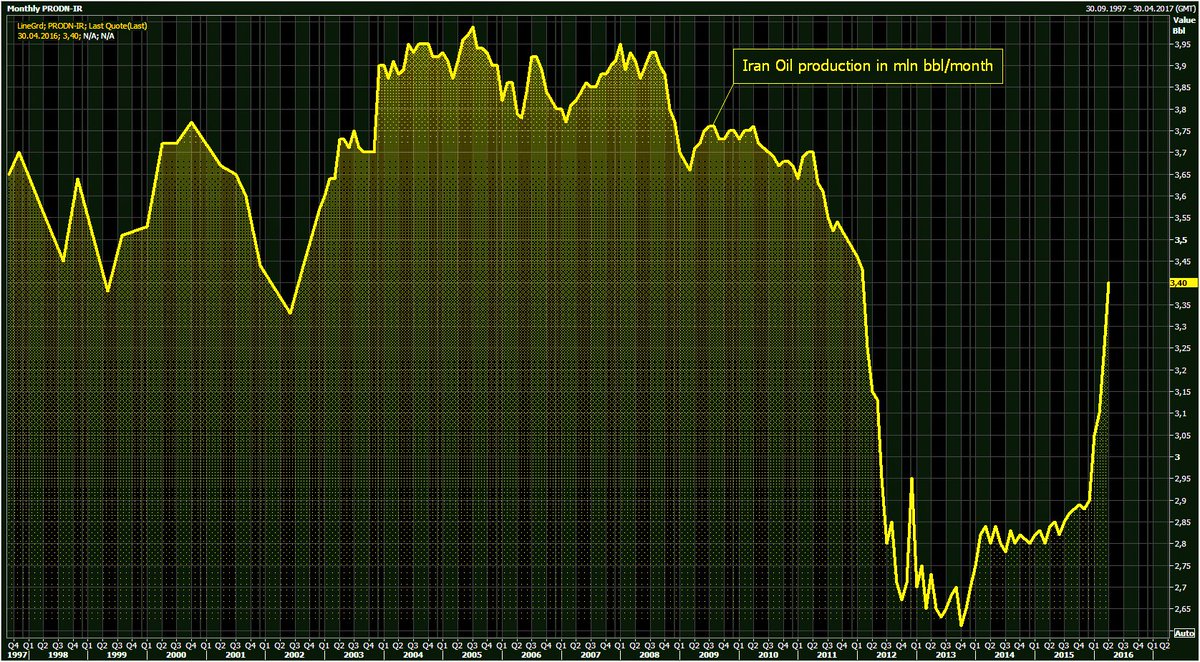

Iran could export 2.2mn b/d of crude by mid-summer: Govt has no plans to freeze its increase in oil output & exports
"Print the Money": Trump's "Reckless" Proposal Echoes Franklin and Lincoln
“Reckless,” “alarming,”
“disastrous,” “swashbuckling,” “playing with fire,” “crazy talk,” “lost
in a forest of nonsense”: these are a few of the labels applied by media commentators
to Donald Trump’s latest proposal for dealing with the federal debt. On
Monday, May 9th, the presumptive Republican presidential candidate said
on CNN, “You print the money.”
The remark was in response to a firestorm created the previous week, when Trump was asked if the US should pay its debt in full or possibly negotiate partial repayment. He replied, “I would borrow, knowing that if the economy crashed, you could make a deal.” Commentators took this to mean a default. On May 9, Trump countered that he was misquoted:
But back to Trump. He went on to explain:
The remark was in response to a firestorm created the previous week, when Trump was asked if the US should pay its debt in full or possibly negotiate partial repayment. He replied, “I would borrow, knowing that if the economy crashed, you could make a deal.” Commentators took this to mean a default. On May 9, Trump countered that he was misquoted:
People said I want to go and buy debt and default on debt — these people are crazy. This is the United States government. First of all, you never have to default because you print the money, I hate to tell you, okay? So there’s never a default.That remark wasn’t exactly crazy. It echoed one by former Federal Reserve Chairman Alan Greenspan, who said in 2011:
The United States can pay any debt it has because we can always print money to do that. So there is zero probability of default.Paying the government’s debts by just issuing the money is as American as apple pie — if you go back far enough. Benjamin Franklin attributed the remarkable growth of the American colonies to this innovative funding solution. Abraham Lincoln revived the colonial system of government-issued money when he endorsed the printing of $450 million in US Notes or “greenbacks” during the Civil War. The greenbacks not only helped the Union win the war but triggered a period of robust national growth and saved the taxpayers about $14 billion in interest payments.
But back to Trump. He went on to explain:
I said if we can buy back government debt at a discount — in other words, if interest rates go up and we can buy bonds back at a discount — if we are liquid enough as a country we should do…Read more
Subscribe to:
Posts (Atom)