Tuesday, May 24, 2016

Wheelbarrow Economics

In 2014, we published an article entitled “Watch the Movie Before It Is Filmed.” In that article, I described the situation in Venezuela at that time. The effects of fifteen years of collectivism were threatening to collapse the economy. The government was reacting by printing bolivares (Venezuelan currency) on a large scale—a knee-jerk solution that has been utilized by over twenty other countries in the last century—always with the same outcome: hyperinflation, resulting in economic collapse.
At the time, I recommended to readers that they “watch the movie” as it was being played out in Venezuela, as it would offer them insight into what was on the way in their own country, should they reside in Europe or North America.
The pattern followed by Venezuela is roughly the same as for the other jurisdictions; Venezuela is just a bit more advanced in the progression. Therefore, what we are observing in Venezuela is likely to be played out in other countries that have made the same mistake of taking on more debt than they can ever pay back.
As predicted, Venezuela is now well along with regard to hyperinflation.
The traditional definition of “inflation” is “the increase of the amount of money in circulation.” Today, we think of inflation as an increase in the cost of goods, but this is merely a predictable by-product of inflation. If the amount of money increases, the cost of goods will always rise to meet it. Therefore, the issuance of large amounts of paper money has only a very temporary positive effect. Ultimately, it creates an increase in the price of goods and services, which, in turn, calls for further printing.
In 1922, Germany was up to its eyes in debt, to the point that it was beyond repayment. The government, in attempting to overcome the dire poverty that had developed, decided to print more paper banknotes. The printing didn’t (and couldn’t) solve the problem, so they printed more. Then more again. They kept up the printing, until, by the autumn of 1922, the reichsmark was worth so little that new bills were being delivered to the banks in boxcars. A story of the time describes a man bringing a wheelbarrow of reichsmarks to a baker to buy a loaf of bread. Whilst in the shop, making the deal with the baker, he was robbed—the wheelbarrow full of money that he had left out on the sidewalk had been stolen. The thief dumped the reichsmarks on the pavement and made off with the wheelbarrow.
Above, we see a photo from the time—a wheelbarrow full of reichsmarks. Next to it, we see a photo from present-day Venezuela—a wheelbarrow full of bolivares.
So, are the leaders of Venezuela learning from the mistakes of other countries that have followed this pattern? Far from it. Recently, they took delivery of over five billion banknotes—enough to fill three dozen 747 cargo planes. At the same time, Venezuela is selling off its gold in order to pay for the new currency and other debts. Venezuela will soon run out of real money to pay for the fiat money, and that will bring the charade to a disastrous end.
The reader may say to himself, “When will people learn?” Sadly, they don’t. Incredibly, when the reichsmark collapsed in 1923, no one blamed the excessive printing. In fact, many people felt that if only the printing had continued just a bit longer, everything might have been all right.
What we can take away from this is that what happened in Weimar Germany in 1922–1923 is happening now in Venezuela in 2016. (And has happened in some twenty other countries over the last hundred years, most recently in Argentina in 2000 and in Zimbabwe in 2008.)
The same will occur in Europe and America in the fairly near future. That’s not a “Chicken Little” overreaction; it’s a virtual certainty. The same economic errors always bring the same catastrophic results.
Ben Bernanke, just two years prior to being named head of the Federal Reserve, assured an audience that the Fed would react to any deflationary trend by printing as many currency notes as necessary. This was no idle threat. Remember, the owners of the Fed profit heavily from the hidden tax of inflation, but lose money if there is deflation. That assures us that, with the present unsustainable level of U.S. national debt (nominally, some nineteen trillion dollars, but actually some hundred trillion dollars, including unfunded liabilities), a collapse in the dollar is a given.
And, of course, the severity of the crash is always commensurate with the level of the debt, which promises us that, since this debt load is by far the greatest the world has ever seen, the crash will be the greatest the world has ever seen.
Those who have studied the histories of countries after they’ve experienced a hyperinflationary collapse will be aware of what’s headed their way, if they reside in Europe or North America. Those who have not undertaken such a study might choose instead to watch the movie—to observe what happens in Venezuela as its hyperinflation plays out and learn what their own fate might be.
Our predicted outcome, which may have seemed hypothetical in 2014, is now right around the corner in Venezuela. This will be of value to the reader who watches as the collapse occurs, then observes what follows. The events that unfold will be essentially the events that will unfold in Europe and North America when their respective collapses occur.
This “movie” is not meant to be entertainment at the expense of others’ suffering; watching it is a way to forewarn oneself as to what’s coming to those countries that are irrevocably on the same path, but have not yet reached the same point.
By watching, the reader may be forewarned as to how to prepare himself so that, whilst his country may be headed toward economic collapse, he may take action to assure that the impact to himself, his family and his investments are diminished.
Editor’s Note: Unfortunately, most people have no idea what really happens when an economy collapses, let alone how to prepare…
How will you protect yourself in the event of an economic crisis?
New York Times best-selling author Doug Casey and his team just released a guide that will show you exactly how. Click here to download the PDF now.
Iran could export 2.2mn b/d of crude by mid-summer: Govt has no plans to freeze its increase in oil output & exports
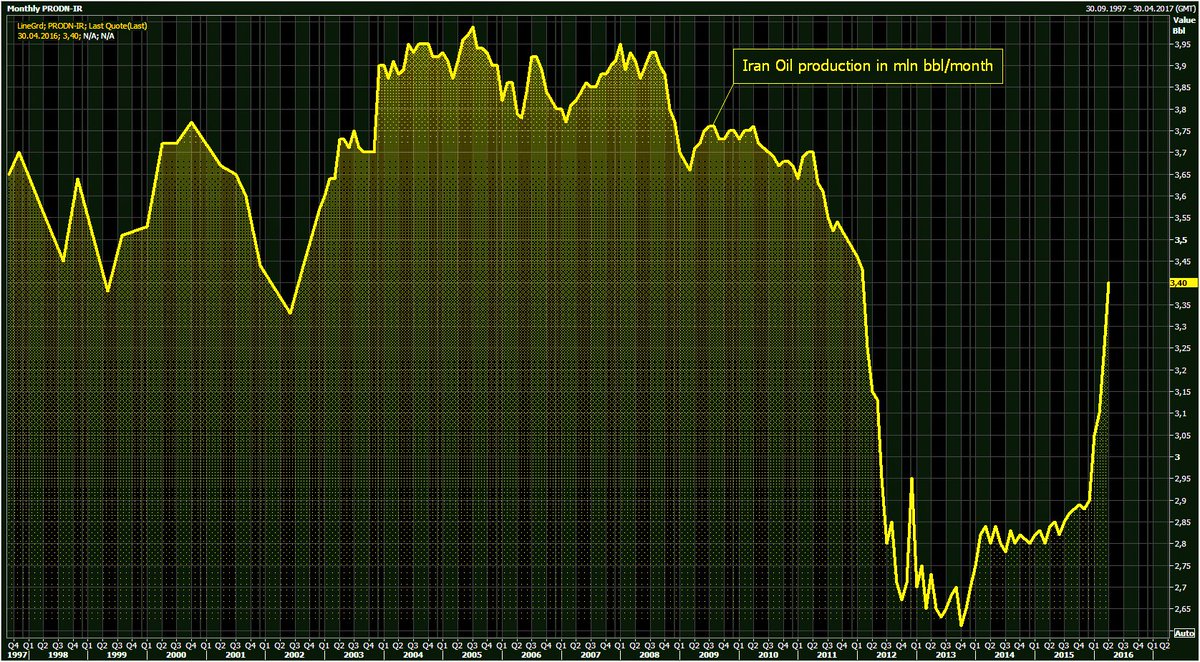

Iran could export 2.2mn b/d of crude by mid-summer: Govt has no plans to freeze its increase in oil output & exports
"Print the Money": Trump's "Reckless" Proposal Echoes Franklin and Lincoln
“Reckless,” “alarming,”
“disastrous,” “swashbuckling,” “playing with fire,” “crazy talk,” “lost
in a forest of nonsense”: these are a few of the labels applied by media commentators
to Donald Trump’s latest proposal for dealing with the federal debt. On
Monday, May 9th, the presumptive Republican presidential candidate said
on CNN, “You print the money.”
The remark was in response to a firestorm created the previous week, when Trump was asked if the US should pay its debt in full or possibly negotiate partial repayment. He replied, “I would borrow, knowing that if the economy crashed, you could make a deal.” Commentators took this to mean a default. On May 9, Trump countered that he was misquoted:
But back to Trump. He went on to explain:
The remark was in response to a firestorm created the previous week, when Trump was asked if the US should pay its debt in full or possibly negotiate partial repayment. He replied, “I would borrow, knowing that if the economy crashed, you could make a deal.” Commentators took this to mean a default. On May 9, Trump countered that he was misquoted:
People said I want to go and buy debt and default on debt — these people are crazy. This is the United States government. First of all, you never have to default because you print the money, I hate to tell you, okay? So there’s never a default.That remark wasn’t exactly crazy. It echoed one by former Federal Reserve Chairman Alan Greenspan, who said in 2011:
The United States can pay any debt it has because we can always print money to do that. So there is zero probability of default.Paying the government’s debts by just issuing the money is as American as apple pie — if you go back far enough. Benjamin Franklin attributed the remarkable growth of the American colonies to this innovative funding solution. Abraham Lincoln revived the colonial system of government-issued money when he endorsed the printing of $450 million in US Notes or “greenbacks” during the Civil War. The greenbacks not only helped the Union win the war but triggered a period of robust national growth and saved the taxpayers about $14 billion in interest payments.
But back to Trump. He went on to explain:
I said if we can buy back government debt at a discount — in other words, if interest rates go up and we can buy bonds back at a discount — if we are liquid enough as a country we should do…Read more
Friday, May 20, 2016
The Economy is Collapsing, Countries Are Selling Off US Debt At The Fastest Pace Since 1978, Texas Is Building Its Own Gold Repository
Spain’s debt is now worth more than the value of the economy. Target
misses expectations as sales decline. Obama now pushing overtime to
adjust for inflation, even though they are reporting no inflation.
Baltic Dry Index holding at 642. Citi surprise index shows the economy
is declining. Texas is building its own gold repository. Saudi Arabia
has a full blown liquidity problem. Countries are selling off Treasuries
at the fastest pace since 1978. FOMC using propaganda of an interest
rate hike to push the markets up.
Hours In Line And Then An ID And Fingerprint Scan — Just To BUY GROCERIES
(Daniel Jennings)
Grocery shopping has become a nightmare for citizens in Venezuela, as
consumers have to stand in line for hours to get into
government-controlled markets, simply to buy small amounts of rationed
goods on certain days.
Citizens even have to use their IDs — and are limited to how many times they can visit the store each week.
“There’s just unplugged display cases, flies and a bad odor,” Caracas resident Anny Valero said of her neighborhood supermarket.
The only food Valero could find was three cans of sardines, and she needed to present a government ID card and submit to a fingerprint scan to get that, National Public Radio (NPR) reported
The clerk made Valero put one can of sardines back due to rationing. Valero also had to present her son’s birth certificate to buy Pampers diapers.
Venezuela now has the world’s highest rate of inflation (180 percent) and shortages of basic goods and electricity. The situation is made worse by low oil prices, as well as a drought that has led to a scarcity of electricity. Venezuela relies on dams for its power.
“This is such a waste of time, and we have to do it every week,” Valero told NPR. “My husband risks losing his job, because he’s here with me shopping, and on top of that we can only buy two of each item.”
Valero’s husband, Yossmy Benaventi, accompanies her to keep thieves from stealing her groceries. The only alternative to the supermarket is the black market, where gangsters charge a fortune for food.
Looting and Pillaging Replace Shopping
The streets outside of Valero’s supermarket were filled with black marketers selling eggs, fish and meat. Valero and Benaventi could have bought meat from them, but it would have cost one-fourth of his monthly salary as a mechanic.
Story continues below video
Many Venezuelans have found an alternative to supermarkets in the form of looting. In the city of Guarenas, a mob pillaged the Paga Poco market because of rumors there was food hidden it. There have been 166 reports of looting in Guarenas this year alone.
The Panama Post reported that mobs of people with sticks were roaming through the streets of Guarenas, trying to break into stores and steal food. Some of the rioters were chanting, “we’re hungry.”
The rioting began after no food was delivered to markets for several days. President Nicolas Maduro responded to the violence by declaring a “state of emergency” and calling out the National Guard.
As part of the emergency, the government seized control of the Dia supermarket in Gueranas. No food has been delivered to the market for a week.
Even worse violence is now occurring in Caracas, where opposition parties organized mass rallies to protest Maduro’s socialist government. Police and soldiers closed off streets and shut down the subway to keep protestors away from the capitol building.
Instead of restoring order, the crackdown led to chaos, with protestors throwing rocks at police and troops teargassing protestors. The protestors are demanding a recall election to get rid of Maduro.
Another Major US Retailer Closing 75 Stores

(NEW YORK) As part of a restructuring, clothing retailer Gap will close its fleet of 53 Old Navy stores in Japan. All told, the company is shuttering 75 stores in an effort to save $275 million annually.
Gap shares quickly jumped 5.5 percent on the news before giving back some of the gains. The stock was last up about more than 3 percent in after-hours trading.
The retailer posted adjusted fiscal first-quarter earnings of 32 cents on revenue of $3.44 billion. Analysts had expected earnings of 32 cents a share on sales of $3.51 billion, according to a consensus estimate from Thomson Reuters. Earnings were down from 56 cents a share a year earlier and revenue fell from $3.66 billion.
Gap said it saw its comparable-store sales decline 5 percent during the quarter. To reposition itself for long-term growth, the company said it will “focus on geographies with the greatest potential” and “streamline its operating model.”
As part of this restructuring, Old Navy will close stores in Japan and focus on growth in North America and China. The brand saw a 6 percent global same-store sales decline in the quarter. Gap emphasized that Japan remains an important market for the company’s portfolio and that 200 Gap and Banana Republic stores will remain in the country.
The retailer also said it would be shut some Banana Republic locations, bringing the total expected store closure count to 75 by the end of fiscal 2016. For the first quarter, Banana Republic global saw an 11 percent decline in comparable-store sales.
“By taking every opportunity to exploit our strategic advantages, our brands will be able to more fully harness the power of the enterprise to better serve their customers across channels and geographies,” Art Peck, CEO of Gap, said in a statement.
Gap also said that it will not reaffirm its earnings outlook for the current fiscal year, but noted that the current “First Call consensus earnings per share estimate of $1.92 falls within a reasonable range of potential outcomes, excluding restructuring impacts from its store closure and streamlining measures.”
The company, however, added that “trends in the apparel retail environment would need to improve from the first quarter of fiscal year 2016 in order to achieve this estimate.”
Subscribe to:
Posts (Atom)