Sunday, March 13, 2016

EU Falling Apart as ECB Begins Money Printing, Asset Purchases, Negative Interest Rates!

 Sources:
Euro gains, U.S. stocks flat; ECB signals end to rate cuts | Reuters
http://www.reuters.com/article/us-glo…
How Central Banks Have Made Wealth Inequality Worse – Bloomberg Business
http://www.bloomberg.com/news/article…
San Francisco mulls state of emergency over homelessness. But will it help? | US news | The Guardian
http://www.theguardian.com/us-news/20…
Photograph Shows Silver Lake Woman Posing Over Sleeping Homeless Man | L.A. Weekly
http://www.laweekly.com/news/what-thi…
US credit card debt balloons to $917B: What it means
http://www.cnbc.com/2016/03/10/us-cre…
$1,248,371,000,000: FY2016 Taxes Set Record Through February; $8,263 Per Worker; Feds Still Run $353,005,000,000 Deficit
http://cnsnews.com/news/article/teren…

Alasdair Macleod On Draghi’s Bazooka: “It’s Terrifying…$1400 Gold Could Happen Quickly”

With Super Mario Draghi dropping a bomb on global financial markets Thursday, Doc & Dubin welcomed Alasdair Macleod out of London back on the show to break down the implications for the markets, gold, and silver:
On Draghi’s Bazooka QE: “It’s actually quite terrifying…“

On Gold:  There is a Golden Cross Underneath a Rising Gold Price, as well as a Pennant Formation!  We’re looking at a minimum gold price of $1400, and it could happen quite quickly…
Full MUST LISTEN Metals and Markets is Below:


To my surprise, we didn’t see much Federal Reserve jawboning this week.  We certainly had the perfect set-up for flapping gums.  Perhaps Fed officials were laying low as the ECB and Draghi took center stage?  In any event, the Federal Open Market Committee (FOMC) meets next Tuesday and Wednesday to discuss interest rate policy.  It’s very unlikely the FOMC will decide to hike rates.
Most analysts and pundits in the precious metals camp are uneasy, expecting a big correction and/or cartel smack-down at any moment.  I’ve outlined a few set-ups where risk for another attack has been elevated, but each time we do see profit taking and cartel capping, buying overwhelms it and at worst, we have trended sideways on a weekly basis.  You can see this most clearly in the gold trade from March 3, onward.  The cartel uses time in its favor, attempting to exhaust momentum and as we move through these sideways consolidation patterns, a veritable paper issuance fiesta is underway (COMEX and beyond), absorbing rising paper demand.  However, both paper and physical demand are not letting up, and the stalling to dilute momentum tactic hasn’t worked.
silver - march 11
gold - march 11
Bottom-line:  Once again, we have a set-up for a hit next week.  However, any damage the cartel is able to inflict should only be a very short-term challenge, requiring only a week or two for repair.  Unlike April, 2013 or any other period over the last four+ year cyclical precious metals bear market, a much larger percentage of conventional money under management is not under any illusions about a European banking sector recovery, nor global economic recovery, as was the near-fully subscribed hopium of recent past.  A growing percentage of the conventional finance world can also see that the U.S. economy is in trouble, that the wealth effect is a lunatic central bank policy myth, and attempting to paper over a solvency crisis with more credit has failed.  These fundamentals and more are indeed why we have seen the birth of the third phase of the precious metals bull market.
Weekend Links:
If you’d like to follow Alasdair Macleod’s work, you can find him at SilverDoctors and at GoldMoney.com.  The first article below notes that the technical situation for the gold price has sharply improved, to the evident surprise of many mainstream analysts. It discusses possible reasons behind the turnaround, and implications for the future.  This is the article that Alasdair references during our podcast.

Thanks for checking out this week’s podcast. — Eric Dubin
 

Blue Cross parent lost $1.5 billion on individual health plans last year

Year 2 of the Affordable Care Act was another financial flop for the Chicago-based parent of Blue Cross and Blue Shield of Illinois but hints of a turnaround are emerging.
Health Care Service Corp.'s financial losses in its individual business, which includes ACA plans, worsened in 2015. The company, which owns Blue Cross affiliates in Illinois and four other states, said it lost $1.5 billion in its individual business, up from $767 million in 2014, the first year of the health law's state exchanges for buying coverage.
In anticipation of ACA-related losses in 2015, HCSC set aside nearly $400 million in 2014 to boost reserves to $680.9 million. The company spent $657.3 million of those reserves to cover the medical expenses associated with ACA plans in 2015.
HCSC is the latest large insurer to report losses on 2015 ACA business, a troubling sign for the state exchanges that are the heart of President Barack Obama's health care overhaul. The far-reaching legislation has increased access to insurance coverage by expanding Medicaid and providing tax credits to subsidize the cost of insurance. Though the law has brought new customers to many insurers, much of that growth has been unprofitable, reflecting higher-than-expected medical expenses, regulatory challenges and unexpected shortfalls in federal risk-sharing programs.
UnitedHealthcare said it had losses of about $475 million on its 2015 ACA business. Aetna didn't break out the loss on its individual health plans but said the operating losses on that line of business were 3 to 4 percent of the sales. 
As a result of the losses, some insurers have considered withdrawing from the state marketplaces. Any exodus would threaten the stability of exchanges, making the online marketplaces less attractive to consumers.
"2015 was not a good year as far as the ACA went," said Stephen Zaharuk, senior vice president at Moody's Investors Service, who covers the health insurance industry. "Insurers had no idea what to expect."
Still, no one expected the rollout of some of the biggest reforms in health care to be smooth. The exchanges are a new way to sell health plans to a population that largely was uninsured. Moreover, the law forbids insurers from using consumers' medical history to set prices. Insurers were essentially groping in the dark.
But with two years of experience under their belts, insurers may be on more secure footing. HCSC, for one, didn't book a reserve for potential 2016 losses on ACA plans, said Carl McDonald, a divisional senior vice president at the company. Zaharuk said that's a good sign the company's individual business may break even this year.
But HCSC officials are not so optimistic that the ACA plans will be profitable in 2016. Company spokesman Greg Thompson said in an email, "Our not booking a (reserve for ACA losses) for 2016 does not indicate nor imply an anticipated level of profitability for the year."
Despite problems with its ACA-related business, HCSC narrowed its overall loss in 2015, according to a financial statement filed with the National Association of Insurance Commissioners. The filing is primarily an accounting of its fully insured lines of business.
The company reported a loss of $65.8 million, down from $281.9 million in 2014, reflecting higher earnings from its group health plans and an increase in investment income. Premium revenue rose 12.5 percent to $31.2 billion.
HCSC is among the biggest players in the individual market, with 1.64 million members at the end of last year, an increase of 3.4 percent, according to the filing. Nearly one-third of its enrollment is in Illinois, where Blue Cross sold roughly 80 percent of all 2015 individual policies in the state.
HCSC doesn't disclose how much of its individual enrollment came from ACA plans sold on and off the exchanges. The individual market also includes policyholders who were allowed to keep the plans they had before the health law was implemented through 2017. Insurers blame that last-minute change by the Obama administration for keeping healthier people out of the exchanges.
When the exchanges launched, HCSC's Blue Cross plans offered some of the lowest-priced policies and largest provider networks. The strategy was to provide cost-effective health care access, reflecting the company's status as a not-for-profit, customer-owned insurer, analysts said.
However, medical costs and customers' use of health care services on ACA-related plans were higher than anticipated. In 2014, HCSC's key medical-loss ratio, which measures the share of premiums used to pay patient medical costs, rose to 86.5 percent, from 85 percent. Last year, the ratio jumped to 90.4 percent, according to the annual statement.
To manage the risk, HCSC followed in the footsteps of its for-profit competitors and made significant changes last year that were not consumer friendly.
The company raised 2016 premiums and redesigned policies to shift more costs to consumers. In Illinois and Texas, its two largest markets, HCSC eliminated its popular PPO plans that were more expensive but had the largest networks of hospitals and doctors. The decision sent Blue Cross customers scrambling to find other plans on the exchanges that included their doctors.
The company even took the hard line of walking away from business. In New Mexico, the company sought a rate increase averaging 51.6 percent, after it said it lost $19.2 million in 2014 on its individual business in the state. New Mexico insurance regulators rejected the request but were willing to approve a lower increase, according to published reports. Instead, HCSC pulled out of the New Mexico exchange.
The company also is cutting expenses. Thompson confirmed that HCSC has laid off employees in its information-technology department but declined to say how many were let go. Last month, the company eliminated commissions to independent brokers in Illinois, Texas and Oklahoma on sales of individual plans that take effect April 1 or later.
After eliminating commissions in Illinois, Blue Cross said it remains committed to "expanding access to quality health care to as many people as possible." The changes are necessary to continue offering "sustainable" health plan options to members, the company said.
Despite signs of strain, the Obama administration says the exchanges are getting stronger. There were many new customers among the 12.7 million people who chose plans during open enrollment for 2016. In Illinois, enrollment grew nearly 12 percent to about 388,000.
Still, the administration has tweaked some regulations to benefit insurers. It placed a one-year moratorium for 2017 on the annual tax insurers pay, which is generally passed along to customers. The change will save some insurers hundreds of millions of dollars. For 2016, HCSC expects to pay a fee of $538.7 million.
The administration also has tightened some of the eligibility rules for people who sign up for insurance after the enrollment deadlines. Insurers have complained that people are waiting until they are sick to buy plans and then dropping coverage after their health problems are resolved, driving up costs and premiums.
asachdev@tribpub.com
Twitter @ameetsachdev
Copyright © 2016, Chicago Tribune

Saturday, March 12, 2016

Hillary promises jobs, but neglected to specify for who.

This is exactly what the STATIST like Clinton do to their low information constituents…SMH
Some of those visas are for six years! That to me is not really a very temporary job. Some regular jobs only last that long.
I don’t really like people pooh-poohing the idea that these jobs aren’t important to Americans because they are temporary or part-time either. When someone is job searching, anything that fills up a hole in a resume is important.
I also wish they would care more for the lower-skilled worker, as I was before retiring. We have to pay rent and feed our kids too. We would love to have the problem of not being able to afford a house on a $45K salary. To us, a $25K salary seems rich. Everyone seems fine with dumping all the illegal competition right on us. We are the ones who it hurts the most.

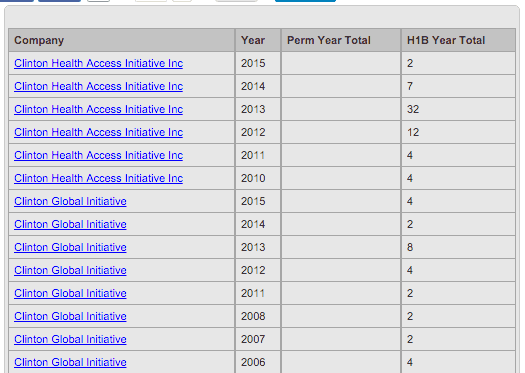
 The MyVisaJobs.com site shows the networks requested up to 87 H-1B workers, although that number may include some duplication and exclude some requests. TheVisaSquare.com site shows 130 requests, of which only two were denied.
That analysis suggests the network has been able to hire to hire roughly 100 foreign graduates in place of Americans.
Despite repeated requests from Breitbart News, the Clinton network declined to state how many visa workers it hired, or why it chose to not hire Americans.
Screen Shot 2016-03-08 at 12.27.48 AM
Screen Shot 2016-03-08 at 12.30.04 AM
Screen Shot 2016-02-27 at 12.41.52 AM
The VisaSquare site shows the data in a similar fashion. 
Screen Shot 2016-03-08 at 2.35.12 PM
Screen Shot 2016-03-08 at 2.42.43 PM
Virgil Bierschwale, a U.S. tech-expert, has built a website showing which companies, universities and non-profit are trying to hire foreign graduates instead of Americans. Bierschwale’s website, for example, allows people to search by zip code, including theClinton foundation’s zipcode.
http://www.breitbart.com/big-government/2016/03/10/clinton-foundation-hires-h-1b-guest-workers-in-place-of-american-graduates/

BK

Brian Hunt: This scary new cash tax will cause gold to soar…

From Brian Hunt, Director, Casey Research:

Have you heard of “negative interest rates?”
It’s become a phenomenon with economists and the media.
There’s a good chance you’ve read an article about it. We’ve covered it many times in the Dispatch.
I’m writing to tell you something about negative interest rates you haven’t heard. You certainly won’t hear about it in the mainstream press.
What’s coming at you is a historic event. It’s something our grandchildren will hear stories about…much like the Great Depression or the Cold War.
What’s coming could send the price of gold much higher in the coming years…and hand gold stock owners 500%+ gains.
If you know what’s coming, it could mean the difference between having lots of free cash in retirement or barely getting by.
To understand the gravity of this moment, let’s cover one of the most bizarre ideas in the world… Negative Interest Rates.
In a normal world, your bank pays you interest on your savings. It takes your money, pools it with other people’s money, and loans it out.
The bank makes money by paying out less in interest on your deposit than it earns in interest from borrowers.
For example, it might pay out 3% to depositors while earning 6% from borrowers.
This is how it has worked for decades.
Negative interest rates turn your “normal” bank account upside down.
Negative interest rates could only exist in a crazy world where idiot politicians are in control.
Unfortunately, that’s just what we’re dealing with right now.
Politicians all over the world are ordering banks to charge depositors (you) a fee for storing cash.
It’s a perversion of saving. It’s a perversion of capitalism. It’s a perversion of planning for the future.
And it’s going to result in disaster.
Politicians think that by making it unattractive for you to keep money in the bank, you’ll save less money. Instead, you’ll spend more money on things like smartphones and cars. You’ll invest in things like stocks and real estate.
This would “stimulate” the economy.
This thinking is very, very wrong. No matter what the government does, it can’t force you to spend money. It can’t force you to make investments if you don’t see good opportunities.
Forcing people to pay banks to hold their money is a tax. It is wealth confiscation for the digital age.
The government and the mainstream press won’t dare call it a tax.
But that’s exactly what it is.
A negative interest rate policy is a tax.
Any time you hear a politician, central banker, or news anchor say “negative interest rates,” just think “TAX.”
Think “TAX ON MY CASH”.
I’ll say it again: Negative interest rates are going to result in financial disaster.
The coming disaster will wipe out many people.
But you don’t have to be one of them.
I’ll explain how you can sidestep this disaster — and even make a lot of money as a result of it — in a moment.
But let’s quickly cover one more thing about negative interest rates…

The Ugly Twin Sister of Negative Interest Rates

If the government makes it unattractive for you to keep cash in the bank, you can pull cash out of the bank. You can simply store it in a safe or under the mattress.
Politicians know this.
That’s why they’ve created another dangerous policy that works hand-in-glove with negative interest rates.
That policy is banning cash.
You see, if you pull your money out of the banking system and stuff it under the mattress, you aren’t doing what the government wants you to do.
You’re not spending money or investing in stocks.
This is a major reason why governments are banning large cash transactions and large denomination bills.
They are fighting a War on Cash.
In just the past few years…
  • Spain banned cash transactions over 2,500 euros
  • Italy banned cash transactions over 1,000 euros
  • France banned cash transactions over 1,000 euros, down from the previous limit of 3,000 euros
And just a few weeks ago, former U.S. Treasury Secretary Larry Summers called for a ban on the $100 bill!
Historians aren’t surprised by Summers’ idea. Franklin Delano Roosevelt banned $500 and $1,000 bills in the 1930s.
You can bet that Big Government types like Hillary Clinton and Donald Trump will do the same thing in a financial emergency.
By making it so difficult (or illegal) to buy and sell things with cash, the government wants to force people into the banking system. That way it can monitor us and coerce us into whatever it wants…like pay outrageous new taxes.
It’s all a dream come true for government central planners.
The governments say these new currency laws are for fighting terrorism, money laundering, and drugs.
But the ultimate goal is control of society…and to confiscate the wealth of private citizens.
As Congressman Ron Paul said, “The cashless society is the IRS’s dream: total knowledge of, and control over, the finances of every single American.”
Whether you agree with these regulations or not, the conclusion is obvious:
By driving us more and more towards trackable digital payments, the government has made it much, much easier to confiscate our wealth.
We’re like sheep that have been “herded” into a corral, ready for shearing.
And Hillary Clinton (and her Big Government cronies) is holding the clippers.
However, you don’t have to be sheared.
You can avoid the shearing by learning how to navigate what will become the largest underground currency market in history.

Hillary Doesn’t Want Your Gold. She Wants Your Cash

On April 5th, 1933, president Franklin Delano Roosevelt issued one of the most controversial orders in U.S. history.
It went by the name “Executive Order 6102.”
Not one American in 1,000 knows about this order. But to this day, many experts consider it to be one of the most destructive acts in U.S. history.
It violated sacred principles held by our founding fathers. It impoverished millions and confiscated the savings of honest, hardworking Americans.
Executive Order 6102 made it illegal for private citizens to own gold. Citizens were ordered to turn in their gold to the government.
Why would the government confiscate the wealth of private citizens?
You can fill a book on the history surrounding Executive Order 6102. But in a nutshell, it was the act of a desperate government in the midst of a financial crisis.
The government wanted the gold in order to increase the nation’s money supply. It believed an increase in the money supply would revive the struggling economy.
Please review those last two paragraphs…
An increase in the money supply…a struggling economy…a desperate government.
Sound similar to what is happening right now?
Since the answer to that question is “YES,” we have to ask another question…
Could such a confiscation happen again?
As the crisis develops, our deeply indebted government will act like a giant wounded beast, lashing out in all directions. It will grow more desperate for control. It will grow desperate for money.
And just like FDR did in the 1930s, it will confiscate the wealth of private citizens.
But Hillary Clinton (or Donald Trump, or whoever wins the election) won’t go after your gold.
Nowadays, the gold market is very small compared to the overall economy.
Going after gold would be too much work for the government.
The government is going to go after YOUR CASH.
It will regulate your cash. It will tax your cash. It will take your cash.
This has all kinds of implications for banking and the economy.
But here’s the most important thing you need to know as an investor:
Negative interest rates and their partner, the War on Cash, will create a renewed interest in gold. This could cause gold to double or even triple in value.
Even children know what the government is doing is crazy.
And people aren’t going to take this lying down.
Rather than participate in the government’s monetary farce, people will go underground.
They will pull cash out of banks and hoard it in safe places. And they will seek the safety, anonymity, and reliability of gold and silver.
Gold and silver have served as money for centuries.
Gold is the ultimate currency because it doesn’t rot or corrode…it is durable…easily divisible…portable…has intrinsic value…is consistent around the world…and it cannot be created from thin air. It cannot be debased by the government.
By enforcing negative interest rates and fighting a War on Cash, the government will create a huge underground currency market.
And the ultimate underground currency will be gold and its sister metal, silver.
Gold is trading for around $1,260 an ounce right now.
As the government blunders into a negative interest rate disaster, gold will likely rise 50%…100%…possibly even 200% higher.
There’s an underground currency market coming to your neighborhood.
If you own enough gold, you’ll be its king.
If you don’t yet own gold, buy it now.
If you own a lot of gold, buy more.
Regards,
Brian Hunt

GOLD: Warning and Lessons From Canada

 The Junius Maltby channel takes another look at the Canadian Gold Crisis, with updated news and a look at what this could mean for Canadians.

The American Way of War as a Do-Over

by , March 11, 2016
Originally posted at TomDispatch.
With General John Campbell’s tour of duty in Afghanistan finished, a new commander has taken over. Admittedly, things did not go well during Campbell’s year and a half heading up the International Security Assistance Force (ISAF) there, but that’s par for the course. In late 2015, while he was in the saddle, the Taliban took the provincial capital of Kunduz, the first city to be (briefly) theirs since the American invasion of 2001. In response, U.S. forces devastated a Doctors Without Borders hospital. The Taliban is also now in control of more territory than at any time since the invasion and gaining an ever-firmer grip on contested Helmand Province in the heart of the country’s poppy-growing region (and so the staggering drug funds that go with it). In that same province, only about half of the “on duty” Afghan security forces the United States trained, equipped, and largely funded (to the tune of more than $65 billion over the years) were reportedly even present.
On his way into retirement, General Campbell has been vigorously urging the Obama administration to expand its operations in that country. (“I’m not going to leave,” he said, “without making sure my leadership understands that there are things we need to do.”) In this, he’s been in good company. Behind the scenes, “top U.S. military commanders” have reportedly been talking up a renewed, decades-long commitment to Afghanistan and its security forces, what one general has termed a “generational approach” to the war there.
And yes, as Campbell headed off stage, General John Nicholson, Jr., beginning his fourth tour of duty in Afghanistan, has officially taken command of ISAF. Though it wasn’t a major news item, he happens to be its 17th commander in the 14-plus years of Washington’s Afghan War. If this pattern holds, by 2030 that international force, dominated by the U.S., will have had 34 commanders and have fought, by at least a multiple of two, the longest war in our history. Talk about all-American records! (USA! USA!)
If such a scenario isn’t the essence of déjà vu all over again, what is? Imagine, for a minute, each of those 17 ISAF commanders (recently, but not always, Americans, including still resonant names like David Petraeus and Stanley McChrystal as well as those like Dan McNeill and David McKiernan already lost in the fog of time) arriving at yearly intervals, each scrambling to catch-up, get the big picture, and run the show. Imagine that process time after time, and you have the definition of what, in kid culture, might be called a do-over – a chance to get something right after doing it wrong the first time. Of course, yearly do-overs are a hell of a way to run a war, but they’re a great mechanism for ensuring that no one will need to take responsibility for a disaster of 14 years and counting.
How to Play Do-Over
For journalists, when it comes to twenty-first-century American war, do-overs are a boon. From collapsing U.S.-trained, funded, and equipped local militaries to that revolving door for commanders in Afghanistan to terror groups whose leaderships are eternally being eviscerated yet are never wiped out, do-overs ensure that your daily copy is essentially pre-written for you. In fact, when it comes to American-style war across the Greater Middle East and increasingly much of Africa, do-over is the name of the game.

In movie terms, you could think of Washington’s war policies in the post-9/11 era as pure “play it again, Sam.” If this weren’t the grimmest “game” around, involving death, destruction, failed states, spreading terror movements, and a region flooded with the uprooted – refugees, internal exiles, transient terrorists, and god knows who else – it could instantly be transmuted into a popular parlor game. We could call it “Do-Over.” The rules would be easy to grasp, though – fair warning – given the recent record of American war making, it could be a very long game.
Modest preparation would be involved, since you’d be using actual headlines from the previous weeks. Given the nature of the Bush administration’s Global War on Terror (now the Obama administration’s no-name war on terror), however, this shouldn’t be a daunting proposition. Any cursory reader of the news, aged 12 to 75, will find it easy to take part. Let me give you just a handful of examples of how Do-Over would work from a plethora of recent news stories:
  • Here, for instance, is a typical, can’t-miss, Do-Over headline: “Back to Iraq: U.S. Military Contractors Return In Droves.” For Washington’s third Iraq War, with a military that now heads into any battle zone hand-in-hand with a set of warrior corporations, the private contractors are returning to Iraq in significant numbers. In the good old days, after the invasion of 2003, for every American soldier in Iraq, there was at least one private contractor. As RAND’s Molly Dunnigan wrote back in 2013, “By 2008, the U.S. Department of Defense employed 155,826 private contractors in Iraq – and 152,275 troops. This degree of privatization is unprecedented in modern warfare.” (Afghan War figures were remarkably similar: in 2010, there were 94,413 contractors and 91,600 American troops in that country.) Now, in the ongoing war against the Islamic State (IS) in Iraq, contractors, 70% American, hired by the Pentagon and other U.S. agencies outnumber the 3,700 U.S. military personnel on the ground by two to one or more and the names of the companies putting them there should ring a distinctly Do-Over bell from the previous round of war: KBR, DynCorp, and Fluor Corporation, among others. Of course, since it’s a Do-Over and we know just what happened the last time around, what could possibly go wrong?
  • Here’s another kind of headline for the game. Think of it as a “new” Do-Over (a story that looks like a first-timer, but couldn’t be more repetitive): “U.S. Plans to Put Advisers on Front Lines of Nigeria’s War Against Boko Haram.” As the New York Times reports, a plan developed by Brigadier General Donald Bolduc, U.S. Special Operations commander for Africa, to “send dozens of Special Operations advisers to the front lines of Nigeria’s fight against the West African militant group Boko Haram” is expected to be approved by the Pentagon and the White House. Those special ops forces, “dozens” of them, are slated to advise Nigerian troops for the first time in the embattled northern part of their country. Though theirs will not officially be a combat role, they will be stationed in an area where anything might happen. At first glance, this may seem like something new under the sun in Washington’s expanding “war against the Islamic State” (to which Boko Haram has pledged its fealty), but only until you consider a remarkably similar October 2015 headline about a neighboring country: “The U.S. Is Sending 300 Military Personnel to Cameroon to Help Fight Boko Haram.” Those special ops troops were to conduct “airborne intelligence and reconnaissance operations” against that grim Nigerian terror group. Or to leap back another year, consider this headline from May 2014: “U.S. Deploys 80 Troops to Chad to Help Find Kidnapped Nigerian Schoolgirls.” (They weren’t found.) And of course, similar headlines could be multiplied across the Greater Middle East over the last decade against groups like al-Qaeda in the Arabian Peninsula and the Islamic State from Yemen to, most recently, Iraq and Syria, with similarly dismal results.
For your success in finding such a headline, you get a bonus question: Fourteen-plus years later, after U.S. special ops forces have repeatedly been sent to scads of countries, and the terror situation has only worsened, what exactly do they have to teach Nigerians or anyone else for that matter? What is it that Washington’s guys know about the world of terror and how to fight it that locals don’t? Given the global record over these years, call that a mystery of our moment.
  • Now, here’s an even rarer form of Do-Over, a headline that calls up not one, but – count ‘em! – two repetitive themes in the American war on terror: “U.S. Captures ISIS Operative, Ushering in Tricky Phase.” The story itself is fairly straightforward. A secretive elite Special Operations team in Iraq has captured “a significant Islamic State operative,” with more such prisoners expected in the near future. The captive is presently being held and questioned “at a temporary detention facility in the city of Erbil in northern Iraq.” What no one in Washington has yet sorted out is: Where are such detainees to be kept in the future? It’s a question that, as you might imagine (and the accompanying New York Times story makes clear), instantly brings to mind Guantanamo and, in Iraq, Abu Ghraib (with its nightmarish photos), and that’s just to begin a longer list of grim places, including a string of “black sites,” and military and CIA prisons begged, borrowed, or appropriated across the planet in the Bush years. In all of them, American intelligence and military personnel (and private contractors) grossly abused, mistreated, tortured and in some cases actually killed prisoners. So in the conundrum of what to do with that single Islamic State captive lies an almost endless set of Do-Over possibilities. Lurking in that same headline, however, is another kind of Do-Over of these last years reflecting another set of repetitive war on terror practices: “U.S. drone strike kills a senior Islamic State militant in Syria,” “U.S. drone strike kills Yemen al-Qaida leader Nasir al-Wuhayshi,” “U.S. Commandos Raid Terrorist Hideouts in Libya, Somalia, Capture Senior Al-Qaeda Official.” In these and so many other headlines like them lies evidence of a deeply held Washington conviction that terror outfits can be successfully disabled and in the end dismantled, as can repressive states like Saddam Hussein’s Iraq or Muammar Gaddafi’s Libya, by taking out key leadership figures. This heavily militarized top-down approach, labeled “the kingpin strategy,” has been brought to bear time and again in America’s post-9/11 conflicts. That there is no evidence at all of its effectiveness (and significant evidence that it actually succeeds in making such groups more brutal and efficient and such states into failed ones) seems not to matter. So in any headline about a terror leader or lieutenant captured in a U.S. special ops raid, there is automatically a second classic Do-Over theme.
  • Now, what about a Do-Over round for events that haven’t even happened and yet are already in reruns? Take this recent headline: “After Gains Against ISIS, Pentagon Focuses on Mosul.” We’re talking about a much-predicted U.S.-backed Iraqi (and Kurdish) offensive against Mosul. Small numbers of Islamic State militants took Iraq’s second largest city in June 2014 after the American-trained Iraqi army collapsed and fled, shedding quantities of American-provided equipment and their uniforms. The offensive to retake it was being touted in a somewhat similar manner a year ago by U.S. Central Command. At that time, 20,000 to 25,000 Iraqi troops were supposedly being prepared to recapture the city in a spring 2015 offensive that somehow never came to be (perhaps because those 20,000 or more troops essentially didn’t then exist). That “pivotal battle” to come was at the time being promoted by American military officials. As Reuters wrote, it was “highly unusual for the U.S. military to openly telegraph the timing of an upcoming offensive, especially to a large group of reporters.” As it turned out, they tipped those reporters off to nothing.
At the moment, Pentagon officials are touting such an offensive all over again for spring 2016, or if not quite now, as Chairman of the Joint Chiefs General Joseph Dunford put it recently, at least not in “the deep, deep future.” (Iraqi military officials, however, already beg to differ, predicting that such an offensive will be at least many months away “or longer.” Welcome to the Mosul offensive of 2017!) Of course, we already have a remarkably clear idea of what Mosul will look like in the wake of such an offensive, should it ever happen. After all, we know just how the smaller Iraqi city of Ramadi ended up after a six-month campaign by U.S.-trained and backed Iraqi troops to retake it from Islamic State militants: largely depopulated, 80% destroyed, and a landscape of rubble thanks to hundreds of U.S. air strikes, street-by-street fighting, and IS booby traps (with no rebuilding funds available). In other words, we already have a Do-Over vision of a future Mosul, should 2016 finally be the year when those Iraqi troops (and American advisers and planes) arrive in the IS-occupied city. (Perhaps the only non-Do-Over possibility is the grimmest of all – that, as the American Embassy in Baghdad has suddenly taken to warning, Mosul’s massive, compromised dam could collapse as the winter snows melt, essentially sweeping the city away and possibly killing hundreds of thousands of downstream Iraqis.)
On the positive side, since the American war on terror shows no sign of abating or succeeding, and as no one in Washington seems ready to consider anything strategically or tactically but more (or slightly less) of the same, Do-Over has a potentially glowing future as a war game. After all, based on almost 15 years of experience from Afghanistan to Nigeria, further destruction, chaos, the growth of failed states, the spread of terror groups, and monumental flows of refugees seem guaranteed, which means that there should never be a dearth of Do-Over-style headlines to draw on.
One warning, though: in the annals of such games, this one is unique. Because of the nature of the American way of war in our time, Do-Over may be the only game ever invented in which there can be no ultimate winner and, unfortunately, the tag line “Everyone’s a loser!” doesn’t seem like a selling way to go. Though the game is still in its planning stages, perhaps the ending has to be something realistic and yet thrilling like: “You’ve been Done-In!”
Tom Engelhardt is a co-founder of the American Empire Project and the author of The United States of Fear as well as a history of the Cold War, The End of Victory Culture. He is a fellow of the Nation Institute and runs TomDispatch.com. His latest book is Shadow Government: Surveillance, Secret Wars, and a Global Security State in a Single-Superpower World.
Follow TomDispatch on Twitter and join us on Facebook. Check out the newest Dispatch Book, Nick Turse’s Tomorrow’s Battlefield: U.S. Proxy Wars and Secret Ops in Africa, and Tom Engelhardt’s latest book, Shadow Government: Surveillance, Secret Wars, and a Global Security State in a Single-Superpower World.
Copyright 2016 Tom Engelhardt