Saturday, March 12, 2016

Why Negative Rates Can’t Stop the Coming Depression

Are you ready to pay to save?

Why Negative Rates Can’t Stop the Coming Depression


Agora founder Bill Bonner explains why “negative interest rates” are spreading around the world…and could soon come to the U.S.
Bill founded Agora Inc. in 1978. Since then, it has grown into one of the largest independent newsletter publishing companies in the world.
He also co-wrote two New York Times bestselling books: Financial Reckoning Day and Empire of Debt. In his latest book, Hormegeddon, Bill describes what happens when you get too much of a good thing in the sphere of public policy, economics, and business.
Like Doug Casey, Bill believes the worst is yet to come.
Bill says the coming financial collapse will be worse than the market crashes in 1987, 2000, and 2008. But this time, he says, it will affect everything from your portfolio...to your bank account...to the cash in your wallet.
You’ll find the important details in his article below.
Until next time,
Nick Giambruno
Senior Editor
International Man

by Bill Bonner
A bird in the hand is worth two in the bush.
– Anonymous.
In our upcoming issue of The Bill Bonner Letter, we explore the strange territory of “NIRP” – negative-interest-rate policy.
About $7 trillion of sovereign bonds now yield less than nothing. Lenders give their money to governments…who swear up and down, no fingers crossed, that they’ll give them back less money sometime in the future.
Is that weird or what?

Into the Unknown

At least one reader didn’t think it was so odd.
“You pay someone to store your boat or even to park your car,” he declared.
“Why not pay someone to look out for your money?”
Ah…we thought he had a point. But then, we realized that the borrower isn’t looking out for your money; he’s taking it…and using it as he sees fit.
It is as though you gave a valet the keys to your car. Then he drove it to Vegas or sold it on eBay.
A borrower takes your money and uses it. He doesn’t just store it for you; that is what safe deposit boxes are for.
When you deposit your money in a bank, it’s the same thing. You are making a loan to the bank. The bank doesn’t store your money in a safe on your behalf; it uses it to balance its books.
If something goes wrong and you want your money back, you can just get in line behind the other creditors.
The future is always unknown. The bird in the bush could fly away. Or someone else could get him.
So, when you lend money, you need a little something to compensate you for the risk that the bird might get away.

A New Level of Absurdity

That’s why bonds pay income – to compensate you for that uncertainty.
Inflation, defaults, depression, war, and revolution all raise bond yields because all increase the odds that you won’t get your money back.
That’s why countries with much uncertainty – such as Venezuela – have higher interest rates than countries, such as Switzerland, where the future is probably going to be a lot like the past.
Venezuelan 10-year government bonds yield 11%. The Swiss 10-year government bond yields negative 0.3%.
The interest you earn on a bond is there to compensate you for the risk that you won’t get your money back. Or that the money you do get back when the bond matures will have less purchasing power than the money you used to buy the bond in the first place.
You never know. Maybe the company or government that issued the bond will go broke. Or maybe the Fed will cause hyperinflation. In that case, even if you get your money back, it won’t buy much.
With interest rates at zero, lenders must believe that the future carries neither risk. The bird in the bush isn’t going anywhere; they’re sure of it.
As unlikely as that is, negative interest rates take the absurdity to a new level.
A person who lends at a negative rate must believe that the future is more certain than the present.
In other words, he believes there will always be MORE birds in the bush.

Boneheaded Logic

The logic of lowering rates below zero is so boneheaded that only a PhD could believe it.
Economic growth rates are falling toward zero. And at zero, it normally doesn’t make sense for the business community – as a whole – to borrow. The growth it expects will be less than the interest it will have to pay.
That’s a big problem…
Because the Fed only has direct control over the roughly 20% of the overall money supply. This takes the form of cash in circulation and bank reserves. The other roughly 80% of the money supply comes from bank lending.
If people don’t borrow, money doesn’t appear. And if money doesn’t appear – or worse, if it disappears – people have less of it. They stop spending…the slowdown gets worse…prices fall…and pretty soon, you have a depression on your hands.
How to prevent it?
If you believe the myth that the feds can create real demand for bank lending by dropping interest below economic growth rates, then you, too, might believe in NIRP.
It’s all relative, you see. It’s like standing on a train platform. The train next to you backs up…and you feel you’re moving ahead.
Negative interest rates are like backing up. They give borrowers the illusion of forward motion…even if the economy is standing still.
Or something like that.
Regards,
Bill
Editor’s Note: Negative interest rates are a disaster story in the making. And they will only speed up the major monetary collapse we believe is coming.
Bill believes the fallout from his catastrophe will be far worse than 2008. When it hits, every service you’ve come to depend on – your bank…your grocery store…your Social Security checks – will shut down.
That’s why Bill recently made a video to warn you what’s coming and how to protect yourself. Click here to watch it now.


Clinton is in danger of seizing up in Rust Belt after Michigan result

Bernie Sanders for the first time won in a state where a quarter of voters are African American. 
Bernie Sanders for the first time won in a state where a quarter of voters are African American. Photograph: Alan Diaz/AP

It’s been a good season for candidates who can channel the anger of the electorate and we saw that again on Tuesday night, when exit polls continued to turn up in favor of Donald Trump, while Bernie Sanders pulled off a surprise victory in Michigan.
Trump’s victory in Mississippi was so decisive that he was declared the winner in that state moments after the first polling reports came in, and he was declared the winner in Michigan soon after. Ted Cruz netted a win in Idaho, keeping a firm grip on second place in the overall GOP race.

Trump’s continued winning streak – despite talk of a lull in his candidacy – wasn’t the biggest victory of the night. That belonged to Sanders, who managed to pull off something he’s been trying to prove throughout his campaign: that he can compete with Hillary Clinton in states like Michigan, where African American voters make up roughly a quarter of the electorate. Clinton won fewer than two-thirds of African American voters in the state, significantly down from the 80-90% support she’s enjoyed elsewhere.
The victories for Trump and Sanders come after a week when both men’s chances were being played down. Sanders’ campaign had been all but left for dead after he failed to make significant inroads with minority voters on Super Tuesday. Trump faced attacks from the party establishment (most notably Mitt Romney) and scorn from the media establishment for his habit of asking people to raise their hands and pledge allegiance to him at rallies, something Cruz quickly seized upon. “We’ve had seven years of a president who thinks he’s an emperor,” he quipped.
For a fleeting moment on Tuesday, it looked like Trump’s star might finally be fading. After all, on Saturday he only won by a few percentage points in Louisiana and Kentucky, while Cruz won handily in Maine and Kansas. But winning by less is still, to put it in Trump terms, #winning. And Tuesday’s results suggest the weekend was merely an ebb in the candidate’s current.
Trump’s win in Mississippi, in particular, is an embarrassment for Cruz, whose plan was to win over the south – something that, as a devout conservative from Texas, he should have been able to do. But that strategy didn’t work for Cruz last month in South Carolina, where he lost southern evangelical voters to Trump by a landslide, and it didn’t work for him on Super Tuesday, either. Mississippi was, if anything, an unwelcome reprise of what’s beginning to sound like a familiar story for Cruz.
But Trump’s win in Michigan is arguably even more significant, and not just because he squelched John Kasich’s improbable hopes for a win there and by extension Ohio. Michigan is especially valuable politically because it embodies America’s manufacturing industry and is a potential bellwether for the all-important Ohio. The state is just as valuable in a general election.
While Michigan is expected to go blue in a general, Trump’s strong performance there (and Hillary Clinton’s difficulty in running against Sanders there) suggests Trump’s talking points on trade and the perils of outsourcing jobs overseas are resonating.
Advertisement
Sanders spent a lot of time campaigning in Michigan and it’s apparently paid off – he’s performed far better in the state than anyone predicted. And it’s somewhat telling that he’s focused single-mindedly on trade. After all, the negative effects of the North American Free Trade Agreement (Nafta), Bill Clinton’s signature trade deal, are still felt acutely here. And Hillary Clinton was slow to come out against the Trans-Pacific Partnership and voice criticism of Nafta. Those are trade positions Sanders has long held, and Clinton’s slowness to adopt them gave him another chance to paint her as politically opportunistic.
Clinton thought she had finessed the trade issue, by focusing on other problems in Michigan, like Flint’s lead-poisoned water, and by skewering Sanders over his vote against the auto bailout (his campaign said it was part of a bigger vote against a bailout for Wall Street). But clearly she hadn’t.
And that’s a troubling finding for anyone worried about a Trump presidency: it suggests the Democrats’ likely nominee could have a problem in crucial manufacturing states.
A majority of Democrats and Republicans in Michigan have reported that recent trade deals have given people like them the shaft. On the Democratic side, six in 10 Michigan voters thought trade takes away jobs and the majority of those voters supported Sanders; on the Republican side, four in 10 thought trade costs the country jobs, and the majority of them supported Trump.
Sanders’ and Trump’s big wins in Michigan tonight, and those polling numbers in particular, should have Clinton very, very afraid.

San Francisco mulls state of emergency over homelessness. But will it help?

California city weighs following similar moves by Los Angeles, Portland and Seattle as west coast copes with crisis much worse than the national average
San Francisco homeless
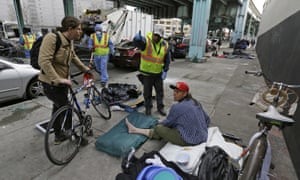
A San Francisco city worker tells a homeless man that the area next to him on is about to be power washed, as part of the clearing-out of a sprawling homeless encampment last month. Photograph: Eric Risberg/AP
When Jacob Riis published his photographs of late 19th-century urban poverty, he invoked French author François Rabelais’s words: “One half the world does not know how the other half lives.” That ignorance may have been understandable in the age when the poor were sequestered in tenements and slums, but in today’s gentrified cities, the two halves share the frame.
A viral photograph of a young woman in Los Angeles posing for a photograph while a homeless man sleeps on the street at her feet exemplifies the 21st-century urban reality. We see how the other half lives, but we don’t let it distract us from taking our selfies.
According to the 2015 annual homeless assessment performed by the Department of Housing and Urban Development, homelessness in the United States has been declining steadily since 2007. But conditions on the west coast are different.
In 2015, California, Oregon, Washington and Hawaii were four of the five states to see the greatest increase in their homeless populations (the fifth was New York). California alone accounts for 21% of the nation’s homeless population. And while nationwide, 31% of homeless people have some kind of shelter at night, California, Oregon and Hawaii all have unsheltered rates above 50%. In California, 63.7% of the homeless population lacks shelter.
Homelessness on the west coast is increasingly perceived by residents as an unacceptable crisis. In response, policymakers have begun declaring “states of emergency” over the manmade disaster unfolding on their streets.
On Tuesday, San Francisco supervisor David Campos introduced legislation to declare a “shelter emergency” in the city of San Francisco. The move came one week after city officials had cleared out a sprawling homeless encampment under a highway overpass where as many as 300 homeless people had been living in tents and makeshift shelters.
San Francisco homeless

Campos’s legislation seeks to activate a California state law that allows cities to declare a “shelter crisis” when “a significant number of persons are without the ability to obtain shelter, resulting in a threat to their health and safety”. Such a declaration suspends certain liabilities and regulations that would “prevent, hinder, or delay” government action to address the crisis.
“This is usually reserved for natural disasters like floods and earthquakes,” Campos said. “This is not a natural disaster. It’s a manmade disaster, but it’s a disaster nonetheless.”
On the same day, another San Francisco supervisor, Jane Kim, introduced a resolution urging Governor Jerry Brown of California to declare a statewide “state of emergency on homelessness”.
“Homelessness knows no city or county boundaries but is a regional and state-wide issue and only a coordinated response will alleviate this crisis,” the resolution reads.
“We would not ask or expect southern California to deal with the aftermath of a major earthquake alone. We wouldn’t ask the Sierra foothills to address the devastation of a fire alone,” Kim said. “We should not expect any single district or city to solve the homelessness crisis by themselves.”
San Francisco’s push for an emergency declaration follows on similar moves in late 2015 by Los Angeles, Portland, Oregon, Seattle and King County, Washington, and the state of Hawaii. (According to the Los Angeles Times, Mayor Eric Garcetti of Los Angeles ultimately did not officially declare a local state of emergency, choosing instead to appeal to the state for a proclamation from the governor’s office of emergency services, which was denied.)
The cities of San Jose, Oakland, and Eugene, Oregon, have also all declared some kind of shelter crisis related to homelessness in recent months. In December, the mayors of Portland, Seattle, Eugene, San Francisco and Los Angeles convened a new alliance specifically designed to elicit more federal support for the homelessness crisis.
In declaring states of emergency on homelessness, civic leaders have generally noted the incongruity of using a government power that citizens are accustomed to applying to natural disasters.
“Emergency declarations are associated with natural disasters, but the persistent and growing phenomenon of homelessness – here and nationwide – is a human-made crisis just as devastating to thousands as a flood or fire,” said King County executive Dow Constantine.
But according to Jacob Remes, a professor of history specializing in disaster studies, the very concept of a disaster is inherently political, and was never limited to “acts of God” or natural calamities like earthquakes and fires.
“When we do disaster aid, we see people who are made homeless and jobless by a hurricane, and we decide that those people are worthy of a special type of aid. But there are homeless and jobless and poor people all the time who we decide are not worthy of that kind of aid,” Remes argues. “What the category of disaster does is sort people into worthy poor and unworthy poor.”
Advertisement
By declaring states of emergency then, Remes argues that west coast politicians could “create a new population of worthy poor”.
One historical example of this political strategy succeeding is the Great Depression, a manmade disaster during which Remes says politicians deliberately “adopted the language of disaster” by casting the economic catastrophe as “an act of God”.
Declaring an emergency allows people to focus on the conditions in which people are living – universally recognized as deplorable – rather than assigning blame to the people experiencing them, since disasters are generally accepted to be blameless.
“The current situation is the product of slower social and political disasters rather than rapid geological forces,” says Gary Blasi, a UCLA professor of law and expert on homelessness, “but the result is experienced in the same way by homeless people, whatever the cause.”
California has declared emergencies over particularly human catastrophes before, according to Kelly Huston of the governor’s office of emergency services, including urban riots and the San Bernardino shootings. But Huston does not believe that such a declaration has ever been made over homelessness.
The governor’s office declined to comment on the San Francisco resolution, which has not yet been passed by its board of supervisors.
For San Francisco’s Campos, it’s at least worth making the effort. As he introduced his resolution on Tuesday, Campos related the tale of meeting an older homeless woman on the steps of the Navigation Center, a shelter in San Francisco’s trendy and increasingly expensive Mission district.
The woman’s best friend had died on the streets a few days earlier.
“She was camping out on the steps of the Navigation Center because she didn’t want to be next. She was pleading with me to get her in,” Campos said. “We have to do better. What we are doing is simply not enough.”


ECB Goes Further Into Negative Territory As Bankers Voice Concerns

The European Central Bank surprised markets today by cutting the deposit rate to -0.4%, expanding its bond-buying program and including corporate debt in purchases effectively throwing the kitchen sink at low inflation. Initially investors rushed into risk assets on the surprise measures however the enthusiasm did not last long as gains quickly reversed after ECB President Mario Draghi hinted rates might not go any lower. The quick reversal highlights investors’ concern that central banks are reaching the limits of monetary policy.
Prior to this announcement several senior bankers across Europe voiced concerns over further negative rates ECB policy actions. Some note worth quotes from this Financial Times article:
  • UBS chief executive Sergio Ermotti warned that excessively low rates were prompting banks to extend too many risky loans because they “don’t know what to do” with deposits.
  • Erste’s Mr Treichl, the longest-serving chief executive of a major European bank, said the ECB’s “limits have been reached” after years of ultra-loose monetary policy that has failed to lift inflation to anywhere near the ECB’s target of “close to but below” 2 per cent.
  • Morgan Stanley analyst Huw van Steenis said negative rates were a “dangerous experiment” and in a report predicted that the 10-basis-point cut would knock 5 per cent off Eurozone bank earnings next year.
  • Nordea's chief economist Helge Pedersen said there has been a “quite significant cost”, especially as loan creation has been low. Mr Pedersen said negative interest rates could, ironically, hinder credit creation because banks could increase lending rates to compensate for the money they are losing on deposits.
European banks have been screaming don’t cut and the ECB has continued further into negative territory, clearly they are getting desperate.

Professor to Wall Street: You're Doing Swaps Accounting Wrong

  • Banks use a broken method for derivative trades, paper argues
  • `If you follow the math you can’t reach any other conclusion'

The world’s largest banks are incorrectly accounting for their swaps trades, locking up money that could otherwise be paid out as dividends to their shareholders, according to a bold new academic paper.
The transactions are funded with money that’s borrowed from the bank’s treasury, and currently that lending cost is deducted from the value of the derivatives. That’s a mistake, according to Darrell Duffie, one of the report’s authors who argues banks should instead charge their trading partners more up-front for the deals, freeing up cash.
By calling out Wall Street accounting conventions, Duffie is in familiar territory. The Stanford University finance professor has already helped spur changes in how banks value credit risk and debt. This time, he’s targeted a business worth many trillions of dollars, where even tiny accounting shortcomings can add up to serious money. The financial health of banks has been a primary concern of regulators since the 2008 credit crisis forced governments around the world to bail out the world’s largest dealers.
Wall Street first revealed a switch to this accounting method for swaps -- called funding valuation adjustment, or FVA -- in 2011 when Goldman Sachs Group Inc. mentioned it in its annual report. In 2013, JPMorgan Chase & Co., the second-largest U.S. derivatives dealer, took a $1.5 billion loss on its fourth-quarter net revenue after it adopted FVA derivatives accounting.

‘Gone Wrong’

“The accounting has gone wrong,” said Duffie, a research associate at the National Bureau of Economic Research and a former member of the Federal Reserve Bank of New York’s financial advisory round table. It took the report’s authors three years to understand and devise the new method, he added during an interview. “I know this sounds strange, but it’s taken people a long time to get this,” he said. “The model is irrefutable. If you follow the math you can’t reach any other conclusion.”
Duffie’s formulas boil down to this: Banks are masking the funding cost of their swaps desks by applying the cost -- in the form of a discount -- to the value of those positions that they report in their financial results every quarter. He’s not accusing the banks of any wrongdoing; he just thinks there’s a better way to book swaps activity.
To illustrate his point, Duffie points to a separate market: U.S. Treasuries. A bank holding $100 million of Treasuries wouldn’t value those securities at $99.5 million just because it had to borrow $500,000 to fund the purchase, Duffie said. Yet that’s exactly what they do in swaps.

‘No Sense’

That “clearly makes no sense,” because the Treasuries haven’t lost value, the authors said in the report. “Instead, this trade should cause an addition of $100 million to the disclosed value of the bank’s assets and a reduction of nearly $0.5 million to the value of the bank’s equity.”
Nitpicking over a $500,000 cost on a $100 million trade might seem inconsequential, but the market for interest-rate swaps, the largest in the world, is $319 trillion in size, according to the Bank for International Settlements. Even small errors matter.
To avoid this problem, banks should be pickier about what swaps they enter into and charge more for trades that require a lot of collateral or cash from the firm’s treasury, Duffie said. That would have the positive effect of lowering borrowing costs. “The banks will be worth more, so they’ll be able to issue debt at lower credit spreads,” Duffie said.
The bank switch to FVA came about for several reasons. In 2008, funding costs for bank swap deals saw “severe deviations” from the historic risk-free borrowing rate, according to the paper, which will be released publicly Friday. Also, large accounting firms “have signaled a willingness to accept FVA disclosures in dealers’ financial statement,” the authors said.
Duffie was one of several academics who near the turn of the century helped change how Wall Street banks account for credit-valuation adjustments and debt-value adjustments. The former are used to measure capital requirements on derivatives trades while the latter reflect the gains or losses a bank would take if it bought back its debt.
Duffie wrote the paper with Leif Andersen and Yang Song. Andersen is co-head of the global quantitative strategy group at Bank of America Corp. while Song is a graduate student in the Ph.D. program at Stanford’s business school.
In the new paper, the authors created a model they argue can be used by Wall Street banks to determine if a swap trade is beneficial or harmful from an equity shareholder point of view. While the issue of the FVA treatment by banks being wrong has been brought up by other researchers, this is the first time a model has been created to address it, they said.
Duffie said he hadn’t showed the paper to Wall Street executives yet.
“I imagine there’s going to be some howling by the banks because they think their accounting practices are right,” he said.

Wounded Warrior Project fires execs amid scandal

Wounded Warrior Project aims to empower wounded veterans, but a recent exposé revealed that the charity spent nearly half of its funding empowering its executives instead. The board of directors responded by beginning to clean house, starting at the top.
Wounded Warrior Project has raised more than a billion dollars in donations since 2003, according to CBS News. Donors might expect their money would be used “to honor and empower Wounded Warriors,” as the nonprofit’s mission states. However, CBS revealed the charity spends between 40 to 50 percent of their money on overhead – while other veterans’ charities spend an average of 10 to 15 percent on the same expenses.
Invade this: Oldest Pearl Harbor veteran pumping iron at 104http://on.rt.com/76j0 


Wounded Warrior Project Chief Executive Officer Steven Nardizzi and Chief Operating Officer Al Giordano were both removed from the organization after accusations arose alleging that the charity’s donations were being misused. The nonprofit’s website says that Nardizzi was a founding member, who spent 10 years as an attorney representing disabled veterans for several veterans service organizations, among other charitable positions.
However, Nardizzi’s image as the COO was more in line with that of a venture capitalist than a nonprofit worker. A former employee told CBS that Nardizzi had entered conferences by “[rappelling] down the side of a building. He’s come in on a Segway. He’s come in on a horse.”
Over $26 million was spent on employee conferences in 2014, compared to $1.7 million in 2010. The events were described as being lavish and boozy, such as one annual meeting held in a luxury hotel in Colorado Springs, where 500 staff members attended a four-day conference that came with a final price tag of $3 million.
Veteran Affairs whistleblowers claim retaliation for complaints about doctorhttp://on.rt.com/766f 


What comes next for Wounded Warrior Project remains to be seen. However, Charity Navigator, a nonprofit that evaluates other nonprofits based on their transparency, accountability, and finances, has added Wounded Warrior to their watchlist. With more eyes on the charity now, more money might reach the 50,000 veterans that donors aim to help.

Record Federal Tax Revenue Over $1.2 Trillion FY 2016 ($8,263 Per Worker) But Still Running $353 Billion Deficit

“Government’s view of the economy could be summed up in a few short phrases: If it moves, tax it. If it keeps moving, regulate it. And if it stops moving, subsidize it.”
– Ronald Reagan

(CNSNews.com) – The U.S. Treasury hauled in a record of approximately $1,248,371,000,000 in tax revenues in the first five months of fiscal 2016 (Oct. 1, 2015 through Feb. 29, 2016), according to the Monthly Treasury Statement released today.
Despite these record tax revenues in the first five months of the fiscal year, the federal government nonetheless ran a deficit of approximately $353,005,000,000 during the same period.
In February alone, the Treasury ran a deficit of $192,614,000,000.
The record five-month tax haul of $1,248,371,000,000 equaled approximately $8,263 for each of the 151,074,000 people in the country who had either a full or part-time job in February.
http://cnsnews.com/news/article/terence-p-jeffrey/1248371000000-fy2016-taxes-set-record-through-february-8263-worker