Thursday, February 18, 2016

Нефть Brent подорожала до $34 за баррель

Стоимость нефтяных контрактов перешла к росту, свидетельствуют данные Межконтинентальной биржи ICE.
По состоянию на 19:11 по московскому времени апрельские фьючерсы на североморскую смесь Brent подорожали на 5,49% — до $34,05 за баррель.

What’s With All the Banking Glitches? Is the Collapse Occurring ALREADY?

 SEE THE WARNING SIGNS AHEAD OF TIME!!!
Banking glitches are ON THE RISE! Big banks such as HSBC, the Royal Bank of Scotland (RBS), Barclays, the State Bank of India, Wells Fargo, PNC, and SunTrust have all experienced banking “glitches” and “technical difficulties” just within these past 2 months alone… The majority of which have occurred ON A FRIDAY.
But the question still remains… WHY? WHY all of a sudden? And WHY so many banks SIMULTANEOUSLY?
Couple that with the PLUNGING stocks, economy, and oil prices WORLDWIDE, and you have irrefutable, undeniable PROOF of an economic collapse occurring right in front of you.
Could all of this be the SIGNS warning us of the COMING WORLDWIDE economic collapse? Could the banks be preparing for a more nefarious agenda at hand? And if they are, just WHAT are they preparing for?
That And More REVEALED!!!
(By the way, if you haven’t already withdrawn your money from the banks, I HIGHLY RECOMMEND YOU DO!!! — But do so in INCREMENTS…)
SEE Bail-Ins: https://youtu.be/CyhVVATm-ws
SEE Economic Collapse: https://youtu.be/RYx6nw2mjFM
SEE Baltic Dry Index PLUNGE: https://youtu.be/BIqzlZn_3P8
SEE Store Closings: https://youtu.be/YnQfcDQRVNM
ALSO SEE
Times of India: http://timesofindia.indiatimes.com/ci…
BBC HSBC: http://www.bbc.com/news/business-3543…
CBR report: http://www.cbronline.com/news/vertica…
Telegraph: http://www.telegraph.co.uk/finance/ne…
This is Money: http://www.thisismoney.co.uk/money/sa…
WQAD: http://wqad.com/2015/12/04/glitches-h…
Economic Collapse Blog: http://theeconomiccollapseblog.com/ar…
72-HOUR WARNING: https://youtu.be/_d2J4jHmEL8

Second-worst charity in America agrees to shut down

James T. Reynolds Sr. looks at a bulletin board covered in photos of cancer patients he says received assistance from Cancer Fund of America. Over the past decade, the charity has received nearly $100 million, but only 2 percent of that has gone to directly help cancer patients.
ADAM BRIMER | Knoxville News Sentinel (2009)
James T. Reynolds Sr. looks at a bulletin board covered in photos of cancer patients he says received assistance from Cancer Fund of America. Over the past decade, the charity has received nearly $100 million, but only 2 percent of that has gone to directly help cancer patients.

 
It came it at No. 2 on the Times' list of America's Worst Charities in 2013, when we teamed up with The Center for Investigative Reporting and CNN to find the most wasteful charities in the country.
Back then, here's what we said about the charity:
While Cancer Fund provides care packages that contain shampoo and toothbrushes, the people in charge have personally made millions of dollars and used donations as venture capital to build a charity empire. Less than 2 cents of every dollar raised has gone to direct cash aid for patients or families, records show.
For years, Cancer Fund founder James T. Reynolds Sr. and his family have obscured that fact with accounting tricks, deceptive marketing campaigns and lies…
Now, after years under federal investigation, it looks like Reynolds will shut his Knoxville, Tennessee-based charity down.
Citing documents filed in U.S. District Court in Phoenix, CNN reported last night that Reynolds has agreed to go out of business and allow the charity he started to be operated by a court-appointed receiver for the time being.
The agreement, which still must be approved by state officials, stems from a civil complaint filed last May by the Federal Trade Commission in concert with attorneys general in all 50 states. That complaint accused Reynolds and some of his family members of building a network of "sham charities'' designed to enrich officers at the expense of sick women and children.
According to the complaint, donations intended for the sick paid for "extravagant insider benefits,'' including cars, college tuition, gym memberships, concert tickets, a Caribbean cruise and trips to Las Vegas and other touristy locales.
"Some charities send children to Disney World,'' South Carolina Secretary of State Mark Hammond said at a Washington D.C. news conference when the complaint was announced. "These charities sent themselves to Disney World.''
According to the complaint, Cancer Fund and other affiliated charities raised $187 million over four years, yet spent almost 90 percent of the contributions on for-profit telemarketers and the "steady lucrative employment'' of Cancer Fund founder James Reynolds Sr., his ex-wife, his son and dozens of members of their extended family.
Details in the 148-page complaint mirror what the Times and its reporting partners uncovered in a yearlong investigation published in 2013.
Cancer Fund collected millions of dollars in cash donations. But patients rarely got help with treatment. Instead they got care packages filled with DvDs, toiletries and other low-cost goods. Almost all the cash collected went to pay for-profit telemarketers and the charities' employees.
Salaries in 2011 topped $8 million — 13 times more than patients received in cash. Nearly $1 million went to Reynolds family members.
The Times found that the network's programs are overstated at best.
"Urgent pain medication" supposedly provided to critically ill cancer patients amounted to nothing more than over-the-counter ibuprofen, regulators determined. A program to drive patients to chemotherapy, touted by the charity in mailings, didn't even exist.
One Reynolds family charity, Breast Cancer Society, told the IRS it shipped $36 million worth of medical supplies overseas in 2011. But the two companies named as suppliers of the donated goods said they have no record of dealing with the group.
Over the past 20 years, Cancer Fund has run afoul of regulators in at least six states, paying more than $525,000 to settle charges that include lying to donors.
Second-worst charity in America agrees to shut down 02/16/16 [Last modified: Tuesday, February 16, 2016 5:51pm]
Photo reprints | Article reprints
© 2016 Tampa Bay Times


Cash Wars: The People Strike Back?

by James Corbett
TheInternationalForecaster.com
February 16, 2016
You might remember that a couple of weeks ago we launched an open source investigation into the war on cash. As I noted at the time, the investigation was spurred by an uptick in anti-cash rhetoric over the last few months from the media, from central bankers and from politicians. Since that investigation took place, however, things have gotten even more in-your-face.
Just four days after we started the investigation Bloomberg came out with an op-ed urging the banksters to “Bring On the Cashless Future.”
Four days after that PayPal kicked off their anti-cash, “PayPal is New Money” advertising campaign at the Super Bowl.
And in the latest move the ECB is now officially considering scrapping the 500 euro note, a move that some worry is just the first step toward limiting cash purchases or eliminating it all together.
“There is a pervasive and increasing conviction in the world of public opinion that high denomination banknotes are used for criminal purposes … It’s in this context that we are considering action,” ECB President Mario Draghi told a journalist in response to a question about the European Council’s recent resolution to “consider appropriate measures” regarding the future of the 500 euro note.
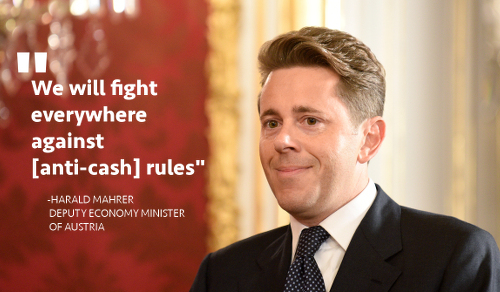
mahrerHarald Mahrer is one of the people warning about the move, and he’s not just your average Joe. He’s a Deputy in the Economic Ministry of the Austrian government. “We don’t want someone to be able to track digitally what we buy, eat and drink, what books we read and what movies we watch,” he told Austrian public radio station Oe1 last week. He argues that the ability to use cash should be a constitutional right for Austrians.
Mahrer is just reflecting what an increasing number of people are beginning to realize: that cash transactions are a key to maintaining anonymity. Heck, when even mainstream propaganda outlets like Slate.com are running pieces making the case that “cash is a classic privacy protection” (in direct contradiction to their earlier anti-cash propaganda) you know the would-be Gods of Money still have a way to go to convince the public to part ways with paper.
But more than just privacy protection, the true importance of cash becomes apparent in times of banking crisis. Just witness when Greece started clamping down on cash withdrawals during their banking panic and people began literally stuffing it under the mattress. It is no coincidence that we are moving into a time of global economic uncertainty being frontrun by (what else?) a banking crisis in Europe.
500euroOn this front, at least, it seems like Mahrer and the forces of common sense might actually be beating back the banksters. Draghi for his part had to almost immediately back off of his cash demonizing comments. He came out on Monday to clarify that the potential scrapping of the 500 euro bill is only about cracking down on money laundering and has nothing to do with an attempt to limit cash transactions.
Trust him as far as you can throw him, but at the very least his backpedaling shows that the banksters have not yet got public opinion on their side on the war on cash. For the time being, anyway…

Gold already in a bull market in currencies other than USD

Syria: At the Gateway of A Greater War

Destroyed buildings are pictured, after the cessation of fighting between rebels and forces loyal to Syria's President Assad, in Homs city
Syrian forces backed by Russian airpower have made major advances across the battlefield along multiple fronts.
Around Aleppo, Syrian forces have cut supply lines from Turkey that were for years, supplying terrorists operating inside the country. Just east of a growing encirclement of the city of Aleppo, a secondary encirclement of so-called “Islamic State” (ISIS) forces is forming as the offensive to relieve Kuweris Airbase has evolved into a northern advance toward Al Bab – a critical logistical hub used by US-NATO-GCC backed terrorists during the initial invasion of Aleppo in 2012 and onward.
Deeper within the interior of Syria, Syrian forces have advanced eastward into the Al Raqqa Governorate, approaching the Tabaqa Airbase. The airbase is a crucial waypoint toward seizing back the city of Al Raqqa itself, which has become the defacto capital of ISIS.
Advances Against ISIS in East Only Possible After Cutting NATO-Fed Supply Lines in North
This second operation aimed at ISIS in Al Raqqah has only been made possible because of successes amid the first operation around Aleppo and along the Turkish-Syrian border. It is now demonstrably clear that the source of ISIS’ fighting capacity originated almost exclusively from NATO-member Turkey’s territory and more specifically, from between the Afrin-Jarabulus corridor.
So far, NATO has been unable to account for this obvious fact, or explain why it has been unable to secure the Turkish border from the Turkish side, particularly when nations including the United States and United Kingdom have for years been conducting military and intelligence operations precisely in the same locations ISIS supplies have been crossing over into Syria from.
As Syrian and Kurdish forces backed by Russian airpower close one logistical corridor after another along the border, the fighting capacity of ISIS has withered to the verge of collapsing.
As ISIS Folds US-NATO-GCC Mount Rescue 
For several days now, Turkey has been firing across the border at the pivotal Syrian city of Azaz. The city is on the verge of being overrun by Kurdish fighters who will for all intents and purposes shut down one of ISIS’ last remaining logistical hubs supplying their fighters in Syria from Turkey.
Turkey has vowed not to allow the city to fall and has implied that it is willing to go as far as invade Syria to ensure that it doesn’t.
While Turkey poses as an enemy of ISIS and has not mentioned its presence in the city of Azaz or why it would attempt to protect them, it would be in 2013 that the BBC itself would declare Azaz “seized” by the terrorist group. In their article, “Isis seizure of Syria’s Azaz exposes rebel rifts,” the BBC would report:
…the Free Syrian Army lost the town of Azaz to the Islamic State in Iraq and Syria, or Isis, the most hardline group linked to al-Qaeda on the rebel side. As a measure of the grip the jihadis have in Azaz, one eyewitness inside the town said no-one was smoking on the streets – tobacco is forbidden according to strict Islamist doctrine.
Other reports from last year indicated that ISIS was either near or in the city – suggesting not that it had ever lost control of Azaz – but that at various moments during the conflict, it suited the West and its regional allies better to pretend “moderate rebels” held it instead.
It should be noted that in all Western media stories, it is never precisely mentioned who the Kurds are fighting in Azaz – because it is ISIS.
Considering this, Turkey would be quite literally intervening to save ISIS and other hardcore terrorist groups sharing the city with it.
Saber-Rattling or Wider War? 
An invasion into Syria would constitute an act of war – and beyond that – affirmation that NATO was behind the ISIS menace from the beginning. While leaks like that of the United States’ own Defense Intelligence Agency (DIA) in 2015 have exposed this rhetorically, a NATO invasion of Syria to save an ISIS stronghold from destruction would prove it demonstrably.
The fact that the US is attempting to distance itself politically from both Turkey and Saudi Arabia – who has also pledged to carry out ground operations in Syria amid the collapse of terrorist fronts across the country – indicates a possible attempt to produce plausible deniability ahead of a much larger provocation or intervention.
Just as US policymakers had plotted in 2009 to use an apparent “unilateral” attack by Israel upon Iran to provoke a retaliation the US could then use as a pretext to “reluctantly’ go to war, a similar strategy appears to be materializing along Syria’s borders today.
While the US and Europe attempt to distance themselves from Turkey, they have at the same time committed to a campaign of disinformation attempting to frame ongoing security operations moving ever closer toward Turkey’s border as “targeting civilians” and attacking “moderate rebels” at the expense of fighting ISIS. This is to lend Turkey and Saudi Arabia rhetorical cover, however tenuous, ahead of any actual intervention.
What will ultimately determine whether this remains mere “saber-rattling” or transforms incrementally into wider war, will be the actual deterrence Syria and its allies, including nuclear-armed Russia, are prepared to meet continued provocations with.
The next few days pose a critical test to Syria and its allies – a test that may determine whether or not this conflict passes through the gateway toward greater war.
Tony Cartalucci is a Bangkok-based geopolitical researcher and writer, especially for the online magazine“New Eastern Outlook”.

Chinese Bid for Chicago Exchange Draws Congressional Concern

  • Casin Group's acquisition faces national security review
  • Lawmakers urge block if links found to Chinese government


The planned sale of the Chicago Stock Exchange to a Chinese buyer should be rigorously investigated by U.S. national security officials and blocked if the buyer has close ties to the Chinese government, a group of U.S. lawmakers said.
The buyer -- Chongqing Casin Enterprise Group -- has many of the "traditional opaque qualities" of a Chinese company and is involved in sectors that likely require close ties to the government, 46 members of Congress said in a letter to the Committee on Foreign Investment in the U.S.
“This proposed acquisition would be the first time a Chinese-owned, possibly state-influenced, firm maintained direct access into the” $21 trillion U.S. equity marketplace, wrote 45 Republicans and one Democrat.
Casin Group’s agreement to buy the exchange has raised a host of questions since it was announced earlier this month, given it has no apparent ties to the securities industry. The company, founded in the 1990s through a privatization of state-owned assets, initially focused on developing real estate projects in Chongqing, before expanding into the environmental and financial industries. While the firm owns stakes in banks and insurers, it has no previous experience owning an exchange.

Market Foothold

The 134-year-old bourse only handles about 0.5 percent of U.S. stock trading. But the deal, if approved, would give Casin Group a foothold into the world’s largest equity market.
The exchange, though tiny, can influence the entire American equity market. U.S. regulations require that trades be routed to whatever exchange is quoting the best price for a stock at any given moment. That means activity on the Chicago Stock Exchange could sway the price of virtually any publicly traded company. It’s linked to the rest of the market through central data feeds, called the securities information processors, or SIPs, which are run by the New York Stock Exchange’s parent company and Nasdaq Inc.
When the deal was announced, Casin Group’s founder and chairman Shengju Lu said in a statement that the deal offers the company a "unique opportunity to help develop financial markets in China over the longer term and to bring exciting Chinese growth companies to U.S. investors.”

Scrutinizing Takeovers

CFIUS, which is led by the Treasury Department and includes the Defense and State departments, reviews acquisitions of U.S. businesses by foreign investors. It has been closely scrutinizing takeovers by Chinese buyers amid a wave of overseas investment from the country. Dutch company Royal Philips NV said last month it was canceling the sale of its lighting-components business to a Chinese-led consortium due to opposition from CFIUS.
The Treasury Department declined to comment on the letter, saying CFIUS reviews are confidential. Representatives of Casin Group couldn’t immediately be reached for comment.
"Should you determine CCEG maintains a close relationship with the Chinese government - and therefore the Chinese military - we would urge CFIUS to deny this acquisition," the lawmakers wrote.
CFIUS has approved a foreign takeover of a U.S. stock exchange before. Germany’s Deutsche Boerse AG was cleared to buy the New York Stock Exchange’s parent, NYSE Euronext, in 2011, though the transaction fell apart for other reasons.