Wednesday, February 17, 2016

Here’s Why (And How) The Government Will “Borrow” Your Retirement Savings

government pickpocket

According to financial research firm ICI, total retirement assets in the Land of the Free now exceed $23 trillion.

$7.3 trillion of that is held in Individual Retirement Accounts (IRAs).

That’s an appetizing figure, especially for a government that just passed $19 trillion in debt and is in pressing need of new funding sources.

Even when you account for all federal assets (like national parks and aircraft carriers), the government’s “net financial position” according to its own accounting is negative $17.7 trillion.

And that number doesn’t include unfunded Social Security entitlements, which the government estimates is another $42 trillion.

The US national debt has increased by roughly $1 trillion annually over the past several years.

The Federal Reserve has conjured an astonishing amount of money out of thin air in order to buy a big chunk of that debt.

But even the Fed has limitations. According to its own weekly financial statement, the Fed’s solvency is at precariously low levels (with a capital base of just 0.8% of assets).

And on a mark-to-market basis, the Fed is already insolvent. So it’s foolish to think they can continue to print money forever and bail out the government without consequence.

The Chinese (and other foreigners) own a big slice of US debt as well.

But it’s just as foolish to expect them to continue bailing out America, especially when they have such large economic problems at home.

US taxpayers own the largest share of the debt, mostly through various trust funds of Social Security and Medicare.

But again, given the $42 trillion funding gap in these programs, it’s mathematically impossible for Social Security to continue funding the national debt.

This reality puts the US government in rough spot.

It’s not like government spending is going down anytime soon; it already takes nearly 100% of tax revenue just to pay mandatory entitlements like Social Security, and interest on the debt.

Plus the government itself estimates that the national debt will hit $30 trillion within ten years.

Bottom line, they need more money. Lots of it. And there is perhaps no easier pool of cash to ‘borrow’ than Americans’ retirement savings.

$7.3 trillion in US IRA accounts is too large for them to ignore.

And if you think it’s inconceivable for the government to borrow your retirement savings, just consider the following:

1) Borrowing retirement funds is becoming a popular tactic.

Forced loans have been a common tactic of bankrupt governments throughout history.

Plus there’s recent precedent all over the world; Hungary, France, Ireland, and Poland are among many governments that have resorted to ‘borrowing’ public and private pension funds.

2) The US government has already done this with federal pension funds.

During the multiple debt ceiling fiascos since 2011, the Treasury Department resorted to “extraordinary measures” at least twice in order to continue funding the government.

What exactly were these extraordinary measures?

They dipped into federal retirement funds and borrowed what they needed to tide them over.

In fact, the debt ceiling debacles were only resolved because the Treasury Department had fully depleted available retirement funds.


3) They’ve been paving the way to borrow your retirement savings for a long time.

Two years ago the government launched a new initiative to ‘help Americans save for retirement.’

It’s called MyRA. And the idea is for people to invest retirement savings ‘in the safety and security of US government bonds’.

Since then they’ve gone on a marketing offensive involving the President, Treasury Secretary, and other prominent politicians.

(Most recently Nancy Pelosi published an Op-Ed in the San Francisco Chronicle a few days ago promoting the program.)

They’ve also proposed a number of legislative reforms to ‘encourage’ American businesses to sign their employees up for MyRA.

Just last week, Congress introduced the “Making Your Retirement Accessible”, or MyRA Act, which would charge a penalty to employers whose workers don’t have a retirement account.

The proposed penalty is $100. Per worker. Per day.

Imagine a small business with, say, 10 employees who don’t have retirement accounts. The penalty to Uncle Sam would be a whopping $30,000 PER MONTH.

There’s a word for this. It’s called extortion.

Obviously when facing a $30,000 monthly penalty, an employer will pick the easiest option.

Given the absurd amount of government regulation on the rest of the financial industry, MyRA is the fastest choice.
This isn’t about fear or paranoia. It’s about facts.

And the reality is that the government in the Land of the Free is moving in the direction of borrowing more and more of your retirement savings.

If you still remain skeptical, remember that last year the government stole more from its citizens through Civil Asset Forfeiture than thieves in the private sector.

Or that just 45-days ago a new law went into effect authorizing the government to strip you of your passport if they believe in their sole discretion that you owe them too much tax.

No judge. No jury. No trial. They just confiscate your passport.

This article was written by Simon Black and originally published at Sovereign Man

Schroeder: NATO Expansion Toward Russia Destroys Basis of German Ostpolitik

In an interview with Westdeutsche Allgemeine Zeitung, former German Chancellor Gerhard Schroeder said that the West should lift anti-Russian sanctions as they harm both Moscow and Europe.

The ex-chancellor supported Bavarian Prime Minister Horst Seehofer on the issue of the withdrawal of anti-Russian sanctions. Earlier, Seehofer was accused by his colleagues of playing into Putin's hands after he stressed the negative impact of anti-Russian sanctions on the German economy.
Schroeder said that during his recent visit to Moscow, the Bavarian Prime Minister acted "solely in the interests of Germany" and did not attempt to pursue a course different from that of Berlin.
"Sanctions are hurting both sides," Schroeder told the newspaper. "They don't help to resolve the conflict, but only create obstacles. It is therefore necessary to gradually abandon them," the politician said.
The former chancellor also did not leave without drawing attention to the tensions between NATO and the Russian Federation. He mentioned that stationing NATO forces along the Russian border has had a negative impact on Berlin's foreign policy.
"We also need a new NATO policy towards Russia. I consider it too risky that the alliance is now building up its military presence on the Russian-European border, thereby destroying the basis of our Ostpolitik," the politician stated.
Gerhard Schroeder has repeatedly opposed the decision of the West to extend sanctions against Russia. The politician said that the restrictive measures are counterproductive, while a constructive dialogue with Moscow is essential for ensuring European security.

European Groups Expose 'Terrifying Extent of Corporate Grab' Within TTIP

Source: Common Dreams

Even with global inequality at historic highs and corporate tax evasion in the public spotlight, a new report out Monday shows how a so-called free trade deal between the U.S. and European Union could further threaten tax justice, hampering governments' ability to ensure that critical public services are well funded or to pursue progressive tax practices.
According to the London-based Global Justice Now and the Netherlands-headquartered Transnational Institute, the TransAtlantic Trade and Investment Partnership (TTIP) "would massively increase the ability of corporations to sue member states of the EU over measures such as windfall taxes on exceptional profits, or use of taxation as a policy instrument such as a possible 'sugar tax'."
"The evidence of the dangers of these investment deals continues to mount. Not only do they affect health and the environment and cost taxpayers millions in legal fees...they also affect the ability of governments to tax corporations effectively."
—Cecilia Olivet, Transnational Institute
"Despite the enormous public outcry over companies like Google and Amazon paying ridiculously small amounts of tax in the UK, the government is trying to sign us up to a trade deal that could effectively prevent us from bringing about laws that could address tax injustice," said Global Justice Now executive director Nick Dearden on Monday.
"The ability to enact effective and fair tax systems to finance vital public services is one of the defining features of sovereignty," he added. "The fact that multinational companies would be able to challenge and undermine that under TTIP is testament to the terrifying extent of the corporate grab embedded in this toxic trade deal."
The report (pdf) zeroes in, as others have done, on the Investor-State Dispute Settlement (ISDS) provisions that are an integral part not only of the TTIP but of other massive and controversial trade deals currently under negotiation. It shows that corporations have already used such provisions of existing trade deals to sue at least 24 countries, from India to Romania, over 40 tax-related disputes, in some cases successfully challenging and lowering their tax bills.
In Ecuador, it notes, fossil fuel companies have sued the government several times over the introduction of new taxes on sales and profits of oil and the withdrawal of tax breaks for foreign oil companies.
Meanwhile, food and drink corporate investors sued Romania successfully, winning a $250 million award, over early termination of tax breaks—such as exemptions from customs duties and a tax on corporate profits—which had been specifically demanded by the European Commission for Romania to join the EU. "In a new twist," the report points out, "in 2015 the European Commission said paying the ISDS award is in itself a violation of EU state aid rules."
Or consider the case of Vodafone, which launched an arbitration claim against India that is still ongoing, after it was ordered to pay tax on an $11 billion deal when it acquired a controlling interest in a major Indian phone company. Vodaphone had paid no capital gains tax on the deal because the transaction used a number of offshore companies.
And as bad as all this is, "it's about to get a lot worse" under deals like the TTIP, Dearden wrote in an op-ed on Monday.
"The evidence of the dangers of these investment deals continues to mount," said Cecilia Olivet of the Transnational Institute. "Not only do they affect health and the environment and cost taxpayers millions in legal fees, this report shows they also affect the ability of governments to tax corporations effectively.  This is yet more money lining the pockets of corporate executives stolen from the public taxpayer. New trade deals such as TTIP and CETA have to be stopped and the public interest defended."
The report underscores that supposed tax 'carve-outs', written into trade or investment treaties in an effort to limit the ability of investors to file tax-related ISDS cases, have not succeeded in stopping taxes being challenged and defeated.
"Though some of these carve-out clauses are stronger and clearer than others, they have not prevented lawyers from filing tax-related ISDS cases, and they have not prevented arbitrators from agreeing to consider them," the report reads. "The language in these treaties is often convoluted and sometimes contradictory, with exceptions within exceptions—giving lawyers a lot to argue about but making it difficult for policymakers to know what actions could risk a treaty claim."
What's more, the report points out, "The threat of an expensive ISDS case can be as powerful as actually filing one. With states unclear about what might trigger successful claims, the safest course of action is to never threaten a multinational corporation's profits—a dangerous prospect for tax justice and public interest laws."
The next round of TTIP negotiations is due to begin in Brussels next week.


Italy’s Banking Crisis Spirals Elegantly out of Control

Wolf Richter wolfstreet.com, www.amazon.com/author/wolfrichter

How to dump toxic waste on the public through the backdoor.

Back during the euro debt crisis, while the ECB was buying government debt from Member States to keep Italian and Spanish government debt from imploding, German politicians fretted out loud about what exactly the ECB was buying. Among them was Frank Schäffler, at the time Member of the Federal Parliament, who in September 2011 said with uncanny accuracy:
“If the ECB continues like this, it will soon buy old bicycles and pay for them with new paper money.”
This is now coming to pass.
Italy, the Eurozone’s third largest economy, is in a full-blown banking crisis. Four small banks were rescued late last year. The big ones are teetering. Their stocks have crashed. They’re saddled with non-performing loans (defined as in default or approaching default). We’re not sure that the full extent of these NPLs is even known.
The number officially tossed around is €201 billion. But even the ECB seems to doubt that number. Its new bank regulator, the Single Supervisory Mechanism, is now seeking additional information about NPLs to get a handle on them.
Other numbers tossed around are over €300 billion, or 18% of total loans outstanding.
The IMF shed an even harsher light on this fiasco. It reported last year that over 80% of the NPLs are corporate loans. Of them, 30% were non-performing, with large regional differences, ranging from 17% in some of the northern regions to over 50% in some of the southern regions. The report:
High corporate NPLs reflect both weak profitability in a severe recession as well the heavy indebtedness of many Italian firms, especially SMEs, which are among the highest in the Euro Area. This picture is consistent with corporate survey data which shows nearly 30% of corporate debt is owed by firms whose earnings (before interest and taxes) are insufficient to cover their interest payments.
The reason these NPLs piled up over the years is because banks have been slow to, or have refused to, write them off or sell them to third parties at market rates. Recognizing the losses would have eaten up the banks’ scarce capital. Reality would have been too ugly to behold.
The study found that the average time for writing off bad loans has jumped to over six years by 2014. And this:
In 2013, on average less than 10% of bad debt, despite already being in a state of insolvency, was written off or sold. The bad debt write-off rate varies significantly across the major banks, with banks with the highest NPL ratios featuring the lowest write-off rates. The slow pace of write-offs is an important factor in the rapid buildup of NPLs.
Now, to keep the banks from toppling, the ECB has an ingenious plan: it’s going to buy these toxic assets or accept them as collateral in return for cash.
That’s what the Italian Treasury told reporters, according to Reuters. Oh, but the ECB is not going to buy them directly. That would violate the rules; it can only buy assets that sport a relatively high credit rating. And this stuff is toxic.
So these loans are going to get bundled into structured Asset Backed Securities (ABS) and sliced into different tranches. The top tranches will be the last ones to absorb losses. A high credit rating will then be stamped on these senior tranches to make them eligible for ECB purchases, though they’re still backed by the same toxic loans, most of which won’t ever be repaid.
The ECB then buys these senior tranches of the ABS as part of its €62.4-billion per-month QE program that already includes about €2.2 billion for ABS (though it has been buying less). Alternatively, the ECB can accept these highly rated, toxic-loan-backed securities as collateral for cash via so-called repurchase agreements.
But buying even these senior tranches would violate the ECB’s own rules, which specify:
At the time of inclusion in the securitisation, a loan should not be in dispute, default, or unlikely to pay. The borrower associated with the loan should not be deemed credit-impaired (as defined in IAS 36).
Hilariously, the NPLs, by definition, are either already in “default” or “unlikely to pay,” most of them have been so for years, and the borrower is already “deemed credit impaired” if the entity even still exists. But hey, this is the ECB, and no one is going to stop it. Reuters:
The move could give a big boost to a recently approved Italian scheme aimed at helping banks offload some of their €200 billion of soured credit and free up resources for new loans.
But the scheme would limit ECB purchases to only the top tranches, and thus only a portion of the toxic loans. So there too is a way around this artificial limit.
To sell lower-rated tranches to the ECB, the banks can dolly up the credit rating of these toxic-loan-backed securities by purchasing a guarantee from the Italian government, which, thanks to the ECB’s de-facto guarantee of Italian government debt, has a credit rating of BBB-, barely above junk, thus “investment grade.”
That’s good enough for the ECB. A guarantee by the Italian government would transfer Italy’s BBB- credit rating to even the lower tranches of these toxic-loan-backed securities.
Reuters got in touch with Standard & Poor’s, which wants to rate these securities because that’s how it makes its money. And then Reuters reported on this exchange about the “Italian scheme”:
“Standard & Poor’s evaluation of previous deals secured by NPL collateral have typically depended on numerous factors, as different collateral types may pose unique risks,” the rating agency wrote in about the Italian scheme.
“Generally, our credit analysis has focused on ascertaining the expected timing of cash flows and net proceeds from the liquidation of the assets.”
Reuters also cited an ECB source who’d said last November that buying re-bundled NPLs could be an extreme option if the Eurozone’s economic situation became “really bad.”
So now, the situation has gotten “really bad.”
As the Italian banking crisis is elegantly spiraling out of control, the ECB is trying to get a handle on it by buying “old bicycles,” namely structured toxic-loan-backed securities whose underlying loans defaulted, on average, six years ago. In the process, the financial middlemen will extract a ton of money. The public in other countries will get to eat the toxic loans plus the money extracted by the middlemen. And the cherished bondholders of Italian banks are a step closer to their own personal bailout.
Those Sinking Banks! Read…  Hounded by NIRP: Global Bear Market Progress Report

One Third Of Energy Companies Could Go Bankrupt Deloitte Warns As Credit Risk Hits Record High

At 1600bps, the extra yield investors are demanding to take on US energy credit risk has never been higher. However, if a new report from Deloitte proves true, this is far from enough as they forecast roughly a third of oil producers are at high risk of slipping into bankruptcy this year as low commodity prices crimp their access to cash and ability to cut debt.
Record high US Energy credit risk...


The report, as Reuters reports, based on a review of more than 500 publicly traded oil and natural gas exploration and production companies across the globe, highlights the deep unease permeating the energy sector as crude prices sit near their lowest levels in more than a decade, eroding margins, forcing budget cuts and thousands of layoffs.
The roughly 175 companies at risk of bankruptcy have more than $150 billion in debt, with the slipping value of secondary stock offerings and asset sales further hindering their ability to generate cash, Deloitte said in the report, released Tuesday.

"These companies have kicked the can down the road as long as they can and now they're in danger of kicking the bucket," said William Snyder, head of corporate restructuring at Deloitte, in an interview. "It's all about liquidity."

Some oil producers are also choosing to liquidate hedges for a quick infusion of cash, a risky bet.

"2016 is the year of hard decisions, where it will all come to a head," John England, vice chairman of Deloitte, said in an interview.
For now, however, there is a corner of the market that offers perhaps a smidge of saefty...
Of the 53 U.S. energy companies that filed for bankruptcy last quarter, only 14 were service providers, a trend that is expected to continue in the short term, Deloitte found.
"Service providers tend to be more of a people business with less capital deployed, so it's easier for them to financially flex," Snyder said.
However, Snyder concludes...
"Eventually, though, they've got to run out of gas, too."

Tuesday, February 16, 2016

Is This Debt’s Last Rattle?


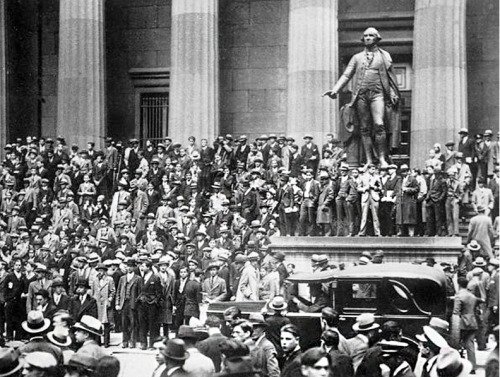
Crowd outside Wall Street Stock Exchange on BlackThursday Oct 24 1929
What we see happening today is why we called our news overview the “Debt Rattle” 8 years ago. The last gasps of a broken system ravished by the very much cancer-like progress of debt. Yes, it took longer than it should have, and than we thought. But that’s pretty much irrelevant, unless you were trying to get rich off of the downfall of your own world. Always a noble goal.
There’s one reason for the delay only: central bank hubris. And now the entire shebang is falling to bits. That this would proceed in chaotic ways was always a given. People don’t know where to look first or last, neither central bankers nor investors nor anyone else.
It’s starting to feel like we have functioning markets again. Starting. Central bankers still seek to meddle where and when they can, but their role is largely done. It’s hard to pinpoint what exactly started it, but certainly after Kuroda’s negative rate ‘surprise’ fell as flat on its face as it did, and then fell straight through the floor and subsequently shot up through the midnight skies, a whole lot more ‘omnipotence credibility’ has disappeared.
Kuroda achieved the very opposite of what he wanted, the yen soared up instead of down -big!-, and that will reflect on Yellen, Draghi et al, because they all use the same playbook. And the latter so far still got a little bit of what they were shooting for, not the opposite. Still, one could also make a good case that it was Yellen’s rate hike that was the culprit. Or even Draghi’s ‘whatever it takes’. It doesn’t matter much anymore.
Though what should remain clear is that it was in their interference in markets to begin with, as extremely expensive as it has been extremely useless and dumb, that the real guilt resides. Or we could take it even a step further back and point to the credit bubbles blown in the west before 2008. Central banks could have let that one go, and allow it to run its natural course. Instead, they decided they should inflate their own balance sheets. What could go wrong?
Then again, these inane policies concocted by a bunch of bankers and bookworm academics who don’t even understand how their own field works, as Steve Keen once again explained recently, would have blown up in their faces long before if not for China’s decision to join in and then some. Some $35 trillion, that is.
Money, debt, spent on ghost cities and on what now turn out to be ghost factories. Ghost jobs, ghost prosperity,a ghost future. Makes us wonder all the time what people thought when they saw China used as much cement in 2011-2013 as the US did in the entire 20th century. Did anyone think that would continue for decades, even grow perhaps? Have we lost all sense of perspective?
How much cement or steel can one country need, even if it’s that large? How much coal and oil can it burn, let alone store? Blinded as we were, apart from the financial shenanigans, much of what the ‘developed nations’ engaged in since 2008 was overleveraged overinvestment, facilitated by ultra-low rates, in industries that would feed China’s hunger for ever more forever. Blind? Blinded?
And now we’re done. If Elon Musk doesn’t come back soon with a zillion little green Martians to pick up China’s slack, we’re all going to be forced to face just how distorted our media-fed visions of our economic futures have become, and how much pain it will take to un-distort them.
Which is what we’re watching crash down to mother earth now. And the central bankers’ loss of ‘omnipotence credibility’ is not something to be underestimated. It encourages people like Kyle Bass to dare the PBoC to show what it’s got left, even if, as Bass said, he’s got maybe a billion to go up against the multi-trillion Chinese state windmills of Beijing. It shouldn’t matter, but it does. Because the windmills are crumbling.
Bass won’t be alone in challenging global central banks. And that’s probably good. Without people like him, we would never see proper checks and balances on what the formerly omnipotent are up to. Kuroda has next to nothing left -or even less that that. Draghi and Yellen only have negative territory left to plow into, and at the very least that means putting positive spins on any economic numbers becomes exceedingly hard to do -and be believed.
Granted, they can still all go for helicopter money -and some will. But that will be the definite last step, and they know it. Dropping free money into a festering cesspool of debt is as useless and deadly as all previous QEs put together.
As we watch the world crash down to earth in epic fashion -and it ain’t even the 1st inning- people are already looking for a bottom to all of this (a waste of time). But if there’s one law in economics, it’s that when a bubble pops it always ends up below where it started. So look at where levels were before the bubble was blown, and then look out below.
Want to argue that this is not a bubble? Good luck. This is the mother of ’em all.
The Lunar New Year, and the breather it brings for Beijing -though we’re sure there’s not a lot of family time off for PBoC personnel- seems like a good moment to take stock of the multiple crises that simultaneously and in concert accelerated head first into the new year. And boy, the rest of the world decided not to wait for China, did it now? For those who’ve seen this coming and/or have no skin in the game, it’s an amusing game of whack-a-mole. For others perhaps not so much.
To take a few steps back, if you ever believed there was a recovery after 2008, or even that it was theoretically possible for that matter, you’re going to have a much harder time understanding what is happening now. If you’ve long since grasped that all that happened over the past 8 years of QE infinity-and-beyond, was nothing but “debt passed off as growth”, it’ll be much easier.
It’s stunning to see for everyone at first blush that the “book value” of global proven oil reserves is down by $120 trillion or so since summer 2014. And it certainly is a big number; the S&P has lost ‘only’ $2 trillion in 2016. But what counts is the speed with which that number sinks in, and that speed depends on one’s reference frame. In the same vein, what’s perhaps most important about all the seemingly separate crises developing before your eyes is how they feed on each other.
Or, rather, how they all turn out to be the same crisis, kind of like in the perfect whack-a-mole game, where there’s only one mole and you still can’t catch it. So try and whack these. Or better still, try and imagine central bankers doing it, or finance ministers, spin doctors. They’re all so out of their leagues it would be funny if they didn’t have the power to make you pay for their incompetence.

NZ growth slows despite migration boom

A farmer monitors operations as dairy cows are milked. Weak dairy prices have been blamed for recent poor economic performance. Photo / Getty Images
New Zealand's economy has ground to a halt with weak dairy prices and a construction slow-down.
ASB economists said forecasts indicate economic growth would continue to slow to a 2.2 per cent and population growth was accounting for much of New Zealand's economic growth.
"On a per-capita basis, there has essentially been no growth over the past year," ASB chief economist Nick Tuffley said.
Tuffley said growth was expected to stabilise, then recover later in the year with support from lower interest rates, and through 2017.
"Declines in interest rates and the NZD over the past year will help support growth - and further rate cuts later this year should provide an extra boost, ensuring inflation lifts more firmly back into the RBNZ's target," Tuffley said.
Falling dairy incomes remain the main headwind for the economy, while tourism is the notable bright note, according to ASB.
The Reserve Bank Governor Graeme Wheeler left the official cash rate at 2.5 per cent, saying further reductions to the rate might be needed with inflation set to take longer to return to the bank's target range of 1-3 per cent.
The Reserve Bank said the inflation rate was expected to move inside the target range from early next year, as earlier petrol price declines will drop out of the annual calculation, and the lower New Zealand dollar will be reflected in higher tradables prices.