Friday, January 15, 2016
Video: Bernie Sanders Decries Lack of Wall Street Prosecutions
Former financial regulator Bill Black says it’s important to reimplement the Glass-Steagall Act – but it’s not enough to prevent another financial crisis.
Via Youtube

The 'Real' Price Of Oil Is Below $17
"You see a big destruction in the income of the oil and commodity producers," exclaims on analyst but, as Bloomberg notes,
while oil prices flashing across traders' terminals are at the lowest
in a decade, in real terms the collapse is considerably deeper. Adjusted
for inflation, WTI is its lowest since 2002 and worse still Saudi Light Crude is trading at below $17 (in 1998 dollar terms) - the lowest since the 1980s...
Slumping prices are a critical signal that the boom in lending in China is “unwinding,” according to Adair Turner, chairman of the Institute for New Economic Thinking.
In fact, while sub-$30 per barrel oil sounds very scary, Saudi prices would be less than $17 a barrel when converted into dollar levels for 1998, the year oil sank to its lowest since the 1980s.

Slowing investment and construction in China, the world’s biggest energy user, is “sending an enormous deflationary impetus through to the world, and that is a significant part of what’s happening in this oil-price collapse,” Turner, former chairman of the U.K. Financial Services Authority, said in an interview with Bloomberg Television.
* * *
So while prices are very low any description, never forget about inflation - The Fed won't!
Sacked ANZ trader says bank tolerated drugs, strip clubs
Sacked ANZ traders say bank tolerated drugs, strip clubs
Two traders sacked by ANZ for
inappropriate behaviour are suing the bank for tens of millions of
dollars, claiming a rampant culture of sex, drugs and alcohol was
condoned among senior staff on the dealing floor.
Mr O'Connor and Mr Alexiou's claims are difficult to read for all of us at ANZ"What a waste, it should have been sprinkled on a birthday cake," a senior ANZ markets trader said after a "white substance" was found in the male toilet of the bank's dealing room floor, according to court documents filed by Etienne Alexiou.
ANZ's chief risk officer, Nigel Williams
 ANZ is facing allegations of tolerating a culture of sex, drugs and alcohol. Photo: Peter Braig
Advertisement
In a potentially more serious claim, Mr Alexiou said he formally
raised concerns about the conduct of the bank towards investors and
clients on three separate occasions, according to his court statement.
One instance included a potential breach of the Corporations Act.Mr Alexiou, who Fairfax Media named in January last year as one of seven traders stood down by the bank in November 2014 as a result of a regulatory probe into setting on the bank bill swap rate, was sacked for lewd and explicit communications via Bloomberg terminals.
 Etienne Alexiou at his house in the eastern suburbs of Sydney.
Culture not a match for standards required
The culture on the dealing floor, Mr Alexiou claimed, was at odds with the official levels of conduct demanded by the bank.In a separate claim, a senior bond salesman, Patrick O'Connor, is suing the bank after he was fired for running up $37,000 of expenses including his rent, healthcare payments, an $18,000 purchase of rare coins and several charges at hotels in Sydney and Hong Kong.
The sackings come amid several other key departures at the bank. In December last year, ANZ's head of markets, Steve Bellotti, left the bank. There have been other departures since.
Ahead of the claims being lodged in the Federal Court, Fairfax Media became aware of an out-of-control culture on ANZ's trading floor that had raised concerns within the bank and externally.
Eddie Listorti, the new acting head of global markets, signed the termination letters of both traders, Mr Alexiou and Mr O'Connor, and was cited at least three times by Mr Alexiou as acting inconsistently with ANZ's code of conduct.
Mr Alexiou and Mr O'Connor are separately suing the bank in the Federal Court for tens of millions of dollars of damages, lost bonuses and income after they were dismissed for inappropriate or offensive electronic communication and, in Mr O'Connor's case, the abuse of a company-issued credit card.
ANZ said on Thursday that the staff were dismissed for serious breaches of its code and it would "be vigorously defending both their court applications".
"Mr O'Connor and Mr Alexiou's claims are difficult to read for all of us at ANZ but common sense says their behaviours are not consistent with our code of conduct and cannot be tolerated," ANZ's chief risk officer, Nigel Williams, said.
Mr Williams said ANZ had "already identified that many of the allegations made in both claims are not accurate and these inaccuracies will become apparent as the matters proceed through the court system".
He said ANZ would investigate allegations made about existing and former staff "that are bought to our attention either through our own management and monitoring or those raised by current or former staff".
Michael Harmer, the lawyer who represented Kristy Fraser-Kirk in her sexual harassment case against David Jones' former chief executive Mark McInnes, is acting for Mr O'Connor. Mr Alexiou's legal representative is Peter Punch of Caroll & O'Dea lawyers.
$30m claim
Mr Alexiou's $30 million claim is to cover deferred shares and bonuses and the loss of future income as a result of his sacking.He was promoted by ANZ to head of balance sheet trading in March 2013 and was one of seven traders stood down as part of the bank bill swap rate (BBSW) investigation on November 19 in 2014, just seven days after he was awarded a $5 million performance bonus.
He was fired by the bank last September. The reason cited was the use of "highly offensive and inappropriate" language in emails and Bloomberg chat. The chats included disparaging comments to women and references to strip clubs and drugs, according to ANZ's termination letter submitted to the Fair Work Commission.
In total, there were 400 internal and external communications of concern from 2011 until September 2013, according to the termination letter.
While Mr Alexiou was among the traders investigated by the bank and the corporate regulator in relation to the bank bill swap rate, the bank confirmed his termination was a separate matter in the letter.
Mr Alexiou claims he was unfairly treated by the bank and questioned why he had not been reinstated while there were no findings of wrongdoing on his part, while a disciplinary investigation that led to his sacking was launched when there was "no proper reason to do so".
Mr Alexiou said he was told by another senior trader that he was unfortunately just "someone that had to be made out to be a big white dildo" in February 2014 after he was "stood down" as part of the BBSW investigation.
Unethical conduct concerns
In his statement, Mr Alexiou said he had raised concerns about unethical conduct towards bank clients on more than one occasion. He claimed that he was "exposed to a culture" at ANZ that "openly condoned" behaviour that was inconsistent with its code of conduct, values and policies.Mr Alexiou was paid around $3.7 million to join the bank in 2011 as compensation for forgone bonus and share incentives from his previous employer, Barclays. He received bonuses of $11.3 million from 2012 to 2014 in cash and deferred shares. He is claiming $8.5 million in withheld payments and $21 million in past and future income losses. Mr Alexiou's $7.2 million Point Piper mansion was put up for sale in November 2015.
In a lengthy termination letter, Mr Listorti rejected Mr Alexiou's defence of his actions that the actual or "living" code of behaviour was at odds with the official code, and said as a "highly remunerated" senior executive, Mr Alexiou was responsible for setting the culture.
He considered, but dismissed, Mr Alexiou's argument that his health and stress should grant him leeway, while also rejecting that misspelt swear words, such as "k-k", "peniss" and "fark" were acceptable because they were not screened by the bank's surveillance systems.
Mr Alexiou claimed in his court filing that Mr Listorti had repeatedly used profanities, the most recent being an apparent threat in March 2014, when he told Mr Alexiou: "Either HR, market risk or f---ing fired. Which one is it?" according to Mr Alexiou's legal statement.
Separate claim
In a separate claim, Mr O'Connor, who was dismissed by ANZ in October 2015, is taking legal action against the bank. He demands that either his job be reinstated, damages be paid in addition to his 2015 bonus of $800,000 and reinstatement of his unvested shares, or he be compensated for his bonuses, shares, expenses, damages and the loss of future income.Mr O'Connor, who had worked for the bank for 10 years as a senior fixed income salesman, was sacked for running up expenses on his corporate credit card of $37,000 over a one-year period, including an $18,000 purchase of rare coins, a $7468 rent payment to LJ Hooker and a $1478 health insurance payment. He made a $2740 payment for alcohol to a company called "Loke" and made three payments totalling $4000 to various Sydney hotels.
The bank mentioned seven instances of lewd and sexually explicit comments about "gang bangs" and having girls eat sushi off him while naked made by Mr O'Connor via his Bloomberg chat terminal.
Mr O'Connor claims ANZ "created, supported and encouraged" the "toxic and unsafe culture".
He claimed in his application that he suffered depression and hyperthymia, or extreme overactivity, and said ANZ had "selectively and disproportionately" subjected him to "investigation, suspension and termination" without attempting to "modify his behaviour".
This behaviour was "required" by ANZ's culture, and, as a result of his disabilities, he "could not effectively control himself".
Mr Williams said the bank understood that the claims have been made at a time of "community concern about behaviours in some financial markets businesses around the world" and as the bank was itself being investigated for potentially manipulating the bank bill swap rate.
But he said the 1000 staff in its Global Markets division continued to work hard for customers in a responsible manner and that the bank would "take the appropriate action to support and build its reputation for corporate responsibility".
To read the full story on the AFR's website here: Inside ANZ's toxic culture
First published on The Australian Financial Review.
The Last Silver Empire? Like the Roman Empire, The United States has paid for its welfare/warfare state by debasing its currency.
by Smaulgld

The American Empire began after WW II when the U.S. emerged as the world’s sole superpower. In 1944 delegates from forty four countries met at Bretton Woods, New Hampshire and decided that the world’s reserve currency would be the U.S. dollar which would be redeemable in gold by other central banks.
 At the time of the Bretton Woods agreement, U.S. dimes, quarters and half dollars were minted with 90% silver. This was not remarkable as most countries, France, Britain, Mexico and Canada to name a few, had silver coins circulating freely among their populations until the mid and late 1960’s.
Total Spending!
After WW II, the United State began to engage in overseas “development”. One of the first projects was the Marshall Plan (1948-1951) under which the U.S. spent over $13 billion (over $100 billion in today’s dollars) to help rebuild western Europe. A military treaty with the European recipients of the Marshall Plan largess, the North Atlantic Treaty (NATO) followed in 1949 to fight the “Cold War” with former U.S. World War II ally, the U.S.S.R. who had annexed most of eastern Europe at the end of WW II.
At the end of WW II, with much of Europe and Asia in ruins the U.S. was the industrial powerhouse of the world and viewed its mission to combat communism across the globe and as the world’s richest nation, to eradicate the embarassment of the poverty of millions of its citizens.
Presidents Kennedy and Johnson Call for Building the Welfare/Warfare State
In John F. Kennedy’s inaugural address on January 20, 1961, he pledged boldly “Let every nation know, whether it wishes us well or ill, that we shall pay any price, bear any burden, meet any hardship, support any friend, oppose any foe to assure the survival and the success of liberty.”
Lyndon Johnson declared a “War on Poverty” in his State of the Union address of January 8, 1964. Four months later, Johnson outlined his plan to build a “Great Society”; one that would involved spending heavily on education and welfare.
In order to attain the goals of being the leader of the “free” world able to “pay any price, bear any burden” AND to eradicate poverty, the U.S. established and began to grow a massive welfare/warfare state.
In the early and mid sixties the U.S. was on top of the world. The vast majority of its citizens had attained a living standard unparalleled any where in the world and it had the most powerful military on earth.
And its coinage was 90% silver.
To achieve the visions laid out by Presidents Kennedy and Johnson the spending began in earnest, accelerated and continues to this day.
Coins and Paper Currency of the United States
At the time of the inaugurations of Presidents Kennedy and Johnson, U.S. dimes, quarters and half dollars were made of silver and per the Bretton Woods Agreements, the U.S. dollar was backed by gold.
Article 1 Section 10 of the U.S. Constitution provides No state shall “make any Thing but gold and silver Coin a Tender in Payment of Debts”
Silver in U.S. Coins/Silver Certificates
U.S. Silver Coinage (1794-1964)
 The first United State silver dollars from 1794-1840 were made of 89.24% silver and 10.76% copper. Starting in 1840, silver dollars were made of 90% silver and 10% copperuntil the final mintage of the Peace Dollar in 1935.
U.S. dimes, quarters and half dollars were also first minted in the late 1700’s of 89.24% silver and 10.76% copper. Starting in 1836, (quarters and half dollars) and 1837 (dimes), U.S. dimes quarters and half dollars were minted of 90% silver and 10% copper. Dimes, quarters and half dollars were minted of 90% silver until mid 1965 (and dated 1964).
During World War II nicklels, were minted of 35% silver from 1942-45.
In the period of the United States “silver era” (1794-1965), the U.S. had so much silver that in 1918 it was able to melt down 270 million U.S. silver dollars to help the UK allievate a silver shortage and to support the U.S. silver mining industry.
 In 1964 the U.S. Mint produced approximately four billion silver dimes, quarters and half dollars for everyday use using about 550 million ounces of silver in the process.
 U.S. Silver Certificates (1878-1968)
U.S. silver certificates were first issued in the United States under the Bland Allison Act of 1878 that also authorized the minting of Morgan Silver Dollars Silver certificates entitled the holder to redeem them at U.S. Banks for silver dollars.
 The Beginning of the End of Silver Coinage and Silver Certificates in America
John Kennedy broke with a long Democratic Party tradition that supported inflationary policies and favored silver and silver mining interests, by his public shunning of silver. In John Kennedy’s Annual Message to the Congress January 21, 1963, he made a call to remove silver from the U.S. monetary system.
“I again urge a revision in our silver policy to reflect the status of silver as a metal for which there is an expanding industrial demand. Except for its use in coins, silver serves no useful monetary function. (emphasis added)
In 1961, at my direction, sales of silver were suspended by the Secretary of the Treasury. As further steps, I recommend repeal of those Acts that oblige the Treasury to support the price of silver; and repeal of the special 50-percent tax on transfers of interest in silver and authorization for the Federal Reserve System to issue notes in denominations of $1, so as to make possible the gradual withdrawal of silver certificates from circulation(emphasis added) and the use of the silver thus released for coinage purposes. I urge the Congress to take prompt action on these recommended changes.”
Goodbye Silver Coins and Silver Certificates
Through the efforts of John F. Kennnedy and Lyndon Johnson, the men that had urged a vast welfare/warefare state, silver was removed from the U.S. monetary system and its coins. Unlike the gradual debasement of the Roman denaius, in 1965, the U,S. eliminated just about all silver from its coinage in one year. From 1965-1970 the U.S. Mint produced40% silver half dollars.
Pursuant to the Act of June 4, 1963 (31 U.S.C. 405a-1) U.S. Treasury C. Douglas Dillon announced in March 1964 the end of redemption of silver certificates to coincide with the cessation of mintage of silver coinage at the end of that year (silver coins dated 1964 were minted well into 1965 at the U.S. Mint). The Act allowed the exchange of silver certificates for silver bullion until June 24, 1968.
In 1965, with silver out of the picture, the United States massively increased it participation in Vietnam (warfare) sending hundreds of thousands of troops to south east Asia and launched the War on Poverty and the Great Society (welfare).
Silver remained out of U.S. coinage until 1981 when the U.S. Mint minted 2.2 million silver half dollars commemorating the 250th Anniversary of George Washington’s birth. These commemoratives, while legal tender were intended for collectors only and not generally circulated.
In 1986, the U.S. Mint began selling 99% American Eagle coins to the public. Since 1986 the U.S. Mint has sold about 450 million silver eagle coins.
 The amount of silver required to produce twenty nine years
worth of American Silver Eagle coins to sell to the public (about 450
million ounces) is still less than the amount of silver the U.S. Mint
used to produce 1964 dated dimes, quarters and half dollars.
 Removing Gold From The U.S. Monetary System
Starting 1795, the U.S. began minting $10 (“Eagles) and $5 (“Half Eagles”)coins made of 91.67% gold and 8.33% silver and copper. By 1849, the composition of Eagles and Half Eagles had switched to 90% gold and 10% copper and $2.50 (Quarter Eagles) and $20 (Double Eagles) face value coins had been introduced with the same composition.
On April 5, 1933 President Franklin Roosevelt issued executive order 6102, that among other things, removed all U.S. gold coins from circulation. For more information on this order see “Think Fed Destroyed the Dollar”
On August 15, 1971, Richard Nixon, unilaterally informed the world that the United States would no longer honor the provisions of the Bretton Wood Agreements that allowed foreign central banks to redeem their dollars for gold held at the U.S. Treasury.
From that date forward United States currency would have neither the backing of gold nor silver.
And the spending continued and increased on welfare and wars.
A debased currency was not enough, however, to support the United States’ welfare/warefare state and massive deficit spending made possible by issuing Treasury securities, first domestically and then increasingly to foreigners was needed to fuel U.S. government spending.

 The U.S. deficit does not include any U.S. agency debt of Government
Sponsored Agencies like Fannie Mae, Freddie Mac, Sally Mae or costs
associated with Social Security and Medicare. Estimates for these
expenditures range from $100 -$200 trillion.
In addition to the Federal government debt loads, U.S. state also have significant debt outstanding. According to Usgovernmentdebt.com the state government debt in the United States is expected to be $1.184 trillion at the end of 2016.
U.S. Mint Examines Ways to Further Debase its Coinage
In 2014, the U.S. Congress, not content to be producing coins from base metals instead of silver, commissioned the U.S. Mint to study even cheaper alternatives to copper and nickel to mint, nickels, dimes and quarters.
Next up “The Decline and Fall Of the First Gold Empire” Subscribe below to get this post as soon as it is published.
Also see “The Decline and Fall of the World’s First Silver Empire”
The decline and fall of the Roman Empire occurred over centuries, how long will U.S. Empire last?
In the “Decline and Fall of the World’s First Silver Empire” we noted that the Roman Empire’s welfare/ warfare state was funded by the denarius, which was first minted of90-98% silver. Over the years of decline of the Roman Empire, the silver content of the denarius also declined.
The decline in the Roman Empire corresponded with the decline in the silver content of the Roman Denarius.
The United States welfare/warfare empire is funded by the U.S. Dollar. The U.S. Dollar was once backed by gold and silver.
The U.S. empire came into existence after World War II (WW II). While
the United States was an industrial power prior to World War II, it was
the United Kingdom (itself a silver empire) that ruled the seas and the world.
The Gold Backed Dollar Becomes the World’s Reserve Currency in 1944The American Empire began after WW II when the U.S. emerged as the world’s sole superpower. In 1944 delegates from forty four countries met at Bretton Woods, New Hampshire and decided that the world’s reserve currency would be the U.S. dollar which would be redeemable in gold by other central banks.
The Mount Washington Hotel in Bretton Woods where the U.S. dollar became the world’s reserve currency.
Total Spending!
After WW II, the United State began to engage in overseas “development”. One of the first projects was the Marshall Plan (1948-1951) under which the U.S. spent over $13 billion (over $100 billion in today’s dollars) to help rebuild western Europe. A military treaty with the European recipients of the Marshall Plan largess, the North Atlantic Treaty (NATO) followed in 1949 to fight the “Cold War” with former U.S. World War II ally, the U.S.S.R. who had annexed most of eastern Europe at the end of WW II.
At the end of WW II, with much of Europe and Asia in ruins the U.S. was the industrial powerhouse of the world and viewed its mission to combat communism across the globe and as the world’s richest nation, to eradicate the embarassment of the poverty of millions of its citizens.
Presidents Kennedy and Johnson Call for Building the Welfare/Warfare State
In John F. Kennedy’s inaugural address on January 20, 1961, he pledged boldly “Let every nation know, whether it wishes us well or ill, that we shall pay any price, bear any burden, meet any hardship, support any friend, oppose any foe to assure the survival and the success of liberty.”
Lyndon Johnson declared a “War on Poverty” in his State of the Union address of January 8, 1964. Four months later, Johnson outlined his plan to build a “Great Society”; one that would involved spending heavily on education and welfare.
In order to attain the goals of being the leader of the “free” world able to “pay any price, bear any burden” AND to eradicate poverty, the U.S. established and began to grow a massive welfare/warfare state.
In the early and mid sixties the U.S. was on top of the world. The vast majority of its citizens had attained a living standard unparalleled any where in the world and it had the most powerful military on earth.
And its coinage was 90% silver.
To achieve the visions laid out by Presidents Kennedy and Johnson the spending began in earnest, accelerated and continues to this day.
Coins and Paper Currency of the United States
At the time of the inaugurations of Presidents Kennedy and Johnson, U.S. dimes, quarters and half dollars were made of silver and per the Bretton Woods Agreements, the U.S. dollar was backed by gold.
Article 1 Section 10 of the U.S. Constitution provides No state shall “make any Thing but gold and silver Coin a Tender in Payment of Debts”
Silver in U.S. Coins/Silver Certificates
U.S. Silver Coinage (1794-1964)
Silver coins like these rattled in the pockets of Americans in the early 1960’s.
U.S. dimes, quarters and half dollars were also first minted in the late 1700’s of 89.24% silver and 10.76% copper. Starting in 1836, (quarters and half dollars) and 1837 (dimes), U.S. dimes quarters and half dollars were minted of 90% silver and 10% copper. Dimes, quarters and half dollars were minted of 90% silver until mid 1965 (and dated 1964).
During World War II nicklels, were minted of 35% silver from 1942-45.
In the period of the United States “silver era” (1794-1965), the U.S. had so much silver that in 1918 it was able to melt down 270 million U.S. silver dollars to help the UK allievate a silver shortage and to support the U.S. silver mining industry.
Two hundred and seventy million Morgan Silver Dollars were melted in 1918 by the U.S. government.
The U.S. Mint produced nearly four billion dimes, quarters and half dollars dated 1964.
U.S. silver certificates were first issued in the United States under the Bland Allison Act of 1878 that also authorized the minting of Morgan Silver Dollars Silver certificates entitled the holder to redeem them at U.S. Banks for silver dollars.
Silver Certificates were U.S. legal tender and entitled the holder to redeem them for their face value in silver.
John Kennedy broke with a long Democratic Party tradition that supported inflationary policies and favored silver and silver mining interests, by his public shunning of silver. In John Kennedy’s Annual Message to the Congress January 21, 1963, he made a call to remove silver from the U.S. monetary system.
“I again urge a revision in our silver policy to reflect the status of silver as a metal for which there is an expanding industrial demand. Except for its use in coins, silver serves no useful monetary function. (emphasis added)
In 1961, at my direction, sales of silver were suspended by the Secretary of the Treasury. As further steps, I recommend repeal of those Acts that oblige the Treasury to support the price of silver; and repeal of the special 50-percent tax on transfers of interest in silver and authorization for the Federal Reserve System to issue notes in denominations of $1, so as to make possible the gradual withdrawal of silver certificates from circulation(emphasis added) and the use of the silver thus released for coinage purposes. I urge the Congress to take prompt action on these recommended changes.”
Goodbye Silver Coins and Silver Certificates
Through the efforts of John F. Kennnedy and Lyndon Johnson, the men that had urged a vast welfare/warefare state, silver was removed from the U.S. monetary system and its coins. Unlike the gradual debasement of the Roman denaius, in 1965, the U,S. eliminated just about all silver from its coinage in one year. From 1965-1970 the U.S. Mint produced40% silver half dollars.
Pursuant to the Act of June 4, 1963 (31 U.S.C. 405a-1) U.S. Treasury C. Douglas Dillon announced in March 1964 the end of redemption of silver certificates to coincide with the cessation of mintage of silver coinage at the end of that year (silver coins dated 1964 were minted well into 1965 at the U.S. Mint). The Act allowed the exchange of silver certificates for silver bullion until June 24, 1968.
In 1965, with silver out of the picture, the United States massively increased it participation in Vietnam (warfare) sending hundreds of thousands of troops to south east Asia and launched the War on Poverty and the Great Society (welfare).
Silver remained out of U.S. coinage until 1981 when the U.S. Mint minted 2.2 million silver half dollars commemorating the 250th Anniversary of George Washington’s birth. These commemoratives, while legal tender were intended for collectors only and not generally circulated.
In 1986, the U.S. Mint began selling 99% American Eagle coins to the public. Since 1986 the U.S. Mint has sold about 450 million silver eagle coins.
The U.S. Mint has sold about 450 million American Silver Eagle coins since 1986.
The U.S. Mint used nearly 550 million ounces of silver in 1964 to mint coins for everyday use.
Starting 1795, the U.S. began minting $10 (“Eagles) and $5 (“Half Eagles”)coins made of 91.67% gold and 8.33% silver and copper. By 1849, the composition of Eagles and Half Eagles had switched to 90% gold and 10% copper and $2.50 (Quarter Eagles) and $20 (Double Eagles) face value coins had been introduced with the same composition.
On April 5, 1933 President Franklin Roosevelt issued executive order 6102, that among other things, removed all U.S. gold coins from circulation. For more information on this order see “Think Fed Destroyed the Dollar”
On August 15, 1971, Richard Nixon, unilaterally informed the world that the United States would no longer honor the provisions of the Bretton Wood Agreements that allowed foreign central banks to redeem their dollars for gold held at the U.S. Treasury.
From that date forward United States currency would have neither the backing of gold nor silver.
And the spending continued and increased on welfare and wars.
A debased currency was not enough, however, to support the United States’ welfare/warefare state and massive deficit spending made possible by issuing Treasury securities, first domestically and then increasingly to foreigners was needed to fuel U.S. government spending.
China holds over $1.2 trillion in U.S. debt obligations.
Federal Debt Total – A Century of Red Ink
The chart below illustrates the ballooning of U.S. deficit spending: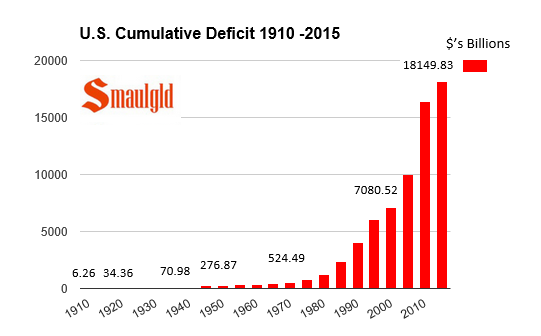
U.S. deficit spending is approaching $20 trillion.
In addition to the Federal government debt loads, U.S. state also have significant debt outstanding. According to Usgovernmentdebt.com the state government debt in the United States is expected to be $1.184 trillion at the end of 2016.
Where the Welfare/Warfare Money is Spent
See below for a list of wars and the new programs and Federal agencies created since the U.S. removed silver from its coinage and gold backing from the dollar.U.S. Mint Examines Ways to Further Debase its Coinage
In 2014, the U.S. Congress, not content to be producing coins from base metals instead of silver, commissioned the U.S. Mint to study even cheaper alternatives to copper and nickel to mint, nickels, dimes and quarters.
Next up “The Decline and Fall Of the First Gold Empire” Subscribe below to get this post as soon as it is published.
Also see “The Decline and Fall of the World’s First Silver Empire”
Treasury Department confirms President Obama has fully turned around the U.S. economy

President Obama’s seven year quest to salvage the U.S. economy from the damage done to it by his predecessor George W. Bush has been an overwhelming success, according to the United States Treasury Department. Obama took over as President at a time when the economy, stock market and banking system had collapsed and were on the verge of throwing the nation into a depression due to Bush’s failed policies. But Obama’s initiatives prevented that from happening, and now the Treasury says he’s fully turned the economy around.
The United States and the European Union are expected to formally lift sanctions against Iran this weekend.
The world powers
and Iran last summer struck a landmark nuclear deal, in which Tehran
agreed to curb its nuclear program in exchange for the lifting
of international sanctions.
Now, Iran is poised to finally feel the effects of the accord, including an end to the EU embargo of Iranian oil imports and reestablished ties between Iranian banks and the European financial system.
According to Abbas Araqchi, Iran’s deputy foreign minister and senior nuclear negotiator, the International Atomic Energy Agency (IAEA) on Friday will verify that Tehran has fulfilled all its obligations under the agreement, including unplugging thousands of centrifuges and significantly reducing its stockpile of low-enriched uranium, the Guardian reported.
That report by the IAEA will trigger the announcement of an “implementation day,” when the lifting of US and EU sanctions will come into effect and all previous nuclear-related UN resolutions will be terminated. Tehran expects this to happen Saturday or Sunday.
Non-nuclear related US sanctions on Iran, such as those relating to terrorism, will remain in place.
Now, Iran is poised to finally feel the effects of the accord, including an end to the EU embargo of Iranian oil imports and reestablished ties between Iranian banks and the European financial system.
According to Abbas Araqchi, Iran’s deputy foreign minister and senior nuclear negotiator, the International Atomic Energy Agency (IAEA) on Friday will verify that Tehran has fulfilled all its obligations under the agreement, including unplugging thousands of centrifuges and significantly reducing its stockpile of low-enriched uranium, the Guardian reported.
That report by the IAEA will trigger the announcement of an “implementation day,” when the lifting of US and EU sanctions will come into effect and all previous nuclear-related UN resolutions will be terminated. Tehran expects this to happen Saturday or Sunday.
“The IAEA inspectors are supposed to issue
their final report on Iran’s honoring of its commitments on Friday,”
Araghchi was quoted by local news agencies as saying.
US Secretary of State John Kerry, speaking in Washington, said the nuclear deal is likely to be implemented in the coming days.
“As agreed, Iran is now well on its way
to dismantling critical elements of its nuclear facilities,” Kerry said.
“Just yesterday, the foreign minister reported to me that the calandria
of the plutonium nuclear reactor is now out and in the next hours it
will be filled with concrete and destroyed.”
“We will ensure that the spectre of a nuclear armed Iran is removed
as a threat to Middle East security and global peace, and it is not
insignificant that Iran has agreed to submit to this, agreed
to undertake these steps, agreed that it will not build this weapon,” he
added.Non-nuclear related US sanctions on Iran, such as those relating to terrorism, will remain in place.
Subscribe to:
Posts (Atom)