Thursday, December 31, 2015

FINANCIAL REPRESSION POLICIES MIRROR AN ACCELERATING“CRISIS OF TRUST

Since the Dot.com Bubble burst the US has accelerated its Macro-Prudential Policies of Financial Repression. PEW Research just released a study which tracks the deterioration in the confidence citizens have in their government.
We have a Crisis of Trust in America and as the charts below show, it has only accelerated with government policies of Financial Repression.
Just 19% of Americans say they “can trust the federal government always or most of the time”. 
  • That’s among the lowest levels in over 50 years.
  • The long-term erosion of public trust is mirrored by a steep decline in the belief that the government is run for the benefit of all Americans.


Less than a year ahead of the presidential election, there is widespread discontent with the federal government. A new Pew Research Center report finds deep distrust in government and considerable cynicism about politics and elected officials alike. But despite these negative assessments, majorities believe government does a good job on many issues and want it to have a major role on a wide range of policy areas.
Here are five of PEW’s key takeaways from the report:
1 The public’s trust in government remains at historic lows. Today, just 19% say they trust the federal government to do what is right always or most of the time, which is little changed from recent years. Fewer than three-in-ten Americans have expressed trust in government in every major national poll conducted since July 2007 – the longest period of low trust in government seen in more than 50 years.
While Democrats are more likely than Republicans to say they trust the government, trust remains low across partisan lines: Just 11% of Republicans and Republican-leaning independents say they trust the government, compared with 26% of Democrats and Democratic leaners. (For more on the public’s trust in government, see this interactive.)
2 As in the past, the public’s feelings about government run more toward frustration than anger. Currently, 57% are frustrated with the federal government; 22% are angry, while 18% are basically content.
Far more Republicans (32%) than Democrats (12%) say they are angry with the government. But higher shares in both parties expressed anger toward government in October 2013, during the partial government shutdown.
While anger at government has been higher among Republicans than Democrats during Barack Obama’s administration, the situation was reversed during George W. Bush’s presidency: In October 2006, 29% of Democrats said they were angry with government, compared with just 9% of Republicans.
3 Despite their widespread cynicism, most Americans give government good ratings in a number of areas. Half or more say the federal government is doing a “very good” or “somewhat good” job in 10 of the 13 governmental functions tested in the survey.
However, the federal government receives particularly low marks in two key areas: Managing the nation’s immigration system and helping people get out of poverty. Nearly seven-in-ten (68%) say the government does a very or somewhat bad job in managing the immigration system; just 28% say it is doing a good job. Ratings are nearly as negative when it comes to the federal government’s efforts to help people get out of poverty: 61% say the government is doing a bad job in this area, while 36% give it a positive assessment.
Majorities say the government should have a major role in dealing with 12 of 13 issues included in the survey.
4 Americans are harshly critical of elected officials. The public views politicians as more selfish and considerably less honest than ordinary Americans. Just 29% say that “honest” describes elected officials very or fairly well, a much smaller share than those who describe the average American as honest (69%).
Most people do say the term “intelligent” describes elected officials very or fairly well (67%). However, just as many view the typical American as intelligent. And when asked if elected officials or ordinary Americans could do a better job of solving the nation’s problems, 55% say ordinary Americans could do better.
While negative opinions of politicians are not new, the perception that elected officials don’t care about what people think is now held more widely than it has been in recent years. Today, 74% say this, compared with a narrower 55% majority who said the same in 2000.
5 Congress is not the only institution the public sees as having a negative influence on how things are going in the country today. Majorities see the national news media (65%) and the entertainment industry (56%) as having a negative impact on the country. By contrast, overwhelming majorities see small businesses (82%) and technology companies (71%) as having a positive impact.
There are substantial partisan and ideological divides in the views of several of these institutions. For example, nearly seven-in-ten liberal Democrats (69%) say colleges and universities have a positive impact on the country, compared with just less than half (48%) of conservative Republicans. Conversely, fully three-quarters of conservative Republicans say that churches and religious organizations have a positive impact on the country, while just 41% of liberal Democrats agree.
The Thompson-Reuters TRust Index of confidence in the top 50 Global Financial Institutions shows an also very worrying trend deterioration!

CRISIS OF TRUST
As we laid out in the 2013 Thesis Paper “Statism“, a Crisis of Trust has a profound impact on the economy and if left unresolved politically for a protracted period will lead to economic stagnation.
In last year’s 2015 Thesis Paper: “Fiduciary Failure” we spelled out the crippling level it has now reached in the US. It has only gotten worse and we detail in the 2016 Thesis Paper: Crisis of Trust in The Era of Uncertainty how it is now infecting the global economy.
Sign-up now for your 2016 Thesis Paper: Crisis of Trust in The Era of Uncertainty

Honey, I Shrunk the Middle Class: Perhaps 1/3 of Households Qualify

If it takes more than $126,000 to fund a qualitatively defined middle-class lifestyle, what sense does it even make to call this “middle”?

The Pew Research Center’s recent report The American Middle Class Is Losing Ground: No longer the majority and falling behind financially made a media splash, as it reported that less than 50% of adults are members of the Great American Middle Class.


My analysis suggests that by more qualitative measures, no more than a third of U.S. households qualify as middle class: claiming 49% of the nation’s households are still middle class is a gross exaggeration.

My analysis starts with the minimum fundamental lifestyle and wealth requirements of middle-class membership: In What Does It Take To Be Middle Class?, I listed these requirements:

1. Meaningful healthcare insurance ($5,000 deductible healthcare plans don’t qualify; they are simulacrum/phantom coverage).
2. Significant equity (25%+) in a home or other real estate.
3. Income/expenses that enable the household to save at least 6% of its income.
4. Significant retirement funds: 401Ks, IRAs, etc.
5. The ability to service all expenses over the medium-term if one of the primary household wage-earners lose their job.
6. Reliable vehicles for each wage-earner.
7. The household does not depend on government assistance to maintain the family lifestyle.
8. A percentage of hard assets beyond the family home that can be transferred to the next generation.
9. Surplus income to invest in children (extracurricular activities, lessons, etc.).
10. Leisure time devoted to the maintenance of physical/spiritual/mental fitness.
In other words, middle class cannot be meaningfully defined by income alone.The middle class is more than owning a home (especially if the equity is modest or dependent on the asset bubble du jour): the most fundamental qualities of the middle class are not measures of income or bling, though obviously income is necessary to provide them:

— real healthcare coverage
— wealth that can’t be destroyed by one bad break or one popped asset bubble

— the ability (and willingness) to invest in children

— the ability (and willingness) to transfer accumulated real wealth to the next generation.

Income is not an accurate proxy, as many high-income households are living paycheck to paycheck: regardless of their income, they don’t qualify as middle class by qualitative standards.

Read the Whole Article

THE HERD IS HEADING FOR A CLIFF: NOW IS THE TIME TO REGAIN YOUR SENSES AND STOP PLAYING IN THIS RIGGED WALL STREET GAME.

by James Quinn 

You would think investors (muppets) would be grateful for the extended topping process of the stock market, as it has given them the opportunity to exit before the inevitable crash. As CNBC and the rest of the mainstream media spin bullish stories to keep the few remaining mom and pop investors sedated and the millions of passive working Americans invested in their 401ks, the Wall Street rigging machine siphons off billions in ill-gotten gains, while absconding with fees for worthless advice.
Does the average schmuck know the S&P 500 stood at 2,063 on November 21, 2014 and currently sits at 2,056, thirteen months later? Based on the media narrative, we are still in the midst of a raging bull market. John Hussman provides the counterpoint to this narrative with unequivocal factual evidence based upon a hundred years of stock market data and valuations. Anyone investing in today’s market should expect ZERO returns over the next ten years and a 40% to 55% plunge in the near future. And as a cherry on top, a recession has arrived.
The summary of this outlook is straightforward. I view the equity market as being in the late-stage top formation of the third financial bubble in 15 years. Based on a century of evidence relating the most historically reliable valuation measures to actual subsequent market returns, neither a market plunge of 40-55% over the completion of the current cycle, nor the expectation of zero 10-12 year S&P 500 nominal total returns, nor the likelihood of substantially negative 10-12 year real returns should be viewed as worst-case scenarios – they are all actually run-of-the-mill expectations from current extremes. Based on the joint behavior of the most reliable leading economic measures (particularly new orders plus order backlogs, minus inventories), widening credit spreads, and clearly deteriorating market internals, our economic outlook has also moved to a guarded expectation of a U.S. recession.
The Federal Reserve has encouraged the rampant speculation over the last few years with their trillions in QE gift to Wall Street banks and ZIRP, which allowed the “brilliant” 30 year old Ivy League educated high frequency traders to take the free Fed money and front run their client’s trades and generate guaranteed profits. Of course, ZIRP also forced grandmas throughout the country to acquire a taste for cat food in order to survive. But Ben and Janet are “heroes”, I’m told. What a coincidence that shortly after the QE spigot was turned off on October 29, 2014, the market has gone nowhere. The speculative juices appear to be drying up.
Because speculation tends to be indiscriminate, the most reliable measure of a robust willingness to speculate is the uniformity of market action across a broad range of individual stocks and security types. An overvalued market populated with speculators who still have the bit in their teeth will tend to hold up or advance further despite valuation extremes. Because of the Federal Reserve’s relentless and intentional encouragement of speculation in the half-cycle since 2009, even measures of overvalued, overbought, overbullish extremes – which had historically been followed almost invariably by market collapses in prior market cycles – were followed instead by further market advances.
John Hussman, inconveniently for those of a bullish ilk, notes that market internals have deteriorated rapidly, with only a few beloved, overvalued, overhyped tech stocks holding up the market. Most stocks are already in a bear market. Corporate profits are falling. PE ratios are high. Consumer spending is anemic. The jobs growth narrative is false. Real household income is at 1989 levels. Based on history, current conditions have only been seen at major tops. I’m sure this time will be different and Cramer, along with all the highly paid Wall Street shills, will be right.
Now that market internals have clearly deteriorated following overvalued, overbought, overbullish extremes, with reliable valuation measures at obscene levels and emerging economic weakness, a century of history suggests that the stock market is vulnerable to the risk of severe losses. Investors should not assume that the “support” that keeps losses relatively shallow during a drawn-out topping process will persist. There’s some truth in the old saying “the bigger the top, the steeper the drop.” Only a few points in history have seen the S&P 500 within 3% of a record high, with both overvaluation and unfavorable market internals during at least 80% of the prior 26-week period. Aside from points in recent months, the other points were major tops in 2007, 2000, 1972, 1969, and 1961.
When you talk to your relatives, neighbors and coworkers they all act like they are buy and hold long term investors. They are either lying or oblivious. Someone who is 60 years old and has accumulated a significant 401k nest egg invested in stocks can not afford a 50% haircut in their retirement portfolio. Anyone with a significant amount in the stock market will have to have balls of steel to not panic as their life savings is cut in half – AGAIN. Three times in fifteen years is pretty hard to swallow. The debt markets (junk bonds) are a flashing red warning light. To not heed the warnings of the market would be foolish. Hussman couldn’t be any clearer, just as he was in 2000 and 2007.
I really do implore investors who could not comfortably ride out a market collapse similar to 2000-2002 or 2007-2009, or who rely on their assets to finance near-term spending plans, to shift their risk exposure down to a level that could tolerate that outcome. Understand that while valuations have been hostile for years, and while overvalued, overbought, overbullish conditions have repeatedly emerged in the recent half-cycle without effect, the hinge that supported continued gains was a persistent willingness to speculate, as conveyed by uniformly favorable market internals. That support has dropped away. Ignore that key distinction at enormous risk. The market behavior we’ve observed in recent quarters is fully consistent with an extended top formation. With credit spreads predictably widening in successively larger spikes, that formation appears increasingly vulnerable to a steep vertical break of prior support.
Robert Prechter perceptively notes that investors act in a herd like manner thinking that because the herd is still invested in the market and has not sensed danger yet, it must be safe. Investors are lazing around the waterhole like unsuspecting gazelles. This herd will be running for their lives in the near future, as danger is lurking.

Still, we doubt that most speculators think about the decision to accept market exposure in such a systematic way. On that point, Robert Prechter of EWI offered a brilliant perspective last week to describe the typical behavior of speculators. He observed, “In neither case – buying or selling – is there any thought about taking on risk, rationally or otherwise. In both cases, they are unconsciously acting to reduce risk, thanks to the emotionally satisfying impulse to herd. Herds act to gain sustenance or avoid danger. Gazelles may lope together toward the water hole or dash in a herd from predators. The goal, albeit unconscious, of both types of actions is to reduce risk. Likewise, in market advances speculators herd as if trying to gain sustenance; and in market declines they herd as if trying to avoid getting killed… Subjectively, i.e. in their own minds, speculators perceive greater risk as less risk and less risk as greater risk. That is why they buy in uptrends and sell in downtrends. In the former case, they behave as if the herd is leading them to sustenance, and in the latter case they behave as if the herd is leading them away from danger. Ironically, the truth is wholly the opposite.”
If you have an ounce of common sense, ability to think critically, and appreciation for risk, you should leave the herd now before the inevitable stampede. Staying with the herd as it heads for the cliff is not an effective strategy.
At present, we observe a herd at the peak of a valuation cliff, where an increasing proportion of the herd is backing away. It’s increasingly urgent to dig in one’s hooves to keep from dashing over the edge. We can do little for those who insist on remaining in full gallop, imagining that sustenance awaits them ahead.
After experiencing two Federal Reserve induced booms and busts in the last fifteen years, you would think people would learn. But the true lesson of history is that people never learn from the lesson of history.
How did the S&P 500 trace out a total return of zero between 2000 and the end of 2011? By first losing half its value, then more than doubling, then losing more than half its value, and then doubling again. Across history, extreme valuations have invariably been followed by similar behavior – wide cyclical swings, yet only modest overall returns over the following decade.
Anyone fully invested in the stock market at this point in time is delusional and mad. If they think they can sense danger before the rest of the herd and exit once the stampede starts, they are badly mistaken. Just as they were in 2000 and 2007. Now is the time to regain your senses and stop playing in this rigged Wall Street game.
After years of Fed-induced yield-seeking speculation that has driven equity valuations to the second most extreme point of overvaluation in history (and the single most extreme point on the basis of median valuations), investors have somehow convinced themselves that this time will be different; that this time the market will maintain at a permanently high plateau. That belief is nothing new – it’s the same delusion that investors have held at speculative peaks across history, refusing to accept the familiar signs of danger until the equally familiar losses were conclusively in hand.
“Men, it has been well said, think in herds; it will be seen that they go mad in herds, while they only recover their senses slowly, one by one.”
Charles Mackay, Extraordinary Popular Delusions and the Madness of Crowds
Read Hussman’s Weekly Letter

How Iceland Escaped From The One Bank

by Jeff Nielson
What have the governments of the corrupt Western bloc spent most of their time doing since the Crash of ’08? We can answer this question in three parts:
1)  Creating increasingly falsified “statistics” to fabricate the illusion that their economies were not all on the verge of an all-out economic collapse.
2)  Hacking-and-slashing every social program in sight, in order to generate the false-savings known as Austerity.
3)  Creating new funny-money and taking on new debt at an exponentially increasing rate, in order todelay collapse, since all that Austerity accomplished was to accelerate these death-spirals.
Making these points apparent to newer readers will require additional elaboration. The starting point is the Crash of ’08 itself. What caused these nations to go from being merely heavily indebted to hopelessly insolvent, overnight? That can be summed-up in a single euphemism of fraud and crime: “too big to fail”.
At the end of 2008; the West’s puppet governments succumbed to History’s ultimate act of blackmail, at the hands of History’s largest and most-rapacious crime syndicate: the One Bank. “Give us all your money, or we’ll blow up your entire financial system.” That is the real meaning of too-big-to-fail: institutionalized extortion, in perpetuity.
What was the real price-tag for this massive extortion operation? Forget the phony numbers published by our corrupt governments, and their mouthpieces in the Corporate media. The total quantum for theseextortion payments was in the $10’s of TRILLIONS. Obviously the Deadbeat Debtors of the West couldn’t raise more than a tiny fraction of that amount of blackmail-money up front. Thus most of this shake-down of (supposedly) sovereign governments came in the form of future tax-breaks and “loss guarantees”.
In the Shake-Down of ’08, our governments did not merely clean out every penny they could scrounge from our public Treasuries, and also borrowed every penny that they could. In addition, they mortgaged the future of our children and grandchildren, by pledging infinite corporate welfare for the One Bank.
Western governments had no money left to spend on their own people after committing $10’s of trillions in extortion payments to this banking crime syndicate, while also having to deal with rapidly rising interest payments (to the same crime syndicate) on all their new debts. So Western governments then pulled out their chain-saws, and attacked our social programs.
Infinite dollars in “interest payments” go to the crime syndicate; no pennies are left for the people. That is Austerity. However, so-called Austerity represents more than simply another act of economic treasonagainst Western populations, it is also the fatal, self-inflicted wound for these economies.
Austerity treason took economies which were already in a slow-motion descent toward collapse, and rapidly sped-up that suicide cycle. The evidence here is overwhelming, but can be summed-up most easily in one word: Greece.
Greece has had far greater and more-punitive amounts of Austerity treason heaped upon its victim population than any other regime in the Corrupt West. It was demanded by the economic sadists known as “the Troika”: the European Union, the European Central Bank, and the International Monetary Fund. The result? This nation was bankrupted twice within a span of five years.
Which nations are closest behind Greece in Europe’s Bankruptcy Derby? Spain and Portugal. These are the #2 and #3 nations, in terms of inflicting the greatest amounts of this suicidal Austerity on their own populations. Austerity kills. More Austerity kills faster.


Here people need to understand that it was always totally predictable that Austerity would fail. It was always totally predictable that Austerity would harm these economies more than help them. And this waspredicted (repeatedly) in previous commentaries.
How do you make any economy stronger? The key lies within one of the most fundamental principles of economics: the Marginal Propensity to Consume. This law of economics is universally accepted, because it is ½ simple arithmetic, and ½ common sense.
In elementary terms, the fastest/easiest way to make any economy stronger is to place a dollar into the hands of a member of the Poor or Middle Class. Why? Because these people will spend most of that dollar (the Middle Class), or all of that dollar (the Poor), immediately. This extra dollar of consumption then gets divided up into wages, payments to suppliers, tax revenues for the government, etc. Then additional portions of that dollar are spent and re-spent. This is known as “the multiplier effect”, and it explains why the Marginal Propensity to Consume is a universally accepted principle.
But what happens if we put a dollar into the hands of the Rich, rather than the Poor or Middle Class? By definition; the Rich person will hoard the vast majority of that dollar. As a matter of the simplest logic and arithmetic, no person can become “rich” unless/until they have spent years hoarding wealth, or they win a lottery.
Thus every time a Rich person receives a dollar, most of that dollar is hoarded and disappears from the economy. Only a few pennies of that dollar are ever circulated, and as a result the multiplier effect isvirtually nil. This is known by the economic euphemism: “trickle-down economics”. Put all the new dollars into the hands of the wealthy, and only a few pennies will ever “trickle down” to the economy.
“Trickle-down economics” has been the official policy of nearly all of the traitorous governments of the Corrupt West since the start of the new millennium, and, in the case of the U.S., it goes back at least a full generation. This policy of everything-for-the-Fat-Cats and nothing for the Little People is one of the primary reasons for the relentless decay in our standard of living, and the relentless collapse of our economies.
How do you then make these sick economies even sicker? Start taking extra dollars out of the hands of the Poor and Middle Class — Austerity. Every dollar of Austerity treason creates a Reverse Multiplier Effect: removing more and more dollars from the system, and thus starving the economy of the fuel which allows our consumer economies to survive: consumer spending.
Austerity causes the economy to get even sicker, leading to larger deficits, more borrowing, and thus even higher interest payments to the parasitic One Bank. Debt slavery. The response from these puppet governments to this vicious circle? Even more Austerity. If something fails, do much more of it.
However, one Western nation that was caught up in the original Crash of ’08 did not climb aboard this treadmill of economic suicide and blackmail: Iceland. As a result, alone among the nations of Europe, Iceland enjoys real robust economic growth. The standard of living of its population is once again rising, rather than falling – as it is throughout the rest of the Corrupt West.
How? How did one, small island nation succeed while every other Western government failed, miserably and completely? As with the economic suicide now practiced throughout the Corrupt West, Iceland’s success also traces back to the same, four words: “too big to fail.”
What happened when Iceland’s Big Banks (more tentacles of the One Bank) arrogantly demanded that the government rubber-stamp the principle-of-crime of “too big to fail” – sacrificing the System in order to save the Big Banks? Iceland’s government responded that it had a different, radical idea: it would sacrifice the Big Banks, and save the System.
Iceland’s Big Banks folded. As with all blackmailers, the One Bank responded to Iceland’s refusal to be blackmailed by immediately lashing-out, in revenge. Among other things, it attacked Iceland’s currency (i.e. manipulated it lower), yet another criminal conspiracy for which the Big Banks have now been convicted.
However, Iceland’s government stood firm, and did not cave in to the attempted extortion by this crime syndicate. It weathered the financial/economic reprisals. It proved that “too big to fail” was always nothing more than a lie and a myth, created by the banking crime syndicate. No entity within any system could ever be more important than the system itself. This was always elementary logic. Iceland has validated that logic.
Iceland refused to be blackmailed. Iceland refused to take on the extra debt (and debt slavery) that came with the blackmail. Iceland refused to touch its social programs. Iceland has the strongest economy in the Western world.
Game, set, and match.

Bank of America is trying to load up on patents for the technology behind bitcoin

by Thomas Dishaw
Banksters gangsters who haven’t did anything innovative since the ATM are loading up on patents hoping to capitalize on the future cryptocurrency trend according  to this QZ report.

Bankers may not think bitcoin will ever go fully mainstream, but they clearly believe there is value in the technology that powers such cryptocurrencies, known as blockchain.
On Dec. 17, the US Patent office published 10 blockchain-related patents filed by Bank of America in July 2014. The patents haven’t been granted yet, but the filings demonstrate the bank’s interest in using blockchain technology to revamp its backend operations, which, like other financial institutions, are largely paper-based.
The wide-ranging patents cover everything from a “cryptocurrency transaction payment system” which would let users make transactions using cryptocurrency, to risk detection, storing cryptocurrencies offline, and using the blockchain to measure fraudulent activity. (The blockchain is essentially a publicly available ledger that’s distributed to everyone within a network.)
Bank of America had no comment.
Financial institutions are quickly ramping up their research efforts around blockchain technology. Last week, IBM, JPMorgan, the London Stock Exchange, and Wells Fargo announced the Open Ledger Project, a new consortium that will focus on allowing businesses to easily build their own blockchain technology. Bank of America is a part of a consortium led by blockchain startup R3 that’s developing blockchain technology to be used in financial markets. The Aite Group estimates that banks have invested $75 million this year on blockchain tech, a figure the research firm forecasts will grow to $400 million in 2019.
Other financial institutions have been building up their blockchain-related intellectual property. Goldman Sachs filed a patent for its own cryptocurrency, SETLCoin, that would allow traders to execute and clear trades in real time.
It’s hard to speculate what Bank of America will do with these patents, if anything. But Coindesk notes these patents could be hinting at BofA working on a complete network based on blockchain.

The real-life genius from ‘The Big Short’ thinks another financial crisis is looming…

From Jessica Pressler at New York Magazine:
If The Big Short, Adam McKay’s adaptation of Michael Lewis’s book about the 2008 financial crisis, got you all worked up over the holidays, you’re probably wondering what Michael Burry, the economic soothsayer portrayed by Christian Bale who’s always just a few steps ahead of everyone else, is up to these days. In an e-mail, which readers of the book will recognize as his preferred method of communication, the real-life head of Scion Asset Management answered some of our panicked questions about the state of the financial system, his ominous-sounding water trade, and what, if anything, we can feel hopeful about.
The movie portrays all of you as kind of swashbuckling heroes in some ways, but McKay suggested to me that you were very troubled by what happened. Is that the case?
I felt I was watching a plane crash. I actually had that dream again and again. I knew what was happening, but there was nothing I, or anyone else, could do to stop it. The last day of 2007, I couldn’t come home. I was in the office till late at night, I couldn’t calm down. I wrote my wife an email and just said, “I can’t come home; it’s just too upsetting what’s happening, and I didn’t want to come home to my kids like this.” As for punishment of those responsible, borrowers were punished for their overindulgences — they lost homes and lives. Let’s not forget that. But the executives at the lenders simply got rich.
Were you surprised no one went to jail?

I am shocked that executives at some of the worst lenders were not punished for what they did. But this is the nature of these things. The ones running the machine did not get punished after the dot-com bubble either — all those VCs and dot-com executives still live in their mansions lining the 280 corridor on the San Francisco peninsula. The little guy will pay for it — the small investor, the borrower. Which is why the little guy needs to be warned to be more diligent and to be more suspicious of society’s sanctioned suits offering free money. It will always be seductive, but that’s the devil that wants your soul.
When I spoke to some of the other real-life characters fromThe Big Short, I was surprised to hear that they thought that financial reform was pretty effective and that the system was much safer. Michael Lewis disagreed. In your opinion, did the crash result in any positive changes?
Unfortunately, not many that I can see. The biggest hope I had was that we would enter a new era of personal responsibility. Instead, we doubled down on blaming others, and this is long-term tragic. Too, the crisis, incredibly, made the biggest banks bigger. And it made the Federal Reserve, an unelected body, even more powerful and therefore more relevant. The major reform legislation, Dodd-Frank, was named after two guys bought and sold by special interests, and one of them should be shouldering a good amount of blame for the crisis. Banks were forced, by the government, to save some of the worst lenders in the housing bubble, then the government turned around and pilloried the banks for the crimes of the companies they were forced to acquire. The zero interest-rate policy broke the social contract for generations of hardworking Americans who saved for retirement, only to find their savings are not nearly enough. And the interest the Federal Reserve pays on the excess reserves of lending institutions broke the money multiplier and handcuffed lending to small and midsized enterprises, where the majority of job creation and upward mobility in wages occurs. Government policies and regulations in the postcrisis era have aided the hollowing-out of middle America far more than anything the private sector has done. These changes even expanded the wealth gap by making asset owners richer at the expense of renters. Maybe there are some positive changes in there, but it seems I fail to see beyond the absurdity.
Where do we stand now, economically?
Well, we are right back at it: trying to stimulate growth through easy money. It hasn’t worked, but it’s the only tool the Fed has got. Meanwhile, the Fed’s policies widen the wealth gap, which feeds political extremism, forcing gridlock in Washington. It seems the world is headed toward negative real interest rates on a global scale. This is toxic. Interest rates are used to price risk, and so in the current environment, the risk-pricing mechanism is broken. That is not healthy for an economy. We are building up terrific stresses in the system, and any fault lines there will certainly harm the outlook.
What makes you most nervous about the future?
Debt. The idea that growth will remedy our debts is so addictive for politicians, but the citizens end up paying the price. The public sector has really stepped up as a consumer of debt. The Federal Reserve’s balance sheet is leveraged 77:1. Like I said, the absurdity, it just befuddles me.
Read the full interview (including Burry’s top idea today) right here…

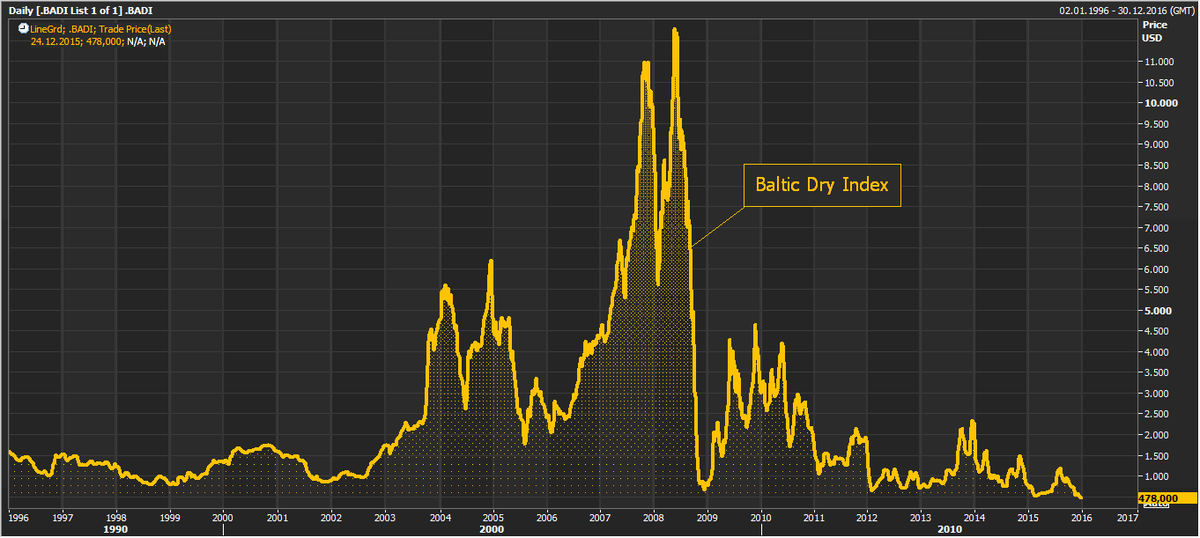
Gloomy omen for 2016: Baltic Dry, a measure of shipping rates for everything from coal to ore, fell to historic low.

Gloomy omen for 2016: Baltic Dry, a measure of shipping rates for everything from coal to ore, fell to historic low.